Software Project Management


    Yasmeen Gul
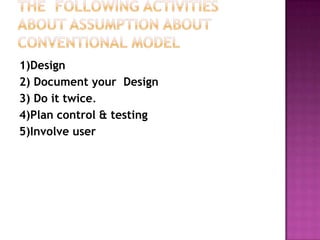
1)Design
2) Document your Design
3) Do it twice.
4)Plan control & testing
5)Involve user
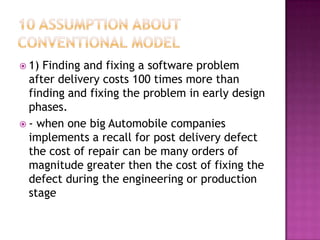
 1) Finding and fixing a software problem
  after delivery costs 100 times more than
  finding and fixing the problem in early design
  phases.
 - when one big Automobile companies
  implements a recall for post delivery defect
  the cost of repair can be many orders of
  magnitude greater then the cost of fixing the
  defect during the engineering or production
  stage
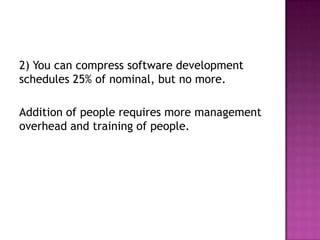
2) You can compress software development
schedules 25% of nominal, but no more.

Addition of people requires more management
overhead and training of people.
 3)For
      every $1 you spend on development,
 you will spend $2 on maintenance.
    Successful products will have much higher ratios of
     “maintenance to development”…..

    Successful S/W product in commercial product domain such as
     orical,microsoft application ,Unix operating system are very
     long lived &can result in much higher ratios of maintenance
     cost to development cost .
 4)Software development and maintenance
 costs are primarily a function of the number
 of source lines of code.
     Generally true. Component-based
      development may dilute this as might reuse -
      but not in common use in the past.
 5)Variations among people account for the
 biggest differences in software productivity.

   Always try to hire good people. But we cannot always to that.
   Balance is critical. Don‟t want all team members trying to
   self-actualize and become heroes. Build the „team concept.‟
   While there is no “I” in „team”, there is an implicit “we.”
 6)The  overall ratio of software to hardware
  costs is still growing. In 1955 it was 15:85; in
  1985, 85:15.
 The fact that S/W represent 85% of the cost
  of most system is not so much a statement
  about S/W productivity as it is about the
  level of functionality being allocated to S/W
  in system solution .
 7) Only about 15% of software development
  effort is devoted to programming.
 Many activities beside the coding are
  necessary for the s/w project success like
  testing ,planning ,project control ,change
  management are equally important
  consideration that consume roughly 85% of
  resource
 8)S/W system    & products cost 3 time as much per
    SLOC as individual S/W programs .S/W- system
    products (system of systems ) cost 9 time as much

   A real fact: the more software you build, the more
    expensive it is per source line
 9)   Walkthroughs catch 60% of the errors.

   Usually good for catching stylistic things; sometimes errors, but usually
   do not represent the deep analysis necessary to catch significant
   shortcomings.

   Major problems, such as performance…are not caught.
 10)80% of the contribution comes from 20%
 of contributors.

software project management Assumption about conventional model

  • 1.
  • 2.
    1)Design 2) Document yourDesign 3) Do it twice. 4)Plan control & testing 5)Involve user
  • 3.
     1) Findingand fixing a software problem after delivery costs 100 times more than finding and fixing the problem in early design phases.  - when one big Automobile companies implements a recall for post delivery defect the cost of repair can be many orders of magnitude greater then the cost of fixing the defect during the engineering or production stage
  • 4.
    2) You cancompress software development schedules 25% of nominal, but no more. Addition of people requires more management overhead and training of people.
  • 5.
     3)For every $1 you spend on development, you will spend $2 on maintenance.  Successful products will have much higher ratios of “maintenance to development”…..  Successful S/W product in commercial product domain such as orical,microsoft application ,Unix operating system are very long lived &can result in much higher ratios of maintenance cost to development cost .
  • 6.
     4)Software developmentand maintenance costs are primarily a function of the number of source lines of code.  Generally true. Component-based development may dilute this as might reuse - but not in common use in the past.
  • 7.
     5)Variations amongpeople account for the biggest differences in software productivity. Always try to hire good people. But we cannot always to that. Balance is critical. Don‟t want all team members trying to self-actualize and become heroes. Build the „team concept.‟ While there is no “I” in „team”, there is an implicit “we.”
  • 8.
     6)The overall ratio of software to hardware costs is still growing. In 1955 it was 15:85; in 1985, 85:15.  The fact that S/W represent 85% of the cost of most system is not so much a statement about S/W productivity as it is about the level of functionality being allocated to S/W in system solution .
  • 9.
     7) Onlyabout 15% of software development effort is devoted to programming.  Many activities beside the coding are necessary for the s/w project success like testing ,planning ,project control ,change management are equally important consideration that consume roughly 85% of resource
  • 10.
     8)S/W system & products cost 3 time as much per SLOC as individual S/W programs .S/W- system products (system of systems ) cost 9 time as much  A real fact: the more software you build, the more expensive it is per source line
  • 11.
     9) Walkthroughs catch 60% of the errors. Usually good for catching stylistic things; sometimes errors, but usually do not represent the deep analysis necessary to catch significant shortcomings. Major problems, such as performance…are not caught.
  • 12.
     10)80% ofthe contribution comes from 20% of contributors.