The Waterfall model
Thewaterfall model is also called as
linear sequential model or classic life
cycle model.
This section examines and critiques the
water fall theory, then looks at how most
of the industry has practices the
conventional software process.
3.
In Theory:
Thereare two essential steps common to the
development of computer programs: analysis and
coding.
In order to manage and control software development
including system requirements definition, software
requirements definition, program design, and testing.
These steps supplement the analysis and coding steps.
The basic frame is risky and invites failures.
4.
The followingare 5 improvements to the basic water
fall process to eliminate the development risks.
1) Program design comes first:
Insert a preliminary program design phase
between the software requirements
generation phase and the analysis phase.
The insufficient resources and the design
limitations are then identified in the early
stages
5.
Begin thedesign process with program designers, not
analysts or programmers.
Allocate processing functions, design the database,
allocate execution time, define interfaces and
processing modes with the operating system, describe
input and output processing, and define preliminary
operating procedures.
Write an overview document that is understandable,
informative, and correct.
6.
2)Document the design
Weknow that document design is required a lot for
software programs
Each designer must communicate with interfacing
designers, managers, and possibly customers.
During early phases, the documentation is the
design.
The real value of documentation is to support later
changes by a separate test team, a separate
maintenance team, and operations personnel who
are not software literate.
7.
3) Do ittwice if possible:
The software delivered to the customer for
operational purpose is actually the second version
after considering critical design and operational
issues.
In the first version, the team must have a special
broad competence where they can quickly sense
trouble spots in the design, model them, model
alternatives.
8.
4)Plan, control andmonitor testing
The combination of manpower, computer
time and management is called the test
phase.
This phase has greater risk in terms of cost
and schedule
9.
The following arethe important things in test phase:
1. Employ a team of test specialists who were not
responsible for the original design;
2. Employ visual inspections to spot the obvious
errors
3. Test every logic path
4. Employ the final checkout on the target computer.
10.
5)Involve the customer:
It is important to involve the customer in a formal way
so that he has committed himself at earlier points
before final delivery.
These include a "preliminary software review"
following the preliminary program design step, a
sequence of "critical software design reviews" during
program design, and a "final software acceptance
review“ after testing is performed.
11.
In practice
Somesoftware projects still follow the conventional
software management process
The characteristics of conventional model are:
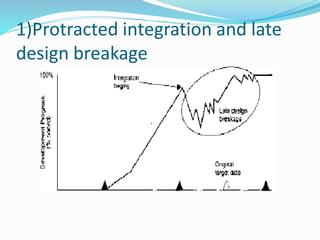
1. Protracted integration and late design breakage
2. Late risk resolution
3.Requirements-driven functional decomposition
4.Adversarial stakeholder relationships
5.Focus on documents and review meetings
Early successvia paper designs and thorough briefings.
Commitment to code late in the life cycle.
Heavy budget and schedule pressure to get the system
working.
Late response of non optimal fixes, with no time for
redesign.
A very delicate, unmaintainable product delivered late.
14.
In conventionalapproach the use of immature
languages and technologies is difficult to understand
the software project design and to change it in future.
In the conventional model, the entire system was
designed on paper, then implemented all at once, then
integrated.
Here we perform system testing at the end of the
process to check the fundamental architecture is good
or not.
15.
2)Late Risk Resolution
Aserious issue associated with the
waterfall lifecycle was the lack of early
risk resolution.
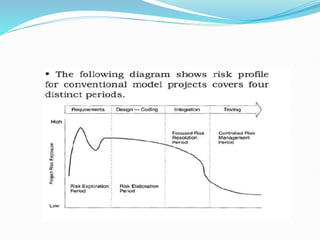
17.
Early inthe life cycle, as the requirements were being
specified, the actual risk exposure was highly
unpredictable.
After a design concept available even on paper, risk
exposure stabilized.
In the next step, after the system was coded some of
the individual component risks was resolved.
When the integration begins the real system risks are
touchable.
18.
3.Requirements-driven functional
decomposition
Thesoftware development process has been
requirements driven.
We should present precise requirements definition
and then implement exactly those requirements.
We should treat all the requirements are equally
important.
Requirement specification is an important and difficut
job in the development process.
19.
4.Adversarial stake holder
Relationship
The contractor prepared a draft contract-deliverable
document and delivered it to the customer for
approval.
The customer was expected to provide comments
The contractor incorporated these comments and
submitted a final version for approval.
20.
5.Focus on documentsand Review
meetings
The conventional software development process
focused on producing various documents that
attempted to describe the software product.
Here formal meetings were conducted to exchange
specific documents.
The developers produce tons of papers to describe the
project progress to the customers rather than to reduce
risk and produce quality software.
21.
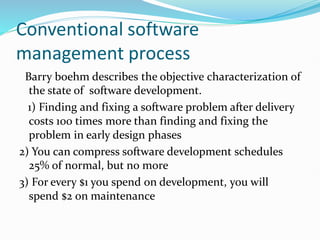
Conventional software
management process
Barryboehm describes the objective characterization of
the state of software development.
1) Finding and fixing a software problem after delivery
costs 100 times more than finding and fixing the
problem in early design phases
2) You can compress software development schedules
25% of normal, but no more
3) For every $1 you spend on development, you will
spend $2 on maintenance
22.
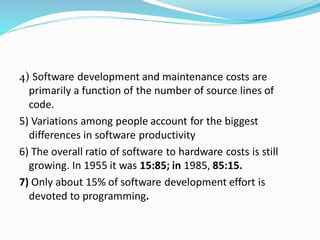
4) Software developmentand maintenance costs are
primarily a function of the number of source lines of
code.
5) Variations among people account for the biggest
differences in software productivity
6) The overall ratio of software to hardware costs is still
growing. In 1955 it was 15:85; in 1985, 85:15.
7) Only about 15% of software development effort is
devoted to programming.
23.
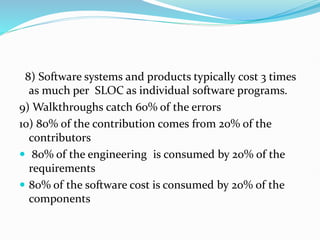
8) Software systemsand products typically cost 3 times
as much per SLOC as individual software programs.
9) Walkthroughs catch 60% of the errors
10) 80% of the contribution comes from 20% of the
contributors
80% of the engineering is consumed by 20% of the
requirements
80% of the software cost is consumed by 20% of the
components
24.
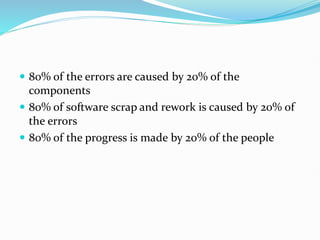
80% ofthe errors are caused by 20% of the
components
80% of software scrap and rework is caused by 20% of
the errors
80% of the progress is made by 20% of the people
25.
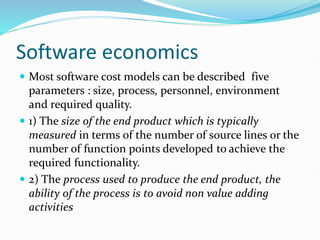
Software economics
Mostsoftware cost models can be described five
parameters : size, process, personnel, environment
and required quality.
1) The size of the end product which is typically
measured in terms of the number of source lines or the
number of function points developed to achieve the
required functionality.
2) The process used to produce the end product, the
ability of the process is to avoid non value adding
activities
26.
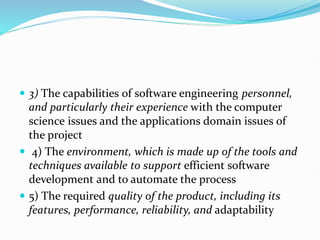
3) Thecapabilities of software engineering personnel,
and particularly their experience with the computer
science issues and the applications domain issues of
the project
4) The environment, which is made up of the tools and
techniques available to support efficient software
development and to automate the process
5) The required quality of the product, including its
features, performance, reliability, and adaptability
27.
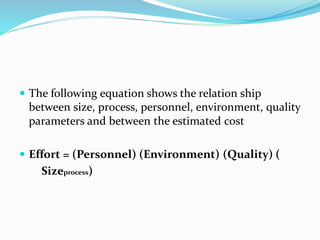
The followingequation shows the relation ship
between size, process, personnel, environment, quality
parameters and between the estimated cost
Effort = (Personnel) (Environment) (Quality) (
Sizeprocess)
28.
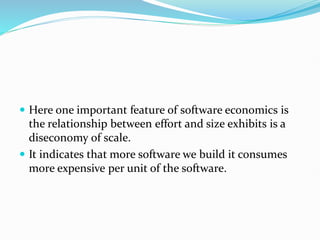
Here oneimportant feature of software economics is
the relationship between effort and size exhibits is a
diseconomy of scale.
It indicates that more software we build it consumes
more expensive per unit of the software.
29.
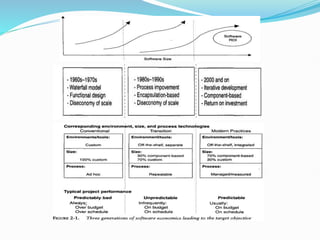
So theper line cost of smaller applications is less than
for the larger applications.
The following diagram shows 3 generations software
economics in the form of basic technology
advancement in tools, components and processes.
31.
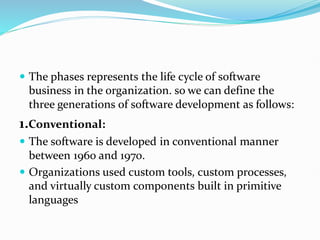
The phasesrepresents the life cycle of software
business in the organization. so we can define the
three generations of software development as follows:
1.Conventional:
The software is developed in conventional manner
between 1960 and 1970.
Organizations used custom tools, custom processes,
and virtually custom components built in primitive
languages
32.
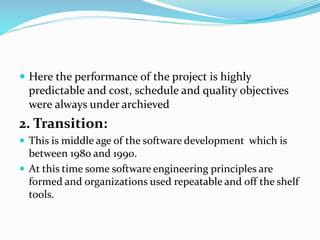
Here theperformance of the project is highly
predictable and cost, schedule and quality objectives
were always under archieved
2. Transition:
This is middle age of the software development which is
between 1980 and 1990.
At this time some software engineering principles are
formed and organizations used repeatable and off the shelf
tools.
33.
During thisphase custom components are built in
higher level languages and Some of the components
were available commercially such as operating system,
database management system, networking, and
graphical user interface.
34.
3.Modern practices :
This phase of software development process started in
year 2000 and later.
In this phase software development is treated as
production.
Here we use integrated automation environments, off
the shelf components.
35.
Pragmatic software costestimation
One critical problem in software cost estimation is a
lack of well-documented case studies of projects that
used an iterative development approach.
Software industry has inconsistently defined metrics
or atomic units of measure the data.
It is hard enough to collect a homogeneous set of
project data within one organization with different
processes, languages, domains, and so on.
36.
There havebeen many debates among developers and
vendors of software cost estimation models and tools.
1. Which cost estimation model to use?
2. Whether to measure software size in source lines of
code or function points.
3. What constitutes a good estimate?
37.
There areseveral popular cost estimation models
COCOMO is also one of the most open and well
documented cost estimation models.
SLOC worked well in applications that were
predominantly custom built & SLOC measurement
was easy to automate.
Most real-world use of cost models is bottom-up
rather than top-down.
38.
A good estimatehas the following attributes:
It is conceived and supported by the project manager,
architecture team, development team, and test team
accountable for performing the work
It is accepted by all the stake holders.