THE DELTA OF AN
ARITHMETIC ASIAN OPTION
VIA THE PATHWISE METHOD
Anna Borisova
University of Bocconi
1/12/2014
Assignment
1. Compute the Monte Carlo simulation for the
price of an Asian option on a lognormal
asset (with descrete monitoring at dates
t1, t2, … , tM);
2. Provide the pathwise estimate of the Delta of
these options.
Structure
❏ Mathematical model;
❏ The code features;
❏ Output.
The price of an Asian option by MCS
An Asian option (call) has discounted payoff:
Y = e-rT
[S - K]+
S =
1
m
S(ti )
i=1
m
å For fixed dates 0<t1<…<tm<T
Since for Monte Carlo simulation we describe the risk-neutral dynamics of the stock price, we
need to use the stochastic differential equation for modeling the price movement of the
underlying asset
S(T) = S(0)exp([r -
1
2
s 2
]T +sW(T))
Where W(T) is the random variable,
normally distributed with mean 0 and
variance T.
S(T) = S(0)exp([r -
1
2
s 2
]T +sW(T))
Monte Carlo simulation of the
lognormal asset price movement
Model:
S = 100, r = 0.045, σ=15%,
trials = 100000
For fixed dates 0<t1<…<tm<T
Constructing the Brownian motion
The properties of Brownian motion:
• W(0) = 0;
• The increments {W(t1)-W(t0), W(t2)-W(t1), … , W(tk)-W(tk-1)} are independent;
• W(t) – W(s) is normally distributed N(0, t-s) for any 0 ≤ s < t ≤ T.
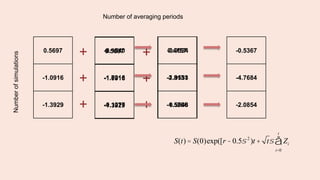
S(t) = S(0)exp([r -0.5s 2
)t + ts Zi
i=0
t
å
0.5697
-1.0916
-1.3929
-0.1540
-1.7215
-0.1277
-0.9524
-1.9553
-0.5648
Numberofsimulations Number of averaging periods
+
+
+
+
+
+
-0.5367
-4.7684
-2.0854
0.4157
-2.8131
-1.5206
0.5697
-1.0916
-1.3929
S(t) = S(0)exp([r -0.5s 2
)t + ts Zi
i=0
t
å
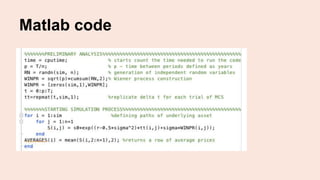
Matlab code
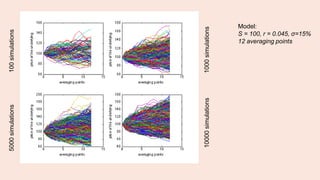
Model:
S = 100, r = 0.045, σ=15%
12 averaging points
100simulations5000simulations
1000simulations10000simulations
Option value estimation and its
confidence level
The sample standard deviation
sC =
1
n-1
(Yi - ˆYn )2
i=1
n
å
1-δ quantile of the standard normal distribution zdConfidence interval:
ˆYn ± zd/2
sC
n
ˆYn =
1
n
Yi
1
n
å
E[ ˆYn ]= Y
ˆYn -Y
sC / n
Þ N(0,1)
The estimation of the option value is unbiased
As number of replications increases, the standardized estimator converges in
distribution to the standard normal
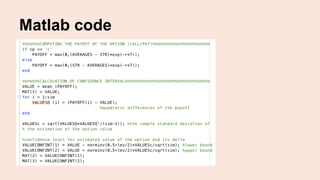
Matlab code
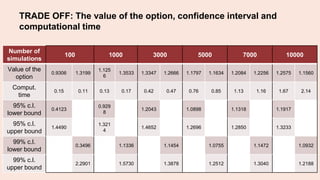
TRADE OFF: The value of the option, confidence interval and
computational time
Number of
simulations
100 1000 3000 5000 7000 10000
Value of the
option
0.9306 1.3199
1.125
6
1.3533 1.3347 1.2666 1.1797 1.1634 1.2084 1.2256 1.2575 1.1560
Comput.
time
0.15 0.11 0.13 0.17 0.42 0.47 0.76 0.85 1.13 1.16 1.67 2.14
95% c.l.
lower bound
0.4123
0.929
8
1.2043 1.0898 1.1318 1.1917
95% c.l.
upper bound
1.4490
1.321
4
1.4652 1.2696 1.2850 1.3233
99% c.l.
lower bound
0.3496 1.1336 1.1454 1.0755 1.1472 1.0932
99% c.l.
upper bound
2.2901 1.5730 1.3878 1.2512 1.3040 1.2188
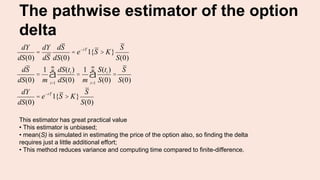
The pathwise estimator of the option
delta
This estimator has great practical value
• This estimator is unbiased;
• mean(S) is simulated in estimating the price of the option also, so finding the delta
requires just a little additional effort;
• This method reduces variance and computing time compared to finite-difference.
dY
dS(0)
=
dY
dS
dS
dS(0)
= e-rT
1{S > K}
S
S(0)
dS
dS(0)
=
1
m
dS(ti )
dS(0)
=
1
m
S(ti )
S(0)
=
i=1
m
å
i=1
m
å
S
S(0)
dY
dS(0)
= e-rT
1{S > K}
S
S(0)
Matlab code
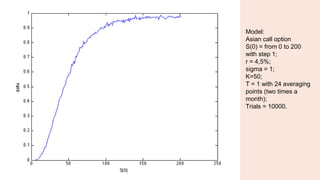
Model:
Asian call option
S(0) = from 0 to 200
with step 1;
r = 4,5%;
sigma = 1;
K=50;
T = 1 with 24 averaging
points (two times a
month);
Trials = 10000.
Matlab code
References:
• Glasserman “Monte Carlo Methods in Financial
Engineering”
• Mark Broadie, Paul Glasserman “Estimating Security
Price Derivatives Using Simulations”
• John C. Hull “Options, futures and other derivatives”
• Huu Tue Huynh, Van Son Lai, Issouf Sourmare
“Stochastic Simulation and Applications in Finance with
MATLAB® Programs”

The Delta Of An Arithmetic Asian Option Via The Pathwise Method

  • 1.
    THE DELTA OFAN ARITHMETIC ASIAN OPTION VIA THE PATHWISE METHOD Anna Borisova University of Bocconi 1/12/2014
  • 2.
    Assignment 1. Compute theMonte Carlo simulation for the price of an Asian option on a lognormal asset (with descrete monitoring at dates t1, t2, … , tM); 2. Provide the pathwise estimate of the Delta of these options.
  • 3.
    Structure ❏ Mathematical model; ❏The code features; ❏ Output.
  • 4.
    The price ofan Asian option by MCS An Asian option (call) has discounted payoff: Y = e-rT [S - K]+ S = 1 m S(ti ) i=1 m å For fixed dates 0<t1<…<tm<T Since for Monte Carlo simulation we describe the risk-neutral dynamics of the stock price, we need to use the stochastic differential equation for modeling the price movement of the underlying asset S(T) = S(0)exp([r - 1 2 s 2 ]T +sW(T)) Where W(T) is the random variable, normally distributed with mean 0 and variance T.
  • 5.
    S(T) = S(0)exp([r- 1 2 s 2 ]T +sW(T)) Monte Carlo simulation of the lognormal asset price movement Model: S = 100, r = 0.045, σ=15%, trials = 100000 For fixed dates 0<t1<…<tm<T
  • 6.
    Constructing the Brownianmotion The properties of Brownian motion: • W(0) = 0; • The increments {W(t1)-W(t0), W(t2)-W(t1), … , W(tk)-W(tk-1)} are independent; • W(t) – W(s) is normally distributed N(0, t-s) for any 0 ≤ s < t ≤ T. S(t) = S(0)exp([r -0.5s 2 )t + ts Zi i=0 t å
  • 7.
    0.5697 -1.0916 -1.3929 -0.1540 -1.7215 -0.1277 -0.9524 -1.9553 -0.5648 Numberofsimulations Number ofaveraging periods + + + + + + -0.5367 -4.7684 -2.0854 0.4157 -2.8131 -1.5206 0.5697 -1.0916 -1.3929 S(t) = S(0)exp([r -0.5s 2 )t + ts Zi i=0 t å
  • 8.
  • 9.
    Model: S = 100,r = 0.045, σ=15% 12 averaging points 100simulations5000simulations 1000simulations10000simulations
  • 10.
    Option value estimationand its confidence level The sample standard deviation sC = 1 n-1 (Yi - ˆYn )2 i=1 n å 1-δ quantile of the standard normal distribution zdConfidence interval: ˆYn ± zd/2 sC n ˆYn = 1 n Yi 1 n å E[ ˆYn ]= Y ˆYn -Y sC / n Þ N(0,1) The estimation of the option value is unbiased As number of replications increases, the standardized estimator converges in distribution to the standard normal
  • 11.
  • 12.
    TRADE OFF: Thevalue of the option, confidence interval and computational time Number of simulations 100 1000 3000 5000 7000 10000 Value of the option 0.9306 1.3199 1.125 6 1.3533 1.3347 1.2666 1.1797 1.1634 1.2084 1.2256 1.2575 1.1560 Comput. time 0.15 0.11 0.13 0.17 0.42 0.47 0.76 0.85 1.13 1.16 1.67 2.14 95% c.l. lower bound 0.4123 0.929 8 1.2043 1.0898 1.1318 1.1917 95% c.l. upper bound 1.4490 1.321 4 1.4652 1.2696 1.2850 1.3233 99% c.l. lower bound 0.3496 1.1336 1.1454 1.0755 1.1472 1.0932 99% c.l. upper bound 2.2901 1.5730 1.3878 1.2512 1.3040 1.2188
  • 13.
    The pathwise estimatorof the option delta This estimator has great practical value • This estimator is unbiased; • mean(S) is simulated in estimating the price of the option also, so finding the delta requires just a little additional effort; • This method reduces variance and computing time compared to finite-difference. dY dS(0) = dY dS dS dS(0) = e-rT 1{S > K} S S(0) dS dS(0) = 1 m dS(ti ) dS(0) = 1 m S(ti ) S(0) = i=1 m å i=1 m å S S(0) dY dS(0) = e-rT 1{S > K} S S(0)
  • 14.
  • 15.
    Model: Asian call option S(0)= from 0 to 200 with step 1; r = 4,5%; sigma = 1; K=50; T = 1 with 24 averaging points (two times a month); Trials = 10000.
  • 16.
  • 17.
    References: • Glasserman “MonteCarlo Methods in Financial Engineering” • Mark Broadie, Paul Glasserman “Estimating Security Price Derivatives Using Simulations” • John C. Hull “Options, futures and other derivatives” • Huu Tue Huynh, Van Son Lai, Issouf Sourmare “Stochastic Simulation and Applications in Finance with MATLAB® Programs”