Applying the
Global Internal Audit Standards
THE INSTITUTE OF INTERNAL AUDITORS INDONESIA
PRESENTED AT FORUM PENGUATAN GRC OTORITAS JASA KEUANGAN
Agenda
• From Proposed Standards to Issued: IPPF Project Update,
Overview of Governance and Standards-setting Process.
• Overview of Updated Global Internal Audit Standards.
• Applying the Global Internal Audit Standards in the Public
Sector.
• Our Recommendations.
• What’s Next.
IPPF Project Update,
Overview of Governance and
Standard-setting Process
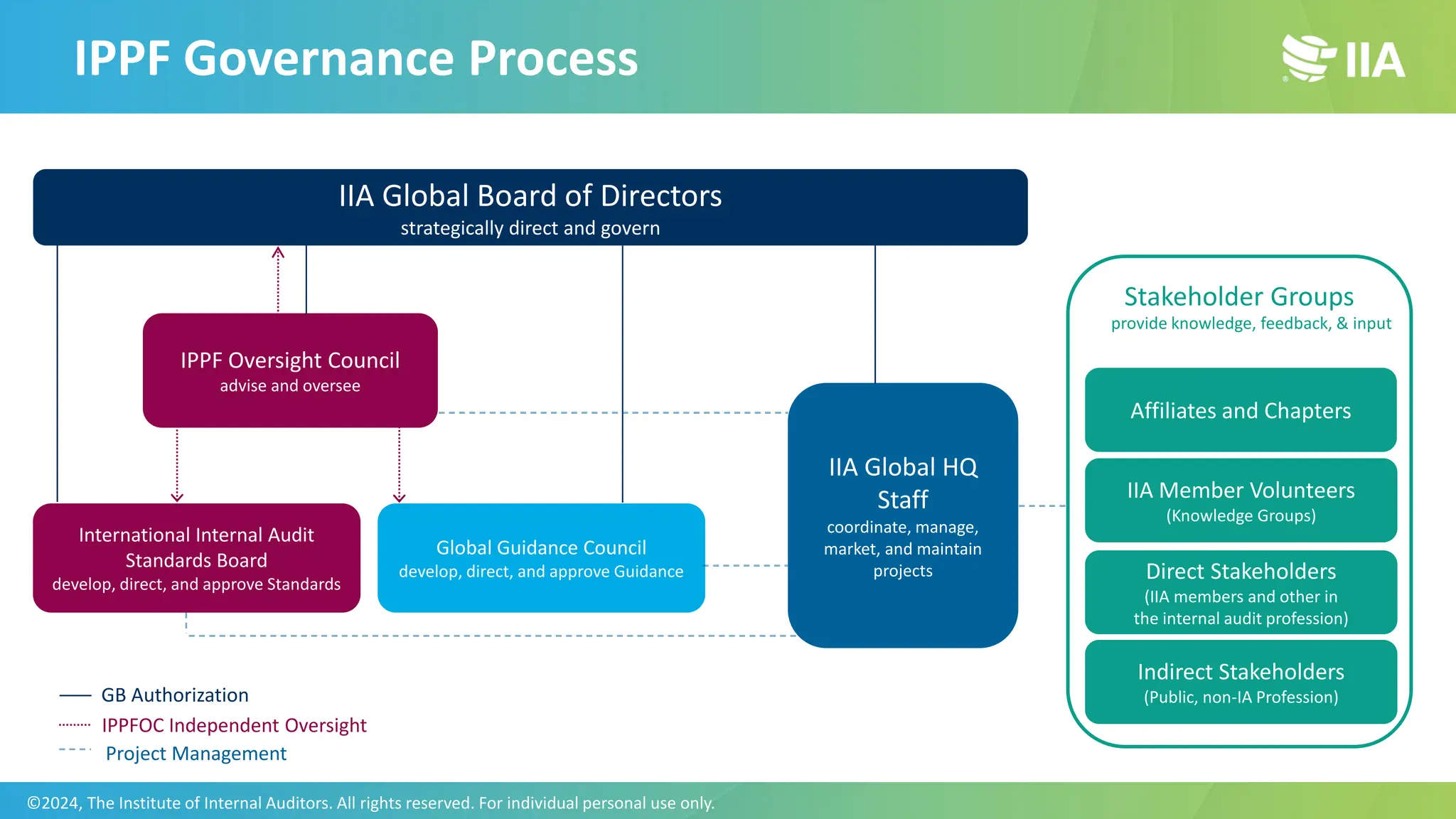
Stakeholder Groups
IIA Member Volunteers
(Knowledge Groups)
Indirect Stakeholders
(Public, non-IA Profession)
Direct Stakeholders
(IIA members and other in
the internal audit profession)
Affiliates and Chapters
IPPF Governance Process
provide knowledge, feedback, & input
IIA Global HQ
Staff
coordinate, manage,
market, and maintain
projects
IIA Global Board of Directors
strategically direct and govern
IPPF Oversight Council
advise and oversee
International Internal Audit
Standards Board
develop, direct, and approve Standards
Global Guidance Council
develop, direct, and approve Guidance
GB Authorization
IPPFOC Independent Oversight
Project Management
©2024, The Institute of Internal Auditors. All rights reserved. For individual personal use only.
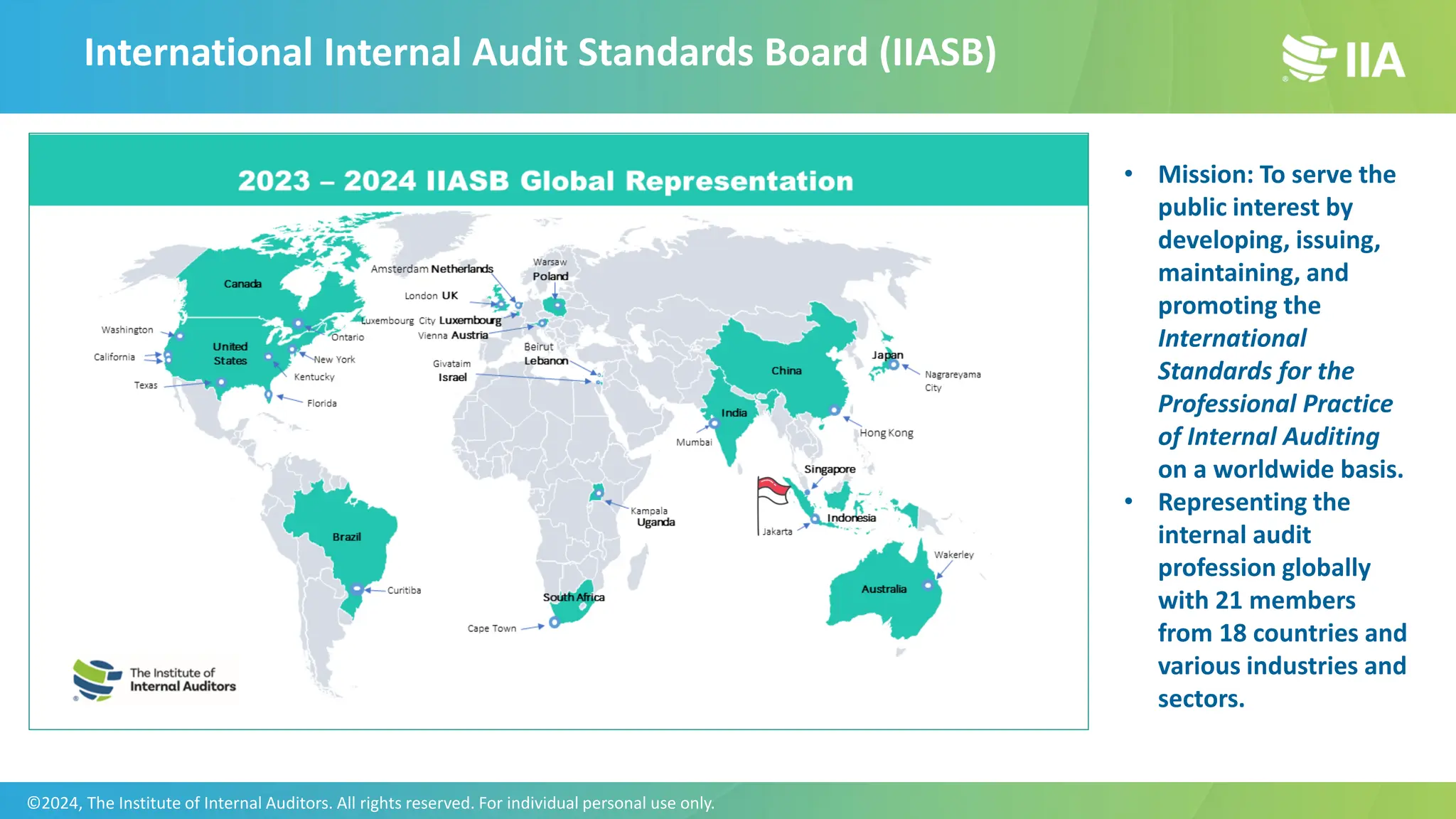
International Internal Audit Standards Board (IIASB)
• Mission: To serve the
public interest by
developing, issuing,
maintaining, and
promoting the
International
Standards for the
Professional Practice
of Internal Auditing
on a worldwide basis.
• Representing the
internal audit
profession globally
with 21 members
from 18 countries and
various industries and
sectors.
©2024, The Institute of Internal Auditors. All rights reserved. For individual personal use only.
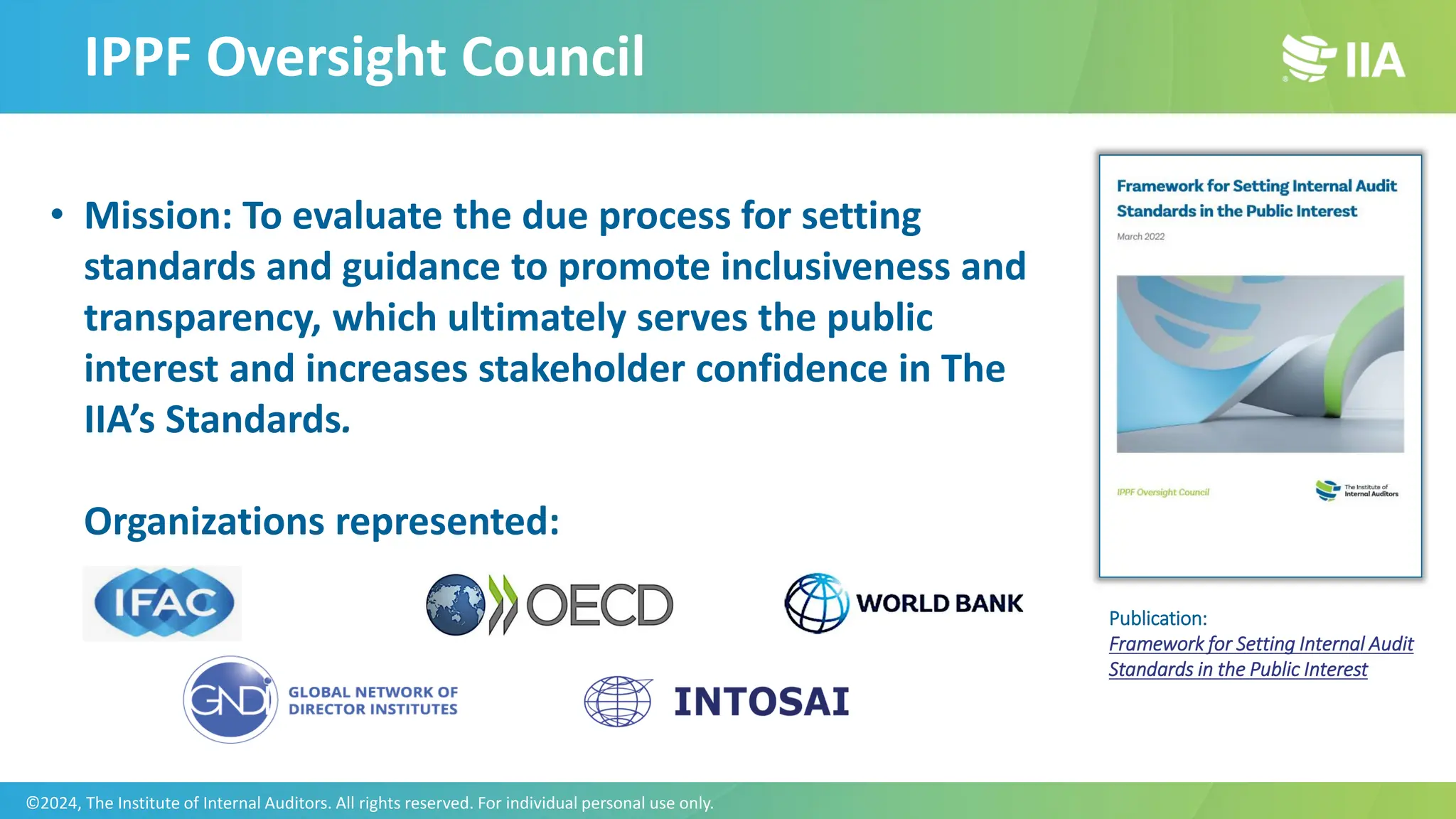
IPPF Oversight Council
• Mission: To evaluate the due process for setting
standards and guidance to promote inclusiveness and
transparency, which ultimately serves the public
interest and increases stakeholder confidence in The
IIA’s Standards.
Organizations represented:
Publication:
Framework for Setting Internal Audit
Standards in the Public Interest
©2024, The Institute of Internal Auditors. All rights reserved. For individual personal use only.
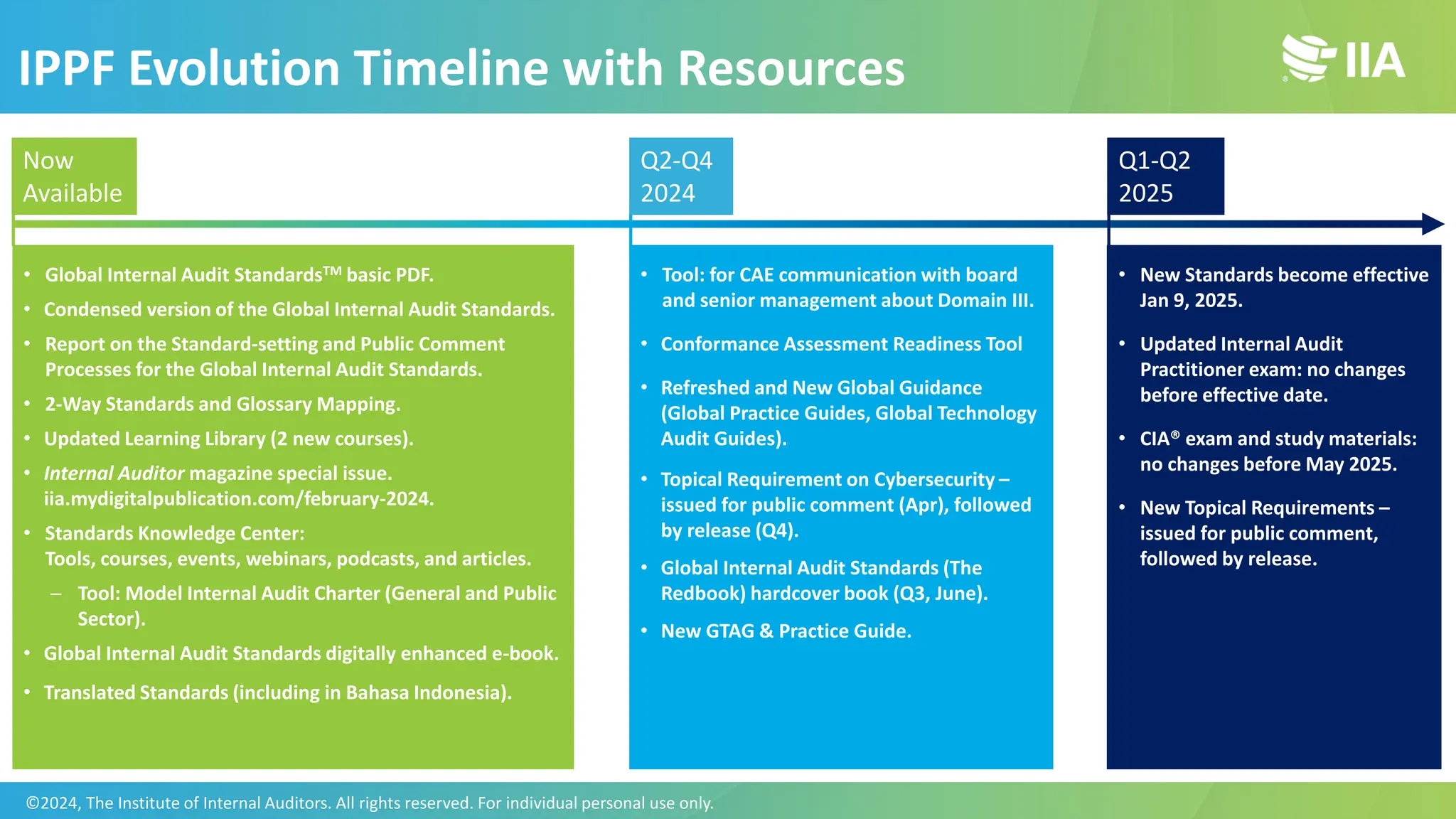
IPPF Evolution Timeline with Resources
Now
Available
Q2-Q4
2024
Q1-Q2
2025
• Global Internal Audit StandardsTM basic PDF.
• Condensed version of the Global Internal Audit Standards.
• Report on the Standard-setting and Public Comment
Processes for the Global Internal Audit Standards.
• 2-Way Standards and Glossary Mapping.
• Updated Learning Library (2 new courses).
• Internal Auditor magazine special issue.
iia.mydigitalpublication.com/february-2024.
• Standards Knowledge Center:
Tools, courses, events, webinars, podcasts, and articles.
─ Tool: Model Internal Audit Charter (General and Public
Sector).
• Global Internal Audit Standards digitally enhanced e-book.
• Translated Standards (including in Bahasa Indonesia).
• Tool: for CAE communication with board
and senior management about Domain III.
• Conformance Assessment Readiness Tool
• Refreshed and New Global Guidance
(Global Practice Guides, Global Technology
Audit Guides).
• Topical Requirement on Cybersecurity –
issued for public comment (Apr), followed
by release (Q4).
• Global Internal Audit Standards (The
Redbook) hardcover book (Q3, June).
• New GTAG & Practice Guide.
• New Standards become effective
Jan 9, 2025.
• Updated Internal Audit
Practitioner exam: no changes
before effective date.
• CIA® exam and study materials:
no changes before May 2025.
• New Topical Requirements –
issued for public comment,
followed by release.
©2024, The Institute of Internal Auditors. All rights reserved. For individual personal use only.
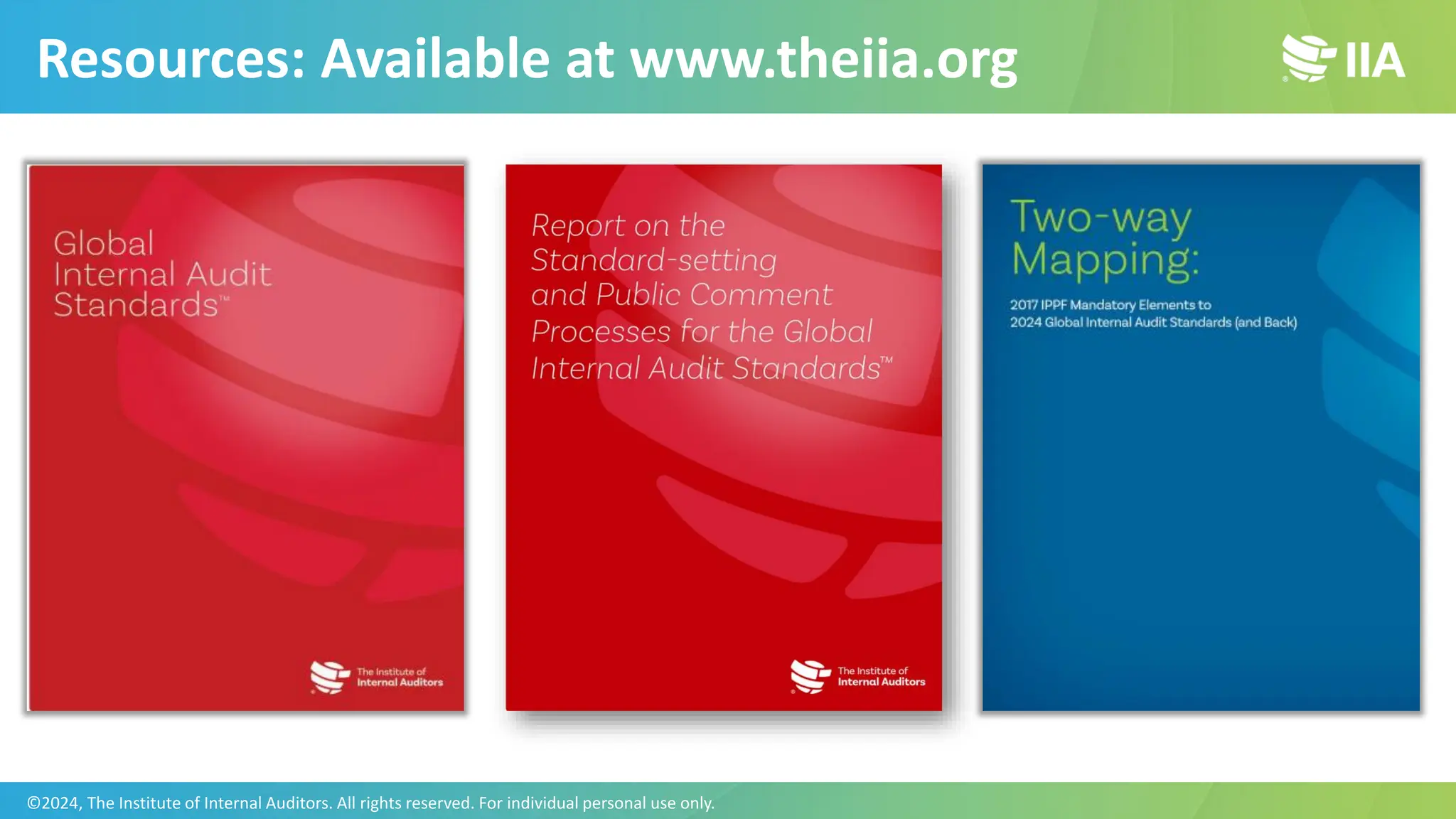
Resources: Available at www.theiia.org
©2024, The Institute of Internal Auditors. All rights reserved. For individual personal use only.
New IPPF and
Global Internal Audit Standards –
Structure
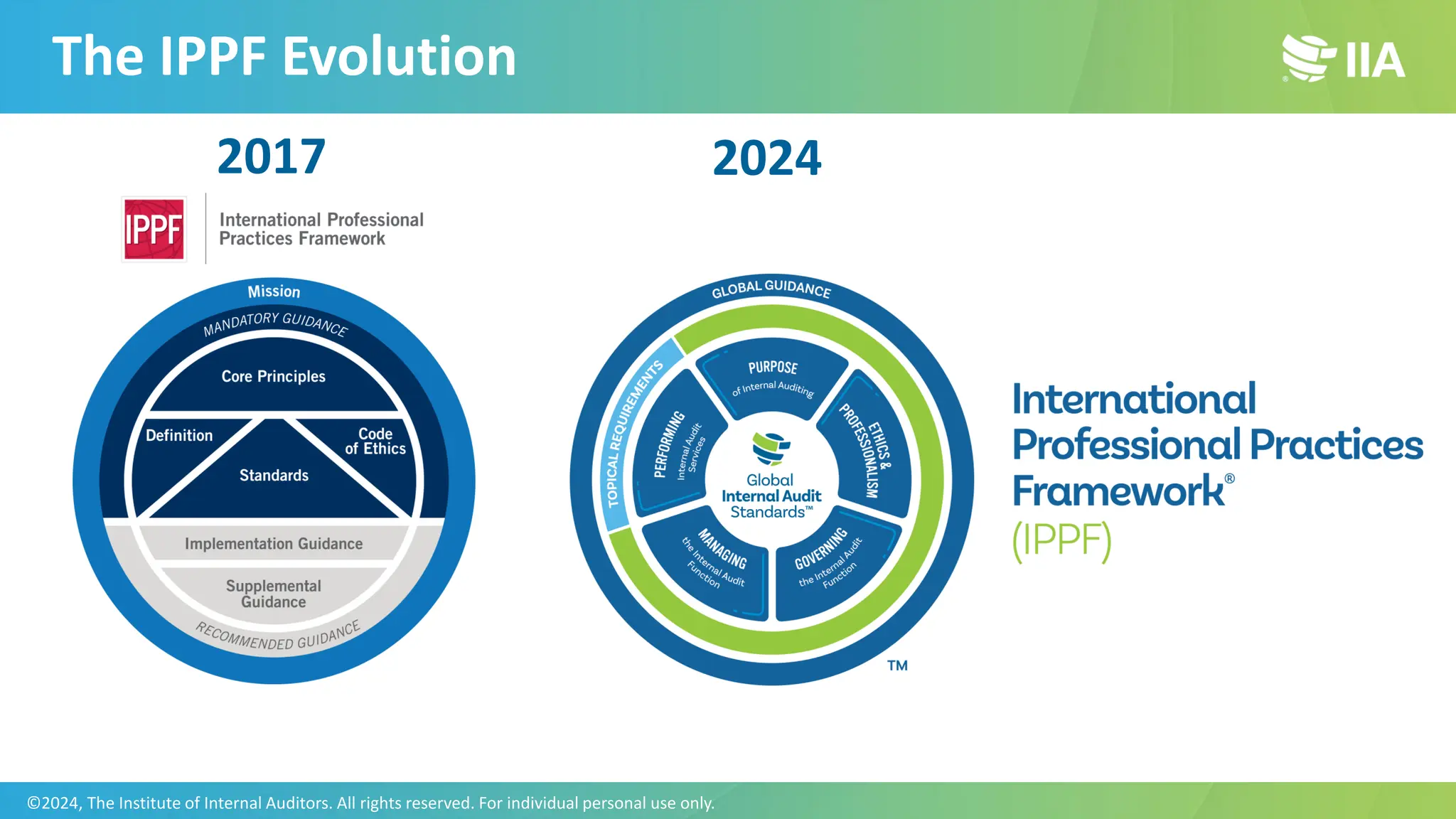
2017 2024
The IPPF Evolution
©2024, The Institute of Internal Auditors. All rights reserved. For individual personal use only.
The New Structure
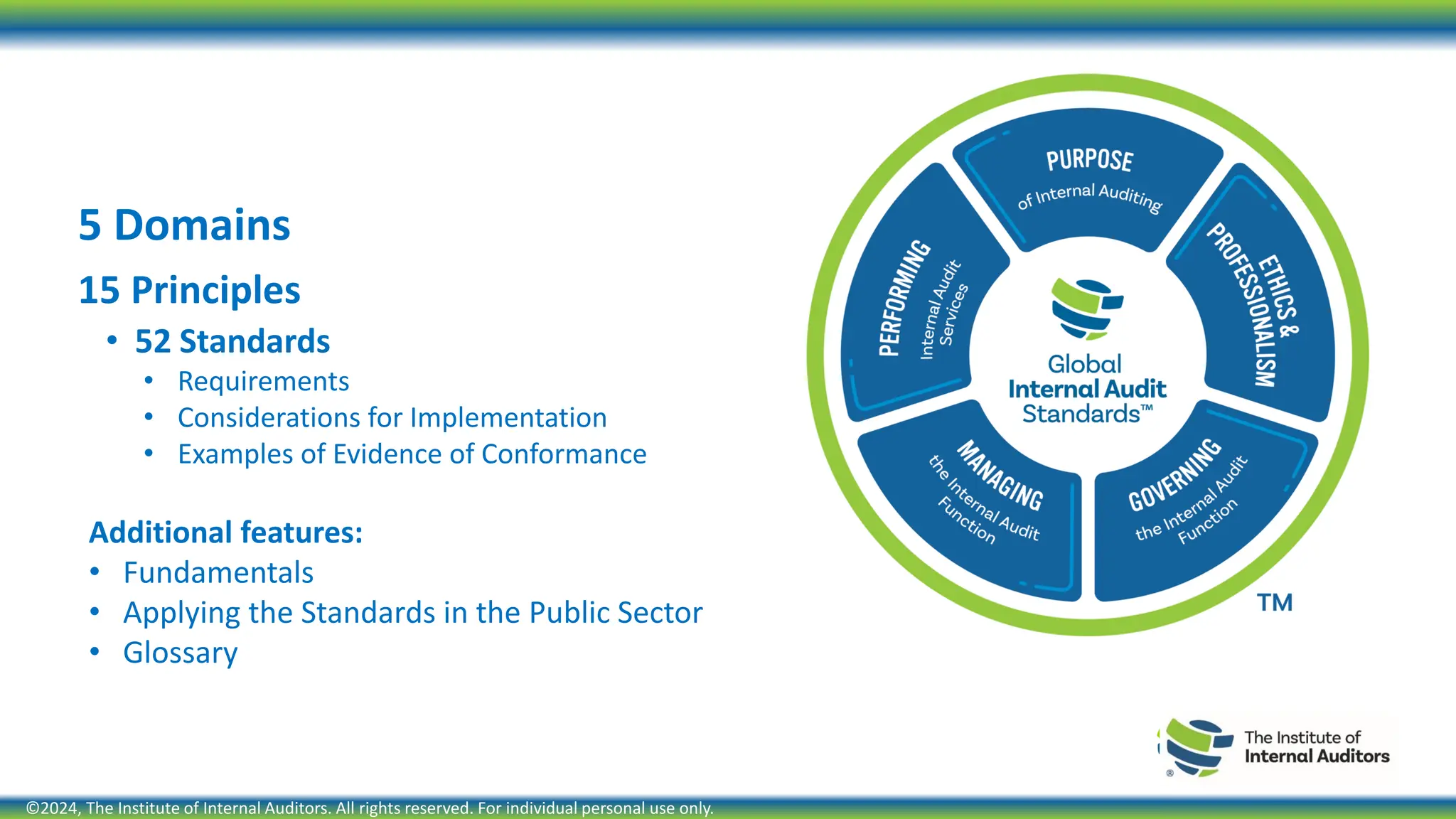
5 Domains
15 Principles
• 52 Standards
• Requirements
• Considerations for Implementation
• Examples of Evidence of Conformance
Additional features:
• Fundamentals
• Applying the Standards in the Public Sector
• Glossary
©2024, The Institute of Internal Auditors. All rights reserved. For individual personal use only.
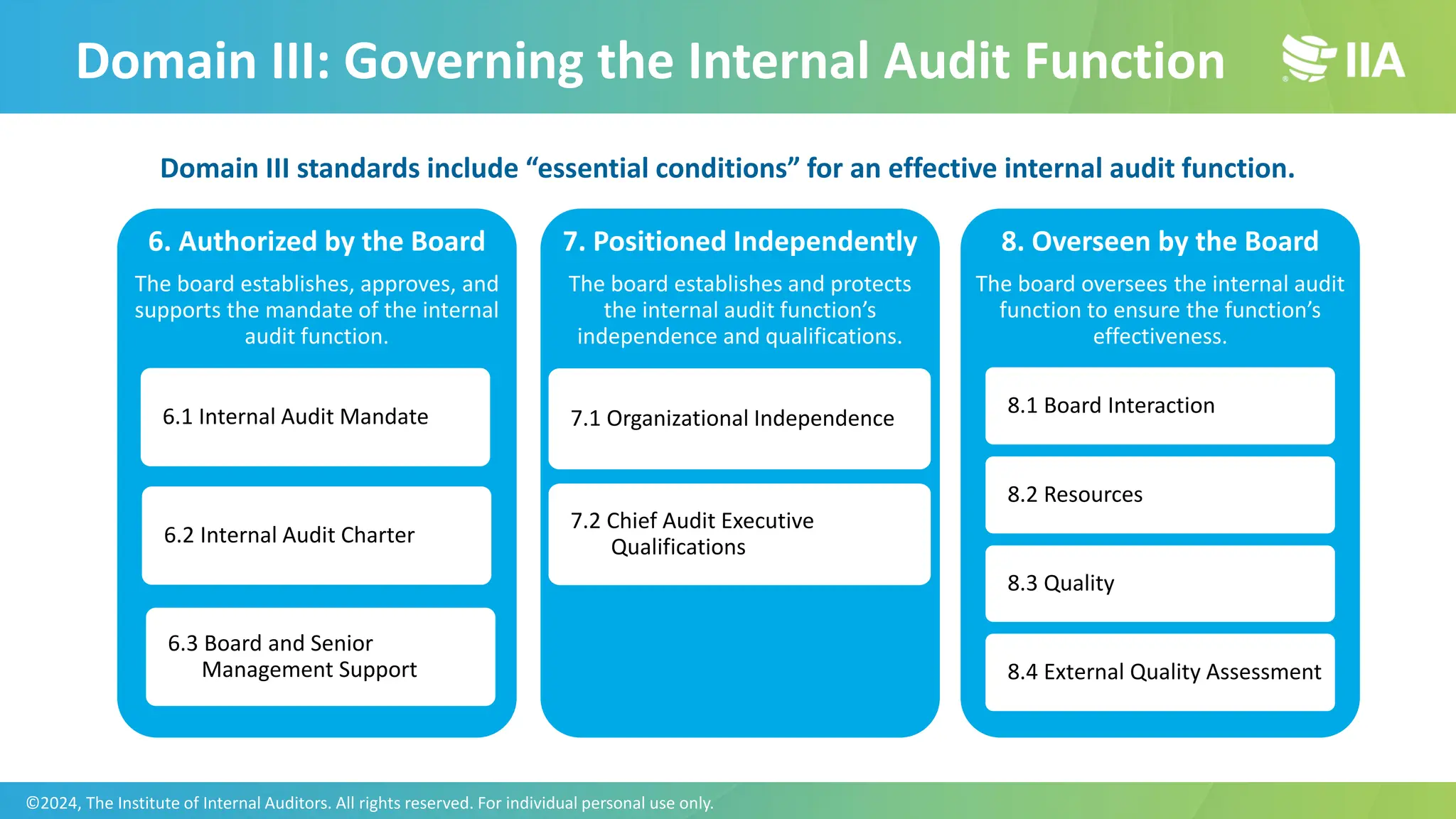
III. Governing the Internal Audit
Function
6. Authorized by the Board
7. Positioned Independently
8. Overseen by the Board
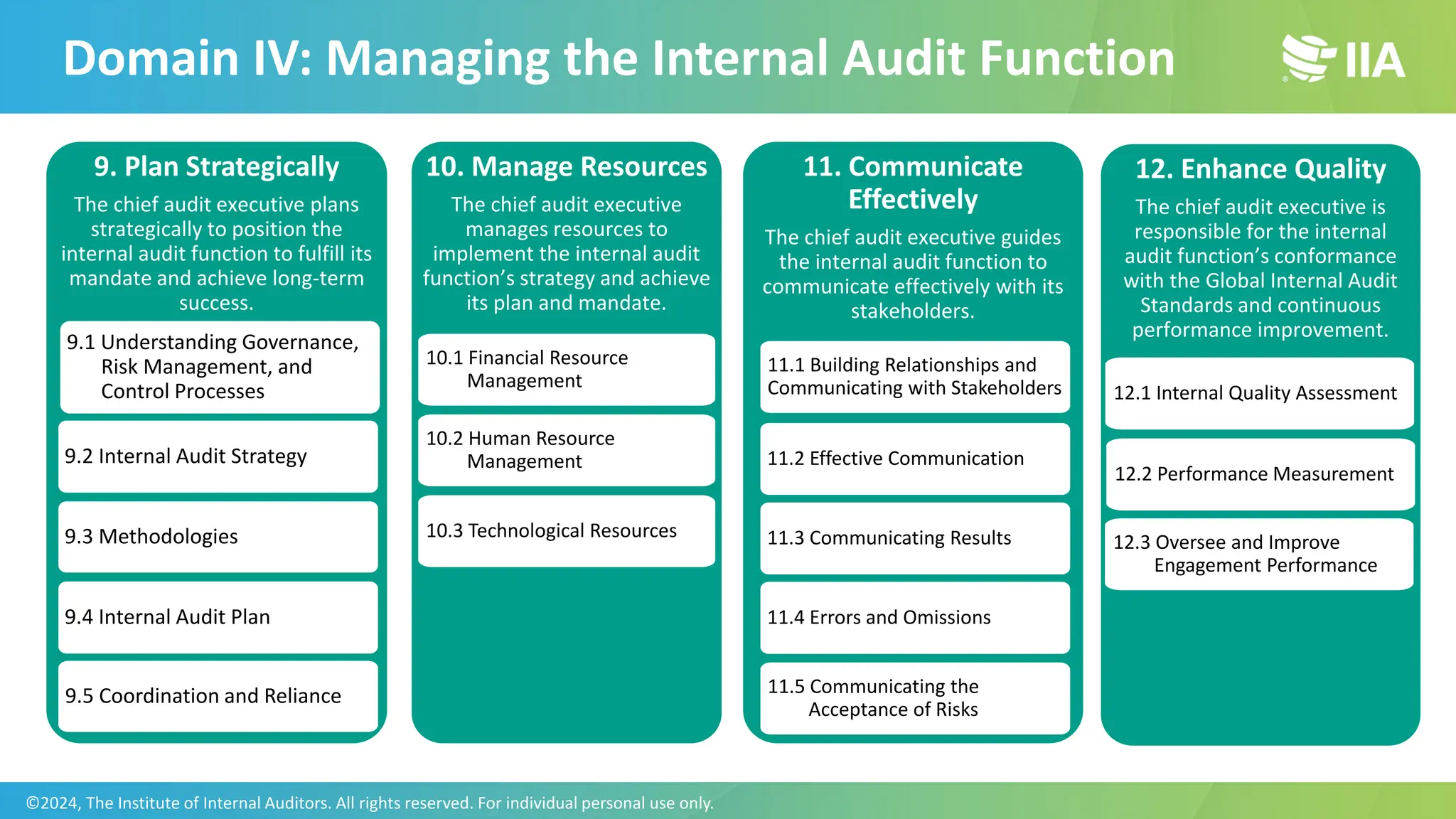
IV. Managing the Internal Audit
Function
9. Plan Strategically
10. Manage Resources
11. Communicate Effectively
12. Enhance Quality
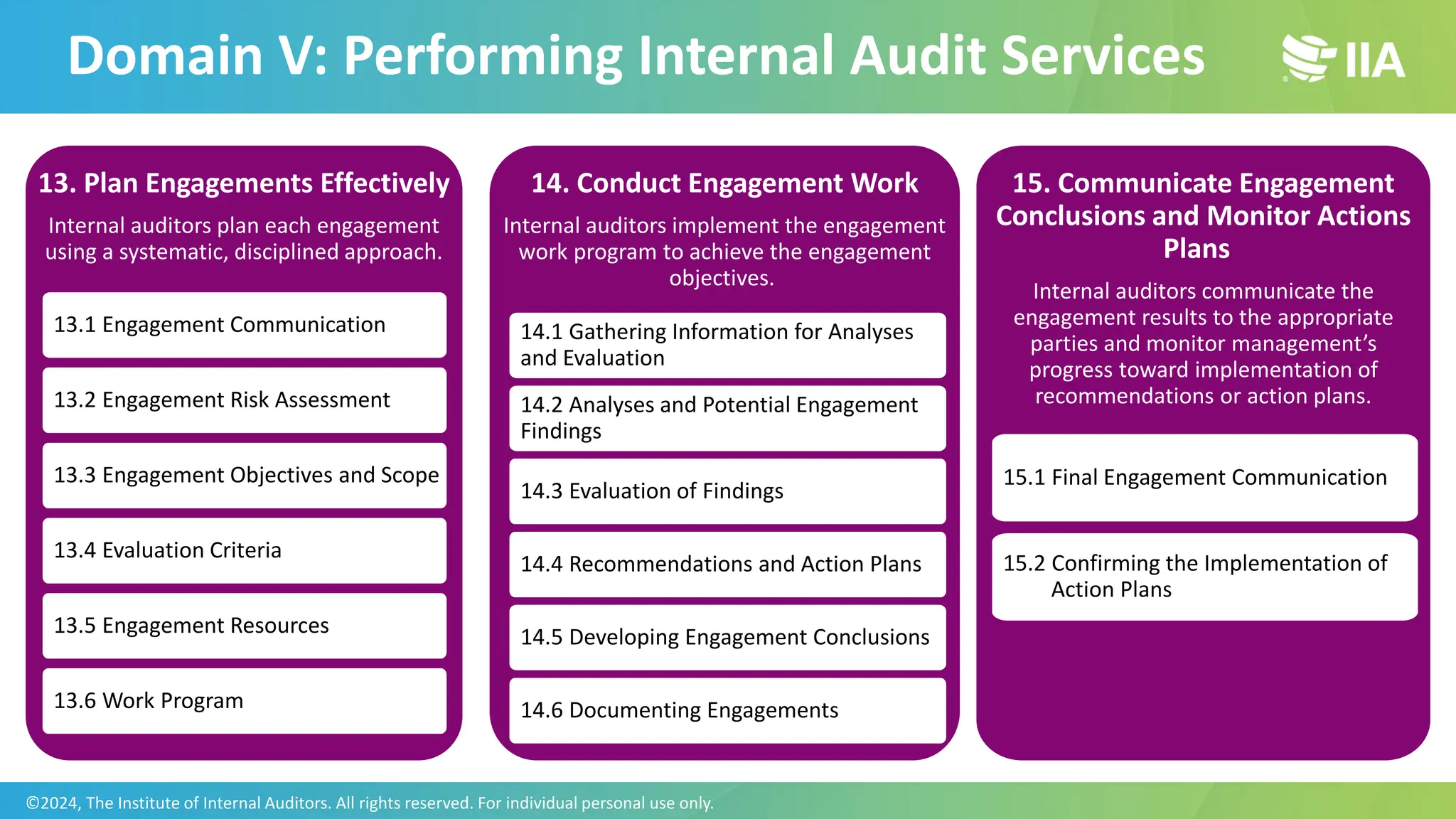
V. Performing Internal Audit
Services
13. Plan Engagements Effectively
14. Conduct Engagement Work
15. Communicate Engagement
Conclusions and Monitor Action
Plans
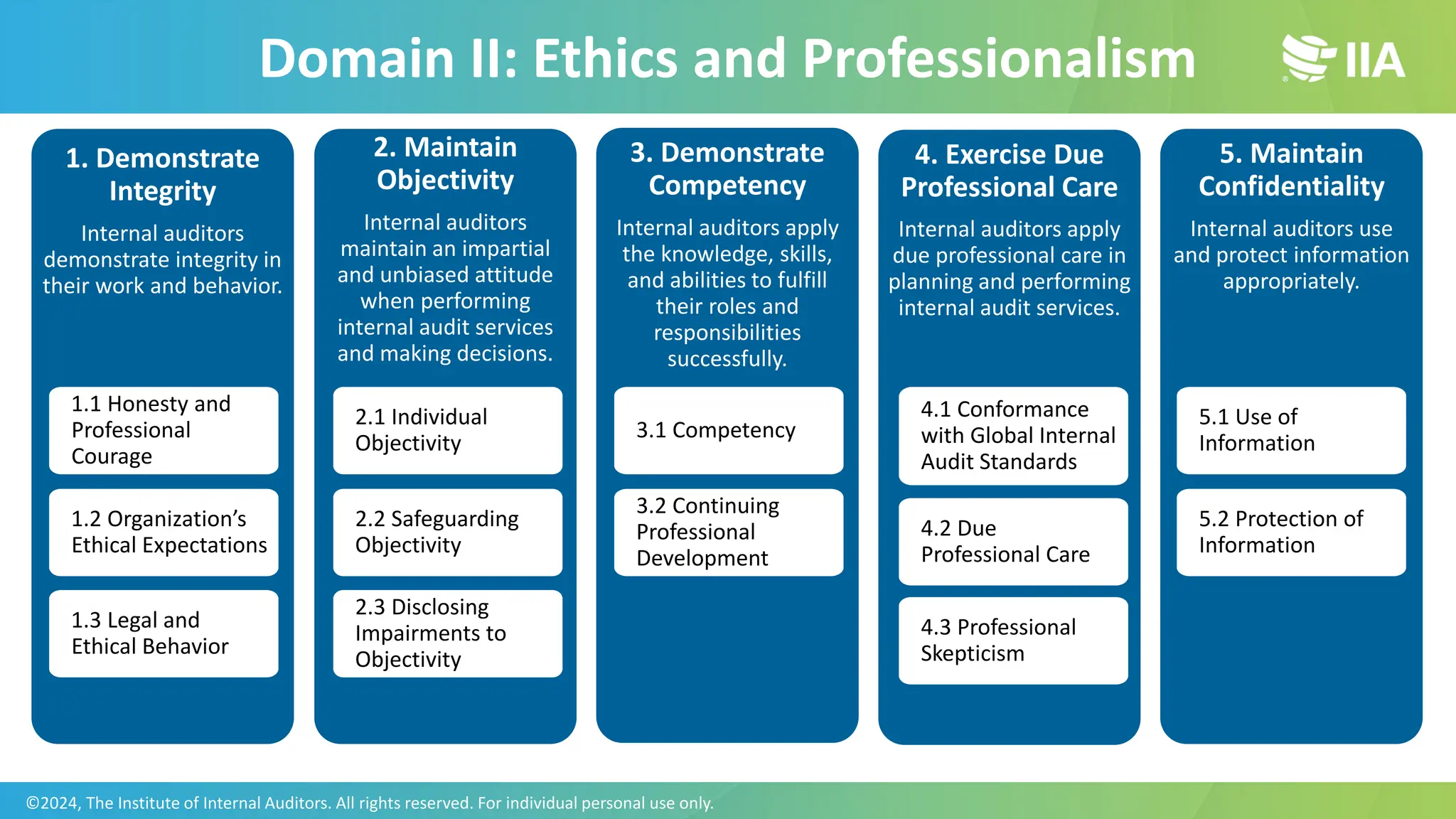
II. Ethics and Professionalism
1. Demonstrate
Integrity
2. Maintain
Objectivity
3. Demonstrate
Competency
4. Exercise Due
Professional Care
5. Maintain
Confidentiality
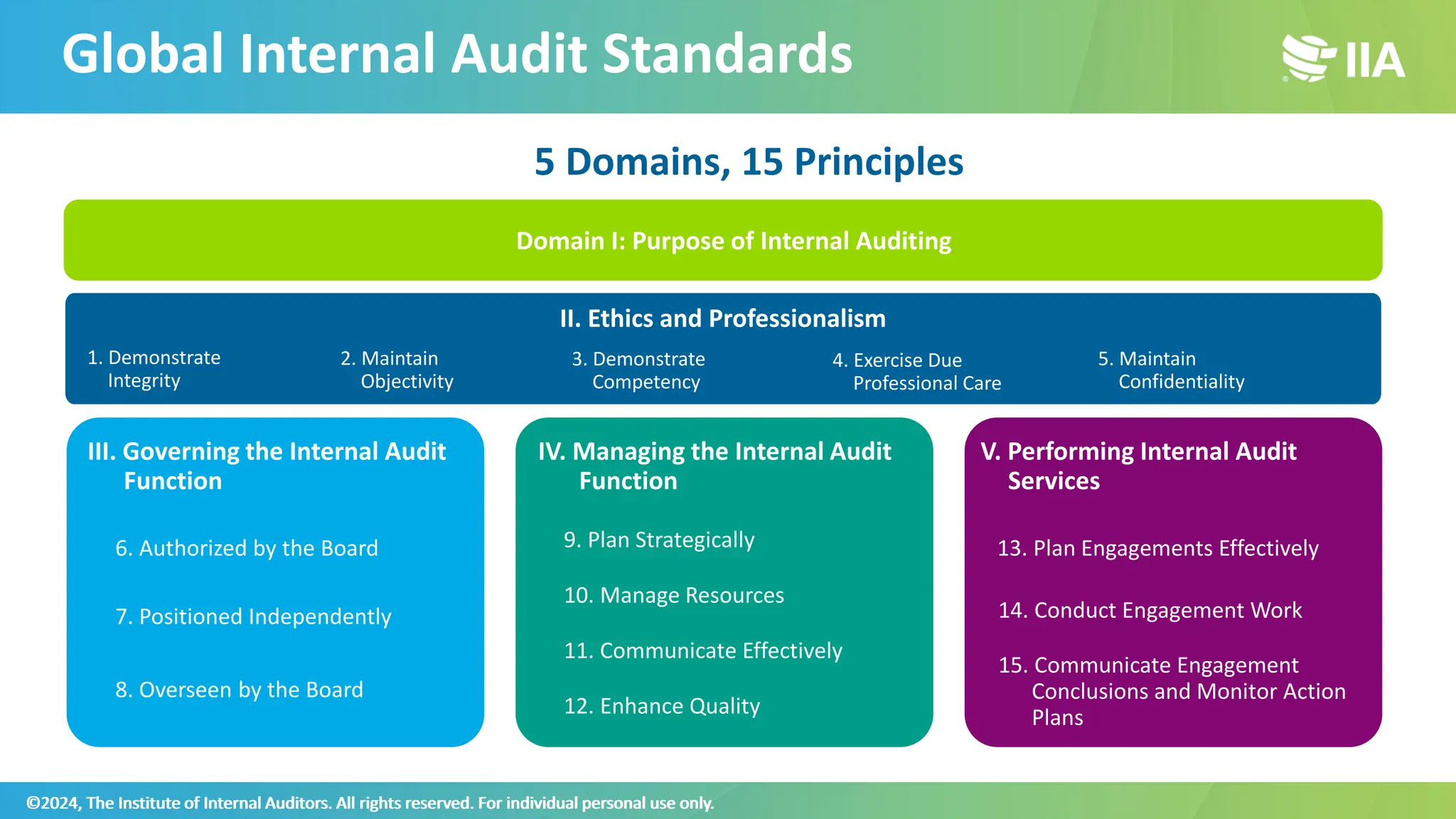
5 Domains, 15 Principles
Domain I: Purpose of Internal Auditing
Global Internal Audit Standards
©2024, The Institute of Internal Auditors. All rights reserved. For individual personal use only.
Global Internal Audit Standards –
Glossary & Fundamentals
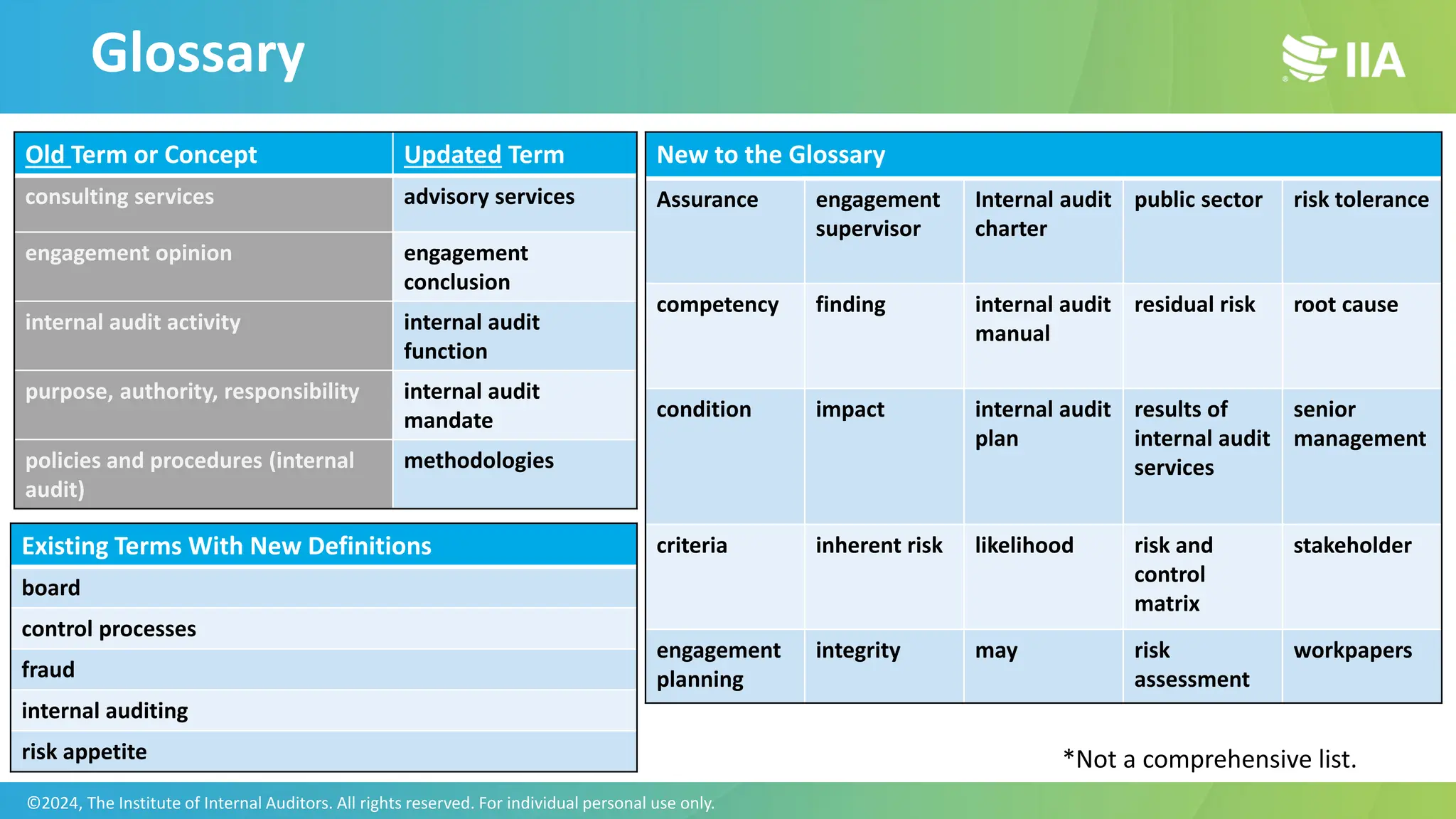
Glossary
Old Term or Concept Updated Term
consulting services advisory services
engagement opinion engagement
conclusion
internal audit activity internal audit
function
purpose, authority, responsibility internal audit
mandate
policies and procedures (internal
audit)
methodologies
New to the Glossary
Assurance engagement
supervisor
Internal audit
charter
public sector risk tolerance
competency finding internal audit
manual
residual risk root cause
condition impact internal audit
plan
results of
internal audit
services
senior
management
criteria inherent risk likelihood risk and
control
matrix
stakeholder
engagement
planning
integrity may risk
assessment
workpapers
*Not a comprehensive list.
Existing Terms With New Definitions
board
control processes
fraud
internal auditing
risk appetite
©2024, The Institute of Internal Auditors. All rights reserved. For individual personal use only.
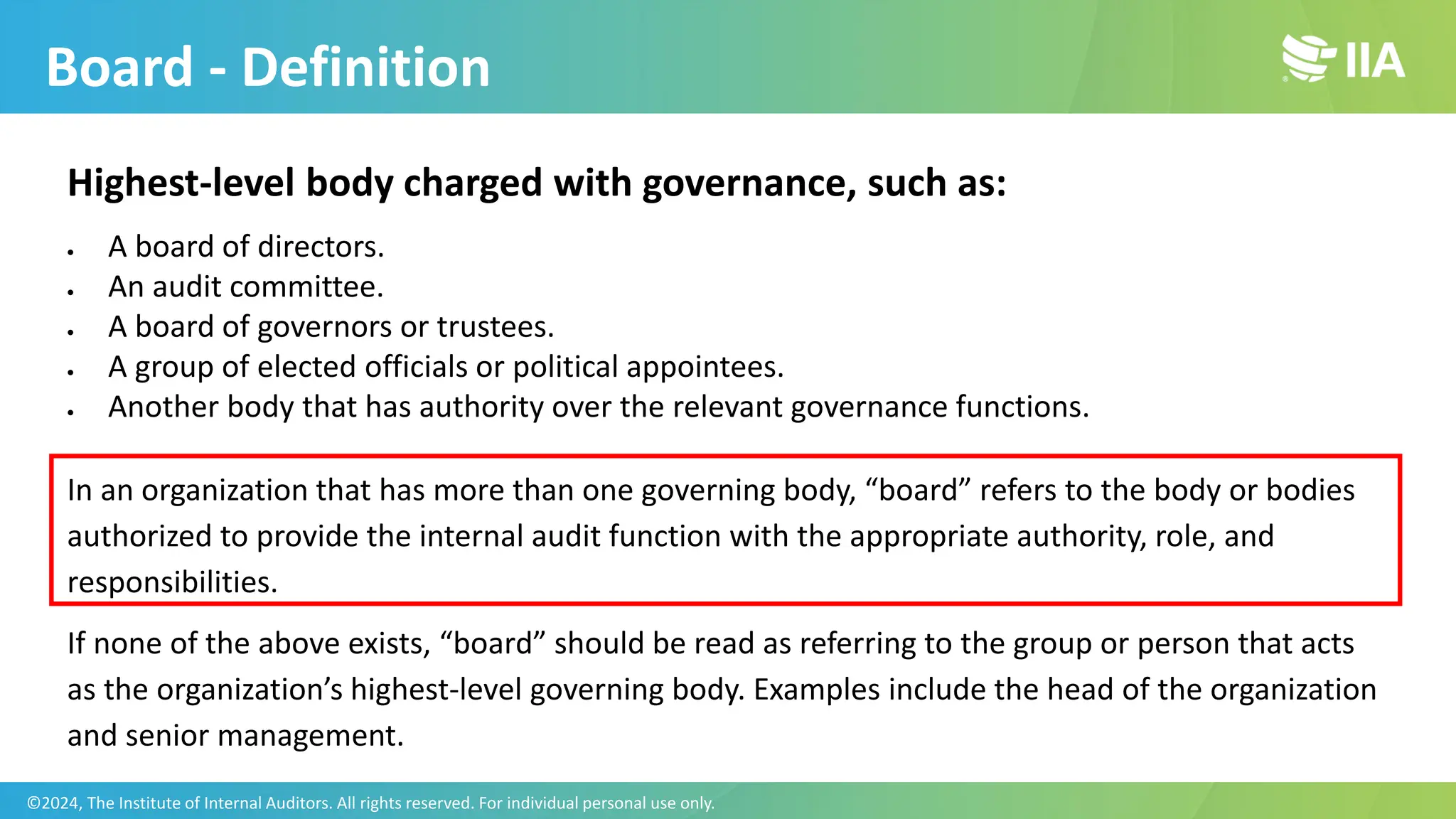
Highest-level body charged with governance, such as:
• A board of directors.
• An audit committee.
• A board of governors or trustees.
• A group of elected officials or political appointees.
• Another body that has authority over the relevant governance functions.
In an organization that has more than one governing body, “board” refers to the body or bodies
authorized to provide the internal audit function with the appropriate authority, role, and
responsibilities.
If none of the above exists, “board” should be read as referring to the group or person that acts
as the organization’s highest-level governing body. Examples include the head of the organization
and senior management.
Board - Definition
©2024, The Institute of Internal Auditors. All rights reserved. For individual personal use only.
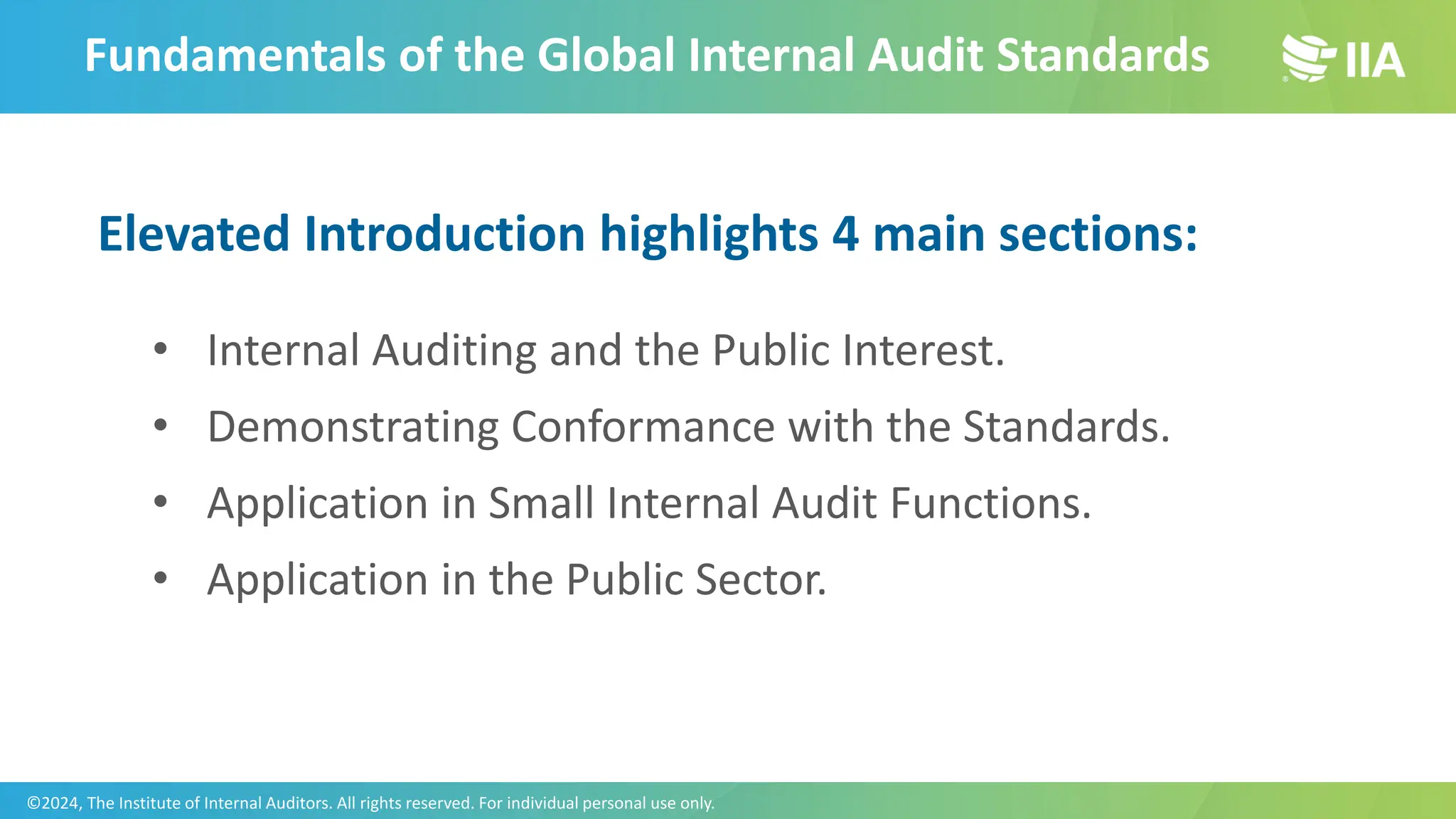
Fundamentals of the Global Internal Audit Standards
Elevated Introduction highlights 4 main sections:
• Internal Auditing and the Public Interest.
• Demonstrating Conformance with the Standards.
• Application in Small Internal Audit Functions.
• Application in the Public Sector.
©2024, The Institute of Internal Auditors. All rights reserved. For individual personal use only.
Fundamentals of the Global Internal Audit Standards
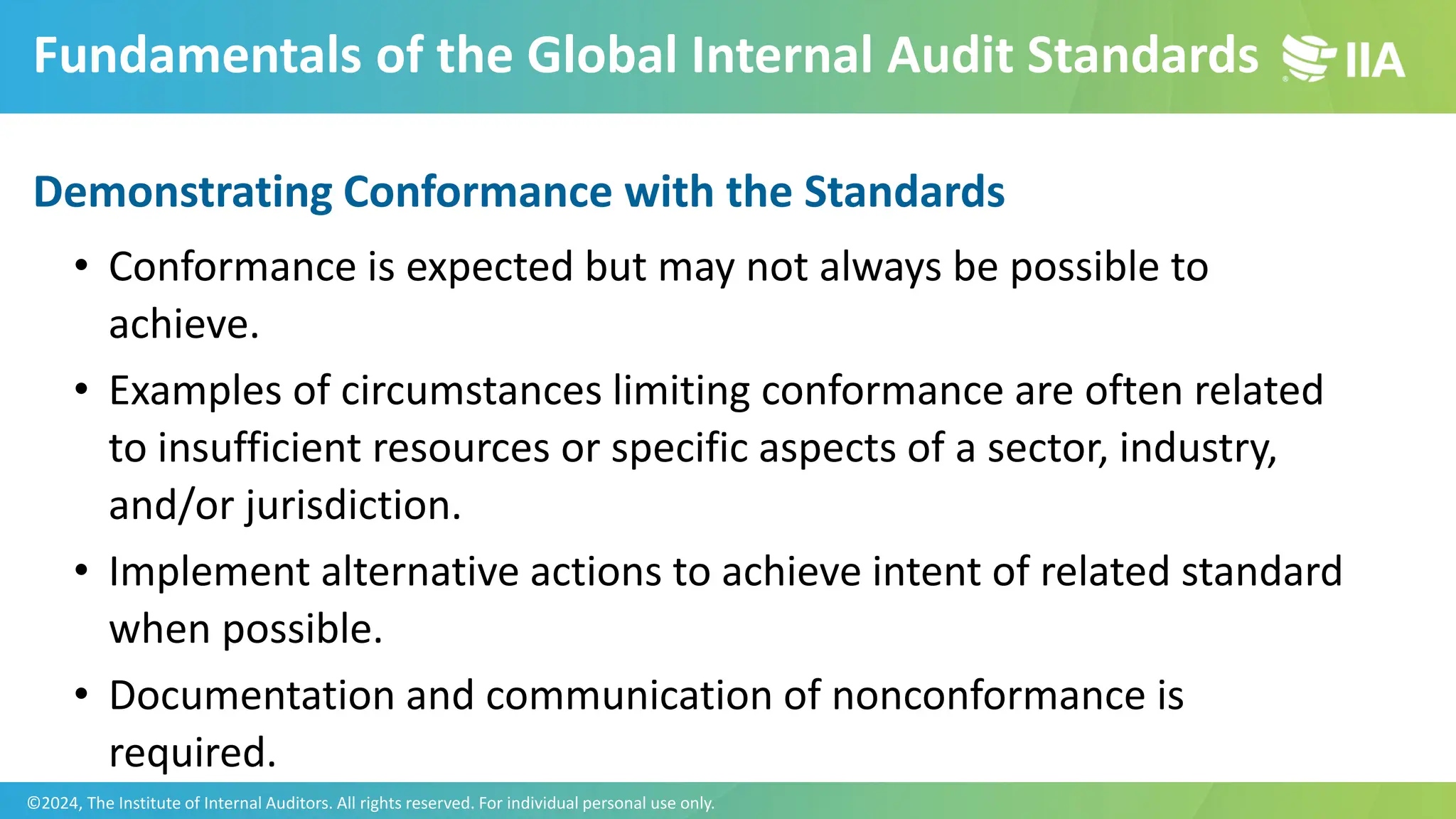
Demonstrating Conformance with the Standards
• Conformance is expected but may not always be possible to
achieve.
• Examples of circumstances limiting conformance are often related
to insufficient resources or specific aspects of a sector, industry,
and/or jurisdiction.
• Implement alternative actions to achieve intent of related standard
when possible.
• Documentation and communication of nonconformance is
required.
©2024, The Institute of Internal Auditors. All rights reserved. For individual personal use only.
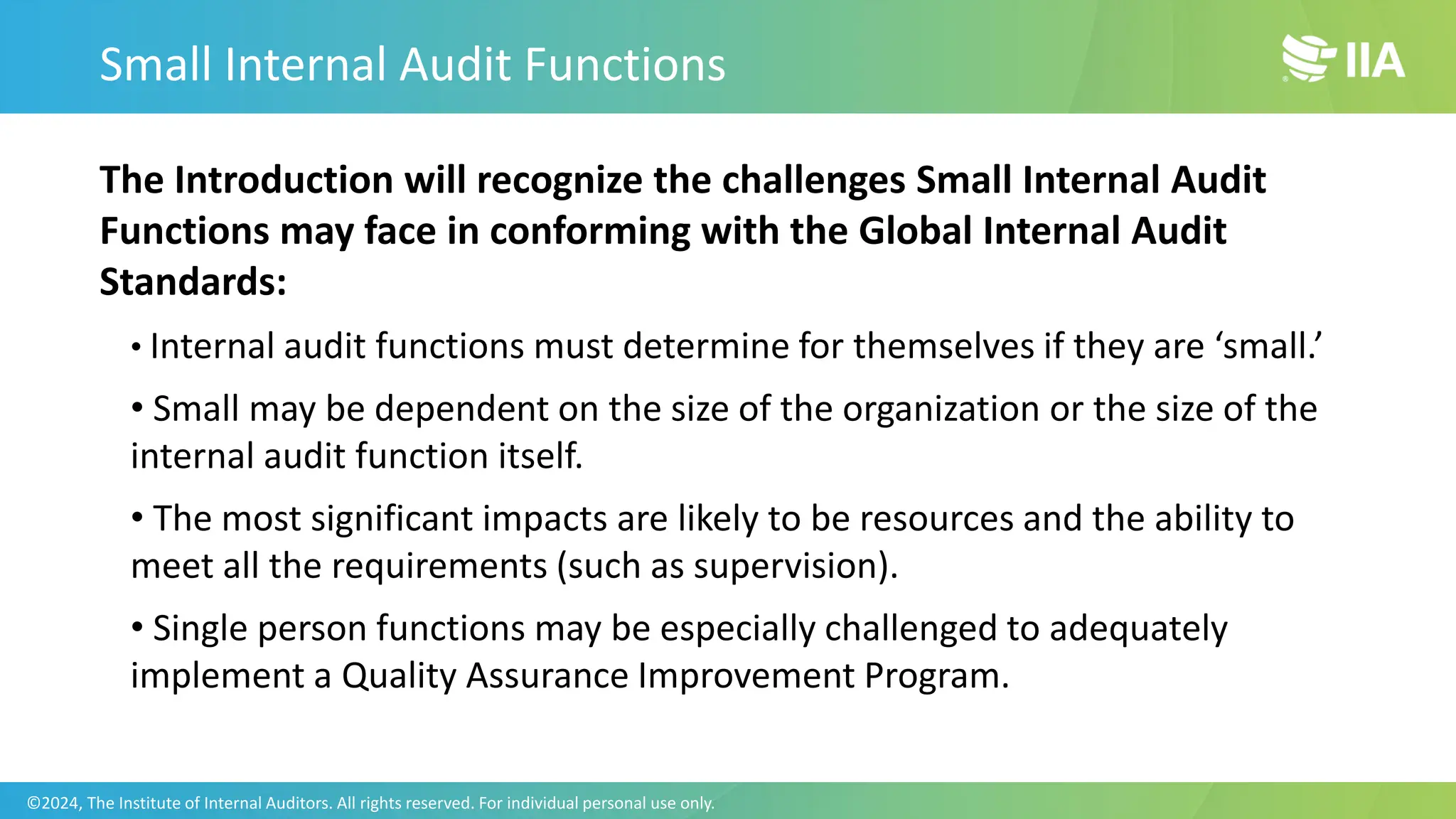
The Introduction will recognize the challenges Small Internal Audit
Functions may face in conforming with the Global Internal Audit
Standards:
• Internal audit functions must determine for themselves if they are ‘small.’
• Small may be dependent on the size of the organization or the size of the
internal audit function itself.
• The most significant impacts are likely to be resources and the ability to
meet all the requirements (such as supervision).
• Single person functions may be especially challenged to adequately
implement a Quality Assurance Improvement Program.
Small Internal Audit Functions
©2024, The Institute of Internal Auditors. All rights reserved. For individual personal use only.
Global Internal Audit Standards:
Domains
©2024, The Institute of Internal Auditors. All rights reserved. For individual personal use only.
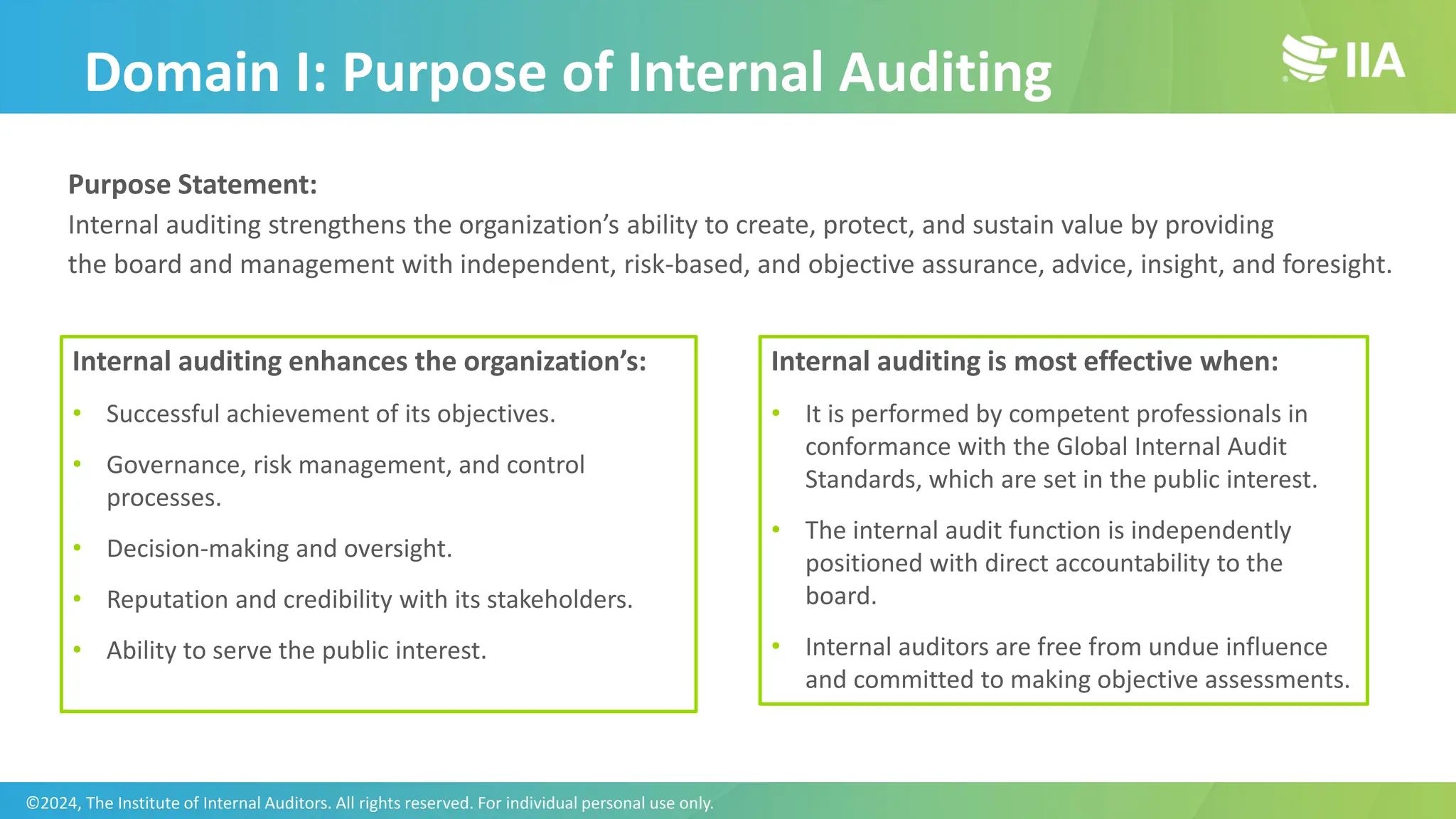
Domain I: Purpose of Internal Auditing
Purpose Statement:
Internal auditing strengthens the organization’s ability to create, protect, and sustain value by providing
the board and management with independent, risk-based, and objective assurance, advice, insight, and foresight.
Internal auditing enhances the organization’s:
• Successful achievement of its objectives.
• Governance, risk management, and control
processes.
• Decision-making and oversight.
• Reputation and credibility with its stakeholders.
• Ability to serve the public interest.
Internal auditing is most effective when:
• It is performed by competent professionals in
conformance with the Global Internal Audit
Standards, which are set in the public interest.
• The internal audit function is independently
positioned with direct accountability to the
board.
• Internal auditors are free from undue influence
and committed to making objective assessments.
©2024, The Institute of Internal Auditors. All rights reserved. For individual personal use only.
1. Demonstrate
Integrity
Internal auditors
demonstrate integrity in
their work and behavior.
1.1 Honesty and
Professional
Courage
1.2 Organization’s
Ethical Expectations
1.3 Legal and
Ethical Behavior
2. Maintain
Objectivity
Internal auditors
maintain an impartial
and unbiased attitude
when performing
internal audit services
and making decisions.
2.1 Individual
Objectivity
2.2 Safeguarding
Objectivity
2.3 Disclosing
Impairments to
Objectivity
3. Demonstrate
Competency
Internal auditors apply
the knowledge, skills,
and abilities to fulfill
their roles and
responsibilities
successfully.
3.1 Competency
3.2 Continuing
Professional
Development
4. Exercise Due
Professional Care
Internal auditors apply
due professional care in
planning and performing
internal audit services.
4.1 Conformance
with Global Internal
Audit Standards
4.2 Due
Professional Care
4.3 Professional
Skepticism
5. Maintain
Confidentiality
Internal auditors use
and protect information
appropriately.
5.1 Use of
Information
5.2 Protection of
Information
Domain II: Ethics and Professionalism
©2024, The Institute of Internal Auditors. All rights reserved. For individual personal use only.
Domain III: Governing the Internal Audit Function
6. Authorized by the Board
The board establishes, approves, and
supports the mandate of the internal
audit function.
6.1 Internal Audit Mandate
6.2 Internal Audit Charter
7. Positioned Independently
The board establishes and protects
the internal audit function’s
independence and qualifications.
7.1 Organizational Independence
7.2 Chief Audit Executive
Qualifications
8. Overseen by the Board
The board oversees the internal audit
function to ensure the function’s
effectiveness.
8.1 Board Interaction
8.2 Resources
8.3 Quality
8.4 External Quality Assessment
6.3 Board and Senior
Management Support
Domain III standards include “essential conditions” for an effective internal audit function.
©2024, The Institute of Internal Auditors. All rights reserved. For individual personal use only.
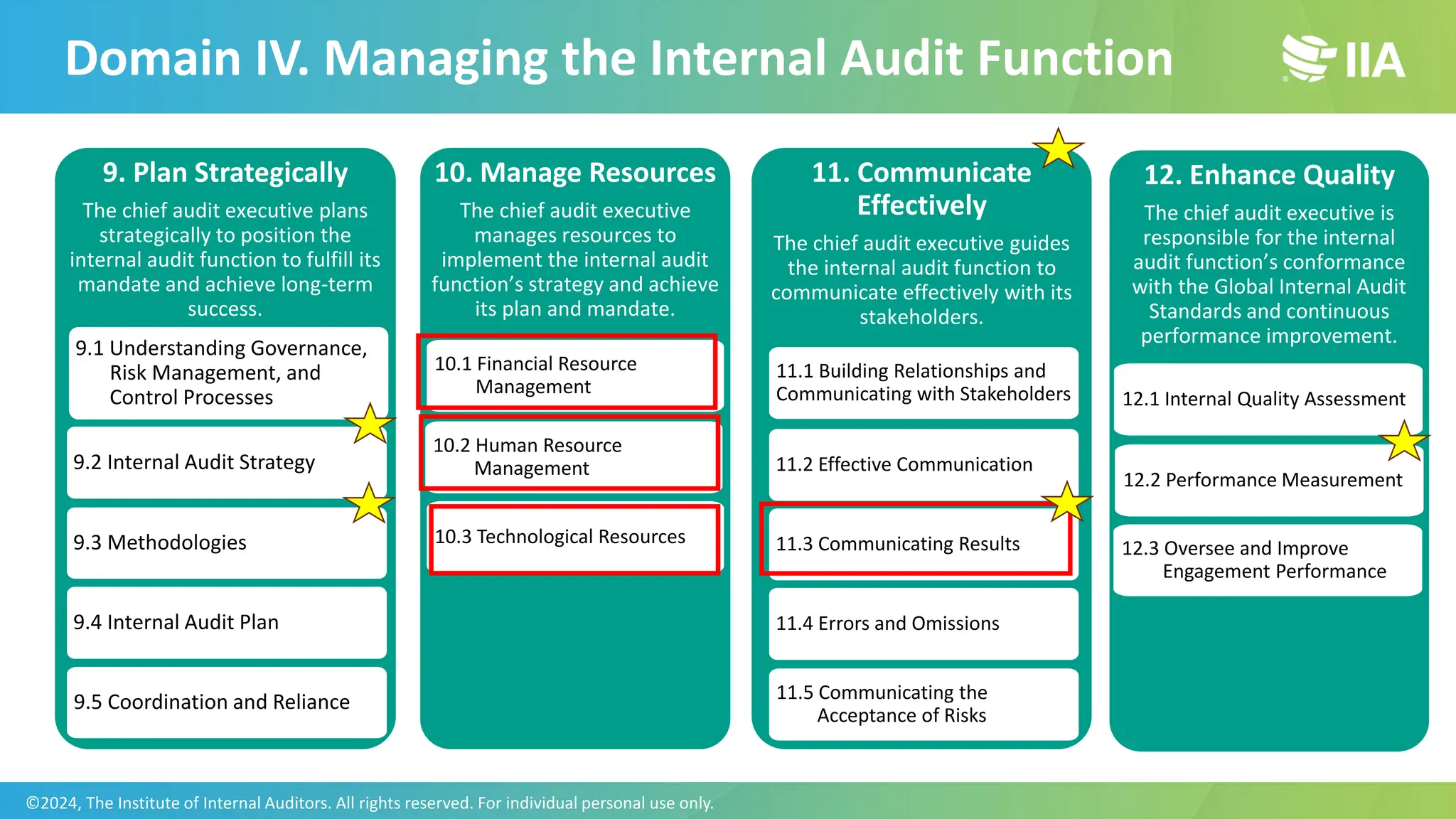
Domain IV: Managing the Internal Audit Function
9. Plan Strategically
The chief audit executive plans
strategically to position the
internal audit function to fulfill its
mandate and achieve long-term
success.
9.1 Understanding Governance,
Risk Management, and
Control Processes
9.2 Internal Audit Strategy
9.3 Methodologies
9.4 Internal Audit Plan
9.5 Coordination and Reliance
10. Manage Resources
The chief audit executive
manages resources to
implement the internal audit
function’s strategy and achieve
its plan and mandate.
10.1 Financial Resource
Management
10.2 Human Resource
Management
10.3 Technological Resources
11. Communicate
Effectively
The chief audit executive guides
the internal audit function to
communicate effectively with its
stakeholders.
11.1 Building Relationships and
Communicating with Stakeholders
11.2 Effective Communication
11.3 Communicating Results
11.4 Errors and Omissions
11.5 Communicating the
Acceptance of Risks
12. Enhance Quality
The chief audit executive is
responsible for the internal
audit function’s conformance
with the Global Internal Audit
Standards and continuous
performance improvement.
12.1 Internal Quality Assessment
12.2 Performance Measurement
12.3 Oversee and Improve
Engagement Performance
©2024, The Institute of Internal Auditors. All rights reserved. For individual personal use only.
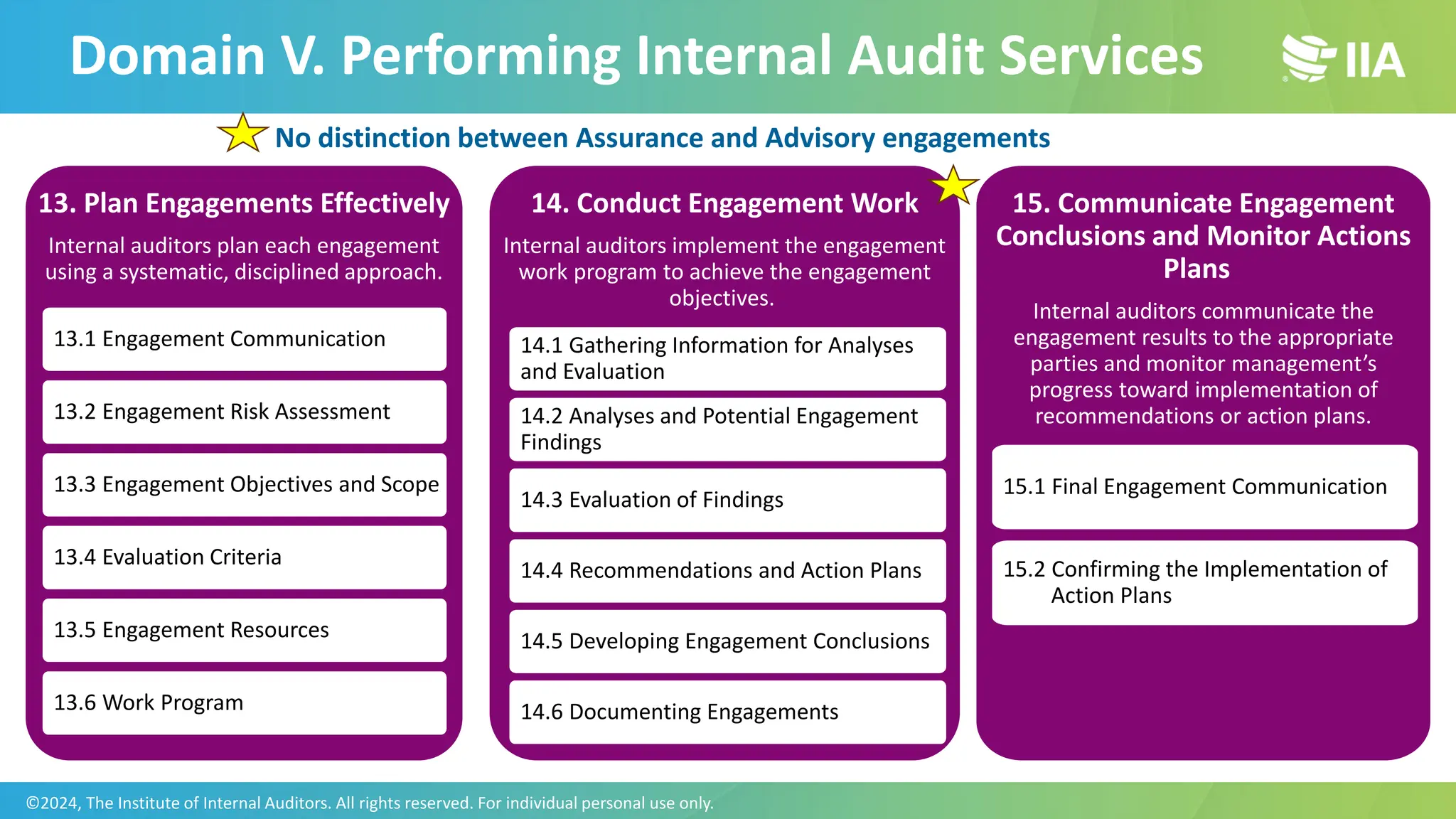
13. Plan Engagements Effectively
Internal auditors plan each engagement
using a systematic, disciplined approach.
13.1 Engagement Communication
13.2 Engagement Risk Assessment
13.3 Engagement Objectives and Scope
13.4 Evaluation Criteria
13.5 Engagement Resources
13.6 Work Program
14. Conduct Engagement Work
Internal auditors implement the engagement
work program to achieve the engagement
objectives.
14.1 Gathering Information for Analyses
and Evaluation
14.2 Analyses and Potential Engagement
Findings
14.3 Evaluation of Findings
14.4 Recommendations and Action Plans
14.5 Developing Engagement Conclusions
14.6 Documenting Engagements
15. Communicate Engagement
Conclusions and Monitor Actions
Plans
Internal auditors communicate the
engagement results to the appropriate
parties and monitor management’s
progress toward implementation of
recommendations or action plans.
15.1 Final Engagement Communication
15.2 Confirming the Implementation of
Action Plans
Domain V: Performing Internal Audit Services
©2024, The Institute of Internal Auditors. All rights reserved. For individual personal use only.
Applying the Global Internal Audit
Standards in the Public Sector
©2024, The Institute of Internal Auditors. All rights reserved. For individual personal use only.
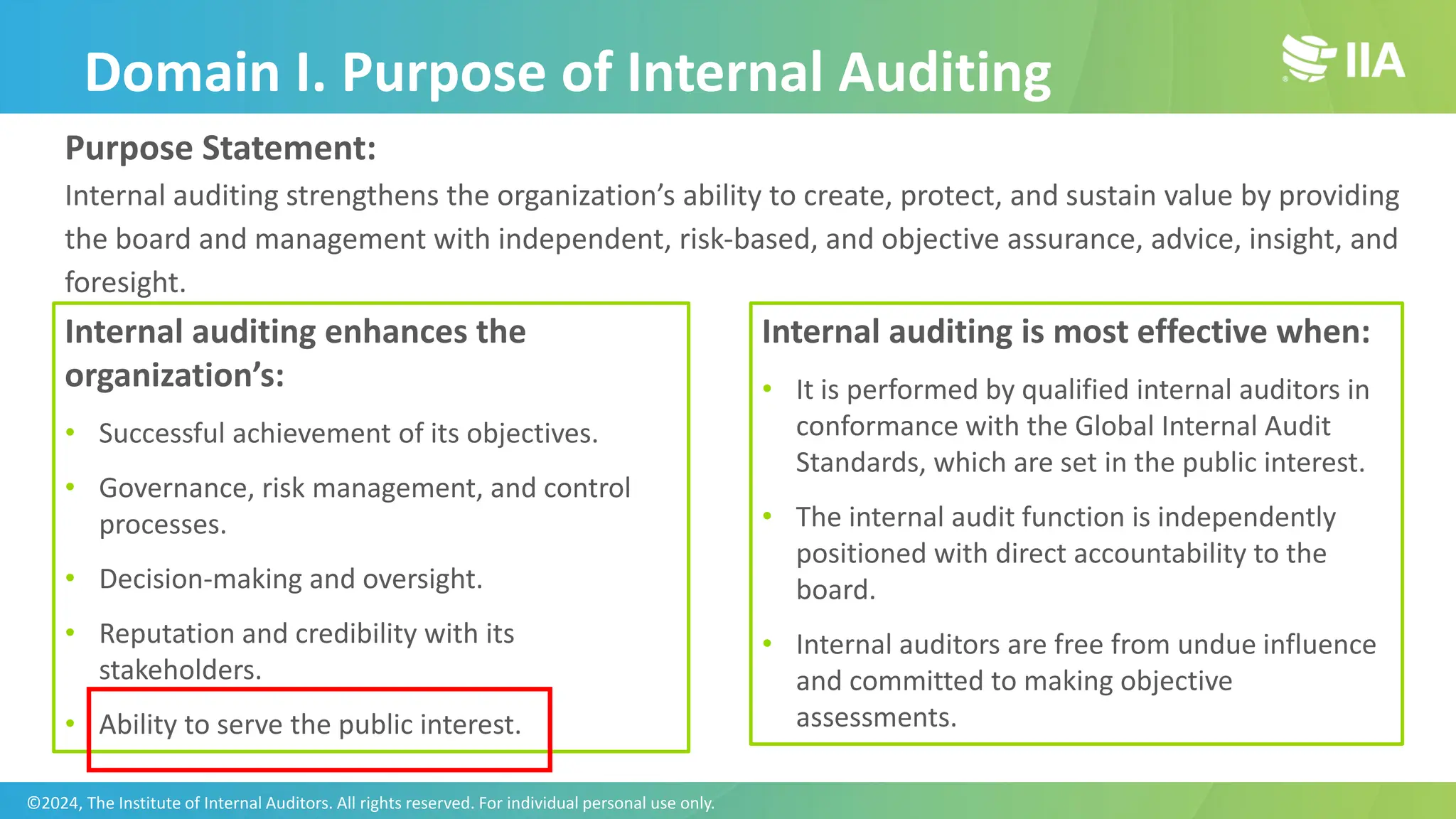
Domain I. Purpose of Internal Auditing
Purpose Statement:
Internal auditing strengthens the organization’s ability to create, protect, and sustain value by providing
the board and management with independent, risk-based, and objective assurance, advice, insight, and
foresight.
Internal auditing enhances the
organization’s:
• Successful achievement of its objectives.
• Governance, risk management, and control
processes.
• Decision-making and oversight.
• Reputation and credibility with its
stakeholders.
• Ability to serve the public interest.
Internal auditing is most effective when:
• It is performed by qualified internal auditors in
conformance with the Global Internal Audit
Standards, which are set in the public interest.
• The internal audit function is independently
positioned with direct accountability to the
board.
• Internal auditors are free from undue influence
and committed to making objective
assessments.
©2024, The Institute of Internal Auditors. All rights reserved. For individual personal use only.
1. Demonstrate
Integrity
Internal auditors
demonstrate integrity in
their work and behavior.
1.1 Honesty and
Professional
Courage
1.2 Organization’s
Ethical Expectations
1.3 Legal and
Ethical Behavior
2. Maintain
Objectivity
Internal auditors
maintain an impartial
and unbiased attitude
when performing
internal audit services
and making decisions.
2.1 Individual
Objectivity
2.2 Safeguarding
Objectivity
2.3 Disclosing
Impairments to
Objectivity
3. Demonstrate
Competency
Internal auditors apply
the knowledge, skills,
and abilities to fulfill
their roles and
responsibilities
successfully.
3.1 Competency
3.2 Continuing
Professional
Development
4. Exercise Due
Professional Care
Internal auditors apply
due professional care in
planning and performing
internal audit services.
4.1 Conformance
with Global Internal
Audit Standards
4.2 Due
Professional Care
4.3 Professional
Skepticism
5. Maintain
Confidentiality
Internal auditors use
and protect information
appropriately.
5.1 Use of
Information
5.2 Protection of
Information
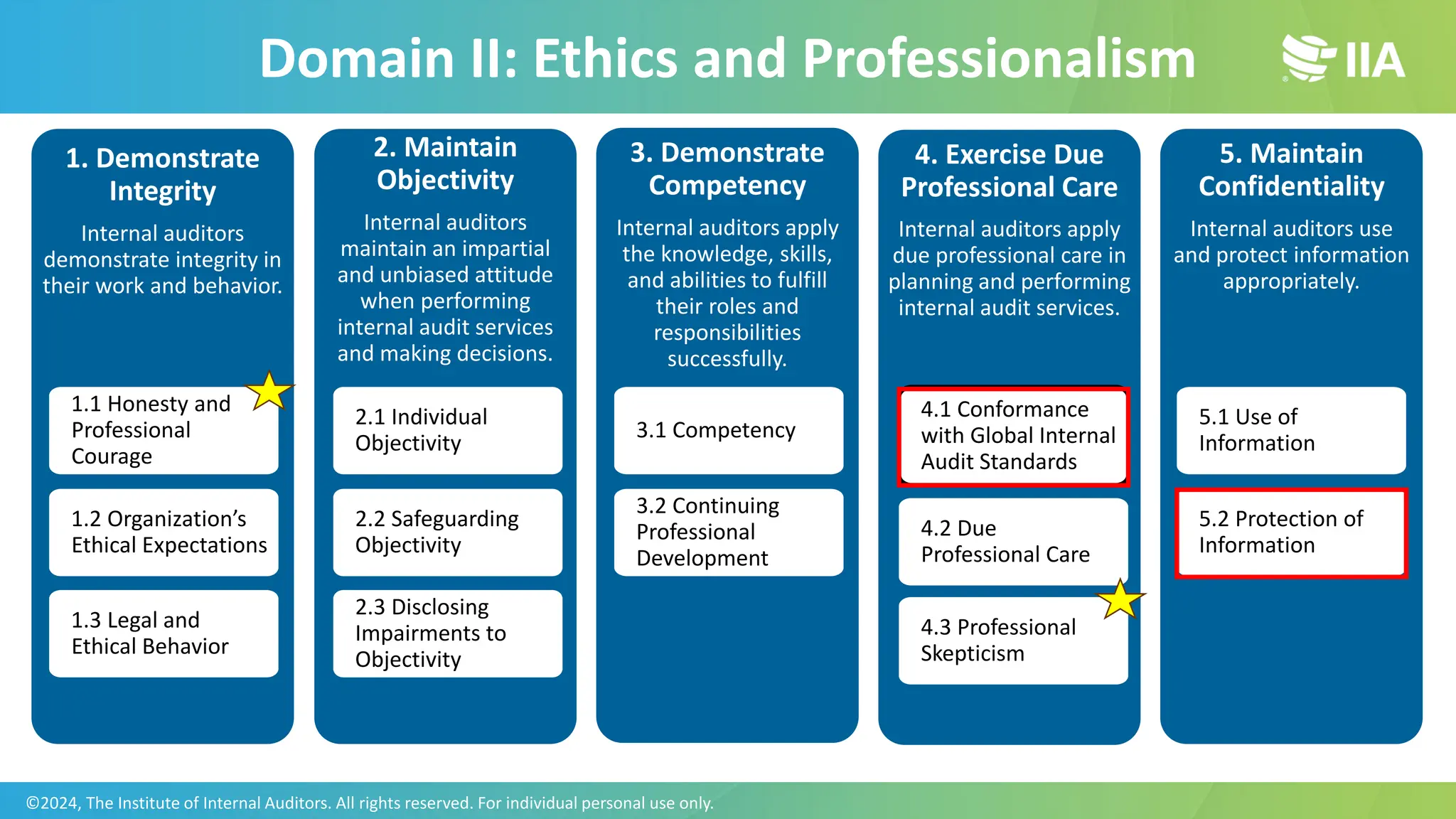
Domain II: Ethics and Professionalism
©2024, The Institute of Internal Auditors. All rights reserved. For individual personal use only.
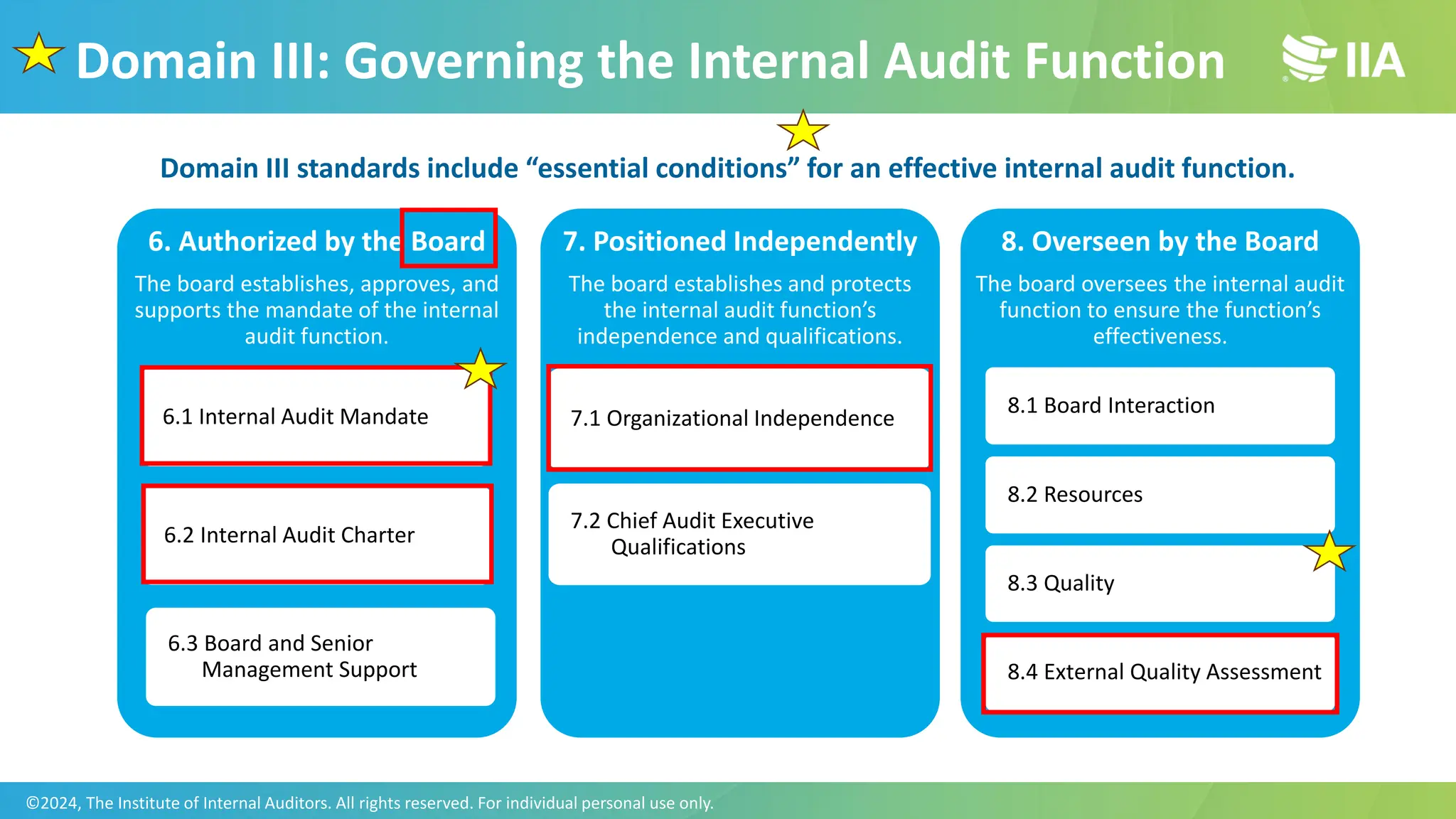
Domain III: Governing the Internal Audit Function
6. Authorized by the Board
The board establishes, approves, and
supports the mandate of the internal
audit function.
6.1 Internal Audit Mandate
6.2 Internal Audit Charter
7. Positioned Independently
The board establishes and protects
the internal audit function’s
independence and qualifications.
7.1 Organizational Independence
7.2 Chief Audit Executive
Qualifications
8. Overseen by the Board
The board oversees the internal audit
function to ensure the function’s
effectiveness.
8.1 Board Interaction
8.2 Resources
8.3 Quality
8.4 External Quality Assessment
6.3 Board and Senior
Management Support
Domain III standards include “essential conditions” for an effective internal audit function.
©2024, The Institute of Internal Auditors. All rights reserved. For individual personal use only.
Domain IV. Managing the Internal Audit Function
9. Plan Strategically
The chief audit executive plans
strategically to position the
internal audit function to fulfill its
mandate and achieve long-term
success.
9.1 Understanding Governance,
Risk Management, and
Control Processes
9.2 Internal Audit Strategy
9.3 Methodologies
9.4 Internal Audit Plan
9.5 Coordination and Reliance
10. Manage Resources
The chief audit executive
manages resources to
implement the internal audit
function’s strategy and achieve
its plan and mandate.
10.1 Financial Resource
Management
10.2 Human Resource
Management
10.3 Technological Resources
11. Communicate
Effectively
The chief audit executive guides
the internal audit function to
communicate effectively with its
stakeholders.
11.1 Building Relationships and
Communicating with Stakeholders
11.2 Effective Communication
11.3 Communicating Results
11.4 Errors and Omissions
11.5 Communicating the
Acceptance of Risks
12. Enhance Quality
The chief audit executive is
responsible for the internal
audit function’s conformance
with the Global Internal Audit
Standards and continuous
performance improvement.
12.1 Internal Quality Assessment
12.2 Performance Measurement
12.3 Oversee and Improve
Engagement Performance
©2024, The Institute of Internal Auditors. All rights reserved. For individual personal use only.
13. Plan Engagements Effectively
Internal auditors plan each engagement
using a systematic, disciplined approach.
13.1 Engagement Communication
13.2 Engagement Risk Assessment
13.3 Engagement Objectives and Scope
13.4 Evaluation Criteria
13.5 Engagement Resources
13.6 Work Program
14. Conduct Engagement Work
Internal auditors implement the engagement
work program to achieve the engagement
objectives.
14.1 Gathering Information for Analyses
and Evaluation
14.2 Analyses and Potential Engagement
Findings
14.3 Evaluation of Findings
14.4 Recommendations and Action Plans
14.5 Developing Engagement Conclusions
14.6 Documenting Engagements
15. Communicate Engagement
Conclusions and Monitor Actions
Plans
Internal auditors communicate the
engagement results to the appropriate
parties and monitor management’s
progress toward implementation of
recommendations or action plans.
15.1 Final Engagement Communication
15.2 Confirming the Implementation of
Action Plans
Domain V. Performing Internal Audit Services
©2024, The Institute of Internal Auditors. All rights reserved. For individual personal use only.
No distinction between Assurance and Advisory engagements
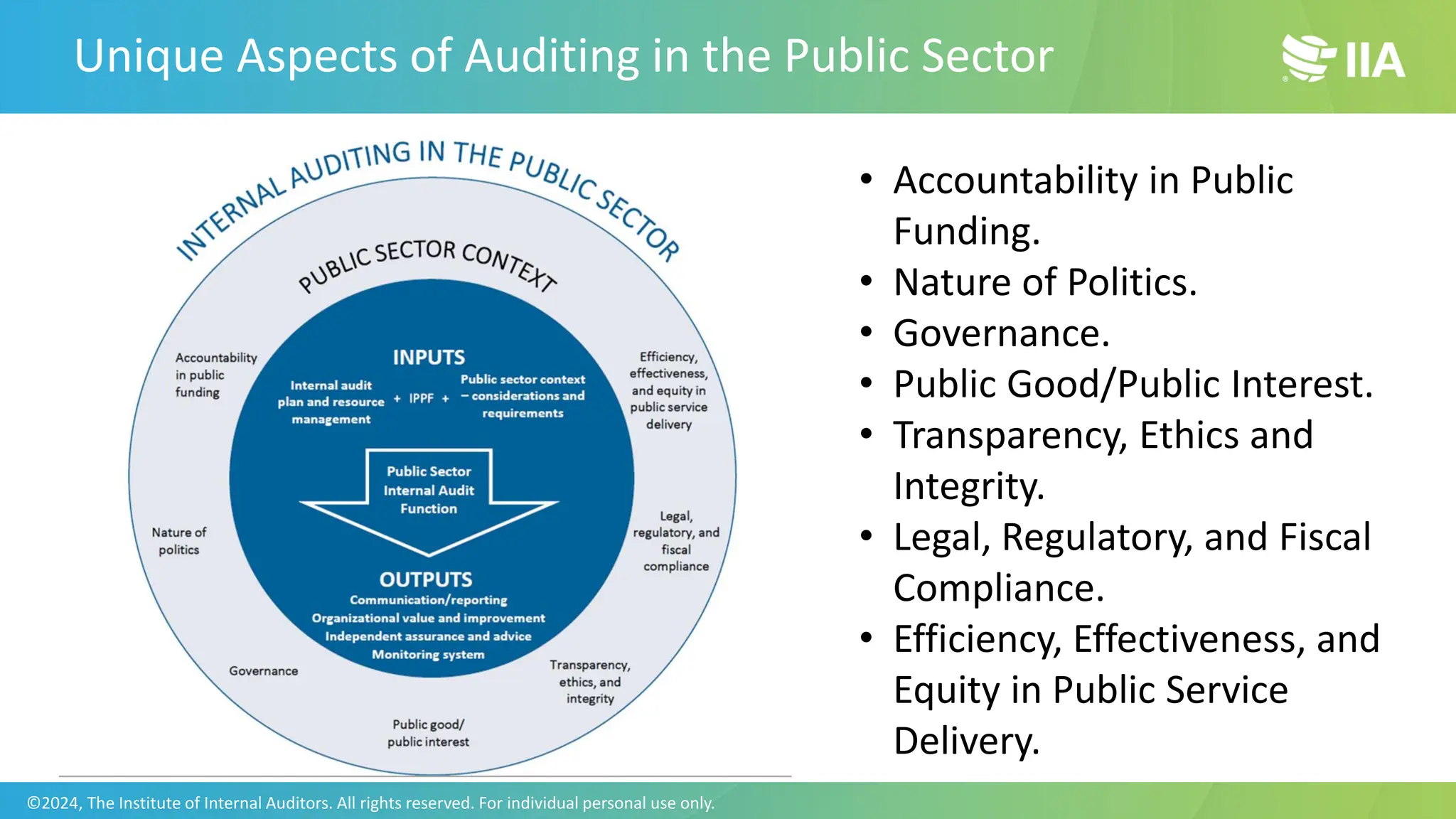
Unique Aspects of Auditing in the Public Sector
• Accountability in Public
Funding.
• Nature of Politics.
• Governance.
• Public Good/Public Interest.
• Transparency, Ethics and
Integrity.
• Legal, Regulatory, and Fiscal
Compliance.
• Efficiency, Effectiveness, and
Equity in Public Service
Delivery.
©2024, The Institute of Internal Auditors. All rights reserved. For individual personal use only.
Our Recommendations
©2024, The Institute of Internal Auditors. All rights reserved. For individual personal use only.
IIA Indonesia Recommends
Familiarize with the new
Standards
Refresh understanding on
organization values and
assess what value can
Internal Audit provides to
the organizations in
relation to GRC
Obtain feedback from key
stakeholders
Align actions and priorities
to the organization's
vision, strategy, and
governance model and
update the IA Strategic
Plan
Update the IA Charter to
incorporate the new ethics
and professionalism
Enforce ethics
Perform an IA Readiness
Assessment to identify
what needs to change to
conform with the new
Standards.
Assess Chief Audit
qualifications
Create plans to develop
coordination and
collaboration with the first
and second line
Develop Quality
Assurance and
Improvement Programme
(QAIP)
Develop IA strategic
plans: GRC-based plan,
IA strategy, restructuring
audit methodology.
Develop IA performance
measurements.
Reflect these changes in
your IA policies,
procedures, and
templates
Refresh your IA training
and development
programme
Socialize [new] IA
reporting and
communications approach
to all IA stakeholders
©2024, The Institute of Internal Auditors. All rights reserved. For individual personal use only.
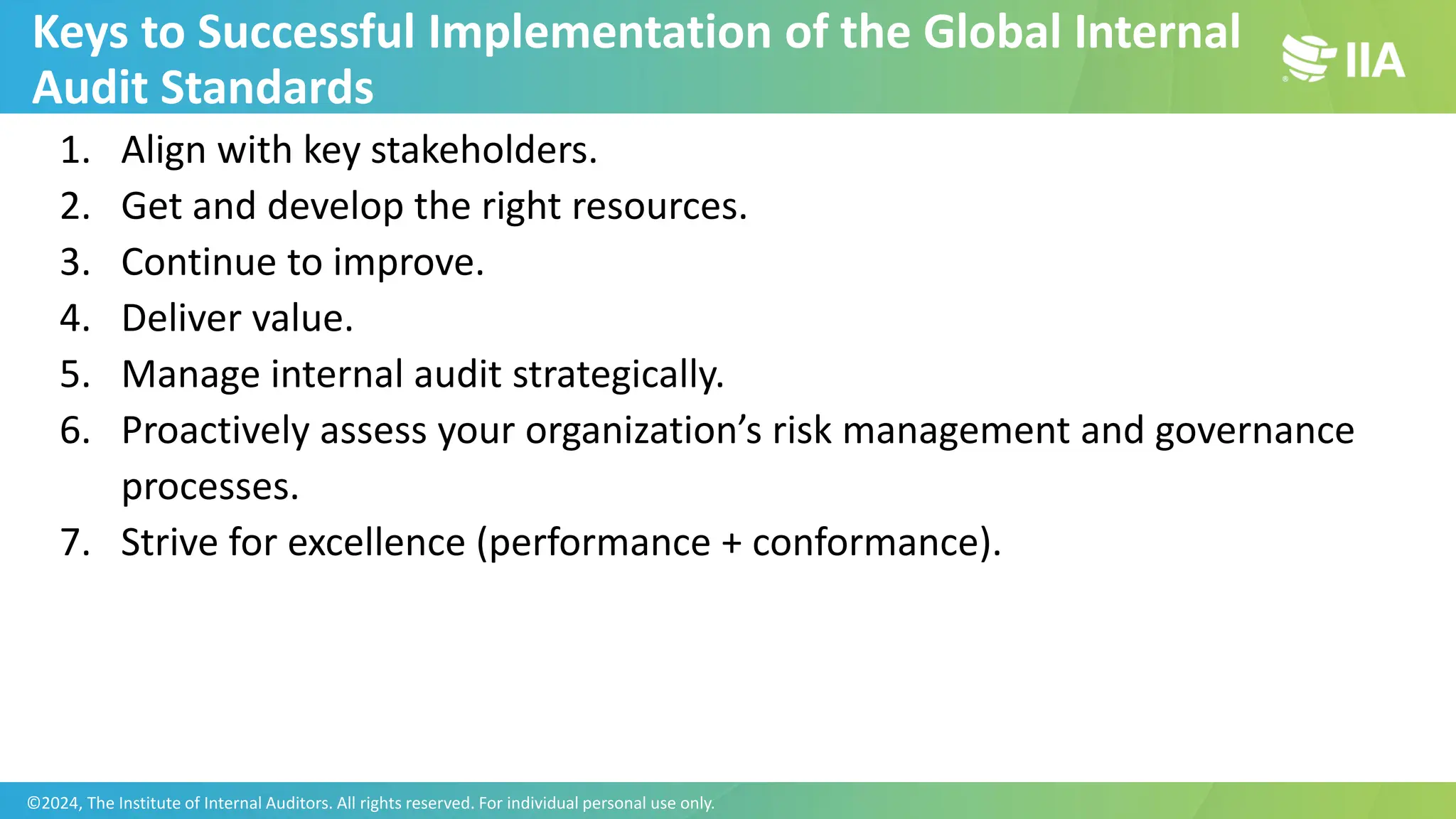
Keys to Successful Implementation of the Global Internal
Audit Standards
1. Align with key stakeholders.
2. Get and develop the right resources.
3. Continue to improve.
4. Deliver value.
5. Manage internal audit strategically.
6. Proactively assess your organization’s risk management and governance
processes.
7. Strive for excellence (performance + conformance).
©2024, The Institute of Internal Auditors. All rights reserved. For individual personal use only.
What’s Next
©2024, The Institute of Internal Auditors. All rights reserved. For individual personal use only.
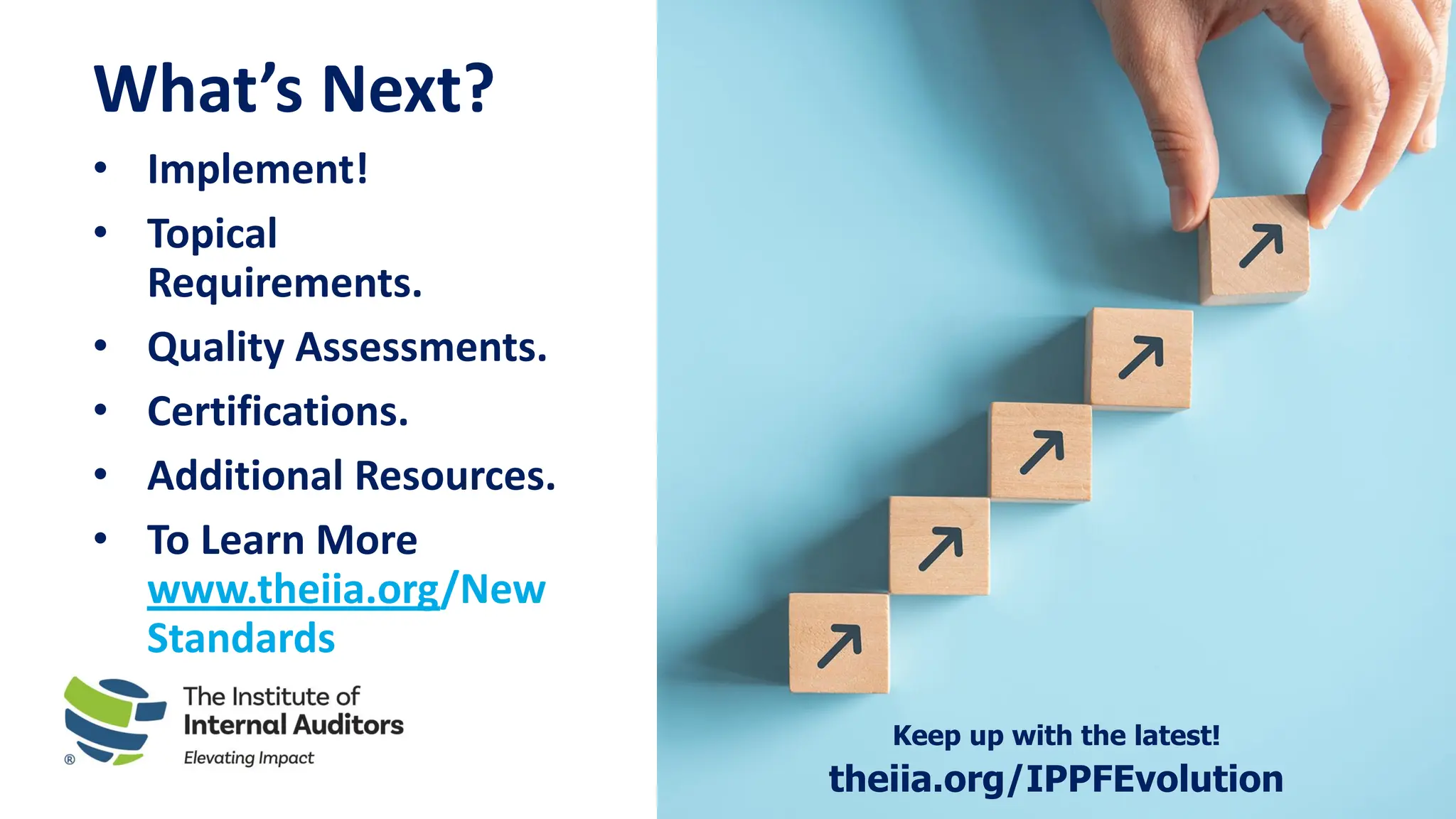
What’s Next?
• Implement!
• Topical
Requirements.
• Quality Assessments.
• Certifications.
• Additional Resources.
• To Learn More
www.theiia.org/New
Standards
Keep up with the latest!
theiia.org/IPPFEvolution
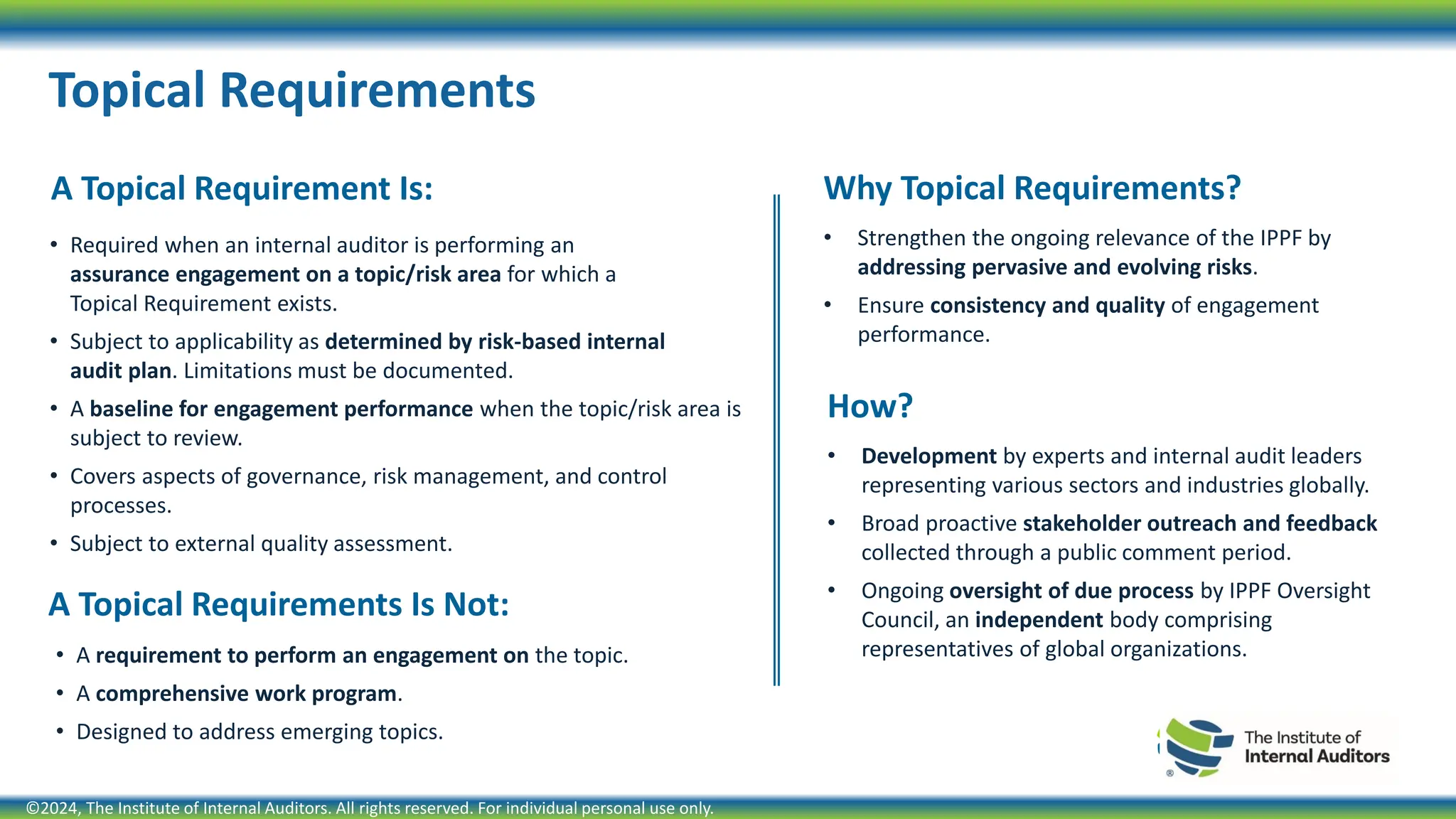
A Topical Requirement Is:
• Required when an internal auditor is performing an
assurance engagement on a topic/risk area for which a
Topical Requirement exists.
• Subject to applicability as determined by risk-based internal
audit plan. Limitations must be documented.
• A baseline for engagement performance when the topic/risk area is
subject to review.
• Covers aspects of governance, risk management, and control
processes.
• Subject to external quality assessment.
Topical Requirements
Why Topical Requirements?
• Strengthen the ongoing relevance of the IPPF by
addressing pervasive and evolving risks.
• Ensure consistency and quality of engagement
performance.
A Topical Requirements Is Not:
• A requirement to perform an engagement on the topic.
• A comprehensive work program.
• Designed to address emerging topics.
How?
• Development by experts and internal audit leaders
representing various sectors and industries globally.
• Broad proactive stakeholder outreach and feedback
collected through a public comment period.
• Ongoing oversight of due process by IPPF Oversight
Council, an independent body comprising
representatives of global organizations.
©2024, The Institute of Internal Auditors. All rights reserved. For individual personal use only.
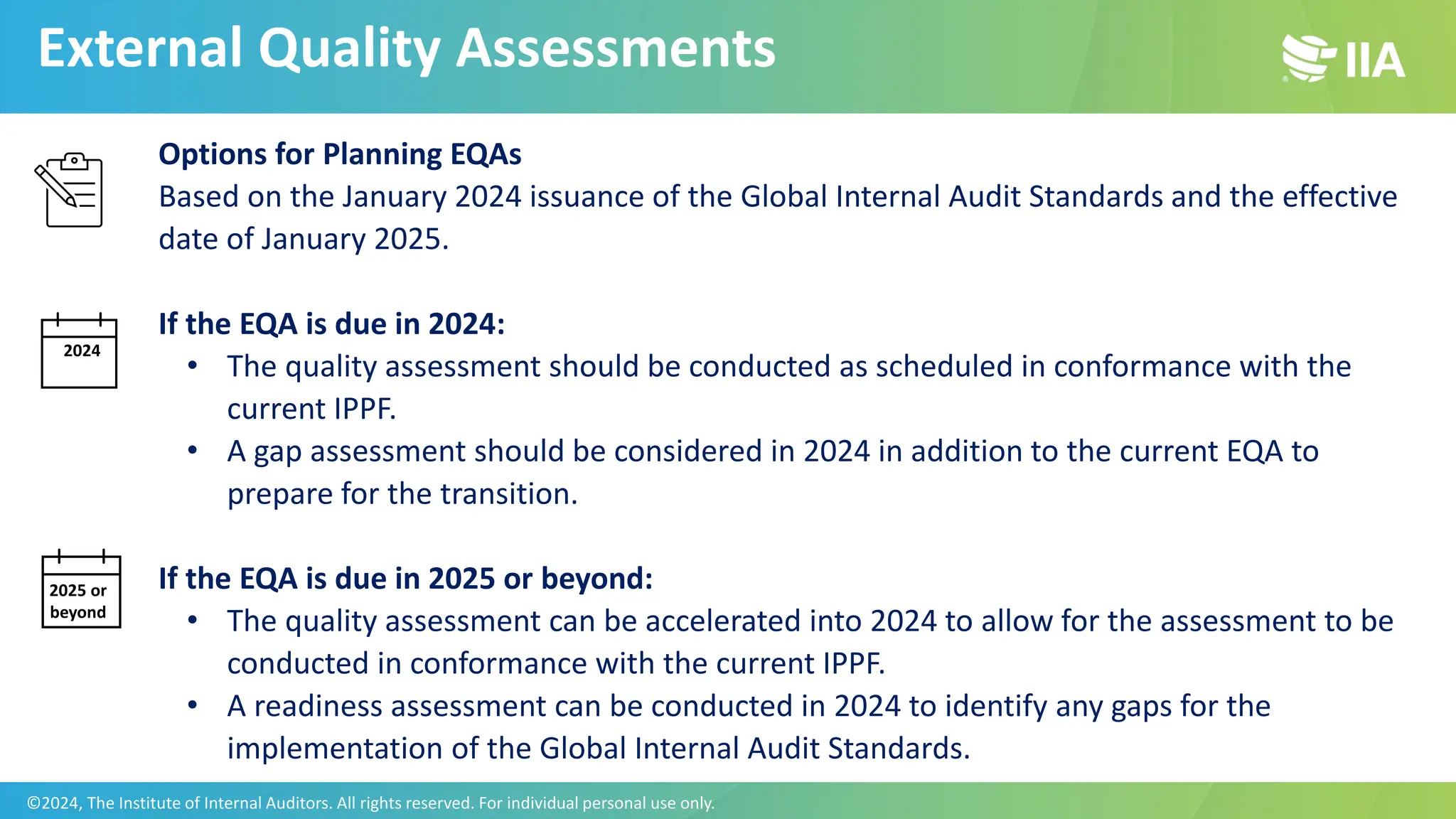
Options for Planning EQAs
Based on the January 2024 issuance of the Global Internal Audit Standards and the effective
date of January 2025.
If the EQA is due in 2024:
• The quality assessment should be conducted as scheduled in conformance with the
current IPPF.
• A gap assessment should be considered in 2024 in addition to the current EQA to
prepare for the transition.
If the EQA is due in 2025 or beyond:
• The quality assessment can be accelerated into 2024 to allow for the assessment to be
conducted in conformance with the current IPPF.
• A readiness assessment can be conducted in 2024 to identify any gaps for the
implementation of the Global Internal Audit Standards.
2024
2025 or
beyond
External Quality Assessments
©2024, The Institute of Internal Auditors. All rights reserved. For individual personal use only.
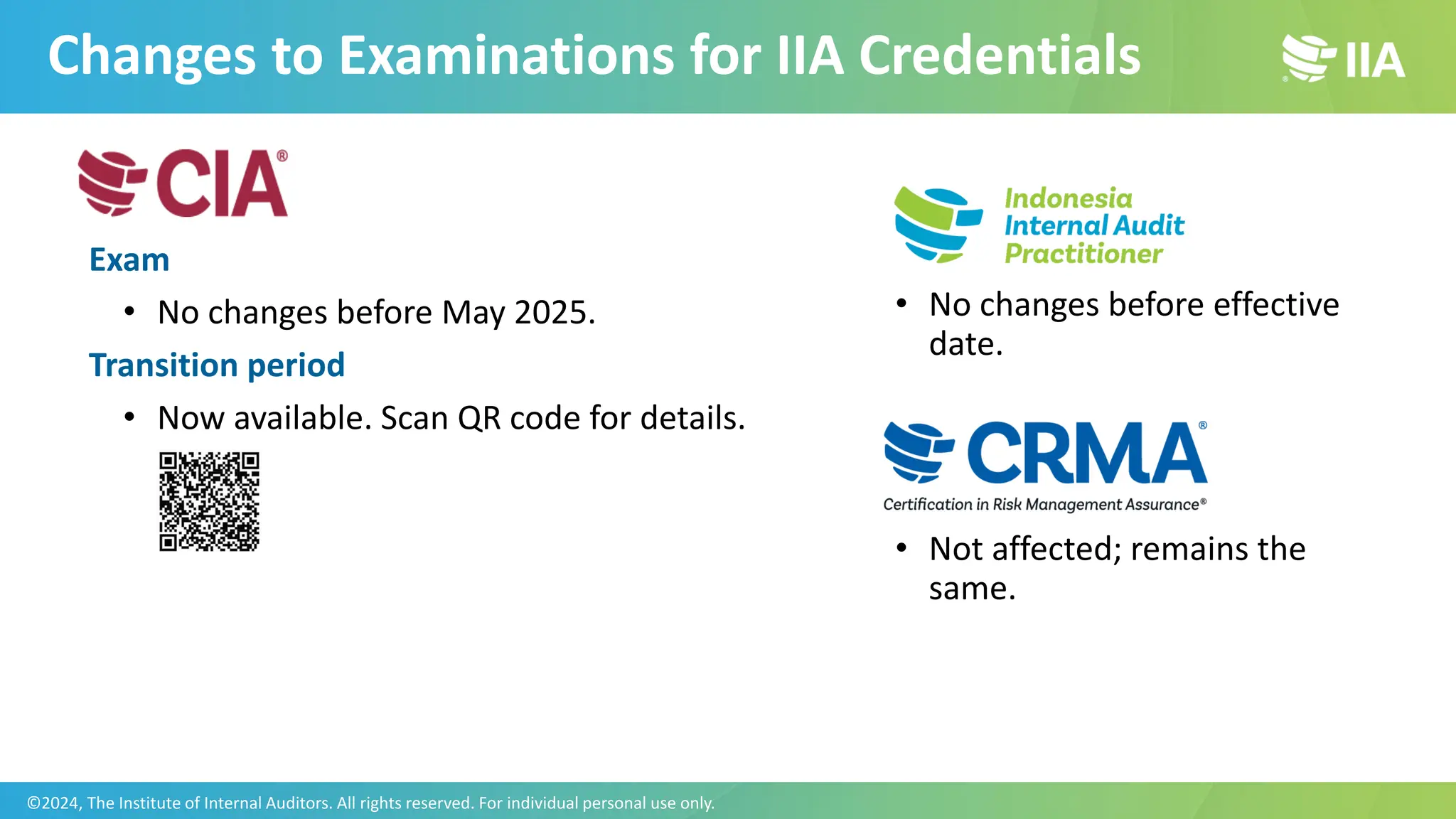
Changes to Examinations for IIA Credentials
• No changes before effective
date.
Exam
• No changes before May 2025.
Transition period
• Now available. Scan QR code for details.
• Not affected; remains the
same.
©2024, The Institute of Internal Auditors. All rights reserved. For individual personal use only.
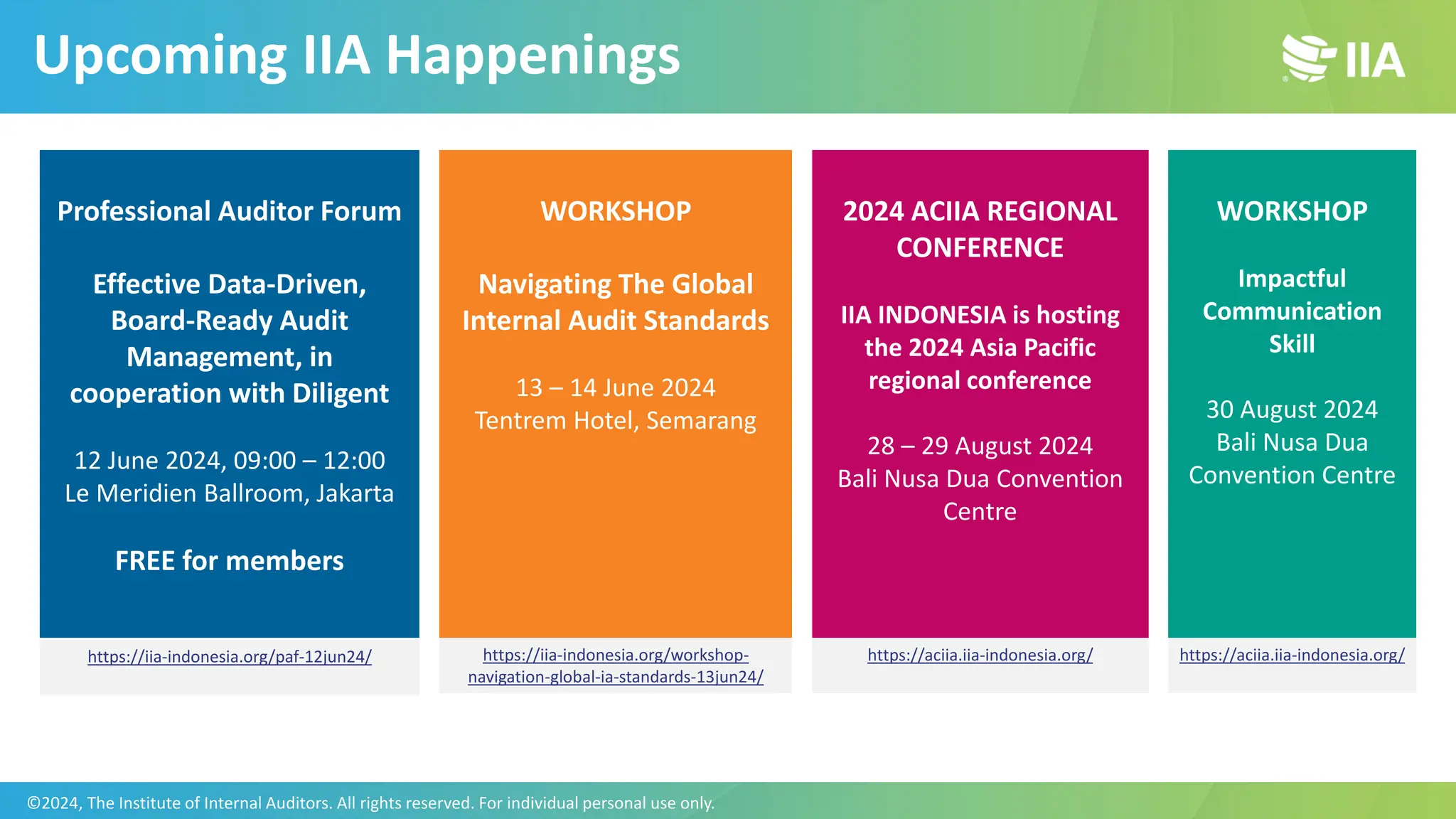
Upcoming IIA Happenings
Professional Auditor Forum
Effective Data-Driven,
Board-Ready Audit
Management, in
cooperation with Diligent
12 June 2024, 09:00 – 12:00
Le Meridien Ballroom, Jakarta
FREE for members
WORKSHOP
Navigating The Global
Internal Audit Standards
13 – 14 June 2024
Tentrem Hotel, Semarang
2024 ACIIA REGIONAL
CONFERENCE
IIA INDONESIA is hosting
the 2024 Asia Pacific
regional conference
28 – 29 August 2024
Bali Nusa Dua Convention
Centre
WORKSHOP
Impactful
Communication
Skill
30 August 2024
Bali Nusa Dua
Convention Centre
https://aciia.iia-indonesia.org/
https://iia-indonesia.org/workshop-
navigation-global-ia-standards-13jun24/
https://iia-indonesia.org/paf-12jun24/
©2024, The Institute of Internal Auditors. All rights reserved. For individual personal use only.
Q & A
The Global Internal Audit Standards and related materials are protected by
copyright law and are operated by The Institute of Internal Auditors, Inc.
(“The IIA”). ©2024 The IIA. All rights reserved.
No part of the materials including branding, graphics, or logos, available in
this publication may be copied, photocopied, reproduced, translated or
reduced to any physical, electronic medium, or machine-readable form, in
whole or in part, without specific permission from the Office of the
General Counsel of The IIA, copyright@theiia.org. Usage and distribution
for commercial purposes is strictly prohibited.
For more information, please read our statement concerning copying,
downloading and distribution of materials available on The IIA’s website at
www.theiia.org/Copyright.
COPYRIGHT NOTICE
Elevating the Standards.
Elevating the Profession.
Elevating Impact!
Thank you!

Applying the Global Internal Audit Standards_AIS.pdf

  • 1.
    Applying the Global InternalAudit Standards THE INSTITUTE OF INTERNAL AUDITORS INDONESIA PRESENTED AT FORUM PENGUATAN GRC OTORITAS JASA KEUANGAN
  • 2.
    Agenda • From ProposedStandards to Issued: IPPF Project Update, Overview of Governance and Standards-setting Process. • Overview of Updated Global Internal Audit Standards. • Applying the Global Internal Audit Standards in the Public Sector. • Our Recommendations. • What’s Next.
  • 3.
    IPPF Project Update, Overviewof Governance and Standard-setting Process
  • 4.
    Stakeholder Groups IIA MemberVolunteers (Knowledge Groups) Indirect Stakeholders (Public, non-IA Profession) Direct Stakeholders (IIA members and other in the internal audit profession) Affiliates and Chapters IPPF Governance Process provide knowledge, feedback, & input IIA Global HQ Staff coordinate, manage, market, and maintain projects IIA Global Board of Directors strategically direct and govern IPPF Oversight Council advise and oversee International Internal Audit Standards Board develop, direct, and approve Standards Global Guidance Council develop, direct, and approve Guidance GB Authorization IPPFOC Independent Oversight Project Management ©2024, The Institute of Internal Auditors. All rights reserved. For individual personal use only.
  • 5.
    International Internal AuditStandards Board (IIASB) • Mission: To serve the public interest by developing, issuing, maintaining, and promoting the International Standards for the Professional Practice of Internal Auditing on a worldwide basis. • Representing the internal audit profession globally with 21 members from 18 countries and various industries and sectors. ©2024, The Institute of Internal Auditors. All rights reserved. For individual personal use only.
  • 6.
    IPPF Oversight Council •Mission: To evaluate the due process for setting standards and guidance to promote inclusiveness and transparency, which ultimately serves the public interest and increases stakeholder confidence in The IIA’s Standards. Organizations represented: Publication: Framework for Setting Internal Audit Standards in the Public Interest ©2024, The Institute of Internal Auditors. All rights reserved. For individual personal use only.
  • 7.
    IPPF Evolution Timelinewith Resources Now Available Q2-Q4 2024 Q1-Q2 2025 • Global Internal Audit StandardsTM basic PDF. • Condensed version of the Global Internal Audit Standards. • Report on the Standard-setting and Public Comment Processes for the Global Internal Audit Standards. • 2-Way Standards and Glossary Mapping. • Updated Learning Library (2 new courses). • Internal Auditor magazine special issue. iia.mydigitalpublication.com/february-2024. • Standards Knowledge Center: Tools, courses, events, webinars, podcasts, and articles. ─ Tool: Model Internal Audit Charter (General and Public Sector). • Global Internal Audit Standards digitally enhanced e-book. • Translated Standards (including in Bahasa Indonesia). • Tool: for CAE communication with board and senior management about Domain III. • Conformance Assessment Readiness Tool • Refreshed and New Global Guidance (Global Practice Guides, Global Technology Audit Guides). • Topical Requirement on Cybersecurity – issued for public comment (Apr), followed by release (Q4). • Global Internal Audit Standards (The Redbook) hardcover book (Q3, June). • New GTAG & Practice Guide. • New Standards become effective Jan 9, 2025. • Updated Internal Audit Practitioner exam: no changes before effective date. • CIA® exam and study materials: no changes before May 2025. • New Topical Requirements – issued for public comment, followed by release. ©2024, The Institute of Internal Auditors. All rights reserved. For individual personal use only.
  • 8.
    Resources: Available atwww.theiia.org ©2024, The Institute of Internal Auditors. All rights reserved. For individual personal use only.
  • 9.
    New IPPF and GlobalInternal Audit Standards – Structure
  • 10.
    2017 2024 The IPPFEvolution ©2024, The Institute of Internal Auditors. All rights reserved. For individual personal use only.
  • 11.
    The New Structure 5Domains 15 Principles • 52 Standards • Requirements • Considerations for Implementation • Examples of Evidence of Conformance Additional features: • Fundamentals • Applying the Standards in the Public Sector • Glossary ©2024, The Institute of Internal Auditors. All rights reserved. For individual personal use only.
  • 12.
    III. Governing theInternal Audit Function 6. Authorized by the Board 7. Positioned Independently 8. Overseen by the Board IV. Managing the Internal Audit Function 9. Plan Strategically 10. Manage Resources 11. Communicate Effectively 12. Enhance Quality V. Performing Internal Audit Services 13. Plan Engagements Effectively 14. Conduct Engagement Work 15. Communicate Engagement Conclusions and Monitor Action Plans II. Ethics and Professionalism 1. Demonstrate Integrity 2. Maintain Objectivity 3. Demonstrate Competency 4. Exercise Due Professional Care 5. Maintain Confidentiality 5 Domains, 15 Principles Domain I: Purpose of Internal Auditing Global Internal Audit Standards ©2024, The Institute of Internal Auditors. All rights reserved. For individual personal use only. ©2024, The Institute of Internal Auditors. All rights reserved. For individual personal use only.
  • 13.
    Global Internal AuditStandards – Glossary & Fundamentals
  • 14.
    Glossary Old Term orConcept Updated Term consulting services advisory services engagement opinion engagement conclusion internal audit activity internal audit function purpose, authority, responsibility internal audit mandate policies and procedures (internal audit) methodologies New to the Glossary Assurance engagement supervisor Internal audit charter public sector risk tolerance competency finding internal audit manual residual risk root cause condition impact internal audit plan results of internal audit services senior management criteria inherent risk likelihood risk and control matrix stakeholder engagement planning integrity may risk assessment workpapers *Not a comprehensive list. Existing Terms With New Definitions board control processes fraud internal auditing risk appetite ©2024, The Institute of Internal Auditors. All rights reserved. For individual personal use only.
  • 15.
    Highest-level body chargedwith governance, such as: • A board of directors. • An audit committee. • A board of governors or trustees. • A group of elected officials or political appointees. • Another body that has authority over the relevant governance functions. In an organization that has more than one governing body, “board” refers to the body or bodies authorized to provide the internal audit function with the appropriate authority, role, and responsibilities. If none of the above exists, “board” should be read as referring to the group or person that acts as the organization’s highest-level governing body. Examples include the head of the organization and senior management. Board - Definition ©2024, The Institute of Internal Auditors. All rights reserved. For individual personal use only.
  • 16.
    Fundamentals of theGlobal Internal Audit Standards Elevated Introduction highlights 4 main sections: • Internal Auditing and the Public Interest. • Demonstrating Conformance with the Standards. • Application in Small Internal Audit Functions. • Application in the Public Sector. ©2024, The Institute of Internal Auditors. All rights reserved. For individual personal use only.
  • 17.
    Fundamentals of theGlobal Internal Audit Standards Demonstrating Conformance with the Standards • Conformance is expected but may not always be possible to achieve. • Examples of circumstances limiting conformance are often related to insufficient resources or specific aspects of a sector, industry, and/or jurisdiction. • Implement alternative actions to achieve intent of related standard when possible. • Documentation and communication of nonconformance is required. ©2024, The Institute of Internal Auditors. All rights reserved. For individual personal use only.
  • 18.
    The Introduction willrecognize the challenges Small Internal Audit Functions may face in conforming with the Global Internal Audit Standards: • Internal audit functions must determine for themselves if they are ‘small.’ • Small may be dependent on the size of the organization or the size of the internal audit function itself. • The most significant impacts are likely to be resources and the ability to meet all the requirements (such as supervision). • Single person functions may be especially challenged to adequately implement a Quality Assurance Improvement Program. Small Internal Audit Functions ©2024, The Institute of Internal Auditors. All rights reserved. For individual personal use only.
  • 19.
    Global Internal AuditStandards: Domains ©2024, The Institute of Internal Auditors. All rights reserved. For individual personal use only.
  • 20.
    Domain I: Purposeof Internal Auditing Purpose Statement: Internal auditing strengthens the organization’s ability to create, protect, and sustain value by providing the board and management with independent, risk-based, and objective assurance, advice, insight, and foresight. Internal auditing enhances the organization’s: • Successful achievement of its objectives. • Governance, risk management, and control processes. • Decision-making and oversight. • Reputation and credibility with its stakeholders. • Ability to serve the public interest. Internal auditing is most effective when: • It is performed by competent professionals in conformance with the Global Internal Audit Standards, which are set in the public interest. • The internal audit function is independently positioned with direct accountability to the board. • Internal auditors are free from undue influence and committed to making objective assessments. ©2024, The Institute of Internal Auditors. All rights reserved. For individual personal use only.
  • 21.
    1. Demonstrate Integrity Internal auditors demonstrateintegrity in their work and behavior. 1.1 Honesty and Professional Courage 1.2 Organization’s Ethical Expectations 1.3 Legal and Ethical Behavior 2. Maintain Objectivity Internal auditors maintain an impartial and unbiased attitude when performing internal audit services and making decisions. 2.1 Individual Objectivity 2.2 Safeguarding Objectivity 2.3 Disclosing Impairments to Objectivity 3. Demonstrate Competency Internal auditors apply the knowledge, skills, and abilities to fulfill their roles and responsibilities successfully. 3.1 Competency 3.2 Continuing Professional Development 4. Exercise Due Professional Care Internal auditors apply due professional care in planning and performing internal audit services. 4.1 Conformance with Global Internal Audit Standards 4.2 Due Professional Care 4.3 Professional Skepticism 5. Maintain Confidentiality Internal auditors use and protect information appropriately. 5.1 Use of Information 5.2 Protection of Information Domain II: Ethics and Professionalism ©2024, The Institute of Internal Auditors. All rights reserved. For individual personal use only.
  • 22.
    Domain III: Governingthe Internal Audit Function 6. Authorized by the Board The board establishes, approves, and supports the mandate of the internal audit function. 6.1 Internal Audit Mandate 6.2 Internal Audit Charter 7. Positioned Independently The board establishes and protects the internal audit function’s independence and qualifications. 7.1 Organizational Independence 7.2 Chief Audit Executive Qualifications 8. Overseen by the Board The board oversees the internal audit function to ensure the function’s effectiveness. 8.1 Board Interaction 8.2 Resources 8.3 Quality 8.4 External Quality Assessment 6.3 Board and Senior Management Support Domain III standards include “essential conditions” for an effective internal audit function. ©2024, The Institute of Internal Auditors. All rights reserved. For individual personal use only.
  • 23.
    Domain IV: Managingthe Internal Audit Function 9. Plan Strategically The chief audit executive plans strategically to position the internal audit function to fulfill its mandate and achieve long-term success. 9.1 Understanding Governance, Risk Management, and Control Processes 9.2 Internal Audit Strategy 9.3 Methodologies 9.4 Internal Audit Plan 9.5 Coordination and Reliance 10. Manage Resources The chief audit executive manages resources to implement the internal audit function’s strategy and achieve its plan and mandate. 10.1 Financial Resource Management 10.2 Human Resource Management 10.3 Technological Resources 11. Communicate Effectively The chief audit executive guides the internal audit function to communicate effectively with its stakeholders. 11.1 Building Relationships and Communicating with Stakeholders 11.2 Effective Communication 11.3 Communicating Results 11.4 Errors and Omissions 11.5 Communicating the Acceptance of Risks 12. Enhance Quality The chief audit executive is responsible for the internal audit function’s conformance with the Global Internal Audit Standards and continuous performance improvement. 12.1 Internal Quality Assessment 12.2 Performance Measurement 12.3 Oversee and Improve Engagement Performance ©2024, The Institute of Internal Auditors. All rights reserved. For individual personal use only.
  • 24.
    13. Plan EngagementsEffectively Internal auditors plan each engagement using a systematic, disciplined approach. 13.1 Engagement Communication 13.2 Engagement Risk Assessment 13.3 Engagement Objectives and Scope 13.4 Evaluation Criteria 13.5 Engagement Resources 13.6 Work Program 14. Conduct Engagement Work Internal auditors implement the engagement work program to achieve the engagement objectives. 14.1 Gathering Information for Analyses and Evaluation 14.2 Analyses and Potential Engagement Findings 14.3 Evaluation of Findings 14.4 Recommendations and Action Plans 14.5 Developing Engagement Conclusions 14.6 Documenting Engagements 15. Communicate Engagement Conclusions and Monitor Actions Plans Internal auditors communicate the engagement results to the appropriate parties and monitor management’s progress toward implementation of recommendations or action plans. 15.1 Final Engagement Communication 15.2 Confirming the Implementation of Action Plans Domain V: Performing Internal Audit Services ©2024, The Institute of Internal Auditors. All rights reserved. For individual personal use only.
  • 25.
    Applying the GlobalInternal Audit Standards in the Public Sector ©2024, The Institute of Internal Auditors. All rights reserved. For individual personal use only.
  • 26.
    Domain I. Purposeof Internal Auditing Purpose Statement: Internal auditing strengthens the organization’s ability to create, protect, and sustain value by providing the board and management with independent, risk-based, and objective assurance, advice, insight, and foresight. Internal auditing enhances the organization’s: • Successful achievement of its objectives. • Governance, risk management, and control processes. • Decision-making and oversight. • Reputation and credibility with its stakeholders. • Ability to serve the public interest. Internal auditing is most effective when: • It is performed by qualified internal auditors in conformance with the Global Internal Audit Standards, which are set in the public interest. • The internal audit function is independently positioned with direct accountability to the board. • Internal auditors are free from undue influence and committed to making objective assessments. ©2024, The Institute of Internal Auditors. All rights reserved. For individual personal use only.
  • 27.
    1. Demonstrate Integrity Internal auditors demonstrateintegrity in their work and behavior. 1.1 Honesty and Professional Courage 1.2 Organization’s Ethical Expectations 1.3 Legal and Ethical Behavior 2. Maintain Objectivity Internal auditors maintain an impartial and unbiased attitude when performing internal audit services and making decisions. 2.1 Individual Objectivity 2.2 Safeguarding Objectivity 2.3 Disclosing Impairments to Objectivity 3. Demonstrate Competency Internal auditors apply the knowledge, skills, and abilities to fulfill their roles and responsibilities successfully. 3.1 Competency 3.2 Continuing Professional Development 4. Exercise Due Professional Care Internal auditors apply due professional care in planning and performing internal audit services. 4.1 Conformance with Global Internal Audit Standards 4.2 Due Professional Care 4.3 Professional Skepticism 5. Maintain Confidentiality Internal auditors use and protect information appropriately. 5.1 Use of Information 5.2 Protection of Information Domain II: Ethics and Professionalism ©2024, The Institute of Internal Auditors. All rights reserved. For individual personal use only.
  • 28.
    Domain III: Governingthe Internal Audit Function 6. Authorized by the Board The board establishes, approves, and supports the mandate of the internal audit function. 6.1 Internal Audit Mandate 6.2 Internal Audit Charter 7. Positioned Independently The board establishes and protects the internal audit function’s independence and qualifications. 7.1 Organizational Independence 7.2 Chief Audit Executive Qualifications 8. Overseen by the Board The board oversees the internal audit function to ensure the function’s effectiveness. 8.1 Board Interaction 8.2 Resources 8.3 Quality 8.4 External Quality Assessment 6.3 Board and Senior Management Support Domain III standards include “essential conditions” for an effective internal audit function. ©2024, The Institute of Internal Auditors. All rights reserved. For individual personal use only.
  • 29.
    Domain IV. Managingthe Internal Audit Function 9. Plan Strategically The chief audit executive plans strategically to position the internal audit function to fulfill its mandate and achieve long-term success. 9.1 Understanding Governance, Risk Management, and Control Processes 9.2 Internal Audit Strategy 9.3 Methodologies 9.4 Internal Audit Plan 9.5 Coordination and Reliance 10. Manage Resources The chief audit executive manages resources to implement the internal audit function’s strategy and achieve its plan and mandate. 10.1 Financial Resource Management 10.2 Human Resource Management 10.3 Technological Resources 11. Communicate Effectively The chief audit executive guides the internal audit function to communicate effectively with its stakeholders. 11.1 Building Relationships and Communicating with Stakeholders 11.2 Effective Communication 11.3 Communicating Results 11.4 Errors and Omissions 11.5 Communicating the Acceptance of Risks 12. Enhance Quality The chief audit executive is responsible for the internal audit function’s conformance with the Global Internal Audit Standards and continuous performance improvement. 12.1 Internal Quality Assessment 12.2 Performance Measurement 12.3 Oversee and Improve Engagement Performance ©2024, The Institute of Internal Auditors. All rights reserved. For individual personal use only.
  • 30.
    13. Plan EngagementsEffectively Internal auditors plan each engagement using a systematic, disciplined approach. 13.1 Engagement Communication 13.2 Engagement Risk Assessment 13.3 Engagement Objectives and Scope 13.4 Evaluation Criteria 13.5 Engagement Resources 13.6 Work Program 14. Conduct Engagement Work Internal auditors implement the engagement work program to achieve the engagement objectives. 14.1 Gathering Information for Analyses and Evaluation 14.2 Analyses and Potential Engagement Findings 14.3 Evaluation of Findings 14.4 Recommendations and Action Plans 14.5 Developing Engagement Conclusions 14.6 Documenting Engagements 15. Communicate Engagement Conclusions and Monitor Actions Plans Internal auditors communicate the engagement results to the appropriate parties and monitor management’s progress toward implementation of recommendations or action plans. 15.1 Final Engagement Communication 15.2 Confirming the Implementation of Action Plans Domain V. Performing Internal Audit Services ©2024, The Institute of Internal Auditors. All rights reserved. For individual personal use only. No distinction between Assurance and Advisory engagements
  • 31.
    Unique Aspects ofAuditing in the Public Sector • Accountability in Public Funding. • Nature of Politics. • Governance. • Public Good/Public Interest. • Transparency, Ethics and Integrity. • Legal, Regulatory, and Fiscal Compliance. • Efficiency, Effectiveness, and Equity in Public Service Delivery. ©2024, The Institute of Internal Auditors. All rights reserved. For individual personal use only.
  • 32.
    Our Recommendations ©2024, TheInstitute of Internal Auditors. All rights reserved. For individual personal use only.
  • 33.
    IIA Indonesia Recommends Familiarizewith the new Standards Refresh understanding on organization values and assess what value can Internal Audit provides to the organizations in relation to GRC Obtain feedback from key stakeholders Align actions and priorities to the organization's vision, strategy, and governance model and update the IA Strategic Plan Update the IA Charter to incorporate the new ethics and professionalism Enforce ethics Perform an IA Readiness Assessment to identify what needs to change to conform with the new Standards. Assess Chief Audit qualifications Create plans to develop coordination and collaboration with the first and second line Develop Quality Assurance and Improvement Programme (QAIP) Develop IA strategic plans: GRC-based plan, IA strategy, restructuring audit methodology. Develop IA performance measurements. Reflect these changes in your IA policies, procedures, and templates Refresh your IA training and development programme Socialize [new] IA reporting and communications approach to all IA stakeholders ©2024, The Institute of Internal Auditors. All rights reserved. For individual personal use only.
  • 34.
    Keys to SuccessfulImplementation of the Global Internal Audit Standards 1. Align with key stakeholders. 2. Get and develop the right resources. 3. Continue to improve. 4. Deliver value. 5. Manage internal audit strategically. 6. Proactively assess your organization’s risk management and governance processes. 7. Strive for excellence (performance + conformance). ©2024, The Institute of Internal Auditors. All rights reserved. For individual personal use only.
  • 35.
    What’s Next ©2024, TheInstitute of Internal Auditors. All rights reserved. For individual personal use only.
  • 36.
    What’s Next? • Implement! •Topical Requirements. • Quality Assessments. • Certifications. • Additional Resources. • To Learn More www.theiia.org/New Standards Keep up with the latest! theiia.org/IPPFEvolution
  • 37.
    A Topical RequirementIs: • Required when an internal auditor is performing an assurance engagement on a topic/risk area for which a Topical Requirement exists. • Subject to applicability as determined by risk-based internal audit plan. Limitations must be documented. • A baseline for engagement performance when the topic/risk area is subject to review. • Covers aspects of governance, risk management, and control processes. • Subject to external quality assessment. Topical Requirements Why Topical Requirements? • Strengthen the ongoing relevance of the IPPF by addressing pervasive and evolving risks. • Ensure consistency and quality of engagement performance. A Topical Requirements Is Not: • A requirement to perform an engagement on the topic. • A comprehensive work program. • Designed to address emerging topics. How? • Development by experts and internal audit leaders representing various sectors and industries globally. • Broad proactive stakeholder outreach and feedback collected through a public comment period. • Ongoing oversight of due process by IPPF Oversight Council, an independent body comprising representatives of global organizations. ©2024, The Institute of Internal Auditors. All rights reserved. For individual personal use only.
  • 38.
    Options for PlanningEQAs Based on the January 2024 issuance of the Global Internal Audit Standards and the effective date of January 2025. If the EQA is due in 2024: • The quality assessment should be conducted as scheduled in conformance with the current IPPF. • A gap assessment should be considered in 2024 in addition to the current EQA to prepare for the transition. If the EQA is due in 2025 or beyond: • The quality assessment can be accelerated into 2024 to allow for the assessment to be conducted in conformance with the current IPPF. • A readiness assessment can be conducted in 2024 to identify any gaps for the implementation of the Global Internal Audit Standards. 2024 2025 or beyond External Quality Assessments ©2024, The Institute of Internal Auditors. All rights reserved. For individual personal use only.
  • 39.
    Changes to Examinationsfor IIA Credentials • No changes before effective date. Exam • No changes before May 2025. Transition period • Now available. Scan QR code for details. • Not affected; remains the same. ©2024, The Institute of Internal Auditors. All rights reserved. For individual personal use only.
  • 40.
    Upcoming IIA Happenings ProfessionalAuditor Forum Effective Data-Driven, Board-Ready Audit Management, in cooperation with Diligent 12 June 2024, 09:00 – 12:00 Le Meridien Ballroom, Jakarta FREE for members WORKSHOP Navigating The Global Internal Audit Standards 13 – 14 June 2024 Tentrem Hotel, Semarang 2024 ACIIA REGIONAL CONFERENCE IIA INDONESIA is hosting the 2024 Asia Pacific regional conference 28 – 29 August 2024 Bali Nusa Dua Convention Centre WORKSHOP Impactful Communication Skill 30 August 2024 Bali Nusa Dua Convention Centre https://aciia.iia-indonesia.org/ https://aciia.iia-indonesia.org/ https://iia-indonesia.org/workshop- navigation-global-ia-standards-13jun24/ https://iia-indonesia.org/paf-12jun24/ ©2024, The Institute of Internal Auditors. All rights reserved. For individual personal use only.
  • 41.
  • 42.
    The Global InternalAudit Standards and related materials are protected by copyright law and are operated by The Institute of Internal Auditors, Inc. (“The IIA”). ©2024 The IIA. All rights reserved. No part of the materials including branding, graphics, or logos, available in this publication may be copied, photocopied, reproduced, translated or reduced to any physical, electronic medium, or machine-readable form, in whole or in part, without specific permission from the Office of the General Counsel of The IIA, copyright@theiia.org. Usage and distribution for commercial purposes is strictly prohibited. For more information, please read our statement concerning copying, downloading and distribution of materials available on The IIA’s website at www.theiia.org/Copyright. COPYRIGHT NOTICE
  • 43.
    Elevating the Standards. Elevatingthe Profession. Elevating Impact! Thank you!