Introduction to Risk-Neutral Valuation
                  - Ashwin Rao


Aug 25, 2010
WHAT ARE DERIVATIVE SECURITIES ?

 • Fundamental Securities – eg: stocks and bonds
 • Derivative Securities - Contract between two parties
 • The contract specifies a contingent future financial claim
 • Contingent on the value of a fundamental security
 • The fundamental security is refered to as the underlying
 asset
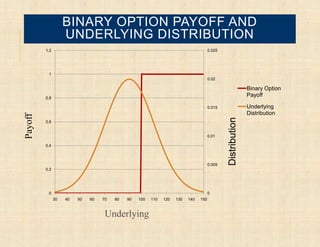
 • A simple example – A binary option
 • How much would you pay to own this binary option ?
 • Key question: What is the expected payoff ?
 • What information is reqd to figure out the expected payoff
 ?
BINARY OPTION PAYOFF AND
                    UNDERLYING DISTRIBUTION
         1.2                                                                          0.025


          1
                                                                                      0.02

                                                                                                             Binary Option
         0.8
                                                                                                             Payoff

                                                                                      0.015                  Underlying
                                                                                                             Distribution
Payoff


                                                                                              Distribution
         0.6


                                                                                      0.01

         0.4


                                                                                      0.005
         0.2


          0                                                                           0
               30   40   50   60   70   80   90   100   110   120   130   140   150


                                    Underlying
A CASINO GAME
• The game operator tosses a fair coin

• You win Rs. 100 if it’s a HEAD and 0 is it’s a TAIL

• How much should you pay to play this game ?

• Would you rather play a game where you get Rs. 50 for both H & T ?

• What if you get Rs. 1 Crore for H and Rs. 0 for T ?

• Depends on your risk attitude

• Risk-averse or Risk-neutral or Risk-seeking

• What is the risk premium for a risk-averse individual ?
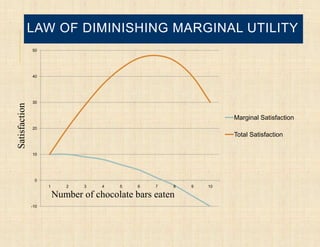
LAW OF DIMINISHING MARGINAL UTILITY
               50


               40


               30
Satisfaction


                                                                   Marginal Satisfaction
               20
                                                                   Total Satisfaction

               10


                0
                     1      2   3    4   5    6   7   8   9   10

                         Number of chocolate bars eaten
               -10
LAW OF DIMINISHING MARGINAL UTILITY

• Note that the total utility function f(x) is concave


• Let x (qty of consumption) be uncertain (some probability distribution)

• Then, E[ f(x) ] < f( E[x] ) (Jensen’s inequality)

• Expected Utility is less than Utility at Expected Consumption

• Consumption y that gives you the expected utility: f(y) = E[ f(x) ]

• So, when faced with uncertain consumption x, we will pay y < E[x]
LAW OF DMU                                 RISK-AVERSION

• E[x] is called the expected value

• y is called the “certainty equivalent”

• y – E[x] is called the “risk premium”

• y – E[x] depends on the utility concavity and distribution
variance

• More concavity means more risk premium and more risk-
aversion

• So to play a game with an uncertain payoff, people would

   Generally pay less than the expected payoff
A SIMPLE DERIVATIVE – FORWARD CONTRACT

  • Contract between two parties X and Y

  • X promises to deliver an asset to Y at a future point in time t

  • Y promises to pay X an amount of Rs. F at the same time t

  • Contract made at time 0 and value of F also established at
  time 0

  • F is called the forward price of the asset

  • What is the fair value of F ?

  • Expectation-based pricing to arrive at the value of F is
  wrong
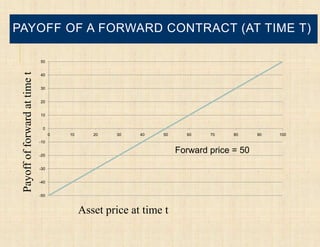
PAYOFF OF A FORWARD CONTRACT (AT TIME T)

                               50
 Payoff of forward at time t


                               40


                               30


                               20


                               10


                                0
                                     0   10      20   30    40   50     60    70    80     90   100
                               -10


                               -20
                                                                      Forward price = 50
                               -30


                               -40


                               -50


                                              Asset price at time t
TIME VALUE OF MONEY

• The concept of risk-free interest rate is very important

• Deposit Rs. 1 and get back Rs. 1+r at time t (rate r for time
t)

• So, Rs. X today is worth Rs. X*(1+r) in time t

• If I’ll have Rs. Y at time t, it is worth Rs. Y/(1+r) today

• So you have to discount future wealth when valuing them
today


• With continuously compound interest, er instead of (1+r)
ARBITRAGE

• The concept of arbitrage is also very important

• Zero wealth today (at time 0)

• Positive wealth in at least one future state of the world (at
time t)

• Negative wealth in no future state of the world (at time t)

• So, starting with 0 wealth, you can guarantee positive
wealth

• Arbitrage = Riskless profit at zero cost

• Fundamental concept: Arbitrage cannot exist in financial
USE THESE CONCEPTS TO VALUE A FORWARD

  • Contract: At time t, you have to deliver asset A and receive Rs. F
  • Assume today’s (t = 0) price of asset A = Rs. S
  • Step 1: At time 0, borrow Rs. S for time t
  • Step 2: At time 0, buy one unit of asset A
  • Step 3: At time t, deliver asset A as per contract
  • Step 4: At time t, receive Rs. F as per contract
  • Step 5: Use the Rs. F to return Rs. Sert of borrowed money
  • If F > Sert , you have made riskless money out of nowhere
  • Make similar arbitrage argument for your counterparty
  • Arbitrage forces F to be equal to Sert
REPLICATING PORTFOLIO FOR A FORWARD

 • A Forward can be replicated by fundamental securities
 • Fundamental Securities are the Asset and Bonds
 • “Long Forward”: At time t, Receive Asset & Pay Forward Price
 F
 • “Long Asset”: Owner of 1 unit of asset
 • “Long Bond”: Lend money for time t (receiving back Rs.1 at t)
 • “Short positions” are the other side (opposite) of “Long
 positions”
 • “Long Forward” equivalent to [“Long 1 Asset”, “Short F
 Bonds”]
 • Because they both have exactly the same payoff at time t
 • This is called the Replicating Portfolio for a forward
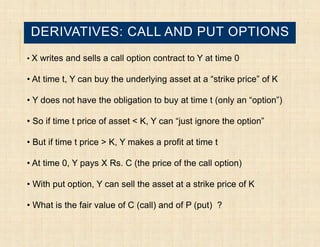
DERIVATIVES: CALL AND PUT OPTIONS
• X writes and sells a call option contract to Y at time 0

• At time t, Y can buy the underlying asset at a “strike price” of K

• Y does not have the obligation to buy at time t (only an “option”)

• So if time t price of asset < K, Y can “just ignore the option”

• But if time t price > K, Y makes a profit at time t

• At time 0, Y pays X Rs. C (the price of the call option)

• With put option, Y can sell the asset at a strike price of K

• What is the fair value of C (call) and of P (put) ?
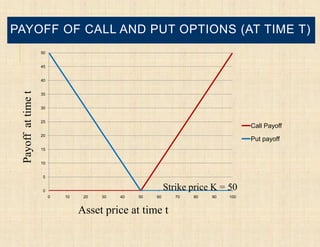
PAYOFF OF CALL AND PUT OPTIONS (AT TIME T)
                    50


                    45


                    40
 Payoff at time t


                    35


                    30


                    25
                                                                                    Call Payoff
                    20
                                                                                    Put payoff
                    15


                    10


                    5


                    0
                                                            Strike price K = 50
                         0   10    20   30   40   50   60      70   80   90   100


                                  Asset price at time t
PRICING OF OPTIONS
• Again,   it is tempting to do expectation-based pricing

• This requires you to know the time t distribution of asset
price

• We know expectation-based pricing is not the right price

• Note that Call Payoff – Put Payoff = Fwd Payoff when K = F

•This is useful but doesn’t help us in figuring out prices C and
P

• Like forwards, use replication and arbitrage arguments

• However, replication is a bit more complicated here

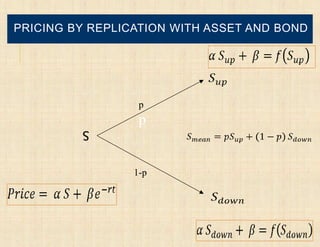
• Consider two states of the world at time t
PRICING BY REPLICATION WITH ASSET AND BOND


                  p
                  p
         S


                 1-p
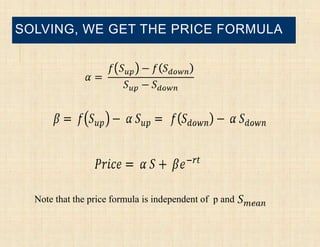
SOLVING, WE GET THE PRICE FORMULA


  Note that the price formula is independent of p and
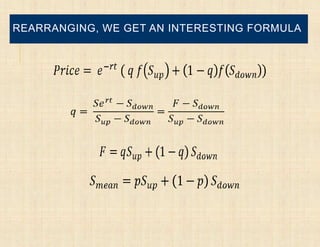
REARRANGING, WE GET AN INTERESTING FORMULA
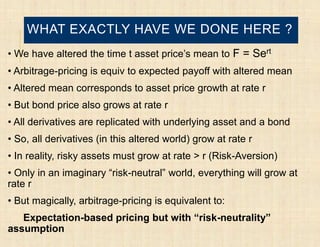
WHAT EXACTLY HAVE WE DONE HERE ?
• We have altered the time t asset price’s mean to F = Sert
• Arbitrage-pricing is equiv to expected payoff with altered mean
• Altered mean corresponds to asset price growth at rate r
• But bond price also grows at rate r
• All derivatives are replicated with underlying asset and a bond
• So, all derivatives (in this altered world) grow at rate r
• In reality, risky assets must grow at rate > r (Risk-Aversion)
• Only in an imaginary “risk-neutral” world, everything will grow at
rate r
• But magically, arbitrage-pricing is equivalent to:
   Expectation-based pricing but with “risk-neutrality”
assumption
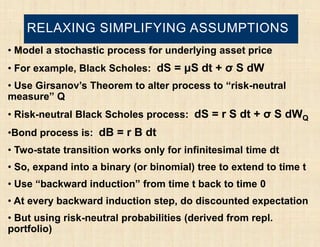
RELAXING SIMPLIFYING ASSUMPTIONS
• Model a stochastic process for underlying asset price
• For example, Black Scholes: dS = μS dt + σ S dW
• Use Girsanov’s Theorem to alter process to “risk-neutral
measure” Q
• Risk-neutral Black Scholes process: dS = r S dt + σ S dWQ
•Bond process is: dB = r B dt
• Two-state transition works only for infinitesimal time dt
• So, expand into a binary (or binomial) tree to extend to time t
• Use “backward induction” from time t back to time 0
• At every backward induction step, do discounted expectation
• But using risk-neutral probabilities (derived from repl.
portfolio)
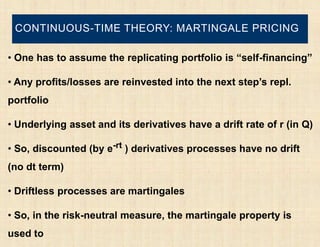
CONTINUOUS-TIME THEORY: MARTINGALE PRICING

• One has to assume the replicating portfolio is “self-financing”

• Any profits/losses are reinvested into the next step’s repl.
portfolio

• Underlying asset and its derivatives have a drift rate of r (in Q)

• So, discounted (by e-rt ) derivatives processes have no drift
(no dt term)

• Driftless processes are martingales

• So, in the risk-neutral measure, the martingale property is
used to

Introduction to Risk-Neutral Pricing

  • 1.
    Introduction to Risk-NeutralValuation - Ashwin Rao Aug 25, 2010
  • 2.
    WHAT ARE DERIVATIVESECURITIES ? • Fundamental Securities – eg: stocks and bonds • Derivative Securities - Contract between two parties • The contract specifies a contingent future financial claim • Contingent on the value of a fundamental security • The fundamental security is refered to as the underlying asset • A simple example – A binary option • How much would you pay to own this binary option ? • Key question: What is the expected payoff ? • What information is reqd to figure out the expected payoff ?
  • 3.
    BINARY OPTION PAYOFFAND UNDERLYING DISTRIBUTION 1.2 0.025 1 0.02 Binary Option 0.8 Payoff 0.015 Underlying Distribution Payoff Distribution 0.6 0.01 0.4 0.005 0.2 0 0 30 40 50 60 70 80 90 100 110 120 130 140 150 Underlying
  • 4.
    A CASINO GAME •The game operator tosses a fair coin • You win Rs. 100 if it’s a HEAD and 0 is it’s a TAIL • How much should you pay to play this game ? • Would you rather play a game where you get Rs. 50 for both H & T ? • What if you get Rs. 1 Crore for H and Rs. 0 for T ? • Depends on your risk attitude • Risk-averse or Risk-neutral or Risk-seeking • What is the risk premium for a risk-averse individual ?
  • 5.
    LAW OF DIMINISHINGMARGINAL UTILITY 50 40 30 Satisfaction Marginal Satisfaction 20 Total Satisfaction 10 0 1 2 3 4 5 6 7 8 9 10 Number of chocolate bars eaten -10
  • 6.
    LAW OF DIMINISHINGMARGINAL UTILITY • Note that the total utility function f(x) is concave • Let x (qty of consumption) be uncertain (some probability distribution) • Then, E[ f(x) ] < f( E[x] ) (Jensen’s inequality) • Expected Utility is less than Utility at Expected Consumption • Consumption y that gives you the expected utility: f(y) = E[ f(x) ] • So, when faced with uncertain consumption x, we will pay y < E[x]
  • 7.
    LAW OF DMU RISK-AVERSION • E[x] is called the expected value • y is called the “certainty equivalent” • y – E[x] is called the “risk premium” • y – E[x] depends on the utility concavity and distribution variance • More concavity means more risk premium and more risk- aversion • So to play a game with an uncertain payoff, people would Generally pay less than the expected payoff
  • 8.
    A SIMPLE DERIVATIVE– FORWARD CONTRACT • Contract between two parties X and Y • X promises to deliver an asset to Y at a future point in time t • Y promises to pay X an amount of Rs. F at the same time t • Contract made at time 0 and value of F also established at time 0 • F is called the forward price of the asset • What is the fair value of F ? • Expectation-based pricing to arrive at the value of F is wrong
  • 9.
    PAYOFF OF AFORWARD CONTRACT (AT TIME T) 50 Payoff of forward at time t 40 30 20 10 0 0 10 20 30 40 50 60 70 80 90 100 -10 -20 Forward price = 50 -30 -40 -50 Asset price at time t
  • 10.
    TIME VALUE OFMONEY • The concept of risk-free interest rate is very important • Deposit Rs. 1 and get back Rs. 1+r at time t (rate r for time t) • So, Rs. X today is worth Rs. X*(1+r) in time t • If I’ll have Rs. Y at time t, it is worth Rs. Y/(1+r) today • So you have to discount future wealth when valuing them today • With continuously compound interest, er instead of (1+r)
  • 11.
    ARBITRAGE • The conceptof arbitrage is also very important • Zero wealth today (at time 0) • Positive wealth in at least one future state of the world (at time t) • Negative wealth in no future state of the world (at time t) • So, starting with 0 wealth, you can guarantee positive wealth • Arbitrage = Riskless profit at zero cost • Fundamental concept: Arbitrage cannot exist in financial
  • 12.
    USE THESE CONCEPTSTO VALUE A FORWARD • Contract: At time t, you have to deliver asset A and receive Rs. F • Assume today’s (t = 0) price of asset A = Rs. S • Step 1: At time 0, borrow Rs. S for time t • Step 2: At time 0, buy one unit of asset A • Step 3: At time t, deliver asset A as per contract • Step 4: At time t, receive Rs. F as per contract • Step 5: Use the Rs. F to return Rs. Sert of borrowed money • If F > Sert , you have made riskless money out of nowhere • Make similar arbitrage argument for your counterparty • Arbitrage forces F to be equal to Sert
  • 13.
    REPLICATING PORTFOLIO FORA FORWARD • A Forward can be replicated by fundamental securities • Fundamental Securities are the Asset and Bonds • “Long Forward”: At time t, Receive Asset & Pay Forward Price F • “Long Asset”: Owner of 1 unit of asset • “Long Bond”: Lend money for time t (receiving back Rs.1 at t) • “Short positions” are the other side (opposite) of “Long positions” • “Long Forward” equivalent to [“Long 1 Asset”, “Short F Bonds”] • Because they both have exactly the same payoff at time t • This is called the Replicating Portfolio for a forward
  • 14.
    DERIVATIVES: CALL ANDPUT OPTIONS • X writes and sells a call option contract to Y at time 0 • At time t, Y can buy the underlying asset at a “strike price” of K • Y does not have the obligation to buy at time t (only an “option”) • So if time t price of asset < K, Y can “just ignore the option” • But if time t price > K, Y makes a profit at time t • At time 0, Y pays X Rs. C (the price of the call option) • With put option, Y can sell the asset at a strike price of K • What is the fair value of C (call) and of P (put) ?
  • 15.
    PAYOFF OF CALLAND PUT OPTIONS (AT TIME T) 50 45 40 Payoff at time t 35 30 25 Call Payoff 20 Put payoff 15 10 5 0 Strike price K = 50 0 10 20 30 40 50 60 70 80 90 100 Asset price at time t
  • 16.
    PRICING OF OPTIONS •Again, it is tempting to do expectation-based pricing • This requires you to know the time t distribution of asset price • We know expectation-based pricing is not the right price • Note that Call Payoff – Put Payoff = Fwd Payoff when K = F •This is useful but doesn’t help us in figuring out prices C and P • Like forwards, use replication and arbitrage arguments • However, replication is a bit more complicated here • Consider two states of the world at time t
  • 17.
    PRICING BY REPLICATIONWITH ASSET AND BOND p p S 1-p
  • 18.
    SOLVING, WE GETTHE PRICE FORMULA Note that the price formula is independent of p and
  • 19.
    REARRANGING, WE GETAN INTERESTING FORMULA
  • 20.
    WHAT EXACTLY HAVEWE DONE HERE ? • We have altered the time t asset price’s mean to F = Sert • Arbitrage-pricing is equiv to expected payoff with altered mean • Altered mean corresponds to asset price growth at rate r • But bond price also grows at rate r • All derivatives are replicated with underlying asset and a bond • So, all derivatives (in this altered world) grow at rate r • In reality, risky assets must grow at rate > r (Risk-Aversion) • Only in an imaginary “risk-neutral” world, everything will grow at rate r • But magically, arbitrage-pricing is equivalent to: Expectation-based pricing but with “risk-neutrality” assumption
  • 21.
    RELAXING SIMPLIFYING ASSUMPTIONS •Model a stochastic process for underlying asset price • For example, Black Scholes: dS = μS dt + σ S dW • Use Girsanov’s Theorem to alter process to “risk-neutral measure” Q • Risk-neutral Black Scholes process: dS = r S dt + σ S dWQ •Bond process is: dB = r B dt • Two-state transition works only for infinitesimal time dt • So, expand into a binary (or binomial) tree to extend to time t • Use “backward induction” from time t back to time 0 • At every backward induction step, do discounted expectation • But using risk-neutral probabilities (derived from repl. portfolio)
  • 22.
    CONTINUOUS-TIME THEORY: MARTINGALEPRICING • One has to assume the replicating portfolio is “self-financing” • Any profits/losses are reinvested into the next step’s repl. portfolio • Underlying asset and its derivatives have a drift rate of r (in Q) • So, discounted (by e-rt ) derivatives processes have no drift (no dt term) • Driftless processes are martingales • So, in the risk-neutral measure, the martingale property is used to