INDEX
1. SAFETY ANDSURVIVAL…………………………………………………….……….…….02
2. EMERGENCY SITUATIONS…………………………...........................................04
3. EVACUATION……………………………………………………………………................07
4. SURVIVAL CRAFTS AND RESCUE BOATS...................................................09
5. PERSONAL LIFE SAVING APPLIANCES………………....................................27
6. PERSONAL LIFE SAVING APPLIANCES (DEMONSTRATIONS)…….…….......31
7. SURVIVAL AT SEA……………………………………………………………..…………….31
8. EMERGENCY RADIO EQUIPMENT..............................................................40
9. HELICOPTER ASSISTANCE ………………………………………………….…….…....36
3.
1. SAFETY ANDSURVIVAL
SCOPE:
This course covers the training recommended in STCW 2010-Personal survival technique module and
covers the requirements of the 2010 STCW Convention and code chapter VI, Section A-VI/1-1.
On meeting the minimum standard of competence in Personal survival technique, a trainee will be
able to survive at sea in the event of ship abandonment.
OBJECTIVE:
A trainee successfully completing this course will be able to react in correct manner during
emergency situations, take appropriate measures for his own survival and for the survival of other
and use survival equipment correctly.
He will also acquire knowledge which in some instance will enable him to identify and correct defects
and thereby prevent emergencies.
1. SAFETY GUIDE LINES:
The adherence to safety rules especially during practical drills are to be followed implicitly. First Aid
supplies will be available, close at hand, when carrying out practical drills. All trainees; will be
provided with life-jackets, correct donning of life-jackets as instructed by the instructor is essential.
Before each practical drill, the instructor will explain each safety practice in detail. These are to
be strictly adhered to and put into practice during the drill.
4.
2. PRINCIPLES OFSURVIVAL AT SEA:
The principle of survival at sea:
• Regular training and drills
• Preparation for any emergency
• Knowledge of action
• When required to abandon ship
• When in the water
• When aboard a survival craft: and
• Knowledge of the main danger of survivors
3. DEFITION, SURVIVAL CRAFT AND APPLIANCES: DEFINITIONS:
• Survival craft is a craft that can save the lives of persons in distress from the time of
abandoning the ship.
• Rescue Boat designed to rescue persons in distress and to marshal survival craft
• Flat-free launching a survival craft so that is automatically released from a sinking ship and is
ready for use.
• Free fall launching is the method of launching a survival craft where by the craft with its
compliment of persons and equipment of persons and equipments onboard is released
an allowed to fall into the sea without any restraint.
• Immersion suit is a protective suit which reduces the body heat-loss of a person wearing it in cold
water.
• Inflatable appliance is one which depends on none—rigid gas filled chambers of buoyancy and which is
normally kept non-inflated until ready for use.
• Thermal protective aid is a bag or suit made or water proof material with low thermal conductivity.
• Launching appliances or arrangements is a means of transferring survival craft of rescue boat from its
stowed position safely to the water.
5.
APPLIANCES:
a.FIRE-FIGHTING APPLIANCES:
As laiddown by the rules, every ship is provided with sufficient numbers and type’s equipment to combat all fires
before they develop into major ones. It is the responsibility of all ship board personnel to not only take part in all
drills but also familiarize themselves with the usage of such equipment, especially in their own work areas.
b.PERSONAL LIFE-SAVING APPLIANCES:
Similar to FFA each ship is well provided with appliances and survival craft for saving of all on board in case the
ship has to be abandoned.
The same principle as in the FFA applies here also. According to its sized each ship should carry a specific number
of life-buoys distributed on the deck. Some of these life-buoys should have life lines, self-igniting lights, smoke
floats.
c.LIFE-JACKETS:
Life jackets as available and approved may be rigid or inflatable. For every ship, the number of life-jackets to be
carried will depend on the minimum number of persons on board that ship at and particular time. A whistle is to
firmly secure to each life-jacket. Each life jacket will require to have a fixed or flashing light also.
d.IMMERSION SUITS AND THERMAL PROTECTIVE AIDS:
These are provided for at least 3 persons in each non-enclosed life-board on both passengers and cargo ship. If
immersion suits are provided there is no need of thermal protective aid.
6.
SURVIVAL CRAFT:
1.LIFE-BOATS:
One maycome across different types of life-boats on different ships:
• Open
• Partially enclosed
• Self-righting partially enclose
• Totally enclosed
• Totally enclosed with air support system
• Totally enclosed with air support system
• Totally enclosed with fire protection system
For passenger ships, the capacity of life-boats is generally sufficient for every person on board. For
cargo ships, the capacity is generally is twice the number of persons on-board. Life-boats are wither
launched by davits or by free- fall method. Embarkation of the boats may be done either at the
embarkation deck or through ladders when the boat is in the water now a day,it is possible for all
personnel, on a cargo ship to embark a life boat and leave the ship. This means that their need not be
any person left on the ship to lower a life-boat.
LIFERAFTS:
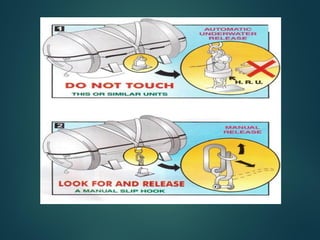
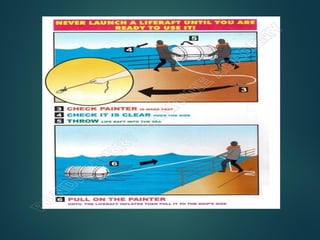
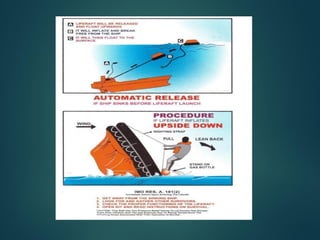
Life rafts are inflatable. They can either be manually or launched by davits or they can also
automatically float-free from a sinking ship
RESCUE BOATS:
Depending on the types of ship (passenger/cargo) a minimum of rescue boats have to be carried. A life-
boat may be designated as a rescue boat also, if it conform to requirements.
7.
EMERGENCY SITUATIONS
Life atsea is full of risks and adventures. A seafarers often faces the fury of the elements of nature. Epic voyage
give graphic description of the dangers including shipwrecks encountered by man since the earliest of times. Tough
technology has advanced bringing about improvement in the design of ships, life-saving a appliances, navigational
aids, weather reporting, communications, search and rescue, etc, a certain amount of risk, dangers and
uncertainties associated with voyages at sea still exist, though of course to a lesser degree.
The modern seafarer can take solace from the fact the after s ship founders and or the master takes a decision to
abandon ship, the chances of survival are today than it has been at any time in the past.
1. TYPES OF EMERGENCIES:
Emergencies that may lead to fire to fire or the foundering of ships are:
• Collision
• Standing/Grounding
• Adverse reaction of dangerous goods or hazardous bulk materials
• Shift of cargo
• Engine room explosion or fire etc.
2. PRECAUTIONS:
Precautions should be taken ion all aspects of ship operations so that such emergencies do both occur.
General precaution consist of water-tight integrity of vessel, it is essential that all watertight closing appliances,
such as: hatch, water-tight doors, bows, stern and side doors and ramps, ducts etc. are securely closed and
battened down prior proceeding to sea.
Further, in case of ingress of water, resulting in flooding and/ or billing of water - tight space or compartment, means
are provided to pump out the water by the bilgpumps, pipelines, hydrant, hoses and nozzles;
Fixed fire detection and extine and ballast systems
3. FIRE PROVISIONS:
Vessls are will equipped with adequate fire extinguishing appliances to handle of fire. The means provided to
combat fires are:
Fire guishing system, such as: Sprinkler system, inert gas system carbon-di-oxide/ Halon systems, foam system,
etc.
3. Design and construction of the vessel which contributes immensely in restricting the spread of fire.
8.
4. FOUNDERING:
A VESSELIS SAID TO ‘Founder: when she has lost her reserve buoyancy and/ or has become unstable and is
unable to stay afloat.
Foundering is prevented by the water-tight integrity and stability of the vessel. In order to maintain the water-
tight integrity of a vessel; it is essential that all watertight closing appliance, such as; hatch-covers, water-tight
doors, bow, stern and side doors and ramps, ducts etc, are securely closed and battened down prior proceeding
to sea.
Further, in cas e of ingress of water, resulting in flooding and /or bilging of a water-tight space or compartment
means are provided to pump out the water by the bilge and ballast systems.
The essential actions that they should take in emergency The proper method of donning life- jackets.
5. CREW EXPERTISE:
The Ship’s crew has considerable resources of skill and ingenuity. They should be well trained in the operation of
life-saving and fire-fighting appliances and emergency.
Emergency procedure training and drills will establish which crew members should be given a particular
emergency duty, this is essential to the success of the emergency procedure. Crew should be familiar with boat
and fire drills that in as emergency, if the order to abandon ship is given, the same can be carried out in an
organized and disciplined manner in the shortest possible time and without any panic or commotion.
6. MUSTER LIST AND EMERGENCY SIGNALS:
The MUSTER LIST provides clear instruction for every person to follow in the event of an emergency. The muster
list is exhibited in conspicuous location throughout the ship; including navigation in appropriate language are
posed in conspicuous locations, crew/passenger cabins and displayed at muster stations/notice boards to inform
crew and passengers with regard to this muster station.
7. CREW AND EMERGENCY INSTRUCTION
Personnel should, as soon as possible after joining a ship, acquire knowledge of:
• The meaning of emergency signals;
• Instruction on the muster list and their duties;
• The location and use o life-saving equipment;
• The location and use of fire-fighting equipment;
• Escape routes and equipment;
• The means provided for survival on hip and survival craft.
9.
8. EXTRA EQUIPMENTAND SURVIVAL:
Survival craft are adequately provisioned and provided with drinking water and equipment. However, every opportunity should be
taken to supplement the a foresaid taking extra materials from the sinking ship.
If it is obvious that the ship is in great danger of sinking, but that there is still a little time in hand before it will become necessary
to abandon ship, a coxswain would do well to have some extra gear in the boat. Always remembering that the extra put in the boat,
the less room will be available for survivors.
A recommended list of extra gear which may be taken from the ship to the survival craft, if time permits, is given below:
• Blankets
• Tinned milk, milk tablet, fruits, biscuits and sweets.
• Torches, batteries and bulbs.
• Palm, needles and sail twine.
• Ship’s pyrotechnics, If unused EPIRBs
• Plastic bags and a small pocket radio receivers
• Fog horn
• Thermal protective aids and immersion suits
• Take extra water, fuel and lubricating oil, three quarter fill clean bottle naked containers or jerry cans, then cork, float and tow
them,
• Take a grapnel and line (in a boat only)
• If the crew members assigned to certain duties are incapacitate, then other would have to perform additional tasks to make
up for them. This means that during drills each
member should watch the whole team at work as well as carry out his own duties.
9. ABANDONING SHIP-COMPLICATIONS:
There is a distinct difference between drills and real emergency situation. Whilst knowledge and practice during drills is important
for handling a real emergency situation, but this may not be enough and personnel should be prepared to perform additional tasks.
Absence of the lighting and listing of the ship may lead to disorientation which can be prevented if the ship’s personnel know by
heart that emergency stations and how to get to them.
Damage to their assigned survival craft may force personnel to embark in other craft. To summarize, complication in abandoning
ship, may be caused by;
• Some of the survival craft not being capable of being launched
• Absence of lighting and
• Absence of personnel assigned to certain duties The essential that they should take in emergency The proper method of
donning life-jacket
The general emergency alarms; signal is provided to alert all crew and passenger, about an emergency. The general emergency alarm system is
capable of sounding the general alarm signal consisting of seven or more short blasts followed by one long blast on the ship’s. Whistle or siren and
additionally on an electrically operated bell or klazon or other equivalent warning system. The system is powered from the ship’s mains supply and the
emergency source of electrical power. The system is capable of operation from the navigation bridge and expect for the ship’s whistle, also from other
strategic points. The system shall be audible throughout the accommodation and normal crew working space and supplemented by public address
10.
system or othersuitable communication system. An emergency communication system comprising of either fixed or
portable equipment’s, or both, is provided for two-way communication between emergency controls stations, muster
and embarkation stations and command canter.
Emergency Drills: should be held at regular intervals to familiarize crew and passengers about their muster stations
duties and use of survival and emergency equipment. Frequent practice builds up confidence and contributes
significantly in the successful handling of an emergency. Practice emergency muster drills are required to be carried
out at regular intervals.
On Cargo Ships: Each member of the crew shall participate in at least one Abandon ship Drill and one Fire-Drill
every month. The drills of the crew shall take place within 24 hours of the ship leaving a port if more than 25% of the
crew have not participated in abandon ship and fire drills onboard that particular ship in the previous month.
On Passenger Ships: On a ship engaged on an International Voyage which is not a short international voyage,
musters of the passengers shall take place within 24 hrs after embarkation.
Passengers shall be instructed in the use of life-jackets and actions to be taken in the event of emergency. If only a
small number of passengers embark at a part after the muster has been held it shall be sufficient, instead of holding
another muster, to draw the attention of these passengers to the emergency instructions. An abandon ship drill and a
fire shall take place weekly.
3. EVACUATION
3.1ABANDONINGSHIP LAST RESORT:
When disaster strikes a ship master in authority may be compelled to order the vessel to be abandoned. Since the
ship provides all life support systems, any decision to abandon is not to be taken lightly, however, should the vessel
be long safe because of collision, fire explosion, toxic substance or caprice or caprice or any other reason the order to
abandon may be given.
2. PERSONAL PREPARATION FOR ABANDONING SHIP:
The circumstances will dictate what action should be taken by personnel. In an escalating emergency where
abandonment is a likely outcome, warm clothing, preferably a thermal suits, covered by an immersion or survival suit,
is essential life jacket should be donned and secure tightly. Individuals in cold water with a badly secured life jacket
would find the task of re- securing with wet, clod hand extremely difficult if not impossible.
3. NEED TO PREVENT PANIC:
It is normal practice that the order to abandon form shop is a passed by word of mouth. Personnel in boats to be seated and strapped into position. The
officer in- charge assumes command of operation within the craft, and persons should remember that launching period is critical, and that he
concentration of the officer in-charge should not be interrupted except in exceptional circumstances. It is a period of tension and it is within survivors
own interests to allow persons with designated task to be left alone to get on with the job in hand. Keep alert, and unless you have constructive comment
regarding situation, keep quite, assist other people inside the craft, especially injured personnel, if you can. Make causalities as comfortable
11.
4. CREW DUTIESTO PASSENGERS:
The Muster list show several duties assigned to member of the crew in relation to passengers in case of emergency. The duties
shall include:
• Warning the passengers
• Seeing that they are suitably clad and have donned their life jacket correctly
• Assembling passengers at muster station.
• Keeping the movement of the passengers
• Ensuring that a supply of blankets is taken to the survival craft.
5. CREW DUTIES LAUNCING SURVIVAL CRAFT:
The regulation specify that he shall be sufficient trained number of persons onboard a ship for the mustering. Who may be
deck officer or certified persons, are required onboard for the operation of survival craft and implementation of launching:
• Bowman
• Ford grips, safety pin painter
• Brakes man
• After griped and safety pins
• Ladder and help passengers man the boat
• Stern sheet
6. MASTER’S ORDER TO ABDON SHIP:
When disaster strikes a vessel and ship s no longer safe due to:
• Collision
• Grounding
• Fire
• Explosion etc.
NO SHIP IS TO ABANDONED, EXCEPT BY ORDER OF THE MASTER
7. MEANS OF SURVIVAL:
The following are the means of survival, after the ship has been abandoned:
• A means of keeping of boat (life jacket and survival craft)
• A means of keeping warm (appropriate warm clothing)
• Drinking water and food. Fist 24 hrs nothing, then issue ½ liter per person per day.
• Only eat carbohydrates such as: sweet, glucose, etc.
• Communication equipment (lie-boar radio, EPIRB, SART, Pyrotechnics, day light signaling mirror, water proof torch
etc)
12.
4. SURVIVAL CRAFTSAND RESCUE BOATS
SOLAS Regulation 31 –
Survival craft and rescue boats:
Gives requirements for carriage of survival craft for cargo ships. Lifeboats carried must accommodate all persons on board,
additional liferafts must also be carried. Chemical tanker sand gas carriers carrying cargoes emitting toxic vapours or gases
must carry lifeboats with a selfcontained air support system that comply with the LSA Code. Oil tankers, chemical tankers and
gas carriers carrying cargoes with a flashpoint not exceeding 60° C must carry fire- protected lifeboats that comply with the
LSA Code.
SOLAS Regulation 21 –
Survival craft and rescue boats:
Passenger ships on international voyages which are not short must carry partially or totally enclosed lifeboats on each side to
accommodate not less than 50% of total number of persons on board (in other words, the two sides together must equal at
least 100%). Some lifeboats can be substituted by liferafts. In addition, inflatable or rigid liferafts to accommodate at least
25% of the total number of persons on board. Passenger ships on short international voyages must carry partially or totally
enclosed lifeboats for at least 30% of persons on board, plus inflatable or rigid liferafts to make total capacity of 100% with the
lifeboats. In addition, they must carry inflatable or rigid liferafts for 25% of total number of persons on board. All survival craft
required to provide for abandonment by the total number of persons on board must be capable of being launched with their full
complement of persons and equipment within a period of 30 minutes from the time the abandon ship signal is given.
SOLAS Regulation 26 –
Additional requirements for ro-ro passenger ships:
Includes requirements for ro-ro passenger ship's liferafts to be served by either marine evacuation systems or launching
appliances compliant with the LSA Code. At least one of the rescue boats must be a fast rescue boat. Ro-ro passenger ships
must be equipped with efficient means for rapidly recovering survivors from the water and transferring them from rescue units
or survival craft to the ship. A sufficient number of lifejackets must be stored in the vicinity of muster stations so passengers do
not have to return to their cabins for lifejackets
1. LIFE-BOATS:
Different types of lifeboats are:
• Open life boat
• Partially enclosed
• Self-righting partially enclosed
• Totally enclosed
• Totally enclosed with a self-contained air support system
• Fire protected life boat
17.
a) OPEN LIFEBOAT
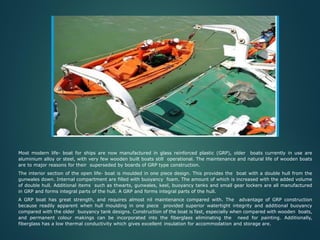
Most modern life- boat for ships are now manufactured in glass reinforced plastic (GRP), older boats currently in use are
aluminium alloy or steel, with very few wooden built boats still operational. The maintenance and natural life of wooden boats
are to major reasons for their superseded by boards of GRP type construction.
The interior section of the open life- boat is moulded in one piece design. This provides the boat with a double hull from the
gunwales down. Internal compartment are filled with buoyancy foam. The amount of which is increased with the added volume
of double hull. Additional items such as thwarts, gunwales, keel, buoyancy tanks and small gear lockers are all manufactured
in GRP and forms integral parts of the hull. A GRP and forms integral parts of the hull.
A GRP boat has great strength, and requires almost nil maintenance compared with. The advantage of GRP construction
because readily apparent when hull moulding in one piece provided superior watertight integrity and additional buoyancy
compared with the older buoyancy tank designs. Construction of the boat is fast, especially when compared with wooden boats,
and permanent colour makings can be incorporated into the fiberglass eliminating the need for painting. Additionally,
fiberglass has a low thermal conductivity which gives excellent insulation for accommodation and storage are.
18.
b) PARTIALLY ENCLOSEDBOATS:
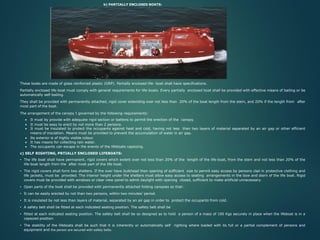
These boats are made of glass reinforced plastic (GRP). Partially enclosed life- boat shall have specifications.
Partially enclosed life-boat must comply with general requirements for life-boats. Every partially enclosed boat shall be provided with effective means of bailing or be
automatically self-bailing.
They shall be provided with permanently attached, rigid cover extending over not less than 20% of the boat length from the stem, and 20% if the length from after
most part of the boat.
The arrangement of the canopy I governed by the following requirements:
• It must by provide with adequate rigid section or battens to permit the erection of the canopy.
• It must be easy to erect by not more than 2 persons.
• It must be insulated to protect the occupants against heat and cold, having not less than two layers of material separated by an air gap or other efficient
means of insulation. Means must be provided to prevent the accumulation of water in air gap.
• Its exterior is of highly visible colour.
• It has means for collecting rain water.
• The occupants can escape in the events of the lifeboats capsizing.
c) SELF RIGHTING, PRTIALLY ENCLOSED LIFEBOATS:
• The life boat shall have permanent, rigid covers which extent over not less than 20% of the length of the life-boat, from the stem and not less than 20% of the
life-boat length from the after most part of the life-boat.
• The rigid covers shall form two shelters. If the over have bulkhead then opening of sufficient size to permit easy access by persons clad in protective clothing and
life jackets, must be provided. The interior height under the shelters must allow easy access to seating arrangements in the bow and stern of the life boat. Rigid
covers must be provided with windows or clear view panel to admit daylight with opening closed, sufficient to make artificial unnecessary.
• Open parts of the boat shall be provided with permanently attached folding canopies so that:
• It can be easily erected by not than two persons, within two minutes’ period.
• It is insulated by not less than layers of material, separated by an air gap in order to protect the occupants from cold.
• A safety belt shall be fitted at each indicated seating position. The safety belt shall be
• fitted at each indicated seating position. The safety belt shall be so designed as to hold a person of a mass of 100 Kgs securely in place when the lifeboat is in a
capsized position.
• The stability of the lifeboats shall be such that it is inherently or automatically self righting where loaded with its full or a partial complement of persons and
equipment and the person are secured with safety belts.
19.
d) TOTALLY ENCLOSED:
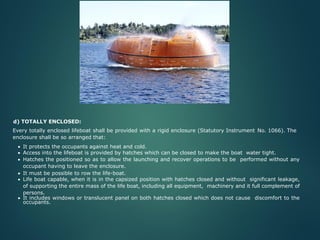
Everytotally enclosed lifeboat shall be provided with a rigid enclosure (Statutory Instrument No. 1066). The
enclosure shall be so arranged that:
• It protects the occupants against heat and cold.
• Access into the lifeboat is provided by hatches which can be closed to make the boat water tight.
• Hatches the positioned so as to allow the launching and recover operations to be performed without any
occupant having to leave the enclosure.
• It must be possible to row the life-boat.
• Life boat capable, when it is in the capsized position with hatches closed and without significant leakage,
of supporting the entire mass of the life boat, including all equipment, machinery and it full complement of
persons.
• It includes windows or translucent panel on both hatches closed which does not cause discomfort to the
occupants.
20.
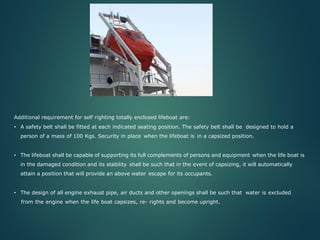
Additional requirement forself righting totally enclosed lifeboat are:
• A safety belt shall be fitted at each indicated seating position. The safety belt shall be designed to hold a
person of a mass of 100 Kgs. Security in place when the lifeboat is in a capsized position.
• The lifeboat shall be capable of supporting its full complements of persons and equipment when the life boat is
in the damaged condition and its stability shall be such that in the event of capsizing, it will automatically
attain a position that will provide an above water escape for its occupants.
• The design of all engine exhaust pipe, air ducts and other openings shall be such that water is excluded
from the engine when the life boat capsizes, re- rights and become upright.
21.
f) FIRE PROTECTEDLIFEBOAT:
A fire lifeboat, when water borne, shall be capable of protecting the number of persons it is permitted to accommodate when subjected to
continuous oil fire that envelops boat for a period of not less than 10 mts.
g)WATER-SPRAY SYSTEM:
A lifeboat with water spray complies with the following:
• Water for the system shall be from the sea by self priming motor pump. It shall “ON” and “OFF” the flow of water over the exterior of
the lifeboat.
• The seawater intake shall be so arranged as to prevent the intake of flammable liquids from the sea surface.
• The seawater intake shall be so flushing with fresh water and allowing complete drainage.
• Lifeboat launching appliances for oil tankers, chemical tankers, and gas carriers with a final angle of heel greater than 20° calculated in
accordance with the International Convention for the Prevention of the Prevention of Pollution from ships, 1973 as modified
by the 1978 Protocol, shall be capable of operating at the final angle of heel on the lower side at the ship.
In addition the following should be complied with:
• The launching appliance will be efficiently protected against corrosion and constructed in a manner to prevent incentive friction or impact
sparking during launching procedures of the craft.
• The launching appliances should be arranged so that excessive forces are not experienced by persons occupying the craft during
the launch.
• The launching appliances should be a rigid structure with such a ramp angle and length which permits the Survival Craft to
effectively clear the area of the ship/
structure.
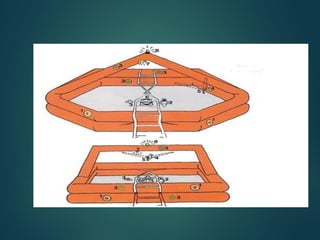
2. LIFE-RAFTS:
There are 2 types of life-rafts which are carried on board ships:
a. Inflatable life-rafts
b. Rigid life-rafts
1. Inflatable life-rafts
Several manufacturers of liferafts supply in Inflatable life-rafts to the merchant vessels throughout the world, including Beaufort, RFD Dunlop
and Viking. The size of the rafts varies with customer requirements but their capacity is not less than six persons.
Life rafts should be capable of withstanding exposure for 30 days of sea conditions. A standard raft should be robust enough in construction to
be launched from a height of 30 meters and when inflated to be able to withstand repeated jumps into surface from height up to 4.5 mts./15
ft.
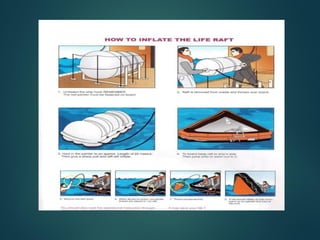
Life raft should be inflated with non-toxic gas and should be inflated within a period of one minute at an ambient temperature of between
18°C and 20°C or within a 3 minute period at a temperature of 30°C. Normal practice is to cause inflation by tugging on the painter line.
22.
The painter’s lengthshould be not less than twice the distance from the stowed position to waterline when the vessel is in it’s
lightest seagoing condition or 15 meters whichever is greater.
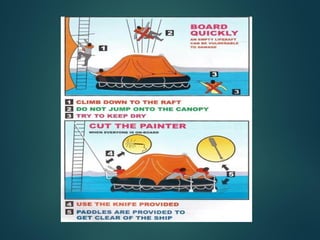
The canopy which protects the occupants from exposure should automatically be set in place when the raft is launched. The
exterior canopy should be of a highly visible colour. The liferafts are fitted with 2 lamps inside and the other outside which are
powered by sea water activated cell.
2)RIGID LIFERAFTS:
All rigid liferafts shall comply with the general requirements specified by the regulations regarding liferafts. The buoyancy of the
rigid liferafts shall be provided by approved inherently buoyant material placed as near as possible to the periphery of the
Liferaft. The buoyant material shall be fire retardant or be protected with fire retardant covering.
The floor of the raft prevents the ingress of water and shall effectively support the occupants out of the water and insulate them
from the cold. The stability being such that it is capable of operating safely whichever way up it is floating. It must be either self
righting or readily righted in a seaway and in calm water by one person. Once loaded with it’s full complement of persons and
equipment it must be possible to tow the raft in clam water at a speed of upto 3 knots
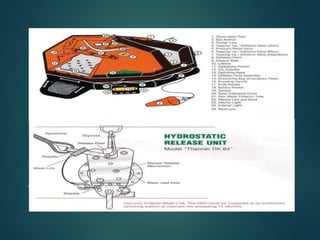
3)FLOAT FREE ARRANGEMENT FOR LIFERAFTS:
The breaking strength of the painter system, with the exception of the weak link arrangement shall be not less than 10.0 KN
rafts carrying nine persons or more and not less than 7.5 KN for other liferafts. A weak link system, if used shall break under a
strain of 2.2+/- 0.4 KN.
A weak link should not be broken by the force required to pull the painter from the raft. If applicable, the weak link should be at
sufficient strength to permit inflation of the raft when sea wash over the unit and they should be fitted with drain to prevent
water accumulation inside the hydrostatic chamber.
Release unit should be constructed of compatible materials so as to prevent malfunction of the unit. Galvanizing or other forms
of metallic coating on parts of the hydrostatic release unit shall not be accepted.
Either a document or identification plate stating the date of manufacture, type and serial number will be provided. Any part
connected to the painter system shall have strength of not less than that required for the painter.
The mariner should note that the where a Survival craft requires a launching appliance and is also designed to float free, the
flat free release of the Survival Craft from it’s stowed position should be automatic.
23.
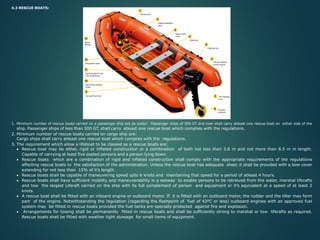
4.3 RESCUE BOATS:
1.Minimum number of rescue boats carried on a passenger ship are as under: Passenger ships of 500 GT and over shall carry atleast one rescue boat on either side of the
ship. Passenger ships of less than 500 GT, shall carry atleast one rescue boat which complies with the regulations.
2. Minimum number of rescue boats carried on cargo ship are:
Cargo ships shall carry atleast one rescue boat which complies with the regulations.
3. The requirement which allow a lifeboat to be classed as a rescue boats are:
• Rescue boat may be either, rigid or inflated construction or a combination of both not less than 3.8 m and not more than 8.5 m in length.
Capable of carrying at least five seated persons and a person lying down.
• Rescue boats which are a combination of rigid and inflated construction shall comply with the appropriate requirements of the regulations
affecting rescue boats to the satisfaction of the administration. Unless the rescue boat has adequate sheer, it shall be provided with a bow cover
extending for not less than 15% of it’s length.
• Rescue boats shall be capable of maneuvering speed upto 6 knots and maintaining that speed for a period of atleast 4 hours.
• Rescue boats shall have sufficient mobility and maneuverability in a seaway to enable persons to be retrieved from the water, marshal liferafts
and tow the largest Liferaft carried on the ship with its full complement of person and equipment or it’s equivalent at a speed of at least 2
knots.
• A rescue boat shall be fitted with an inboard engine or outboard motor. If it is fitted with an outboard motor, the rudder and the tiller may form
part of the engine. Notwithstanding the regulation (regarding the flashpoint of fuel of 43°C or less) outboard engines with an approved fuel
system may be fitted in rescue boats provided the fuel tanks are specially protected against fire and explosion.
• Arrangements for towing shall be permanently fitted in rescue boats and shall be sufficiently strong to marshal or tow liferafts as required.
Rescue boats shall be fitted with weather tight stowage for small items of equipment.
24.
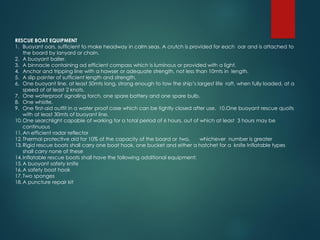
RESCUE BOAT EQUIPMENT
1.Buoyant oars, sufficient to make headway in calm seas. A crutch is provided for each oar and is attached to
the board by lanyard or chain.
2. A buoyant bailer.
3. A binnacle containing ad efficient compass which is luminous or provided with a light.
4. Anchor and tripping line with a hawser or adequate strength, not less than 10mts in length.
5. A slip painter of sufficient length and strength.
6. One buoyant line, at least 50mts long, strong enough to tow the ship’s largest life raft, when fully loaded, at a
speed of at least 2 knots.
7. One waterproof signaling torch, one spare battery and one spare bulb.
8. One whistle.
9. One first-aid outfit in a water proof case which can be tightly closed after use. 10.One buoyant rescue quoits
with at least 30mts of buoyant line.
10.One searchlight capable of working for a total period of 6 hours, out of which at least 3 hours may be
continuous
11.An efficient radar reflector
12.Thermal protective aid for 10% of the capacity of the board or two, whichever number is greater
13.Rigid rescue boats shall carry one boat hook, one bucket and either a hatchet for a knife Inflatable types
shall carry none of these
14.Inflatable rescue boats shall have the following additional equipment:
15.A buoyant safety knife
16.A safety boat hook
17.Two sponges
18.A puncture repair kit
34.
5. PERSONAL LIFESAVING APPLIANCES
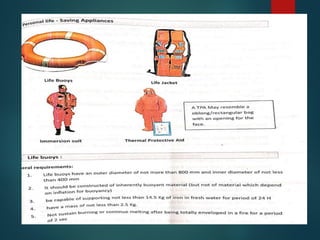
5.1. LIFE BUOYS
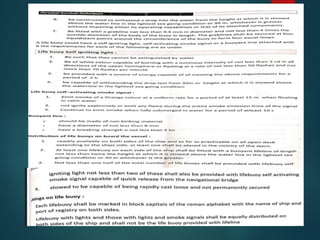
Life buoys are distributed over the ship actual life buoy to show as follows:
• Life buoy shall be distributed as to be readily available on both sides of the ship
and as far as practicable on all open decks extending on the ship side, At least
one to be placed in the vicinity of the stern
• Life buoy should stowed so as to be capable of being caused loose and not
permanently secured in any way.
The requirements for additional equipment attached to life buoy:
• At least one life buoys on each side of the vessel should be fitted with a buoyant life line, equal in length to not
less than twice the height at which it is stowed above the water line in the highest sea going condition or 30mts
which ever is the greater.
• Not less than on half of the total number of life buoyant shall be provided with self igniting lights and not less than
two of these shall also be provided with self activation.
• Smoke signals and be capable of quick release from the navigating bridge. These life buoys should be equally
distributed wither side of the ship and should not be the life buoys previously stated with buoyant lines.
• Self igniting lights on life buoys of tankers shall be of an electric battery type.
• Each life buoy shall be marked in block capitals of the roman alphabet with name and part of registry of the ship
on which it is carried.
37.
5.2. LIFE JACKETS
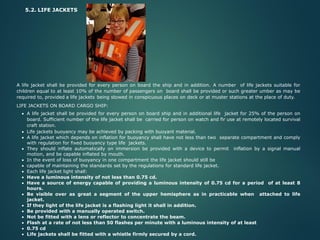
Alife jacket shall be provided for every person on board the ship and in addition. A number of life jackets suitable for
children equal to at least 10% of the number of passengers on board shall be provided or such greater umber as may be
required to, provided a life jackets being stowed in conspicuous places on deck or at muster stations at the place of duty.
LIFE JACKETS ON BOARD CARGO SHIP:
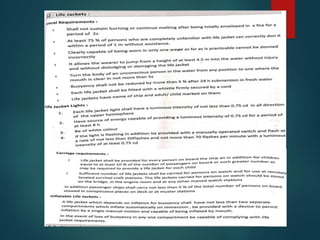
• A life jacket shall be provided for every person on board ship and in additional life jacket for 25% of the person on
board. Sufficient number of the life jacket shall be carried for person on watch and fir use at remotely located survival
craft station.
• Life jackets buoyancy may be achieved by packing with buoyant material.
• A life jacket which depends on inflation for buoyancy shall have not less than two separate compartment and comply
with regulation for fixed buoyancy type life jackets.
• They should inflate automatically on immersion be provided with a device to permit inflation by a signal manual
motion, and be capable inflated by mouth.
• In the event of loss of buoyancy in one compartment the life jacket should still be
• capable of maintaining the standards set by the regulations for standard life jacket.
• Each life jacket light shall:
• Have a luminous intensity of not less than 0.75 cd.
• Have a source of energy capable of providing a luminous intensity of 0.75 cd for a period of at least 8
hours.
• Be visible over as great a segment of the upper hemisphere as in practicable when attached to life
jacket.
• If they light of the life jacket is a flashing light it shall in addition.
• Be provided with a manually operated switch.
• Not be fitted with a lens or reflector to concentrate the beam.
• Flash at a rate of not less than 50 flashes per minute with a luminous intensity of at least
• 0.75 cd
• Life jackets shall be fitted with a whistle firmly secured by a cord.
39.
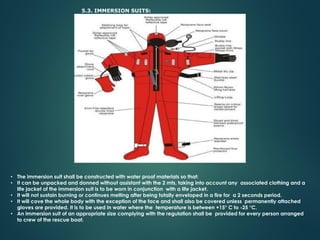
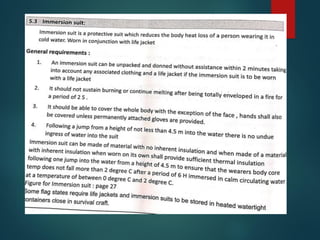
5.3. IMMERSION SUITS:
•The immersion suit shall be constructed with water proof materials so that:
• It can be unpacked and donned without assistant with the 2 mts, taking into account any associated clothing and a
life jacket of the immersion suit is to be worn in conjunction with a life jacket.
• It will not sustain burning or continues melting after being totally enveloped in a fire for a 2 seconds period.
• It will cove the whole body with the exception of the face and shall also be covered unless permanently attached
gloves are provided. It is to be used in water where the temperature is between +15° C to -25 °C.
• An immersion suit of an appropriate size complying with the regulation shall be provided for every person arranged
to crew of the rescue boat.
41.
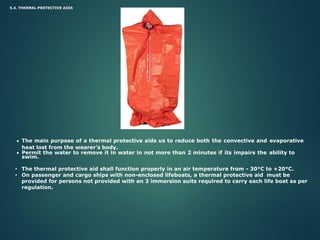
5.4. THERMAL PROTECTIVEAIDS
• The main purpose of a thermal protective aids us to reduce both the convective and evaporative
heat lost from the wearer’s body.
• Permit the water to remove it in water in not more than 2 minutes if its impairs the ability to
swim.
• The thermal protective aid shall function properly in an air temperature from - 30°C to +20°C.
• On passenger and cargo ships with non-enclosed lifeboats, a thermal protective aid must be
provided for persons not provided with an 3 immersion suits required to carry each life boat as per
regulation.
44.
Once above isdone, the after the survivors must stay in one place and protect themselves from
the environment that is heat and cold. Follow the survival at sea principles laid down for
prolonging life under survival conditions.
1. DANGERS TO SURVIVORS:
HEAT STROKE
• A serious condition where the body temperature rises above the normal to 40°Cor more.
It is caused by prolonged exposure to very hot or very humid conditions.
• The symptoms are a hot, dry skin, with a rapid pulse rate. The patient may appear
flushed and could experience some confusion, unconsciousness may follow:
SUN STROKE
• Sun stroke can occur when there is hot sun with high temperature and the absence of
wind. The patient gets headaches dizziness and feels hot, sun stroke may sometimes
be fatal.
45.
Detection is atwo sided matter. Survivors should use the equipment provided to attract attention as follows:
1. EPIRB
2. PORTABLE RADIO
3. PYROTECHNICS
4. HELIOGRAPH
5. SART
When survivors are in the survival craft the in-charge should raise the morale of the persons who are in the survival craft by keeping the
person and their mind busy by a good routine and discipline maintained at the outset of the situation. A watch system using emergency
RADIO, this should be activated as soon as practicable. The lookout should be made aware of the position of pyrotechnics and how to use
instructions being read well before they actually need to be used. By letting persons read the instructions on equipment and designating
various job functions the minds of survivors are kept active. Morale is maintained and will to survive in not lost.
For this reason a waterproof suit must be considered extremely desirable for survival. However, for persons finding themselves in water, the
following actions are recommended:
• Avoid unnecessary swimming. This will only use up valuable energy and increase the body’s heat loss to surrounding water.
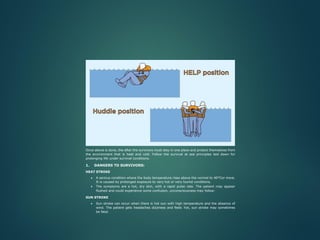
• Float on the surface in a HELP position. (Heat Exchange Lessening Posture)
• With the knees clasped up against the chest. This position conserved body heat.
• If your lifejacket is equipped with a face visor, secure it. Failing this, protect
• Your airways against breaking seas by using your hands to form a face bar.
• If there is more than one person, group together in HUDDLE Position. There is
• Safety in numbers as you are making a larger target when grouped on the surface. If survivors form a circle group, free-flowing water
is restricted in the centre of the circle and the loss of heat is reduced. Causalities can also be kept warmer by being placed in the
middle of the circle and supported by the others. Lifelines fitted to certain suits
can also be employed to link survivors together.
• Try to keep your morale, up and keep the will to survive.
• To avoid panic action.
8. EMERGENCY RADIO EQUIPMENT
Whenever abandon ship is announced THREE safety radio equipment are to be carried to survival crafts as mentioned in
muster list
EPIRB
SART
Portable VHF
46.
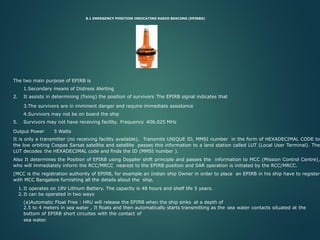
8.1 EMERGENCY POSITIONINDICATING RADIO BEACONS (EPIRBS)
The two main purpose of EPIRB is
1.Secondary means of Distress Alerting
2. It assists in determining (fixing) the position of survivors The EPIRB signal indicates that
3.The survivors are in imminent danger and require immediate assistance
4.Survivors may not be on board the ship
5. Survivors may not have receiving facility. Frequency 406.025 MHz
Output Power 5 Watts
It is only a transmitter (no receiving facility available). Transmits UNIQUE ID, MMSI number in the form of HEXADECIMAL CODE to
the low orbiting Cospas Sarsat satellite and satellite passes this information to a land station called LUT (Local User Terminal). The
LUT decodes the HEXADECIMAL code and finds the ID (MMSI number ).
Also It determines the Position of EPIRB using Doppler shift principle and passes the information to MCC (Mission Control Centre),
who will immediately inform the RCC/MRCC nearest to the EPIRB position and SAR operation is initiated by the RCC/MRCC.
(MCC is the registration authority of EPIRB, for example an Indian ship Owner in order to place an EPIRB in his ship have to register
with MCC Bangalore furnishing all the details about the ship.
1.It operates on 18V Lithium Battery. The capacity is 48 hours and shelf life 5 years.
2.It can be operated in two ways
(a)Automatic Float Free : HRU will release the EPIRB when the ship sinks at a depth of
2.5 to 4 meters in sea water , It floats and then automatically starts transmitting as the sea water contacts situated at the
bottom of EPIRB short circuites with the contact of
sea water.
47.
(b) Manually byremoving safety pin and keep the switch in emergency position or it is spring loaded
automatically will go to ‘ ON’ position.
3. A strobe light will indicate the EPIRB location at night/cloudy weather when in operation
4. Must be capable of operating even in bad weather, withstand vib ration, ice formation in icy regions and
be capable of being released in icy conditions.
5. Operating instructions and the ships identity slip (received after registration) must be affixed on the
equipment.
6. Should be installed clear of obstructions
7. Frame holding the EPIRB should be of non-corrosive material
8. While testing, First read the Manufacturer’s instructions , hold the test switch in TEST
position for 15-20 sec It flashes for 15 secs and steady strobe light at the end to Indicate that the test
is successful. If the above indication does not come, then test has failed.
9. All the ships including in the vicinity will get the information through EGC or by other means.
(Ships cannot receive EPRIB signals).
10.To de-activate the EPIRB bring the switch to OFF position and insert the Safety pin.
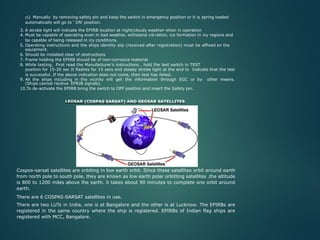
LEOSAR (COSPAS SARSAT) AND GEOSAR SATELLITES
Cospos-sarsat satellites are orbiting in low earth orbit. Since these satellites orbit around earth
from north pole to south pole, they are known as low earth polar orbitting satellites .the altitude
is 800 to 1200 miles above the earth. it takes about 90 minutes to complete one orbit around
earth.
There are 6 COSPAS-SARSAT satellites in use.
There are two LUTs in India, one is at Bangalore and the other is at Lucknow. The EPIRBs are
registered in the same country where the ship is registered. EPIRBs of Indian flag ships are
registered with MCC, Bangalore.
48.
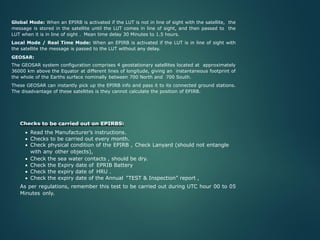
Global Mode: Whenan EPIRB is activated if the LUT is not in line of sight with the satellite, the
message is stored in the satellite until the LUT comes in line of sight, and then passed to the
LUT when it is in line of sight . Mean time delay 30 Minutes to 1.5 hours.
Local Mode / Real Time Mode: When an EPIRB is activated if the LUT is in line of sight with
the satellite the message is passed to the LUT without any delay.
GEOSAR:
The GEOSAR system configuration comprises 4 geostationary satellites located at approximately
36000 km above the Equator at different lines of longitude, giving an instantaneous footprint of
the whole of the Earths surface nominally between 700 North and 700 South.
These GEOSAR can instantly pick up the EPIRB info and pass it to its connected ground stations.
The disadvantage of these satellites is they cannot calculate the position of EPIRB.
Checks to be carried out on EPIRBS:
• Read the Manufacturer’s instructions.
• Checks to be carried out every month.
• Check physical condition of the EPIRB , Check Lanyard (should not entangle
with any other objects),
• Check the sea water contacts , should be dry.
• Check the Expiry date of EPRIB Battery
• Check the expiry date of HRU .
• Check the expiry date of the Annual “TEST & Inspection” report ,
As per regulations, remember this test to be carried out during UTC hour 00 to 05
Minutes only.
49.
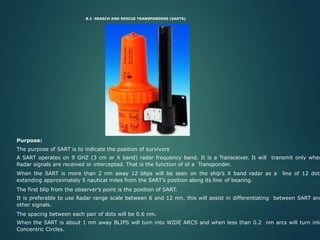
8.2 -SEARCH ANDRESCUE TRANSPONDERS (SARTS)
Purpose:
The purpose of SART is to indicate the position of survivors
A SART operates on 9 GHZ (3 cm or X band) radar frequency band. It is a Transceiver. It will transmit only when
Radar signals are received or intercepted. That is the function of of a Transponder.
When the SART is more than 2 nm away 12 blips will be seen on the ship’s X band radar as a line of 12 dots
extending approximately 5 nautical miles from the SART’s position along its line of bearing.
The first blip from the observer’s point is the position of SART.
It is preferable to use Radar range scale between 6 and 12 nm, this will assist in differentiating between SART and
other signals.
The spacing between each pair of dots will be 0.6 nm.
When the SART is about 1 nm away BLIPS will turn into WIDE ARCS and when less than 0.2 nm arcs will turn into
Concentric Circles.
50.
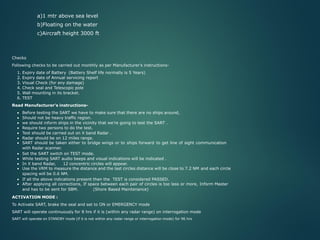
a)1 mtr abovesea level
b)Floating on the water
c)Aircraft height 3000 ft
Checks
Following checks to be carried out monthly as per Manufacturer’s instructions-
1. Expiry date of Battery (Battery Shelf life normally is 5 Years)
2. Expiry date of Annual servicing report
3. Visual Check (for any damage)
4. Check seal and Telescopic pole
5. Wall mounting in its bracket.
6. TEST
Read Manufacturer’s instructions-
• Before testing the SART we have to make sure that there are no ships around,
• Should not be heavy traffic region.
• we should inform ships in the vicinity that we’re going to test the SART .
• Require two persons to do the test.
• Test should be carried out on X band Radar .
• Radar should be on 12 miles range.
• SART should be taken either to bridge wings or to ships forward to get line of sight communication
with Radar scanner.
• Set the SART switch on TEST mode.
• While testing SART audio beeps and visual indications will be indicated .
• In X band Radar, 12 concentric circles will appear.
• Use the VRM to measure the distance and the last circles distance will be close to 7.2 NM and each circle
spacing will be 0.6 NM.
• If all the above indications present then the TEST is considered PASSED.
• After applying all corrections, If space between each pair of circles is too less or more, Inform Master
and has to be sent for SBM. (Shore Based Maintenance)
ACTIVATION MODE :
To Activate SART, brake the seal and set to ON or EMERGENCY mode
SART will operate continuously for 8 hrs if it is (within any radar range) on interrogation mode
SART will operate on STANDBY mode (if it is not within any radar range or interrogation mode) for 96 hrs
51.
.
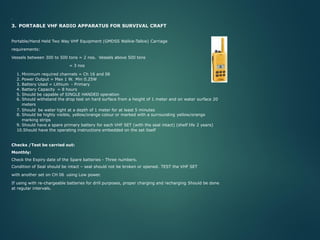
3. PORTABLE VHFRADIO APPARATUS FOR SURVIVAL CRAFT
Portable/Hand Held Two Way VHF Equipment (GMDSS Walkie-Talkie) Carriage
requirements:
Vessels between 300 to 500 tons = 2 nos. Vessels above 500 tons
= 3 nos
1. Minimum required channels = Ch 16 and 06
2. Power Output = Max 1 W. Min 0.25W
3. Battery Used = Lithium - Primary
4. Battery Capacity = 8 hours
5. Should be capable of SINGLE HANDED operation
6. Should withstand the drop test on hard surface from a height of 1 meter and on water surface 20
meters
7. Should be water tight at a depth of 1 meter for at least 5 minutes
8. Should be highly visible, yellow/orange colour or marked with a surrounding yellow/orange
marking strips
9. Should have a spare primary battery for each VHF SET (with the seal intact) (shelf life 2 years)
10.Should have the operating instructions embedded on the set itself
Checks /Test be carried out:
Monthly:
Check the Expiry date of the Spare batteries - Three numbers.
Condition of Seal should be intact – seal should not be broken or opened. TEST the VHF SET
with another set on CH 06 using Low power.
If using with re-chargeable batteries for drill purposes, proper charging and recharging Should be done
at regular intervals.
52.
To be pickedup from the ship, a clear space will have to be available on the ship which is clear of masts, riggings and other impediments.
Evacuations from a lifeboat or a liferaft is even more dangerous and has to be done with proper understanding between the survivor and
the helicopter. The pickup may be executed through harness, stretches or rescue net. Sometimes a member of the helicopter may assist
in pick up. Instructions given by the helicopter should be obeyed promptly and correctly.
3. HELICOPTER PICKUP
• Place the head and both arms through the lifting strop.
• Ensure that the strop is seated firmly under the armpits; with the padded section of the strop positioned as high as possible the back.
• Pull down the toggle to tighten the strop.
• Once secure inside the strop and ready to be hoisted, give a “thumbs up” signal to which man or observer of the helicopter.
• Place both arms down by your sides.
RESCUE NET
The rescue net has a conically shaped –“bird cage” appearance and is open on one side when the net is trailing in the water. The survivor
merely enters the opening sits in the nets and holds on.
LITTER
Injured persons should be evacuated in the litter provided by the helicopter. This rigged with the proper bridles and means for attaching
to hoist able.
Signals uses for safe lifting are as follows:
• Arms extended horizontally fingers clenched and thumbs down (Do not hoist, not ready)
• Arm raised above the horizontal and thumbs up (Hoist ready).
GENERERAL PRECAUTIONS FOR PERSONNEL DURING WINCHING OPERATIONS
In the majority of cases where helicopter assistance is being given a member of the aircrew will instruct and assist in the correct method
of transfer. In the event of an aircraft being engaged and when the strop only is lowered, without a frogman or winch-man, the following
list of precautionary measures are advised.
• Do not touch the strop, winch wire or any part of the lifting hoist until the static electricity has been removed from the wire. The pilot
will first earth the wire by allowing it to enter the sea or touch the deck of the ship, to remove static electricity.
• Keep the lifejacket on and place the strop over the upper part of the body, around the back and over the lifejacket. Draw down the
toggle of the web straps and ensure a tight
fit around your person.
• Place your arms at the side (when engages in the United kingdom) or follow the instructions of the landing officer.
• When ready to be winched up, extend your arm & give a thumbs-up signal to the aircraft, while
looking towards the helicopter, Replace your arm at ur side
• Once winched towards the access of the aircraft, and along side the door way to the cabin, remain passive until instructed to move
but the aircrew operator.
• In an in-flight emergency the pilot will attempt to prepare passengers for the possibility of the aircraft having to ditch. This
preparation for the type of action to be taken will
53.
9. HELICOPTER ASSISTANCE
9.1COMMUNICATING WIH HELICOPTER
Wireless communications can be established on VHF and in the absence of wireless
equipment’s which can be used to communicate with helicopter directly or through a shore
station, hand and arm signals are to be used.
9.2. EVACUATION FROM SHIP AND SURVIVAL CRAFT
depend on several factors. Obviously, circumstances may limit the time available for detailed
explanations and any instructions by the pilot or officer in charge or the aircraft should be
obeyed implicitly. The type of aircraft and the nature of the emergency will dictate the
following sequence of events, as will the degree of composure and experience of passengers.
On the assumption that all persons are wearing immersion suits and aviation lifejackets the
instructions that will b given should include:
• Place immersion suit hoods over heads, and close to all seals to the suit.
• Unpack the aviation lifejacket and place it over our head, but do not inflate the lifejacket.
• Tighten up the lap strap/seat belt.
• Arch the spine, gripping the underside of the legs, with feet braced firmly on the floor, of the
aircraft.
• Brace the body, especially the head, against impact prior to the ditching point.
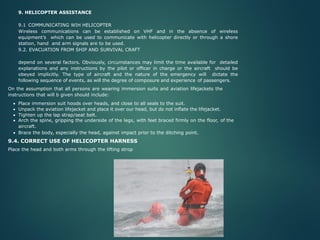
9.4. CORRECT USE OF HELICOPTER HARNESS
Place the head and both arms through the lifting strop
54.
Annex 1:
Pocket Guideto Cold Water Survival
The Guide, first published by IMO in 1981, examines the hazards of exposure to cold
when immersed in sea water and provides advice on how to prevent or minimize
these dangers. The 1992 edition also contains information on how to treat victims of
hypothermia. The Guide states: "It is important to realize that you are not helpless to
effect your own survival in cold water. Body heat loss is a gradual process, and
research shows that in calm water at 5°C a normally dressed person has only a 50
per cent chance of surviving one hour. Simple, self-help techniques can extend this
time, particularly if the person is wearing a lifejacket. You can make the difference."
The final section of the booklet sums up important information for anyone on board a
ship:
1.Plan your emergency moves in advance.
2.Know how your survival equipment works.
3.Wear many layers of clothing to offset cold. 4 Put on a lifejacket as soon as
possible in an emergency situation.
4.Try to board the lifeboat or life raft without entering the water.
5.If you need to enter water, enter the water gradually.
6.Swim only if it is to reach a safe refuge nearby.
7.Try to float with legs together, elbows to side, arms across chest – to avoid heat
loss.
8.Force yourself to have the will to survive.