Anila
Anatomy and Functions
• Facial Nerve is a mixed nerve having motor
and a sensory root
• The sensory root (nerve of Wrisberg) also
carries secretomotor fibres to the lacrimal
gland and salivary glands, and brings fibres of
taste and general sensation
• There are 2 efferent and 2 afferent pathways
Components of facial nerve
Components of facial nerve Function
Supplies the muscles of facial
expression, auricular muscles
(vestigial) stylohyoid, posterior belly
of digastric and stapedius
Parasympathetic innervation of the
lacrimal, submandibular and
sublingual glands and the smaller
secretory glands of nasal mucosa
and the palate
Taste sensation from the anterior 2/3
of tongue via chorda tympani . Hard
and soft palates via greater petrosal
nerve.
General sensation from the concha,
posterosuperior part of external
canal and the tympanic membrane.
• Motor nucleus situated in the pons.
• Receives fibres from the precentral gyrus.
• Upper part of the nucleus which
innervates forehead muscles receives
fibres from both the cerebral
hemispheres.
• Lower part of nucleus which supplies
lower face gets only crossed fibres from
one hemisphere.
• The function of forehead is preserved in
supranuclear lesions because of bilateral
innervation.
• Facial nucleus also receives fibres from the
thalamus by alternate routes and provides
involuntary control to facial muscles
• Emotional movements such as smiling and
crying are thus preserved in supranuclear
palsies because of these fibres fron
thalamus
• Motor fibres originate from the nucleus of VIIth nerve, hook
around the nucleus of VIth nerve and are joined by the sensory
root (nerve of Wrisberg).
• Facial nerve leaves the brainstem at pontomedullary junction,
travels through posterior cranial fossa and enters the internal
acoustic meatus
• At the fundus of the meatus (lateral most part of the meatus),
the nerve enters the bony facial canal, traverses the temporal
bone and comes out of the stylomastoid foramen .
• It crosses the styloid process and divides into terminal
branches.
• Thus the course of the nerve can be divided in to :
1) Intracranial part – From pons to internal acoustic meatus (15-
17 mm)
2) Intratemporal part – From internal acoustic meatus to
stylomastoid foramen. It is further divided into:
a. Meatal segment – with in internal acoustic meatus
b. Labyrinthine segment – From fundus of meatus to the
geniculate ganglion where nerve takes a turn posteriorly
forming a “genu”. Nerve in the labyrinthine segment has the
narrowest diameter (0.61 – 0.68 mm) and the bony canal in
this segment is also the narrowest . Thus edema or
inflammation can easily compress the nerve and cause
paralysis . This is also the shortest segment of the nerve – 4.0
mm
c. Tympanic /horizontal segment – From geniculate ganglion to
just above the pyramidal eminence. It lies above the oval
window and below the lateral semicircular canal
d. Mastoid or vertical segment – From pyramid to stylomastoid
foramen. Between the tympanic and mastoid segment is the
second genu of the nerve
3) Extracranial part – From stylomastoid foramen to the termination of
its peripheral branches
Branches of Facial Nerve
1. Greater superficial petrosal nerve – Arises from the geniculate
ganglion & carries secretomotor fibres to lacrimal gland and the
glands of nasal mucosa
2. Nerve to stapedius – Arises at the level of second genu and
supplies stapedius muscle.
3. Chorda tympani – Arises from the middle of vertical segment,
passes between the incus and neck of malleus, and leaves the
tympanic cavity through petrotympanic fissure. Carries fibres to
submandibular & sublingual glands and brings taste from
anterior two-thirds of tongue.
4. Communicating branch – It joins the auricular branch of vagus
and supplies the concha, retroauricular grove, posterior meatus
and the outer surface of tympanic membrane
5. Posterior auricular nerve – Supplies muscles of pinna , occipital
belly of occipitofrontalis and communicates with auricular
branch of vagus.
6. Muscular branches – To stylohyoid and posterior belly of digastric
7. Peripheral branches – Nerve trunk after crossing the styloid process,
forms two division , an upper temporofacial and a lower
cervicofacial, which further divide into smaller branches. These are
the temporal, zygomatic buccal, mandibular and cervical and
together form pesansernius (goose-foot). They supply all the
muscles of facial expression.
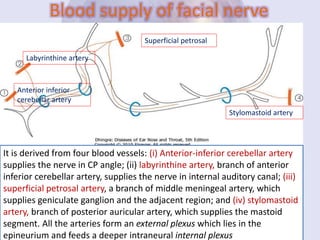
Blood supply of facial nerve
It is derived from four blood vessels: (i) Anterior-inferior cerebellar artery
supplies the nerve in CP angle; (ii) labyrinthine artery, branch of anterior
inferior cerebellar artery, supplies the nerve in internal auditory canal; (iii)
superficial petrosal artery, a branch of middle meningeal artery, which
supplies geniculate ganglion and the adjacent region; and (iv) stylomastoid
artery, branch of posterior auricular artery, which supplies the mastoid
segment. All the arteries form an external plexus which lies in the
epineurium and feeds a deeper intraneural internal plexus
Anterior inferior
cerebellar artery
Labyrinthine artery
Superficial petrosal
Stylomastoid artery
Surgical landmarks of Facial nerve
For middle ear and mastoid surgery
• 1. Processus cochleariformis. It demarcates the
geniculate ganglion which lies just anterior to it.
Tympanic segment of the nerve starts at this level.
• 2. Oval window and horizontal canal. The facial nerve
runs above the oval window (stapes) and below the
horizontal canal.
• 3. Short process of incus. Facial nerve lies medial to
the short process of incus at the level of aditus.
• 4. Pyramid. Nerve runs behind the pyramid and the
posterior tympanic sulcus.
• 5. Tympanomastoid suture. In vertical or mastoid
segment, nerve runs behind this suture.
• 6. Digastric ridge. The nerve leaves the mastoid at the
anterior end of digastric ridge.
• For parotid surgery
• 1. Cartilaginous pointer. The nerve lies 1 cm deep and sightly
anterior and inferior to the pointer. Cartilaginous pointer is a sharp
triangular piece of cartilage of the pinna and "points" to the nerve.
• 2. Tympanomastoid suture. Nerve lies 6-8 mm deep to this suture.
• 3. Styloid process. The nerve crosses lateral to styloid process.
• 4. Posterior belly of digastric. If posterior belly of digastric muscle
is traced backwards along its upper border to its attachment to the
digastric groove, nerve is found to lie between it and the styloid
process.
STRUCTURE OF NERVE
From inside out, nerve consists of
• Axon,
• Myelin sheath,
• Neurilemma,
• Endoneurium
A group of nerve fibres is enclosed in a sheath
called perineurium to form a fascicle and the
fascicles are bound together by epineurium
Severity of Nerve Injury
• Degree of nerve injury will determine the
regeneration of nerve & its function.
• Earlier nerve injuries were divided into
(Seddon’s Classification):
Neuraparaxia, a conduction block, where flow
of axoplasm through the axons was partially
obstructed
Axonotmesis – injury to axons
Neurotmesis – injury to nerves
Seddon’s Classification
Sunderland classification
Sunderland classification is now widely accepted.
Sunderland classified nerve injuries into five
degrees of severity based on anatomical
structure of the nerve
1ᵒ= Partial block to flow of axoplasm; no morphological changes
seen. Recovery of function is complete (Neuraparaxia).
2ᵒ= Loss of axons, but endoneurial tubes remain intact. During
recovery, axons will grow into their respective tubes, and the
result is good (axonotmesis).
3ᵒ= Injury to endoneurium. During recovery, axons of one tube
can grow into another. Synkinesis can occur (neurotmesis).
4ᵒ= Injury to perineurium in addition to above. Scarring will
impair regeneration of fibres (partial resection).
5ᵒ= Injury to epineurium in addition to above (complete nerve
transection).
The first three degrees are seen in viral and inflammatory
disorders while fourth and fifth are seen in surgical or accidental
trauma to the nerve or in neoplasms. The prognosis is poor for
degrees 3 onwards.
Electrodiagnostic Tests
 Useful to differentiate between neurapraxia and
degeneration of the nerve.
 Helps to indicate time for surgical decompression of
the nerve.
1. Minimal Nerve excitability test- The nerve is
stimulated at steadily increasing intensity till facial twitch
is just noticeable. This is compared with the normal side.
There is no difference between the normal and paralysed
side in conduction block. In other injuries, where
degeneration sets in, nerve excitability is gradually lost.
When the difference between two sides exceed 3.5
milliamperes, the test is positive for degeneration.
Degeneration of fibres cannot be detected earlier than
48-72 hours of its commencement
2. Maximal stimulation test (MST) - This test is
similar to the minimal nerve excitability test but
instead of measuring the threshold of
stimulation, the current level which gives
maximum facial movement is determined and
compared with the normal side. Response is
visually graded as equal, decreased or absent.
Reduced or absent response with maximal
stimulation indicates degeneration and is
followed by incomplete recovery.
• 3. Electroneuronography (ENoG)
It is a sort of evoked electromyography. The facial
nerve is stimulated at the stylomastoid foramen
and the compound muscle action potentials are
picked up by the surface electrodes. Supramaximal
stimulation is used to obtain maximal action
potentials. The response of action potentials of the
paralysed side are compared with that of the
normal side on similar stimulation and thus
percentage of degenerating fibres is calculated.
Studies reveal that degeneration of 90% occurring
in the first 14 days indicates poor recovery of
function. Faster rate of degeneration occurring in
less than 14 days has a still poorer prognosis. ENoG
is most useful between 4 and 21 days of the onset
of complete paralysis
4. Electromyography (EMG)
• This tests the motor activity of facial muscles by direct
insertion of needle electrodes usually in orbicular oculi
and orbicularis oris muscles and the recordings are
made during rest and voluntary contraction of muscle.
• In a normal resting muscle, biphasic or triphasic
potentials are seen every 30-50 milliseconds.
• In a denervated muscle spontaneous involuntary action
potentials called fibrillation potentials are seen. They
appear 14-21 days after denervation. With
regeneration of the nerve after injury, polyphasic
reinnervation potentials replace fibrillation potentials.
They appear 6-12 weeks prior to clinical evidence of
facial function and thus provide the earliest evidence
of recovery.
• Electromyography is useful in planning
reanimation procedures. Presence of normal or
polyphasic potentials after 1 year of injury
indicates that reinnervation is taking place and
there is no need for reanimation procedure. If
fibrillation potentials are seen, it indicates intact
motor end plates but no evidence of
reinnervation and need for nerve substitution.
Electrical silence indicates atrophy of motor end
plates and need for muscle transfer procedures
rather than nerve substitution.
• Voluntary contraction causes motor discharge.
Diminished or no response to voluntary
contraction is seen after nerve injury
• The cause may be central or
peripheral
• The peripheral lesion are
more common and may
involve the nerve in its
intracranial, intratemporal
or extratemporal parts.
• Other causes are linked to
Systemic diseases like DM,
hypothyroidism etc.
• Brain abscess
• Pontine gliomas
• Poliomyelitis
• Acoustic neuroma
• Meningoma
• Congenital
cholesteatoma
• Idiopathic
• Infections
• Trauma
• Neoplasms
• Malignancy of parotid
• Surgery of parotid
• Neonatal facial injury
• Diabetes mellitus
• Hypothyroidism
• Uremia
• Polyarteritis nodosa
Idiopathic,
peripheral facial paralysis or
paresis of acute onset
• Both sexes are equally affected.
• Any age may be affected but
incidence rises with increasing
age.
• +ve family hx in 6-8%
• Risk: diabetes and pregnancy
•sudden onset
• unable to close eyes
• Bell’s phenomenon (eyeball turns
up and out on attempting to close
the eye)
• dribbling of saliva
• asymmetrical face
• epiphora
• pain in ear precede or accompany
nerve paralysis
• noise intolerance and loss of taste
 Viral infection
HSV, Herpes zoster, EBV
 Vascular ischemia
-Primary ischemia (induced by cold or emotional stress)
-Secondary ischemia ( primary ischemia increased capillary
permeability exudation of fluid, edema, compression of
microcircultation).
 Hereditary
Fallopian tube is narrow making it susceptible to early
compression
 Autoimmune disorder
T-lymphocyte changes have been observed.
history taking
complete otological and
head and neck examination
X-ray studies
blood test (total count,
peripheral smear,
sedimentation rate, blood
sugar and serology)
nerve excitability test
General
reassurance
relief of ear pain by analgesic
care of eye
physiotherapy or massage of
facial muscles
Steroids - prevents incidence of synkinesis,
crocodile tears and shortens the recovery time of
facial paralysis.
Other drugs -vasodilators, vitamins, mast cell
inhibitors, antihistaminics have not found to be
useful
Nerve decompression relieves pressure on nerve
fibers and thus improves the microcirculation of the
nerve
Idiopathic disorder
Triad- facial paralysis, swelling of lips and fissured tongue.
Paralysis may be recurrent
seen
in bell’s palsy, melkersson’s
syndrome, diabetes,
sarcoidosis and tumors.
seen in guillian barre
syndrome, sarcoidosis, sickle
cell disease, acute leukemia,
bulbar palsy, leprosy and some
other systemic disorder.
• There is facial paralysis along with vesicular rash in
the external auditory canal and pinna.
• There may also be anesthesia of face, giddiness and
hearing impairment due to involvement of Vth and
VIIIth nerves. Treatment is the same as for Bell's
palsy.
• Fractures of temporal bone may be longitudinal,
transverse or mixed. Facial palsy is seen more often
in transverse fractures (50%). Paralysis is due to
intraneural haematoma or by compression.
• It is important to know whether paralysis was of
immediate or delayed onset.
• Delayed onset paralysis is treated conservatively like
Bell's palsy while immediate onset paralysis may
require surgery (decompression, re-anastomosis of
cut ends or cable nerve graft)
• Facial nerve is injured
during stapedectomy,
tympanoplasty or mastoid
surgery.
• Paralysis may be immediate
or delayed and treatment is
the same as in temporal
bone trauma.
• Sometimes, nerve is
paralysed due to pressure of
packing on the exposed
nerve and this should be
relieved first.
• Facial nerve may be injured
in surgery of parotid
tumours or deliberately
excised in malignant
tumours.
• Accidental injuries in the
parotid region can also
cause facial paralysis.
• Application of obstetrical
forceps may also result in
facial paralysis in the
neonate due to pressure on
the extratemporal part of
nerve.
• Carcinoma of external or middle ear, glomus tumor,
rhabdomyosarcoma and metastatic tumors of temporal bone all
result in facial nerve palsy.
• Facial nerve neuroma occurs anywhere along the course of the
nerve and produces paralysis of gradual or sudden onset.
• Treated by excision and grafting.
• High resolution CT scan and gadolinium-enhanced MRI – very
useful for facial nerve tumor
• Facial paralysis with tumor of the
parotid almost always implies
malignancy.
• Peripheral facial paralysis is mostly of idiopathic
• Exclusion of diabetes, hypothyroidism, leukemia,
sarcoidosis, periarteritis nodosa, Wegner’s
granulomatosis, leprosy, syphilis and demyelinating
disease.
LOCALISATION OF FACIAL LESION
• Central facial paralysis
Caused by cerebrovascular accidents
(hemorrhage, thrombosis, embolism), tumor or
an abscess. It causes paralysis of only the lower
half of face on the contralateral side. Forehead
movements are retained due to bilateral
innervation of frontalis muscle. Involuntary
emotional movements and the tone of facial
muscles are also retained.
• Peripheral Facial Paralysis
All the muscles of the face on the involved side are
paralysed. Patient is unable to frown, close the eye, purse
the lips or whistle
A lesion at the level of nucleus is identified by associated
paralysis of VIth nerve.
A lesion at cerebellopontine angle is identified by the
presence of vestibular and auditory defects and
involvement of other cranial nerves such as Vth, IXth, Xth
and XIth.
A lesion in the bony canal, from internal acoustic
meatus to stylomastoid foramen, can be localised by
topodiagnostic tests.
A lesion outside the temporal bone, in the parotid area,
affects only the motor functions of nerve. It may
sometimes be incomplete as some branches of the nerve
may not be involved in tumour or trauma.
Topodiagnostic Tests for Lesions in
Intratemporal Part
1. Schirmer's test
It compares lacrimation of the two sides. A strip of filter paper is
hooked in the lower fornix of each eye and the amount of
wetting of strip measured. Decreased lacrimation indicates
lesion proximal to the geniculate ganglion as the secretomotor
fibres to lacrimal gland leave at the geniculate ganglion via
greater superficial petrosal nerve.
2. Stapedial reflex
Stapedial reflex is lost in lesions above the nerve
to stapedius. It is tested by tympanometry.
Persistence of the stapedial reflex in Bell’s palsy
gives a better prognosis
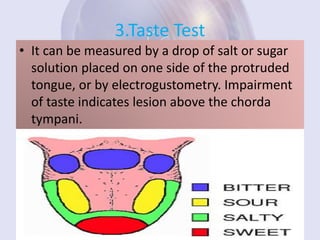
3.Taste Test
• It can be measured by a drop of salt or sugar
solution placed on one side of the protruded
tongue, or by electrogustometry. Impairment
of taste indicates lesion above the chorda
tympani.
4.Submandibular salivary flow test
• It also measures function of chorda tympani.
Polythene tubes are passed into both
Wharton's ducts and drops of saliva counted
during one minute period. Decreased
salivation shows injury above the chorda.
1. Incomplete recovery:
 Facial asymmetry persists
 Eye cannot be closed resulting in epiphora
 Weak oral sphincter results in drooling and difficulty
in taking food
2. Exposure keratitis:
 Dryness, exposure keratitis and corneal ulcer occurs
(eye cannot be closed and tear film from cornea
evaporates)
 Worse when tear production is also affected
3. Synkinesis (mass movement):
 When the patient wishes to close the eye, corner of
the mouth also twitches or vice versa.
 It is due to cross innervation of fibers.
 There is no treatment.
4. Tics and spasms:
 Result of faulty regeneration of fibers.
 Involuntary movements are seen on the affected side
of the face.
5. Contractures:
 Results from fibrosis of atrophied muscles or fixed
contraction of a group of muscles.
 Affect movements of face but facial symmetry at rest
is good.
6. Crocodile tears (gustatory lacrimation):
 Unilateral lacrimation with mastication.
 Due to faulty regeneration of parasympathetic fibers
which now supply lacrimal gland instead of the
salivary glands.
 It can be treated by section of greater superficial
petrosal nerve or tympanic neurectomy.
7. Frey’s syndrome (gustatory sweating):
 There is sweating and flushing of skin over the
parotid area during mastication.
 Results from parotid surgery.
8. Psychological and social problems:
 Drooling during eating and drinking and impairement
of speech causes social problems.
Hyperkinetic Disorders of Facial
Nerve
They are characterized by involuntary twitching
of facial muscles on one or both sides
Hemifacial Spasm
• Characterized by repeated, uncontrollable twitching of
facial muscles on one side.
2 types
a) essential/ idiopathic- cause is unknown
b) Secondary – cause is acoustic neuroma , congenital
cholesteatoma or glomus tumor.
• Many cases of facial spasm are due to irritation of
nerve because of vascular loop at the cerebellopontine
angle.
• Microvascular decompression through posterior fossa
craniotomy has met with high success rate
• Idiopathic type has been treated by selective section
of the branches of facial nerve in the parotid or by
puncturing the facial nerve with a needle in its
tympanic segment
• Botulinum toxin has been used in the affected
muscle. It blocks the neuromuscular junction by
preventing release of acetylcholine
Blepharospasm
• Twitching and spasms are limited to the
orbicularis oculi muscles on both sides.
• Eyes are closed due to muscle spasms causing
functional blindness.
• Cause is uncertain but probably lies in the
basal ganglia. It is treated by selective section
of nerves supplying muscles around the eye
on both side
• Botulinum- A toxin injected into the
periorbital muscles gives relief for 3-6 months.
Injection can be repeated if necessary.
Surgery of Facial Nerve
1) Decompression – Nerve may be compressed by
edema, hematoma or a fractured bone in its
intratemporal part. The bony canal is exposed
and uncapped. The sheath of nerve is also slit to
relieve pressure due to edema or intraneural
hematoma.
2) End to end anastomosis –This done when the
gap between severed ends of the nerves is only
a few millimeters. Its is a suitable procedure for
extratemporal part of the nerve . There should
not be any tension in the approximated ends.
4) Nerve graft (cable graft) When the gap between
the severed ends cannot be closed by end to end
anastomosis, a nerve graft is more suitable than
extensive re-routing or mobilisation of nerve. Nerve
graft is taken from greater auricular, lateral
cutaneous nerve of thigh or the sural nerve. In the
bony canal, the graft may not require any suturing.
5) Hypoglossal – facial anastomosis - Hypoglossal
nerve is anastomosed to the severed peripheral end
of the facial nerve. It improves the muscle tone and
permits some movements of facial muscles, but at
the expense of atrophy of tongue on that side.
However, disability of tongue due to atrophy is not
so severe and patient adjusts to the difficulty in
chewing and articulation after a few weeks.
5) Plastic procedures - They are used to improve
cosmetic appearance when nerve grafting is not
feasible or has failed. The procedures include
facial slings, face lift operation or slings of
masseter and temporalis muscle. The latter also
gives some movement to face in addition to
symmetry.
References
Diseases of Ear, Nose & Throat by P L Dhingra
5th edition
Any Questions??
Facial nerve and its disorders

Facial nerve and its disorders

  • 1.
  • 3.
    Anatomy and Functions •Facial Nerve is a mixed nerve having motor and a sensory root • The sensory root (nerve of Wrisberg) also carries secretomotor fibres to the lacrimal gland and salivary glands, and brings fibres of taste and general sensation • There are 2 efferent and 2 afferent pathways
  • 6.
    Components of facialnerve Components of facial nerve Function Supplies the muscles of facial expression, auricular muscles (vestigial) stylohyoid, posterior belly of digastric and stapedius Parasympathetic innervation of the lacrimal, submandibular and sublingual glands and the smaller secretory glands of nasal mucosa and the palate Taste sensation from the anterior 2/3 of tongue via chorda tympani . Hard and soft palates via greater petrosal nerve. General sensation from the concha, posterosuperior part of external canal and the tympanic membrane.
  • 7.
    • Motor nucleussituated in the pons. • Receives fibres from the precentral gyrus. • Upper part of the nucleus which innervates forehead muscles receives fibres from both the cerebral hemispheres. • Lower part of nucleus which supplies lower face gets only crossed fibres from one hemisphere. • The function of forehead is preserved in supranuclear lesions because of bilateral innervation. • Facial nucleus also receives fibres from the thalamus by alternate routes and provides involuntary control to facial muscles • Emotional movements such as smiling and crying are thus preserved in supranuclear palsies because of these fibres fron thalamus
  • 9.
    • Motor fibresoriginate from the nucleus of VIIth nerve, hook around the nucleus of VIth nerve and are joined by the sensory root (nerve of Wrisberg). • Facial nerve leaves the brainstem at pontomedullary junction, travels through posterior cranial fossa and enters the internal acoustic meatus • At the fundus of the meatus (lateral most part of the meatus), the nerve enters the bony facial canal, traverses the temporal bone and comes out of the stylomastoid foramen . • It crosses the styloid process and divides into terminal branches.
  • 10.
    • Thus thecourse of the nerve can be divided in to : 1) Intracranial part – From pons to internal acoustic meatus (15- 17 mm) 2) Intratemporal part – From internal acoustic meatus to stylomastoid foramen. It is further divided into: a. Meatal segment – with in internal acoustic meatus b. Labyrinthine segment – From fundus of meatus to the geniculate ganglion where nerve takes a turn posteriorly forming a “genu”. Nerve in the labyrinthine segment has the narrowest diameter (0.61 – 0.68 mm) and the bony canal in this segment is also the narrowest . Thus edema or inflammation can easily compress the nerve and cause paralysis . This is also the shortest segment of the nerve – 4.0 mm c. Tympanic /horizontal segment – From geniculate ganglion to just above the pyramidal eminence. It lies above the oval window and below the lateral semicircular canal d. Mastoid or vertical segment – From pyramid to stylomastoid foramen. Between the tympanic and mastoid segment is the second genu of the nerve
  • 11.
    3) Extracranial part– From stylomastoid foramen to the termination of its peripheral branches
  • 12.
    Branches of FacialNerve 1. Greater superficial petrosal nerve – Arises from the geniculate ganglion & carries secretomotor fibres to lacrimal gland and the glands of nasal mucosa 2. Nerve to stapedius – Arises at the level of second genu and supplies stapedius muscle. 3. Chorda tympani – Arises from the middle of vertical segment, passes between the incus and neck of malleus, and leaves the tympanic cavity through petrotympanic fissure. Carries fibres to submandibular & sublingual glands and brings taste from anterior two-thirds of tongue. 4. Communicating branch – It joins the auricular branch of vagus and supplies the concha, retroauricular grove, posterior meatus and the outer surface of tympanic membrane 5. Posterior auricular nerve – Supplies muscles of pinna , occipital belly of occipitofrontalis and communicates with auricular branch of vagus.
  • 13.
    6. Muscular branches– To stylohyoid and posterior belly of digastric 7. Peripheral branches – Nerve trunk after crossing the styloid process, forms two division , an upper temporofacial and a lower cervicofacial, which further divide into smaller branches. These are the temporal, zygomatic buccal, mandibular and cervical and together form pesansernius (goose-foot). They supply all the muscles of facial expression.
  • 14.
    Blood supply offacial nerve It is derived from four blood vessels: (i) Anterior-inferior cerebellar artery supplies the nerve in CP angle; (ii) labyrinthine artery, branch of anterior inferior cerebellar artery, supplies the nerve in internal auditory canal; (iii) superficial petrosal artery, a branch of middle meningeal artery, which supplies geniculate ganglion and the adjacent region; and (iv) stylomastoid artery, branch of posterior auricular artery, which supplies the mastoid segment. All the arteries form an external plexus which lies in the epineurium and feeds a deeper intraneural internal plexus Anterior inferior cerebellar artery Labyrinthine artery Superficial petrosal Stylomastoid artery
  • 15.
    Surgical landmarks ofFacial nerve For middle ear and mastoid surgery • 1. Processus cochleariformis. It demarcates the geniculate ganglion which lies just anterior to it. Tympanic segment of the nerve starts at this level. • 2. Oval window and horizontal canal. The facial nerve runs above the oval window (stapes) and below the horizontal canal. • 3. Short process of incus. Facial nerve lies medial to the short process of incus at the level of aditus. • 4. Pyramid. Nerve runs behind the pyramid and the posterior tympanic sulcus. • 5. Tympanomastoid suture. In vertical or mastoid segment, nerve runs behind this suture. • 6. Digastric ridge. The nerve leaves the mastoid at the anterior end of digastric ridge.
  • 16.
    • For parotidsurgery • 1. Cartilaginous pointer. The nerve lies 1 cm deep and sightly anterior and inferior to the pointer. Cartilaginous pointer is a sharp triangular piece of cartilage of the pinna and "points" to the nerve. • 2. Tympanomastoid suture. Nerve lies 6-8 mm deep to this suture. • 3. Styloid process. The nerve crosses lateral to styloid process. • 4. Posterior belly of digastric. If posterior belly of digastric muscle is traced backwards along its upper border to its attachment to the digastric groove, nerve is found to lie between it and the styloid process.
  • 17.
  • 18.
    From inside out,nerve consists of • Axon, • Myelin sheath, • Neurilemma, • Endoneurium A group of nerve fibres is enclosed in a sheath called perineurium to form a fascicle and the fascicles are bound together by epineurium
  • 19.
    Severity of NerveInjury • Degree of nerve injury will determine the regeneration of nerve & its function. • Earlier nerve injuries were divided into (Seddon’s Classification): Neuraparaxia, a conduction block, where flow of axoplasm through the axons was partially obstructed Axonotmesis – injury to axons Neurotmesis – injury to nerves
  • 20.
  • 21.
  • 22.
    Sunderland classification isnow widely accepted. Sunderland classified nerve injuries into five degrees of severity based on anatomical structure of the nerve 1ᵒ= Partial block to flow of axoplasm; no morphological changes seen. Recovery of function is complete (Neuraparaxia). 2ᵒ= Loss of axons, but endoneurial tubes remain intact. During recovery, axons will grow into their respective tubes, and the result is good (axonotmesis). 3ᵒ= Injury to endoneurium. During recovery, axons of one tube can grow into another. Synkinesis can occur (neurotmesis). 4ᵒ= Injury to perineurium in addition to above. Scarring will impair regeneration of fibres (partial resection). 5ᵒ= Injury to epineurium in addition to above (complete nerve transection).
  • 23.
    The first threedegrees are seen in viral and inflammatory disorders while fourth and fifth are seen in surgical or accidental trauma to the nerve or in neoplasms. The prognosis is poor for degrees 3 onwards.
  • 24.
    Electrodiagnostic Tests  Usefulto differentiate between neurapraxia and degeneration of the nerve.  Helps to indicate time for surgical decompression of the nerve. 1. Minimal Nerve excitability test- The nerve is stimulated at steadily increasing intensity till facial twitch is just noticeable. This is compared with the normal side. There is no difference between the normal and paralysed side in conduction block. In other injuries, where degeneration sets in, nerve excitability is gradually lost. When the difference between two sides exceed 3.5 milliamperes, the test is positive for degeneration. Degeneration of fibres cannot be detected earlier than 48-72 hours of its commencement
  • 25.
    2. Maximal stimulationtest (MST) - This test is similar to the minimal nerve excitability test but instead of measuring the threshold of stimulation, the current level which gives maximum facial movement is determined and compared with the normal side. Response is visually graded as equal, decreased or absent. Reduced or absent response with maximal stimulation indicates degeneration and is followed by incomplete recovery.
  • 26.
    • 3. Electroneuronography(ENoG) It is a sort of evoked electromyography. The facial nerve is stimulated at the stylomastoid foramen and the compound muscle action potentials are picked up by the surface electrodes. Supramaximal stimulation is used to obtain maximal action potentials. The response of action potentials of the paralysed side are compared with that of the normal side on similar stimulation and thus percentage of degenerating fibres is calculated. Studies reveal that degeneration of 90% occurring in the first 14 days indicates poor recovery of function. Faster rate of degeneration occurring in less than 14 days has a still poorer prognosis. ENoG is most useful between 4 and 21 days of the onset of complete paralysis
  • 28.
    4. Electromyography (EMG) •This tests the motor activity of facial muscles by direct insertion of needle electrodes usually in orbicular oculi and orbicularis oris muscles and the recordings are made during rest and voluntary contraction of muscle. • In a normal resting muscle, biphasic or triphasic potentials are seen every 30-50 milliseconds. • In a denervated muscle spontaneous involuntary action potentials called fibrillation potentials are seen. They appear 14-21 days after denervation. With regeneration of the nerve after injury, polyphasic reinnervation potentials replace fibrillation potentials. They appear 6-12 weeks prior to clinical evidence of facial function and thus provide the earliest evidence of recovery.
  • 29.
    • Electromyography isuseful in planning reanimation procedures. Presence of normal or polyphasic potentials after 1 year of injury indicates that reinnervation is taking place and there is no need for reanimation procedure. If fibrillation potentials are seen, it indicates intact motor end plates but no evidence of reinnervation and need for nerve substitution. Electrical silence indicates atrophy of motor end plates and need for muscle transfer procedures rather than nerve substitution. • Voluntary contraction causes motor discharge. Diminished or no response to voluntary contraction is seen after nerve injury
  • 31.
    • The causemay be central or peripheral • The peripheral lesion are more common and may involve the nerve in its intracranial, intratemporal or extratemporal parts. • Other causes are linked to Systemic diseases like DM, hypothyroidism etc.
  • 32.
    • Brain abscess •Pontine gliomas • Poliomyelitis • Acoustic neuroma • Meningoma • Congenital cholesteatoma • Idiopathic • Infections • Trauma • Neoplasms • Malignancy of parotid • Surgery of parotid • Neonatal facial injury • Diabetes mellitus • Hypothyroidism • Uremia • Polyarteritis nodosa
  • 33.
    Idiopathic, peripheral facial paralysisor paresis of acute onset • Both sexes are equally affected. • Any age may be affected but incidence rises with increasing age. • +ve family hx in 6-8% • Risk: diabetes and pregnancy •sudden onset • unable to close eyes • Bell’s phenomenon (eyeball turns up and out on attempting to close the eye) • dribbling of saliva • asymmetrical face • epiphora • pain in ear precede or accompany nerve paralysis • noise intolerance and loss of taste
  • 34.
     Viral infection HSV,Herpes zoster, EBV  Vascular ischemia -Primary ischemia (induced by cold or emotional stress) -Secondary ischemia ( primary ischemia increased capillary permeability exudation of fluid, edema, compression of microcircultation).  Hereditary Fallopian tube is narrow making it susceptible to early compression  Autoimmune disorder T-lymphocyte changes have been observed.
  • 35.
    history taking complete otologicaland head and neck examination X-ray studies blood test (total count, peripheral smear, sedimentation rate, blood sugar and serology) nerve excitability test General reassurance relief of ear pain by analgesic care of eye physiotherapy or massage of facial muscles
  • 36.
    Steroids - preventsincidence of synkinesis, crocodile tears and shortens the recovery time of facial paralysis. Other drugs -vasodilators, vitamins, mast cell inhibitors, antihistaminics have not found to be useful Nerve decompression relieves pressure on nerve fibers and thus improves the microcirculation of the nerve
  • 37.
    Idiopathic disorder Triad- facialparalysis, swelling of lips and fissured tongue. Paralysis may be recurrent seen in bell’s palsy, melkersson’s syndrome, diabetes, sarcoidosis and tumors. seen in guillian barre syndrome, sarcoidosis, sickle cell disease, acute leukemia, bulbar palsy, leprosy and some other systemic disorder.
  • 38.
    • There isfacial paralysis along with vesicular rash in the external auditory canal and pinna. • There may also be anesthesia of face, giddiness and hearing impairment due to involvement of Vth and VIIIth nerves. Treatment is the same as for Bell's palsy.
  • 39.
    • Fractures oftemporal bone may be longitudinal, transverse or mixed. Facial palsy is seen more often in transverse fractures (50%). Paralysis is due to intraneural haematoma or by compression. • It is important to know whether paralysis was of immediate or delayed onset. • Delayed onset paralysis is treated conservatively like Bell's palsy while immediate onset paralysis may require surgery (decompression, re-anastomosis of cut ends or cable nerve graft)
  • 41.
    • Facial nerveis injured during stapedectomy, tympanoplasty or mastoid surgery. • Paralysis may be immediate or delayed and treatment is the same as in temporal bone trauma. • Sometimes, nerve is paralysed due to pressure of packing on the exposed nerve and this should be relieved first. • Facial nerve may be injured in surgery of parotid tumours or deliberately excised in malignant tumours. • Accidental injuries in the parotid region can also cause facial paralysis. • Application of obstetrical forceps may also result in facial paralysis in the neonate due to pressure on the extratemporal part of nerve.
  • 42.
    • Carcinoma ofexternal or middle ear, glomus tumor, rhabdomyosarcoma and metastatic tumors of temporal bone all result in facial nerve palsy. • Facial nerve neuroma occurs anywhere along the course of the nerve and produces paralysis of gradual or sudden onset. • Treated by excision and grafting. • High resolution CT scan and gadolinium-enhanced MRI – very useful for facial nerve tumor • Facial paralysis with tumor of the parotid almost always implies malignancy.
  • 43.
    • Peripheral facialparalysis is mostly of idiopathic • Exclusion of diabetes, hypothyroidism, leukemia, sarcoidosis, periarteritis nodosa, Wegner’s granulomatosis, leprosy, syphilis and demyelinating disease.
  • 44.
    LOCALISATION OF FACIALLESION • Central facial paralysis Caused by cerebrovascular accidents (hemorrhage, thrombosis, embolism), tumor or an abscess. It causes paralysis of only the lower half of face on the contralateral side. Forehead movements are retained due to bilateral innervation of frontalis muscle. Involuntary emotional movements and the tone of facial muscles are also retained.
  • 45.
    • Peripheral FacialParalysis All the muscles of the face on the involved side are paralysed. Patient is unable to frown, close the eye, purse the lips or whistle A lesion at the level of nucleus is identified by associated paralysis of VIth nerve. A lesion at cerebellopontine angle is identified by the presence of vestibular and auditory defects and involvement of other cranial nerves such as Vth, IXth, Xth and XIth. A lesion in the bony canal, from internal acoustic meatus to stylomastoid foramen, can be localised by topodiagnostic tests. A lesion outside the temporal bone, in the parotid area, affects only the motor functions of nerve. It may sometimes be incomplete as some branches of the nerve may not be involved in tumour or trauma.
  • 47.
    Topodiagnostic Tests forLesions in Intratemporal Part 1. Schirmer's test It compares lacrimation of the two sides. A strip of filter paper is hooked in the lower fornix of each eye and the amount of wetting of strip measured. Decreased lacrimation indicates lesion proximal to the geniculate ganglion as the secretomotor fibres to lacrimal gland leave at the geniculate ganglion via greater superficial petrosal nerve.
  • 48.
    2. Stapedial reflex Stapedialreflex is lost in lesions above the nerve to stapedius. It is tested by tympanometry. Persistence of the stapedial reflex in Bell’s palsy gives a better prognosis
  • 49.
    3.Taste Test • Itcan be measured by a drop of salt or sugar solution placed on one side of the protruded tongue, or by electrogustometry. Impairment of taste indicates lesion above the chorda tympani.
  • 50.
    4.Submandibular salivary flowtest • It also measures function of chorda tympani. Polythene tubes are passed into both Wharton's ducts and drops of saliva counted during one minute period. Decreased salivation shows injury above the chorda.
  • 52.
    1. Incomplete recovery: Facial asymmetry persists  Eye cannot be closed resulting in epiphora  Weak oral sphincter results in drooling and difficulty in taking food 2. Exposure keratitis:  Dryness, exposure keratitis and corneal ulcer occurs (eye cannot be closed and tear film from cornea evaporates)  Worse when tear production is also affected
  • 53.
    3. Synkinesis (massmovement):  When the patient wishes to close the eye, corner of the mouth also twitches or vice versa.  It is due to cross innervation of fibers.  There is no treatment. 4. Tics and spasms:  Result of faulty regeneration of fibers.  Involuntary movements are seen on the affected side of the face. 5. Contractures:  Results from fibrosis of atrophied muscles or fixed contraction of a group of muscles.  Affect movements of face but facial symmetry at rest is good.
  • 54.
    6. Crocodile tears(gustatory lacrimation):  Unilateral lacrimation with mastication.  Due to faulty regeneration of parasympathetic fibers which now supply lacrimal gland instead of the salivary glands.  It can be treated by section of greater superficial petrosal nerve or tympanic neurectomy. 7. Frey’s syndrome (gustatory sweating):  There is sweating and flushing of skin over the parotid area during mastication.  Results from parotid surgery. 8. Psychological and social problems:  Drooling during eating and drinking and impairement of speech causes social problems.
  • 55.
    Hyperkinetic Disorders ofFacial Nerve They are characterized by involuntary twitching of facial muscles on one or both sides
  • 56.
    Hemifacial Spasm • Characterizedby repeated, uncontrollable twitching of facial muscles on one side. 2 types a) essential/ idiopathic- cause is unknown b) Secondary – cause is acoustic neuroma , congenital cholesteatoma or glomus tumor. • Many cases of facial spasm are due to irritation of nerve because of vascular loop at the cerebellopontine angle. • Microvascular decompression through posterior fossa craniotomy has met with high success rate
  • 57.
    • Idiopathic typehas been treated by selective section of the branches of facial nerve in the parotid or by puncturing the facial nerve with a needle in its tympanic segment • Botulinum toxin has been used in the affected muscle. It blocks the neuromuscular junction by preventing release of acetylcholine
  • 58.
    Blepharospasm • Twitching andspasms are limited to the orbicularis oculi muscles on both sides. • Eyes are closed due to muscle spasms causing functional blindness. • Cause is uncertain but probably lies in the basal ganglia. It is treated by selective section of nerves supplying muscles around the eye on both side
  • 59.
    • Botulinum- Atoxin injected into the periorbital muscles gives relief for 3-6 months. Injection can be repeated if necessary.
  • 60.
    Surgery of FacialNerve 1) Decompression – Nerve may be compressed by edema, hematoma or a fractured bone in its intratemporal part. The bony canal is exposed and uncapped. The sheath of nerve is also slit to relieve pressure due to edema or intraneural hematoma. 2) End to end anastomosis –This done when the gap between severed ends of the nerves is only a few millimeters. Its is a suitable procedure for extratemporal part of the nerve . There should not be any tension in the approximated ends.
  • 61.
    4) Nerve graft(cable graft) When the gap between the severed ends cannot be closed by end to end anastomosis, a nerve graft is more suitable than extensive re-routing or mobilisation of nerve. Nerve graft is taken from greater auricular, lateral cutaneous nerve of thigh or the sural nerve. In the bony canal, the graft may not require any suturing. 5) Hypoglossal – facial anastomosis - Hypoglossal nerve is anastomosed to the severed peripheral end of the facial nerve. It improves the muscle tone and permits some movements of facial muscles, but at the expense of atrophy of tongue on that side. However, disability of tongue due to atrophy is not so severe and patient adjusts to the difficulty in chewing and articulation after a few weeks.
  • 62.
    5) Plastic procedures- They are used to improve cosmetic appearance when nerve grafting is not feasible or has failed. The procedures include facial slings, face lift operation or slings of masseter and temporalis muscle. The latter also gives some movement to face in addition to symmetry.
  • 63.
    References Diseases of Ear,Nose & Throat by P L Dhingra 5th edition
  • 64.

Editor's Notes

  • #5 Special visceral efferent forms the motor root and supplies all the muscles derived from the second branchial arch, i.e. all the muscles of facial expression, auricular muscles (now vestigial), stylohyoid, posterior belly of digastric and the stapedius. General visceral efferent supplies secretomotor fibres to lacrimal, submandibular and sublingual glands and the smaller secretory glands in the nasal mucosa and the palate Special visceral afferent brings taste from the anterior two thirds of tongue via chorda tympani and soft and hard palate via greater superficial petrosal nerve. Taste is carried to the nucleus of tractus solitaries. General somatic afferent brings general sensation from the concha, posterosuperior part of external canal and the tympanic membrane. These fibres account for vestibular eruption in the herpes zoster infection of the geniculate ganglion. It also brings proprioceptive sensation from the facial muscles.
  • #12 Course of facial nerve. Intratemporal part consists of four segments: Meatal (1), Labyrinthine (2), Tympanic (3), Mastoid (4). (B) Branches of facial nerve on face.
  • #15 It is derived from four blood vessels: (i) Anterior-inferior cerebellar artery supplies the nerve in CP angle; (ii) labyrinthine artery, branch of anterior inferior cerebellar artery, supplies the nerve in internal auditory canal; (iii) superficial petrosal artery, a branch of middle meningeal artery, which supplies geniculate ganglion and the adjacent region; and (iv) stylomastoid artery, branch of posterior auricular artery, which supplies the mastoid segment. All the arteries form an external plexus which lies in the epineurium and feeds a deeper intraneural internal plexus
  • #22 1ᵒ= Partial block to flow of axoplasm 2ᵒ= Loss of axons, but endoneurial tubes remain intact 3ᵒ= Injury to endoneurium 4ᵒ= Injury to perineurium in addition to above 5ᵒ= Injury to epineurium in addition to above
  • #41 (A) Longitudinal fracture runs along the axis of petrous pyramid. Typically, it starts at squamous part of temporal bone, runs through roof of external ear canal and middle ear towards the petrous apex, and to foramen lacerum. (B) Transverse fracture. It runs across the axis of petrous. Typically, it begins at foramen magnum, passes through occipital bone, jugular fossa, petrous pyramid ending in middle cranial fossa. It may pass medial, lateral or through the labyrinth.
  • #52 Topographical localisation of VIIth nerve lesions. (A) Suprageniculate or transgeniculate lesion. Secretomotor fibres to the lacrimal gland leave at the geniculate ganglion and are interrupted in lesions situated at/or proximal to geniculate ganglion. (B) Suprastapedial lesions cause loss of stapedial reflex and taste but preserve lacrimation. (C) Infrastapedial lesions cause loss of taste but preserve stapedial reflex and lacrimation. (D) Infrachordal lesions cause loss of facial motor function only.