19
The International Journal of Educational and Psychological Assessment
January 2013, Vol. 12(2)
© 2013 Time Taylor Academic Journals ISSN 2094-0734
Assessing Students’ Critical Thinking and Approaches to Learning
Carlo Magno
De La Salle University, Manila
Abstract
The present study explored the construct validity of the Revised Learning Process
Questionnaire R-LPQ 2F with the Watson Glaser Critical Thinking Appraisal (WGCTA).
The construct validation process test the assumption that deep approaches to learning that
includes relating knowledge to new knowledge, distinguishing evidences and arguments,
organizing and structuring content into a coherent whole results to critical thinking. The R-
LPQ 2F and the WGCTA was administered to 104 senior high school students in the
Philippines. Only surface approach to learning was significantly correlated with the subtests
on interpretation of the WGCTA (r=-.51, p<.01). A measurement model was tested using
Confirmatory Factor Analysis (CFA) and showed that both deep and surface approach
increases the variance explained for critical thinking as a latent construct. The model
attained an adequate fit: RMSEA=.04, SRMR=.04, CFI=.96, and TLI=.93.
Keywords: deep approach, surface approach, critical thinking, R-LPQ, WGCTA
Introduction
Students differ in their ability to think, memorize, reason, read and process
information. It is important for critical thinkers to execute their own learning to be able to
generate and evaluate conclusions from related evidence. The students who are considered
as high critical thinkers have a better implementation of their learning approach (Halpern,
1996; Magno, 2010). For the past twenty years, the process of thinking is again
experiencing one its periodic resurgences as a legitimate topic of psychology and education
because of the assertion that schools need to develop 21st century skills among their
students. Part of the 21st century skills is critical thinking and learning skills of students. A
part of that resurgence can be attributable to several studies on critical thinking, logic, and
thinking skills. According to Norris (1985) that societal factors calls a need for well
developed thinking skills. Studies in psychology, education, business, and other fields call
for more and better thinking skills instruction in schools and especially in the Philippine
setting. Students do not exhibit an impressive level of skills in critical or creative thinking.
Moreover, the review of Norris shows that the typical critical thinking ability is not
widespread. Most students do not score well on the tests that measures ability to recognize
assumptions, evaluate arguments and appraise inferences (Neuschmidt, Barth, & Hastedt,
2008; Ramirez, 2006).
High results in the Watson and Glaser Critical Thinking Appraisal describe critical
thinkers to have a potential success on certain types of occupations and instructional
programs. Previous studies believe that the thinking of students will remain "invisible" to
them unless they are supportively challenged to discover the problems in their thinking.
This is not possible unless they receive careful introduction into the intellectual workings of
the human mind. Critical thinking involves several skills, including the ability to listen and
20
The International Journal of Educational and Psychological Assessment
January 2013, Vol. 12(2)
© 2013 Time Taylor Academic Journals ISSN 2094-0734
read carefully, evaluate arguments, look for and find hidden assumptions, and to trace the
consequences of a claim. Critical thinking is after seen as a universal goal of higher
education but is seldom confirmed as an outcome. In order to develop critical thinking in
the educational setting, students need to adapt an appropriate learning approach. The
proper approach to learning facilitates critical thinking (Magno, 2010). Previous research
regarding learning approaches, suggests that it is found to be an influential element for
motivation and achievement. Studies exemplifying the relationship between critical thinking
and learning approaches are still few. The relationship between learning approach and
critical thinking makes a good basis for explaining learning but they were investigated with
different correlates. Establishing the possibility of linking these two variables has been
neglected. This present study examines the relationship between critical thinking and
learning approaches for high school students. The relationship will establish construct
validation of the outcome of learning approach as an appropriate mechanism to propel
critical thinking.
Approach to Learning
The learning process consists of the way in which the learning takes place and
involves primarily the capacities by the activities by means of which knowledge is gained,
skill is produced, habits, attitudes, and ideas are required (Schön, 1987). Learning
approach are always the major concerns of school teachers and college professors.
Educators have theorized different models and engaged in research to help understand the
nature of student’s learning processes. One commonly cited model in teaching and
learning literature is the 3P model of classroom learning outlined by Dunkin and Biddle in
1974. Strategies to learn are considered important elements (Biggs, 1993).
Researchers have done numerous studies of student’s study approaches since the
late 1970’s. Learning approaches are the patterns followed by students in order to achieve
higher quality learning. Basically, two approaches to learning have been identified: the
“surface” approach and the “deep” approach. A surface approach describes the intention
to reproduce information in compliance with externally imposed task demands while deep
approach involves the intention to understand (Kember, Biggs, & Leung, 2004).
Deep processing also labeled elaboration or critical thinking involves challenging
the veracity of information encountered and attempting to integrate new information with
prior knowledge and experience (Biggs, Kember, & Leung, 2001). On the other hand,
surface processing also labeled rehearsal or memorization; involves the repetitive rehearsal
and rote memorization of information. Kember et al. (1996) indicated that students who
adopt surface approach to learning are referred to as surface learners and deep approach
students are referred to as deep learner.
Biggs (1999) described that the deep approach is task-centered and task-
appropriate. Deep approach to learning is encouraged by (1) teaching and assessing
methods; (2) stimulating and considerate teaching specially teaching which demonstrate the
teacher’s personal commitment to the subject matter and stresses its meaning and relevance
to students; (3) clearly stating academic expectations; (4) opportunities to exercise
responsible choice in the content of the study; (5) interest in and background knowledge
and (6) previous experiences of educational settings that encourage deep approach. On the
other hand, surface approach is encouraged by (1) assessment methods emphasizing recall
21
The International Journal of Educational and Psychological Assessment
January 2013, Vol. 12(2)
© 2013 Time Taylor Academic Journals ISSN 2094-0734
of the application of trivial procedural knowledge; (2) assessment methods that create
anxiety; (3) cynical or conflicting messages about rewards; (4) excessive amount of materials
and (5) poor or absent feedback (Ramsden, 1988).
The deep approach to learning can result in good learning outcome. Deep
processing, involves the intention of a student to understand and attempt to relate incoming
information to previous knowledge and experiences in order to come up with a personal
meaning (Biggs, Kember, & Leung, 2004). For example those individuals who follow the
mastery goal orientation utilize deep approach, requiring a lot of cognitive effort but leads
to better understanding (Rahman & Mokhtar, 2012). On the other hand, surface approach
is the intention of a student to fulfill the task requirements such as rote memorization of
such information needed to pass an examination (Ramsden et al., 1999). Surface approach
leads to increase in knowledge through memorization of information and by following
certain procedures. It generally leads to low retention and an inability to use information in
new contexts.
Past studies suggest that Asian students rely on rote learning and a surface approach
while Western studies such as those from Australia employ deep Learning strategies to
learning (Biggs & Moore, 1993; Magno, 2009). However, in a later study of Hong Kong
Chinese students’ study approaches, researchers introduced a new concept of learning
called “deep memorization” as a way to enhance understanding (Watkins & Hattie, 1985).
From the research of Rhem (1995), more students advanced in their academics, the
tendency for them to use surface processing also increased. He further explained that the
use of surface processing might be due to the traditional teaching styles being used in
schools. He also listed a couple of other factors that might have been responsible for
student to resort to surface processing: (1) an excessive amount of course material in the
curriculum; (2) relatively high class contact hours, (3) an excessive amount of course
materials, (4) a lack of opportunity to pursue subjects in depth, (5) a lack of choice over the
method of study and over the subjects and (6) a threatening and anxiety provoking
assessment system. This evidence shows that there is a transition in the use of learning
approaches from deep to surface and both are used as predictors of students test
performance.
Students' approaches can vary according to students' perceptions of their learning
environment. Students’ learning approaches do not have fixed characteristics. A student,
who takes a deep approach to one subject, or even part of a subject, may take a surface
approach in relation to something else. The researchers chose learning approach as a
variable because it strongly influences the quality of student’s learning outcomes (Quinita
1998).
When a student abstracts meaning from what is already given, there is a deep
approach to learning which can result in good learning outcomes. Surface approach leads
to increase in knowledge through memorization of information and by following certain
procedures. It generally leads to low retention and an inability to use information in new
contexts.
Hoon, Goh, and Chia (1995) compared surface and deep approach in learning
activity series of metals in a high school Chemistry course and concluded that students who
adopt deep approach are better in inter-relating chemical concepts, possess better
comprehension and higher retention of knowledge compared to students who adopt
surface approach. Emphasis on effort to learn for self-improvement, and collaborative
22
The International Journal of Educational and Psychological Assessment
January 2013, Vol. 12(2)
© 2013 Time Taylor Academic Journals ISSN 2094-0734
learning with peers, may promote deep learning. Confucian philosophy, also, advocates
deep learning: 'seeing is perilous'. Strong motivation to achieve and the attribution of
success to internal and controllable factors such as effort, interest and study skills should
help Chinese students develop adaptive approaches to learning. This is supported by
findings that Chinese students in Hong Kong score higher on the deep and achieving
approaches and lower on the surface approach than Australian students (Biggs, 1990).
There is evidence that deep approach to learning facilitates better learning
outcomes. The kind of challenge that students engage in learning allows them to
demonstrate critical thinking. However, there is also large evidence of studies indicating
surface which could not be adaptive in producing better learning outcomes.
Critical Thinking
Experts explain critical thinking in varying perspectives. One commonality among
the perspectives is the conviction of critical thinkers which they expressed their opinions on
a topic. Some explains that there are "stages" or "aspects" of critical thinking. The idea of
bringing critical thinking into the classroom was unanimous, however, ideas for making this
happen as well as the implementation differed dramatically. The focus of critical thinking
on education started in the work of Dewey who proposed that critical thinking involved the
suspension of judgment and healthy skepticism. Students should be assisted in the
engagement of making the reflective, reasonable, and direction on what to believe or do.
Stancato (2000) used several definitions from previous research to define critical
thinking. Critical thinking has been defined as "a process for determining the value of an
idea". Others see critical thinking as "a process of thinking without a single solution"
(Yahiro, 1994). Paul (1990) defines it as "open-mindedness,” although, it is not a "natural"
disposition of the human mind. However, openness to contradiction and opposing points
of view are the hallmarks of the critical thinking. Paul and Elder (2001) explains that critical
thinking involves "to be able to take one's thinking apart systematically, to analyze each part,
assess it for quality and then improve it." Moreover, critical thinking involves being able to
break down a piece of information or a thought, find any value that it may contain, and
discard the remains. This piece of information then goes through a process of scrutiny,
being subject to analysis, change, improvement, and integration.
A number of researchers have put forth definitions and theories regarding critical
thinking. Facione (1998) was the head of a systematic inquiry into the research on critical
thinking and how to assess it. He views critical thinking to be a purposeful, self-regulatory
judgment which results in interpretation analysis, evaluation and inference as well as
explanation of the evidential conceptual methodological, contextual consciousness upon
which that judgment was based. Supporting Facione’s model, Lundquist (1999) explained
that the “fundamental to learning is reflection and the ability to draw conclusions from
more of less successful attempts to come to an understanding of the issues at hand” would
be a paramount characteristic of critical thinking.
Hemming (2000) breaks down each process, beginning with logic. She says that
logical relationships need to be addressed in order to exhibit critical thinking. According to
Hemming, critical thinking is best fostered among students by “treating them with respect,
be being open and honest with them, and being willing to accept scrutiny of beliefs and
practices, and by encouraging them to question their own ideas and those of others.” In
23
The International Journal of Educational and Psychological Assessment
January 2013, Vol. 12(2)
© 2013 Time Taylor Academic Journals ISSN 2094-0734
addition, Hemming (2000) views critical thinking as a process that include dialogical
reasoning, evaluating criteria, content, and caring and connecting with criticism. Dialogical
reasoning involves being open-minded and allowing multiple perspectives and ideas to be
factors in forming conclusions. Being open-minded means that the individual needs to be
open to the fact that he or she may be wrong and is, therefore, willing to reevaluate his or
her ideas. Hemming states that critical thinking includes the following criteria for creating
judgments: reasons, shared values, facts, definitions, standards, laws, principles, and
conventions. The combination of content and critical thinking as curriculum is a question
of hot debate and will be addressed later in this review.
Paul (1992) explains that “objectivity and rationality aimed at discovering truth are
crucial to critical thinking. This involves reasoning, the application of standards, and the
use of logic.” The author states, “in dialogical reasoning it is important to understand that
the purpose is not merely to think about the perspective of others, but to examine one’s
own ideas, and those of others, in a search for the truth.” In other words, others’ ideas are
not more important than one’s own, but can add additional, useful information.
Similar to Hemming’s process of critical thinking, Perry’s ideas of critical thinking
claims that there are four stages: dualism, multiplicity, contextual relativism, and dialectic.
Perry formulated his model of critical thinking after interviewing many college students
during their freshman year, throughout their college years, and finally, as seniors. Perry
found a series of steps that increased the students’ sophistication of thought, along with a
transformation of philosophy regarding the role of nature, the role of the student, and the
role of the teacher.
The definition of Watson and Glaser (1980) of critical thinking is used in the
present study. Their typology includes inference, recognition of assumptions, deduction,
interpretation, and evaluation of arguments. This typology of critical thinking is widely used
around the world and all other critical thinking skills and definitions of scholars are
covered within the five dimensions. For example, formal logic as part of critical thinking
explained by Ennis (1987) involves rules of deduction and inference. In the same way,
good judgment in critical thinking as explained by Halpern (1998) involves the evaluation
of arguments. Beyer (1995) also includes that identifying and making academic arguments
is part of critical thinking which is covered in recognition of assumption. The framework by
Watson and Glaser provides the best representation of critical thinking because they have
operationalized each domain as a set of items where a stimulus is read by examinees and
the skills are shown by responding appropriately. Specifically, the their existing test
measures the ability to recognize the existence of problems and an acceptance of the
general need for evidence in support of what is asserted to be true, and knowledge of the
nature of valid inferences, abstractions, and generalizations in which the weight or accuracy
of different kinds of evidence are logically determined (Watson & Glaser, 2008).
Presently, the standard form of the WGCTA is composed of 80 items that measure
different aspects of critical thinking. The appraisal aims to provide an estimate of an
individuals’ standing in the composite of abilities by means of five subtests. The five
subtests of the Critical Thinking Appraisal are as follows (Watson & Glaser, 1980):
Inference. Discriminating among degrees of truth or falsity of inferences drawn
from given data.
Recognition of Assumptions. Recognizing unstated assumptions or presuppositions
in given statements or assertions.
24
The International Journal of Educational and Psychological Assessment
January 2013, Vol. 12(2)
© 2013 Time Taylor Academic Journals ISSN 2094-0734
Deduction. Determining whether certain conclusions necessarily follow from
information in given statements or premises.
Interpretation. Weighing evidence and deciding if generalizations or conclusions
based on the given data are warranted.
Evaluation of Arguments. Distinguishing between arguments that are strong
relevant.
The WGTCA has been widely used as indication of individuals’ critical thinking
competence. While not directly comparable to other tests, such as the California critical
thinking skills test, both follow the same theoretical underpinnings and format.
The development and maintaining the five factors of the WGCTA was explained in the
paper of Magno (2010):
These five factors of the Watson Glaser still hold to be valid despite many revisions
of the WGCTA (Watson & Glaser, 2008). A Confirmatory Factor Analysis (CFA) was
conducted (N=306) with the 40 items of the WGCTA and tested a one factor model, three
factor model (RED model), and the traditional five factor model (Watson & Glaser, 2008).
These models were compared and the five factor model still had the best fit. The five
factor model had the lowest chi-square (χ2
=159.39, df=125) and RMSEA value (.03),
highest Goodness of Fit Index (GFI=.95) and Adjusted Goodness of Fit Index (AGFI=.93).
The items under the five factor model also had higher parameter estimates than in the
other models. The traditional five factor model of the WGCTA also correlated well
(significant and moderate to high relationships) with the revised factors. In addition, the five
factors remained stable across time and they are correlated with several indicators of ability
(see Watson & Glaser, 2008). In a metanalytic study conducted by Bernard et al. (2008),
13 different studies were used and the factors of the WGCTA were combined in pairs.
They found that the average correlation coefficients for each paired combination of the
WGCTA factors achieved convergence with a positive relationship (the overall the average
correlations ranged from a low of 0.17 to high of 0.40). They also interpreted that the five
major subtests are significantly heterogeneous.
The Present Study
The connection between approaches to learning and critical thinking is explained in
the 3P model by John Biggs.The model represents an integrated cycle or system, in which
components interact: Personal and situational presage factors exist prior to a given learning
situation; these factors influence the learning process, or the approach adopted by the
student to the learning task; which in turn influences the product, or outcomes of learning
(Biggs, 1993). Deep and surface approaches are considered as the approaches adapted by
the students to learn. The strategies used in deep and surface learning indicate ways in
which students relate to the learning material while the outcome can critical thinking. The
relationship between approaches to learning and critical thinking is not new. Dunn and
Musolino (2011) established the relationship between deep and surface approach to
learning with reflective thinking. Reflective thinking in the study is the process of making
critical judgment on events which is similar to critical thinking. However, a non-cognitive
measure for critical thinking was used in her study.
25
The International Journal of Educational and Psychological Assessment
January 2013, Vol. 12(2)
© 2013 Time Taylor Academic Journals ISSN 2094-0734
Deep and surface approaches to study was derived from the original empirical
research by Marton and Säljö (1976) and Entwistle and Ramsden (1983) and elaborated by
Biggs and among others. Although learners may be classified as “deep” and “surface” they
are not attributes of an individual, one person may use both approaches at different times,
although he or she may have preferences for one or the other. The use of deep approach
manifest high critical thinking skills that focuses on “what is signified”, relates knowledge to
new knowledge, relates and distinguishes evidence and arguments, organizes and structure
content into coherent whole and emphasis is internal, from within the students while the
use of surface approach shows low critical thinking that only focuses on “signs” (or on the
learning as a signifier of something else), focuses on unrelated parts of the task, information
for assessment is simple memorized, facts and concepts are associated unreflectively,
principles are not distinguished from examples, task is treated as an external imposition
and emphasis is external from the demands of assessment (Biggs, 1993). The present study
validates the functional use of approaches to learning in promoting critical thinking among
secondary education students.
Method
Participants
There were 104 senior high school seniors students in a private school in the
Philippines. The participants came from three sections. The students were all in their
senior years enrolled in a private school and were undergoing the same curriculum.
Instruments
To measure learning approach, the researcher used the Revised Learning Process
Questionnaire (R-LPQ) developed by Kember, Biggs, and Leung (2001). The
questionnaire consists of 22 items. It is provided with two approach scores (1) deep
approach and (2) surface approach. It uses a five point Likert scale ranging from “always”
or “almost always true of me” to “never” or “only rarely true of me”. The alpha coefficient
obtained is .71 for the combine scale and .62 for deep approach and .54 for surface
approach.
To measure the critical thinking, the Watson-Glaser Critical Thinking Appraisal
Test (WGCTA) was used which consist of series of tests exercises which require
application of some of the important abilities involved in critical thinking. The exercises
include problems, statements, arguments, and interpretations of data. It is a test of power
with no rigid time limit. The five subtests are as follows: Inference (samples ability to
discriminate among degrees of truth or falsity of interferences drawn from given data),
Recognition of Assumptions (samples ability to recognize unstated assumptions or
presuppositions which are taken for granted in given statements or assertions), Deduction
(samples ability to reason deductively from given statements or premises; to recognize the
relation of implication between propositions; to determine whether what may seem to be
an implication of necessary implication or necessary interference from given premises),
Interpretations (samples ability to weigh evidence and to distinguish between [a]
generalizations from given data that are not warranted beyond a reasonable doubt; [b]
26
The International Journal of Educational and Psychological Assessment
January 2013, Vol. 12(2)
© 2013 Time Taylor Academic Journals ISSN 2094-0734
generalization which, although not absolutely certain or necessary, do seen to be warranted
beyond a reasonable doubt), Evaluation of Arguments (samples ability to distinguish
between arguments which are strong and relevant and those which are weak or irrelevant to
particular question at issue).
Data Gathering Procedure
The researcher met with the school principal of the private schools. The
participants were requested to answer the R-LPQ and the WGCTA. The measures were
completed done in one day. The researcher assured the students that the test is not part of
their grades.
The participants were allowed to ask questions regarding the tests and procedures.
The first test that was administered was the revised learning processes questionnaire. The
students were asked to respond to the items using a 5-point Likert scale. The respondents
were asked to complete the questionnaire during the administration of the test and
returned it to the researchers after completion.
After finishing the R-LPQ-2F the participants were given the Watson-Glaser in their
classes. The examiner assigned to have at least 10 minutes available to take care of the
actual working time and the times spent in giving directions, passing out materials, and
other preliminary activity before testing. After distributing all the necessary materials the
participants filled in the name and the other information required in the test. They are
further instructed to read carefully the directions for each set of the test and study the
example questions. For each question, the participant decides what they think is the best
answer. Their choice of answer is recorded by choosing the best answer in the appropriate
space before the number. After the administration of the tests, the participants were
debriefed about the purpose of the study and they were thanked for their effort.
Data Analysis
To determine the level of critical thinking and learning approach the mean and
standard deviation was obtained. To determine the relationship among the critical thinking
and learning approach factors, the Pearson r moment correlation coefficient was used.
Structural Equations Modeling (SEM) was used to test whether construct validity exist
between deep and surface approach and critical thinking as latent factors. It is proposed
that the three variables would attain factor convergence. Significant parameter estimates
should be produced to establish the relationship among the latent constructs. Parcels were
created as components under each latent constructs. The fit of the hypothesized model was
assessed by examining several fit indices including three absolute and one incremental fit
index. The minimum fit function chi-square, the Root Mean Square Error of
Approximation (RMSEA), and the Standardized Root Mean Square Residual (SRMR) are
absolute fit indices. The chi-square statistic (χ2
) assessed the difference between the sample
covariance matrix and the implied covariance matrix from the hypothesized model. A
statistically non-significant χ2
indicates adequate model fit. Because the χ2
test is very
sensitive to large sample sizes (Hu & Bentler, 1995), additional absolute fit indices were
examined. As Hu and Bentler (1998) note, RMSEA is moderately sensitive to simple
model misspecification and very sensitive to complex model misspecification. They suggest
27
The International Journal of Educational and Psychological Assessment
January 2013, Vol. 12(2)
© 2013 Time Taylor Academic Journals ISSN 2094-0734
that values of .06 or less indicate a close fit. On the other hand, SRMR is very sensitive to
simple model misspecification and moderately sensitive to complex model misspecification
(Hu & Bentler, 1998). Hu and Bentler (1999) suggest that adequate fit is represented by
values of .08 or less. In addition, two incremental fit indices-the comparative fit index (CFI)
and the Tucker-Lewis Index (TLI)-were examined. The CFI and the TLI are moderately
sensitive to simple model misspecification and very sensitive to complex model
misspecification (Hu & Bentler, 1998). Hu and Bentler (1999) recommend a cutoff of .95
or greater for both the CFI and the TLI.
Results
The means and standard deviations of the critical thinking and learning approach
with their subscales were first obtained.
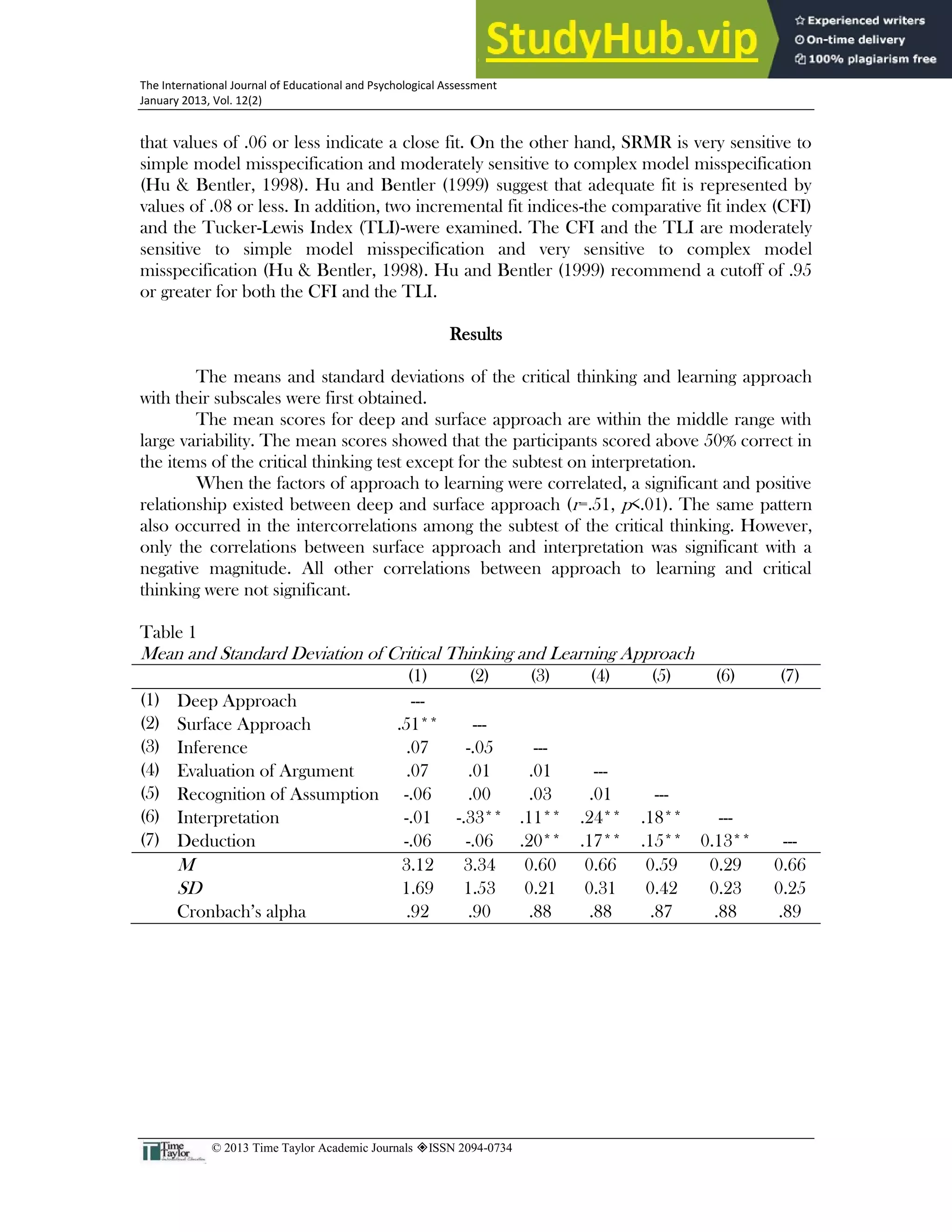
The mean scores for deep and surface approach are within the middle range with
large variability. The mean scores showed that the participants scored above 50% correct in
the items of the critical thinking test except for the subtest on interpretation.
When the factors of approach to learning were correlated, a significant and positive
relationship existed between deep and surface approach (r=.51, p<.01). The same pattern
also occurred in the intercorrelations among the subtest of the critical thinking. However,
only the correlations between surface approach and interpretation was significant with a
negative magnitude. All other correlations between approach to learning and critical
thinking were not significant.
Table 1
Mean and Standard Deviation of Critical Thinking and Learning Approach
(1) (2) (3) (4) (5) (6) (7)
(1) Deep Approach ---
(2) Surface Approach .51** ---
(3) Inference .07 -.05 ---
(4) Evaluation of Argument .07 .01 .01 ---
(5) Recognition of Assumption -.06 .00 .03 .01 ---
(6) Interpretation -.01 -.33** .11** .24** .18** ---
(7) Deduction -.06 -.06 .20** .17** .15** 0.13** ---
M 3.12 3.34 0.60 0.66 0.59 0.29 0.66
SD 1.69 1.53 0.21 0.31 0.42 0.23 0.25
Cronbach’s alpha .92 .90 .88 .88 .87 .88 .89
28
The International Journal of Educational and Psychological Assessment
January 2013, Vol. 12(2)
© 2013 Time Taylor Academic Journals ISSN 2094-0734
Figure 1
Predicting Critical Thinking through Deep and Surface Approach to Learning
A Confirmatory Factor Analysis (CFA) was conducted to test the construct validity
of the approach to learning on critical thinking. The CFA results first showed that parcels
on both deep and surface approach were significant. The five subtests of critical thinking
were also significant. The contribution of deep and surface approach on critical thinking
was also significant. Both deep and surface approach increases the variability for explaining
critical thinking. Using a standardized estimate, the contribution (effect size) of surface
approach (.40) is larger than deep approach (.26) on critical thinking. The model attained
an adequate fit: RMSEA=.04, SRMR=.04, CFI=.96, and TLI=.93.
Discussion
The results of the present study showed that there is a convergence between deep
and surface approach based on the zero-order correlation. It was also found that both deep
and surface approach to learning increase the variability in explaining critical thinking.
Given the concepts and difference between surface and deep approach to learning,
there is an expected understanding that divergence in this two constructs will be obtained.
Contrary to such expectation, the findings in the present study showed convergence of the
two constructs (r=.51, p<.01) with 31.36% explained variance. This convergence indicates
that there is a parallelism between the intention to reproduce (surface) and the intention to
understand (deep). It provides a perspective that both constructs are not opposites and they
can be both used to enhance each other. It starts that both approaches to learning are
.40**
.26**
1.00
.61**
.62**
.64**
.56**
.40**
.39**
.35**
.63**
.52**
.49**
.73**
.43**
.41**
.58**
Parcel1
Parcel 2
Parcel3
Parcel4
Parcel5
Parcel1
Parcel 2
Parcel3
Parcel4
Parcel5
Inference
Evaluation of
Arguments
Recognition
of
Assumption
Deduction
Interpretation
Deep
Approach
Surface
Approach
Critical
Thinking
29
The International Journal of Educational and Psychological Assessment
January 2013, Vol. 12(2)
© 2013 Time Taylor Academic Journals ISSN 2094-0734
intentions and the learner can use them both when engaged in an academic tasks. When a
learner rehearses information to be memorized (surface), they may use elaboration and
integration of other ideas to attain understanding (deep). When it comes to instruction,
when memorization is encouraged in class, learners engage in specific strategies showing a
responsible choice of learning. Moreover, when learners read information to seek for
meaning they also engage in going over and over the materials when understanding is not
attained. These scenarios explain how both deep and surface approach can complement
each other.
The zero-order correlations showed that only interpretation among all other critical
thinking factors was correlated with surface approach to learning. More specifically, higher
engagement in surface approach decreases the ability to weigh evidences and deciding
whether obtained generalizations and conclusions are warranted. This relationship is the
only result in the study that supports previous findings on surface approach to learning. For
example, Quinita (1998) explains that learning approaches influences students’ learning
outcomes where surface approach may not facilitate an increased learning outcome. This
idea was supported in the present study but only for the skill on weighing evidences. This
skill on interpretation where majority of the participants did not get very high proportion of
correct answers (M=0.29) can be considered as difficult and requires a deeper strategy and
thought to be accomplished. He use of rote memorization, reproduction, and rehearsal was
not effective in allowing the learner to make such interpretation skills and thus warranted a
negative and significant relationship.
The present study based on the CFA showed that both deep and surface
approaches are useful in promoting critical thinking as a whole factor. Previous studies
explain that the learning outcomes of deep and surface approach are different (Hoon Goh,
& Chia, ????). More specifically, deep approach results to higher comprehension and
higher retention of knowledge as compared to learners who use surface approach. The
findings of the present study do not support this idea where surface approach can be used
to facilitate critical thinking in the same way as deep approach to learning. The study of
Magno (2009), where Filipino college learners are ale the participants, both deep and
surface approach facilitates metacognition and both were supported with increased school
ability. The findings of Watkins and Hattie (1985) were also consistent where Asian
students who use surface approach enhanced their understanding. These findings were
consistent in the present study, however, the outcome is critical thinking.
The present study reiterates the functional and useful aspect of surface approach
from the findings of Magno (2009) and Watkins and Hattie (1985). The use of rote
memorization, rehearsal, and reproduction does not result to decreased learning but in
may also facilitate learning such as the case of promoting critical thinking. Previous studies
explain that surface approach is produced because of excessive materials to be learned,
high contact hours in learning, lack of choice, and anxiety provoking assessment which is
very descriptive of the Asian education. These characteristics in teaching and students’
experience allow them to use surface approach in a functional way that results in critical
thinking. The notion of the western perspective is that these scenarios may hamper better
learning outcomes. However, this perspective neglected to see how useful rote
memorization and rehearsal could be for Asian students. Previous studies by Magno (2009)
explains usefulness of surface approach in facilitating metacognition and the present study
banks on the same idea that surface approach contributes in developing critical thinking.
30
The International Journal of Educational and Psychological Assessment
January 2013, Vol. 12(2)
© 2013 Time Taylor Academic Journals ISSN 2094-0734
Surface approach to learning does not only facilitate awareness of learning (metacognition)
but contributes in the development of critical thinking as well.
Schools in the Philippines that aim at developing the critical thinking of secondary
education students can integrate successful execution of various skills to enhance their deep
approach to learning. Regardless whether the approach is deep or surface, they equally
contribute in developing critical thinking. This is better supported when teachers adapt
their strategies to students’ learning approaches in order to foster an equitable learning
environment that would enhance their critical thinking and use more deep approach as
their learning strategies. Teaching can be directed to enhance of students critical thinking
by using appropriate approaches to learning.
Assessment for learning approaches and critical thinking are necessary in order for
teachers to truly determine if these skills are present and how of them needs to be further
developed. Having assessed the level of critical thinking of students allows teacher to
determine the extent of instruction of deep approach needed when facilitating.
References
Bernard, R., Zhang, D., Abrami, P., Sicoly, F., Borokhovski, E., & Surkes, M. (2008).
Exploring the structure of the Watson-Glaser critical thinking appraisal: One scale
or many subscales?. Thinking Skills and Creativity, 3, 14-22
Beyer, B. K. (1995). Critical thinking. Bloomington, IN: Phi Delta Kappa Educational
Foundation
Biggs, J. (1990). Asian students’ approaches to learning: Implications for teaching overseas
students. In M. Kratzing (Ed.), Eighth Australasian Learning and Language
Conference Proceedings (pp. 2-50). Brisbane: QUT Counselling Services.
Biggs, J. (1999). Teaching for quality learning at university. Buckingham: Open University
Press.
Biggs, J. (1993). What do inventories of students' learning processes really measure? A
theoretical review and clarification. British Journal of Educational Psychology, 63,
1-17.
Dunn, L., & Musolino, G. (2011). Assessing reflective thinking and approaches to learning.
Journal of Allied Health, 40(3), 128-136.
Ennis, R. H. (1987). A taxonomy of critical thinking disposition and abilities. In J. B.
Baron & R. J. Sternberg (Eds.), Teaching thinking skills: Theory and practice (pp.
9-26). New York: Freeman.
Entwistle, N. J., & Ramsden, P. (1983). Understanding student learning. London: Croom-
Helm.
Biggs, J., Kember, D., & Leung, D. Y. P (2001). The revised two factor Study Process
Questionnaire: R-SPQ-2F. British Journal of Educational Psychology, 71, 133-149.
Entwistle, N. J., & Ramsden, P. (1983). Understanding student learning. London: Croom
Helm.
Facione, P. A. (1998). Critical thinking: What it is and why it counts: A resource paper.
Millbrae, CA: California Academic Press.
Halpern, D. F. (1996). Thought and knowledge: An introduction to critical thinking (3rd
ed.). Mahwah, NJ: Lawrence Erlbaum Associates.
31
The International Journal of Educational and Psychological Assessment
January 2013, Vol. 12(2)
© 2013 Time Taylor Academic Journals ISSN 2094-0734
Hallpern, B. M. (1993). Assessing the effectiveness of critical-thinking instruction. The
Journal of General Education, 42, 239-254.
Hallpern, D. F. (1998). Teaching critical thinking for transfer across domains: Dispositions,
skills, structure training, and metacognitive monitoring. American Psychologist, 53,
449-455.
Hemming, H. (2000). Encouraging critical thinking: "But-- what does that mean?". McGill
Journal of Education, 35(2), 173-186.
Hoon, T. G., Goh, N. K., & Chia, L. S. (1995). Studying activity series of metals: Using
deep-learning strategies. Journal of Chemical Education, 72, 51–54
Hu, L., & Bentler, P. M. (1998). Fit indices in covariance structure modeling: Sensitivity to
underparameterized model misspecification. Psychological Methods, 3, 424-453.
Kember, D., Ng, S., Pomfret, M., Tse, H., & Wong, E. T. T. (1996). An examination of
the interrelationships between workload, study time, learning approaches and
academic outcomes. Studies in Higher Education, 21(3), 347-358.
Lundquista, R. (1999). Critical thinking and the art of making good mistakes. Teaching in
Higher Education, 4(4), 523-530. DOI: 10.1080/1356251990040408
Marton, F., & Saljo, R. (1976). On qualitative differences in learning: Outcome and
process. British Journal of Educational Psychology, 46, 4-11.
Magno, C. (2009). Investigating the effect of school ability on self-efficacy, learning
approaches, and metacognition. The Asia-Pacific Education Researcher, 18(2), 233-
244.
Magno, C. (2010). The role of metacognition in developing critical thinking. Metacognition
and Learning, 5(2), 137-156.
Neuschmidt, O., Barth, J., & Hastedt, D. (2008). Trends in gender differences in
mathematics and science (TIMSS 1995–2003). Studies in Educational Evaluation,
34(2), 56-72.
Norris, S. P. (1985). Synthesis of research on critical thinking. Educational Leadership,
42(8), 40-45.
Norris, S. P. (1989). Evaluating critical thinking. Pacific Grove, CA: Midwest Publications.
Paul, R. (1998). Critical thinking: Placing it at the heart of ethics instruction. Journal of
Developmental Education, 22(2), 36-38.
Paul,R. (1990). Critical thinking: What every person needs to survive in a rapidly changing
world. CA: Center for Critical Thinking.
Paul,R. (1992). Critical thinking: What every person needs to survive in a rapidly changing
world (2nd ed). Santa Rosa, CA: Foundation for Critical Thinking.
Paul, R. (1993). Critical thinking: How to prepare students for a rapidly changing world.
Santa Rosa, CA: Foundation for Critical Thinking.
Paul, R., & Elder, L. (2001). Inert information, activated ignorance, and activated
knowledge. Journal of Developmental Education, 25(2), 36-37.
Quinita, F. A. (1998). Illustrated laboratory procedures in chemistry: Effects on the
achievement of surface and deep learners. Unpublished master’s theses: DLSU
Manila, Philippines.
Rahman, S., & Mokhtar, S. (2012). Structural relationship of learning environment,
learning approaches, and generic skills among engineering students. Asian Social
Science, 8(13), 280-290.
32
The International Journal of Educational and Psychological Assessment
January 2013, Vol. 12(2)
© 2013 Time Taylor Academic Journals ISSN 2094-0734
Ramírez, M. (2006). Understanding the low mathematics achievement of Chilean students:
A cross-national analysis using TIMSS data. International Journal of Educational
Research, 45(3), 102-116.
Ramsden, P. (1988). Improving learning: New perspective. London: Kogan Page.
Ramsden, P., Prosser, M., Trigwell, K., & Martin, E. (2007). University teachers’
experiences of academic leadership and their approaches to teaching. Learning and
Instruction, 17, 140-155.
Rhem, J. (1995). Deep/surface approaches to learning: An introduction. The National
Teaching and Learning Forum, 5(1), 1-5.
Schön, D. A. (1987). Educating the reflective practitioner. San Francisco: Jossey-Bass.
Stancato, F. A. (2000). Tenure, academic freedom and the teaching of critical thinking.
College Student Journal, 34(3) 377-382.
Watkins, J., & Hattie, J. (1985). A longitudinal study of the approaches to learning of
Australian tertiary students. Human Learning, 4, 127-141.
Watson, G., & Glaser, E. M. (2008). Watson-Glaser critical thinking appraisal: Short form
manual. NY: Pearson.
Watson, G., & Glaser, E. M. (1980). Watson-Glaser critical thinking appraisal. San
Antonio: Psychological Corp.
Watson, G., & Galser, E. (1964). Critical thinking appraisal manual. New York: Harcourt,
Brace & World.
Yahiro, K. (1994). A critical thinking model for nursing judgment. Journal of Nursing
Education, 33(8), 351-356.
About the Author
Dr. Carlo Magno is presently a faculty of the Counseling and Educational Psychology
Department at De La Salle University, in Manila, Philippines. Most of his researches focus
on assessment of student learning in the area of educational psychology.

Assessing Students Critical Thinking And Approaches To Learning

  • 1.
    19 The International Journalof Educational and Psychological Assessment January 2013, Vol. 12(2) © 2013 Time Taylor Academic Journals ISSN 2094-0734 Assessing Students’ Critical Thinking and Approaches to Learning Carlo Magno De La Salle University, Manila Abstract The present study explored the construct validity of the Revised Learning Process Questionnaire R-LPQ 2F with the Watson Glaser Critical Thinking Appraisal (WGCTA). The construct validation process test the assumption that deep approaches to learning that includes relating knowledge to new knowledge, distinguishing evidences and arguments, organizing and structuring content into a coherent whole results to critical thinking. The R- LPQ 2F and the WGCTA was administered to 104 senior high school students in the Philippines. Only surface approach to learning was significantly correlated with the subtests on interpretation of the WGCTA (r=-.51, p<.01). A measurement model was tested using Confirmatory Factor Analysis (CFA) and showed that both deep and surface approach increases the variance explained for critical thinking as a latent construct. The model attained an adequate fit: RMSEA=.04, SRMR=.04, CFI=.96, and TLI=.93. Keywords: deep approach, surface approach, critical thinking, R-LPQ, WGCTA Introduction Students differ in their ability to think, memorize, reason, read and process information. It is important for critical thinkers to execute their own learning to be able to generate and evaluate conclusions from related evidence. The students who are considered as high critical thinkers have a better implementation of their learning approach (Halpern, 1996; Magno, 2010). For the past twenty years, the process of thinking is again experiencing one its periodic resurgences as a legitimate topic of psychology and education because of the assertion that schools need to develop 21st century skills among their students. Part of the 21st century skills is critical thinking and learning skills of students. A part of that resurgence can be attributable to several studies on critical thinking, logic, and thinking skills. According to Norris (1985) that societal factors calls a need for well developed thinking skills. Studies in psychology, education, business, and other fields call for more and better thinking skills instruction in schools and especially in the Philippine setting. Students do not exhibit an impressive level of skills in critical or creative thinking. Moreover, the review of Norris shows that the typical critical thinking ability is not widespread. Most students do not score well on the tests that measures ability to recognize assumptions, evaluate arguments and appraise inferences (Neuschmidt, Barth, & Hastedt, 2008; Ramirez, 2006). High results in the Watson and Glaser Critical Thinking Appraisal describe critical thinkers to have a potential success on certain types of occupations and instructional programs. Previous studies believe that the thinking of students will remain "invisible" to them unless they are supportively challenged to discover the problems in their thinking. This is not possible unless they receive careful introduction into the intellectual workings of the human mind. Critical thinking involves several skills, including the ability to listen and
  • 2.
    20 The International Journalof Educational and Psychological Assessment January 2013, Vol. 12(2) © 2013 Time Taylor Academic Journals ISSN 2094-0734 read carefully, evaluate arguments, look for and find hidden assumptions, and to trace the consequences of a claim. Critical thinking is after seen as a universal goal of higher education but is seldom confirmed as an outcome. In order to develop critical thinking in the educational setting, students need to adapt an appropriate learning approach. The proper approach to learning facilitates critical thinking (Magno, 2010). Previous research regarding learning approaches, suggests that it is found to be an influential element for motivation and achievement. Studies exemplifying the relationship between critical thinking and learning approaches are still few. The relationship between learning approach and critical thinking makes a good basis for explaining learning but they were investigated with different correlates. Establishing the possibility of linking these two variables has been neglected. This present study examines the relationship between critical thinking and learning approaches for high school students. The relationship will establish construct validation of the outcome of learning approach as an appropriate mechanism to propel critical thinking. Approach to Learning The learning process consists of the way in which the learning takes place and involves primarily the capacities by the activities by means of which knowledge is gained, skill is produced, habits, attitudes, and ideas are required (Schön, 1987). Learning approach are always the major concerns of school teachers and college professors. Educators have theorized different models and engaged in research to help understand the nature of student’s learning processes. One commonly cited model in teaching and learning literature is the 3P model of classroom learning outlined by Dunkin and Biddle in 1974. Strategies to learn are considered important elements (Biggs, 1993). Researchers have done numerous studies of student’s study approaches since the late 1970’s. Learning approaches are the patterns followed by students in order to achieve higher quality learning. Basically, two approaches to learning have been identified: the “surface” approach and the “deep” approach. A surface approach describes the intention to reproduce information in compliance with externally imposed task demands while deep approach involves the intention to understand (Kember, Biggs, & Leung, 2004). Deep processing also labeled elaboration or critical thinking involves challenging the veracity of information encountered and attempting to integrate new information with prior knowledge and experience (Biggs, Kember, & Leung, 2001). On the other hand, surface processing also labeled rehearsal or memorization; involves the repetitive rehearsal and rote memorization of information. Kember et al. (1996) indicated that students who adopt surface approach to learning are referred to as surface learners and deep approach students are referred to as deep learner. Biggs (1999) described that the deep approach is task-centered and task- appropriate. Deep approach to learning is encouraged by (1) teaching and assessing methods; (2) stimulating and considerate teaching specially teaching which demonstrate the teacher’s personal commitment to the subject matter and stresses its meaning and relevance to students; (3) clearly stating academic expectations; (4) opportunities to exercise responsible choice in the content of the study; (5) interest in and background knowledge and (6) previous experiences of educational settings that encourage deep approach. On the other hand, surface approach is encouraged by (1) assessment methods emphasizing recall
  • 3.
    21 The International Journalof Educational and Psychological Assessment January 2013, Vol. 12(2) © 2013 Time Taylor Academic Journals ISSN 2094-0734 of the application of trivial procedural knowledge; (2) assessment methods that create anxiety; (3) cynical or conflicting messages about rewards; (4) excessive amount of materials and (5) poor or absent feedback (Ramsden, 1988). The deep approach to learning can result in good learning outcome. Deep processing, involves the intention of a student to understand and attempt to relate incoming information to previous knowledge and experiences in order to come up with a personal meaning (Biggs, Kember, & Leung, 2004). For example those individuals who follow the mastery goal orientation utilize deep approach, requiring a lot of cognitive effort but leads to better understanding (Rahman & Mokhtar, 2012). On the other hand, surface approach is the intention of a student to fulfill the task requirements such as rote memorization of such information needed to pass an examination (Ramsden et al., 1999). Surface approach leads to increase in knowledge through memorization of information and by following certain procedures. It generally leads to low retention and an inability to use information in new contexts. Past studies suggest that Asian students rely on rote learning and a surface approach while Western studies such as those from Australia employ deep Learning strategies to learning (Biggs & Moore, 1993; Magno, 2009). However, in a later study of Hong Kong Chinese students’ study approaches, researchers introduced a new concept of learning called “deep memorization” as a way to enhance understanding (Watkins & Hattie, 1985). From the research of Rhem (1995), more students advanced in their academics, the tendency for them to use surface processing also increased. He further explained that the use of surface processing might be due to the traditional teaching styles being used in schools. He also listed a couple of other factors that might have been responsible for student to resort to surface processing: (1) an excessive amount of course material in the curriculum; (2) relatively high class contact hours, (3) an excessive amount of course materials, (4) a lack of opportunity to pursue subjects in depth, (5) a lack of choice over the method of study and over the subjects and (6) a threatening and anxiety provoking assessment system. This evidence shows that there is a transition in the use of learning approaches from deep to surface and both are used as predictors of students test performance. Students' approaches can vary according to students' perceptions of their learning environment. Students’ learning approaches do not have fixed characteristics. A student, who takes a deep approach to one subject, or even part of a subject, may take a surface approach in relation to something else. The researchers chose learning approach as a variable because it strongly influences the quality of student’s learning outcomes (Quinita 1998). When a student abstracts meaning from what is already given, there is a deep approach to learning which can result in good learning outcomes. Surface approach leads to increase in knowledge through memorization of information and by following certain procedures. It generally leads to low retention and an inability to use information in new contexts. Hoon, Goh, and Chia (1995) compared surface and deep approach in learning activity series of metals in a high school Chemistry course and concluded that students who adopt deep approach are better in inter-relating chemical concepts, possess better comprehension and higher retention of knowledge compared to students who adopt surface approach. Emphasis on effort to learn for self-improvement, and collaborative
  • 4.
    22 The International Journalof Educational and Psychological Assessment January 2013, Vol. 12(2) © 2013 Time Taylor Academic Journals ISSN 2094-0734 learning with peers, may promote deep learning. Confucian philosophy, also, advocates deep learning: 'seeing is perilous'. Strong motivation to achieve and the attribution of success to internal and controllable factors such as effort, interest and study skills should help Chinese students develop adaptive approaches to learning. This is supported by findings that Chinese students in Hong Kong score higher on the deep and achieving approaches and lower on the surface approach than Australian students (Biggs, 1990). There is evidence that deep approach to learning facilitates better learning outcomes. The kind of challenge that students engage in learning allows them to demonstrate critical thinking. However, there is also large evidence of studies indicating surface which could not be adaptive in producing better learning outcomes. Critical Thinking Experts explain critical thinking in varying perspectives. One commonality among the perspectives is the conviction of critical thinkers which they expressed their opinions on a topic. Some explains that there are "stages" or "aspects" of critical thinking. The idea of bringing critical thinking into the classroom was unanimous, however, ideas for making this happen as well as the implementation differed dramatically. The focus of critical thinking on education started in the work of Dewey who proposed that critical thinking involved the suspension of judgment and healthy skepticism. Students should be assisted in the engagement of making the reflective, reasonable, and direction on what to believe or do. Stancato (2000) used several definitions from previous research to define critical thinking. Critical thinking has been defined as "a process for determining the value of an idea". Others see critical thinking as "a process of thinking without a single solution" (Yahiro, 1994). Paul (1990) defines it as "open-mindedness,” although, it is not a "natural" disposition of the human mind. However, openness to contradiction and opposing points of view are the hallmarks of the critical thinking. Paul and Elder (2001) explains that critical thinking involves "to be able to take one's thinking apart systematically, to analyze each part, assess it for quality and then improve it." Moreover, critical thinking involves being able to break down a piece of information or a thought, find any value that it may contain, and discard the remains. This piece of information then goes through a process of scrutiny, being subject to analysis, change, improvement, and integration. A number of researchers have put forth definitions and theories regarding critical thinking. Facione (1998) was the head of a systematic inquiry into the research on critical thinking and how to assess it. He views critical thinking to be a purposeful, self-regulatory judgment which results in interpretation analysis, evaluation and inference as well as explanation of the evidential conceptual methodological, contextual consciousness upon which that judgment was based. Supporting Facione’s model, Lundquist (1999) explained that the “fundamental to learning is reflection and the ability to draw conclusions from more of less successful attempts to come to an understanding of the issues at hand” would be a paramount characteristic of critical thinking. Hemming (2000) breaks down each process, beginning with logic. She says that logical relationships need to be addressed in order to exhibit critical thinking. According to Hemming, critical thinking is best fostered among students by “treating them with respect, be being open and honest with them, and being willing to accept scrutiny of beliefs and practices, and by encouraging them to question their own ideas and those of others.” In
  • 5.
    23 The International Journalof Educational and Psychological Assessment January 2013, Vol. 12(2) © 2013 Time Taylor Academic Journals ISSN 2094-0734 addition, Hemming (2000) views critical thinking as a process that include dialogical reasoning, evaluating criteria, content, and caring and connecting with criticism. Dialogical reasoning involves being open-minded and allowing multiple perspectives and ideas to be factors in forming conclusions. Being open-minded means that the individual needs to be open to the fact that he or she may be wrong and is, therefore, willing to reevaluate his or her ideas. Hemming states that critical thinking includes the following criteria for creating judgments: reasons, shared values, facts, definitions, standards, laws, principles, and conventions. The combination of content and critical thinking as curriculum is a question of hot debate and will be addressed later in this review. Paul (1992) explains that “objectivity and rationality aimed at discovering truth are crucial to critical thinking. This involves reasoning, the application of standards, and the use of logic.” The author states, “in dialogical reasoning it is important to understand that the purpose is not merely to think about the perspective of others, but to examine one’s own ideas, and those of others, in a search for the truth.” In other words, others’ ideas are not more important than one’s own, but can add additional, useful information. Similar to Hemming’s process of critical thinking, Perry’s ideas of critical thinking claims that there are four stages: dualism, multiplicity, contextual relativism, and dialectic. Perry formulated his model of critical thinking after interviewing many college students during their freshman year, throughout their college years, and finally, as seniors. Perry found a series of steps that increased the students’ sophistication of thought, along with a transformation of philosophy regarding the role of nature, the role of the student, and the role of the teacher. The definition of Watson and Glaser (1980) of critical thinking is used in the present study. Their typology includes inference, recognition of assumptions, deduction, interpretation, and evaluation of arguments. This typology of critical thinking is widely used around the world and all other critical thinking skills and definitions of scholars are covered within the five dimensions. For example, formal logic as part of critical thinking explained by Ennis (1987) involves rules of deduction and inference. In the same way, good judgment in critical thinking as explained by Halpern (1998) involves the evaluation of arguments. Beyer (1995) also includes that identifying and making academic arguments is part of critical thinking which is covered in recognition of assumption. The framework by Watson and Glaser provides the best representation of critical thinking because they have operationalized each domain as a set of items where a stimulus is read by examinees and the skills are shown by responding appropriately. Specifically, the their existing test measures the ability to recognize the existence of problems and an acceptance of the general need for evidence in support of what is asserted to be true, and knowledge of the nature of valid inferences, abstractions, and generalizations in which the weight or accuracy of different kinds of evidence are logically determined (Watson & Glaser, 2008). Presently, the standard form of the WGCTA is composed of 80 items that measure different aspects of critical thinking. The appraisal aims to provide an estimate of an individuals’ standing in the composite of abilities by means of five subtests. The five subtests of the Critical Thinking Appraisal are as follows (Watson & Glaser, 1980): Inference. Discriminating among degrees of truth or falsity of inferences drawn from given data. Recognition of Assumptions. Recognizing unstated assumptions or presuppositions in given statements or assertions.
  • 6.
    24 The International Journalof Educational and Psychological Assessment January 2013, Vol. 12(2) © 2013 Time Taylor Academic Journals ISSN 2094-0734 Deduction. Determining whether certain conclusions necessarily follow from information in given statements or premises. Interpretation. Weighing evidence and deciding if generalizations or conclusions based on the given data are warranted. Evaluation of Arguments. Distinguishing between arguments that are strong relevant. The WGTCA has been widely used as indication of individuals’ critical thinking competence. While not directly comparable to other tests, such as the California critical thinking skills test, both follow the same theoretical underpinnings and format. The development and maintaining the five factors of the WGCTA was explained in the paper of Magno (2010): These five factors of the Watson Glaser still hold to be valid despite many revisions of the WGCTA (Watson & Glaser, 2008). A Confirmatory Factor Analysis (CFA) was conducted (N=306) with the 40 items of the WGCTA and tested a one factor model, three factor model (RED model), and the traditional five factor model (Watson & Glaser, 2008). These models were compared and the five factor model still had the best fit. The five factor model had the lowest chi-square (χ2 =159.39, df=125) and RMSEA value (.03), highest Goodness of Fit Index (GFI=.95) and Adjusted Goodness of Fit Index (AGFI=.93). The items under the five factor model also had higher parameter estimates than in the other models. The traditional five factor model of the WGCTA also correlated well (significant and moderate to high relationships) with the revised factors. In addition, the five factors remained stable across time and they are correlated with several indicators of ability (see Watson & Glaser, 2008). In a metanalytic study conducted by Bernard et al. (2008), 13 different studies were used and the factors of the WGCTA were combined in pairs. They found that the average correlation coefficients for each paired combination of the WGCTA factors achieved convergence with a positive relationship (the overall the average correlations ranged from a low of 0.17 to high of 0.40). They also interpreted that the five major subtests are significantly heterogeneous. The Present Study The connection between approaches to learning and critical thinking is explained in the 3P model by John Biggs.The model represents an integrated cycle or system, in which components interact: Personal and situational presage factors exist prior to a given learning situation; these factors influence the learning process, or the approach adopted by the student to the learning task; which in turn influences the product, or outcomes of learning (Biggs, 1993). Deep and surface approaches are considered as the approaches adapted by the students to learn. The strategies used in deep and surface learning indicate ways in which students relate to the learning material while the outcome can critical thinking. The relationship between approaches to learning and critical thinking is not new. Dunn and Musolino (2011) established the relationship between deep and surface approach to learning with reflective thinking. Reflective thinking in the study is the process of making critical judgment on events which is similar to critical thinking. However, a non-cognitive measure for critical thinking was used in her study.
  • 7.
    25 The International Journalof Educational and Psychological Assessment January 2013, Vol. 12(2) © 2013 Time Taylor Academic Journals ISSN 2094-0734 Deep and surface approaches to study was derived from the original empirical research by Marton and Säljö (1976) and Entwistle and Ramsden (1983) and elaborated by Biggs and among others. Although learners may be classified as “deep” and “surface” they are not attributes of an individual, one person may use both approaches at different times, although he or she may have preferences for one or the other. The use of deep approach manifest high critical thinking skills that focuses on “what is signified”, relates knowledge to new knowledge, relates and distinguishes evidence and arguments, organizes and structure content into coherent whole and emphasis is internal, from within the students while the use of surface approach shows low critical thinking that only focuses on “signs” (or on the learning as a signifier of something else), focuses on unrelated parts of the task, information for assessment is simple memorized, facts and concepts are associated unreflectively, principles are not distinguished from examples, task is treated as an external imposition and emphasis is external from the demands of assessment (Biggs, 1993). The present study validates the functional use of approaches to learning in promoting critical thinking among secondary education students. Method Participants There were 104 senior high school seniors students in a private school in the Philippines. The participants came from three sections. The students were all in their senior years enrolled in a private school and were undergoing the same curriculum. Instruments To measure learning approach, the researcher used the Revised Learning Process Questionnaire (R-LPQ) developed by Kember, Biggs, and Leung (2001). The questionnaire consists of 22 items. It is provided with two approach scores (1) deep approach and (2) surface approach. It uses a five point Likert scale ranging from “always” or “almost always true of me” to “never” or “only rarely true of me”. The alpha coefficient obtained is .71 for the combine scale and .62 for deep approach and .54 for surface approach. To measure the critical thinking, the Watson-Glaser Critical Thinking Appraisal Test (WGCTA) was used which consist of series of tests exercises which require application of some of the important abilities involved in critical thinking. The exercises include problems, statements, arguments, and interpretations of data. It is a test of power with no rigid time limit. The five subtests are as follows: Inference (samples ability to discriminate among degrees of truth or falsity of interferences drawn from given data), Recognition of Assumptions (samples ability to recognize unstated assumptions or presuppositions which are taken for granted in given statements or assertions), Deduction (samples ability to reason deductively from given statements or premises; to recognize the relation of implication between propositions; to determine whether what may seem to be an implication of necessary implication or necessary interference from given premises), Interpretations (samples ability to weigh evidence and to distinguish between [a] generalizations from given data that are not warranted beyond a reasonable doubt; [b]
  • 8.
    26 The International Journalof Educational and Psychological Assessment January 2013, Vol. 12(2) © 2013 Time Taylor Academic Journals ISSN 2094-0734 generalization which, although not absolutely certain or necessary, do seen to be warranted beyond a reasonable doubt), Evaluation of Arguments (samples ability to distinguish between arguments which are strong and relevant and those which are weak or irrelevant to particular question at issue). Data Gathering Procedure The researcher met with the school principal of the private schools. The participants were requested to answer the R-LPQ and the WGCTA. The measures were completed done in one day. The researcher assured the students that the test is not part of their grades. The participants were allowed to ask questions regarding the tests and procedures. The first test that was administered was the revised learning processes questionnaire. The students were asked to respond to the items using a 5-point Likert scale. The respondents were asked to complete the questionnaire during the administration of the test and returned it to the researchers after completion. After finishing the R-LPQ-2F the participants were given the Watson-Glaser in their classes. The examiner assigned to have at least 10 minutes available to take care of the actual working time and the times spent in giving directions, passing out materials, and other preliminary activity before testing. After distributing all the necessary materials the participants filled in the name and the other information required in the test. They are further instructed to read carefully the directions for each set of the test and study the example questions. For each question, the participant decides what they think is the best answer. Their choice of answer is recorded by choosing the best answer in the appropriate space before the number. After the administration of the tests, the participants were debriefed about the purpose of the study and they were thanked for their effort. Data Analysis To determine the level of critical thinking and learning approach the mean and standard deviation was obtained. To determine the relationship among the critical thinking and learning approach factors, the Pearson r moment correlation coefficient was used. Structural Equations Modeling (SEM) was used to test whether construct validity exist between deep and surface approach and critical thinking as latent factors. It is proposed that the three variables would attain factor convergence. Significant parameter estimates should be produced to establish the relationship among the latent constructs. Parcels were created as components under each latent constructs. The fit of the hypothesized model was assessed by examining several fit indices including three absolute and one incremental fit index. The minimum fit function chi-square, the Root Mean Square Error of Approximation (RMSEA), and the Standardized Root Mean Square Residual (SRMR) are absolute fit indices. The chi-square statistic (χ2 ) assessed the difference between the sample covariance matrix and the implied covariance matrix from the hypothesized model. A statistically non-significant χ2 indicates adequate model fit. Because the χ2 test is very sensitive to large sample sizes (Hu & Bentler, 1995), additional absolute fit indices were examined. As Hu and Bentler (1998) note, RMSEA is moderately sensitive to simple model misspecification and very sensitive to complex model misspecification. They suggest
  • 9.
    27 The International Journalof Educational and Psychological Assessment January 2013, Vol. 12(2) © 2013 Time Taylor Academic Journals ISSN 2094-0734 that values of .06 or less indicate a close fit. On the other hand, SRMR is very sensitive to simple model misspecification and moderately sensitive to complex model misspecification (Hu & Bentler, 1998). Hu and Bentler (1999) suggest that adequate fit is represented by values of .08 or less. In addition, two incremental fit indices-the comparative fit index (CFI) and the Tucker-Lewis Index (TLI)-were examined. The CFI and the TLI are moderately sensitive to simple model misspecification and very sensitive to complex model misspecification (Hu & Bentler, 1998). Hu and Bentler (1999) recommend a cutoff of .95 or greater for both the CFI and the TLI. Results The means and standard deviations of the critical thinking and learning approach with their subscales were first obtained. The mean scores for deep and surface approach are within the middle range with large variability. The mean scores showed that the participants scored above 50% correct in the items of the critical thinking test except for the subtest on interpretation. When the factors of approach to learning were correlated, a significant and positive relationship existed between deep and surface approach (r=.51, p<.01). The same pattern also occurred in the intercorrelations among the subtest of the critical thinking. However, only the correlations between surface approach and interpretation was significant with a negative magnitude. All other correlations between approach to learning and critical thinking were not significant. Table 1 Mean and Standard Deviation of Critical Thinking and Learning Approach (1) (2) (3) (4) (5) (6) (7) (1) Deep Approach --- (2) Surface Approach .51** --- (3) Inference .07 -.05 --- (4) Evaluation of Argument .07 .01 .01 --- (5) Recognition of Assumption -.06 .00 .03 .01 --- (6) Interpretation -.01 -.33** .11** .24** .18** --- (7) Deduction -.06 -.06 .20** .17** .15** 0.13** --- M 3.12 3.34 0.60 0.66 0.59 0.29 0.66 SD 1.69 1.53 0.21 0.31 0.42 0.23 0.25 Cronbach’s alpha .92 .90 .88 .88 .87 .88 .89
  • 10.
    28 The International Journalof Educational and Psychological Assessment January 2013, Vol. 12(2) © 2013 Time Taylor Academic Journals ISSN 2094-0734 Figure 1 Predicting Critical Thinking through Deep and Surface Approach to Learning A Confirmatory Factor Analysis (CFA) was conducted to test the construct validity of the approach to learning on critical thinking. The CFA results first showed that parcels on both deep and surface approach were significant. The five subtests of critical thinking were also significant. The contribution of deep and surface approach on critical thinking was also significant. Both deep and surface approach increases the variability for explaining critical thinking. Using a standardized estimate, the contribution (effect size) of surface approach (.40) is larger than deep approach (.26) on critical thinking. The model attained an adequate fit: RMSEA=.04, SRMR=.04, CFI=.96, and TLI=.93. Discussion The results of the present study showed that there is a convergence between deep and surface approach based on the zero-order correlation. It was also found that both deep and surface approach to learning increase the variability in explaining critical thinking. Given the concepts and difference between surface and deep approach to learning, there is an expected understanding that divergence in this two constructs will be obtained. Contrary to such expectation, the findings in the present study showed convergence of the two constructs (r=.51, p<.01) with 31.36% explained variance. This convergence indicates that there is a parallelism between the intention to reproduce (surface) and the intention to understand (deep). It provides a perspective that both constructs are not opposites and they can be both used to enhance each other. It starts that both approaches to learning are .40** .26** 1.00 .61** .62** .64** .56** .40** .39** .35** .63** .52** .49** .73** .43** .41** .58** Parcel1 Parcel 2 Parcel3 Parcel4 Parcel5 Parcel1 Parcel 2 Parcel3 Parcel4 Parcel5 Inference Evaluation of Arguments Recognition of Assumption Deduction Interpretation Deep Approach Surface Approach Critical Thinking
  • 11.
    29 The International Journalof Educational and Psychological Assessment January 2013, Vol. 12(2) © 2013 Time Taylor Academic Journals ISSN 2094-0734 intentions and the learner can use them both when engaged in an academic tasks. When a learner rehearses information to be memorized (surface), they may use elaboration and integration of other ideas to attain understanding (deep). When it comes to instruction, when memorization is encouraged in class, learners engage in specific strategies showing a responsible choice of learning. Moreover, when learners read information to seek for meaning they also engage in going over and over the materials when understanding is not attained. These scenarios explain how both deep and surface approach can complement each other. The zero-order correlations showed that only interpretation among all other critical thinking factors was correlated with surface approach to learning. More specifically, higher engagement in surface approach decreases the ability to weigh evidences and deciding whether obtained generalizations and conclusions are warranted. This relationship is the only result in the study that supports previous findings on surface approach to learning. For example, Quinita (1998) explains that learning approaches influences students’ learning outcomes where surface approach may not facilitate an increased learning outcome. This idea was supported in the present study but only for the skill on weighing evidences. This skill on interpretation where majority of the participants did not get very high proportion of correct answers (M=0.29) can be considered as difficult and requires a deeper strategy and thought to be accomplished. He use of rote memorization, reproduction, and rehearsal was not effective in allowing the learner to make such interpretation skills and thus warranted a negative and significant relationship. The present study based on the CFA showed that both deep and surface approaches are useful in promoting critical thinking as a whole factor. Previous studies explain that the learning outcomes of deep and surface approach are different (Hoon Goh, & Chia, ????). More specifically, deep approach results to higher comprehension and higher retention of knowledge as compared to learners who use surface approach. The findings of the present study do not support this idea where surface approach can be used to facilitate critical thinking in the same way as deep approach to learning. The study of Magno (2009), where Filipino college learners are ale the participants, both deep and surface approach facilitates metacognition and both were supported with increased school ability. The findings of Watkins and Hattie (1985) were also consistent where Asian students who use surface approach enhanced their understanding. These findings were consistent in the present study, however, the outcome is critical thinking. The present study reiterates the functional and useful aspect of surface approach from the findings of Magno (2009) and Watkins and Hattie (1985). The use of rote memorization, rehearsal, and reproduction does not result to decreased learning but in may also facilitate learning such as the case of promoting critical thinking. Previous studies explain that surface approach is produced because of excessive materials to be learned, high contact hours in learning, lack of choice, and anxiety provoking assessment which is very descriptive of the Asian education. These characteristics in teaching and students’ experience allow them to use surface approach in a functional way that results in critical thinking. The notion of the western perspective is that these scenarios may hamper better learning outcomes. However, this perspective neglected to see how useful rote memorization and rehearsal could be for Asian students. Previous studies by Magno (2009) explains usefulness of surface approach in facilitating metacognition and the present study banks on the same idea that surface approach contributes in developing critical thinking.
  • 12.
    30 The International Journalof Educational and Psychological Assessment January 2013, Vol. 12(2) © 2013 Time Taylor Academic Journals ISSN 2094-0734 Surface approach to learning does not only facilitate awareness of learning (metacognition) but contributes in the development of critical thinking as well. Schools in the Philippines that aim at developing the critical thinking of secondary education students can integrate successful execution of various skills to enhance their deep approach to learning. Regardless whether the approach is deep or surface, they equally contribute in developing critical thinking. This is better supported when teachers adapt their strategies to students’ learning approaches in order to foster an equitable learning environment that would enhance their critical thinking and use more deep approach as their learning strategies. Teaching can be directed to enhance of students critical thinking by using appropriate approaches to learning. Assessment for learning approaches and critical thinking are necessary in order for teachers to truly determine if these skills are present and how of them needs to be further developed. Having assessed the level of critical thinking of students allows teacher to determine the extent of instruction of deep approach needed when facilitating. References Bernard, R., Zhang, D., Abrami, P., Sicoly, F., Borokhovski, E., & Surkes, M. (2008). Exploring the structure of the Watson-Glaser critical thinking appraisal: One scale or many subscales?. Thinking Skills and Creativity, 3, 14-22 Beyer, B. K. (1995). Critical thinking. Bloomington, IN: Phi Delta Kappa Educational Foundation Biggs, J. (1990). Asian students’ approaches to learning: Implications for teaching overseas students. In M. Kratzing (Ed.), Eighth Australasian Learning and Language Conference Proceedings (pp. 2-50). Brisbane: QUT Counselling Services. Biggs, J. (1999). Teaching for quality learning at university. Buckingham: Open University Press. Biggs, J. (1993). What do inventories of students' learning processes really measure? A theoretical review and clarification. British Journal of Educational Psychology, 63, 1-17. Dunn, L., & Musolino, G. (2011). Assessing reflective thinking and approaches to learning. Journal of Allied Health, 40(3), 128-136. Ennis, R. H. (1987). A taxonomy of critical thinking disposition and abilities. In J. B. Baron & R. J. Sternberg (Eds.), Teaching thinking skills: Theory and practice (pp. 9-26). New York: Freeman. Entwistle, N. J., & Ramsden, P. (1983). Understanding student learning. London: Croom- Helm. Biggs, J., Kember, D., & Leung, D. Y. P (2001). The revised two factor Study Process Questionnaire: R-SPQ-2F. British Journal of Educational Psychology, 71, 133-149. Entwistle, N. J., & Ramsden, P. (1983). Understanding student learning. London: Croom Helm. Facione, P. A. (1998). Critical thinking: What it is and why it counts: A resource paper. Millbrae, CA: California Academic Press. Halpern, D. F. (1996). Thought and knowledge: An introduction to critical thinking (3rd ed.). Mahwah, NJ: Lawrence Erlbaum Associates.
  • 13.
    31 The International Journalof Educational and Psychological Assessment January 2013, Vol. 12(2) © 2013 Time Taylor Academic Journals ISSN 2094-0734 Hallpern, B. M. (1993). Assessing the effectiveness of critical-thinking instruction. The Journal of General Education, 42, 239-254. Hallpern, D. F. (1998). Teaching critical thinking for transfer across domains: Dispositions, skills, structure training, and metacognitive monitoring. American Psychologist, 53, 449-455. Hemming, H. (2000). Encouraging critical thinking: "But-- what does that mean?". McGill Journal of Education, 35(2), 173-186. Hoon, T. G., Goh, N. K., & Chia, L. S. (1995). Studying activity series of metals: Using deep-learning strategies. Journal of Chemical Education, 72, 51–54 Hu, L., & Bentler, P. M. (1998). Fit indices in covariance structure modeling: Sensitivity to underparameterized model misspecification. Psychological Methods, 3, 424-453. Kember, D., Ng, S., Pomfret, M., Tse, H., & Wong, E. T. T. (1996). An examination of the interrelationships between workload, study time, learning approaches and academic outcomes. Studies in Higher Education, 21(3), 347-358. Lundquista, R. (1999). Critical thinking and the art of making good mistakes. Teaching in Higher Education, 4(4), 523-530. DOI: 10.1080/1356251990040408 Marton, F., & Saljo, R. (1976). On qualitative differences in learning: Outcome and process. British Journal of Educational Psychology, 46, 4-11. Magno, C. (2009). Investigating the effect of school ability on self-efficacy, learning approaches, and metacognition. The Asia-Pacific Education Researcher, 18(2), 233- 244. Magno, C. (2010). The role of metacognition in developing critical thinking. Metacognition and Learning, 5(2), 137-156. Neuschmidt, O., Barth, J., & Hastedt, D. (2008). Trends in gender differences in mathematics and science (TIMSS 1995–2003). Studies in Educational Evaluation, 34(2), 56-72. Norris, S. P. (1985). Synthesis of research on critical thinking. Educational Leadership, 42(8), 40-45. Norris, S. P. (1989). Evaluating critical thinking. Pacific Grove, CA: Midwest Publications. Paul, R. (1998). Critical thinking: Placing it at the heart of ethics instruction. Journal of Developmental Education, 22(2), 36-38. Paul,R. (1990). Critical thinking: What every person needs to survive in a rapidly changing world. CA: Center for Critical Thinking. Paul,R. (1992). Critical thinking: What every person needs to survive in a rapidly changing world (2nd ed). Santa Rosa, CA: Foundation for Critical Thinking. Paul, R. (1993). Critical thinking: How to prepare students for a rapidly changing world. Santa Rosa, CA: Foundation for Critical Thinking. Paul, R., & Elder, L. (2001). Inert information, activated ignorance, and activated knowledge. Journal of Developmental Education, 25(2), 36-37. Quinita, F. A. (1998). Illustrated laboratory procedures in chemistry: Effects on the achievement of surface and deep learners. Unpublished master’s theses: DLSU Manila, Philippines. Rahman, S., & Mokhtar, S. (2012). Structural relationship of learning environment, learning approaches, and generic skills among engineering students. Asian Social Science, 8(13), 280-290.
  • 14.
    32 The International Journalof Educational and Psychological Assessment January 2013, Vol. 12(2) © 2013 Time Taylor Academic Journals ISSN 2094-0734 Ramírez, M. (2006). Understanding the low mathematics achievement of Chilean students: A cross-national analysis using TIMSS data. International Journal of Educational Research, 45(3), 102-116. Ramsden, P. (1988). Improving learning: New perspective. London: Kogan Page. Ramsden, P., Prosser, M., Trigwell, K., & Martin, E. (2007). University teachers’ experiences of academic leadership and their approaches to teaching. Learning and Instruction, 17, 140-155. Rhem, J. (1995). Deep/surface approaches to learning: An introduction. The National Teaching and Learning Forum, 5(1), 1-5. Schön, D. A. (1987). Educating the reflective practitioner. San Francisco: Jossey-Bass. Stancato, F. A. (2000). Tenure, academic freedom and the teaching of critical thinking. College Student Journal, 34(3) 377-382. Watkins, J., & Hattie, J. (1985). A longitudinal study of the approaches to learning of Australian tertiary students. Human Learning, 4, 127-141. Watson, G., & Glaser, E. M. (2008). Watson-Glaser critical thinking appraisal: Short form manual. NY: Pearson. Watson, G., & Glaser, E. M. (1980). Watson-Glaser critical thinking appraisal. San Antonio: Psychological Corp. Watson, G., & Galser, E. (1964). Critical thinking appraisal manual. New York: Harcourt, Brace & World. Yahiro, K. (1994). A critical thinking model for nursing judgment. Journal of Nursing Education, 33(8), 351-356. About the Author Dr. Carlo Magno is presently a faculty of the Counseling and Educational Psychology Department at De La Salle University, in Manila, Philippines. Most of his researches focus on assessment of student learning in the area of educational psychology.