“Victorian Summer”
“Red Music Box”
What is Assemblage

 Assemblage sculpture is the
  bonding of shapes or objects by
  gluing, soldering, pasting, nailing,
  etc… These objects tend to be
  mainly found objects.
 Basically, assemblage is a three-
  dimensional collage.
“Red Planet”
“Thinking of Mahler”
Why is it important?

 Assemblage is an innovative
  method of creating art.
 Many world famous artists have
  used assemblage to create modern
  masterpieces.
 Assemblage allows us to give new
  meaning to everyday objects.
Reconstructed
    Chair
Famous Artists that used
          Assemblage
   Marcel Duchamp
   Bicycle Wheel was the first of a
    class of objects that Duchamp
    called his “readymades.” He
    created twenty-one of them, all
    between 1915 and 1923. The
    readymades are a varied
    collection of items, but there are
    several ideas that unite them.
   The readymades are
    experiments in provocation, the
    products of a conscious effort to
    break every rule of the artistic
    tradition, in order to create a
    new kind of art—one that
    engages the mind instead of the
    eye, in ways that provoke the
    observer to participate and
    think.
Fountain
    Duchamp’s most notorious
     readymade was a manufactured
     urinal entitled “Fountain”. Conceived
     for a show promoting avant-garde
     art, “Fountain” took advantage of
     the show’s lack of juried panels,
     which invariably excluded forward-
     looking artists.

    Under a pseudonym, “R.Mutt,”
     Duchamp submitted “Fountain”. It
     was a prank, meant to taunt his
     avant-garde peers. For some of the
     show’s organizers this was too much
     —was the artist equating modern art
     with a toilet fixture? –and “Fountain”
     as ‘misplaced’ for the duration of
     the exhibition. It disappeared soon
     thereafter.
Box in a Valise
   Box in a Valise is a
    portable museum of
    Duchamp’s works,
    reproduced in
    miniature, packed
    in a customized
    collapsible case,
    like a salesman’s
    valise. It debuted in
    a deluxe edition of
    twenty copies in
    1940.

   Duchamp must
    have been
    concerned for his
    legacy. In 1934 he
    learned that a few
    of his works had
    been broken. More
    than half the
    readymades were
    lost. Box in a Valise
    is a mini-museum, a
    resume of
    Duchamp’s life in
    art, created with
    painstaking care in
    the face of a
    vanishing material
    legacy.
Louise Nevelson
“I have made my world and it is a much better world than I
                 ever saw outside”
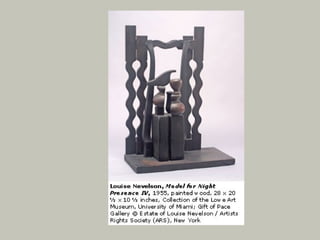
Louise Nevelson (1899-1988) was a towering
figure in postwar American art, exerting great
influence with her monumental installations,
innovative sculptures made of found wood
objects, and celebrated public art. She was
recognized during her lifetime as one of
America’s most prominent and innovative
sculptors, and her work continues to inspire
contemporary sculptors today.
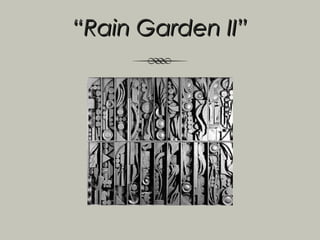
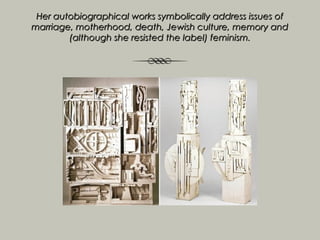
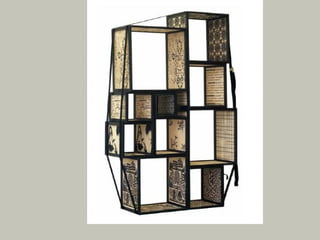
“Rain Garden II”
Her autobiographical works symbolically address issues of
marriage, motherhood, death, Jewish culture, memory and
        (although she resisted the label) feminism.
   Nevelson was born in the Ukraine and immigrated to
    the United States with her family six years later. Her life
    encompassed most of the 20th century, giving her
    exposure to Cubism, Dada, Surrealism, Abstract
    Expressionism, Minimalism, and installation art. Although
    linked to all of these movements, Nevelson formed a
    unique visual language that earned her recognition as
    one of America’s most distinguished artists. Her work
    continues to inform contemporary sculpture nearly 20
    years after her death.
   Her groundbreaking technique involved assembling
    cast-off wood pieces and transforming them with coats
    of monochromatic black, white, and (more rarely) gold
    spray paint. Nevelson’s work started with tabletop scale
    objects, but quickly grew into human-scale and room-
    sized works. Her later, monumental public works stood
    their ground with the buildings that surrounded them.
   Despite the size and drama of Nevelson’s sculptures,
    they were at times overwhelmed by her larger-than-
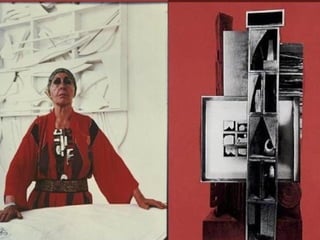
    life public persona. She was known for wearing eye-
    catching assemblages of couture, ethnographic
    clothing, outsize jewelry and hats. A trademark look
    involved donning multiple layers of false eyelashes.
    “With the passage of time, Nevelson’s larger-than-
    life persona may be viewed in historical perspective,
    thus allowing viewers to focus on her extraordinary
    artistic legacy,” says Timothy Anglin Burgard, Ednah
    Root Curator-in-Charge of the American Art
    Department.
Robert Rauschenberg
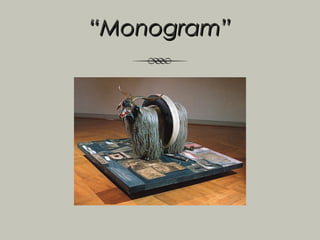
“Monogram”
Rauschenberg

   Rauschenberg’s enthusiasm for popular culture and his rejection of the angst
    and seriousness of the Abstract Expressionists led him to search for a new
    way of painting. He found his signature mode by embracing materials
    traditionally outside of the artist’s reach. He would cover a canvas with
    house paint, or ink the wheel of a car and run it over paper to create a
    drawing, while demonstrating rigor and concern for formal painting. By 1958,
    at the time of his first solo exhibition at the Leo Castelli Gallery, his work had
    moved from abstract painting to drawings like “Erased De Kooning” (1953)
    (which was exactly as it sounds) to what he termed “combines.” These
    combines (meant to express both the finding and forming of combinations in
    three-dimensional collage) cemented his place in art history.


   One of Rauschenberg’s first and most famous combines was entitled
    “Monogram” (1959) and consisted of an unlikely set of materials: a stuffed
    angora goat, a tire, a police barrier, the heel of a shoe, a tennis ball, and
    paint. This pioneering altered the course of modern art. The idea of
    combining and of noticing combinations of objects and images has
    remained at the core of Rauschenberg’s work.
You tube Video about
DeKooning/Rauschenberg

http://www.youtube.com/watch?v=tpCWh3IFtDQ
In Conclusion

   Assemblage is a creative method of sculpture
    incorporating everyday found objects into a
    three-dimensional sculpture and can be used to
    create dramatic, humorous, satirical, and
    emotional works of art.
Assemblage sculpture

Assemblage sculpture

  • 2.
  • 3.
  • 4.
    What is Assemblage Assemblage sculpture is the bonding of shapes or objects by gluing, soldering, pasting, nailing, etc… These objects tend to be mainly found objects.  Basically, assemblage is a three- dimensional collage.
  • 5.
  • 6.
  • 7.
    Why is itimportant?  Assemblage is an innovative method of creating art.  Many world famous artists have used assemblage to create modern masterpieces.  Assemblage allows us to give new meaning to everyday objects.
  • 8.
  • 9.
    Famous Artists thatused Assemblage  Marcel Duchamp  Bicycle Wheel was the first of a class of objects that Duchamp called his “readymades.” He created twenty-one of them, all between 1915 and 1923. The readymades are a varied collection of items, but there are several ideas that unite them.  The readymades are experiments in provocation, the products of a conscious effort to break every rule of the artistic tradition, in order to create a new kind of art—one that engages the mind instead of the eye, in ways that provoke the observer to participate and think.
  • 10.
    Fountain  Duchamp’s most notorious readymade was a manufactured urinal entitled “Fountain”. Conceived for a show promoting avant-garde art, “Fountain” took advantage of the show’s lack of juried panels, which invariably excluded forward- looking artists.  Under a pseudonym, “R.Mutt,” Duchamp submitted “Fountain”. It was a prank, meant to taunt his avant-garde peers. For some of the show’s organizers this was too much —was the artist equating modern art with a toilet fixture? –and “Fountain” as ‘misplaced’ for the duration of the exhibition. It disappeared soon thereafter.
  • 11.
    Box in aValise  Box in a Valise is a portable museum of Duchamp’s works, reproduced in miniature, packed in a customized collapsible case, like a salesman’s valise. It debuted in a deluxe edition of twenty copies in 1940.  Duchamp must have been concerned for his legacy. In 1934 he learned that a few of his works had been broken. More than half the readymades were lost. Box in a Valise is a mini-museum, a resume of Duchamp’s life in art, created with painstaking care in the face of a vanishing material legacy.
  • 12.
    Louise Nevelson “I havemade my world and it is a much better world than I ever saw outside”
  • 14.
    Louise Nevelson (1899-1988)was a towering figure in postwar American art, exerting great influence with her monumental installations, innovative sculptures made of found wood objects, and celebrated public art. She was recognized during her lifetime as one of America’s most prominent and innovative sculptors, and her work continues to inspire contemporary sculptors today.
  • 16.
  • 17.
    Her autobiographical workssymbolically address issues of marriage, motherhood, death, Jewish culture, memory and (although she resisted the label) feminism.
  • 18.
    Nevelson was born in the Ukraine and immigrated to the United States with her family six years later. Her life encompassed most of the 20th century, giving her exposure to Cubism, Dada, Surrealism, Abstract Expressionism, Minimalism, and installation art. Although linked to all of these movements, Nevelson formed a unique visual language that earned her recognition as one of America’s most distinguished artists. Her work continues to inform contemporary sculpture nearly 20 years after her death.  Her groundbreaking technique involved assembling cast-off wood pieces and transforming them with coats of monochromatic black, white, and (more rarely) gold spray paint. Nevelson’s work started with tabletop scale objects, but quickly grew into human-scale and room- sized works. Her later, monumental public works stood their ground with the buildings that surrounded them.
  • 20.
    Despite the size and drama of Nevelson’s sculptures, they were at times overwhelmed by her larger-than- life public persona. She was known for wearing eye- catching assemblages of couture, ethnographic clothing, outsize jewelry and hats. A trademark look involved donning multiple layers of false eyelashes. “With the passage of time, Nevelson’s larger-than- life persona may be viewed in historical perspective, thus allowing viewers to focus on her extraordinary artistic legacy,” says Timothy Anglin Burgard, Ednah Root Curator-in-Charge of the American Art Department.
  • 25.
  • 26.
  • 27.
    Rauschenberg  Rauschenberg’s enthusiasm for popular culture and his rejection of the angst and seriousness of the Abstract Expressionists led him to search for a new way of painting. He found his signature mode by embracing materials traditionally outside of the artist’s reach. He would cover a canvas with house paint, or ink the wheel of a car and run it over paper to create a drawing, while demonstrating rigor and concern for formal painting. By 1958, at the time of his first solo exhibition at the Leo Castelli Gallery, his work had moved from abstract painting to drawings like “Erased De Kooning” (1953) (which was exactly as it sounds) to what he termed “combines.” These combines (meant to express both the finding and forming of combinations in three-dimensional collage) cemented his place in art history.  One of Rauschenberg’s first and most famous combines was entitled “Monogram” (1959) and consisted of an unlikely set of materials: a stuffed angora goat, a tire, a police barrier, the heel of a shoe, a tennis ball, and paint. This pioneering altered the course of modern art. The idea of combining and of noticing combinations of objects and images has remained at the core of Rauschenberg’s work.
  • 28.
    You tube Videoabout DeKooning/Rauschenberg http://www.youtube.com/watch?v=tpCWh3IFtDQ
  • 29.
    In Conclusion  Assemblage is a creative method of sculpture incorporating everyday found objects into a three-dimensional sculpture and can be used to create dramatic, humorous, satirical, and emotional works of art.