PORUKARA COLLEGE OF EDUCATION
CHAMPAKULAM
SUBMITTED TO ;
Mrs. SINDHU M.V
LECTURER IN COMMERCE
SUBMITTED BY
ASHA THOMAS
NATURAL SCIENCE
WELCOME
MICROTEACHING
INTRODUCTION
• Microteaching is introduced by D.W Allen
• It is a training procedure.
• It helps to improve a specific skill.
• Time limit is 5 – 10 minutes.
• 5 – 10 students are included.
• Only a small portion of topic.
DEFINITION
• Microteaching is in defined as “A scale down
sample o teaching in which teacher teaches a
small unit to small group for a small period of
time ’’.
OBJECTIVES
• It is increases the confidence level.
• It helps to enables the teacher training.
• It helps to accumulate new knowledge.
TEACHING SKILLS
1. Skill of Introducing a lesson.
2. Skill of Stimulus variation.
3. Skill of Explaining.
4. Skill of Using black board.
5. Skill of Illustrating with example.
6. Skill of Posing probing questions.
7. Skill of Fluency in questioning.
8. Skill of Reinforcement.
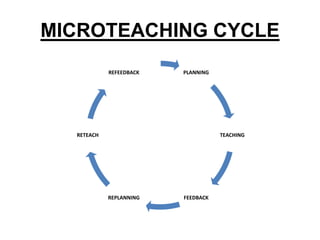
MICROTEACHING CYCLE
PLANNING
TEACHING
FEEDBACKREPLANNING
RETEACH
REFEEDBACK
STEPS IN MICROTEACHING
• Defining the microteaching skill.
• Demonstration of skill.
• Selection of suitable topic.
• Preparation of lesson plan.
• Presentation of topic in the presence of observers
& supervisors.
• Seeking feedback.
• Arranging replanning, reteaching, refeeback if it
is wanted.
• Repeating the cycle till acquiring the skill.
PHASES IN MICROTEACHING
1. Knowledge acquisition phase.
2. Skill acquisition phase.
3. Transfer phase.
ADVANTAGES OF MICROTACHING
• Helps to improve performances in stage.
• Helps to developing skill purposes.
• Improve teacher competency.
• Get feedback.
• Helps to modify the behaviour.
LIMITATIONS OF MICROTEACHING
• Only skill oriented.
• Content is not acquired.
• Covers only a few specific skills.
• Administrative problems to make lesson plan.
CONCLUSION
• Microteaching is a scale down teaching
encounter in class size an class time.
• It helps to improve the teaching skills.
• It increases the confidence level.
THANK YOU

asha

  • 1.
    PORUKARA COLLEGE OFEDUCATION CHAMPAKULAM SUBMITTED TO ; Mrs. SINDHU M.V LECTURER IN COMMERCE SUBMITTED BY ASHA THOMAS NATURAL SCIENCE
  • 2.
  • 3.
  • 4.
    INTRODUCTION • Microteaching isintroduced by D.W Allen • It is a training procedure. • It helps to improve a specific skill. • Time limit is 5 – 10 minutes. • 5 – 10 students are included. • Only a small portion of topic.
  • 5.
    DEFINITION • Microteaching isin defined as “A scale down sample o teaching in which teacher teaches a small unit to small group for a small period of time ’’.
  • 6.
    OBJECTIVES • It isincreases the confidence level. • It helps to enables the teacher training. • It helps to accumulate new knowledge.
  • 7.
    TEACHING SKILLS 1. Skillof Introducing a lesson. 2. Skill of Stimulus variation. 3. Skill of Explaining. 4. Skill of Using black board. 5. Skill of Illustrating with example. 6. Skill of Posing probing questions. 7. Skill of Fluency in questioning. 8. Skill of Reinforcement.
  • 8.
  • 9.
    STEPS IN MICROTEACHING •Defining the microteaching skill. • Demonstration of skill. • Selection of suitable topic. • Preparation of lesson plan. • Presentation of topic in the presence of observers & supervisors. • Seeking feedback. • Arranging replanning, reteaching, refeeback if it is wanted. • Repeating the cycle till acquiring the skill.
  • 10.
    PHASES IN MICROTEACHING 1.Knowledge acquisition phase. 2. Skill acquisition phase. 3. Transfer phase.
  • 11.
    ADVANTAGES OF MICROTACHING •Helps to improve performances in stage. • Helps to developing skill purposes. • Improve teacher competency. • Get feedback. • Helps to modify the behaviour.
  • 12.
    LIMITATIONS OF MICROTEACHING •Only skill oriented. • Content is not acquired. • Covers only a few specific skills. • Administrative problems to make lesson plan.
  • 13.
    CONCLUSION • Microteaching isa scale down teaching encounter in class size an class time. • It helps to improve the teaching skills. • It increases the confidence level.
  • 14.