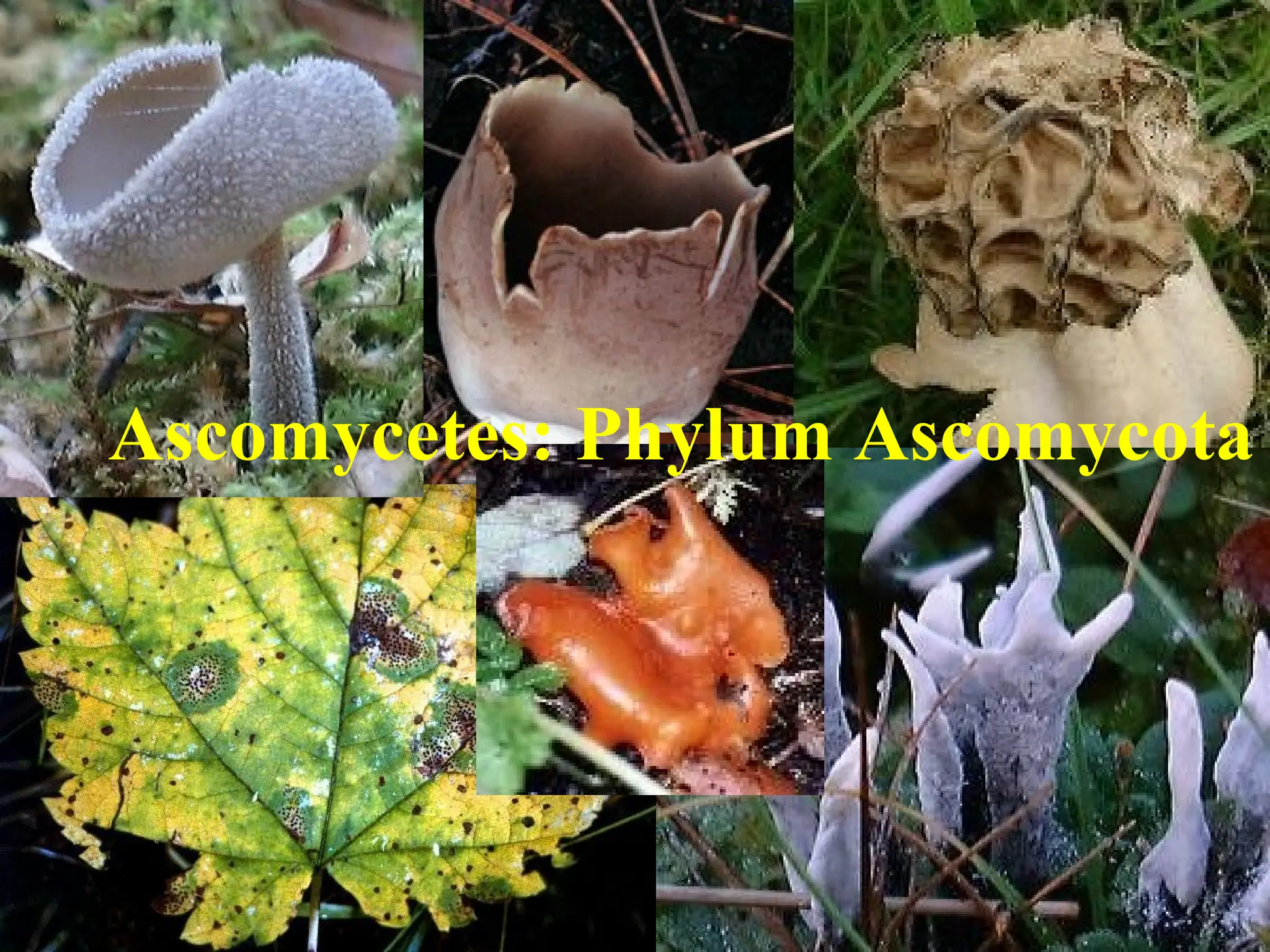
Ascomycetes: Phylum Ascomycota
Ascomycetes are organisms that belong to the
phylum Ascomycota.
The phylum Ascomycota is the largest in the
kingdom of fungus, with about 64000 species.
They are part of the Dikarya sub-kingdom.
Today, in this article we are going to learn about
Ascomycetes, their life cycle, their importance,
and more.
The living habitat and the feeding habits of the
ascomycetes are very diverse, some of them are
saprophytes and the others are pathogens causing
various diseases in plants and animals.
Some of the ascomycetes are edible like mushrooms and
some of them live in a symbiotic association like lichens
and mycorrhiza.
Some of the ascomycetes examples are yeast, powdery
mildews, cup fungi, morels, truffles, Neurospora,
Aspergillus, Cladonia, Penicillium, Candida, Claviceps,
etc.
• The reproductive structure of the ascomycetes is known as ascus
or asci .
Most of the ascomycetes are terrestrial, parasitic or coprophilous.
It might be unicellular or multicellular fungi.
The mycelium of the ascomycetes is made up of septate or
branched hyphae and the cell wall is made up of chitin or -
ꞵ
glucans.
Ascomycetes have cytoplasmic continuity due to septal pores.
In ascomycetes, asexual reproduction is by the formation of
conidia exogenously on conidiophores and Sexual reproduction is
by conjugation between two gametangia. They can be either
homothallic or heterothallic.
In ascomycetes, the fruiting body is called ascocarp and there are
mainly four types of ascocarps. Ascomycetes examples of
ascospores are cleistothecium, perithecium, apothecium, and
ascostroma. Ascospores are produced endogenously in ascii.
General Characteristics of Ascomycetes.
Economic Importance of Ascomycetes
1. They are one of the biggest groups of fungi having diverse habitats.
2. Many useful products are derived from them like foods, medicines, and some
chemical products.
3. Many food industries depend on yeast for fermentation like brewing, bread and
cheese making.
4. They are used to make antibiotics like penicillin, which is derived from
Penicillium chrysogenum.
5. Ascomycetes produce many organic acids and enzymes like citric acid, gluconic
acid, amylases, proteases, etc.
6. Ciclosporin derived from the fungus Tolypocladium niveum is used to transplant
organs and treat autoimmune diseases. It is used as an immunosuppressant.
7. It is used to prepare different types of cheese using different penicillium species
like camembert, brie, and Roquefort.
8. Ascomycetes like Claviceps purpurea (Ergot) are used as medicine to stop
excessive bleeding during menstrual periods and to speed up labour.
9. They are one of the delicacies like morels, truffles and lobster mushrooms.
10. Aspergillus is used to prepare soya sauce and also other Asian alcoholic
beverages.
11.Some of the ascomycetes are widely used to study genetics Neurospora,
Saccharomyces, etc.
Ascomycetes
• Group of fungi
characterized
by their
production of
sexual spores
in a sac-like
structure called
an ascus.
“Cup fungus”
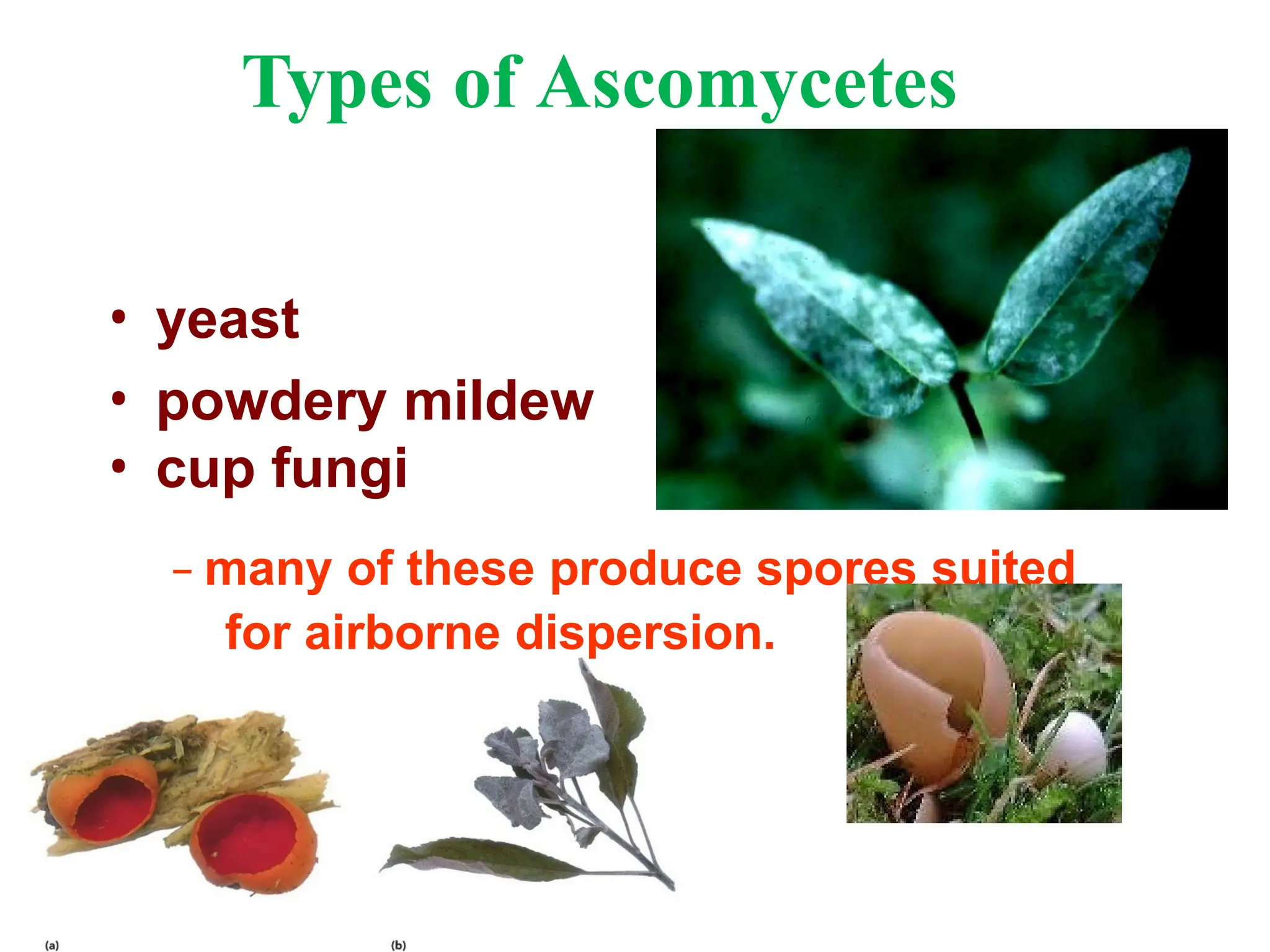
Types of Ascomycetes
• yeast
• powdery mildew
• cup fungi
– many of these produce spores suited
for airborne dispersion.
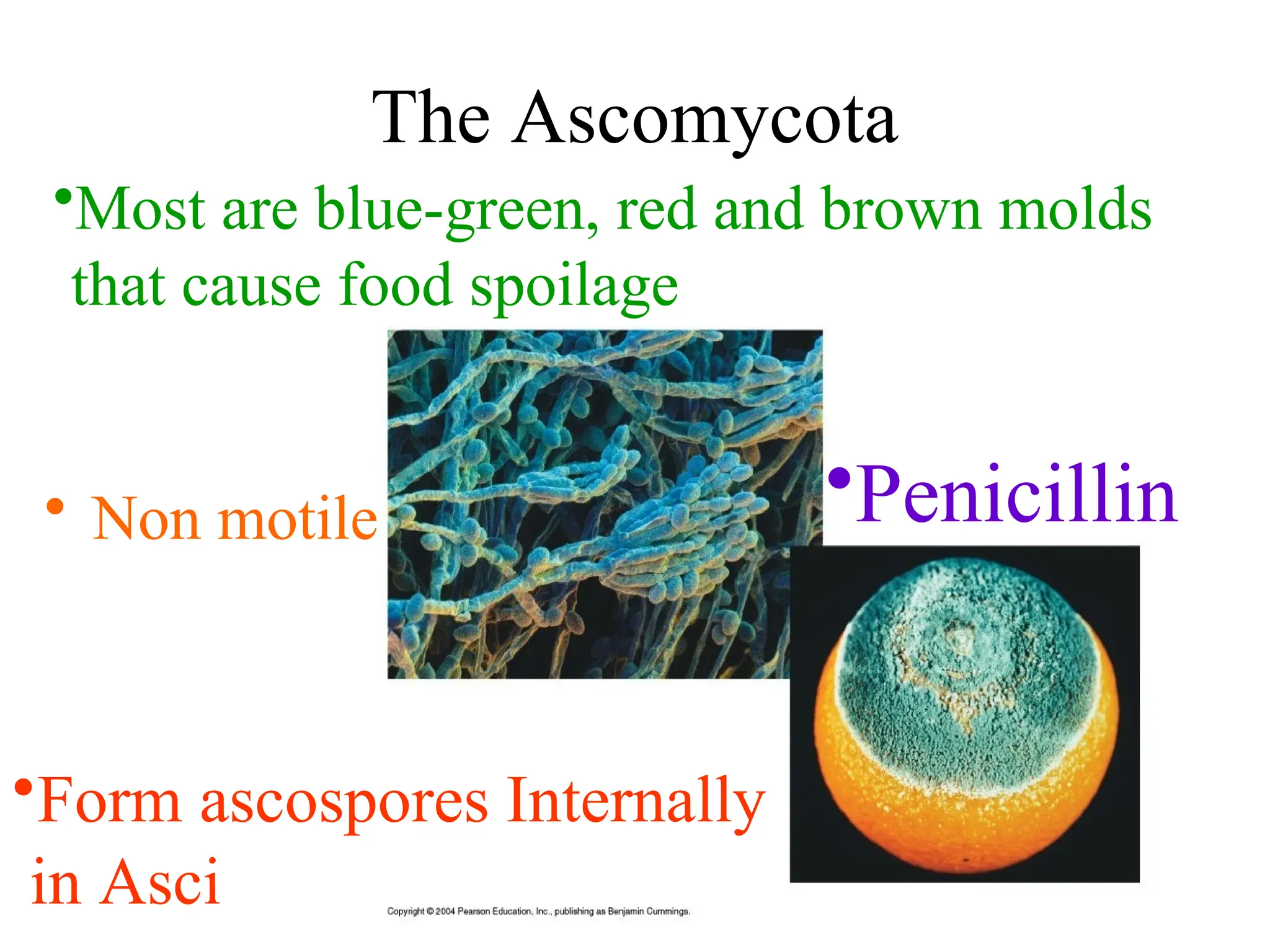
The Ascomycota
• Non motile
•Form ascospores Internally
in Asci
•Most are blue-green, red and brown molds
that cause food spoilage
•Penicillin
Ascomycetes Eyelash cup, Scutellinia scutellata
Ascomycetes can cause plant
disease
• Brown rot of stone
fruits (Monilinia
fructicola)
•chestnut blight
(Cryphonectria
Dutch elm disease
( Ophiostoma ulmi)
Beneficial Ascomycete
• Many Yeast are also ascomycetes
•Edible Morels and truffles
Edible black truffle,
Tuber melanosporum
spore-bearing structure is
produced below ground
mainly on oaks and
hazelnuts
Edible Ascomycete
Ascomycetes growth
• Most have either unicellular or
filamentous growth forms
• Hyphae have perforated septa
• Hyphal cells of Vegetative
mycelim may be either
uninucleated or multinucleated
• Some are homothallic others
heterothallic
Life cycle of an Ascomycete
• Most species undergo asexual reproduction
by the formation of multinucleated
conidia
• Conidia formed from the conidiogenous
cells
• Conidiogeneous cells are borne at the tips
of modified hyphae called
conidiophores “conidia bearers”
Conidia- the characteristic
asexual spores of
ascomycetes shows the
stages in the formation of
conidia which infects the
velvetbean caterpillar
TEM of Various
stages of
developments of
conidida
Ascomycetes spore development vs.
Zygomycetes spore development
• Unlike zygomycetes which produce
spores internally within a sporangium,
ascomycetes produce their asexual spores
externally as conidia.
Sexual reproduction in
Ascomycetes
• Always involves the formation of an ascus (pl.
asci)- saclike structure within which a haploid
ascospores are formed following meiosis.
• Because the ascus resembles as sac, commonly
referred to as “sac fungi”
• Both the asci and ascospores are unique structures
that distinguish the ascomycetes from all other
fungi
• Ascus formation usually occurs within a complex
structure composed of tightly interwoven hyphae-
the ascoma (pl. ascomata) or ascocarp.
Maturing ascospores in
Asci of Ascodesmis
nigricans
Enclosed asci and
ascospores of Ascoma
called a cleistrothecium
An ascoma of Coniochaeta
showing the enclosed asci
and ascospores
Perithecium- fruiting body
contains ascospores
Xylaria fungus
“Dead mans fingers”
Perithecium with ascospores
Finger Xsec
Hymenial layer
• Asci usually develop on an inner surface
of the asoma, a layer called the hymenium
or hymenial layer
Hymenium of an ascomycete showing asci with
ascospores section thru the hymenial layer of Morela
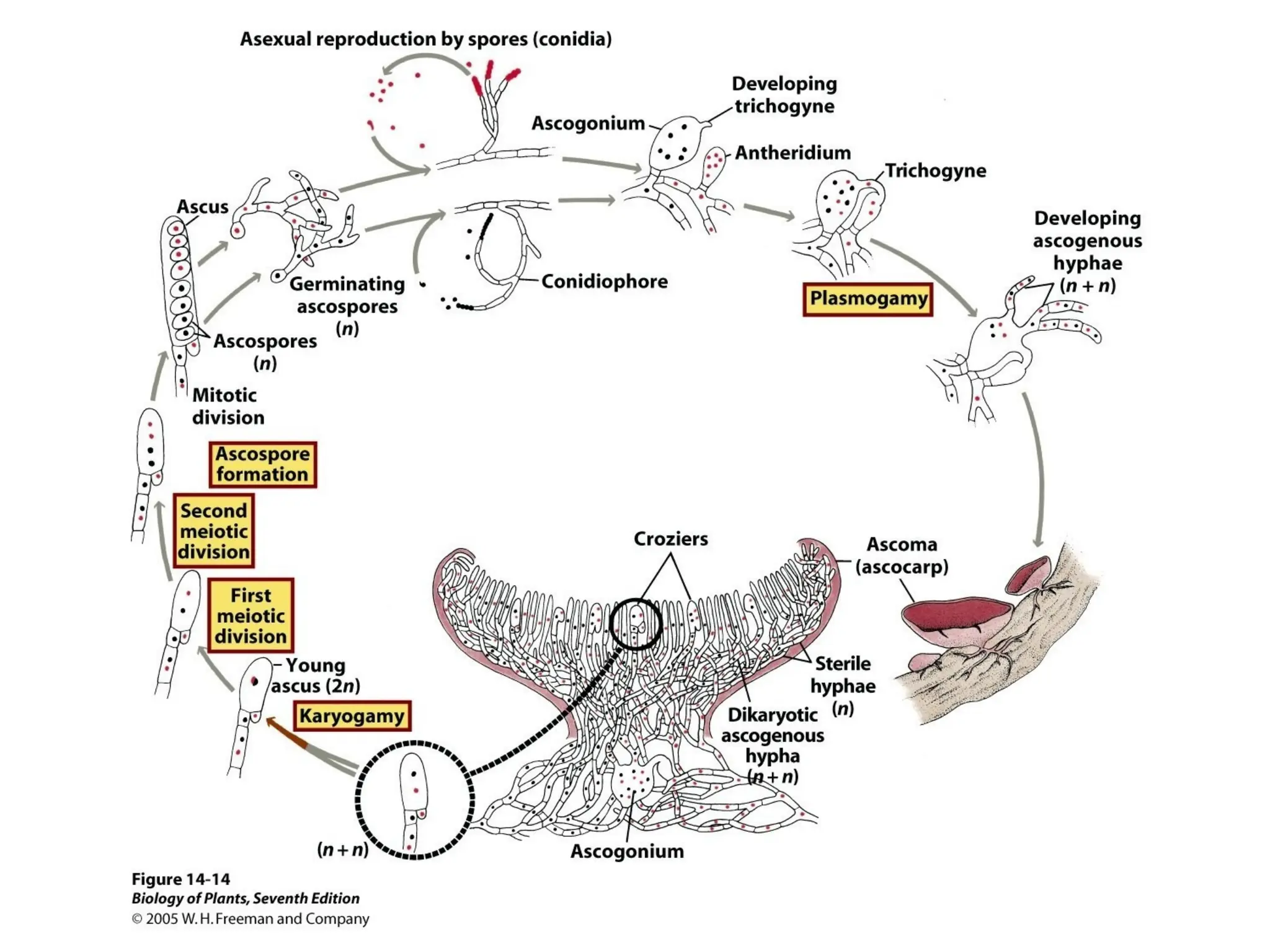
Life cycle of Ascomycete
• The mycelium grows out from
a germinating ascospore
• Mycelium begins to reproduce asexually
by forming conidia
• Many conidia are produced
• Conidia are responsible for propagating
and disseminating the fungus
Ascomycete life cycle
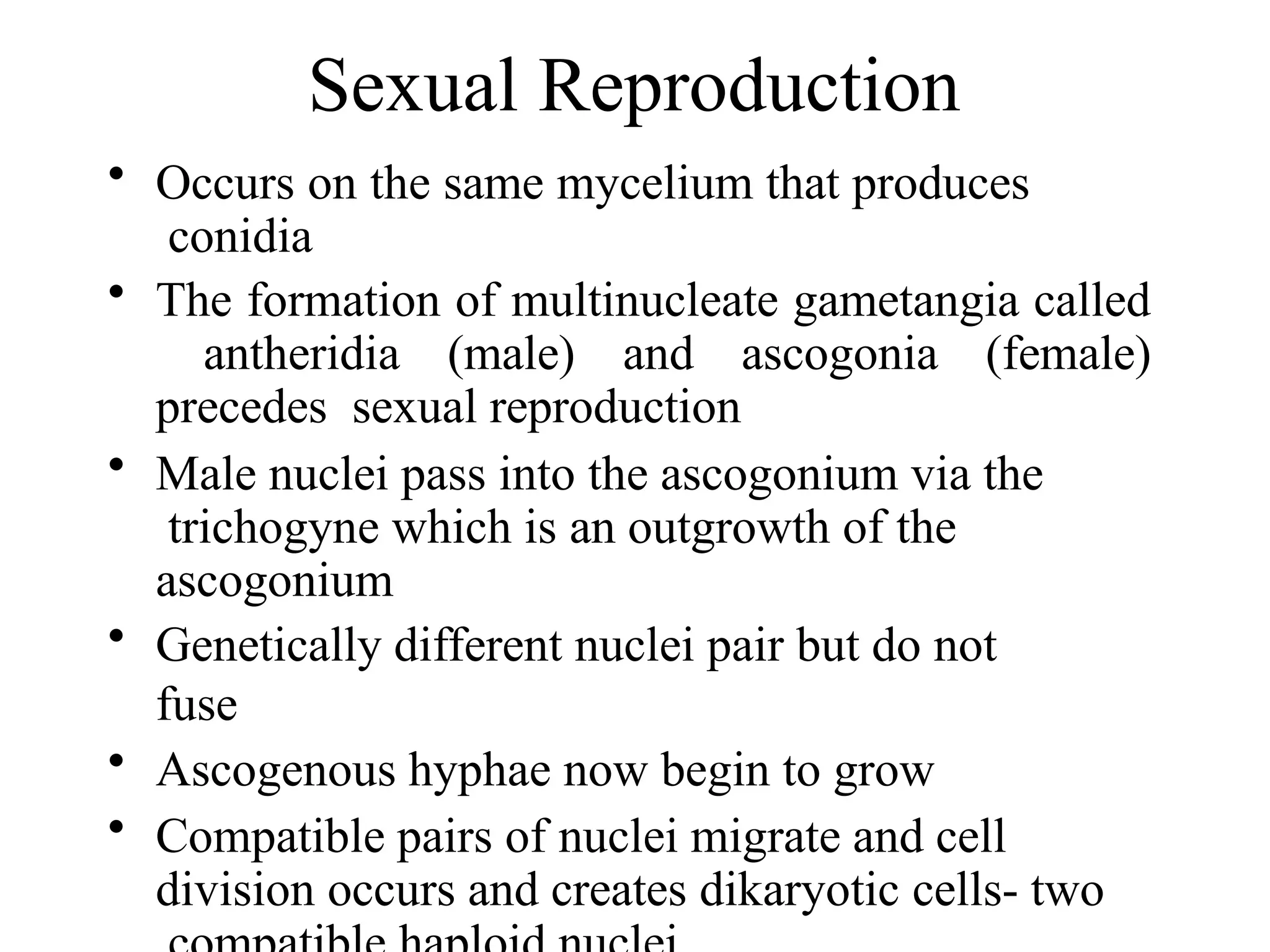
Sexual Reproduction
• Occurs on the same mycelium that produces
conidia
• The formation of multinucleate gametangia called
antheridia (male) and ascogonia (female)
precedes sexual reproduction
• Male nuclei pass into the ascogonium via the
trichogyne which is an outgrowth of the
ascogonium
• Genetically different nuclei pair but do not
fuse
• Ascogenous hyphae now begin to grow
• Compatible pairs of nuclei migrate and cell
division occurs and creates dikaryotic cells- two
• Crozier- the apical cell of the ascogenous hypha
which allows the paired nuclei to divide
simultaneously
• Compatible pair of nuclei fuse (karyogamy) to
form a zygote
• Zygote undergoes meiosis producing ascus with 8
nuclei
• Haploid nuclei cut off to form ascospores
• Ascus as it matures becomes turgid, and finally
burst to release its ascospores
Ascomycetes                                l,.pptx

Ascomycetes l,.pptx

  • 1.
  • 2.
    Ascomycetes are organismsthat belong to the phylum Ascomycota. The phylum Ascomycota is the largest in the kingdom of fungus, with about 64000 species. They are part of the Dikarya sub-kingdom. Today, in this article we are going to learn about Ascomycetes, their life cycle, their importance, and more.
  • 3.
    The living habitatand the feeding habits of the ascomycetes are very diverse, some of them are saprophytes and the others are pathogens causing various diseases in plants and animals. Some of the ascomycetes are edible like mushrooms and some of them live in a symbiotic association like lichens and mycorrhiza. Some of the ascomycetes examples are yeast, powdery mildews, cup fungi, morels, truffles, Neurospora, Aspergillus, Cladonia, Penicillium, Candida, Claviceps, etc.
  • 4.
    • The reproductivestructure of the ascomycetes is known as ascus or asci . Most of the ascomycetes are terrestrial, parasitic or coprophilous. It might be unicellular or multicellular fungi. The mycelium of the ascomycetes is made up of septate or branched hyphae and the cell wall is made up of chitin or - ꞵ glucans. Ascomycetes have cytoplasmic continuity due to septal pores. In ascomycetes, asexual reproduction is by the formation of conidia exogenously on conidiophores and Sexual reproduction is by conjugation between two gametangia. They can be either homothallic or heterothallic. In ascomycetes, the fruiting body is called ascocarp and there are mainly four types of ascocarps. Ascomycetes examples of ascospores are cleistothecium, perithecium, apothecium, and ascostroma. Ascospores are produced endogenously in ascii. General Characteristics of Ascomycetes.
  • 5.
    Economic Importance ofAscomycetes 1. They are one of the biggest groups of fungi having diverse habitats. 2. Many useful products are derived from them like foods, medicines, and some chemical products. 3. Many food industries depend on yeast for fermentation like brewing, bread and cheese making. 4. They are used to make antibiotics like penicillin, which is derived from Penicillium chrysogenum. 5. Ascomycetes produce many organic acids and enzymes like citric acid, gluconic acid, amylases, proteases, etc. 6. Ciclosporin derived from the fungus Tolypocladium niveum is used to transplant organs and treat autoimmune diseases. It is used as an immunosuppressant. 7. It is used to prepare different types of cheese using different penicillium species like camembert, brie, and Roquefort. 8. Ascomycetes like Claviceps purpurea (Ergot) are used as medicine to stop excessive bleeding during menstrual periods and to speed up labour. 9. They are one of the delicacies like morels, truffles and lobster mushrooms. 10. Aspergillus is used to prepare soya sauce and also other Asian alcoholic beverages. 11.Some of the ascomycetes are widely used to study genetics Neurospora, Saccharomyces, etc.
  • 6.
    Ascomycetes • Group offungi characterized by their production of sexual spores in a sac-like structure called an ascus.
  • 7.
  • 8.
    Types of Ascomycetes •yeast • powdery mildew • cup fungi – many of these produce spores suited for airborne dispersion.
  • 9.
    The Ascomycota • Nonmotile •Form ascospores Internally in Asci •Most are blue-green, red and brown molds that cause food spoilage •Penicillin
  • 10.
    Ascomycetes Eyelash cup,Scutellinia scutellata
  • 11.
    Ascomycetes can causeplant disease • Brown rot of stone fruits (Monilinia fructicola) •chestnut blight (Cryphonectria
  • 12.
    Dutch elm disease (Ophiostoma ulmi)
  • 13.
    Beneficial Ascomycete • ManyYeast are also ascomycetes •Edible Morels and truffles
  • 14.
    Edible black truffle, Tubermelanosporum spore-bearing structure is produced below ground mainly on oaks and hazelnuts
  • 15.
  • 16.
    Ascomycetes growth • Mosthave either unicellular or filamentous growth forms • Hyphae have perforated septa • Hyphal cells of Vegetative mycelim may be either uninucleated or multinucleated • Some are homothallic others heterothallic
  • 17.
    Life cycle ofan Ascomycete • Most species undergo asexual reproduction by the formation of multinucleated conidia • Conidia formed from the conidiogenous cells • Conidiogeneous cells are borne at the tips of modified hyphae called conidiophores “conidia bearers”
  • 18.
    Conidia- the characteristic asexualspores of ascomycetes shows the stages in the formation of conidia which infects the velvetbean caterpillar
  • 19.
    TEM of Various stagesof developments of conidida
  • 20.
    Ascomycetes spore developmentvs. Zygomycetes spore development • Unlike zygomycetes which produce spores internally within a sporangium, ascomycetes produce their asexual spores externally as conidia.
  • 21.
    Sexual reproduction in Ascomycetes •Always involves the formation of an ascus (pl. asci)- saclike structure within which a haploid ascospores are formed following meiosis. • Because the ascus resembles as sac, commonly referred to as “sac fungi” • Both the asci and ascospores are unique structures that distinguish the ascomycetes from all other fungi • Ascus formation usually occurs within a complex structure composed of tightly interwoven hyphae- the ascoma (pl. ascomata) or ascocarp.
  • 22.
    Maturing ascospores in Asciof Ascodesmis nigricans
  • 23.
    Enclosed asci and ascosporesof Ascoma called a cleistrothecium
  • 24.
    An ascoma ofConiochaeta showing the enclosed asci and ascospores Perithecium- fruiting body contains ascospores
  • 25.
    Xylaria fungus “Dead mansfingers” Perithecium with ascospores Finger Xsec
  • 26.
    Hymenial layer • Asciusually develop on an inner surface of the asoma, a layer called the hymenium or hymenial layer
  • 27.
    Hymenium of anascomycete showing asci with ascospores section thru the hymenial layer of Morela
  • 28.
    Life cycle ofAscomycete • The mycelium grows out from a germinating ascospore • Mycelium begins to reproduce asexually by forming conidia • Many conidia are produced • Conidia are responsible for propagating and disseminating the fungus
  • 30.
  • 31.
    Sexual Reproduction • Occurson the same mycelium that produces conidia • The formation of multinucleate gametangia called antheridia (male) and ascogonia (female) precedes sexual reproduction • Male nuclei pass into the ascogonium via the trichogyne which is an outgrowth of the ascogonium • Genetically different nuclei pair but do not fuse • Ascogenous hyphae now begin to grow • Compatible pairs of nuclei migrate and cell division occurs and creates dikaryotic cells- two
  • 33.
    • Crozier- theapical cell of the ascogenous hypha which allows the paired nuclei to divide simultaneously • Compatible pair of nuclei fuse (karyogamy) to form a zygote • Zygote undergoes meiosis producing ascus with 8 nuclei • Haploid nuclei cut off to form ascospores • Ascus as it matures becomes turgid, and finally burst to release its ascospores