AS MEDIA STUDIES
FOUNDATION PORTFOLIO IN MEDIA
IntroducingYour MainTask
 Napoleon Dynamite opening sequence
 http://vimeo.com/5524216
Preparing Minds
 What is:
 Action match?
 Shot/ reverse shot?
 180 degree rule?
 Blog?
 Why are they important?
Success Criteria
 We will
 Note down key information about final task
 Answer and ask questions, where relevant
 Plan a basic research/ development schedule
What you need to do
 Blog including detailed research/ planning (20 marks)
 Titles and opening of new fiction film - 2 mins (60 marks)
 Continuity features:
 Action match
 Shot/ reverse shot
 180 degree rule
 Other features
 Titles (essential)
 Genre-specific features (e.g. mise-en-scene/ music)
 Range of shots/ camera movement (essential)
 Range of edits/ effects (if appropriate)
 Evaluation (20 marks)
Examples
 I will email you a dropbox link allowing you to
access these.
Effective Openings
 The Fall
 Fight Club
Weekly Tasks
 Maintain blog (at least 3 entries a week – OCR
suggest one a day)
 Include images/ video clips supporting work
(planning + work in progress)
 Consider all aspects of production process,
including institutions, audience and
representation
 Include as much detail as you can, justifying
choices made
 Link to your work in progress
 Thorough outline of production process
Planning – Lvl 4
 Planning and research evidence complete and detailed
 Excellent research into similar products and potential
target audience
 Excellent organisation of actors, locations, costumes or
props
 Excellent work on shotlists, layouts, drafting, scripting or
storyboarding
 Excellent level of care in the presentation of research and
planning
 Time management is excellent
Production work should demo
 Material appropriate for target audience and task
 Titles used appropriately according to institutional
conventions
 Sound, images and editing used appropriately
 Material shot appropriate to task set, including:
 controlled use of camera
 attention to framing
 variety of shot distance
 close attention to mise-en-scene
 Editing so that meaning apparent to viewer and with
selective and appropriate use of shot transitions and
other effects
Demonstrate
 Steadiness of shots where appropriate
 Framing shots, including/ excluding elements
 Variety of shots/ distances
 Shooting appropriate material
 Selecting mise-en-scene
 Colour/ lighting/ objects/ setting
 Editing for meaning using appropriate effects
 Accurate use of sound/ image
 Appropriate use of titles
Production Checklist
 Places
 Rehearsal
 Setting
 Production Base
 Transport
 Post-Production
 People
 Call sheets
 Actors
 Technical
 Camera
 Continuity
 Support
 Things
 Props
 Costumes
 Technical
 Script
 Cameras
 Media
 Log sheets
 Storyboards
 Schedule
 FX/ SFX
What do you need to know?
 Pre Production
 Research
 Scripting
 Storyboarding
 Location scouting
 Production schedule
 Call sheets
 Shooting
 Logging shots
 Continuity
Evaluation
 Evaluate / reflect upon creative process/ experience
 Evaluate electronically, guided by key questions
 Should not be solely textual; combination of text/
image/ presentation/ video/ audio etc.
 Examples of suitable formats for the evaluation:
 A podcast
 DVD extras
 Detailed blog entries
 PowerPoint/ Prezi
 Director’s commentary
 “Making of” documentary
Evaluation Questions
 Following questions must be answered:
 How does product use, develop or challenge forms and
conventions of real media products? - Must research these
 How does product represent particular social groups? -
Must aim to include a social group
 What kind of media institution might distribute product and why?
- Research studios and distribution
 Who would be audience for product? – Research audience
 How did you attract/address your audience? – Evidence from
planning/ final product
 What have you learnt about technologies from process of
constructing product? – Evidence from blog (shooting/ editing)
 Looking back at preliminary task, what have you learnt in
progression to full product?
Evaluation – Forms/ Conventions
 Need to be able to identify conventions
 Will come from research into openings
 Should be explicit in the first stages of your blog
to revisit in evaluation
 Includes media language, representation, use
of titles, use of music, mise-en-scene etc
(effectively, macro and micro features
 Could be done as a video including
comparisons of your work and your research
Evaluation – Social Groups
 Product must include a social group.
For example:
 Teenagers
 Ethnic groups
 Social demographics
 Consider work on representation and apply
this when researching and planning
 May affect genre/ form of final piece
Evaluation – institutions
 Need to know which kind of companies make
and distribute movies of genre/ style you are
making
 Mainstream or niche?
 Conglomerate or indie?
 Info fromWikipedia/ IMDB/ Box-office mojo
 Demonstrated through research and choice
of distributor/ studio for final piece
Evaluations - audience
 Need to know who watches your genre of
film – demographics/ psychographics
 Can do primary/ secondary research
 Should find data from the web (e.g. box-
office figures) as well as market information,
if available
 Might consider primary and secondary
audiences (e.g. “Lego Movie”, Pixar films etc.
Evaluation – attracting aud
 How was final piece designed to meet
audience needs?
 Evidence from your piece compared to existing
pieces
 Interviews/ vox pops with target audience
reflecting on film
 Detailed deconstruction of what you did/ why you
did it – could be in Prezi form, for example,
including stills/ clips
Evaluation - technology
 Need to regularly blog about engagement
with tech (cameras/ editing)
 Identify problems and solutions
 Take photos/ screengrabs
 Record clearly what you did at the time
 Will effectively be a reflexive post
 Can take into account development from start of
course
 Should be incisive and clear – the more primary
evidence the better
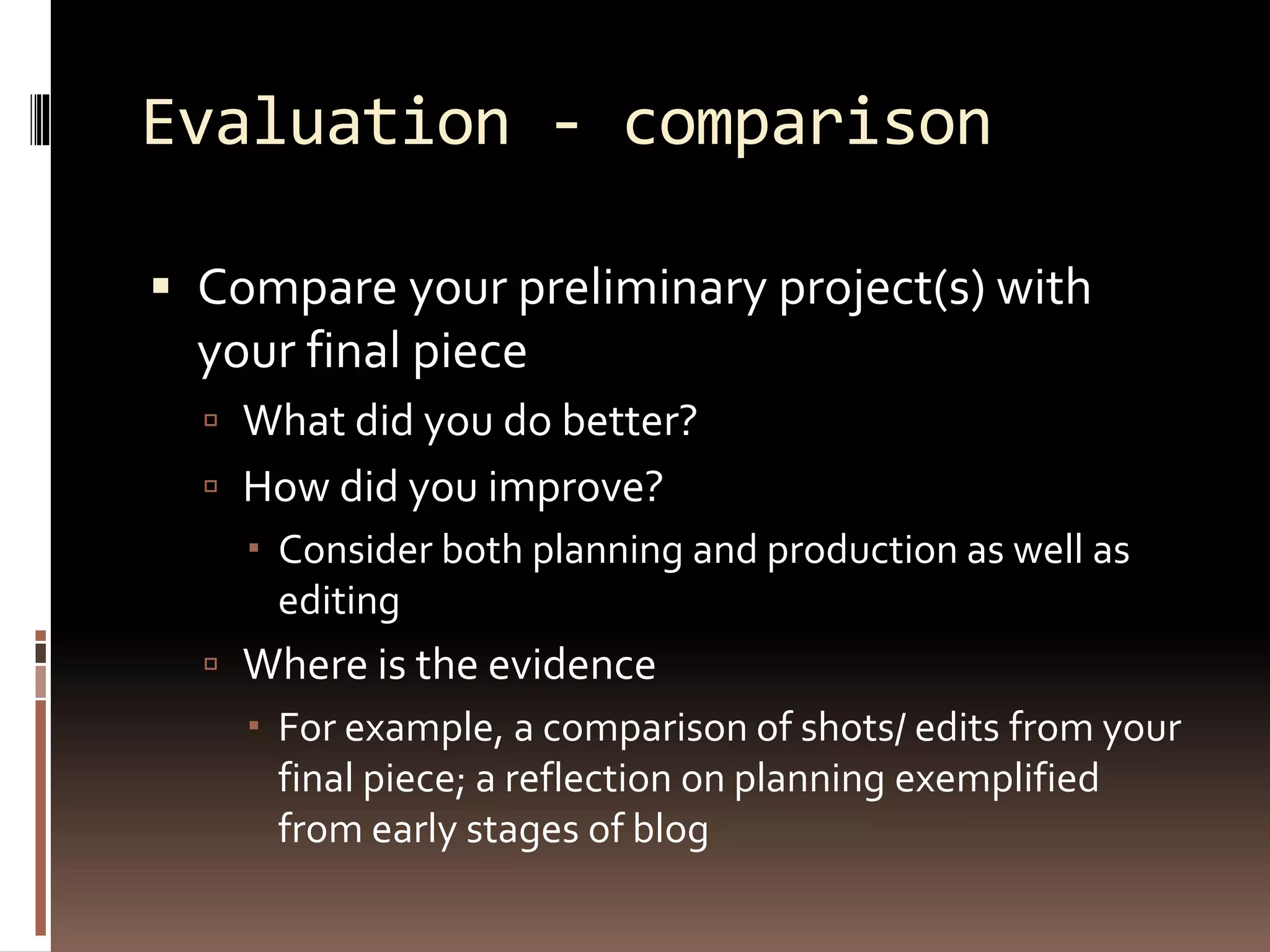
Evaluation - comparison
 Compare your preliminary project(s) with
your final piece
 What did you do better?
 How did you improve?
 Consider both planning and production as well as
editing
 Where is the evidence
 For example, a comparison of shots/ edits from your
final piece; a reflection on planning exemplified
from early stages of blog
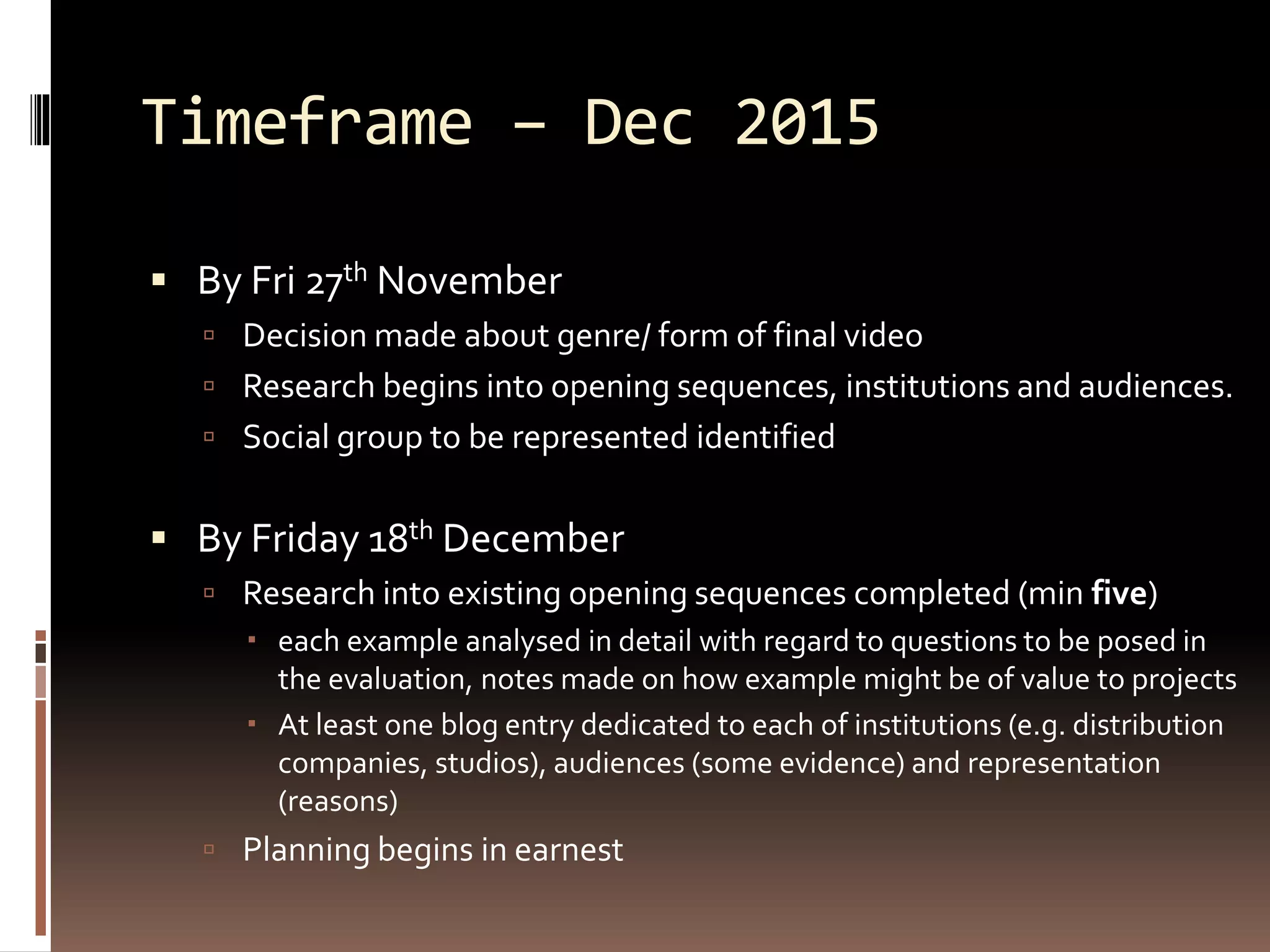
Timeframe – Dec 2015
 By Fri 27th November
 Decision made about genre/ form of final video
 Research begins into opening sequences, institutions and audiences.
 Social group to be represented identified
 By Friday 18th December
 Research into existing opening sequences completed (min five)
 each example analysed in detail with regard to questions to be posed in
the evaluation, notes made on how example might be of value to projects
 At least one blog entry dedicated to each of institutions (e.g. distribution
companies, studios), audiences (some evidence) and representation
(reasons)
 Planning begins in earnest
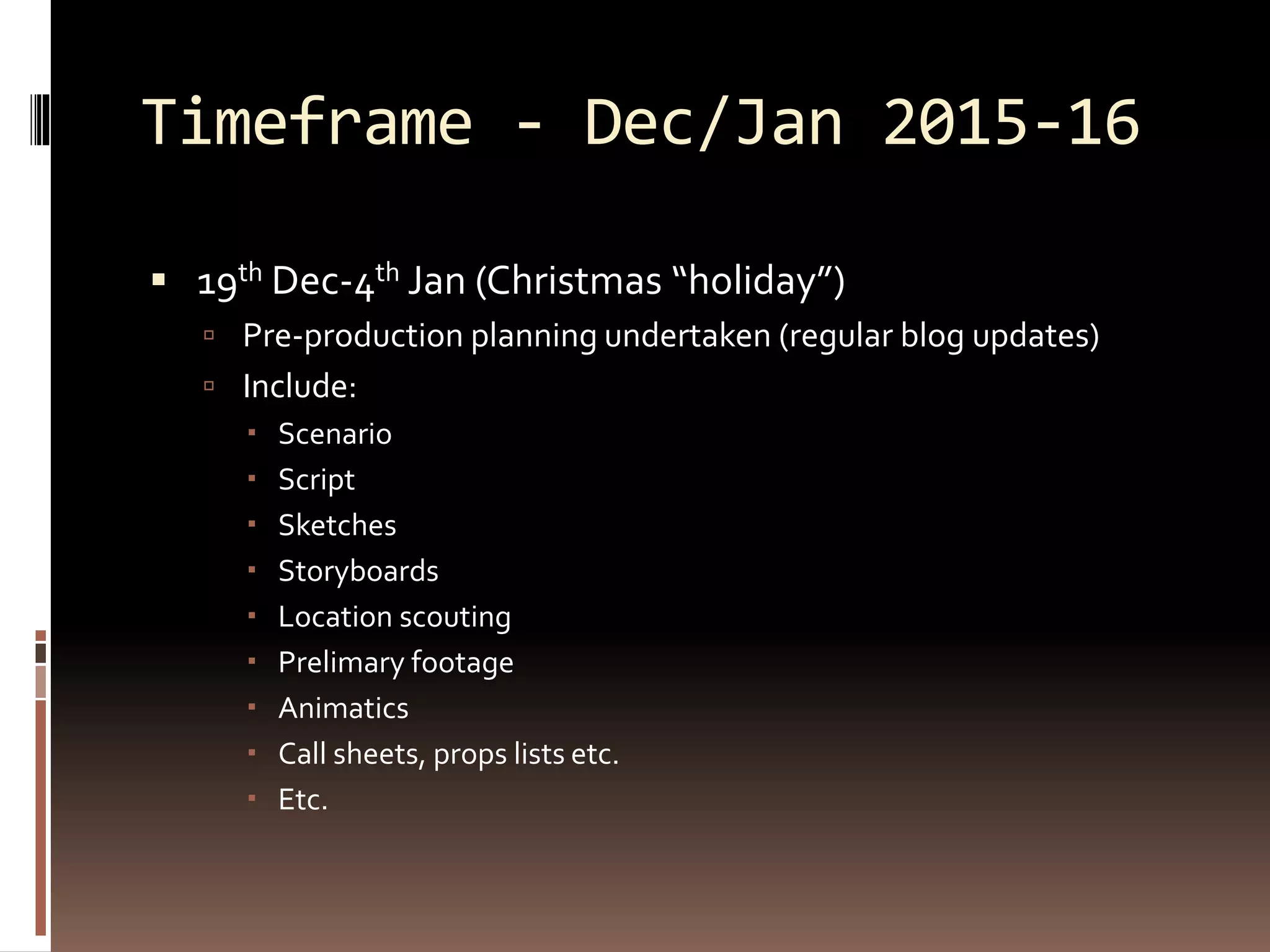
Timeframe - Dec/Jan 2015-16
 19th Dec-4th Jan (Christmas “holiday”)
 Pre-production planning undertaken (regular blog updates)
 Include:
 Scenario
 Script
 Sketches
 Storyboards
 Location scouting
 Prelimary footage
 Animatics
 Call sheets, props lists etc.
 Etc.
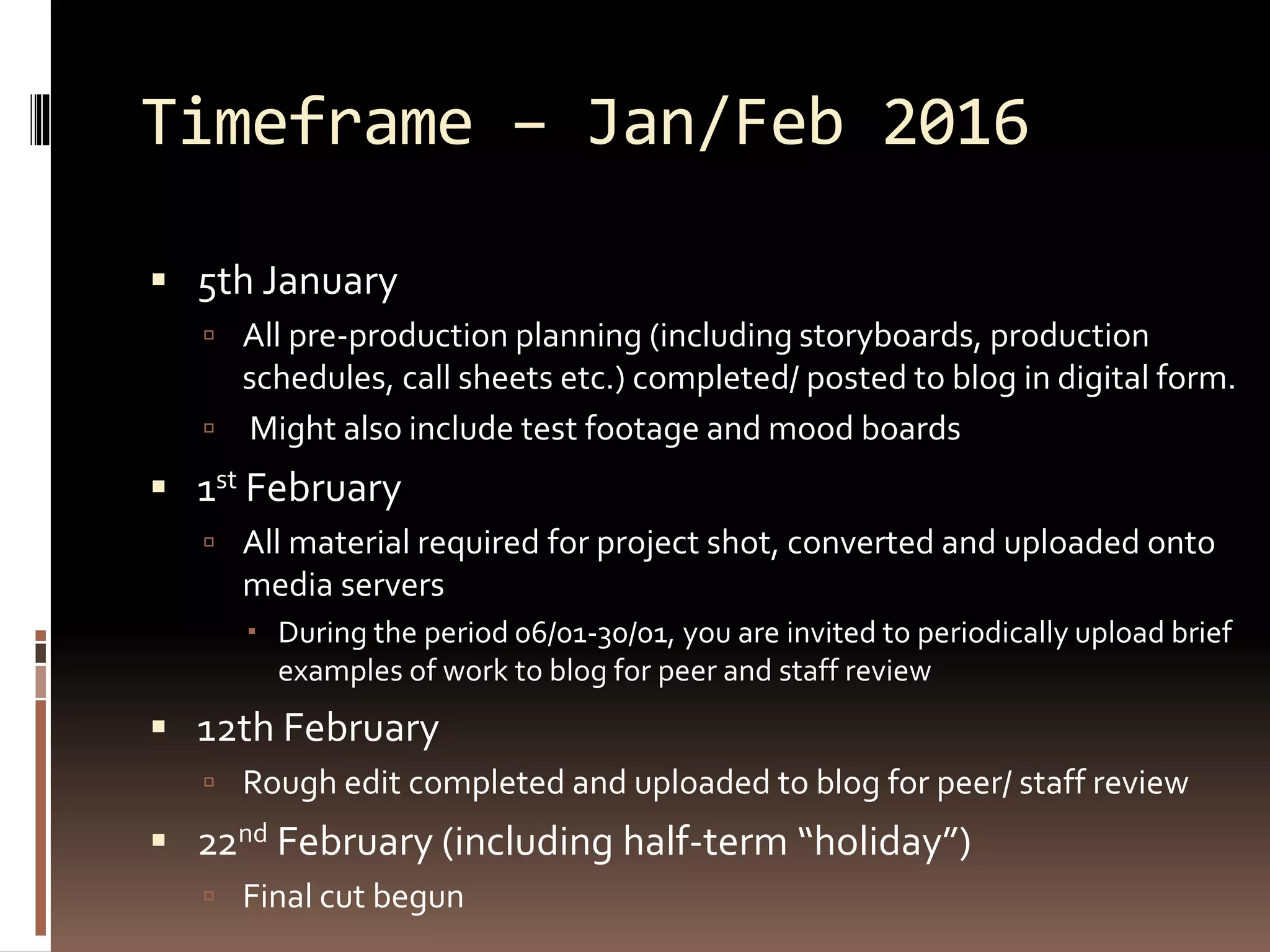
Timeframe – Jan/Feb 2016
 5th January
 All pre-production planning (including storyboards, production
schedules, call sheets etc.) completed/ posted to blog in digital form.
 Might also include test footage and mood boards
 1st February
 All material required for project shot, converted and uploaded onto
media servers
 During the period 06/01-30/01, you are invited to periodically upload brief
examples of work to blog for peer and staff review
 12th February
 Rough edit completed and uploaded to blog for peer/ staff review
 22nd February (including half-term “holiday”)
 Final cut begun
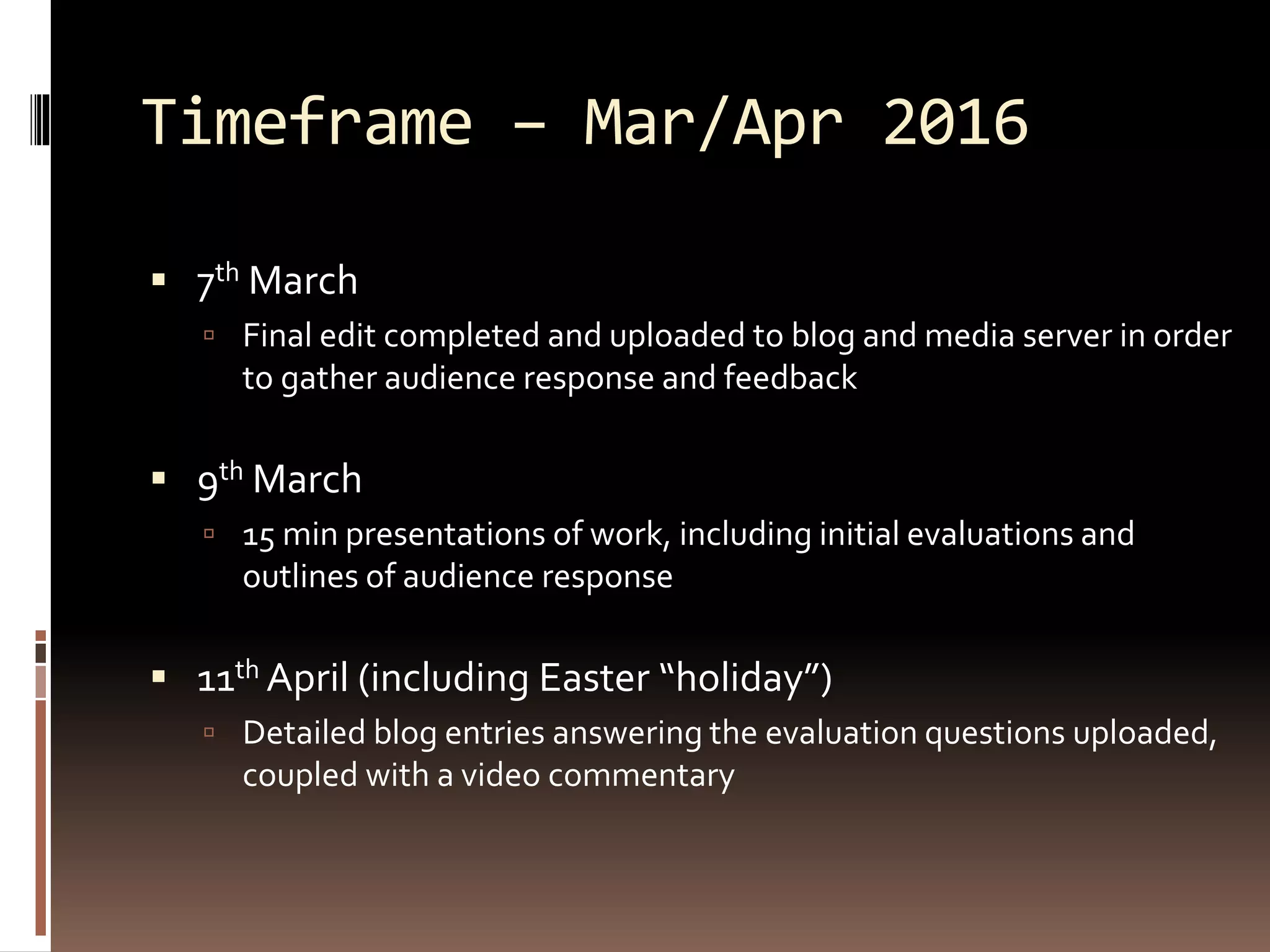
Timeframe – Mar/Apr 2016
 7th March
 Final edit completed and uploaded to blog and media server in order
to gather audience response and feedback
 9th March
 15 min presentations of work, including initial evaluations and
outlines of audience response
 11th April (including Easter “holiday”)
 Detailed blog entries answering the evaluation questions uploaded,
coupled with a video commentary
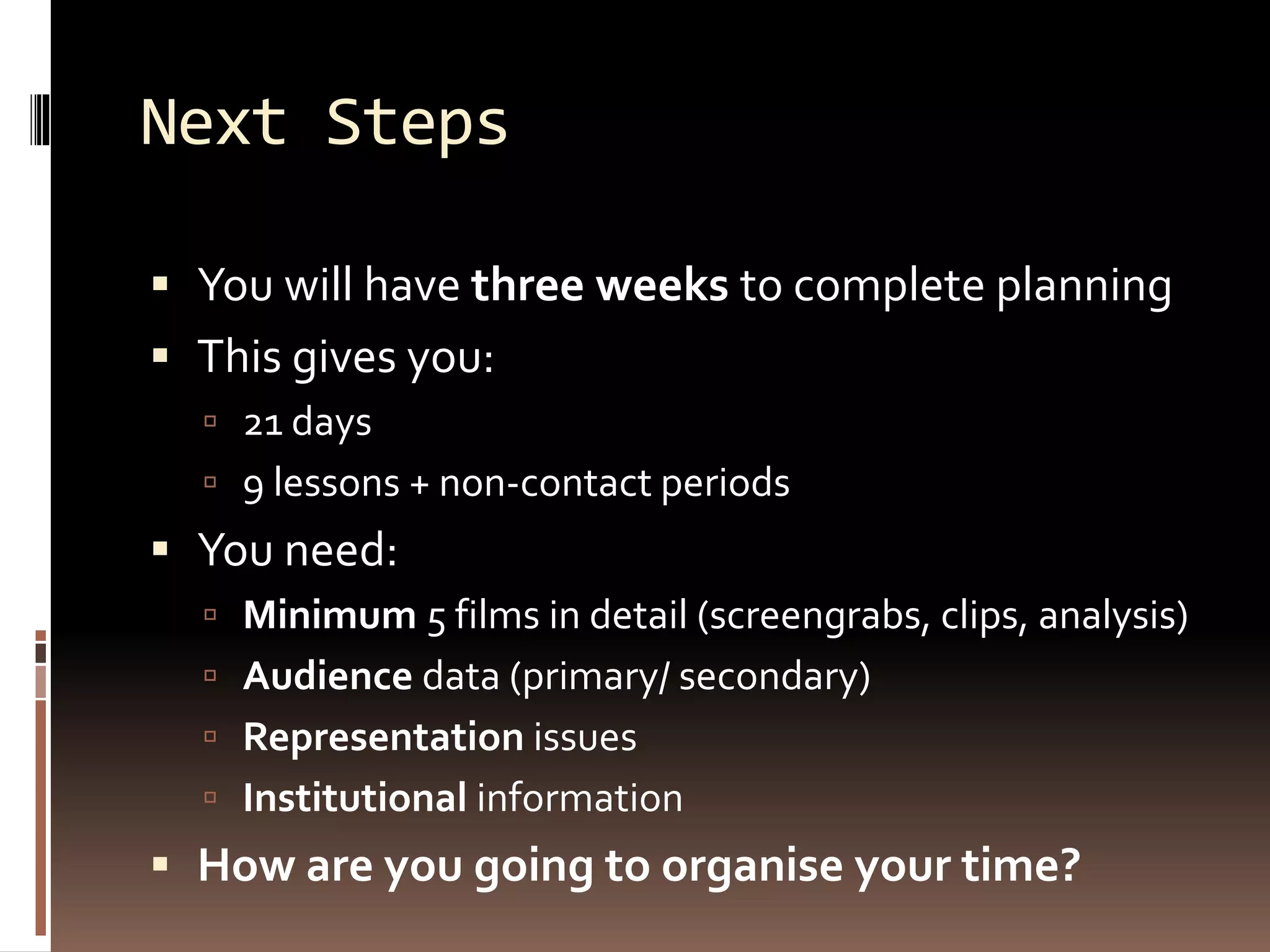
Next Steps
 You will have three weeks to complete planning
 This gives you:
 21 days
 9 lessons + non-contact periods
 You need:
 Minimum 5 films in detail (screengrabs, clips, analysis)
 Audience data (primary/ secondary)
 Representation issues
 Institutional information
 How are you going to organise your time?
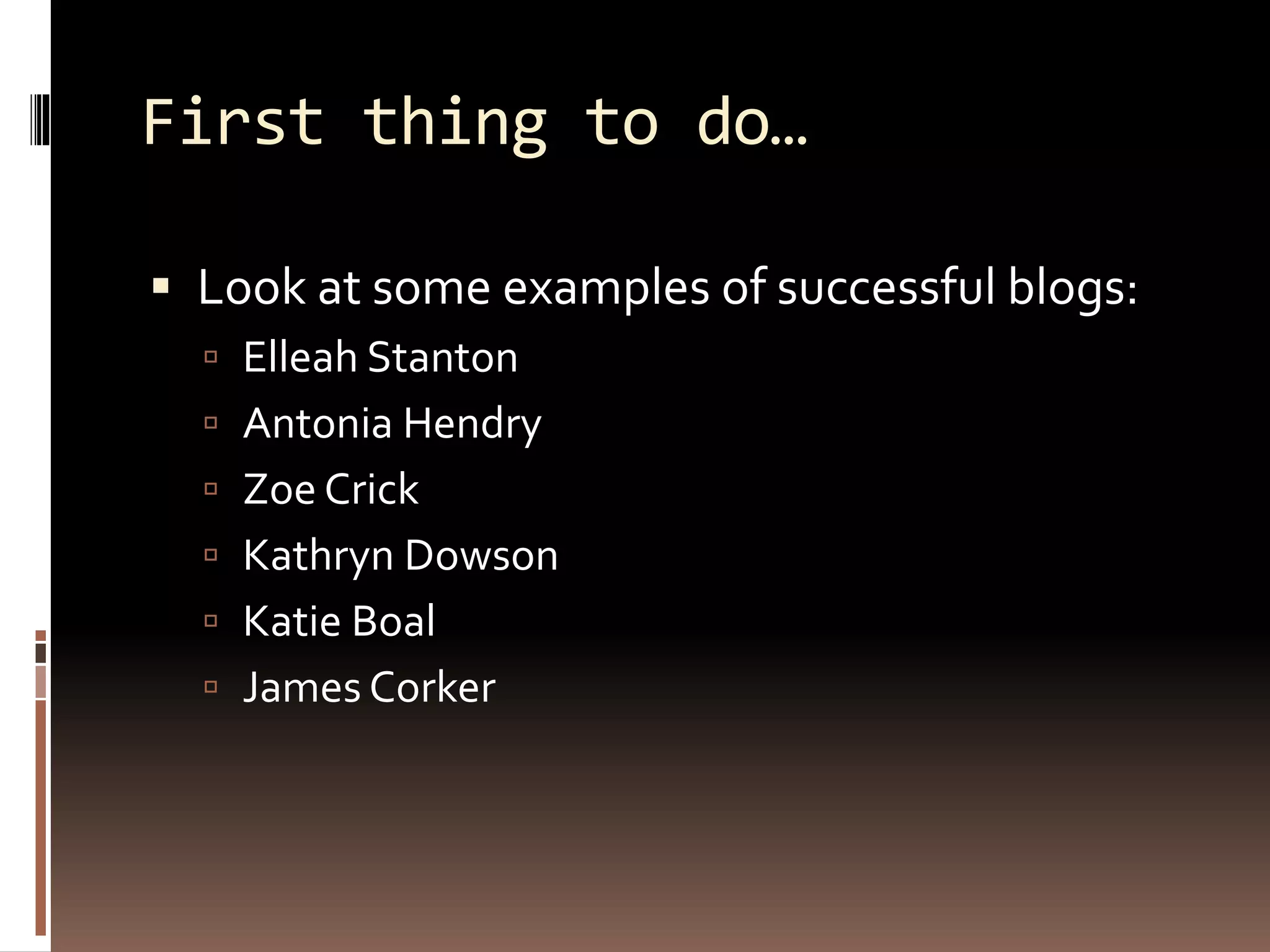
First thing to do…
 Look at some examples of successful blogs:
 Elleah Stanton
 Antonia Hendry
 Zoe Crick
 Kathryn Dowson
 Katie Boal
 James Corker
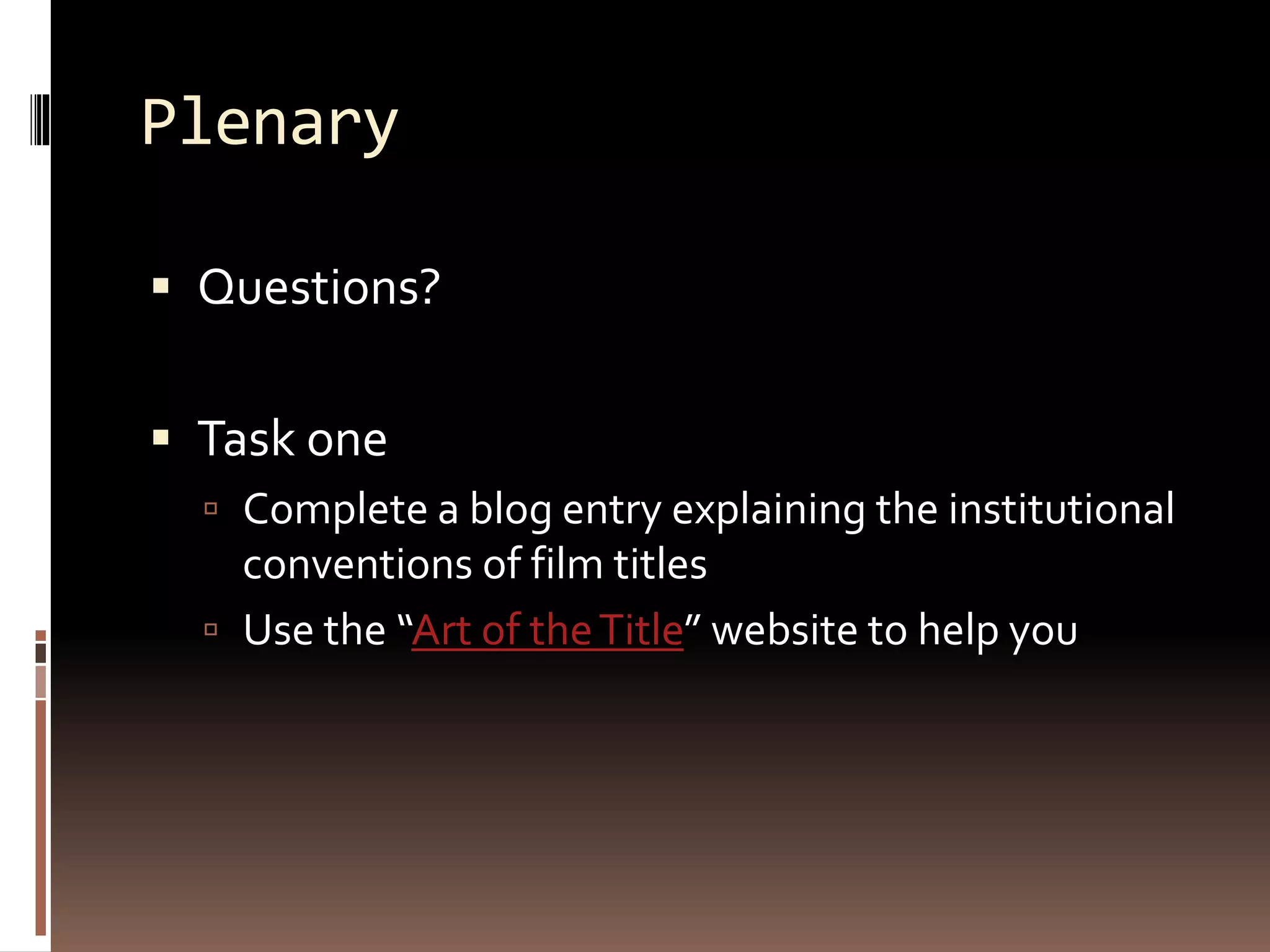
Plenary
 Questions?
 Task one
 Complete a blog entry explaining the institutional
conventions of film titles
 Use the “Art of theTitle” website to help you

As media lesson 10 foundation portfolio - final project - 2015

  • 1.
    AS MEDIA STUDIES FOUNDATIONPORTFOLIO IN MEDIA IntroducingYour MainTask
  • 2.
     Napoleon Dynamiteopening sequence  http://vimeo.com/5524216
  • 3.
    Preparing Minds  Whatis:  Action match?  Shot/ reverse shot?  180 degree rule?  Blog?  Why are they important?
  • 4.
    Success Criteria  Wewill  Note down key information about final task  Answer and ask questions, where relevant  Plan a basic research/ development schedule
  • 5.
    What you needto do  Blog including detailed research/ planning (20 marks)  Titles and opening of new fiction film - 2 mins (60 marks)  Continuity features:  Action match  Shot/ reverse shot  180 degree rule  Other features  Titles (essential)  Genre-specific features (e.g. mise-en-scene/ music)  Range of shots/ camera movement (essential)  Range of edits/ effects (if appropriate)  Evaluation (20 marks)
  • 6.
    Examples  I willemail you a dropbox link allowing you to access these.
  • 7.
    Effective Openings  TheFall  Fight Club
  • 8.
    Weekly Tasks  Maintainblog (at least 3 entries a week – OCR suggest one a day)  Include images/ video clips supporting work (planning + work in progress)  Consider all aspects of production process, including institutions, audience and representation  Include as much detail as you can, justifying choices made  Link to your work in progress  Thorough outline of production process
  • 9.
    Planning – Lvl4  Planning and research evidence complete and detailed  Excellent research into similar products and potential target audience  Excellent organisation of actors, locations, costumes or props  Excellent work on shotlists, layouts, drafting, scripting or storyboarding  Excellent level of care in the presentation of research and planning  Time management is excellent
  • 10.
    Production work shoulddemo  Material appropriate for target audience and task  Titles used appropriately according to institutional conventions  Sound, images and editing used appropriately  Material shot appropriate to task set, including:  controlled use of camera  attention to framing  variety of shot distance  close attention to mise-en-scene  Editing so that meaning apparent to viewer and with selective and appropriate use of shot transitions and other effects
  • 11.
    Demonstrate  Steadiness ofshots where appropriate  Framing shots, including/ excluding elements  Variety of shots/ distances  Shooting appropriate material  Selecting mise-en-scene  Colour/ lighting/ objects/ setting  Editing for meaning using appropriate effects  Accurate use of sound/ image  Appropriate use of titles
  • 12.
    Production Checklist  Places Rehearsal  Setting  Production Base  Transport  Post-Production  People  Call sheets  Actors  Technical  Camera  Continuity  Support  Things  Props  Costumes  Technical  Script  Cameras  Media  Log sheets  Storyboards  Schedule  FX/ SFX
  • 13.
    What do youneed to know?  Pre Production  Research  Scripting  Storyboarding  Location scouting  Production schedule  Call sheets  Shooting  Logging shots  Continuity
  • 14.
    Evaluation  Evaluate /reflect upon creative process/ experience  Evaluate electronically, guided by key questions  Should not be solely textual; combination of text/ image/ presentation/ video/ audio etc.  Examples of suitable formats for the evaluation:  A podcast  DVD extras  Detailed blog entries  PowerPoint/ Prezi  Director’s commentary  “Making of” documentary
  • 15.
    Evaluation Questions  Followingquestions must be answered:  How does product use, develop or challenge forms and conventions of real media products? - Must research these  How does product represent particular social groups? - Must aim to include a social group  What kind of media institution might distribute product and why? - Research studios and distribution  Who would be audience for product? – Research audience  How did you attract/address your audience? – Evidence from planning/ final product  What have you learnt about technologies from process of constructing product? – Evidence from blog (shooting/ editing)  Looking back at preliminary task, what have you learnt in progression to full product?
  • 16.
    Evaluation – Forms/Conventions  Need to be able to identify conventions  Will come from research into openings  Should be explicit in the first stages of your blog to revisit in evaluation  Includes media language, representation, use of titles, use of music, mise-en-scene etc (effectively, macro and micro features  Could be done as a video including comparisons of your work and your research
  • 17.
    Evaluation – SocialGroups  Product must include a social group. For example:  Teenagers  Ethnic groups  Social demographics  Consider work on representation and apply this when researching and planning  May affect genre/ form of final piece
  • 18.
    Evaluation – institutions Need to know which kind of companies make and distribute movies of genre/ style you are making  Mainstream or niche?  Conglomerate or indie?  Info fromWikipedia/ IMDB/ Box-office mojo  Demonstrated through research and choice of distributor/ studio for final piece
  • 19.
    Evaluations - audience Need to know who watches your genre of film – demographics/ psychographics  Can do primary/ secondary research  Should find data from the web (e.g. box- office figures) as well as market information, if available  Might consider primary and secondary audiences (e.g. “Lego Movie”, Pixar films etc.
  • 20.
    Evaluation – attractingaud  How was final piece designed to meet audience needs?  Evidence from your piece compared to existing pieces  Interviews/ vox pops with target audience reflecting on film  Detailed deconstruction of what you did/ why you did it – could be in Prezi form, for example, including stills/ clips
  • 21.
    Evaluation - technology Need to regularly blog about engagement with tech (cameras/ editing)  Identify problems and solutions  Take photos/ screengrabs  Record clearly what you did at the time  Will effectively be a reflexive post  Can take into account development from start of course  Should be incisive and clear – the more primary evidence the better
  • 22.
    Evaluation - comparison Compare your preliminary project(s) with your final piece  What did you do better?  How did you improve?  Consider both planning and production as well as editing  Where is the evidence  For example, a comparison of shots/ edits from your final piece; a reflection on planning exemplified from early stages of blog
  • 23.
    Timeframe – Dec2015  By Fri 27th November  Decision made about genre/ form of final video  Research begins into opening sequences, institutions and audiences.  Social group to be represented identified  By Friday 18th December  Research into existing opening sequences completed (min five)  each example analysed in detail with regard to questions to be posed in the evaluation, notes made on how example might be of value to projects  At least one blog entry dedicated to each of institutions (e.g. distribution companies, studios), audiences (some evidence) and representation (reasons)  Planning begins in earnest
  • 24.
    Timeframe - Dec/Jan2015-16  19th Dec-4th Jan (Christmas “holiday”)  Pre-production planning undertaken (regular blog updates)  Include:  Scenario  Script  Sketches  Storyboards  Location scouting  Prelimary footage  Animatics  Call sheets, props lists etc.  Etc.
  • 25.
    Timeframe – Jan/Feb2016  5th January  All pre-production planning (including storyboards, production schedules, call sheets etc.) completed/ posted to blog in digital form.  Might also include test footage and mood boards  1st February  All material required for project shot, converted and uploaded onto media servers  During the period 06/01-30/01, you are invited to periodically upload brief examples of work to blog for peer and staff review  12th February  Rough edit completed and uploaded to blog for peer/ staff review  22nd February (including half-term “holiday”)  Final cut begun
  • 26.
    Timeframe – Mar/Apr2016  7th March  Final edit completed and uploaded to blog and media server in order to gather audience response and feedback  9th March  15 min presentations of work, including initial evaluations and outlines of audience response  11th April (including Easter “holiday”)  Detailed blog entries answering the evaluation questions uploaded, coupled with a video commentary
  • 27.
    Next Steps  Youwill have three weeks to complete planning  This gives you:  21 days  9 lessons + non-contact periods  You need:  Minimum 5 films in detail (screengrabs, clips, analysis)  Audience data (primary/ secondary)  Representation issues  Institutional information  How are you going to organise your time?
  • 28.
    First thing todo…  Look at some examples of successful blogs:  Elleah Stanton  Antonia Hendry  Zoe Crick  Kathryn Dowson  Katie Boal  James Corker
  • 29.
    Plenary  Questions?  Taskone  Complete a blog entry explaining the institutional conventions of film titles  Use the “Art of theTitle” website to help you