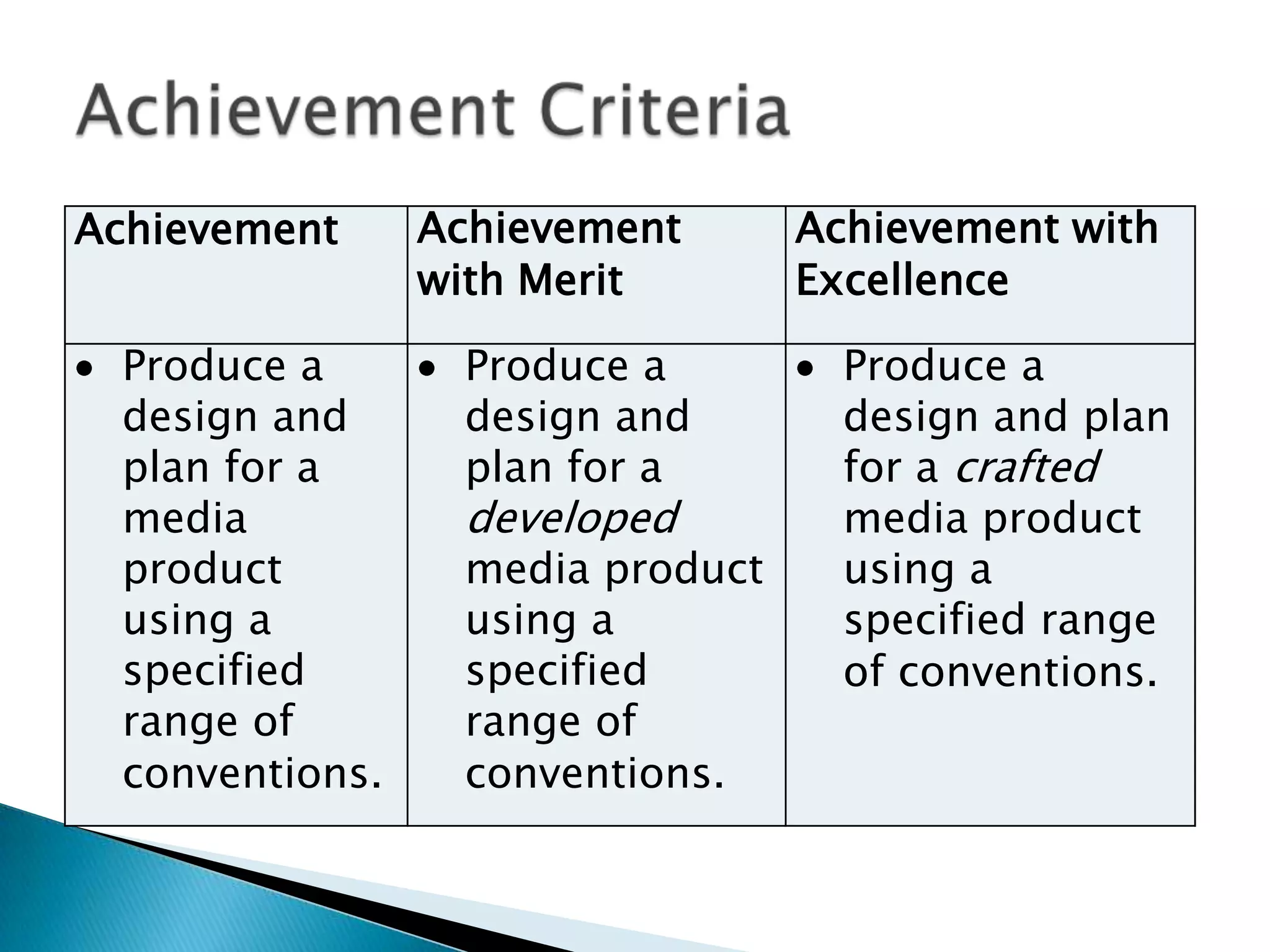
Achievement Achievement
with Merit
Achievement with
Excellence
Produce a
design and
plan for a
media
product
using a
specified
range of
conventions.
Produce a
design and
plan for a
developed
media product
using a
specified
range of
conventions.
Produce a
design and plan
for a crafted
media product
using a
specified range
of conventions.
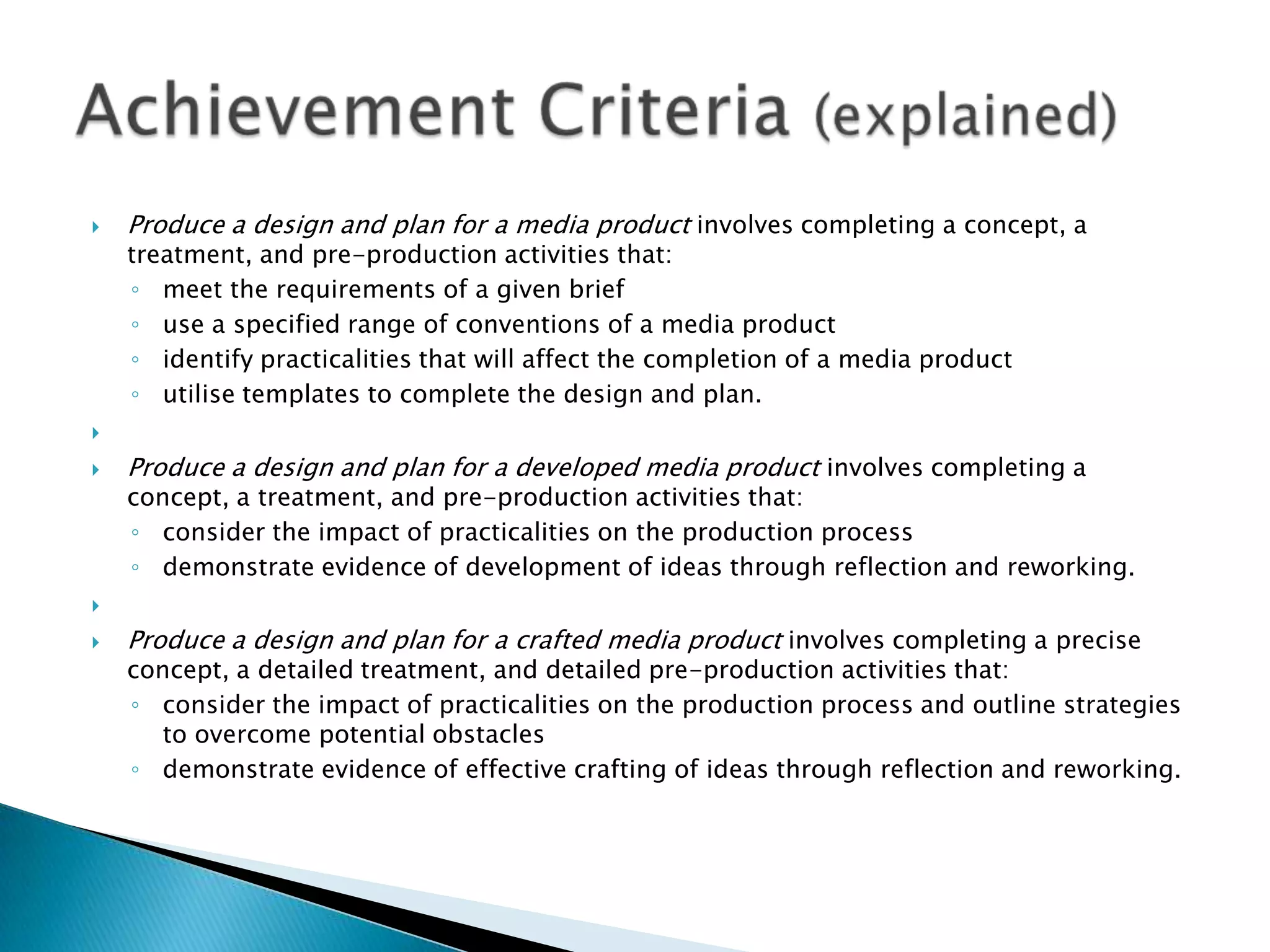
 Produce a design and plan for a media product involves completing a concept, a
treatment, and pre-production activities that:
◦ meet the requirements of a given brief
◦ use a specified range of conventions of a media product
◦ identify practicalities that will affect the completion of a media product
◦ utilise templates to complete the design and plan.

 Produce a design and plan for a developed media product involves completing a
concept, a treatment, and pre-production activities that:
◦ consider the impact of practicalities on the production process
◦ demonstrate evidence of development of ideas through reflection and reworking.

 Produce a design and plan for a crafted media product involves completing a precise
concept, a detailed treatment, and detailed pre-production activities that:
◦ consider the impact of practicalities on the production process and outline strategies
to overcome potential obstacles
◦ demonstrate evidence of effective crafting of ideas through reflection and reworking.
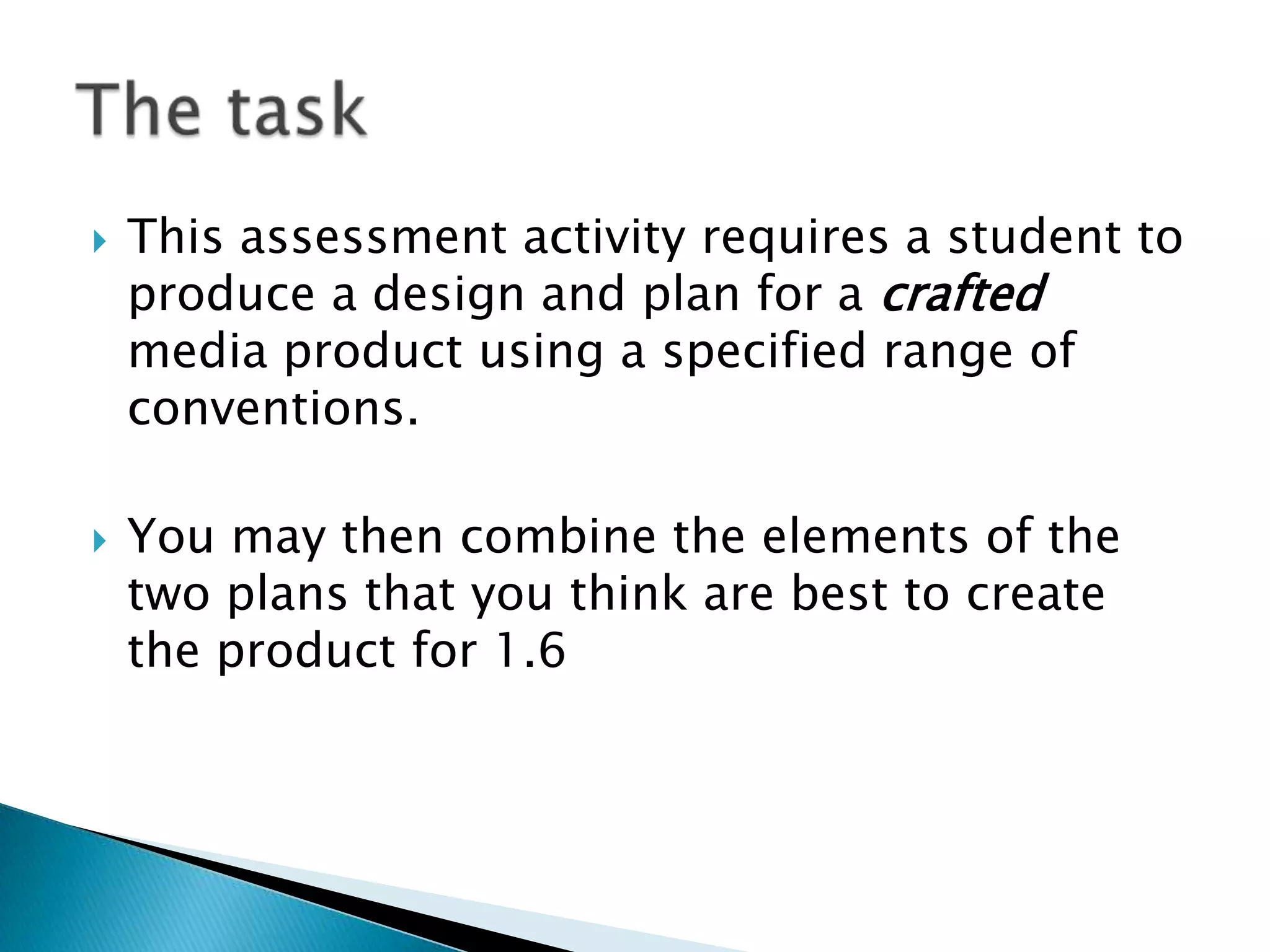
 This assessment activity requires a student to
produce a design and plan for a crafted
media product using a specified range of
conventions.
 You may then combine the elements of the
two plans that you think are best to create
the product for 1.6
 Effective crafting of ideas means students
produce a design and plan that enables the
production of a media product that appeals
to the target audience, achieves its intended
outcomes.
 Your ability to make and apply design choices in developing a concept,
treatment and pre-production activities that:
 describes in detail and justifies the concept, target audience, tone,
setting, and any costumes or props to be used.
 describes a range of codes and/or conventions of the genre that they
plan to use in the production of the Music video, and explains/justifies
their use.
 outlines any copyright considerations and provides practical solutions.
 shows awareness of the conventions of Music videos, and how to use
these to effectively communicate essential information and narrative
with clarity and impact to the target audience, and includes an
appropriate range.
 is workable, detailed and considered, fulfils the brief and uses a
specified range of elements (such as shot size and dialogue) that are
appropriate for a crafted Music video;
 shows development through reflection and reworking of ideas following
teacher and/or peer feedback;
 identifies practicalities, including locations, technology, transport,
cast/crew, props, weather, costs, time etc) and their potential impact on
the completion of an Music video, and outline strategies to overcome
potential obstacles.
 As your media products are being created to
fit a brief, it means that they are most likely
to be shown in public! Therefore some
guidelines need to be followed
 See “Film Making Guidelines” document on
the level 1 Moodle page.
Digital or physical, I don‟t care
as long as you keep up and
don‟t lose anything!!
(I would actually prefer digital!)
 Brainstorm and develop your initial concept
 The concept must include an outline of the music
video. It should introduce the music track to be
used, character, the setting, and the situation as
well as the inciting incident which engages the
audience.
 Write an outline of your concept and include the
following:
◦ The music track
◦ The main character‟s name
◦ The dramatic premise
◦ The inciting incident
◦ The rising tension
 Jamie is the lone survivor of the teen zombie
apocalypse in Nelson. She has hidden out in
her old school as no teenager is going to go
there. One day, she notices a mess in the
food tech room – bread, peanut butter, a dirty
plate, and knife and… crumbs. She didn‟t
make the mess which means someone else
did. Jamie searches the school, she finds
nothing of note until her OCD becomes her
greatest asset and she finds more crumbs.
Literally following a trail of breadcrumbs
Jamie makes a frightening discovery
Visual Treatment
 1. Visual treatment: a treatment is a detailed
description about how you will visually create
your music video. This should be completed
focusing on the visual aspects of media
production that you and your group want to
use to make the media product. This will
include mise-en-scene, editing pace and
rhythm, visual effects and any font or
secondary media you want to incorporate.
1
 1. Visual treatment:
◦ Identify your Target Audience, (Age, Sex, etc.)
◦ Explain in detail the kind of atmosphere/tone you
will create visually and how you intend to use
equipment and conventions to create this style. For
example, in an action film, rapid shot transitions
will convey a sense of atmosphere to the audience
◦ Explain in detail why your Visual stylistic
approaches are appropriate for your target
audience, and how it will appeal to them
1
 2. Conventions of the Medium/Genre:
 You must identify, describe and explain in
detail AT LEAST FIVE specific conventions
associated with you genre. More may appear
in your music video, but you will only need to
write well on at least five.
 For EACH convention, explain in detail how its
use is appropriate for, and will appeal to your
target audience.
2
 3. Location Scouting:
 Prepare a brief profile on each location that
you wish to use. Have photos of each location
included with the details of the location.
These photos do not count as test shots and
as such, these can be from Google maps or
any time of the day.
 Discuss why you are using this location, and
how it will be used to contribute to the mood
of the story.
3
 4. Test shots:
 Complete test shots of relevant locations for
your film. Test shots are actually testing the
look and feel of the location as it would
appear in your film. The idea here is to try
out your location and how all the elements
might come together when you shoot. You
should do test shots at each location to check
for composition or lighting issues. This is a
good opportunity to try things and see what
works and what needs revising. Spending
time on this process will make your shoot go
more smoothly 4
 5. Story boarding:
 Prepare a range of shot templates of key
scenes in your short film. You can use the
sketch tool in Celtx, Photoshop resources, or
hand draw them if your wish.
 You should focus on having a good range of
shot types, angles, and movements in your
short film and use shots appropriate to your
purpose.
 For the purposes of assessment, a section of
your film storyboarded into 24 frames is all
that is required.
5
 6. Copyright consideration :
 Outline any copyright considerations in
regard to what music you will use and how
you will address any issues that you
encounter.
6
 7. Visual effects:
 Compile a selection of tutorials, screen grabs
or web-links for visual effects you hope to
include in your music video. These can be
simple examples of colour grading, in-
camera effects, plug-ins for premiere or full-
blown animated sequences. The effects
should reinforce the style and tone of your
music video.
7
 8. Revision and reworking:
 Revise any aspects of your plan as a result of
test shots or other technical, practical,
aesthetic or story considerations.
 In practice, revision will be an on-going
process right through all the stages of the
production.
 And you are being assessed on re-working!
 Be flexible! 8
Audio Treatment and Pre-Production
 1. Audio Treatment:
 This treatment is a detailed description about
how your music video will sound. This should be
completed focusing on a audio aspects of media
production that you want to use to make the
media product. This will include soundtrack,
volume, editing pace and rhythm, sound effects
and any voiceover or secondary media you want
to incorporate.
 Note: as this is a music video, your audio may
only be the track that you are intending to use;
however, if you wish to extend your skills you
may consider adding other sounds and dialogue
to add to your narrative.
1
 1. Audio Treatment:
◦ Explain in detail the kind of atmosphere/tone you
will create and how you intend to use sound and
dialogue to contribute to this style. For example, in
a quieter section of the music, the use of dialogue
will add to the narrative and contribute to the mood
of sorrow and sadness.
◦ Explain in detail why your audio stylistic approaches
are appropriate for your target audience, and how it
will appeal to them.
1
 2. Production schedule:
 Complete a detailed production schedule
showing how and when you will complete the
necessary steps to enable a successful and
quality short film. In your Production log,
consider in detail the practicalities of
available resources, time, access to
technology and equipment, and locations.
 Make any necessary changes to your
treatment and write a comment where you
critically reflect on the impact of the changes
to your production. 2
 3. SWOT Analysis:
 This is a detailed analysis of the factors which
could make or break the production of your
short film. Use the following headings to help
you complete this analysis:
 Strengths: these are the immediate factors of
your production which will assist you in
making the best short film possible. For
example: easy access to a good location, your
cousin is Emma Stone, etc. 3
 3. SWOT Analysis:
 Weaknesses: these are immediate factors of
your production which interfere with you
making (or even completing) the best short
film possible. For example, sporting conflicts,
no driver‟s licence, you have a mutant ability
to destroy technology, etc.
3
 3. SWOT Analysis:
 Opportunities: these are possible factors you
can organise or have access to which may
assist you in making the best short film
possible. For example: someone in your
extended family has a bach or office which
would be in the perfect location, there‟s an
event in the school calendar that would be a
good chance to create a crowd scene, Weta
Workshop just called saying you could borrow
their equipment for a week post-production,
etc. 3
 3. SWOT Analysis:
 Threats: these are possible factors you may
not have control over which could interfere
with you making (or even completing) the
best short film possible. For example,
shooting outdoor scenes in Term 3 could be
ruined by winter weather, your lead actors are
a couple and could break up before
production is finished, etc.
3
 3. SWOT Analysis:
 Strategies: these are ways in which you will
overcome the weaknesses and threats you
have identified in order to make the best
short film possible. For example, having a
second script ready to move outdoor scenes
indoors due to bad weather, changing your
production schedule so that your cameraman
can head off for tournament week, etc.
 Answer all the „What if…?‟ questions!
3
 4. Production lists and paperwork:
 Crew and talent: secure services of crew and
talent as appropriate. Prepare a master list of
team members and include home phone
numbers if the production involves work out
of school hours.
 Props and costumes: prepare a master list of
props and costumes required and where you
will source them. Include names and phone
numbers of suppliers
4
 5. Permissions :
 Locations: secure the permission to use any
location through the owner of the location.
Pay careful attention to identifying safety
issues and actions to prevent injuries from
occurring.
 Talent: you will need to secure agreement
with your cast members for them to appear in
your short film. This becomes a contract for
them to be involved. Be sure that they have
copies of the production schedule and know
what is required of them. 5
 6. Revisions :
 Revise any aspects of your plan as a result of
audio changes or other technical, practical,
aesthetic or story considerations.
 In practice, revision will be an on-going
process right through all the stages of the
production.
 And you are being assessed on re-working!
 Be flexible!
6
And „break a leg!‟

Design and plan 1.5

  • 2.
    Achievement Achievement with Merit Achievementwith Excellence Produce a design and plan for a media product using a specified range of conventions. Produce a design and plan for a developed media product using a specified range of conventions. Produce a design and plan for a crafted media product using a specified range of conventions.
  • 3.
     Produce adesign and plan for a media product involves completing a concept, a treatment, and pre-production activities that: ◦ meet the requirements of a given brief ◦ use a specified range of conventions of a media product ◦ identify practicalities that will affect the completion of a media product ◦ utilise templates to complete the design and plan.   Produce a design and plan for a developed media product involves completing a concept, a treatment, and pre-production activities that: ◦ consider the impact of practicalities on the production process ◦ demonstrate evidence of development of ideas through reflection and reworking.   Produce a design and plan for a crafted media product involves completing a precise concept, a detailed treatment, and detailed pre-production activities that: ◦ consider the impact of practicalities on the production process and outline strategies to overcome potential obstacles ◦ demonstrate evidence of effective crafting of ideas through reflection and reworking.
  • 4.
     This assessmentactivity requires a student to produce a design and plan for a crafted media product using a specified range of conventions.  You may then combine the elements of the two plans that you think are best to create the product for 1.6
  • 5.
     Effective craftingof ideas means students produce a design and plan that enables the production of a media product that appeals to the target audience, achieves its intended outcomes.
  • 6.
     Your abilityto make and apply design choices in developing a concept, treatment and pre-production activities that:  describes in detail and justifies the concept, target audience, tone, setting, and any costumes or props to be used.  describes a range of codes and/or conventions of the genre that they plan to use in the production of the Music video, and explains/justifies their use.  outlines any copyright considerations and provides practical solutions.  shows awareness of the conventions of Music videos, and how to use these to effectively communicate essential information and narrative with clarity and impact to the target audience, and includes an appropriate range.  is workable, detailed and considered, fulfils the brief and uses a specified range of elements (such as shot size and dialogue) that are appropriate for a crafted Music video;  shows development through reflection and reworking of ideas following teacher and/or peer feedback;  identifies practicalities, including locations, technology, transport, cast/crew, props, weather, costs, time etc) and their potential impact on the completion of an Music video, and outline strategies to overcome potential obstacles.
  • 7.
     As yourmedia products are being created to fit a brief, it means that they are most likely to be shown in public! Therefore some guidelines need to be followed  See “Film Making Guidelines” document on the level 1 Moodle page.
  • 8.
    Digital or physical,I don‟t care as long as you keep up and don‟t lose anything!! (I would actually prefer digital!)
  • 9.
     Brainstorm anddevelop your initial concept  The concept must include an outline of the music video. It should introduce the music track to be used, character, the setting, and the situation as well as the inciting incident which engages the audience.  Write an outline of your concept and include the following: ◦ The music track ◦ The main character‟s name ◦ The dramatic premise ◦ The inciting incident ◦ The rising tension
  • 10.
     Jamie isthe lone survivor of the teen zombie apocalypse in Nelson. She has hidden out in her old school as no teenager is going to go there. One day, she notices a mess in the food tech room – bread, peanut butter, a dirty plate, and knife and… crumbs. She didn‟t make the mess which means someone else did. Jamie searches the school, she finds nothing of note until her OCD becomes her greatest asset and she finds more crumbs. Literally following a trail of breadcrumbs Jamie makes a frightening discovery
  • 11.
  • 12.
     1. Visualtreatment: a treatment is a detailed description about how you will visually create your music video. This should be completed focusing on the visual aspects of media production that you and your group want to use to make the media product. This will include mise-en-scene, editing pace and rhythm, visual effects and any font or secondary media you want to incorporate. 1
  • 13.
     1. Visualtreatment: ◦ Identify your Target Audience, (Age, Sex, etc.) ◦ Explain in detail the kind of atmosphere/tone you will create visually and how you intend to use equipment and conventions to create this style. For example, in an action film, rapid shot transitions will convey a sense of atmosphere to the audience ◦ Explain in detail why your Visual stylistic approaches are appropriate for your target audience, and how it will appeal to them 1
  • 14.
     2. Conventionsof the Medium/Genre:  You must identify, describe and explain in detail AT LEAST FIVE specific conventions associated with you genre. More may appear in your music video, but you will only need to write well on at least five.  For EACH convention, explain in detail how its use is appropriate for, and will appeal to your target audience. 2
  • 15.
     3. LocationScouting:  Prepare a brief profile on each location that you wish to use. Have photos of each location included with the details of the location. These photos do not count as test shots and as such, these can be from Google maps or any time of the day.  Discuss why you are using this location, and how it will be used to contribute to the mood of the story. 3
  • 16.
     4. Testshots:  Complete test shots of relevant locations for your film. Test shots are actually testing the look and feel of the location as it would appear in your film. The idea here is to try out your location and how all the elements might come together when you shoot. You should do test shots at each location to check for composition or lighting issues. This is a good opportunity to try things and see what works and what needs revising. Spending time on this process will make your shoot go more smoothly 4
  • 17.
     5. Storyboarding:  Prepare a range of shot templates of key scenes in your short film. You can use the sketch tool in Celtx, Photoshop resources, or hand draw them if your wish.  You should focus on having a good range of shot types, angles, and movements in your short film and use shots appropriate to your purpose.  For the purposes of assessment, a section of your film storyboarded into 24 frames is all that is required. 5
  • 18.
     6. Copyrightconsideration :  Outline any copyright considerations in regard to what music you will use and how you will address any issues that you encounter. 6
  • 19.
     7. Visualeffects:  Compile a selection of tutorials, screen grabs or web-links for visual effects you hope to include in your music video. These can be simple examples of colour grading, in- camera effects, plug-ins for premiere or full- blown animated sequences. The effects should reinforce the style and tone of your music video. 7
  • 20.
     8. Revisionand reworking:  Revise any aspects of your plan as a result of test shots or other technical, practical, aesthetic or story considerations.  In practice, revision will be an on-going process right through all the stages of the production.  And you are being assessed on re-working!  Be flexible! 8
  • 21.
    Audio Treatment andPre-Production
  • 22.
     1. AudioTreatment:  This treatment is a detailed description about how your music video will sound. This should be completed focusing on a audio aspects of media production that you want to use to make the media product. This will include soundtrack, volume, editing pace and rhythm, sound effects and any voiceover or secondary media you want to incorporate.  Note: as this is a music video, your audio may only be the track that you are intending to use; however, if you wish to extend your skills you may consider adding other sounds and dialogue to add to your narrative. 1
  • 23.
     1. AudioTreatment: ◦ Explain in detail the kind of atmosphere/tone you will create and how you intend to use sound and dialogue to contribute to this style. For example, in a quieter section of the music, the use of dialogue will add to the narrative and contribute to the mood of sorrow and sadness. ◦ Explain in detail why your audio stylistic approaches are appropriate for your target audience, and how it will appeal to them. 1
  • 24.
     2. Productionschedule:  Complete a detailed production schedule showing how and when you will complete the necessary steps to enable a successful and quality short film. In your Production log, consider in detail the practicalities of available resources, time, access to technology and equipment, and locations.  Make any necessary changes to your treatment and write a comment where you critically reflect on the impact of the changes to your production. 2
  • 25.
     3. SWOTAnalysis:  This is a detailed analysis of the factors which could make or break the production of your short film. Use the following headings to help you complete this analysis:  Strengths: these are the immediate factors of your production which will assist you in making the best short film possible. For example: easy access to a good location, your cousin is Emma Stone, etc. 3
  • 26.
     3. SWOTAnalysis:  Weaknesses: these are immediate factors of your production which interfere with you making (or even completing) the best short film possible. For example, sporting conflicts, no driver‟s licence, you have a mutant ability to destroy technology, etc. 3
  • 27.
     3. SWOTAnalysis:  Opportunities: these are possible factors you can organise or have access to which may assist you in making the best short film possible. For example: someone in your extended family has a bach or office which would be in the perfect location, there‟s an event in the school calendar that would be a good chance to create a crowd scene, Weta Workshop just called saying you could borrow their equipment for a week post-production, etc. 3
  • 28.
     3. SWOTAnalysis:  Threats: these are possible factors you may not have control over which could interfere with you making (or even completing) the best short film possible. For example, shooting outdoor scenes in Term 3 could be ruined by winter weather, your lead actors are a couple and could break up before production is finished, etc. 3
  • 29.
     3. SWOTAnalysis:  Strategies: these are ways in which you will overcome the weaknesses and threats you have identified in order to make the best short film possible. For example, having a second script ready to move outdoor scenes indoors due to bad weather, changing your production schedule so that your cameraman can head off for tournament week, etc.  Answer all the „What if…?‟ questions! 3
  • 30.
     4. Productionlists and paperwork:  Crew and talent: secure services of crew and talent as appropriate. Prepare a master list of team members and include home phone numbers if the production involves work out of school hours.  Props and costumes: prepare a master list of props and costumes required and where you will source them. Include names and phone numbers of suppliers 4
  • 31.
     5. Permissions:  Locations: secure the permission to use any location through the owner of the location. Pay careful attention to identifying safety issues and actions to prevent injuries from occurring.  Talent: you will need to secure agreement with your cast members for them to appear in your short film. This becomes a contract for them to be involved. Be sure that they have copies of the production schedule and know what is required of them. 5
  • 32.
     6. Revisions:  Revise any aspects of your plan as a result of audio changes or other technical, practical, aesthetic or story considerations.  In practice, revision will be an on-going process right through all the stages of the production.  And you are being assessed on re-working!  Be flexible! 6
  • 33.