Film task
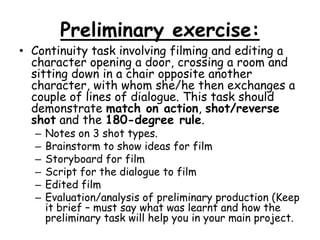
Preliminary exercise:

• Continuity task involving filming and editing a
character opening a door, crossing a room and
sitting down in a chair opposite another
character, with whom she/he then exchanges a
couple of lines of dialogue. This task should
demonstrate match on action, shot/reverse
shot and the 180-degree rule.
–
–
–
–
–
–

Notes on 3 shot types.
Brainstorm to show ideas for film
Storyboard for film
Script for the dialogue to film
Edited film
Evaluation/analysis of preliminary production (Keep
it brief – must say what was learnt and how the
preliminary task will help you in your main project.
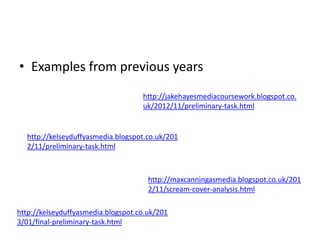
• Examples from previous years
http://jakehayesmediacoursework.blogspot.co.
uk/2012/11/preliminary-task.html

http://kelseyduffyasmedia.blogspot.co.uk/201
2/11/preliminary-task.html

http://maxcanningasmedia.blogspot.co.uk/201
2/11/scream-cover-analysis.html
http://kelseyduffyasmedia.blogspot.co.uk/201
3/01/final-preliminary-task.html
Main task
• the titles and opening of a new fiction
film, to last a maximum of two minutes.
• All video and audio material must be

original, produced by the candidate(s),
with the exception of music or audio
effects from a copyright-free source.
Research
• Camera shot types
• Conventions of horror films
• Conventions of film openings in general (look at content, style,
features)
• Different genres of films (list films linked to the genre)
• Questions on „What is suspense‟
• Institution research (2 companies)
• Notes on at least 8 film openings
• Conventions of openings of films from horror films (such as
regular features, specific techniques, ways narrative is
explained)
• Detailed analysis of AT LEAST 4 existing film openings (at least
2 must be horror)
• 9 frame storyboard for films
• Opening timelines
• Audience profile for horror genre
• Horror location shot types
Research
• Camera shot types
• Conventions of horror films
• Conventions of film openings in general (look at content, style,
features)
• Different genres of films (list films linked to the genre)
• Questions on „What is suspense‟
• Institution research (2 companies)
• Notes on at least 8 film openings
• Conventions of openings of films from horror films (such as
regular features, specific techniques, ways narrative is
explained)
• Detailed analysis of AT LEAST 4 existing film openings (at least
2 must be horror)
• 9 frame storyboard for films
• Opening timelines
• Audience profile for horror genre
• Horror location shot types
Planning
•
•
•
•
•
•
•
•
•
•
•
•
•
•
•
•

Brainstorm/plan ideas for your film (to include narrative, ideas for opening sequence,
styles, colours, styles of copy, inspiration)
Brainstorm names for your film/state why you chose a particular name for your film.
Suitable institution to produce your film. And why.
Survey of your target audience to find out what hooks them onto a film from this
genre.
Audience profile for your film.
Storyboard ideas for the opening, with annotations to show development of ideas.
Script for film
Animatic storyboard
Locations photographs with comments on suitability and when they could be used.
Costume plans
Prop list
A range of photographs for the storyboard/opening – blocking out your film.
Explanation of your film‟s concept in 25 words or less.
A production schedule/shooting schedule.
A final draft version – with annotations/commentary on good and bad aspects of the
production.
Survey/feedback of the target audience again to get their opinions on your
production and any changes.
Underline = easy to do
digitally
•
•
•
•
•
•
•
•
•
•
•
•
•
•
•
•

Planning

Brainstorm/plan ideas for your film (to include narrative, ideas for opening sequence,
styles, colours, styles of copy, inspiration)
Brainstorm names for your film/state why you chose a particular name for your film.
Suitable institution to produce your film. And why.
Survey of your target audience to find out what hooks them onto a film from this
genre.
Audience profile for your film.
Storyboard ideas for the opening, with annotations to show development of ideas.
Script for film
Animatic storyboard
Locations photographs with comments on suitability and when they could be used.
Costume plans
Prop list
A range of photographs for the storyboard/opening – blocking out your film.
Explanation of your film‟s concept in 25 words or less.
A production schedule/shooting schedule.
A final draft version – with annotations/commentary on good and bad aspects of the
production.
Survey/feedback of the target audience again to get their opinions on your
production and any changes.
• RESEARCH + PLANNING

=

20 marks (1/5 of total but
SOOOOOOOOOOOOOOOOOOOOOO
OOOOOOOOOOOOOOOOOOOOOOO
OOOOOOOOOOOOOOOOOOOO
important.
Construction
• Final opening and titles to your film

– lasting no more than 2 minutes
– upload final version to your blog as well as recording
onto a DVD.

• 60 MARKS!!! 3/5 of total project
• Marks gained (and lost) for
–
–
–
–
–
–
–
–

camera work,
shot choice (distance, angle, movement)
lighting,
editing,
soundtrack,
conventions,
Prop choice
Mise en scene
Evaluation
• Of whole project (MUST answer ALL of the set questions and
NOT just as an essay)
1.
2.

3.
4.
5.
6.

7.
•
•
•

In what ways does your media product use, develop or
challenge forms and conventions of real media products?
How does your media product represent particular social
groups?
What kind of media institution might distribute your media
product and why?
Who would be the audience for your media product?
How did you attract/address your audience?
What have you learnt about technologies from the process of
constructing this product?
Looking back at your preliminary task, what do you feel you
have learnt in the progression from it to the full product?
20 Marks (1/5 of project)
Digitally – BE CREATIVE. Do not „write‟ your answers.
Be analytical. Don‟t just describe.
Finally
•All this is to be included on your BLOG. Keep uploading work to your blog
regularly.
•The evaluation MUST go on to the end of your blog.
•You must present your work using creative and digital media forms where
possible – avoid „essay‟/text based answers as much as you can.

•Make clear the roles each person plays in all aspects of the filming and
editing process.
•Remember to check http://ktsasmedia2012-13.blogspot.co.uk/ regularly
for guidance, resources, and tasks, as well as comments from teachers on
work done.
•The unit is marked out of a total of 100 marks:
o20 marks for the presentation of the planning and research;
o60 marks for the construction;
o20 marks for the evaluation.
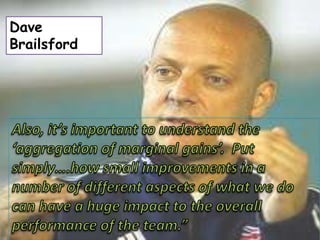
Dave
Brailsford
Lots of small
things add up
to get you
better marks
9 steps to a better mark
1) Take time to understand the task.
•
•
•
•

what‟s the task?
what‟s the assessment and criteria?
what‟s the timeframe?
what‟s the equipment?
2) Blog – detailed, technologically sound and
evidence of all work.
3) Develop skills:
camerawork,
sound,
editing
4) Investigate
•
•
•
•

what do film openings actually look like?
what does other student work look like?
what do you need to know about titles?
how are you going to do something that
stands out?
5) Brainstorm ideas
• possible scenarios for
pitches/treatments
• 25 word pitch
• moodboard treatment
• peer and teacher feedback
• realistic expectations- keep it simple
6) Planning
• experimenting with camera and editing
• recce shots of locations
• examples of shots, costumes, props, etc
onto blog
• post-it storyboard, animatic, moodboard
• logistics planning- including risk
assessment
7) The shoot
•
•
•
•

people, places, props, costumes
rehearsing, directing
equipment, jobs on the day
keeping a record of the process
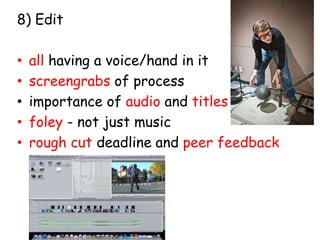
8) Edit
•
•
•
•
•

all having a voice/hand in it
screengrabs of process
importance of audio and titles
foley - not just music
rough cut deadline and peer feedback
9) Evaluation
•
•
•
•
•

Seven guiding questions
20 of the 100 marks
need to be creative in execution
digital depth
act on teacher advice!
Six most common student film
openings
• Saw: victim tied up in shed
• Scream: hooded stalker follows female
victim
• Se7en: killer sticks knife in polaroid photos
• Lock, Stock: gangsters play cards and kill
each other
• Waking up: clean teeth, brush hair, leave
house
• Flashback or Flash forward: “2 weeks later...”
Six most common problems
• looks more like a trailer or a short
film
• insufficient titles
• poor sound, poor lighting
• poorly directed actors, not costumed
• confusing for the viewer
• uses one of the six common
openings(badly)
Key features
•
•
•
•
•

Genre
Narrative (enigma)
Character
Atmosphere
Setting
Blogs
• Bad (level 1)
• http://www.chrisadamschrisadams.blogspot.co.u
k/
• Good (level 4-I think)
• http://thrillerblog2011.blogspot.co.uk/
• Almost top mark video (58) and a poor vide (25)
• http://ocrmediastudies.weebly.com/coursework
-with-levels.html

film main task overview

  • 1.
  • 2.
    Preliminary exercise: • Continuitytask involving filming and editing a character opening a door, crossing a room and sitting down in a chair opposite another character, with whom she/he then exchanges a couple of lines of dialogue. This task should demonstrate match on action, shot/reverse shot and the 180-degree rule. – – – – – – Notes on 3 shot types. Brainstorm to show ideas for film Storyboard for film Script for the dialogue to film Edited film Evaluation/analysis of preliminary production (Keep it brief – must say what was learnt and how the preliminary task will help you in your main project.
  • 3.
    • Examples fromprevious years http://jakehayesmediacoursework.blogspot.co. uk/2012/11/preliminary-task.html http://kelseyduffyasmedia.blogspot.co.uk/201 2/11/preliminary-task.html http://maxcanningasmedia.blogspot.co.uk/201 2/11/scream-cover-analysis.html http://kelseyduffyasmedia.blogspot.co.uk/201 3/01/final-preliminary-task.html
  • 4.
    Main task • thetitles and opening of a new fiction film, to last a maximum of two minutes. • All video and audio material must be original, produced by the candidate(s), with the exception of music or audio effects from a copyright-free source.
  • 5.
    Research • Camera shottypes • Conventions of horror films • Conventions of film openings in general (look at content, style, features) • Different genres of films (list films linked to the genre) • Questions on „What is suspense‟ • Institution research (2 companies) • Notes on at least 8 film openings • Conventions of openings of films from horror films (such as regular features, specific techniques, ways narrative is explained) • Detailed analysis of AT LEAST 4 existing film openings (at least 2 must be horror) • 9 frame storyboard for films • Opening timelines • Audience profile for horror genre • Horror location shot types
  • 6.
    Research • Camera shottypes • Conventions of horror films • Conventions of film openings in general (look at content, style, features) • Different genres of films (list films linked to the genre) • Questions on „What is suspense‟ • Institution research (2 companies) • Notes on at least 8 film openings • Conventions of openings of films from horror films (such as regular features, specific techniques, ways narrative is explained) • Detailed analysis of AT LEAST 4 existing film openings (at least 2 must be horror) • 9 frame storyboard for films • Opening timelines • Audience profile for horror genre • Horror location shot types
  • 7.
    Planning • • • • • • • • • • • • • • • • Brainstorm/plan ideas foryour film (to include narrative, ideas for opening sequence, styles, colours, styles of copy, inspiration) Brainstorm names for your film/state why you chose a particular name for your film. Suitable institution to produce your film. And why. Survey of your target audience to find out what hooks them onto a film from this genre. Audience profile for your film. Storyboard ideas for the opening, with annotations to show development of ideas. Script for film Animatic storyboard Locations photographs with comments on suitability and when they could be used. Costume plans Prop list A range of photographs for the storyboard/opening – blocking out your film. Explanation of your film‟s concept in 25 words or less. A production schedule/shooting schedule. A final draft version – with annotations/commentary on good and bad aspects of the production. Survey/feedback of the target audience again to get their opinions on your production and any changes.
  • 8.
    Underline = easyto do digitally • • • • • • • • • • • • • • • • Planning Brainstorm/plan ideas for your film (to include narrative, ideas for opening sequence, styles, colours, styles of copy, inspiration) Brainstorm names for your film/state why you chose a particular name for your film. Suitable institution to produce your film. And why. Survey of your target audience to find out what hooks them onto a film from this genre. Audience profile for your film. Storyboard ideas for the opening, with annotations to show development of ideas. Script for film Animatic storyboard Locations photographs with comments on suitability and when they could be used. Costume plans Prop list A range of photographs for the storyboard/opening – blocking out your film. Explanation of your film‟s concept in 25 words or less. A production schedule/shooting schedule. A final draft version – with annotations/commentary on good and bad aspects of the production. Survey/feedback of the target audience again to get their opinions on your production and any changes.
  • 9.
    • RESEARCH +PLANNING = 20 marks (1/5 of total but SOOOOOOOOOOOOOOOOOOOOOO OOOOOOOOOOOOOOOOOOOOOOO OOOOOOOOOOOOOOOOOOOOOOO OOOOOOOOOOOOOOOOOOOOOOO OOOOOOOOOOOOOOOOOOOO important.
  • 10.
    Construction • Final openingand titles to your film – lasting no more than 2 minutes – upload final version to your blog as well as recording onto a DVD. • 60 MARKS!!! 3/5 of total project • Marks gained (and lost) for – – – – – – – – camera work, shot choice (distance, angle, movement) lighting, editing, soundtrack, conventions, Prop choice Mise en scene
  • 11.
    Evaluation • Of wholeproject (MUST answer ALL of the set questions and NOT just as an essay) 1. 2. 3. 4. 5. 6. 7. • • • In what ways does your media product use, develop or challenge forms and conventions of real media products? How does your media product represent particular social groups? What kind of media institution might distribute your media product and why? Who would be the audience for your media product? How did you attract/address your audience? What have you learnt about technologies from the process of constructing this product? Looking back at your preliminary task, what do you feel you have learnt in the progression from it to the full product? 20 Marks (1/5 of project) Digitally – BE CREATIVE. Do not „write‟ your answers. Be analytical. Don‟t just describe.
  • 12.
    Finally •All this isto be included on your BLOG. Keep uploading work to your blog regularly. •The evaluation MUST go on to the end of your blog. •You must present your work using creative and digital media forms where possible – avoid „essay‟/text based answers as much as you can. •Make clear the roles each person plays in all aspects of the filming and editing process. •Remember to check http://ktsasmedia2012-13.blogspot.co.uk/ regularly for guidance, resources, and tasks, as well as comments from teachers on work done. •The unit is marked out of a total of 100 marks: o20 marks for the presentation of the planning and research; o60 marks for the construction; o20 marks for the evaluation.
  • 13.
  • 14.
    Lots of small thingsadd up to get you better marks
  • 15.
    9 steps toa better mark 1) Take time to understand the task. • • • • what‟s the task? what‟s the assessment and criteria? what‟s the timeframe? what‟s the equipment?
  • 16.
    2) Blog –detailed, technologically sound and evidence of all work.
  • 17.
  • 18.
    4) Investigate • • • • what dofilm openings actually look like? what does other student work look like? what do you need to know about titles? how are you going to do something that stands out?
  • 19.
    5) Brainstorm ideas •possible scenarios for pitches/treatments • 25 word pitch • moodboard treatment • peer and teacher feedback • realistic expectations- keep it simple
  • 20.
    6) Planning • experimentingwith camera and editing • recce shots of locations • examples of shots, costumes, props, etc onto blog • post-it storyboard, animatic, moodboard • logistics planning- including risk assessment
  • 21.
    7) The shoot • • • • people,places, props, costumes rehearsing, directing equipment, jobs on the day keeping a record of the process
  • 22.
    8) Edit • • • • • all havinga voice/hand in it screengrabs of process importance of audio and titles foley - not just music rough cut deadline and peer feedback
  • 23.
    9) Evaluation • • • • • Seven guidingquestions 20 of the 100 marks need to be creative in execution digital depth act on teacher advice!
  • 24.
    Six most commonstudent film openings • Saw: victim tied up in shed • Scream: hooded stalker follows female victim • Se7en: killer sticks knife in polaroid photos • Lock, Stock: gangsters play cards and kill each other • Waking up: clean teeth, brush hair, leave house • Flashback or Flash forward: “2 weeks later...”
  • 25.
    Six most commonproblems • looks more like a trailer or a short film • insufficient titles • poor sound, poor lighting • poorly directed actors, not costumed • confusing for the viewer • uses one of the six common openings(badly)
  • 26.
  • 27.
    Blogs • Bad (level1) • http://www.chrisadamschrisadams.blogspot.co.u k/ • Good (level 4-I think) • http://thrillerblog2011.blogspot.co.uk/ • Almost top mark video (58) and a poor vide (25) • http://ocrmediastudies.weebly.com/coursework -with-levels.html