Name:…………………………………………. Date:……………….
AS MEDIA STUDIES: Foundation Production Evaluation
Each candidate will evaluate and reflect upon the creative process and their experience
of it. Candidates will evaluate their work electronically, this evaluation being guided by
the set of key questions below. This evaluation may be done collectively for a group
production or individually. Examples of suitable formats for the evaluation are:
 A podcast
 DVD extras
 A blog
 A PowerPoint
In all cases, candidates should be discouraged from seeing the evaluation as simply a
written essay and the potential of the format chosen should be exploited through
the use of images, audio, video and links to online resources. Marks should be
supported by teacher comments and may be supported by other forms such as audio or
videotaped presentations.
In the evaluation the following questions must be answered:
1. In what ways does your media product use, develop or challenge forms and
conventions of real media products?
2. How does your media product represent particular social groups?
3. What kind of media institution might distribute your media product and why?
4. Who would be the audience for your media product?
5. How did you attract/address your audience?
6. What have you learnt about technologies from the process of constructing this
product?
7. Looking back at your preliminary task, what do you feel you have learnt in the
progression from it to the full product?
Name:…………………………………………. Date:……………….
1. In what ways does your media product use, develop or challenge forms and conventions
of real media products?
Think about…
 What are the typical conventions of a thriller opening?
 Think about style/format/cinematography/narrative/characters/settings/text /titling.
 Have you used typical conventions?
 Any specific influences from other films?
 Have you deliberately broken or subverted the typical conventions?
 How and why have you done this? Think of specific examples.
NOW… BLOG ENTRY.
write up your ideas and use screen shots from your film to illustrate how you have used
developed or challenged typical conventions. Annotate the shots to show your ideas
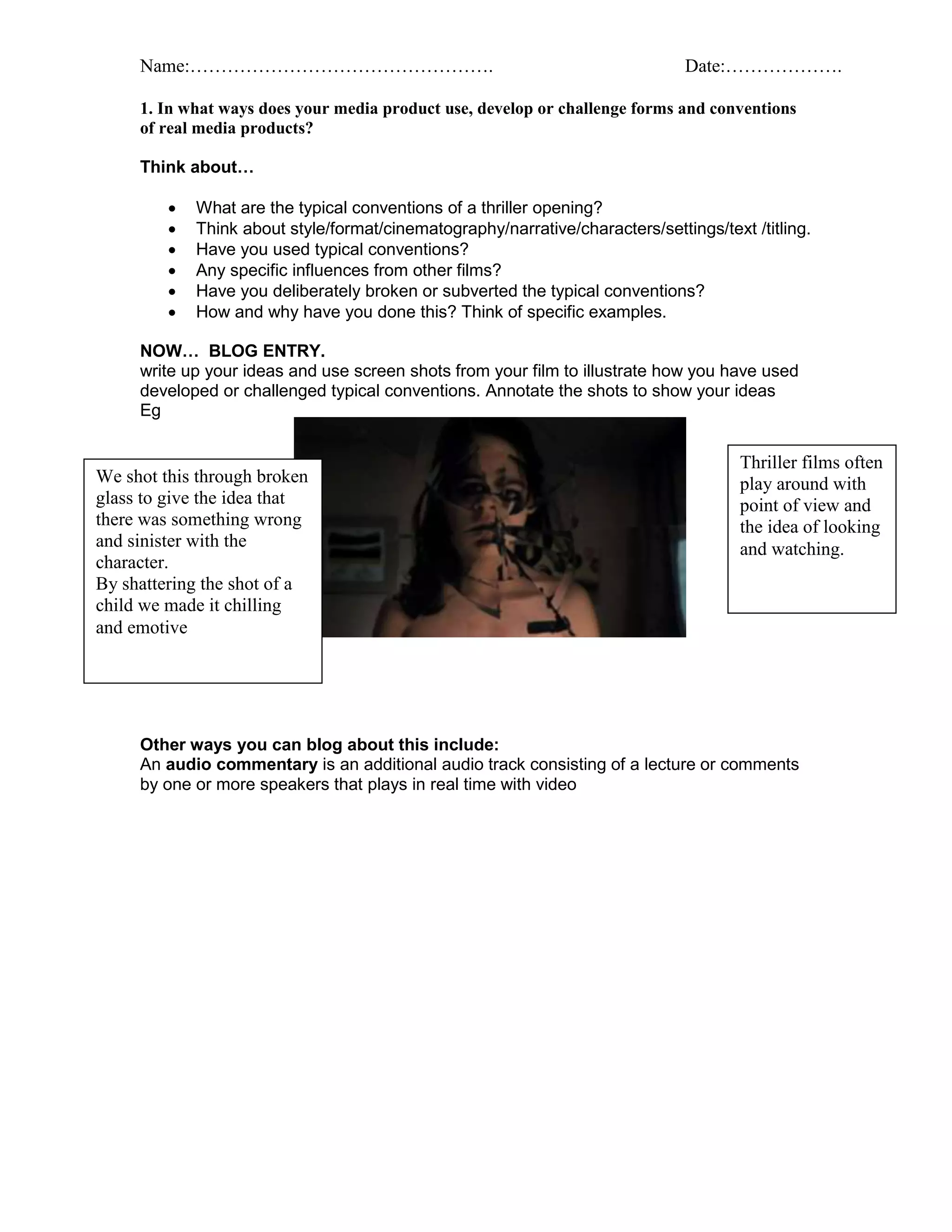
Eg
Other ways you can blog about this include:
An audio commentary is an additional audio track consisting of a lecture or comments
by one or more speakers that plays in real time with video
Thriller films often
play around with
point of view and
the idea of looking
and watching.
We shot this through broken
glass to give the idea that
there was something wrong
and sinister with the
character.
By shattering the shot of a
child we made it chilling
and emotive
Name:…………………………………………. Date:……………….
2. How does your media product represent particular social groups?
The groups that you will consider will depend on your film. They may be related to age,
gender, social class, ethnicity/ race, special interest etc
Think about how you have represented them through your construction of film language.
How far have you replicated dominant representations? How far have you challenged or
subverted those representations?
NOW..BLOG ENTRY
Create a collage of images of typical representations of your group/ characters in other
thriller films/ the media generally
Chose some screen shots photos of your groups/ characters and annotate to explore
your representations.
KEYWORDS: DEMOGRAPHICS, PSYCHOGRAPHICS,
Name:…………………………………………. Date:……………….
3. What kind of media institution might distribute your media product and why?
What sort of companies would finance make and distribute your film. Think about all the
stuff you learned in the film unit. Would it be a big budget Hollywood film? A low budget
British film? A combination? Justify your ideas.
Discuss in your group and reach some conclusions.
Research some similar films and who they were financed / produced and distributed by.
Other ways you can blog about this include:
NOW… BLOG ENTRY
Write up your main ideas about who would finance, produce and distribute your film.
Add examples of similar films and the logos of the production and distribution companies
Create a podcast; record your answer to this question and include a picture slideshow
how – you can do this using moviemaker.
Name:…………………………………………. Date:……………….
4. Who would be the audience for your media product?
Outline the demographic and psychographic profile of your main audience.
Is there more than one audience? If so who? Why? Decide in your group. What
elements did you include in the film to attract the audience?
NOW..BLOG Entry
Create an annotated visual graphic of your audience. You can annotate print
screens. You could also create a movie in movie-maker and discuss elements of
sound, camerawork, mise-en-scene and editing.
Name:…………………………………………. Date:……………….
5. How did you attract/address your audience?
Outline the demographic and psychographic profile of your main audience.
Is there more than one audience? If so who? Why? Decide in your group.
What elements did you include in the film to attract the audience?
Show your film opening to some people in your target audience and get feedback. Film
some little VOX pops on the flip cameras.
NOW..BLOG Entry
Write up your main ideas on audience and upload some vox pops from your feedback.
Name:…………………………………………. Date:……………….
6. What have you learnt about technologies from the process of constructing this
product?
You need to show two things
 The potential of digital technology for creativity and communication
 The skills you have developed in using technologies
Think about all of the advantages and disadvantages that digital technologies have
brought in terms of the power to create and communicate/ to make and distribute media
products. You will do some work on this as a class. Make notes to use in your blog entry.
Pair up in your groups and interview each other on the skills and technologies you have
used and developed using flip cameras. Refer to specific things that you did i.e. shots
you filmed/ bits you edited. Show each other using the technology if possible!
Filming/editing/blogging
If not -take still images and annotate.
NOW BLOG ENTRY
Write up your notes on the bullet points. Then upload your video to Youtube and add a
link your interview to show your skills development. You could add some stills photos of
you using the equipment
Name:…………………………………………. Date:……………….
7. Looking back at your preliminary task, what do you feel you have learnt in the
progression from it to the full product?
What was the prelim task? What was the point of doing it? Look at it again? What did
you learn? Think about the rules of continuity editing. How did it help you in filming your
thriller opening? How much has your work developed.
NOW …BLOG
Upload your prelim task and add a link to your blog.
Write up your reflection and evaluation of your development
You could create some kind of measure of your skills development across the tasks!
Name:…………………………………………. Date:……………….
Marking Criteria for the Evaluation
Candidates will evaluate their work electronically. This MUST contain an element of
audience feedback and may be either integrated with the presentation of the research
and planning material or may be presented separately. Where candidates have worked
in a group, the evaluation may be presented individually or collectively but the teacher
must allocate a mark according the contribution/level of understanding demonstrated by
the individual candidate.
Level 1 0–7 marks
 Minimal understanding of issues around audience, institution, technology,
representation, forms and conventions in relation to production.
 Minimal ability to refer to the choices made and outcomes.
 Minimal understanding of their development from preliminary to full task.
 Minimal ability to communicate.
 Minimal skill in the use of digital technology or ICT in the evaluation.
Level 2 8–11 marks
 Basic understanding of issues around audience, institution, technology,
representation, forms and conventions in relation to production.
 Basic ability to refer to the choices made and outcomes.
 Basic understanding of their development from preliminary to full task.
 Basic ability to communicate.
 Basic skill in the use of digital technology or ICT in the evaluation
Level 3 12–15 marks
 Proficient understanding of issues around audience, institution, technology,
representation, forms and conventions in relation to production.
 Proficient ability to refer to the choices made and outcomes.
 Proficient understanding of their development from preliminary to full task.
 Proficient ability to communicate.
 Proficient skill in the use of digital technology or ICT in the evaluation
Level 4 16–20 marks
 Excellent understanding of issues around audience, institution, technology,
representation, forms and conventions in relation to production.
 Excellent ability to refer to the choices made and outcomes.
 Excellent understanding of their development from preliminary to full task.
 Excellent ability to communicate.
 Excellent skill in the use of digital technology or ICT in the evaluation

Foundation portfolio evaluation final

  • 1.
    Name:…………………………………………. Date:………………. AS MEDIASTUDIES: Foundation Production Evaluation Each candidate will evaluate and reflect upon the creative process and their experience of it. Candidates will evaluate their work electronically, this evaluation being guided by the set of key questions below. This evaluation may be done collectively for a group production or individually. Examples of suitable formats for the evaluation are:  A podcast  DVD extras  A blog  A PowerPoint In all cases, candidates should be discouraged from seeing the evaluation as simply a written essay and the potential of the format chosen should be exploited through the use of images, audio, video and links to online resources. Marks should be supported by teacher comments and may be supported by other forms such as audio or videotaped presentations. In the evaluation the following questions must be answered: 1. In what ways does your media product use, develop or challenge forms and conventions of real media products? 2. How does your media product represent particular social groups? 3. What kind of media institution might distribute your media product and why? 4. Who would be the audience for your media product? 5. How did you attract/address your audience? 6. What have you learnt about technologies from the process of constructing this product? 7. Looking back at your preliminary task, what do you feel you have learnt in the progression from it to the full product?
  • 2.
    Name:…………………………………………. Date:………………. 1. Inwhat ways does your media product use, develop or challenge forms and conventions of real media products? Think about…  What are the typical conventions of a thriller opening?  Think about style/format/cinematography/narrative/characters/settings/text /titling.  Have you used typical conventions?  Any specific influences from other films?  Have you deliberately broken or subverted the typical conventions?  How and why have you done this? Think of specific examples. NOW… BLOG ENTRY. write up your ideas and use screen shots from your film to illustrate how you have used developed or challenged typical conventions. Annotate the shots to show your ideas Eg Other ways you can blog about this include: An audio commentary is an additional audio track consisting of a lecture or comments by one or more speakers that plays in real time with video Thriller films often play around with point of view and the idea of looking and watching. We shot this through broken glass to give the idea that there was something wrong and sinister with the character. By shattering the shot of a child we made it chilling and emotive
  • 3.
    Name:…………………………………………. Date:………………. 2. Howdoes your media product represent particular social groups? The groups that you will consider will depend on your film. They may be related to age, gender, social class, ethnicity/ race, special interest etc Think about how you have represented them through your construction of film language. How far have you replicated dominant representations? How far have you challenged or subverted those representations? NOW..BLOG ENTRY Create a collage of images of typical representations of your group/ characters in other thriller films/ the media generally Chose some screen shots photos of your groups/ characters and annotate to explore your representations. KEYWORDS: DEMOGRAPHICS, PSYCHOGRAPHICS,
  • 4.
    Name:…………………………………………. Date:………………. 3. Whatkind of media institution might distribute your media product and why? What sort of companies would finance make and distribute your film. Think about all the stuff you learned in the film unit. Would it be a big budget Hollywood film? A low budget British film? A combination? Justify your ideas. Discuss in your group and reach some conclusions. Research some similar films and who they were financed / produced and distributed by. Other ways you can blog about this include: NOW… BLOG ENTRY Write up your main ideas about who would finance, produce and distribute your film. Add examples of similar films and the logos of the production and distribution companies Create a podcast; record your answer to this question and include a picture slideshow how – you can do this using moviemaker.
  • 5.
    Name:…………………………………………. Date:………………. 4. Whowould be the audience for your media product? Outline the demographic and psychographic profile of your main audience. Is there more than one audience? If so who? Why? Decide in your group. What elements did you include in the film to attract the audience? NOW..BLOG Entry Create an annotated visual graphic of your audience. You can annotate print screens. You could also create a movie in movie-maker and discuss elements of sound, camerawork, mise-en-scene and editing.
  • 6.
    Name:…………………………………………. Date:………………. 5. Howdid you attract/address your audience? Outline the demographic and psychographic profile of your main audience. Is there more than one audience? If so who? Why? Decide in your group. What elements did you include in the film to attract the audience? Show your film opening to some people in your target audience and get feedback. Film some little VOX pops on the flip cameras. NOW..BLOG Entry Write up your main ideas on audience and upload some vox pops from your feedback.
  • 7.
    Name:…………………………………………. Date:………………. 6. Whathave you learnt about technologies from the process of constructing this product? You need to show two things  The potential of digital technology for creativity and communication  The skills you have developed in using technologies Think about all of the advantages and disadvantages that digital technologies have brought in terms of the power to create and communicate/ to make and distribute media products. You will do some work on this as a class. Make notes to use in your blog entry. Pair up in your groups and interview each other on the skills and technologies you have used and developed using flip cameras. Refer to specific things that you did i.e. shots you filmed/ bits you edited. Show each other using the technology if possible! Filming/editing/blogging If not -take still images and annotate. NOW BLOG ENTRY Write up your notes on the bullet points. Then upload your video to Youtube and add a link your interview to show your skills development. You could add some stills photos of you using the equipment
  • 8.
    Name:…………………………………………. Date:………………. 7. Lookingback at your preliminary task, what do you feel you have learnt in the progression from it to the full product? What was the prelim task? What was the point of doing it? Look at it again? What did you learn? Think about the rules of continuity editing. How did it help you in filming your thriller opening? How much has your work developed. NOW …BLOG Upload your prelim task and add a link to your blog. Write up your reflection and evaluation of your development You could create some kind of measure of your skills development across the tasks!
  • 9.
    Name:…………………………………………. Date:………………. Marking Criteriafor the Evaluation Candidates will evaluate their work electronically. This MUST contain an element of audience feedback and may be either integrated with the presentation of the research and planning material or may be presented separately. Where candidates have worked in a group, the evaluation may be presented individually or collectively but the teacher must allocate a mark according the contribution/level of understanding demonstrated by the individual candidate. Level 1 0–7 marks  Minimal understanding of issues around audience, institution, technology, representation, forms and conventions in relation to production.  Minimal ability to refer to the choices made and outcomes.  Minimal understanding of their development from preliminary to full task.  Minimal ability to communicate.  Minimal skill in the use of digital technology or ICT in the evaluation. Level 2 8–11 marks  Basic understanding of issues around audience, institution, technology, representation, forms and conventions in relation to production.  Basic ability to refer to the choices made and outcomes.  Basic understanding of their development from preliminary to full task.  Basic ability to communicate.  Basic skill in the use of digital technology or ICT in the evaluation Level 3 12–15 marks  Proficient understanding of issues around audience, institution, technology, representation, forms and conventions in relation to production.  Proficient ability to refer to the choices made and outcomes.  Proficient understanding of their development from preliminary to full task.  Proficient ability to communicate.  Proficient skill in the use of digital technology or ICT in the evaluation Level 4 16–20 marks  Excellent understanding of issues around audience, institution, technology, representation, forms and conventions in relation to production.  Excellent ability to refer to the choices made and outcomes.  Excellent understanding of their development from preliminary to full task.  Excellent ability to communicate.  Excellent skill in the use of digital technology or ICT in the evaluation