CELL JUNCTION
MADE BY:- AANSHI SRIVASTAVA
WHAT IS CELL JUNCTION
Cell junction (intercellular bridges) are
a class of cellular structures consisting
of multiprotein complexes that provide
contact or adhesion between
neighboring cells or between a cell and
the extracellular matrix in the animals.
Cell junctions are especially abundant in the
epithelial tissues. Combined with cell adhesion
molecules, and extracellular matrix, cell junctions
help hold the animal cells together.
Cell Junctions are also especially important in
enabling communication between neighboring
cells via specialized protein complexes called
communicating junctions. And, are also important
in reducing stress placed upon cells.
TYPES OF CELL JUNCTION
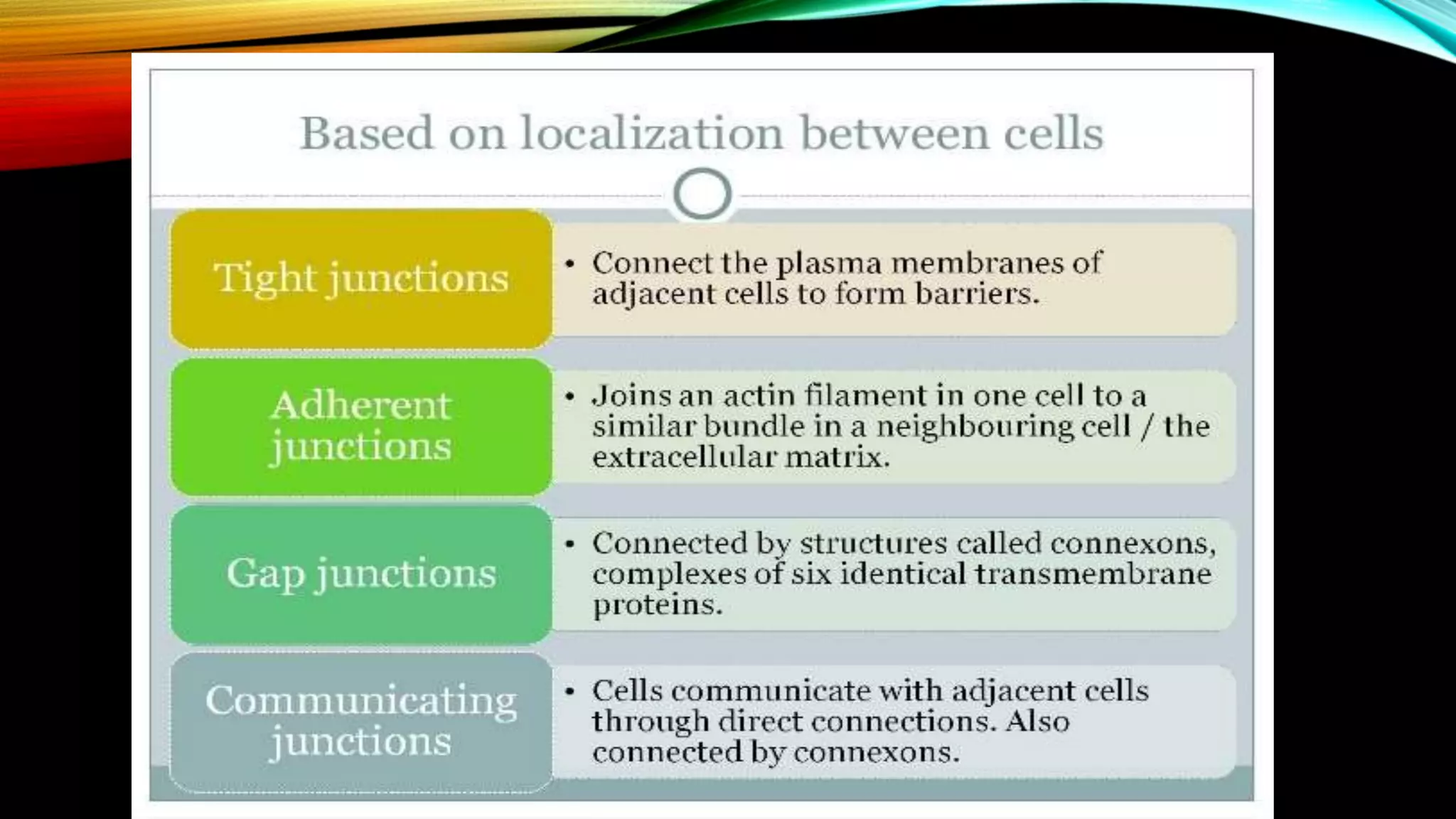
ANCHORING JUNCTION
• Cells within tissues and organs must be anchored to one another
and attached to components of the extracellular matrix.
• Anchoring junction not only hold cells together but provide
tissues with structural cohesion. These junctions are most
abundant in tissues that are subject to constant mechanical stress
such as skin, and heart.
GAP JUNCTION
• Gap junction (communicating junction) allow for the direct chemical
communication between adjacent cellular cytoplasm through diffusion
without contact with the extracellular fluid. This is possible due to
six connexin proteins interacting to form a cylinder with a pore in the centre
called a connexon.
• Gap junctions play vital roles in the human body, including their role in the
uniform contractile of the heart muscle. They are relevant in signal transfers
in the brain, and their absence shows a decreased cell density in the brain.
TIGHT JUNCTION
Found in vertebrate epithelia, tight junctions act as barriers
that regulate the movement of water and solutes between
epithelial layers. Tight junctions are classified as
a paracellular barrier which is defined as not having
directional discrimination. There is evidence to suggest
that the structures in which solutes pass through are
somewhat like pores.
TRICELLULAR JUNCTIONS
•Tricellular junctions seal epithelia at the corners of
three cells. Due to the geometry of three-cell
vertices, the sealing of the cells at these sites
requires a specific junctional organization, different
from those in bicellular junctions. In vertebrates,
components tricellular junctions are tricellulin and
lipolysis-stimulated lipoprotein receptors.
CELL JUNCTION MOLECULES
SELECTINS are cell adhesion molecules that play an important role in the initiation of inflammatory
processes. The functional capacity of selectin is limited to leukocyte collaborations with vascular
endothelium.
CADHERINS are calcium-dependent adhesion molecules. Cadherins are extremely important in the
process of morphogenesis – fetal development. Together with an alpha-beta catenin complex, the cadherin
can bind to the microfilaments of the cytoskeleton of the cell. This allows for homophilic cell–cell adhesion.
INTEGRINS act as adhesion receptors, transporting signals across the plasma membrane in multiple
directions. These molecules are an invaluable part of cellular communication, as a single ligand can be
used for many integrins.
IMMUNOGLOBULIN SUPERFAMILY are a group of calcium independent proteins capable of homophilic
and heterophilic adhesion. Homophilic adhesion involves the immunoglobulin-like domains on the cell
surface binding to the immunoglobulin-like domains on an opposing cell’s surface while heterophilic
adhesion refers to the binding of the immunoglobulin-like domains to integrins and carbohydrates instead
.
Cell junction
Cell junction

Cell junction

  • 1.
    CELL JUNCTION MADE BY:-AANSHI SRIVASTAVA
  • 2.
    WHAT IS CELLJUNCTION Cell junction (intercellular bridges) are a class of cellular structures consisting of multiprotein complexes that provide contact or adhesion between neighboring cells or between a cell and the extracellular matrix in the animals.
  • 3.
    Cell junctions areespecially abundant in the epithelial tissues. Combined with cell adhesion molecules, and extracellular matrix, cell junctions help hold the animal cells together. Cell Junctions are also especially important in enabling communication between neighboring cells via specialized protein complexes called communicating junctions. And, are also important in reducing stress placed upon cells.
  • 4.
    TYPES OF CELLJUNCTION
  • 5.
    ANCHORING JUNCTION • Cellswithin tissues and organs must be anchored to one another and attached to components of the extracellular matrix. • Anchoring junction not only hold cells together but provide tissues with structural cohesion. These junctions are most abundant in tissues that are subject to constant mechanical stress such as skin, and heart.
  • 6.
    GAP JUNCTION • Gapjunction (communicating junction) allow for the direct chemical communication between adjacent cellular cytoplasm through diffusion without contact with the extracellular fluid. This is possible due to six connexin proteins interacting to form a cylinder with a pore in the centre called a connexon. • Gap junctions play vital roles in the human body, including their role in the uniform contractile of the heart muscle. They are relevant in signal transfers in the brain, and their absence shows a decreased cell density in the brain.
  • 7.
    TIGHT JUNCTION Found invertebrate epithelia, tight junctions act as barriers that regulate the movement of water and solutes between epithelial layers. Tight junctions are classified as a paracellular barrier which is defined as not having directional discrimination. There is evidence to suggest that the structures in which solutes pass through are somewhat like pores.
  • 8.
    TRICELLULAR JUNCTIONS •Tricellular junctionsseal epithelia at the corners of three cells. Due to the geometry of three-cell vertices, the sealing of the cells at these sites requires a specific junctional organization, different from those in bicellular junctions. In vertebrates, components tricellular junctions are tricellulin and lipolysis-stimulated lipoprotein receptors.
  • 9.
  • 10.
    SELECTINS are celladhesion molecules that play an important role in the initiation of inflammatory processes. The functional capacity of selectin is limited to leukocyte collaborations with vascular endothelium. CADHERINS are calcium-dependent adhesion molecules. Cadherins are extremely important in the process of morphogenesis – fetal development. Together with an alpha-beta catenin complex, the cadherin can bind to the microfilaments of the cytoskeleton of the cell. This allows for homophilic cell–cell adhesion. INTEGRINS act as adhesion receptors, transporting signals across the plasma membrane in multiple directions. These molecules are an invaluable part of cellular communication, as a single ligand can be used for many integrins. IMMUNOGLOBULIN SUPERFAMILY are a group of calcium independent proteins capable of homophilic and heterophilic adhesion. Homophilic adhesion involves the immunoglobulin-like domains on the cell surface binding to the immunoglobulin-like domains on an opposing cell’s surface while heterophilic adhesion refers to the binding of the immunoglobulin-like domains to integrins and carbohydrates instead .