International Accounting
  Standard-8
Accounting Policies, Changes in Accounting
Estimates and Errors
                  Slides Prepared By: Zain Tareen
Effective date of IAS-8
   This standard was applied to annual
    periods begun on or immediately after

                        1st January, 2005.
Objective Of IAS 8
It prescribes the criteria for:
  Selection of accounting policies;
  Changes in accounting policies;
  Accounting treatment;
  Disclosure of changes in accounting
      policies;
  Changes in accounting estimates;
      And
  Correction of errors;
The achievement of the
objective would result in
        Enhancement of:
  Relevance and reliability of financial
   statements;
  Comparability of financial statements
   with the financial statements of other
   entities and of prior periods of the
   same entity.
Key Concepts
Retrospective Application:


• Retrospective application is applying a
  new policy to transactions, other events &
  Conditions as if that policy had always
  been applicable.
Retrospective
                    Restatement:


 It is basically the after effect of
  Retrospective application on the Prior
  Periods presented along the current
  year’s Financial Statement.
Prospective Application
   Prospective Application means
    applying the changes on current and
    future periods only.
    In the past what’s done is done no
    such alteration is required in the books
    of the accounts.
Impracticable Applying:


   Applying a requirement is
    impracticable when the entity cannot
    apply it after making every possible
    effort.
Accounting Policies
What are Accounting
                   Policies??
 Basis;
 Rules;
 Conventions;
 Practices;
 Specific Principles;


        That are applied in preparing and
        presenting financial Statements
Reasons for Change in
        Accounting Policies

 Change in International Financial
  Reporting Standard
 Change in Local Legislation
 For More True & Fair View
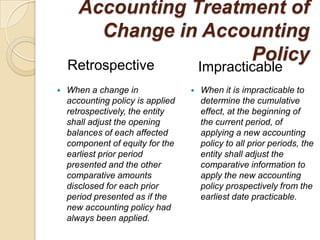
Accounting Treatment of
         Change in Accounting
    Retrospective
                       Policy
                                       Impracticable
   When a change in                  When it is impracticable to
    accounting policy is applied       determine the cumulative
    retrospectively, the entity        effect, at the beginning of
    shall adjust the opening           the current period, of
    balances of each affected          applying a new accounting
    component of equity for the        policy to all prior periods, the
    earliest prior period              entity shall adjust the
    presented and the other            comparative information to
    comparative amounts                apply the new accounting
    disclosed for each prior           policy prospectively from the
    period presented as if the         earliest date practicable.
    new accounting policy had
    always been applied.
DISCLOSURE
REQUIREMENTS OF CHANGE
IN ACCOUNTING POLICY
  Nature of change
   Description of transitional provision if any
   For the current period and each prior period
    presented, to the extent practicable, the amount of
    adjustment:
    ◦           For each financial statement line item
      affected;
    ◦      Earnings per share – revised
Accounting Estimates
What is a Change in Accounting
                    Estimates?
Change in Accounting Estimates is an
Adjustment in
 Carrying value of an Asset ;
 or a liability;
 Or the amount of Periodic
  consumption of an Asset;
                   As a Result of Present
           Conditions and Circumstances
What are the Reasons for
                    Estimation??


When an item of financial statements
cannot be measured precisely, it can
only be estimated. This is because of:
 Uncertainties inherent in the business;
 Where judgments are involved;
Where Estimation is
                   Required??
Estimates may be required of
 Bad Debts
 Inventory obsolescence
 Fair value of financial assets or
  financial liabilities
 The useful lives of, or expected
  pattern of consumption of the future
  economic benefits embodied in,
  depreciable assets
 Warranty Obligations etc.
When Change in Accounting
              Estimate Becomes
                    Necessary??


   If changes occur in the circumstances
    on which the estimate was based
    ◦ As a result of a new information
    ◦ As a result of new development
    ◦ More Experience
What is the Recognition Criteria
          of Change in Accounting
                            Estimate??
 Adjusting the carrying amount of the
  related asset, liability or equity item in
  the period of change recognizes a
  change in an accounting estimate
 Example:
  ◦ Management estimated that provision for
    doubtful debts up to 5 percent of the total
    population of trade debts. However, upon
    identifying the age of the trade debts, it
    revealed that bad debts are about 6.5
    percent of total population of trade debts.
    Management immediately recognizes the
    increase in bad debts expense in the books
    of accounts.
Accounting Treatment of Change
        in Accounting Estimates


 International Accounting Standard 8
  Requires Recognizing the effect of the
  change in the accounting estimate in the
 Current;
 and future periods;
                      affected by the
change.
Disclosures Required for Change
         in Accounting Estimates
   If the effect of a change in estimate is
    immaterial (as is usually the case for
    changes in reserves and allowances),
    we do not disclose the alteration.
   However, we disclose the change in
    estimate if the amount is material. Also, if
    the change affects several future periods,
    e.g., the effect on income from continuing
    operations, net income, and per share
    amounts.
Errors
What are Errors??
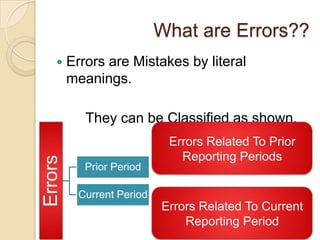
        Errors are Mistakes by literal
         meanings.

            They can be Classified as shown.
                             Errors Related To Prior
                               Reporting Periods
Errors


            Prior Period

           Current Period
                            Errors Related To Current
                                Reporting Period
What are Prior Period
                        Errors?
 Failure to use or misuse of reliable
  information that was available when
  financial statements for those periods
  were authorized for issue.
 Failure to use or misuse of reliable
  information that could reasonably be
  expected to have been obtained and
  taken into account in the preparation
  and presentation of those financial
  statements.
What are the Examples of Prior
                   Period Errors??
     Effect of mathematical mistakes
     Mistakes in applying accounting
      policies
     Oversight
     Misinterpretation of facts
     Fraud.


Change in accounting estimates result from New
information or New developments are NOT corrections of
What is the Accounting
       Treatment for Rectification of
                           Errors??
   An entity shall correct material prior
    period errors retrospectively in the first
    set of financial statements authorized
    for issue after their discovery by:
    ◦ Restating the comparative amounts for
      the prior period(s) presented in which the
      error occurred; or
    ◦ If the error occurred before the earliest
      prior period presented, restating the
      opening balances of assets, liabilities and
      equity for the earliest prior period
What are the Disclosure
             Requirements of IAS-8??
 Nature of the prior period error
 To the extent practicable, the amount of
  the correction:
    ◦ For each financial statement line item
      affected; and
    ◦ Revision in earnings per share (EPS)
    The amount of the correction at the beginning
    of the earliest prior period presented; and
         If retrospective restatement is
    impracticable for a particular prior period, the
    circumstances that led to the existence of that
    condition and a description of how and from
    when the error has been corrected.
Ias 8 presentation final

Ias 8 presentation final

  • 1.
    International Accounting Standard-8 Accounting Policies, Changes in Accounting Estimates and Errors Slides Prepared By: Zain Tareen
  • 2.
    Effective date ofIAS-8  This standard was applied to annual periods begun on or immediately after 1st January, 2005.
  • 3.
    Objective Of IAS8 It prescribes the criteria for:  Selection of accounting policies;  Changes in accounting policies;  Accounting treatment;  Disclosure of changes in accounting policies;  Changes in accounting estimates; And  Correction of errors;
  • 4.
    The achievement ofthe objective would result in Enhancement of:  Relevance and reliability of financial statements;  Comparability of financial statements with the financial statements of other entities and of prior periods of the same entity.
  • 5.
  • 6.
    Retrospective Application: • Retrospectiveapplication is applying a new policy to transactions, other events & Conditions as if that policy had always been applicable.
  • 7.
    Retrospective Restatement:  It is basically the after effect of Retrospective application on the Prior Periods presented along the current year’s Financial Statement.
  • 8.
    Prospective Application  Prospective Application means applying the changes on current and future periods only. In the past what’s done is done no such alteration is required in the books of the accounts.
  • 9.
    Impracticable Applying:  Applying a requirement is impracticable when the entity cannot apply it after making every possible effort.
  • 10.
  • 11.
    What are Accounting Policies??  Basis;  Rules;  Conventions;  Practices;  Specific Principles; That are applied in preparing and presenting financial Statements
  • 12.
    Reasons for Changein Accounting Policies  Change in International Financial Reporting Standard  Change in Local Legislation  For More True & Fair View
  • 13.
    Accounting Treatment of Change in Accounting Retrospective Policy Impracticable  When a change in  When it is impracticable to accounting policy is applied determine the cumulative retrospectively, the entity effect, at the beginning of shall adjust the opening the current period, of balances of each affected applying a new accounting component of equity for the policy to all prior periods, the earliest prior period entity shall adjust the presented and the other comparative information to comparative amounts apply the new accounting disclosed for each prior policy prospectively from the period presented as if the earliest date practicable. new accounting policy had always been applied.
  • 14.
    DISCLOSURE REQUIREMENTS OF CHANGE INACCOUNTING POLICY  Nature of change  Description of transitional provision if any  For the current period and each prior period presented, to the extent practicable, the amount of adjustment: ◦ For each financial statement line item affected; ◦ Earnings per share – revised
  • 15.
  • 16.
    What is aChange in Accounting Estimates? Change in Accounting Estimates is an Adjustment in  Carrying value of an Asset ;  or a liability;  Or the amount of Periodic consumption of an Asset; As a Result of Present Conditions and Circumstances
  • 17.
    What are theReasons for Estimation?? When an item of financial statements cannot be measured precisely, it can only be estimated. This is because of:  Uncertainties inherent in the business;  Where judgments are involved;
  • 18.
    Where Estimation is Required?? Estimates may be required of  Bad Debts  Inventory obsolescence  Fair value of financial assets or financial liabilities  The useful lives of, or expected pattern of consumption of the future economic benefits embodied in, depreciable assets  Warranty Obligations etc.
  • 19.
    When Change inAccounting Estimate Becomes Necessary??  If changes occur in the circumstances on which the estimate was based ◦ As a result of a new information ◦ As a result of new development ◦ More Experience
  • 20.
    What is theRecognition Criteria of Change in Accounting Estimate??  Adjusting the carrying amount of the related asset, liability or equity item in the period of change recognizes a change in an accounting estimate  Example: ◦ Management estimated that provision for doubtful debts up to 5 percent of the total population of trade debts. However, upon identifying the age of the trade debts, it revealed that bad debts are about 6.5 percent of total population of trade debts. Management immediately recognizes the increase in bad debts expense in the books of accounts.
  • 21.
    Accounting Treatment ofChange in Accounting Estimates  International Accounting Standard 8 Requires Recognizing the effect of the change in the accounting estimate in the  Current;  and future periods; affected by the change.
  • 22.
    Disclosures Required forChange in Accounting Estimates  If the effect of a change in estimate is immaterial (as is usually the case for changes in reserves and allowances), we do not disclose the alteration.  However, we disclose the change in estimate if the amount is material. Also, if the change affects several future periods, e.g., the effect on income from continuing operations, net income, and per share amounts.
  • 23.
  • 24.
    What are Errors??  Errors are Mistakes by literal meanings. They can be Classified as shown. Errors Related To Prior Reporting Periods Errors Prior Period Current Period Errors Related To Current Reporting Period
  • 25.
    What are PriorPeriod Errors?  Failure to use or misuse of reliable information that was available when financial statements for those periods were authorized for issue.  Failure to use or misuse of reliable information that could reasonably be expected to have been obtained and taken into account in the preparation and presentation of those financial statements.
  • 26.
    What are theExamples of Prior Period Errors??  Effect of mathematical mistakes  Mistakes in applying accounting policies  Oversight  Misinterpretation of facts  Fraud. Change in accounting estimates result from New information or New developments are NOT corrections of
  • 27.
    What is theAccounting Treatment for Rectification of Errors??  An entity shall correct material prior period errors retrospectively in the first set of financial statements authorized for issue after their discovery by: ◦ Restating the comparative amounts for the prior period(s) presented in which the error occurred; or ◦ If the error occurred before the earliest prior period presented, restating the opening balances of assets, liabilities and equity for the earliest prior period
  • 28.
    What are theDisclosure Requirements of IAS-8??  Nature of the prior period error  To the extent practicable, the amount of the correction: ◦ For each financial statement line item affected; and ◦ Revision in earnings per share (EPS) The amount of the correction at the beginning of the earliest prior period presented; and If retrospective restatement is impracticable for a particular prior period, the circumstances that led to the existence of that condition and a description of how and from when the error has been corrected.