Africa Rising Mali report
    on Year 1 (2012)
Eva Weltzien, Tom van Mourik, A. Rouamba, Vera
   Lugutuah, Yah Diakite, Bougouna Sogoba,
 Abdoulaye Diakite, Mamourou Sidibe, Joachim
    Binam, Augustine Ayantunde, Abdou Fall

Africa RISING West Africa Stakeholder Meeting,
         Accra, Ghana, 23 January 2013
Outline
 Key events
 Implementing Partners
 Research Approach
 Key Research questions, Results and Outputs
 Conclusions and Outlook
Key events
 Jan 2012: Inception workshop in Tamale: identification of
  target outcomes and target zones in Mali
 Feb 2012: Stakeholder workshops in the two target zones:
  Identification of implementation partners and key constraints
  to sustainable intensification
 April/May 2012: Planning meetings with all actors
 May/June 2012: Training on tools for implementation of
  farmer managed trials
 June - Dec 2012: Implementation of rainy season field
  experimentation
 Aug/Sep 2012 Preparations for Innovation Platform on
  options for Crop –livestock integration
Implementation Partners
 CGIAR: ICRISAT, ICRAF, ILRI, AVRDC
 Koutiala area:
   AMASSA: Strengthening farmer groups and
    associations for crop/grain marketing
   AMEDD: Facilitation, Natural Resources
    Management, Communication
 Bougouni:
   Mobiom: Organizing farmers for marketing, and
    improved production technologies
Consultants:
 Moussa Djire: Experiences with of land-use
  conventions in Koutiala and Bougouni districts
  (ILRI)
 Alpha Kergna: Household survey to compliment
  PROGEBE survey (focus on crops, additional sites)
  (ILRI)
 Paul van Mele: Production and Translation of
  Farmer to Farmer videos (ICRISAT)
 Moussa Noussourou: Training IPM for tomatoes
  (AVRDC)
Research Approach (1)
1. Identification of Research Priorities: Needs
   expressed by stakeholders from the target
   areas, and discussions in view of opportunities
   provided by broad- based group of researchers
2. Search for entry points to facilitate participatory
   research across the production system: provide
   a local institutional context for joint learning
Research Approach (2)
3. Address sustainability issues, while working on
intensification research questions :
   Ensure that on-farm experimentation is
    demand driven
   Focus on building capacity in the target
    communities
   Monitoring natural resources indicators
   Targeting women's priorities
   Initiate research on household typologies
Main results:
1. Entry points for participatory research
2. Characterization of key elements in the target
   production systems
3. Options for increasing crop productivity
4. Options for improving nutritional status of
   young children
5. Options for enhancing natural resources (not
   reported today)
1. Entry points for participatory
  research on SI with multiple partners
A. Strengthening existing seed and grain
   production cooperatives in the target areas:
 Interest in a wide range of crops, Capacity to produce seed, Motivated
  to increase seed and/or grain sales,
 Opportunities: identify varieties and crop management options for SI
  with the full range of crops, and a wide range of potential customers.
 Sustainability focus: Building farmer and cooperative’s capacity for
  choosing varieties for multiplication/sale; for testing SI options; for
  communicating SI options
 Partners: AMASSA, Mobiom, ICRISAT, AVRDC, ICRAF
1. Entry points for participatory research
      on SI with multiple partners (2)
B. Innovation Platform for crop-livestock
   integration:
   Local governments involved, as well as actors along the whole
    value chain for livestock, and forestry products, landscape
    scale, NRM issues
   Opportunities: Addressing land management issues constructively;
    strengthening negotiation skills of a wide range of partners; local
    marketing issues considered, fodder availability options from the
    whole range of land types and for different types of livestock can
    be researched
   Sustainability: attracting interest from other development
    actors, strengthening negotiation skills of a wide range of partners;
   Partners: Mobiom, ILRI, ICRAF
1. Entry points for participatory research
on SI with multiple partners (3)
3. Community Health Centers to facilitate work
with women’s groups
 Health with support for treating malnourished children; they have a
  responsibility for providing preventive care and advice
 Opportunity: Supporting health centers with advice to prevent
  malnutrition, a wide diversity of crops, including vegetables and trees
  are adapted to the ecology
 Sustainability: TOT with women’s groups, producing visuals as training
  material, joining training on nutrition with cooking lessons and crop
  production
 Partners: AMEDD, ICRISAT. AVRDC, ICRAF
1. Entry Points for participatory
research an SI with multiple partners
 Each entry point provides a framework for
  collaboration with target communities with a
  specific purpose
 Each entry point ensures that the research
  activities generate benefits for participating
  farmers from year 1
 Creating opportunities for immediate impacts
 Entry points could be compared and sequenced
  for studying specific outcomes
2. Characterization of target zone
Population pyramid of Garalo “commune”
in Koutiala in 2009/2010
                                                                                     > 80


                                                                                     ]70 - 75]
         Female                                                        Male

                                                                                     ]60 - 65]


                                                                                     ]50 - 55]


                                                                                     ]40 - 45]


                                                                                     ]30 - 35]


                                                                                     ]20 - 25]


                                                                                     ]10 - 15]


                                                                                     ]0 - 5]

  0.15            0.10              0.05              0.00    0.05   0.10     0.15

                         Proportion of the Total Population                    Age Class
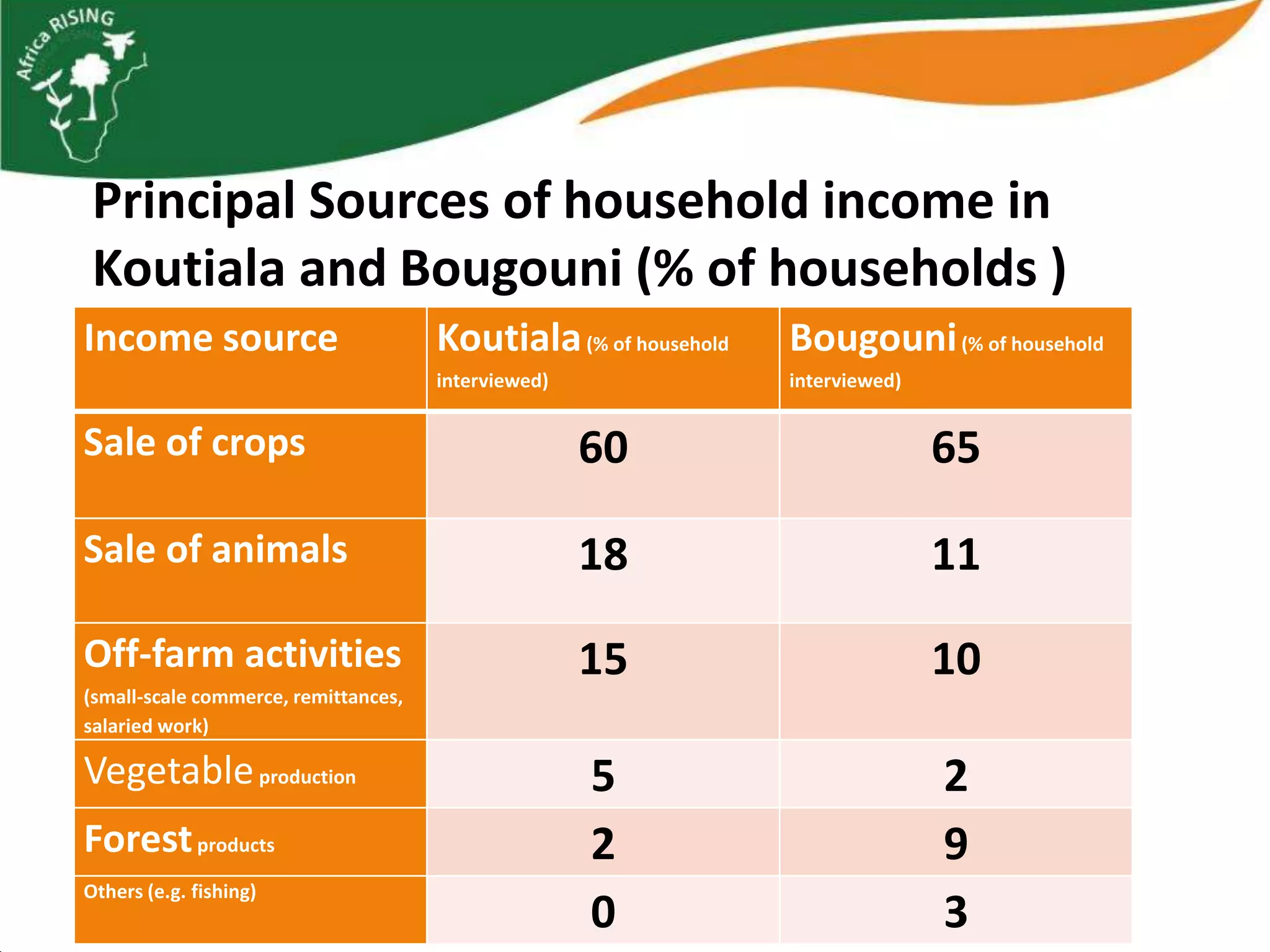
Principal Sources of household income in
 Koutiala and Bougouni (% of households )
Income source                         Koutiala (% of household   Bougouni (% of household
                                      interviewed)               interviewed)


Sale of crops                                        60                         65

Sale of animals                                      18                         11
Off-farm activities                                  15                         10
(small-scale commerce, remittances,
salaried work)

Vegetable production                                 5                          2
Forest products                                      2                          9
Others (e.g. fishing)
                                                     0                          3
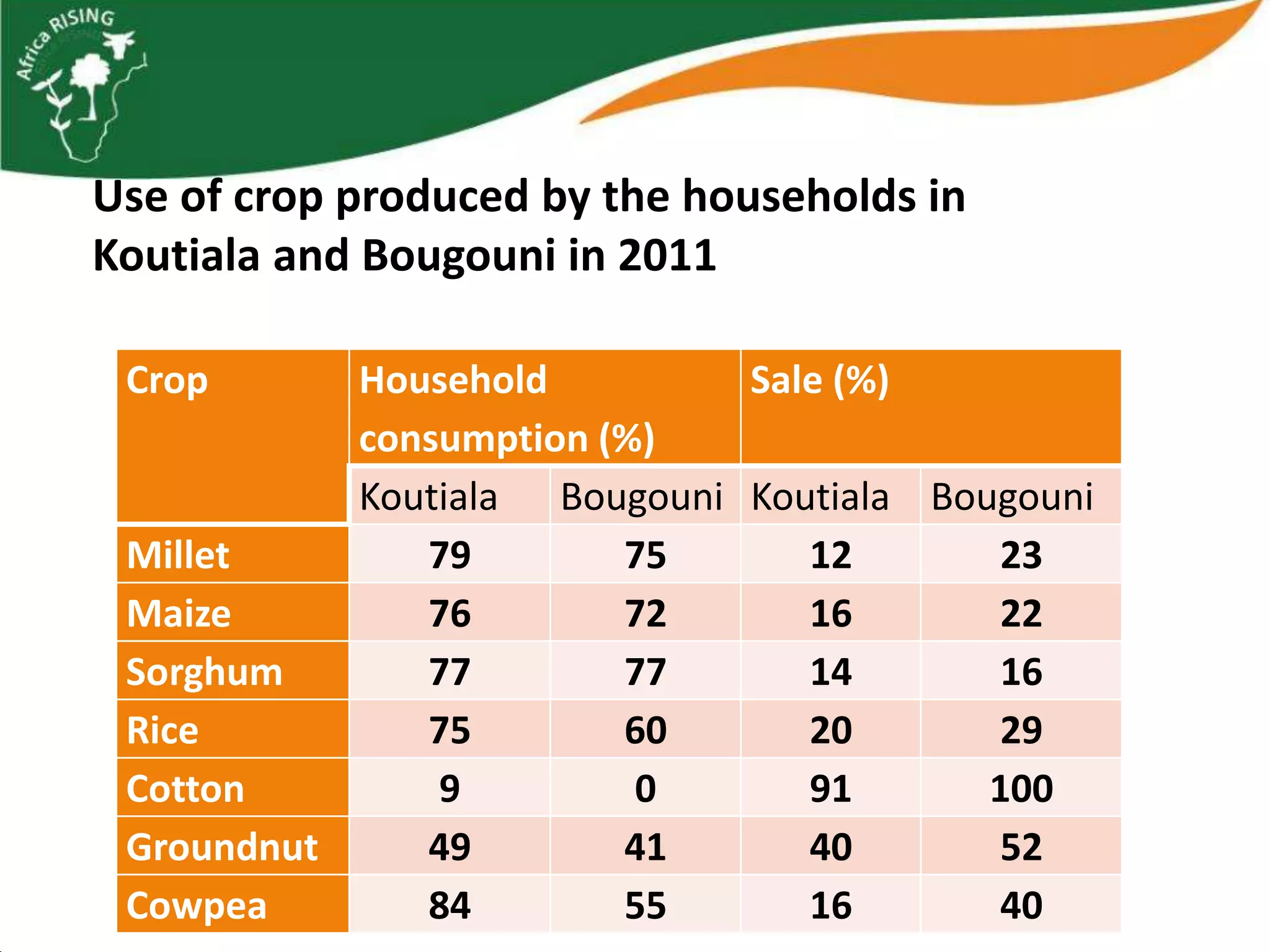
Use of crop produced by the households in
Koutiala and Bougouni in 2011

 Crop      Household         Sale (%)
           consumption (%)
           Koutiala Bougouni Koutiala Bougouni
 Millet       79        75      12        23
 Maize        76        72      16        22
 Sorghum      77        77      14        16
 Rice         75        60      20        29
 Cotton        9         0      91       100
 Groundnut    49        41      40        52
 Cowpea       84        55      16        40
Key issues for Sustainable
  Intensification from survey results
 Access to agricultural implements and inputs, credit
 Risk mitigation to cope with climate variability, and
  market shocks
 Information systems and training on improved
  agronomy, quality control of drugs and pesticides
 Value addition particularly cereals
   and livestock value chains
 Adequate feed for traction animals
Farm typology : establisment (1/2)
 IER SEP dataset : 30 farms of 3 village of the
  Koutiala area monitored from 1994 to 2011 on
  structural characteristics (household composition,
  assets)
 Cluster Analysis on 6 parameters : Cropland size, number of
 workers, Household total size, TLU, Oxen, Draught tools

4 Farm types :

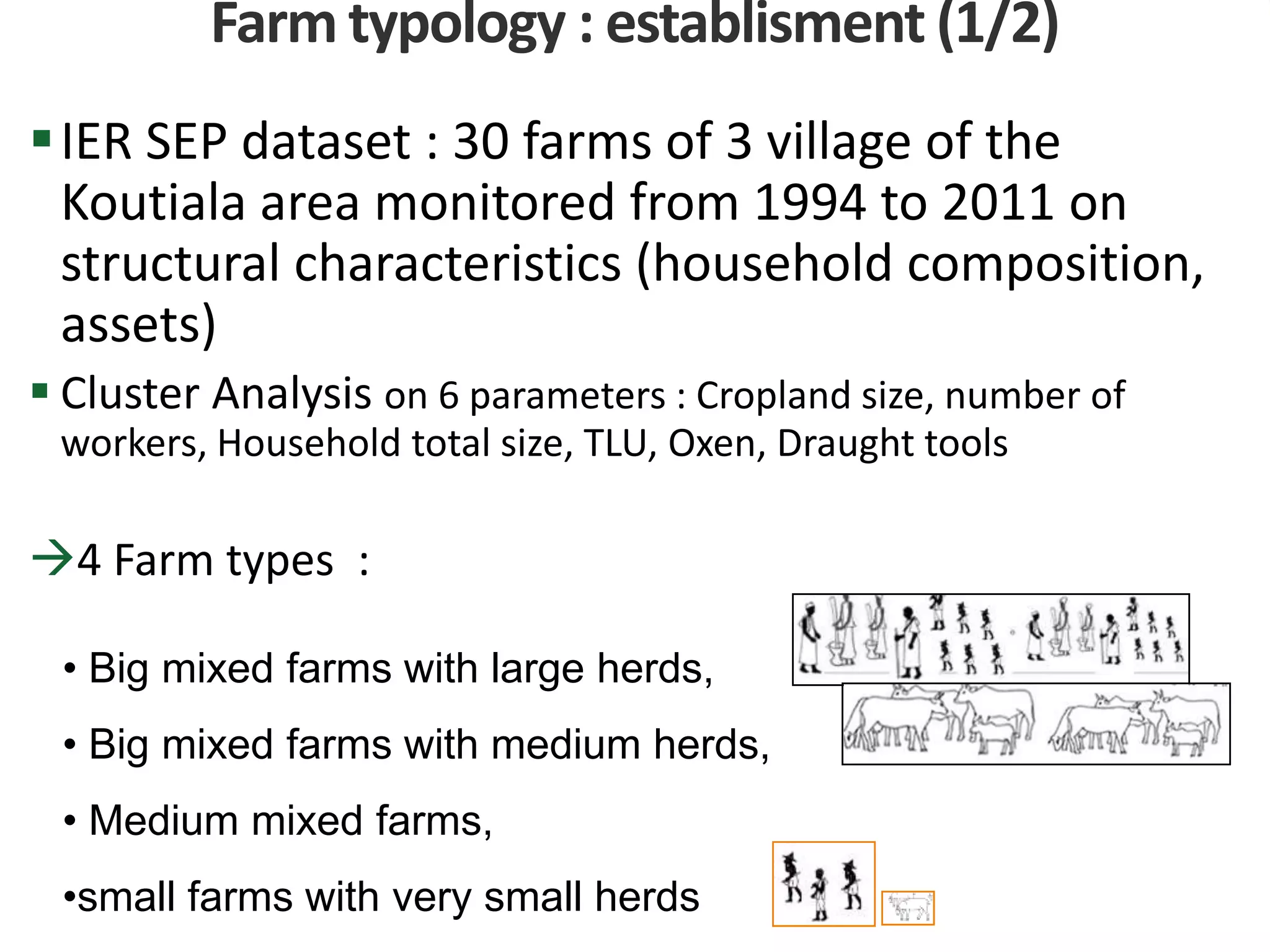
 • Big mixed farms with large herds,
 • Big mixed farms with medium herds,
 • Medium mixed farms,
 •small farms with very small herds
Farm typology : Farmers’ feedback (2/2)

• Presentation of the typology to a group of 23
  farmers involved in Icrisat activities. Each farmer
  can recognize himself in a type
• Farmers recognize strategies to move ‘up’ to a
  type of better resource endowment :

       1. Crop livestock integration and better soil
          fertility management
       2. Management of working
          calendars, Agreement between family
          members on activities and income
          repartition
       3. Diversification activities (livestock
          fattening, vegetables, banana
          plantation, activities out of agriculture)
3. Options for increasing crop
productivity and farmers’
incomes
1. Maize-cowpea intercropping
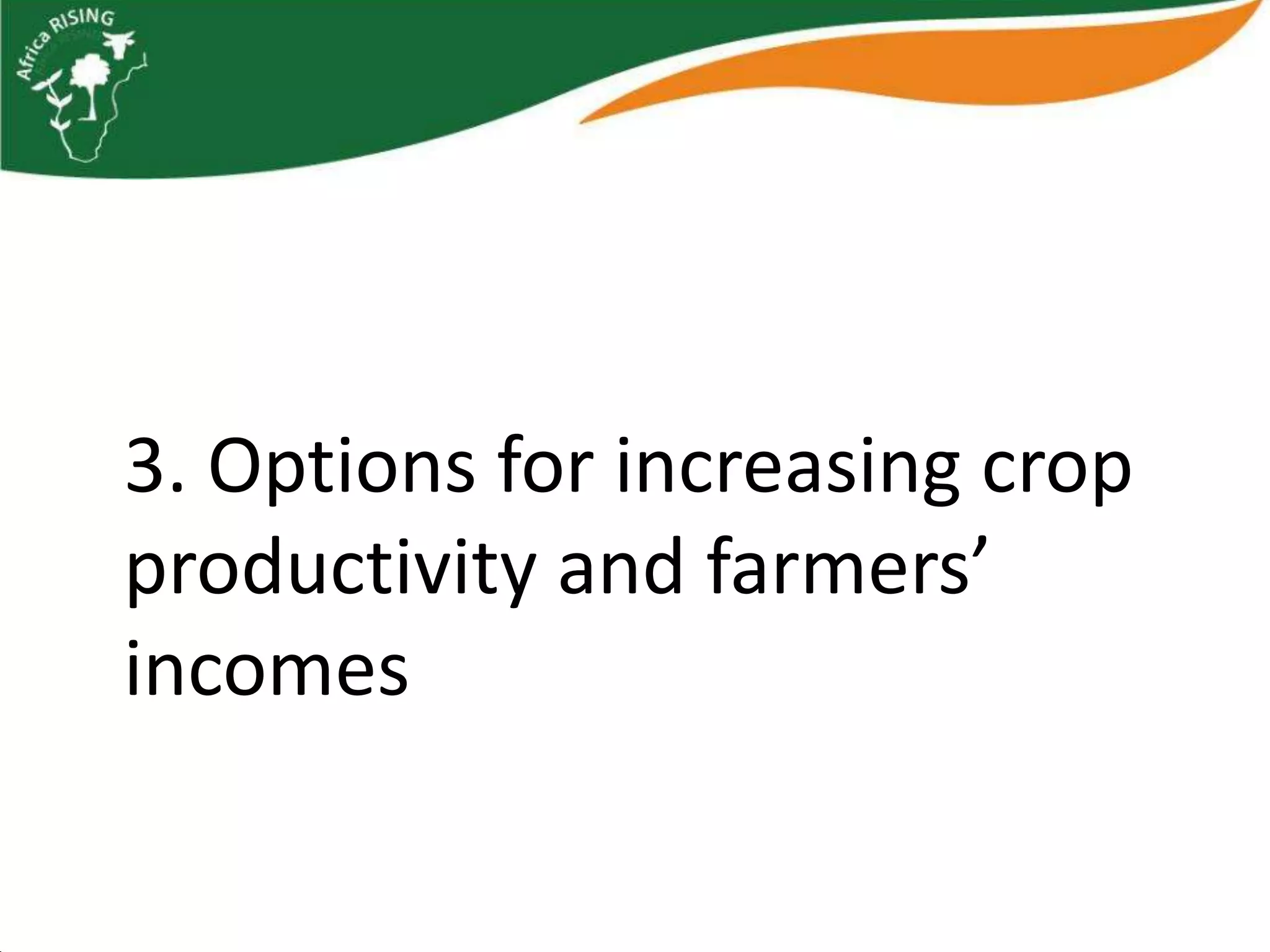
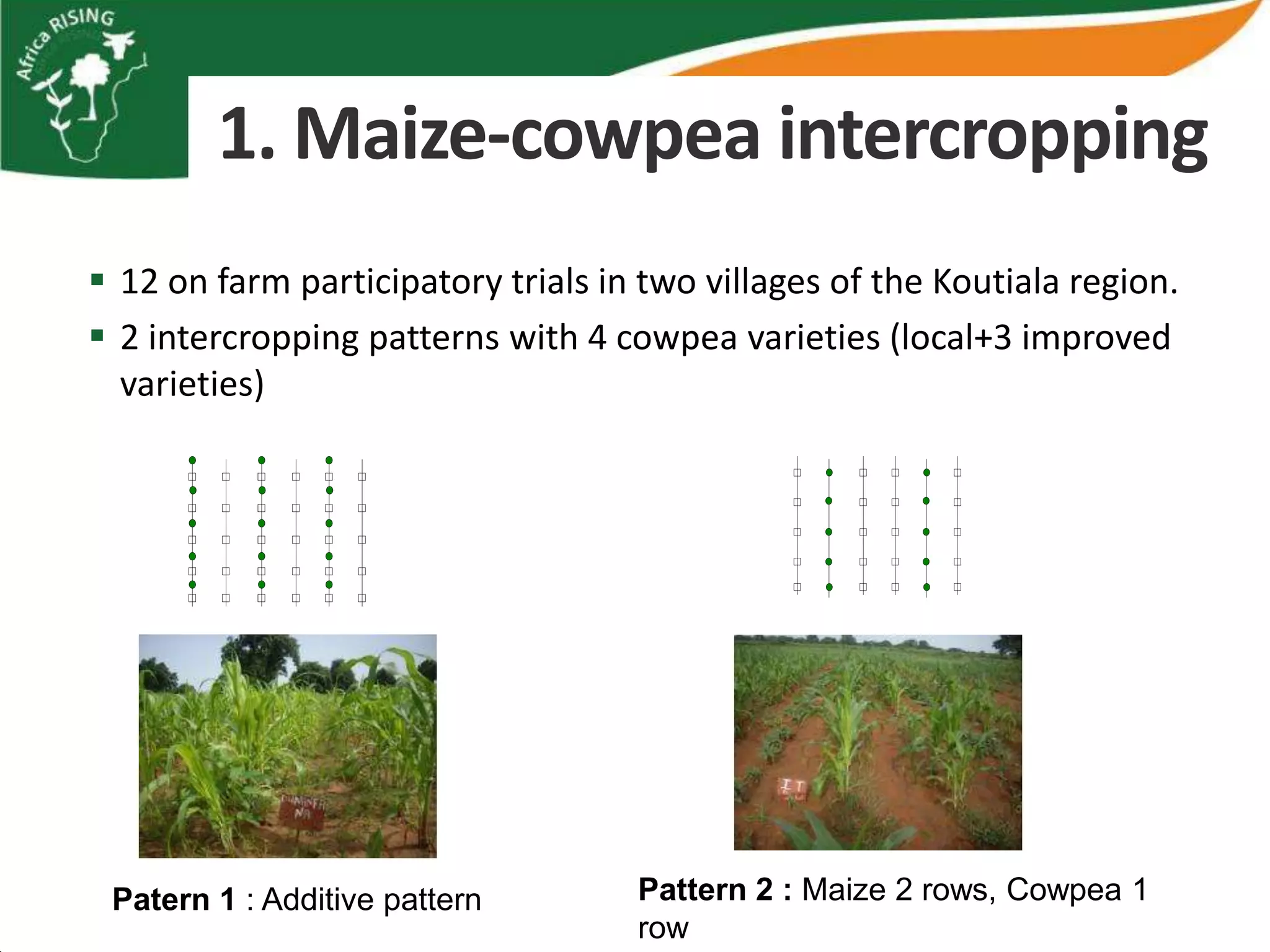
 12 on farm participatory trials in two villages of the Koutiala region.
 2 intercropping patterns with 4 cowpea varieties (local+3 improved
  varieties)


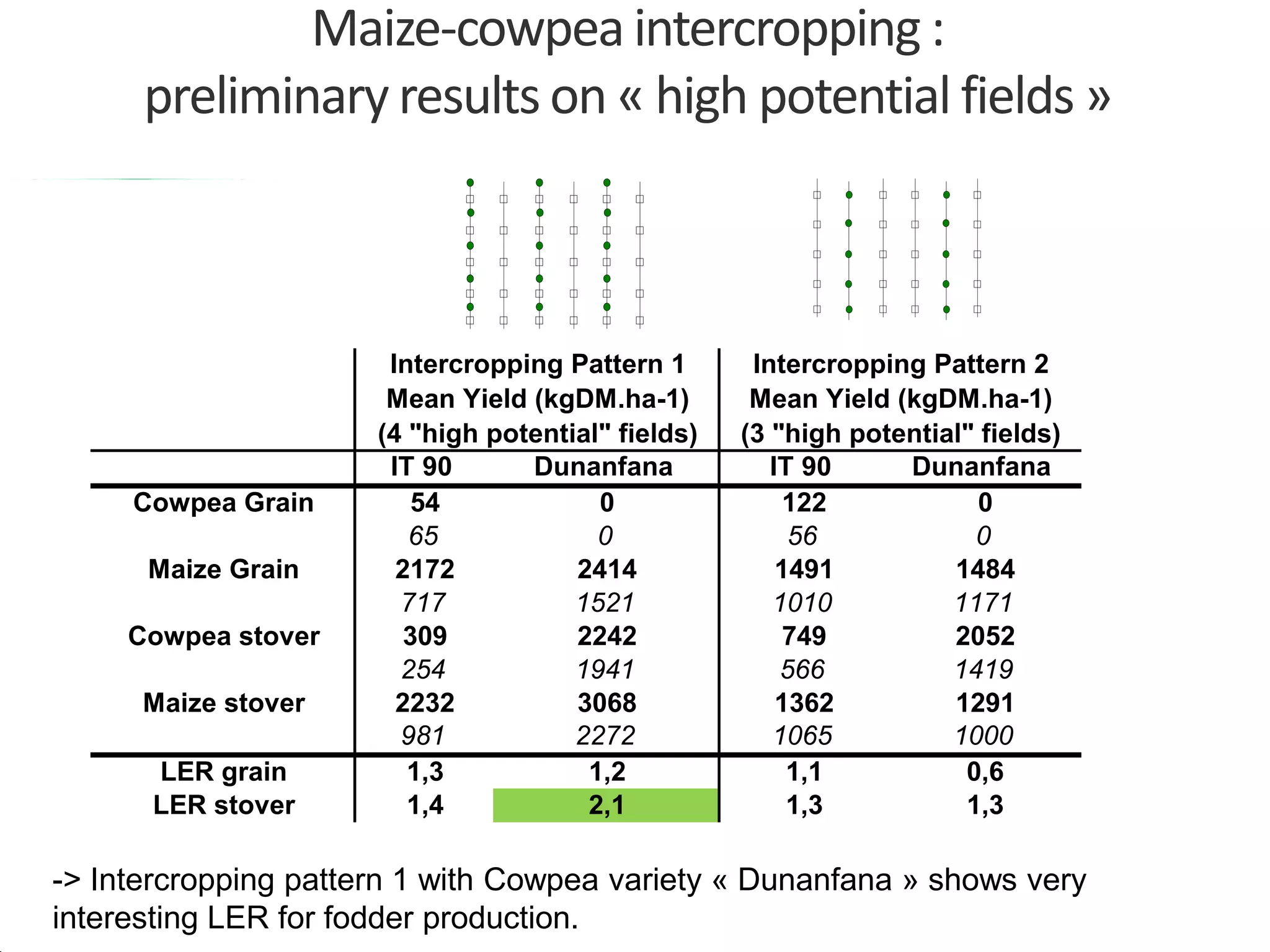
 Patern 1 : Additive pattern        Pattern 2 : Maize 2 rows, Cowpea 1
                                    row
Maize-cowpea intercropping :
      preliminary results on « high potential fields »


                       Intercropping Pattern 1       Intercropping Pattern 2
                       Mean Yield (kgDM.ha-1)        Mean Yield (kgDM.ha-1)
                      (4 "high potential" fields)   (3 "high potential" fields)
                       IT 90      Dunanfana            IT 90     Dunanfana
     Cowpea Grain         54            0                122            0
                         65             0                56            0
      Maize Grain       2172          2414              1491         1484
                        717           1521             1010          1171
     Cowpea stover       309          2242               749         2052
                        254           1941              566          1419
      Maize stover      2232          3068              1362         1291
                        981           2272             1065          1000
      LER grain          1,3           1,2               1,1          0,6
      LER stover         1,4           2,1               1,3          1,3

-> Intercropping pattern 1 with Cowpea variety « Dunanfana » shows very
interesting LER for fodder production.
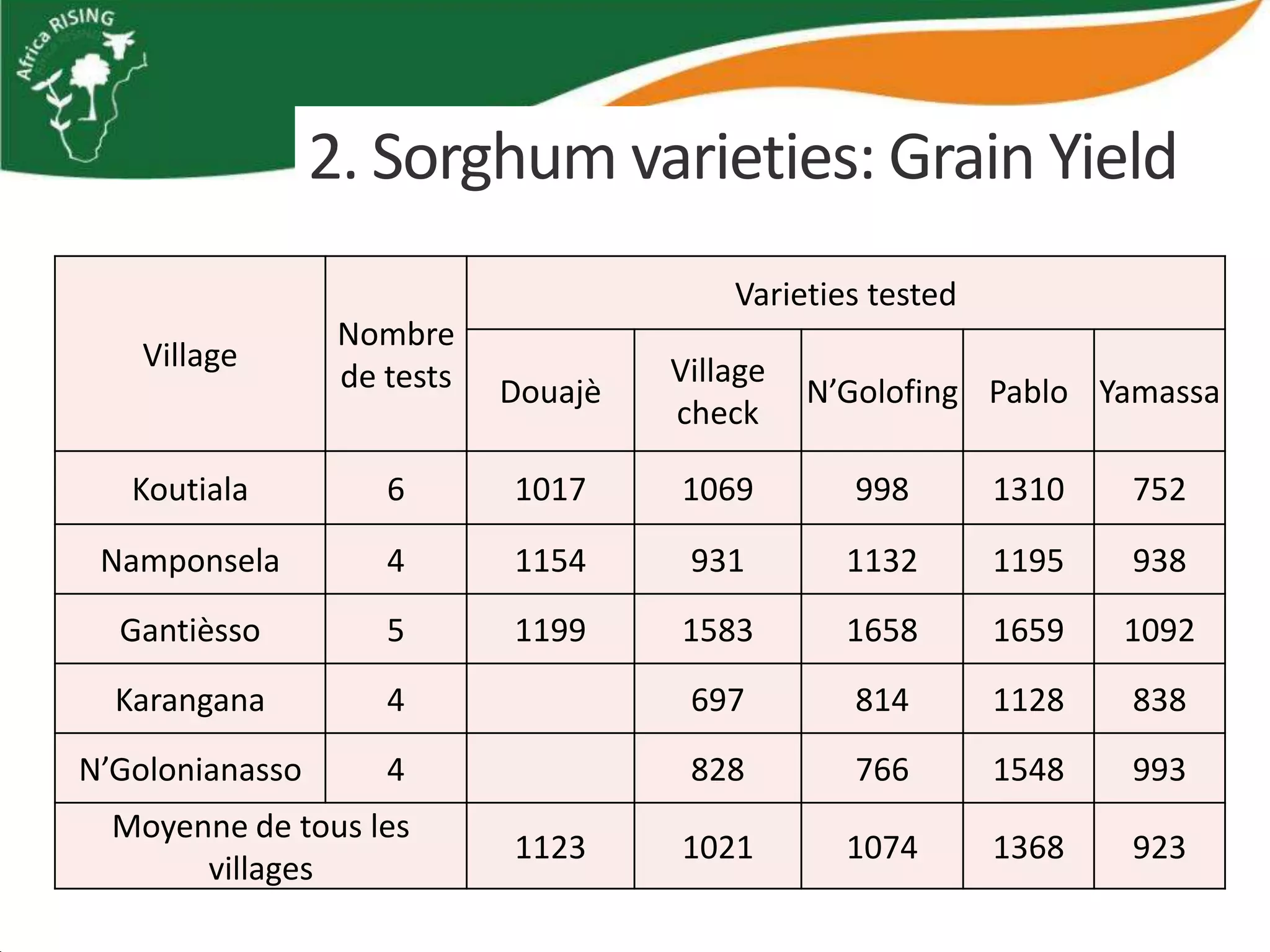
2. Sorghum varieties: Grain Yield
                                          Varieties tested
                  Nombre
    Village                           Village
                  de tests   Douajè             N’Golofing Pablo Yamassa
                                      check

   Koutiala          6       1017     1069        998        1310   752

 Namponsela          4       1154      931        1132       1195   938
  Gantièsso          5       1199     1583        1658       1659   1092
  Karangana          4                 697        814        1128   838
N’Golonianasso       4                 828        766        1548   993
  Moyenne de tous les
                             1123     1021        1074       1368   923
       villages
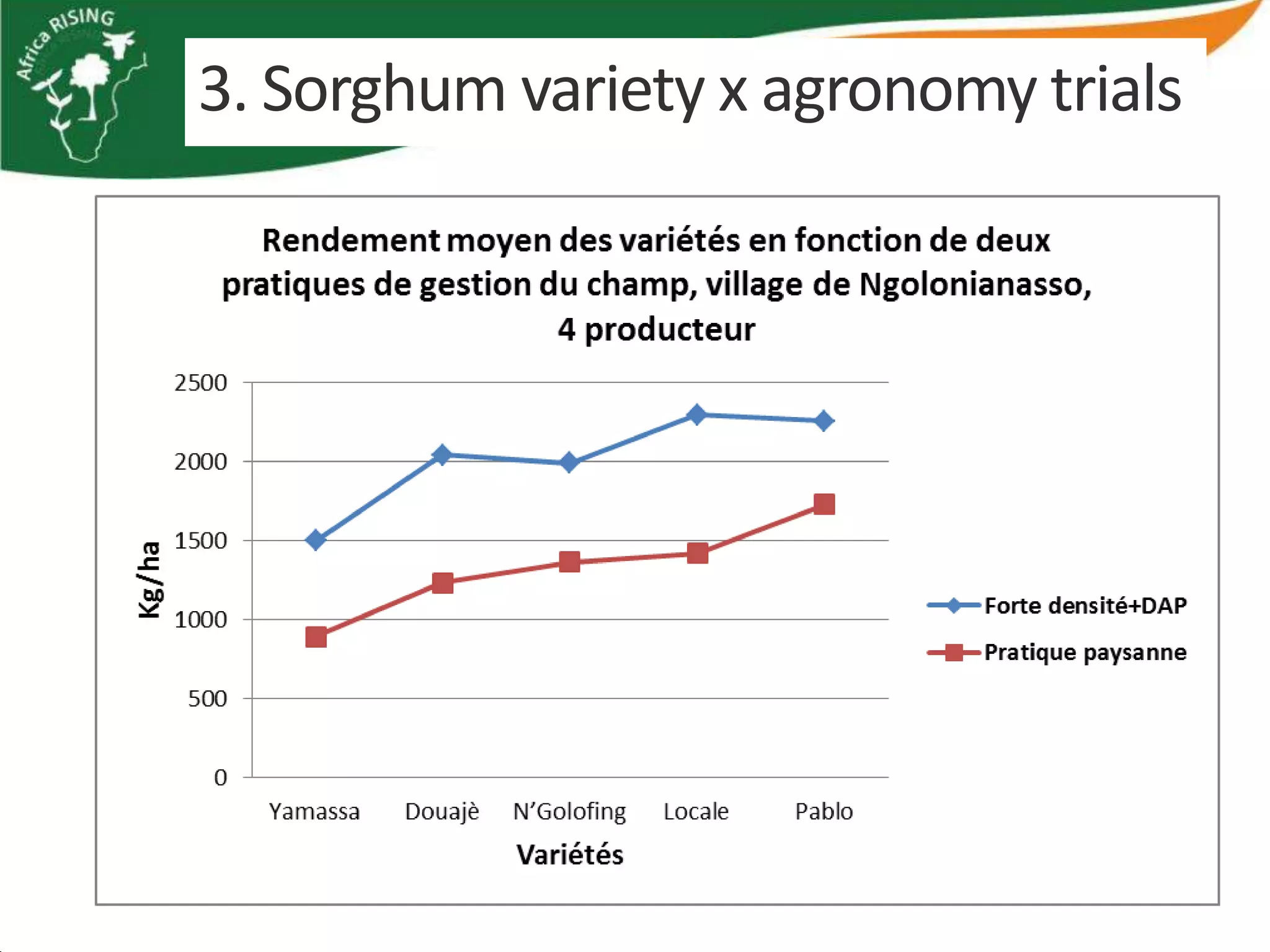
3. Sorghum variety x agronomy trials
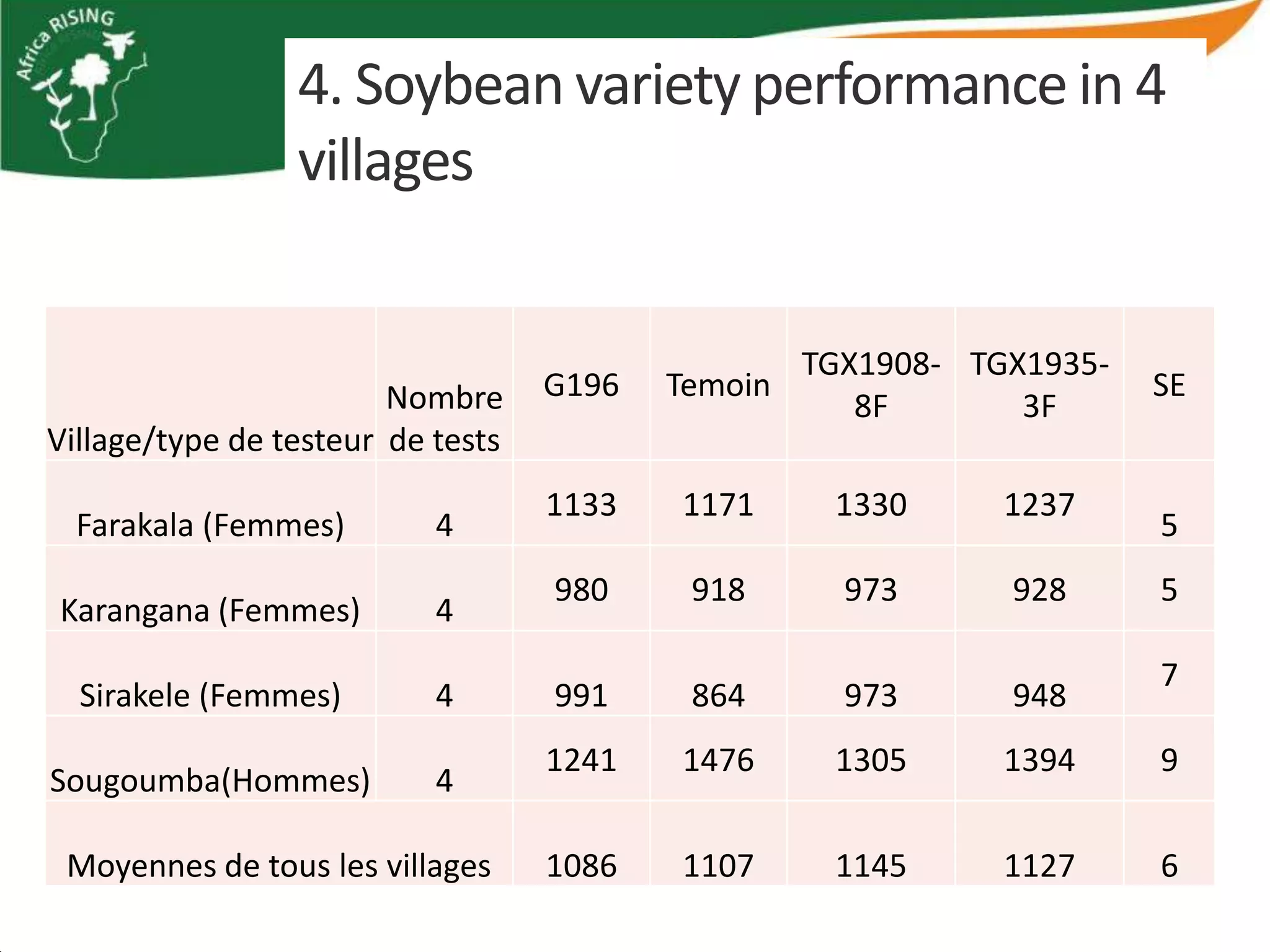
4. Soybean variety performance in 4
                 villages


                                                   TGX1908- TGX1935-
                        Nombre     G196   Temoin                       SE
                                                      8F       3F
Village/type de testeur de tests
                                   1133   1171      1330      1237
  Farakala (Femmes)        4                                           5
                                   980     918       973      928      5
Karangana (Femmes)         4
                                                                       7
  Sirakele (Femmes)        4       991     864       973      948
                                   1241   1476      1305      1394     9
Sougoumba(Hommes)          4

 Moyennes de tous les villages     1086   1107      1145      1127     6
Summary of experiments and training conducted with
             seed cooperatives in Yr1

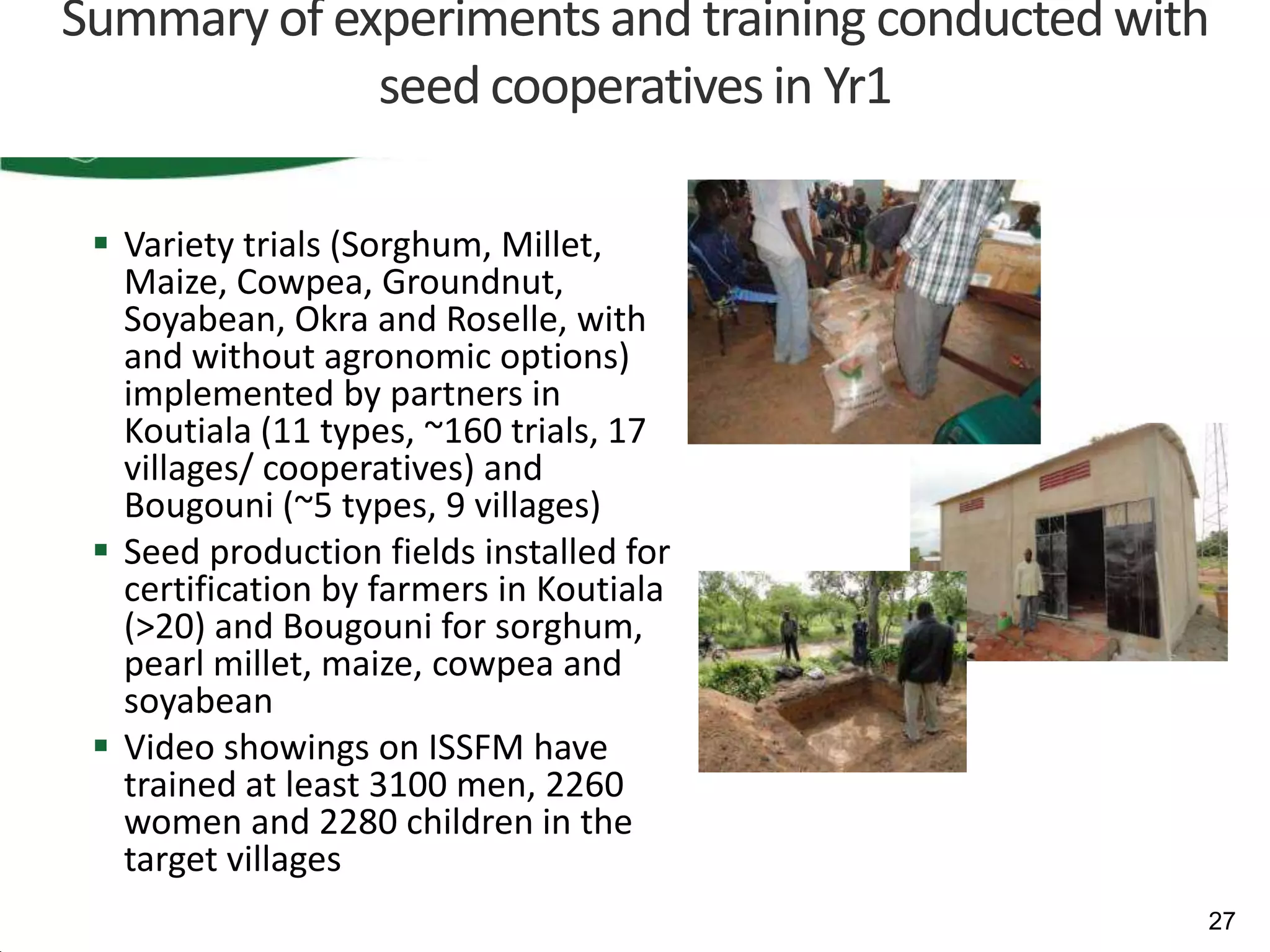
  Variety trials (Sorghum, Millet,
   Maize, Cowpea, Groundnut,
   Soyabean, Okra and Roselle, with
   and without agronomic options)
   implemented by partners in
   Koutiala (11 types, ~160 trials, 17
   villages/ cooperatives) and
   Bougouni (~5 types, 9 villages)
  Seed production fields installed for
   certification by farmers in Koutiala
   (>20) and Bougouni for sorghum,
   pearl millet, maize, cowpea and
   soyabean
  Video showings on ISSFM have
   trained at least 3100 men, 2260
   women and 2280 children in the
   target villages
                                                 27
4. Options for improving
nutritional status of young
         children
4 Training Modules developed:
                Preventing Malnutrition
 Module 1 : Alimentation des enfants de 6 mois à 2 ans ;
  Option : Bouillie enrichie à base de produits locaux +
  Conseils pratiques
 Module 2 : Nutrition et santé des femmes enceintes et
  allaitantes ; Option : Sauce de feuilles vertes & Sauce
  d’arachide avec feuilles vertes + Conseils pratiques
 Module 3 : Alimentation des enfants malades ; Option :
  Bouillie enrichie à base mil, soja, arachide + sucre + jus de
  fruits + Conseils pratiques
 Module 4 : « Prévention des carences alimentaires
  (vitamine A, iode et fer) ; Option : Soupe de légumes +
  Conseils pratiques
Indication of outcomes
 Monthly reporting for each of 36 villages of
  number of participating women using recipes
 Collection of ‘stories’ on experiences with using
  recipes
 Monitoring of sale of seed mini-packs from health
  centers
 Plan to collect medical records, to verify
  statements that less malnourished children arrive
  at health centers than from villages who did not
  participate in the training
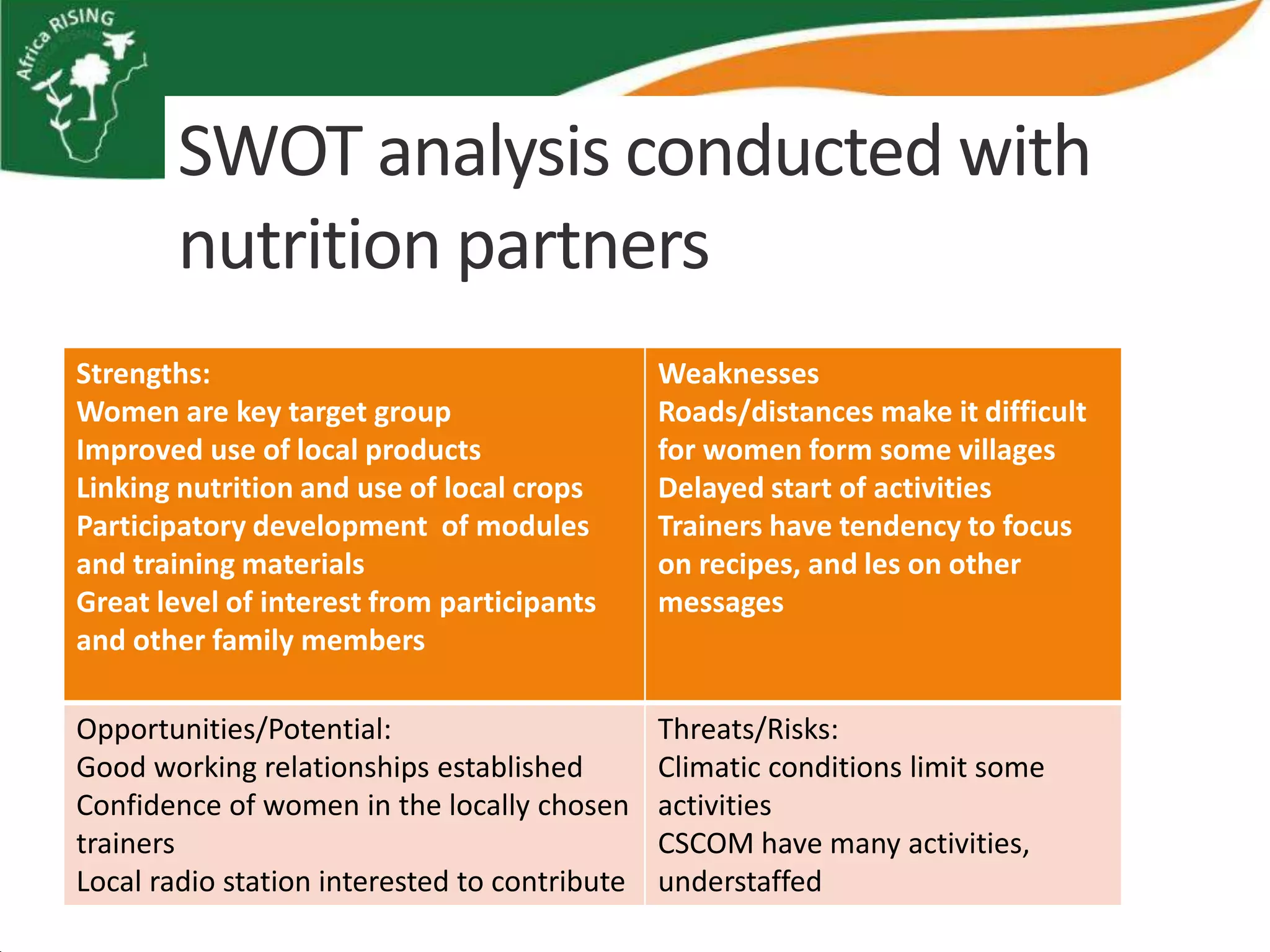
SWOT analysis conducted with
        nutrition partners
Strengths:                                     Weaknesses
Women are key target group                     Roads/distances make it difficult
Improved use of local products                 for women form some villages
Linking nutrition and use of local crops       Delayed start of activities
Participatory development of modules           Trainers have tendency to focus
and training materials                         on recipes, and les on other
Great level of interest from participants      messages
and other family members

Opportunities/Potential:                       Threats/Risks:
Good working relationships established         Climatic conditions limit some
Confidence of women in the locally chosen      activities
trainers                                       CSCOM have many activities,
Local radio station interested to contribute   understaffed
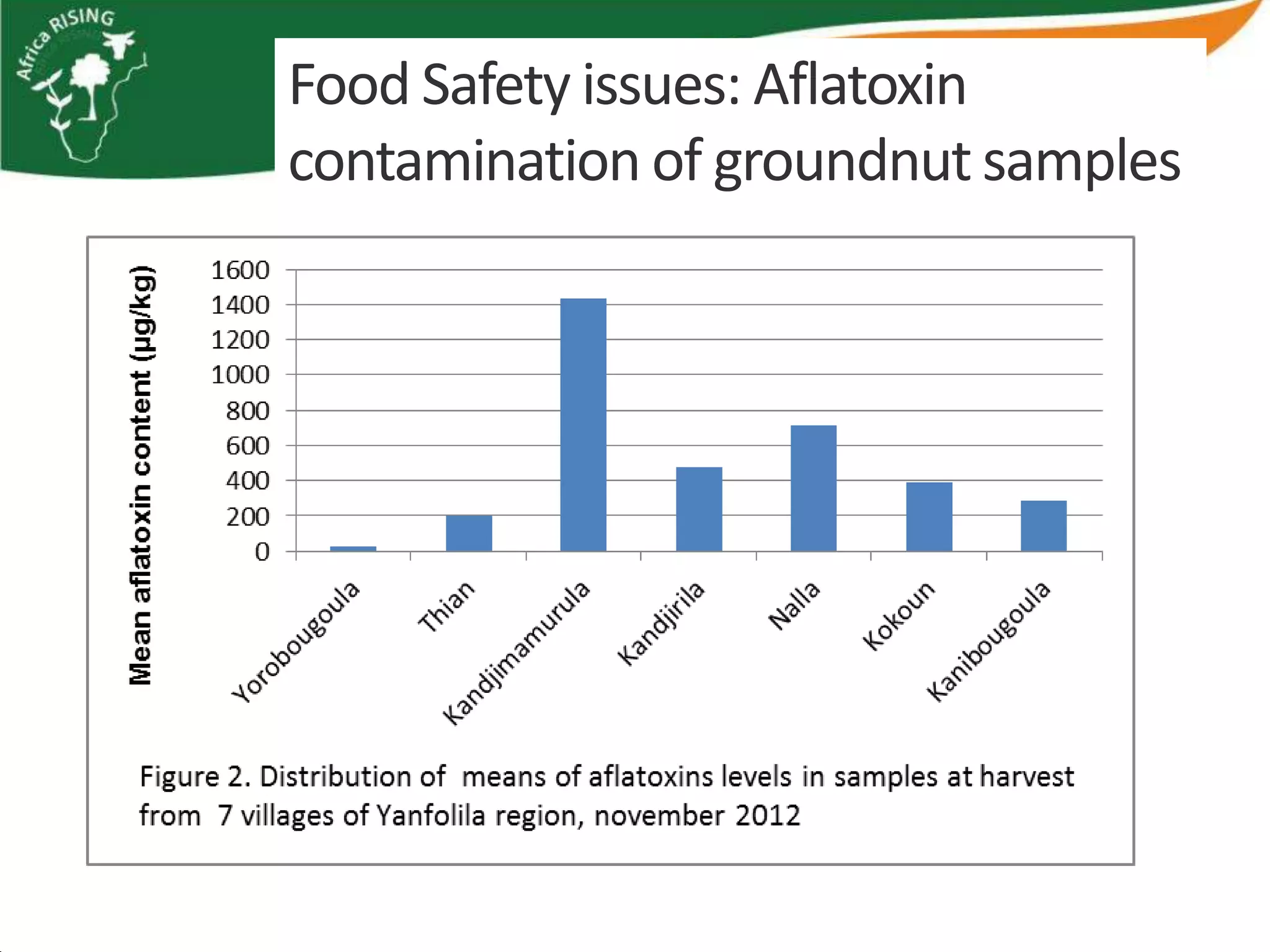
Food Safety issues: Aflatoxin
contamination of groundnut samples
Africa Research in Sustainable Intensification for the Next Generation
                    africa-rising.net

Africa RISING Mali report on Year 1 (2012)

  • 1.
    Africa Rising Malireport on Year 1 (2012) Eva Weltzien, Tom van Mourik, A. Rouamba, Vera Lugutuah, Yah Diakite, Bougouna Sogoba, Abdoulaye Diakite, Mamourou Sidibe, Joachim Binam, Augustine Ayantunde, Abdou Fall Africa RISING West Africa Stakeholder Meeting, Accra, Ghana, 23 January 2013
  • 2.
    Outline  Key events Implementing Partners  Research Approach  Key Research questions, Results and Outputs  Conclusions and Outlook
  • 3.
    Key events  Jan2012: Inception workshop in Tamale: identification of target outcomes and target zones in Mali  Feb 2012: Stakeholder workshops in the two target zones: Identification of implementation partners and key constraints to sustainable intensification  April/May 2012: Planning meetings with all actors  May/June 2012: Training on tools for implementation of farmer managed trials  June - Dec 2012: Implementation of rainy season field experimentation  Aug/Sep 2012 Preparations for Innovation Platform on options for Crop –livestock integration
  • 4.
    Implementation Partners  CGIAR:ICRISAT, ICRAF, ILRI, AVRDC  Koutiala area:  AMASSA: Strengthening farmer groups and associations for crop/grain marketing  AMEDD: Facilitation, Natural Resources Management, Communication  Bougouni:  Mobiom: Organizing farmers for marketing, and improved production technologies
  • 5.
    Consultants:  Moussa Djire:Experiences with of land-use conventions in Koutiala and Bougouni districts (ILRI)  Alpha Kergna: Household survey to compliment PROGEBE survey (focus on crops, additional sites) (ILRI)  Paul van Mele: Production and Translation of Farmer to Farmer videos (ICRISAT)  Moussa Noussourou: Training IPM for tomatoes (AVRDC)
  • 6.
    Research Approach (1) 1.Identification of Research Priorities: Needs expressed by stakeholders from the target areas, and discussions in view of opportunities provided by broad- based group of researchers 2. Search for entry points to facilitate participatory research across the production system: provide a local institutional context for joint learning
  • 7.
    Research Approach (2) 3.Address sustainability issues, while working on intensification research questions :  Ensure that on-farm experimentation is demand driven  Focus on building capacity in the target communities  Monitoring natural resources indicators  Targeting women's priorities  Initiate research on household typologies
  • 8.
    Main results: 1. Entrypoints for participatory research 2. Characterization of key elements in the target production systems 3. Options for increasing crop productivity 4. Options for improving nutritional status of young children 5. Options for enhancing natural resources (not reported today)
  • 9.
    1. Entry pointsfor participatory research on SI with multiple partners A. Strengthening existing seed and grain production cooperatives in the target areas:  Interest in a wide range of crops, Capacity to produce seed, Motivated to increase seed and/or grain sales,  Opportunities: identify varieties and crop management options for SI with the full range of crops, and a wide range of potential customers.  Sustainability focus: Building farmer and cooperative’s capacity for choosing varieties for multiplication/sale; for testing SI options; for communicating SI options  Partners: AMASSA, Mobiom, ICRISAT, AVRDC, ICRAF
  • 10.
    1. Entry pointsfor participatory research on SI with multiple partners (2) B. Innovation Platform for crop-livestock integration:  Local governments involved, as well as actors along the whole value chain for livestock, and forestry products, landscape scale, NRM issues  Opportunities: Addressing land management issues constructively; strengthening negotiation skills of a wide range of partners; local marketing issues considered, fodder availability options from the whole range of land types and for different types of livestock can be researched  Sustainability: attracting interest from other development actors, strengthening negotiation skills of a wide range of partners;  Partners: Mobiom, ILRI, ICRAF
  • 11.
    1. Entry pointsfor participatory research on SI with multiple partners (3) 3. Community Health Centers to facilitate work with women’s groups  Health with support for treating malnourished children; they have a responsibility for providing preventive care and advice  Opportunity: Supporting health centers with advice to prevent malnutrition, a wide diversity of crops, including vegetables and trees are adapted to the ecology  Sustainability: TOT with women’s groups, producing visuals as training material, joining training on nutrition with cooking lessons and crop production  Partners: AMEDD, ICRISAT. AVRDC, ICRAF
  • 12.
    1. Entry Pointsfor participatory research an SI with multiple partners  Each entry point provides a framework for collaboration with target communities with a specific purpose  Each entry point ensures that the research activities generate benefits for participating farmers from year 1  Creating opportunities for immediate impacts  Entry points could be compared and sequenced for studying specific outcomes
  • 13.
  • 15.
    Population pyramid ofGaralo “commune” in Koutiala in 2009/2010 > 80 ]70 - 75] Female Male ]60 - 65] ]50 - 55] ]40 - 45] ]30 - 35] ]20 - 25] ]10 - 15] ]0 - 5] 0.15 0.10 0.05 0.00 0.05 0.10 0.15 Proportion of the Total Population Age Class
  • 16.
    Principal Sources ofhousehold income in Koutiala and Bougouni (% of households ) Income source Koutiala (% of household Bougouni (% of household interviewed) interviewed) Sale of crops 60 65 Sale of animals 18 11 Off-farm activities 15 10 (small-scale commerce, remittances, salaried work) Vegetable production 5 2 Forest products 2 9 Others (e.g. fishing) 0 3
  • 17.
    Use of cropproduced by the households in Koutiala and Bougouni in 2011 Crop Household Sale (%) consumption (%) Koutiala Bougouni Koutiala Bougouni Millet 79 75 12 23 Maize 76 72 16 22 Sorghum 77 77 14 16 Rice 75 60 20 29 Cotton 9 0 91 100 Groundnut 49 41 40 52 Cowpea 84 55 16 40
  • 18.
    Key issues forSustainable Intensification from survey results  Access to agricultural implements and inputs, credit  Risk mitigation to cope with climate variability, and market shocks  Information systems and training on improved agronomy, quality control of drugs and pesticides  Value addition particularly cereals and livestock value chains  Adequate feed for traction animals
  • 19.
    Farm typology :establisment (1/2)  IER SEP dataset : 30 farms of 3 village of the Koutiala area monitored from 1994 to 2011 on structural characteristics (household composition, assets)  Cluster Analysis on 6 parameters : Cropland size, number of workers, Household total size, TLU, Oxen, Draught tools 4 Farm types : • Big mixed farms with large herds, • Big mixed farms with medium herds, • Medium mixed farms, •small farms with very small herds
  • 20.
    Farm typology :Farmers’ feedback (2/2) • Presentation of the typology to a group of 23 farmers involved in Icrisat activities. Each farmer can recognize himself in a type • Farmers recognize strategies to move ‘up’ to a type of better resource endowment : 1. Crop livestock integration and better soil fertility management 2. Management of working calendars, Agreement between family members on activities and income repartition 3. Diversification activities (livestock fattening, vegetables, banana plantation, activities out of agriculture)
  • 21.
    3. Options forincreasing crop productivity and farmers’ incomes
  • 22.
    1. Maize-cowpea intercropping 12 on farm participatory trials in two villages of the Koutiala region.  2 intercropping patterns with 4 cowpea varieties (local+3 improved varieties) Patern 1 : Additive pattern Pattern 2 : Maize 2 rows, Cowpea 1 row
  • 23.
    Maize-cowpea intercropping : preliminary results on « high potential fields » Intercropping Pattern 1 Intercropping Pattern 2 Mean Yield (kgDM.ha-1) Mean Yield (kgDM.ha-1) (4 "high potential" fields) (3 "high potential" fields) IT 90 Dunanfana IT 90 Dunanfana Cowpea Grain 54 0 122 0 65 0 56 0 Maize Grain 2172 2414 1491 1484 717 1521 1010 1171 Cowpea stover 309 2242 749 2052 254 1941 566 1419 Maize stover 2232 3068 1362 1291 981 2272 1065 1000 LER grain 1,3 1,2 1,1 0,6 LER stover 1,4 2,1 1,3 1,3 -> Intercropping pattern 1 with Cowpea variety « Dunanfana » shows very interesting LER for fodder production.
  • 24.
    2. Sorghum varieties:Grain Yield Varieties tested Nombre Village Village de tests Douajè N’Golofing Pablo Yamassa check Koutiala 6 1017 1069 998 1310 752 Namponsela 4 1154 931 1132 1195 938 Gantièsso 5 1199 1583 1658 1659 1092 Karangana 4 697 814 1128 838 N’Golonianasso 4 828 766 1548 993 Moyenne de tous les 1123 1021 1074 1368 923 villages
  • 25.
    3. Sorghum varietyx agronomy trials
  • 26.
    4. Soybean varietyperformance in 4 villages TGX1908- TGX1935- Nombre G196 Temoin SE 8F 3F Village/type de testeur de tests 1133 1171 1330 1237 Farakala (Femmes) 4 5 980 918 973 928 5 Karangana (Femmes) 4 7 Sirakele (Femmes) 4 991 864 973 948 1241 1476 1305 1394 9 Sougoumba(Hommes) 4 Moyennes de tous les villages 1086 1107 1145 1127 6
  • 27.
    Summary of experimentsand training conducted with seed cooperatives in Yr1  Variety trials (Sorghum, Millet, Maize, Cowpea, Groundnut, Soyabean, Okra and Roselle, with and without agronomic options) implemented by partners in Koutiala (11 types, ~160 trials, 17 villages/ cooperatives) and Bougouni (~5 types, 9 villages)  Seed production fields installed for certification by farmers in Koutiala (>20) and Bougouni for sorghum, pearl millet, maize, cowpea and soyabean  Video showings on ISSFM have trained at least 3100 men, 2260 women and 2280 children in the target villages 27
  • 28.
    4. Options forimproving nutritional status of young children
  • 29.
    4 Training Modulesdeveloped: Preventing Malnutrition  Module 1 : Alimentation des enfants de 6 mois à 2 ans ; Option : Bouillie enrichie à base de produits locaux + Conseils pratiques  Module 2 : Nutrition et santé des femmes enceintes et allaitantes ; Option : Sauce de feuilles vertes & Sauce d’arachide avec feuilles vertes + Conseils pratiques  Module 3 : Alimentation des enfants malades ; Option : Bouillie enrichie à base mil, soja, arachide + sucre + jus de fruits + Conseils pratiques  Module 4 : « Prévention des carences alimentaires (vitamine A, iode et fer) ; Option : Soupe de légumes + Conseils pratiques
  • 30.
    Indication of outcomes Monthly reporting for each of 36 villages of number of participating women using recipes  Collection of ‘stories’ on experiences with using recipes  Monitoring of sale of seed mini-packs from health centers  Plan to collect medical records, to verify statements that less malnourished children arrive at health centers than from villages who did not participate in the training
  • 31.
    SWOT analysis conductedwith nutrition partners Strengths: Weaknesses Women are key target group Roads/distances make it difficult Improved use of local products for women form some villages Linking nutrition and use of local crops Delayed start of activities Participatory development of modules Trainers have tendency to focus and training materials on recipes, and les on other Great level of interest from participants messages and other family members Opportunities/Potential: Threats/Risks: Good working relationships established Climatic conditions limit some Confidence of women in the locally chosen activities trainers CSCOM have many activities, Local radio station interested to contribute understaffed
  • 32.
    Food Safety issues:Aflatoxin contamination of groundnut samples
  • 33.
    Africa Research inSustainable Intensification for the Next Generation africa-rising.net

Editor's Notes

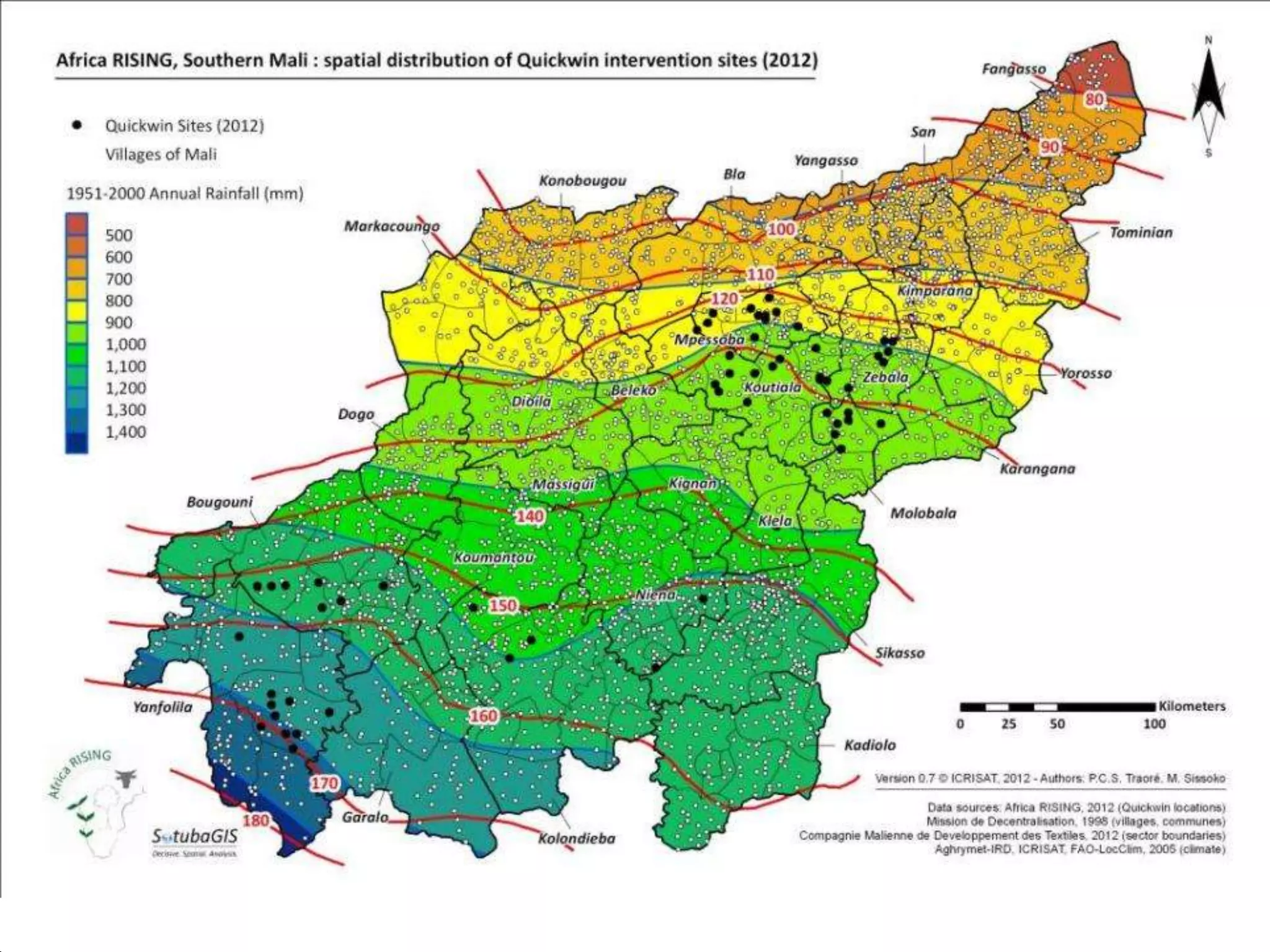
  • #15 Contrastingly, the length of growing season spans a lower range than Ghana’s Africa RISING domain, in Southern Mali here from 80 to 180 days.