MODERN ART
Modern art embraces a wide variety of movements,
theories, and attitudes whose modernism resides particularly in a
tendency to reject traditional, historical, or academic forms and
conventions in an effort to create an art more in keeping with
changed social, economic, and intellectual conditions.
Father of Modern Art Work
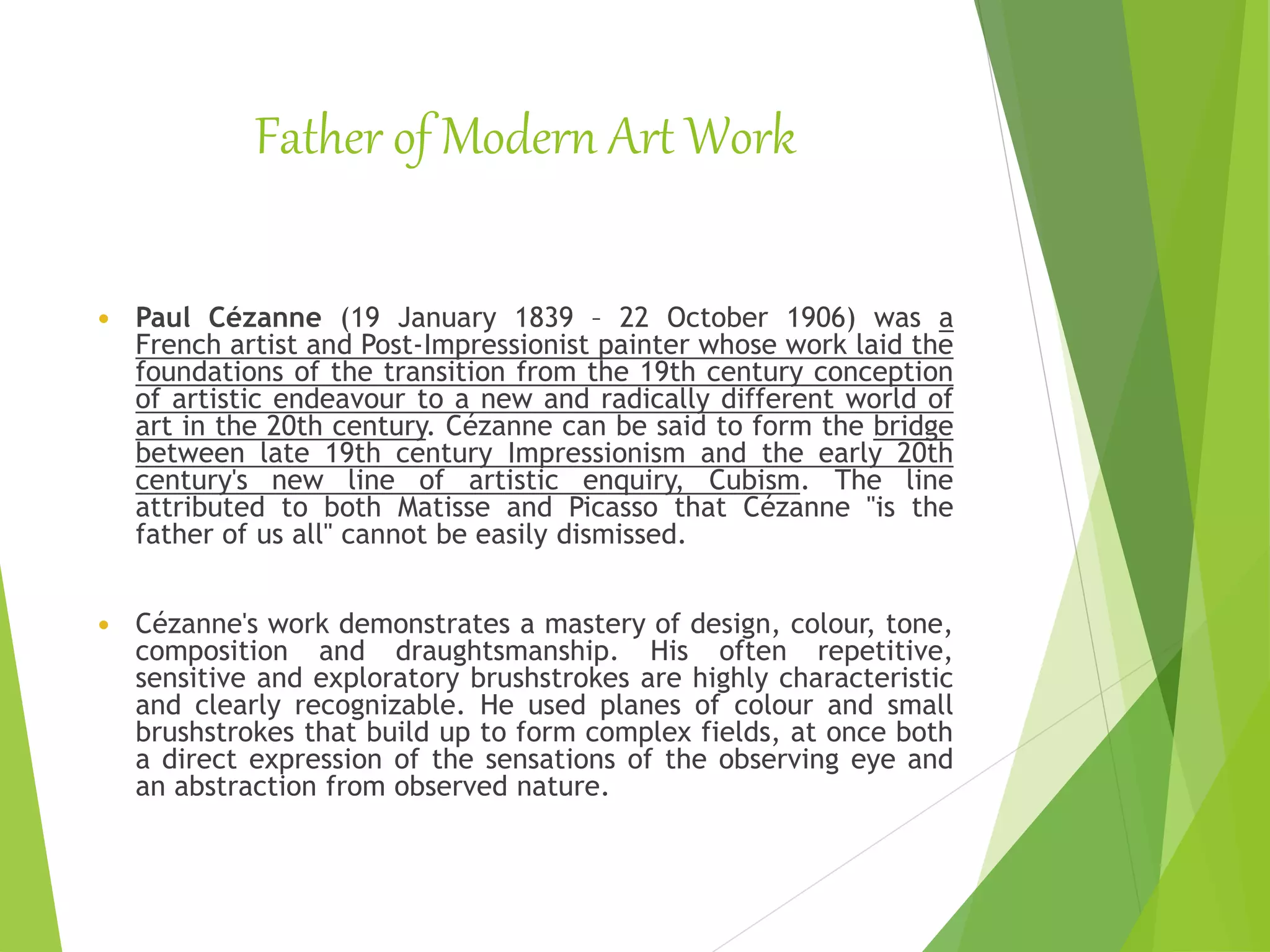
 Paul Cézanne (19 January 1839 – 22 October 1906) was a
French artist and Post-Impressionist painter whose work laid the
foundations of the transition from the 19th century conception
of artistic endeavour to a new and radically different world of
art in the 20th century. Cézanne can be said to form the bridge
between late 19th century Impressionism and the early 20th
century's new line of artistic enquiry, Cubism. The line
attributed to both Matisse and Picasso that Cézanne "is the
father of us all" cannot be easily dismissed.
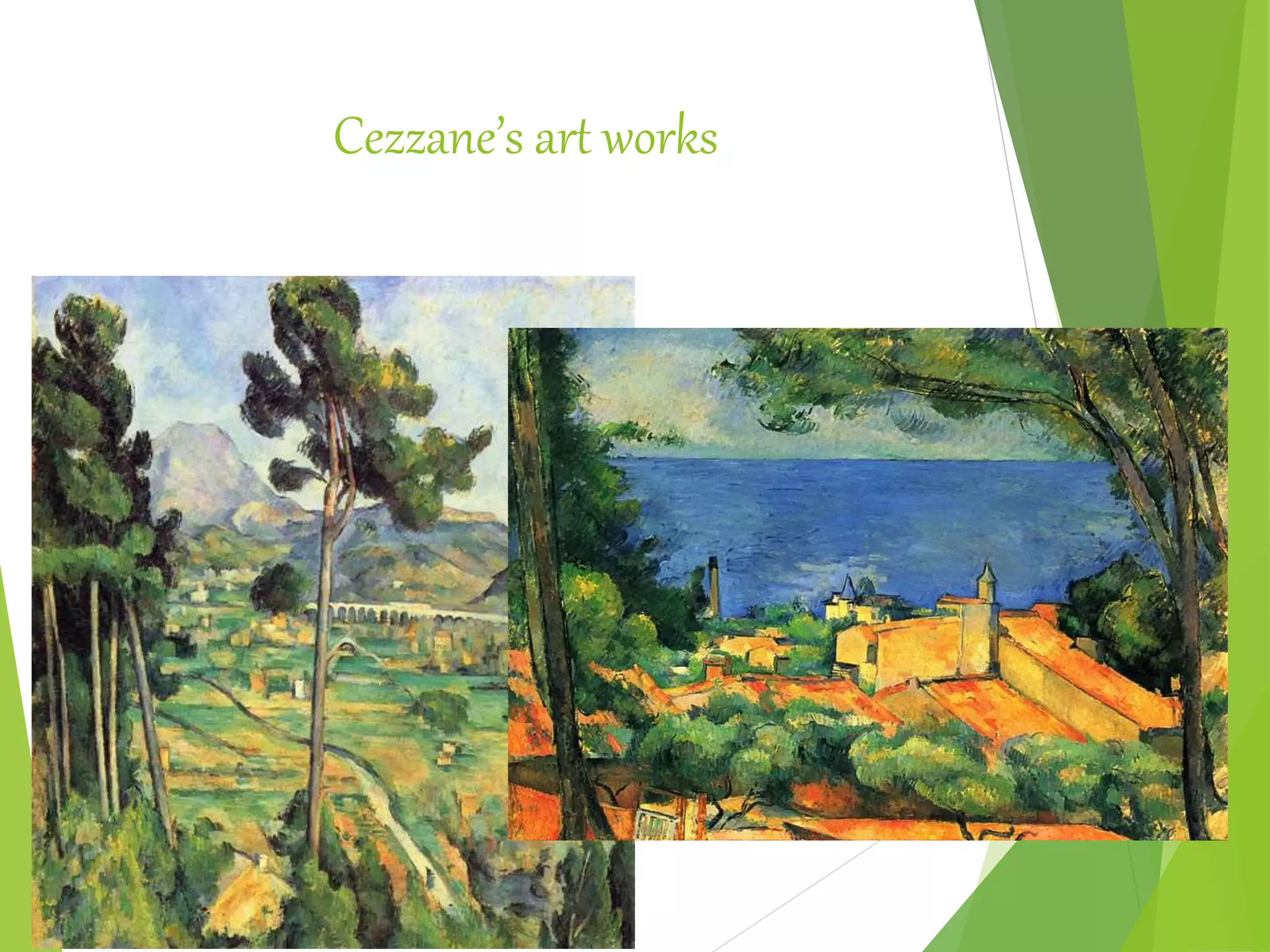
 Cézanne's work demonstrates a mastery of design, colour, tone,
composition and draughtsmanship. His often repetitive,
sensitive and exploratory brushstrokes are highly characteristic
and clearly recognizable. He used planes of colour and small
brushstrokes that build up to form complex fields, at once both
a direct expression of the sensations of the observing eye and
an abstraction from observed nature.
PAUL CEZANNE (19 January 1839 – 22 October 1906)
Cezzane’s art works
CLASSIFICATION OF MODERN
MOVEMENTS
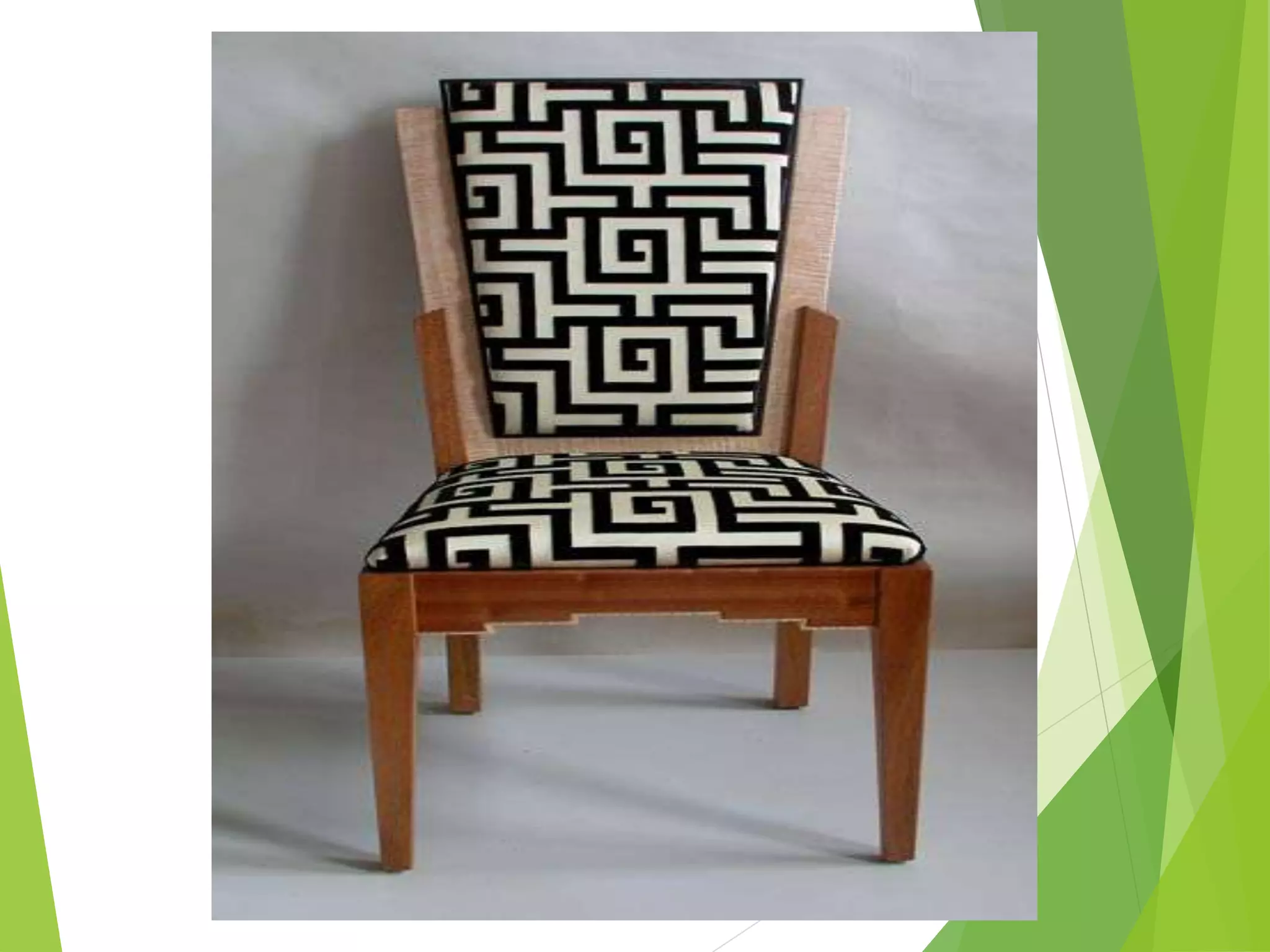
 Art Deco is an eclectic artistic and design
style that began in Paris in the 1920s and
flourished internationally throughout the
1930s, into the World War II era. The style
influenced all areas of design, including
architecture and interior design,
industrial design, fashion and jewelry, as
well as the visual arts such as painting,
graphic arts and film. At its best, Art Deco
represented elegance, glamour,
functionality and modernity.
Art Nouveau
 Art Nouveau, is an international philosophy
and style of art, architecture and applied
art—especially the decorative arts—that
were most popular during 1890–1905. The
name "Art Nouveau" is French for "new art".
It is known also as Jugendstil. Art Nouveau
is a philosophy of design according to which
artists should work on everything from
architecture to furniture, making art part
of ordinary life.
Abstract
 Abstract art uses a visual language of form, color and
line to create a composition which may exist with a
degree of independence from visual references in the
world. Western art had been, from the Renaissance up
to the middle of the 19th century, underpinned by the
logic of perspective and an attempt to reproduce an
illusion of visible reality.
 But Abstract has no exact or recognizable
representation of images and thus, proper strokes in
applying pigments are not required.
CUBISM
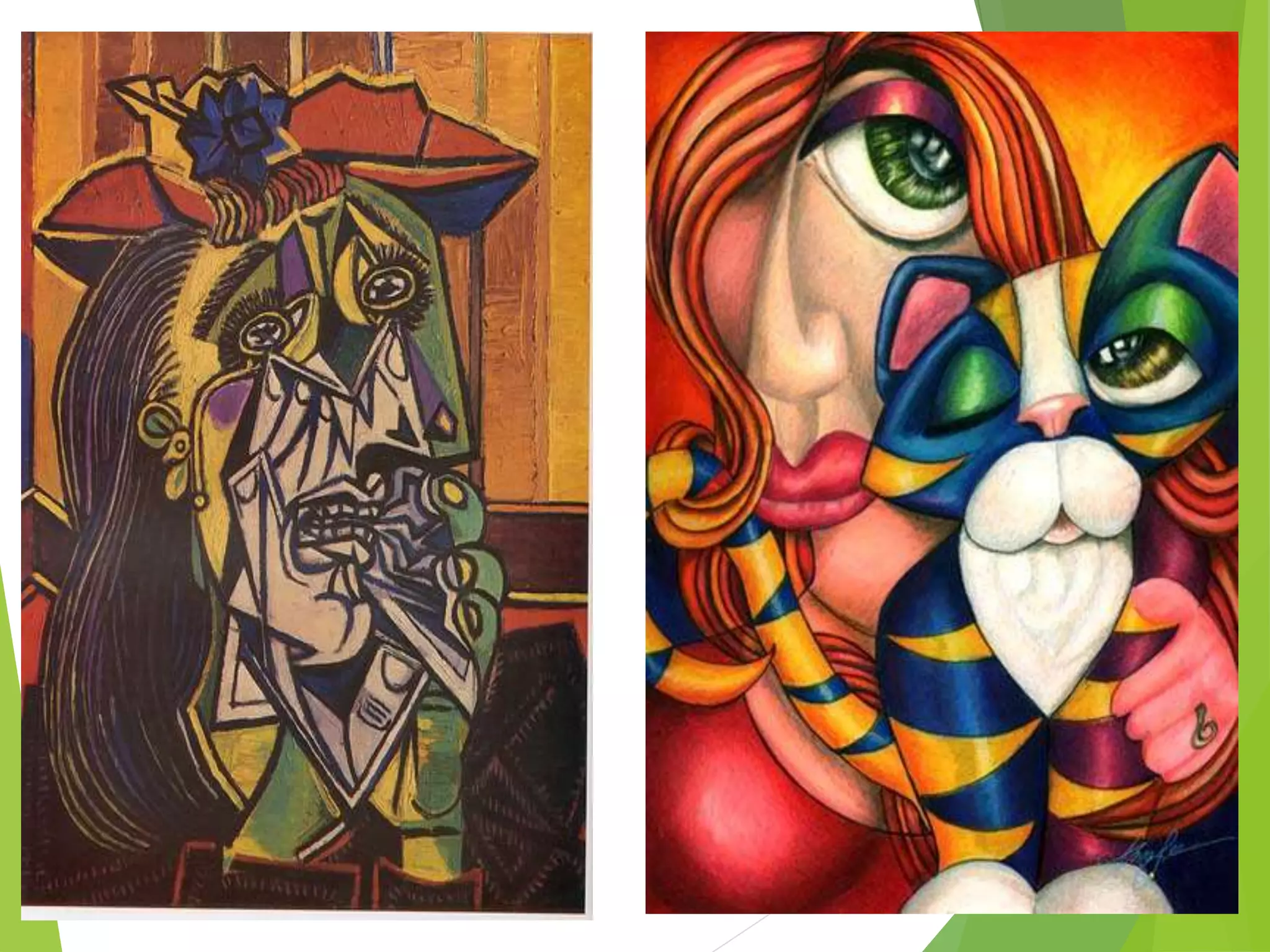
 Cubism was a 20th century avant-garde art
movement, pioneered by Pablo Picasso (full
name Pablo Diego José Francisco de Paula
Juan Nepomuceno María de los Remedios
Cipriano de la Santísima Trinidad Clito Ruiz y
Picasso) and Georges Braque, that
revolutionized European painting and
sculpture, and inspired related movements in
music, literature and architecture. In cubist
artworks, objects are shown from several
positions or different sides at one time.
 Cubism is represented through geometrical
forms.
LES NOCES DE PIERETTE(The Marriage of Pierette-most
valuable work of Picasso in 2000
DADAISM
 Dadaism is a cultural movement that began in Zurich,
Switzerland, during World War I and peaked from 1916 to
1922. he movement primarily involved visual arts,
literature—poetry, art manifestoes, art theory—theatre,
and graphic design, and concentrated its anti-war
politics through a rejection of the prevailing standards in
art through anti-art cultural works. Its purpose was to
ridicule what its participants considered to be the
meaninglessness of the modern world. In addition to
being anti-war, dada was also anti-bourgeois and
anarchist in nature.
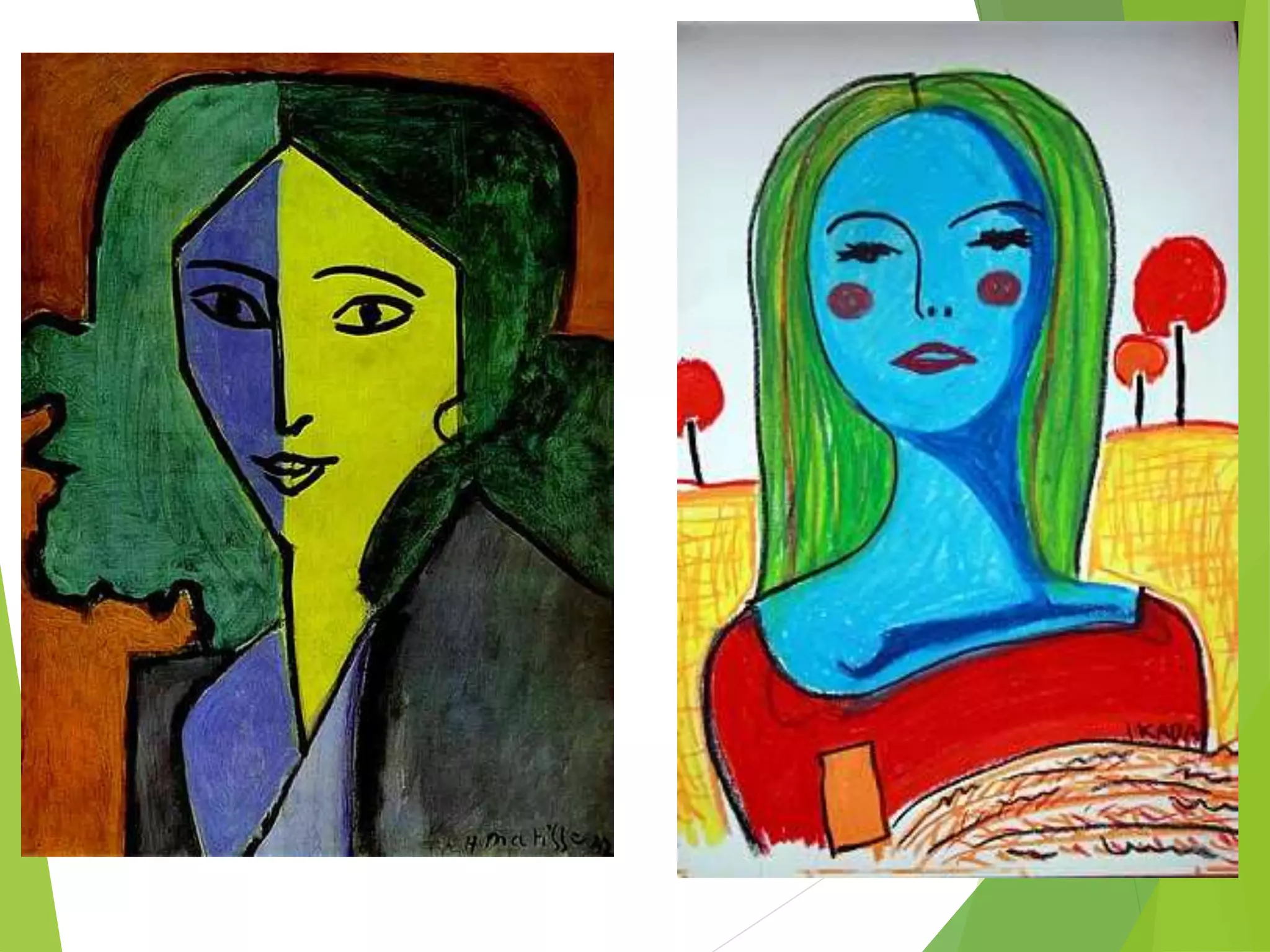
fauvism
 Fauvism is the style of les Fauves
(French for "the wild beasts"), a short-
lived and loose group of early twentieth-
century Modern artists whose works
emphasized painterly qualities and strong
color over the representational or
realistic values retained by
Impressionism. The leaders of the
movement were Henri Matisse and André
Derain.
 It is being represented in concept of
colors.
futurism
 Futurism was an artistic and social movement
that originated in Italy in the early 20th
century. It emphasized and glorified themes
associated with contemporary concepts of the
future, including speed, technology, youth and
violence, and objects such as the car, the
airplane and the industrial city. Futurism
influenced art movements such as Art Deco,
Constructivism, Surrealism, Dada, and to a
greater degree, Rayonism and Vorticism.
 It is represented through machine age and
speed.
Op art
 Op art, also known as optical art, is a style of
visual art that makes use of optical illusions.
"Optical art is a method of painting
concerning the interaction between illusion
and picture plane, between understanding
and seeing." Op art works are abstract, with
many of the better known pieces made in
only black and white. When the viewer looks
at them, the impression is given of
movement, hidden images, flashing and
vibration, patterns, or alternatively, of
swelling or warping.
pointillism
 Pointillism is a technique of painting
in which small, distinct dots of pure
color are applied in patterns to form
an image. Georges Seurat developed
the technique in 1886, branching from
Impressionism. The term Pointillism
was first coined by art critics in the
late 1880s to ridicule the works of
these artists, and is now used without
its earlier mocking connotation.
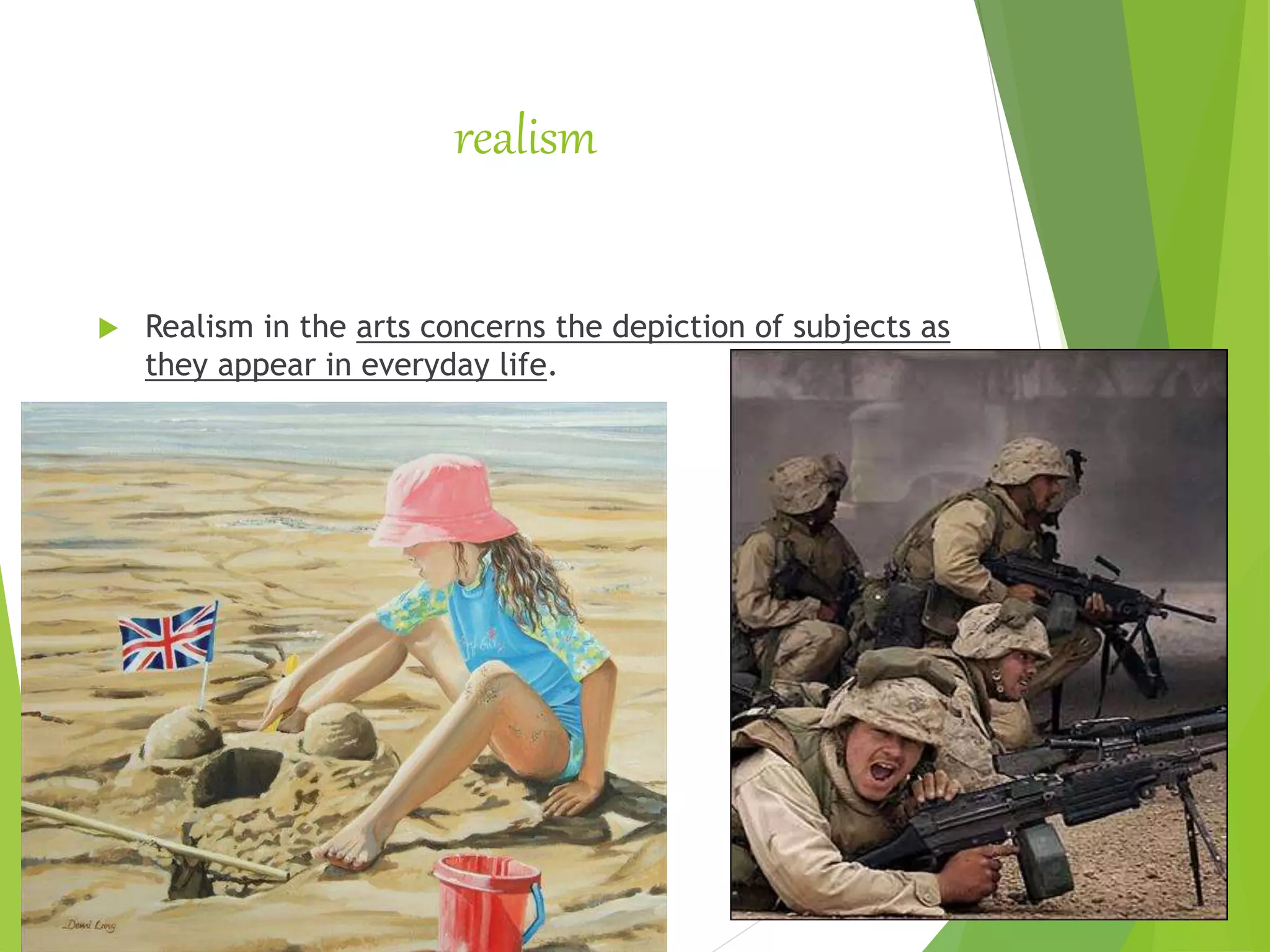
realism
 Realism in the arts concerns the depiction of subjects as
they appear in everyday life.
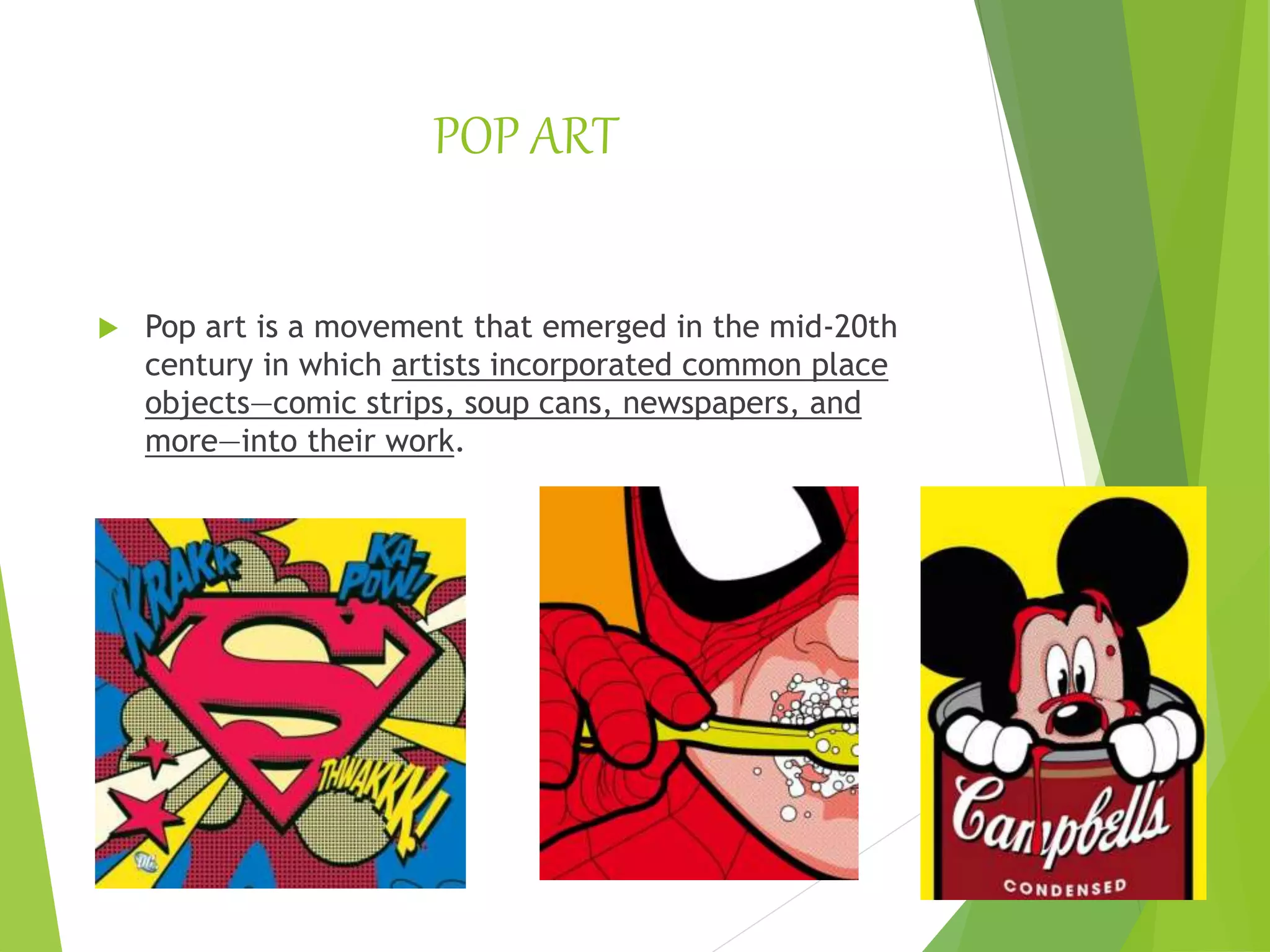
POP ART
 Pop art is a movement that emerged in the mid-20th
century in which artists incorporated common place
objects—comic strips, soup cans, newspapers, and
more—into their work.
POP ART
 Perhaps the most well-known artistic
development of the 20th century, Pop art
emerged in reaction to consumerism, mass
media, and popular culture. This movement
surfaced in the 1950s and gained major
momentum throughout the sixties. Pop art
transitioned away from the theory and
methods used in Abstract Expressionism, the
leading movement that preceded it. Instead,
it drew upon everyday objects and media like
newspapers, comic books, magazines, and
other mundane objects to produce vibrant
compositions, establishing the movement as a
cornerstone of contemporary art.
surrealism
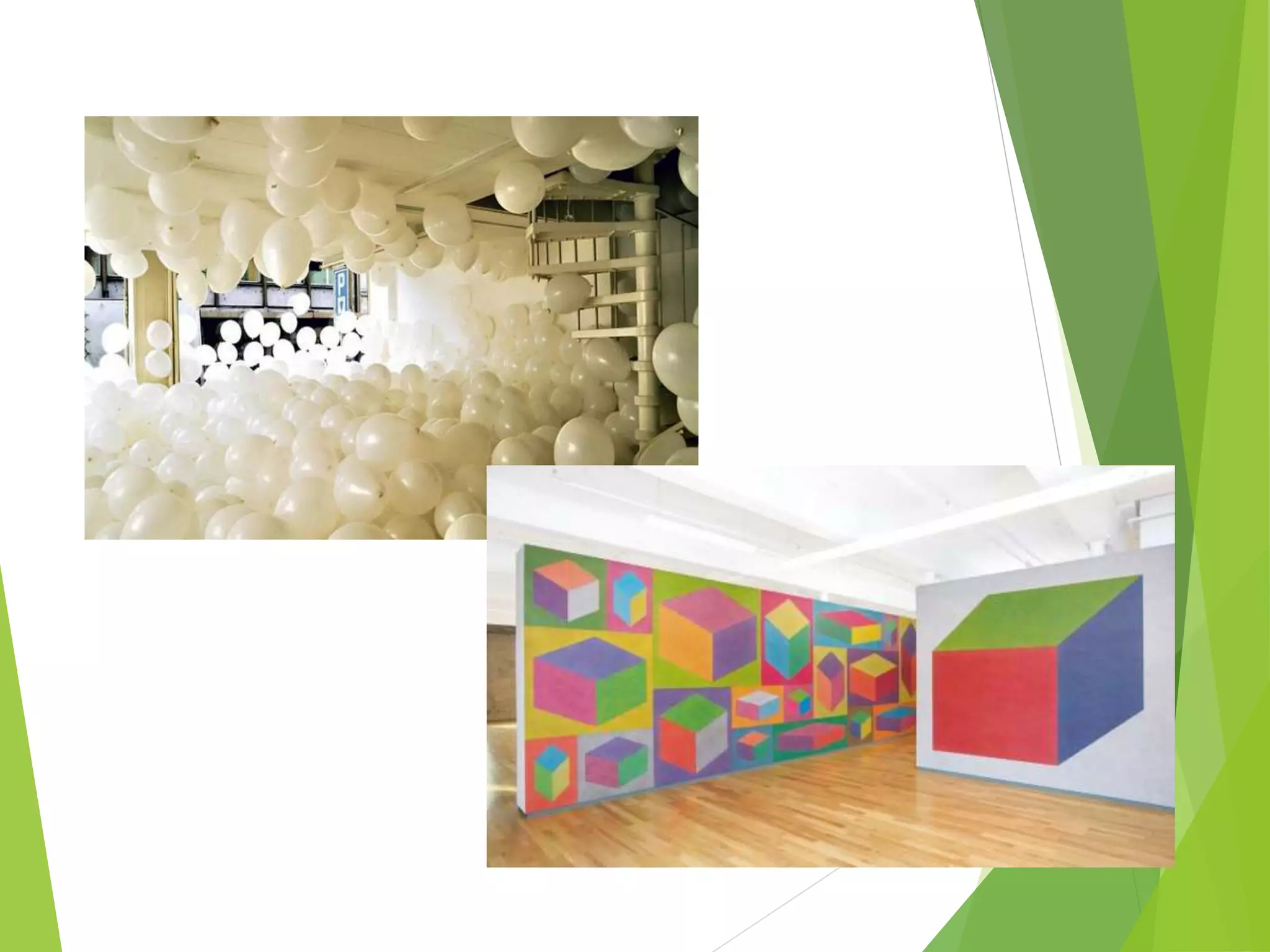
 Surrealist works feature the
element of surprise,
unexpected juxtapositions and
non sequitur; however, many
Surrealist artists and writers.
 Images are represented mainly
in the realm of dreams and the
unconscious mind.
Conceptual art
 sometimes simply called
conceptualism, is art in which the
concept(s) or idea(s) involved in the
work take precedence over
traditional aesthetic, technical, and
material concerns. Some works of
conceptual art, sometimes called
installations, may be constructed by
anyone simply by following a set of
written instructions
Installation/
assemblage art
 is an artistic form or medium
usually created on a defined
substrate that consists of three-
dimensional elements projecting
out of or from the substrate. It is
similar to collage, a two-
dimensional medium. It is part of
the visual arts, and it typically
uses found objects, but is not
limited to these materials.[
assemblage
Performance art
 is a performance presented to an
audience within a fine art context,
traditionally interdisciplinary.
Performance may be either scripted
or unscripted, random or carefully
orchestrated, spontaneous or
otherwise carefully planned with or
without audience participation. The
performance can be live or via
media; the performer can be present
or absent.
When I work, I work very fast, but
preparing to work can take any
length of time.
-alice neel-

MODERN ART.ppt

  • 1.
    MODERN ART Modern artembraces a wide variety of movements, theories, and attitudes whose modernism resides particularly in a tendency to reject traditional, historical, or academic forms and conventions in an effort to create an art more in keeping with changed social, economic, and intellectual conditions.
  • 2.
    Father of ModernArt Work  Paul Cézanne (19 January 1839 – 22 October 1906) was a French artist and Post-Impressionist painter whose work laid the foundations of the transition from the 19th century conception of artistic endeavour to a new and radically different world of art in the 20th century. Cézanne can be said to form the bridge between late 19th century Impressionism and the early 20th century's new line of artistic enquiry, Cubism. The line attributed to both Matisse and Picasso that Cézanne "is the father of us all" cannot be easily dismissed.  Cézanne's work demonstrates a mastery of design, colour, tone, composition and draughtsmanship. His often repetitive, sensitive and exploratory brushstrokes are highly characteristic and clearly recognizable. He used planes of colour and small brushstrokes that build up to form complex fields, at once both a direct expression of the sensations of the observing eye and an abstraction from observed nature.
  • 3.
    PAUL CEZANNE (19January 1839 – 22 October 1906)
  • 4.
  • 5.
    CLASSIFICATION OF MODERN MOVEMENTS Art Deco is an eclectic artistic and design style that began in Paris in the 1920s and flourished internationally throughout the 1930s, into the World War II era. The style influenced all areas of design, including architecture and interior design, industrial design, fashion and jewelry, as well as the visual arts such as painting, graphic arts and film. At its best, Art Deco represented elegance, glamour, functionality and modernity.
  • 8.
    Art Nouveau  ArtNouveau, is an international philosophy and style of art, architecture and applied art—especially the decorative arts—that were most popular during 1890–1905. The name "Art Nouveau" is French for "new art". It is known also as Jugendstil. Art Nouveau is a philosophy of design according to which artists should work on everything from architecture to furniture, making art part of ordinary life.
  • 11.
    Abstract  Abstract artuses a visual language of form, color and line to create a composition which may exist with a degree of independence from visual references in the world. Western art had been, from the Renaissance up to the middle of the 19th century, underpinned by the logic of perspective and an attempt to reproduce an illusion of visible reality.  But Abstract has no exact or recognizable representation of images and thus, proper strokes in applying pigments are not required.
  • 14.
    CUBISM  Cubism wasa 20th century avant-garde art movement, pioneered by Pablo Picasso (full name Pablo Diego José Francisco de Paula Juan Nepomuceno María de los Remedios Cipriano de la Santísima Trinidad Clito Ruiz y Picasso) and Georges Braque, that revolutionized European painting and sculpture, and inspired related movements in music, literature and architecture. In cubist artworks, objects are shown from several positions or different sides at one time.  Cubism is represented through geometrical forms.
  • 16.
    LES NOCES DEPIERETTE(The Marriage of Pierette-most valuable work of Picasso in 2000
  • 17.
    DADAISM  Dadaism isa cultural movement that began in Zurich, Switzerland, during World War I and peaked from 1916 to 1922. he movement primarily involved visual arts, literature—poetry, art manifestoes, art theory—theatre, and graphic design, and concentrated its anti-war politics through a rejection of the prevailing standards in art through anti-art cultural works. Its purpose was to ridicule what its participants considered to be the meaninglessness of the modern world. In addition to being anti-war, dada was also anti-bourgeois and anarchist in nature.
  • 19.
    fauvism  Fauvism isthe style of les Fauves (French for "the wild beasts"), a short- lived and loose group of early twentieth- century Modern artists whose works emphasized painterly qualities and strong color over the representational or realistic values retained by Impressionism. The leaders of the movement were Henri Matisse and André Derain.  It is being represented in concept of colors.
  • 21.
    futurism  Futurism wasan artistic and social movement that originated in Italy in the early 20th century. It emphasized and glorified themes associated with contemporary concepts of the future, including speed, technology, youth and violence, and objects such as the car, the airplane and the industrial city. Futurism influenced art movements such as Art Deco, Constructivism, Surrealism, Dada, and to a greater degree, Rayonism and Vorticism.  It is represented through machine age and speed.
  • 23.
    Op art  Opart, also known as optical art, is a style of visual art that makes use of optical illusions. "Optical art is a method of painting concerning the interaction between illusion and picture plane, between understanding and seeing." Op art works are abstract, with many of the better known pieces made in only black and white. When the viewer looks at them, the impression is given of movement, hidden images, flashing and vibration, patterns, or alternatively, of swelling or warping.
  • 25.
    pointillism  Pointillism isa technique of painting in which small, distinct dots of pure color are applied in patterns to form an image. Georges Seurat developed the technique in 1886, branching from Impressionism. The term Pointillism was first coined by art critics in the late 1880s to ridicule the works of these artists, and is now used without its earlier mocking connotation.
  • 27.
    realism  Realism inthe arts concerns the depiction of subjects as they appear in everyday life.
  • 28.
    POP ART  Popart is a movement that emerged in the mid-20th century in which artists incorporated common place objects—comic strips, soup cans, newspapers, and more—into their work.
  • 29.
    POP ART  Perhapsthe most well-known artistic development of the 20th century, Pop art emerged in reaction to consumerism, mass media, and popular culture. This movement surfaced in the 1950s and gained major momentum throughout the sixties. Pop art transitioned away from the theory and methods used in Abstract Expressionism, the leading movement that preceded it. Instead, it drew upon everyday objects and media like newspapers, comic books, magazines, and other mundane objects to produce vibrant compositions, establishing the movement as a cornerstone of contemporary art.
  • 30.
    surrealism  Surrealist worksfeature the element of surprise, unexpected juxtapositions and non sequitur; however, many Surrealist artists and writers.  Images are represented mainly in the realm of dreams and the unconscious mind.
  • 32.
    Conceptual art  sometimessimply called conceptualism, is art in which the concept(s) or idea(s) involved in the work take precedence over traditional aesthetic, technical, and material concerns. Some works of conceptual art, sometimes called installations, may be constructed by anyone simply by following a set of written instructions
  • 34.
    Installation/ assemblage art  isan artistic form or medium usually created on a defined substrate that consists of three- dimensional elements projecting out of or from the substrate. It is similar to collage, a two- dimensional medium. It is part of the visual arts, and it typically uses found objects, but is not limited to these materials.[
  • 35.
  • 36.
    Performance art  isa performance presented to an audience within a fine art context, traditionally interdisciplinary. Performance may be either scripted or unscripted, random or carefully orchestrated, spontaneous or otherwise carefully planned with or without audience participation. The performance can be live or via media; the performer can be present or absent.
  • 38.
    When I work,I work very fast, but preparing to work can take any length of time. -alice neel-