Basics of Artificial Intelligence
AI - Definition
• The science and engineering of making intelligent machines,
especially intelligent computer programs –John McCarthy
• Artificial Intelligence is a way of making a computer, a robot,
or a software that think intelligently like intelligent humans
think.
How AI is Accomplished?
• By studying how human brain thinks and how humans learn,
decide, and work while trying to solve a problem.
• Use the outcomes of this study (course) as a basis of developing
intelligent software and systems.
Need of AI
• There are numerous reasons to learn AI.
– AI can learn through data
– AI can teach itself
– AI can help us understand what “intelligence” means
What is Intelligence?
The ability of a system to
• Perceive the environment
• Calculate & reason from the percepts
• Learn from experience
• Store and retrieve information from memory
• Solve problems, comprehend complex ideas
• Use natural language fluently
• Classify, generalize, and adapt to new situations.
Types of Intelligence
• Linguistic Intelligence
• Musical Intelligence
• Logical-Mathematical intelligence
• Spatial intelligence
• Soft skills, etc..
Signs of Intelligence
• Perception
• Reasoning
• Learning
• Problem Solving
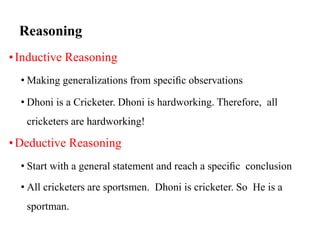
Reasoning
•Inductive Reasoning
• Making generalizations from specific observations
• Dhoni is a Cricketer. Dhoni is hardworking. Therefore, all
cricketers are hardworking!
•Deductive Reasoning
• Start with a general statement and reach a specific conclusion
• All cricketers are sportsmen. Dhoni is cricketer. So He is a
sportman.
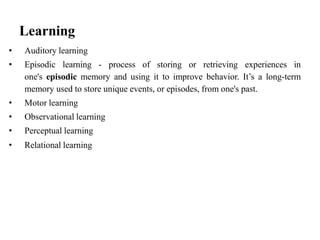
Learning
• Auditory learning
• Episodic learning - process of storing or retrieving experiences in
one's episodic memory and using it to improve behavior. It’s a long-term
memory used to store unique events, or episodes, from one's past.
• Motor learning
• Observational learning
• Perceptual learning
• Relational learning
Other types of Learning
• Supervised learning
• Unsupervised learning
• Semi-Supervised learning
• Reinforcement learning
Problem Solving
• It is the process in which one perceives and tries to arrive at a
desired solution from a present situation by taking some path,
which is blocked by known or unknown hurdles.
• It is the process of decision making, which involves selecting the
best alternative out of multiple alternatives to reach the desired
goal.
Applications of AI
• Games
• Natural Language Processing
• Expert Systems
• Vision Systems
• Speech Recognition
• Handwriting Recognition
• Intelligent Robots
References
• Tom Markiewicz & Josh Zheng, Getting started with Artificial Intelligence,
Published by O’Reilly Media,2017
• Stuart J. Russell and Peter Norvig, Artificial Intelligence A Modern Approach

Artificial Intelligence introduction

  • 1.
  • 2.
    AI - Definition •The science and engineering of making intelligent machines, especially intelligent computer programs –John McCarthy • Artificial Intelligence is a way of making a computer, a robot, or a software that think intelligently like intelligent humans think.
  • 3.
    How AI isAccomplished? • By studying how human brain thinks and how humans learn, decide, and work while trying to solve a problem. • Use the outcomes of this study (course) as a basis of developing intelligent software and systems.
  • 4.
    Need of AI •There are numerous reasons to learn AI. – AI can learn through data – AI can teach itself – AI can help us understand what “intelligence” means
  • 5.
    What is Intelligence? Theability of a system to • Perceive the environment • Calculate & reason from the percepts • Learn from experience • Store and retrieve information from memory • Solve problems, comprehend complex ideas • Use natural language fluently • Classify, generalize, and adapt to new situations.
  • 6.
    Types of Intelligence •Linguistic Intelligence • Musical Intelligence • Logical-Mathematical intelligence • Spatial intelligence • Soft skills, etc..
  • 7.
    Signs of Intelligence •Perception • Reasoning • Learning • Problem Solving
  • 8.
    Reasoning •Inductive Reasoning • Makinggeneralizations from specific observations • Dhoni is a Cricketer. Dhoni is hardworking. Therefore, all cricketers are hardworking! •Deductive Reasoning • Start with a general statement and reach a specific conclusion • All cricketers are sportsmen. Dhoni is cricketer. So He is a sportman.
  • 9.
    Learning • Auditory learning •Episodic learning - process of storing or retrieving experiences in one's episodic memory and using it to improve behavior. It’s a long-term memory used to store unique events, or episodes, from one's past. • Motor learning • Observational learning • Perceptual learning • Relational learning
  • 10.
    Other types ofLearning • Supervised learning • Unsupervised learning • Semi-Supervised learning • Reinforcement learning
  • 11.
    Problem Solving • Itis the process in which one perceives and tries to arrive at a desired solution from a present situation by taking some path, which is blocked by known or unknown hurdles. • It is the process of decision making, which involves selecting the best alternative out of multiple alternatives to reach the desired goal.
  • 12.
    Applications of AI •Games • Natural Language Processing • Expert Systems • Vision Systems • Speech Recognition • Handwriting Recognition • Intelligent Robots
  • 13.
    References • Tom Markiewicz& Josh Zheng, Getting started with Artificial Intelligence, Published by O’Reilly Media,2017 • Stuart J. Russell and Peter Norvig, Artificial Intelligence A Modern Approach