Introduction to Artificial
Intelligence
ECEG-7601
OUTLINE
• What is artificial Intelligence?
• Foundations of Artificial Intelligence
• History and Evolution of Artificial Intelligence
• Overview of Key Ideas of Artificial Intelligence
• Knowledge Representation and Reasoning
• Rule-based Expert Systems
• Search
• Learning
• Applications of Artificial Intelligence in Medicine
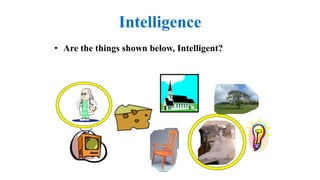
Intelligence
• Are the things shown below, Intelligent?
3
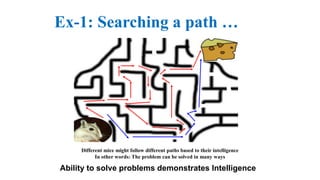
Ex-1: Searching a path …
4
Different mice might follow different paths based to their intelligence
In other words: The problem can be solved in many ways
Ability to solve problems demonstrates Intelligence
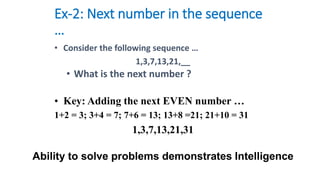
Ex-2: Next number in the sequence
…
• Consider the following sequence …
1,3,7,13,21,__
• What is the next number ?
5
• Key: Adding the next EVEN number …
1+2 = 3; 3+4 = 7; 7+6 = 13; 13+8 =21; 21+10 = 31
1,3,7,13,21,31
Ability to solve problems demonstrates Intelligence
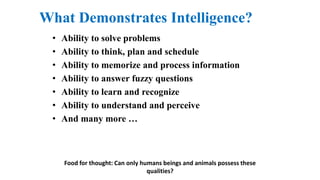
What Demonstrates Intelligence?
• Ability to solve problems
• Ability to think, plan and schedule
• Ability to memorize and process information
• Ability to answer fuzzy questions
• Ability to learn and recognize
• Ability to understand and perceive
• And many more …
6
Food for thought: Can only humans beings and animals possess these
qualities?
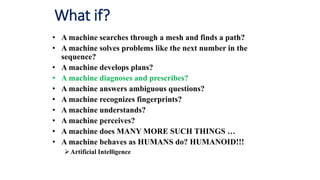
What if?
• A machine searches through a mesh and finds a path?
• A machine solves problems like the next number in the
sequence?
• A machine develops plans?
• A machine diagnoses and prescribes?
• A machine answers ambiguous questions?
• A machine recognizes fingerprints?
• A machine understands?
• A machine perceives?
• A machine does MANY MORE SUCH THINGS …
• A machine behaves as HUMANS do? HUMANOID!!!
Artificial Intelligence
7
What is Artificial Intelligence?
• Artificial: Not natural or real, made by the art of man
• Intelligence: 1) The power of perceiving, learning,
understanding and knowing; mental ability.
2) News, information.
(Oxford Advanced Learners Dictionary of Current English)
What is Artificial Intelligence?
• Artificial Intelligence is the design and study of computer programs that
behave intelligently. (Dean, Allen.)
• The branch of computer science that is concerned with the automation of
intelligent behavior. (Luger, Stubblefield)
• “The science and engineering of making intelligent machines, especially
intelligent computer programs” (John McCarthy )
• Artificial Intelligence is the art of making computers work the way they do
in the movies. (Unknown)
What is Artificial Intelligence?
Systems that THINK Like Humans
• “[The automation of] activities that we associate with human thinking,
activities such as decision making, problem solving, learning …”
(Bellman, 1978)
• “The exciting new effort to make computers think … machines with
minds, in the full and literal sense” (Haugeland, 1985)
• “The study of computation that make it possible to perceive, reason
and act” (Winston 1992)
• “The study of mental faculties through the use of computational
models” (Charniak and McDermott)
What is Artificial Intelligence?
Systems that ACT Like Humans
• “The art of creating machines that perform functions that require
intelligence when performed by people” (Kurzweil 1990)
• “A field of study that seeks to explain and emulate intelligent behavior
in terms of computational processes” (Schalkoff, 1990)
• “The branch of computer science that is concerned with the
automation of intelligent behavior” (Luger and Stubblefield, 1993)
• “The study of how to make computers do things which, at the moment,
people do better” (Rich and Knight, 1991)
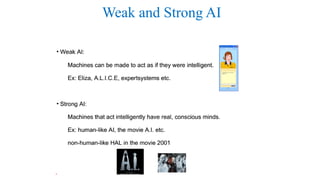
Weak and Strong AI
Goals of AI
• To Create Expert Systems - The systems which exhibit
intelligent behavior, learn, demonstrate, explain, and advice its
users.
• To Implement Human Intelligence in Machines - Creating
systems that understand, think, learn, and behave like humans.
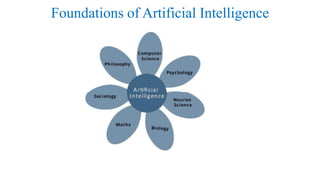
Foundations of Artificial Intelligence
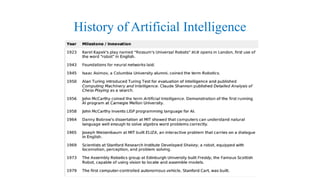
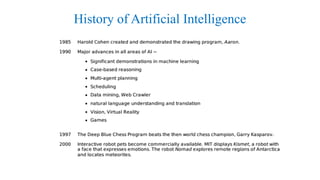
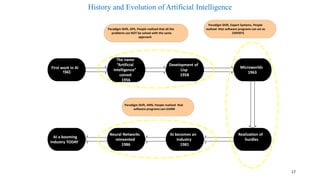
History of Artificial Intelligence
17
First work in AI
1943
The name
“Artificial
Intelligence”
coined
1956
Development of
Lisp
1958
Microworlds
1963
Realization of
hurdles
AI becomes an
Industry
1981
Neural Networks
reinvented
1986
AI a booming
Industry TODAY
Paradigm Shift, GPS, People realized that all the
problems can NOT be solved with the same
approach
Paradigm Shift, Expert Systems, People
realized that software programs can act as
EXPERTS
Paradigm Shift, ANN, People realized that
software programs can LEARN
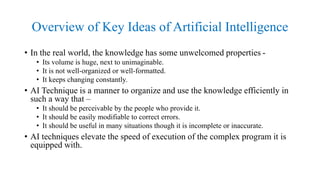
Overview of Key Ideas of Artificial Intelligence
• In the real world, the knowledge has some unwelcomed properties -
• Its volume is huge, next to unimaginable.
• It is not well-organized or well-formatted.
• It keeps changing constantly.
• AI Technique is a manner to organize and use the knowledge efficiently in
such a way that –
• It should be perceivable by the people who provide it.
• It should be easily modifiable to correct errors.
• It should be useful in many situations though it is incomplete or inaccurate.
• AI techniques elevate the speed of execution of the complex program it is
equipped with.
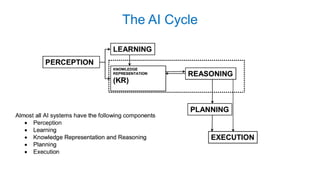
The AI Cycle
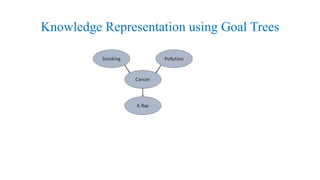
Knowledge Representation using Goal Trees
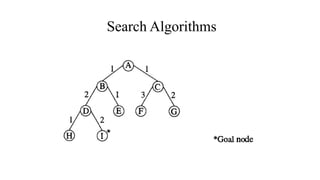
Search Algorithms
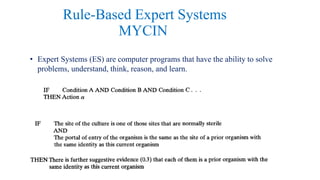
Rule-Based Expert Systems
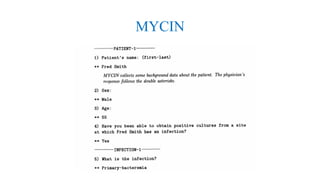
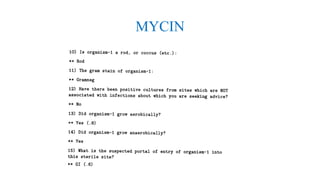
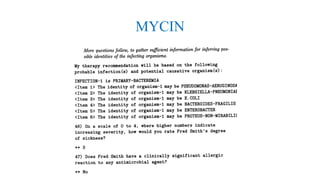
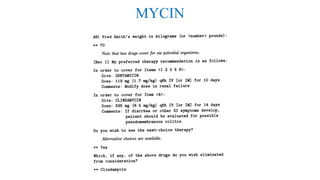
MYCIN
• Expert Systems (ES) are computer programs that have the ability to solve
problems, understand, think, reason, and learn.
MYCIN
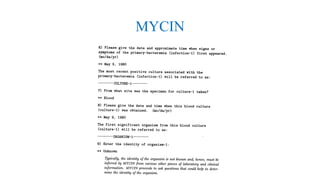
MYCIN
MYCIN
MYCIN
MYCIN
MYCIN
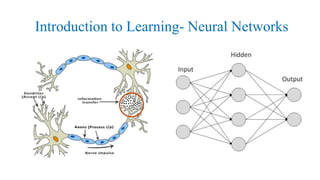
Introduction to Learning- Neural Networks
Applications of AI
• Gaming
• Natural Language Processing
• Clinical Expert Systems
• Vision Systems
• Speech Recognition
• Handwriting Recognition
• Intelligent Robots
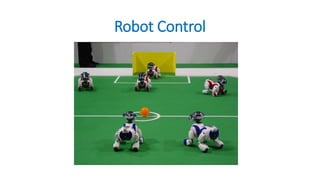
Robot Control
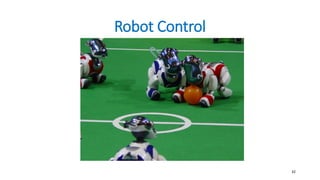
Robot Control
32

Lec 1 introduction

  • 1.
  • 2.
    OUTLINE • What isartificial Intelligence? • Foundations of Artificial Intelligence • History and Evolution of Artificial Intelligence • Overview of Key Ideas of Artificial Intelligence • Knowledge Representation and Reasoning • Rule-based Expert Systems • Search • Learning • Applications of Artificial Intelligence in Medicine
  • 3.
    Intelligence • Are thethings shown below, Intelligent? 3
  • 4.
    Ex-1: Searching apath … 4 Different mice might follow different paths based to their intelligence In other words: The problem can be solved in many ways Ability to solve problems demonstrates Intelligence
  • 5.
    Ex-2: Next numberin the sequence … • Consider the following sequence … 1,3,7,13,21,__ • What is the next number ? 5 • Key: Adding the next EVEN number … 1+2 = 3; 3+4 = 7; 7+6 = 13; 13+8 =21; 21+10 = 31 1,3,7,13,21,31 Ability to solve problems demonstrates Intelligence
  • 6.
    What Demonstrates Intelligence? •Ability to solve problems • Ability to think, plan and schedule • Ability to memorize and process information • Ability to answer fuzzy questions • Ability to learn and recognize • Ability to understand and perceive • And many more … 6 Food for thought: Can only humans beings and animals possess these qualities?
  • 7.
    What if? • Amachine searches through a mesh and finds a path? • A machine solves problems like the next number in the sequence? • A machine develops plans? • A machine diagnoses and prescribes? • A machine answers ambiguous questions? • A machine recognizes fingerprints? • A machine understands? • A machine perceives? • A machine does MANY MORE SUCH THINGS … • A machine behaves as HUMANS do? HUMANOID!!! Artificial Intelligence 7
  • 8.
    What is ArtificialIntelligence? • Artificial: Not natural or real, made by the art of man • Intelligence: 1) The power of perceiving, learning, understanding and knowing; mental ability. 2) News, information. (Oxford Advanced Learners Dictionary of Current English)
  • 9.
    What is ArtificialIntelligence? • Artificial Intelligence is the design and study of computer programs that behave intelligently. (Dean, Allen.) • The branch of computer science that is concerned with the automation of intelligent behavior. (Luger, Stubblefield) • “The science and engineering of making intelligent machines, especially intelligent computer programs” (John McCarthy ) • Artificial Intelligence is the art of making computers work the way they do in the movies. (Unknown)
  • 10.
    What is ArtificialIntelligence? Systems that THINK Like Humans • “[The automation of] activities that we associate with human thinking, activities such as decision making, problem solving, learning …” (Bellman, 1978) • “The exciting new effort to make computers think … machines with minds, in the full and literal sense” (Haugeland, 1985) • “The study of computation that make it possible to perceive, reason and act” (Winston 1992) • “The study of mental faculties through the use of computational models” (Charniak and McDermott)
  • 11.
    What is ArtificialIntelligence? Systems that ACT Like Humans • “The art of creating machines that perform functions that require intelligence when performed by people” (Kurzweil 1990) • “A field of study that seeks to explain and emulate intelligent behavior in terms of computational processes” (Schalkoff, 1990) • “The branch of computer science that is concerned with the automation of intelligent behavior” (Luger and Stubblefield, 1993) • “The study of how to make computers do things which, at the moment, people do better” (Rich and Knight, 1991)
  • 12.
  • 13.
    Goals of AI •To Create Expert Systems - The systems which exhibit intelligent behavior, learn, demonstrate, explain, and advice its users. • To Implement Human Intelligence in Machines - Creating systems that understand, think, learn, and behave like humans.
  • 14.
  • 15.
  • 16.
  • 17.
    17 First work inAI 1943 The name “Artificial Intelligence” coined 1956 Development of Lisp 1958 Microworlds 1963 Realization of hurdles AI becomes an Industry 1981 Neural Networks reinvented 1986 AI a booming Industry TODAY Paradigm Shift, GPS, People realized that all the problems can NOT be solved with the same approach Paradigm Shift, Expert Systems, People realized that software programs can act as EXPERTS Paradigm Shift, ANN, People realized that software programs can LEARN
  • 18.
    Overview of KeyIdeas of Artificial Intelligence • In the real world, the knowledge has some unwelcomed properties - • Its volume is huge, next to unimaginable. • It is not well-organized or well-formatted. • It keeps changing constantly. • AI Technique is a manner to organize and use the knowledge efficiently in such a way that – • It should be perceivable by the people who provide it. • It should be easily modifiable to correct errors. • It should be useful in many situations though it is incomplete or inaccurate. • AI techniques elevate the speed of execution of the complex program it is equipped with.
  • 19.
  • 20.
  • 21.
  • 22.
    Rule-Based Expert Systems MYCIN •Expert Systems (ES) are computer programs that have the ability to solve problems, understand, think, reason, and learn.
  • 23.
  • 24.
  • 25.
  • 26.
  • 27.
  • 28.
  • 29.
  • 30.
    Applications of AI •Gaming • Natural Language Processing • Clinical Expert Systems • Vision Systems • Speech Recognition • Handwriting Recognition • Intelligent Robots
  • 31.
  • 32.