Lecture 1: Introduction to Artificial Intelligence
1
Course Learning Outcomes
At the end of this course:
• Knowledge and understanding
You should have a knowledge and understanding of the basic
concepts of Artificial Intelligence including Search, Game Playing,
KBS (including Uncertainty), Planning and Machine Learning.
• Intellectual skills
You should be able to use this knowledge and understanding of
appropriate principles and guidelines to synthesise solutions to
tasks in AI and to critically evaluate alternatives.
• Practical skills
You should be able to use a well known declarative language
(Prolog) and to construct simple AI systems.
• Transferable Skills
You should be able to solve problems and evaluate outcomes and
alternatives
3
What is AI?
• The branch of computer science called Artificial Intelligen
is said to have been born at a conference held at
Dartmouth, USA, in 1956
• The scientists attending that conference represented seve
different disciplines: mathematics, neurology,
psychology, electrical engineering, etc
• They had one thing in common:
They all were trying to use the recently developed
computers to simulate various aspects of human
intelligence
4
What is AI?
• Artificial Intelligence may be defined as the branch of
computer science that is concerned with the
automation of intelligent behavior
• An exact definition of intelligence is not easy to formula
• However, there are some general abilities which are
universally considered as intelligent
5
What is AI?
According to Douglas Hofstadter these are:
- To respond to situations very flexibly
If the same response is exhibited each time, the
behavior is called mechanical.
To survive in changing environments, one need to
exhibit innovative behavior (e.g. art of begging)
- To make sense out of ambiguous or contradictory
messages
We understand such messages because our knowledge
and experience allows us to place them in context.
(e.g. time flies like an arrow, buy this washing powder
versus buy that washing powder)
6
What is AI?
- To recognize the relative importance of different element
of a situation
(e.g. quality versus price of a commodity)
- To find similarities between situations despite difference
which may separate them
(e.g. chairs in two different pictures)
- To draw distinctions between situations despite similariti
which may link them
(e.g. differences in two cars)
These abilities are largely due to knowledge and experience
which allows you to place an information in its wider contex
7
What is AI?
Another definition of intelligence:
It is the ability to
- perceive inter-relationship of facts
- learn and understand from experience
- acquire and retain knowledge
- respond quickly and successfully to a new
situation
8
What is AI?
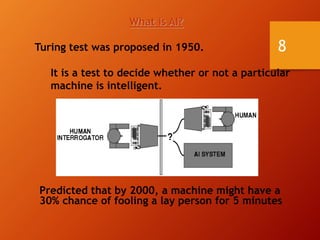
Turing test was proposed in 1950.
It is a test to decide whether or not a particular
machine is intelligent.
Predicted that by 2000, a machine might have a
30% chance of fooling a lay person for 5 minutes
9
What is AI?
- Contact only through monitor and keyboard
- Machine tries to pose as a human
- If the player cannot distinguish between human
and machine, then machine is considered
intelligent
Revised Turing Test: A human converses with an
unseen respondent and attempts to determine
whether it is a man or machine. If the computer
fools you into thinking that it is a human, than
that machine is intelligent
10
What is AI?
Sometimes it is possible to program computers to
carry on shallow conversations, in limited areas,
and thus fool unsuspecting humans into believing
that they are addressing other humans.
Example: Program ELIZA simulating a psychiatrist.
Person: I miss my children
ELIZA: “Why do you miss your children?”
or “ Tell me more about your family”
ELIZA is programmed to ask pre-determined
questions and parrot segments of your responses
back to you. Hence Turing test may not be such a
good judge of machine intelligence after all
11
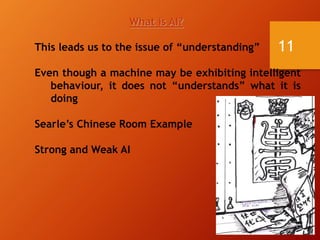
What is AI?
This leads us to the issue of “understanding”
Even though a machine may be exhibiting intelligent
behaviour, it does not “understands” what it is
doing
Searle’s Chinese Room Example
Strong and Weak AI
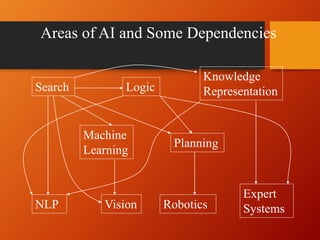
Areas of AI and Some Dependencies
Search
Vision
Planning
Machine
Learning
Knowledge
Representation
Logic
Expert
Systems
Robotics
NLP
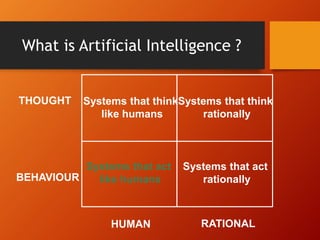
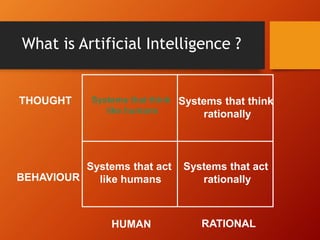
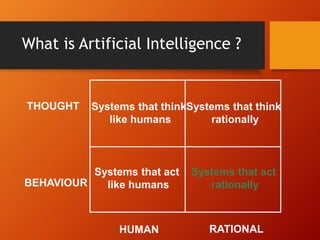
What is Artificial Intelligence ?
Systems that act
rationally
Systems that think
like humans
Systems that think
rationally
Systems that act
like humans
THOUGHT
BEHAVIOUR
HUMAN RATIONAL
Systems that act like humans:
Turing Test
• “The art of creating machines that perform functions
that require intelligence when performed by
people.” (Kurzweil)
• “The study of how to make computers do things at
which, at the moment, people are better.” (Rich and
Knight)
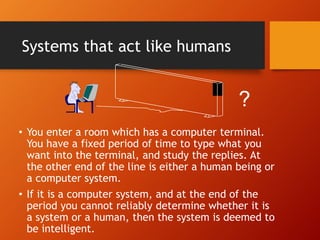
Systems that act like humans
• You enter a room which has a computer terminal.
You have a fixed period of time to type what you
want into the terminal, and study the replies. At
the other end of the line is either a human being or
a computer system.
• If it is a computer system, and at the end of the
period you cannot reliably determine whether it is
a system or a human, then the system is deemed to
be intelligent.
?
Systems that act like humans
• The Turing Test approach
• a human questioner cannot tell if
• there is a computer or a human answering his question, via
teletype (remote communication)
• The computer must behave intelligently
• Intelligent behavior
• to achieve human-level performance in all cognitive tasks
Systems that act like humans
• These cognitive tasks include:
• Natural language processing
• for communication with human
• Knowledge representation
• to store information effectively & efficiently
• Automated reasoning
• to retrieve & answer questions using the stored information
• Machine learning
• to adapt to new circumstances
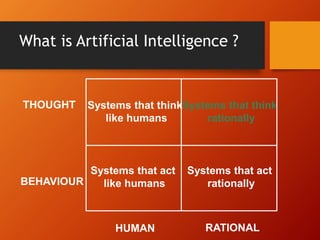
What is Artificial Intelligence ?
Systems that act
rationally
Systems that think
like humans
Systems that think
rationally
Systems that act
like humans
THOUGHT
BEHAVIOUR
HUMAN RATIONAL
Systems that think like humans:
cognitive modeling
• Humans as observed from ‘inside’
• How do we know how humans think?
• Introspection vs. psychological experiments
• Cognitive Science
• “The exciting new effort to make computers
think … machines with minds in the full and
literal sense” (Haugeland)
• “[The automation of] activities that we
associate with human thinking, activities such
as decision-making, problem solving, learning
…” (Bellman)
What is Artificial Intelligence ?
Systems that act
rationally
Systems that think
like humans
Systems that think
rationally
Systems that act
like humans
THOUGHT
BEHAVIOUR
HUMAN RATIONAL
Systems that think ‘rationally’
"laws of thought"
• Humans are not always ‘rational’
• Rational - defined in terms of logic?
• Logic can’t express everything (e.g. uncertainty)
• Logical approach is often not feasible in terms of
computation time (needs ‘guidance’)
• “The study of mental facilities through the use
of computational models” (Charniak and
McDermott)
• “The study of the computations that make it
possible to perceive, reason, and act” (Winston)
What is Artificial Intelligence ?
Systems that act
rationally
Systems that think
like humans
Systems that think
rationally
Systems that act
like humans
THOUGHT
BEHAVIOUR
HUMAN RATIONAL
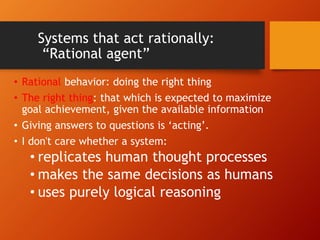
Systems that act rationally:
“Rational agent”
• Rational behavior: doing the right thing
• The right thing: that which is expected to maximize
goal achievement, given the available information
• Giving answers to questions is ‘acting’.
• I don't care whether a system:
• replicates human thought processes
• makes the same decisions as humans
• uses purely logical reasoning
Systems that act rationally
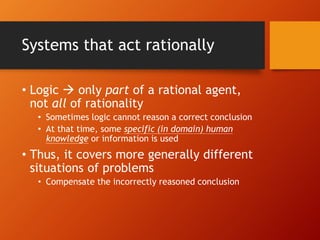
• Logic  only part of a rational agent,
not all of rationality
• Sometimes logic cannot reason a correct conclusion
• At that time, some specific (in domain) human
knowledge or information is used
• Thus, it covers more generally different
situations of problems
• Compensate the incorrectly reasoned conclusion
Systems that act rationally
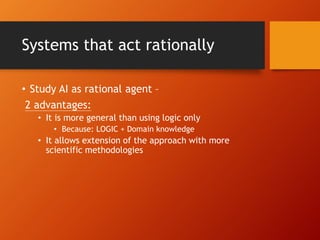
• Study AI as rational agent –
2 advantages:
• It is more general than using logic only
• Because: LOGIC + Domain knowledge
• It allows extension of the approach with more
scientific methodologies
Rational agents
 An agent is an entity that perceives and acts
 This course is about designing rational agents
 Abstractly, an agent is a function from percept
histories to actions:

[f: P*  A]
 For any given class of environments and tasks, we
seek the agent (or class of agents) with the best
performance
 Caveat: computational limitations make perfect
rationality unachievable
  design best program for given machine resources
• Artificial
• Produced by human art or effort, rather than originating
naturally.
• Intelligence
• is the ability to acquire knowledge and use it"
[Pigford and Baur]
• So AI was defined as:
• AI is the study of ideas that enable computers to be
intelligent.
• AI is the part of computer science concerned with design of
computer systems that exhibit human intelligence(From the
Concise Oxford Dictionary)
Rational agents
From the above two definitions, we can see that
AI has two major roles:
• Study the intelligent part concerned with humans.
• Represent those actions using computers.
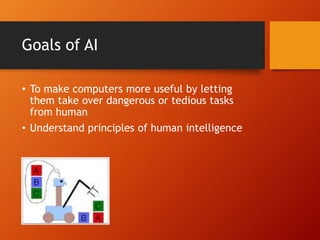
Goals of AI
• To make computers more useful by letting
them take over dangerous or tedious tasks
from human
• Understand principles of human intelligence
The Foundation of AI
• Philosophy
• At that time, the study of human intelligence began
with no formal expression
• Initiate the idea of mind as a machine and its
internal operations
The Foundation of AI
 Mathematics formalizes the three main area
of AI: computation, logic, and probability
 Computation leads to analysis of the problems that
can be computed
 complexity theory
 Probability contributes the “degree of belief” to
handle uncertainty in AI
 Decision theory combines probability theory and
utility theory (bias)
The Foundation of AI
• Psychology
• How do humans think and act?
• The study of human reasoning and acting
• Provides reasoning models for AI
• Strengthen the ideas
• humans and other animals can be considered as
information processing machines
The Foundation of AI
• Computer Engineering
• How to build an efficient computer?
• Provides the artifact that makes AI application
possible
• The power of computer makes computation of large
and difficult problems more easily
• AI has also contributed its own work to computer
science, including: time-sharing, the linked list data
type, OOP, etc.
The Foundation of AI
• Control theory and Cybernetics
• How can artifacts operate under their own control?
• The artifacts adjust their actions
• To do better for the environment over time
• Based on an objective function and feedback from
the environment
• Not limited only to linear systems but also other
problems
• as language, vision, and planning, etc.
The Foundation of AI
• Linguistics
• For understanding natural languages
• different approaches has been adopted from the
linguistic work
• Formal languages
• Syntactic and semantic analysis
• Knowledge representation
The main topics in AI
Artificial intelligence can be considered under a number
of headings:
• Search (includes Game Playing).
• Representing Knowledge and Reasoning with it.
• Planning.
• Learning.
• Natural language processing.
• Expert Systems.
• Interacting with the Environment
(e.g. Vision, Speech recognition, Robotics)
We won’t have time in this course to consider all of these.
• more powerful and more useful computers
• new and improved interfaces
• solving new problems
• better handling of information
• relieves information overload
• conversion of information into knowledge
Some Advantages of Artificial
Intelligence
The Disadvantages
• increased costs
• difficulty with software development - slow and expensive
• few experienced programmers
• few practical products have reached the market as yet.
Search
• Search is the fundamental technique of AI.
• Possible answers, decisions or courses of action are structured
into an abstract space, which we then search.
• Search is either "blind" or “uninformed":
• blind
• we move through the space without worrying about what is
coming next, but recognising the answer if we see it
• informed
• we guess what is ahead, and use that information to decide
where to look next.
• We may want to search for the first answer that satisfies our goal,
or we may want to keep searching until we find the best answer.
Knowledge Representation & Reasoning
• The second most important concept in AI
• If we are going to act rationally in our environment, then we must
have some way of describing that environment and drawing
inferences from that representation.
• how do we describe what we know about the world ?
• how do we describe it concisely ?
• how do we describe it so that we can get hold of the right
piece of knowledge when we need it ?
• how do we generate new pieces of knowledge ?
• how do we deal with uncertain knowledge ?
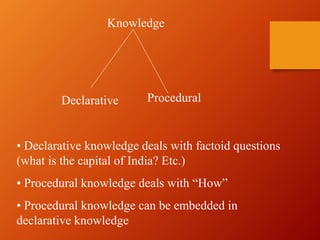
Knowledge
Declarative Procedural
• Declarative knowledge deals with factoid questions
(what is the capital of India? Etc.)
• Procedural knowledge deals with “How”
• Procedural knowledge can be embedded in
declarative knowledge
Planning
Given a set of goals, construct a sequence of actions that
achieves those goals:
• often very large search space
• but most parts of the world are independent of most other
parts
• often start with goals and connect them to actions
• no necessary connection between order of planning and
order of execution
• what happens if the world changes as we execute the plan
and/or our actions don’t produce the expected results?
Learning
• If a system is going to act truly appropriately, then it
must be able to change its actions in the light of
experience:
• how do we generate new facts from old
?
• how do we generate new concepts ?
• how do we learn to distinguish
different situations in new
environments ?
Interacting with the Environment
• In order to enable intelligent behaviour, we will have
to interact with our environment.
• Properly intelligent systems may be expected to:
• accept sensory input
• vision, sound, …
• interact with humans
• understand language, recognise speech,
generate text, speech and graphics, …
• modify the environment
• robotics
Symbolic and Sub-symbolic AI
• Symbolic AI is concerned with describing and
manipulating our knowledge of the world as explicit
symbols, where these symbols have clear
relationships to entities in the real world.
• Sub-symbolic AI (e.g. neural-nets) is more concerned
with obtaining the correct response to an input
stimulus without ‘looking inside the box’ to see if
parts of the mechanism can be associated with
discrete real world objects.
• This course is concerned with symbolic AI.
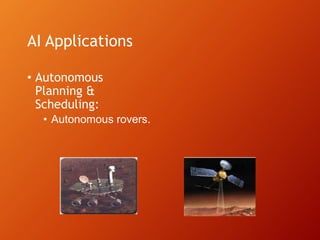
AI Applications
• Autonomous
Planning &
Scheduling:
• Autonomous rovers.
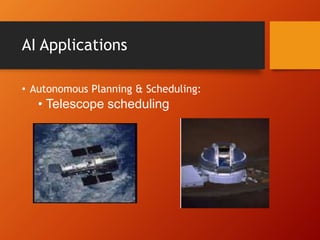
AI Applications
• Autonomous Planning & Scheduling:
• Telescope scheduling
AI Applications
• Autonomous Planning & Scheduling:
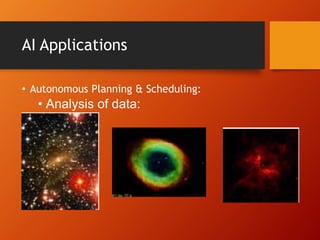
• Analysis of data:
AI Applications
• Medicine:
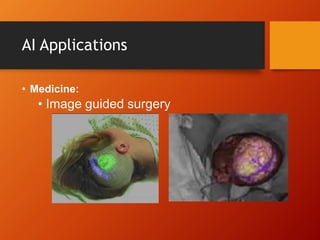
• Image guided surgery
AI Applications
• Medicine:
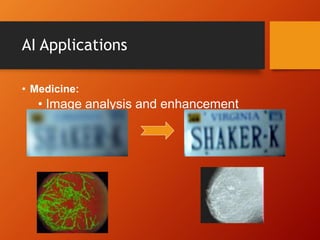
• Image analysis and enhancement
AI Applications
• Transportation:
• Autonomous
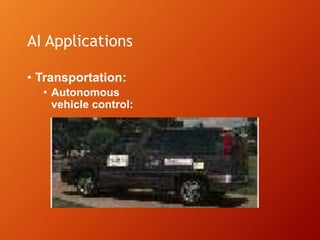
vehicle control:
AI Applications
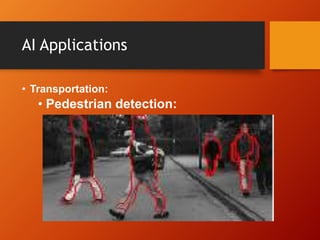
• Transportation:
• Pedestrian detection:
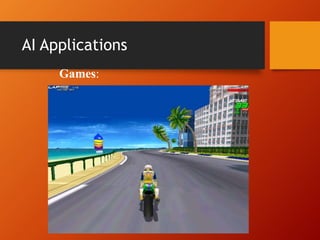
AI Applications
Games:
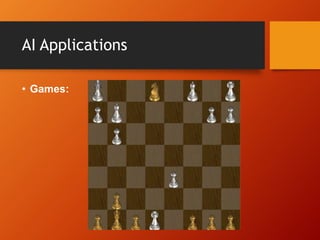
AI Applications
• Games:
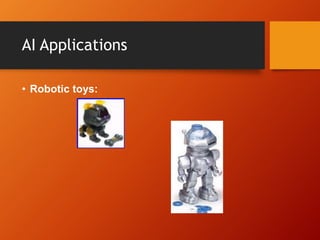
AI Applications
• Robotic toys:
AI Applications
Other application areas:
• Bioinformatics:
• Gene expression data analysis
• Prediction of protein structure
• Text classification, document sorting:
• Web pages, e-mails
• Articles in the news
• Video, image classification
• Music composition, picture drawing
• Natural Language Processing

AI.ppt

  • 1.
    Lecture 1: Introductionto Artificial Intelligence 1
  • 2.
    Course Learning Outcomes Atthe end of this course: • Knowledge and understanding You should have a knowledge and understanding of the basic concepts of Artificial Intelligence including Search, Game Playing, KBS (including Uncertainty), Planning and Machine Learning. • Intellectual skills You should be able to use this knowledge and understanding of appropriate principles and guidelines to synthesise solutions to tasks in AI and to critically evaluate alternatives. • Practical skills You should be able to use a well known declarative language (Prolog) and to construct simple AI systems. • Transferable Skills You should be able to solve problems and evaluate outcomes and alternatives
  • 3.
    3 What is AI? •The branch of computer science called Artificial Intelligen is said to have been born at a conference held at Dartmouth, USA, in 1956 • The scientists attending that conference represented seve different disciplines: mathematics, neurology, psychology, electrical engineering, etc • They had one thing in common: They all were trying to use the recently developed computers to simulate various aspects of human intelligence
  • 4.
    4 What is AI? •Artificial Intelligence may be defined as the branch of computer science that is concerned with the automation of intelligent behavior • An exact definition of intelligence is not easy to formula • However, there are some general abilities which are universally considered as intelligent
  • 5.
    5 What is AI? Accordingto Douglas Hofstadter these are: - To respond to situations very flexibly If the same response is exhibited each time, the behavior is called mechanical. To survive in changing environments, one need to exhibit innovative behavior (e.g. art of begging) - To make sense out of ambiguous or contradictory messages We understand such messages because our knowledge and experience allows us to place them in context. (e.g. time flies like an arrow, buy this washing powder versus buy that washing powder)
  • 6.
    6 What is AI? -To recognize the relative importance of different element of a situation (e.g. quality versus price of a commodity) - To find similarities between situations despite difference which may separate them (e.g. chairs in two different pictures) - To draw distinctions between situations despite similariti which may link them (e.g. differences in two cars) These abilities are largely due to knowledge and experience which allows you to place an information in its wider contex
  • 7.
    7 What is AI? Anotherdefinition of intelligence: It is the ability to - perceive inter-relationship of facts - learn and understand from experience - acquire and retain knowledge - respond quickly and successfully to a new situation
  • 8.
    8 What is AI? Turingtest was proposed in 1950. It is a test to decide whether or not a particular machine is intelligent. Predicted that by 2000, a machine might have a 30% chance of fooling a lay person for 5 minutes
  • 9.
    9 What is AI? -Contact only through monitor and keyboard - Machine tries to pose as a human - If the player cannot distinguish between human and machine, then machine is considered intelligent Revised Turing Test: A human converses with an unseen respondent and attempts to determine whether it is a man or machine. If the computer fools you into thinking that it is a human, than that machine is intelligent
  • 10.
    10 What is AI? Sometimesit is possible to program computers to carry on shallow conversations, in limited areas, and thus fool unsuspecting humans into believing that they are addressing other humans. Example: Program ELIZA simulating a psychiatrist. Person: I miss my children ELIZA: “Why do you miss your children?” or “ Tell me more about your family” ELIZA is programmed to ask pre-determined questions and parrot segments of your responses back to you. Hence Turing test may not be such a good judge of machine intelligence after all
  • 11.
    11 What is AI? Thisleads us to the issue of “understanding” Even though a machine may be exhibiting intelligent behaviour, it does not “understands” what it is doing Searle’s Chinese Room Example Strong and Weak AI
  • 12.
    Areas of AIand Some Dependencies Search Vision Planning Machine Learning Knowledge Representation Logic Expert Systems Robotics NLP
  • 13.
    What is ArtificialIntelligence ? Systems that act rationally Systems that think like humans Systems that think rationally Systems that act like humans THOUGHT BEHAVIOUR HUMAN RATIONAL
  • 14.
    Systems that actlike humans: Turing Test • “The art of creating machines that perform functions that require intelligence when performed by people.” (Kurzweil) • “The study of how to make computers do things at which, at the moment, people are better.” (Rich and Knight)
  • 15.
    Systems that actlike humans • You enter a room which has a computer terminal. You have a fixed period of time to type what you want into the terminal, and study the replies. At the other end of the line is either a human being or a computer system. • If it is a computer system, and at the end of the period you cannot reliably determine whether it is a system or a human, then the system is deemed to be intelligent. ?
  • 16.
    Systems that actlike humans • The Turing Test approach • a human questioner cannot tell if • there is a computer or a human answering his question, via teletype (remote communication) • The computer must behave intelligently • Intelligent behavior • to achieve human-level performance in all cognitive tasks
  • 17.
    Systems that actlike humans • These cognitive tasks include: • Natural language processing • for communication with human • Knowledge representation • to store information effectively & efficiently • Automated reasoning • to retrieve & answer questions using the stored information • Machine learning • to adapt to new circumstances
  • 18.
    What is ArtificialIntelligence ? Systems that act rationally Systems that think like humans Systems that think rationally Systems that act like humans THOUGHT BEHAVIOUR HUMAN RATIONAL
  • 19.
    Systems that thinklike humans: cognitive modeling • Humans as observed from ‘inside’ • How do we know how humans think? • Introspection vs. psychological experiments • Cognitive Science • “The exciting new effort to make computers think … machines with minds in the full and literal sense” (Haugeland) • “[The automation of] activities that we associate with human thinking, activities such as decision-making, problem solving, learning …” (Bellman)
  • 20.
    What is ArtificialIntelligence ? Systems that act rationally Systems that think like humans Systems that think rationally Systems that act like humans THOUGHT BEHAVIOUR HUMAN RATIONAL
  • 21.
    Systems that think‘rationally’ "laws of thought" • Humans are not always ‘rational’ • Rational - defined in terms of logic? • Logic can’t express everything (e.g. uncertainty) • Logical approach is often not feasible in terms of computation time (needs ‘guidance’) • “The study of mental facilities through the use of computational models” (Charniak and McDermott) • “The study of the computations that make it possible to perceive, reason, and act” (Winston)
  • 22.
    What is ArtificialIntelligence ? Systems that act rationally Systems that think like humans Systems that think rationally Systems that act like humans THOUGHT BEHAVIOUR HUMAN RATIONAL
  • 23.
    Systems that actrationally: “Rational agent” • Rational behavior: doing the right thing • The right thing: that which is expected to maximize goal achievement, given the available information • Giving answers to questions is ‘acting’. • I don't care whether a system: • replicates human thought processes • makes the same decisions as humans • uses purely logical reasoning
  • 24.
    Systems that actrationally • Logic  only part of a rational agent, not all of rationality • Sometimes logic cannot reason a correct conclusion • At that time, some specific (in domain) human knowledge or information is used • Thus, it covers more generally different situations of problems • Compensate the incorrectly reasoned conclusion
  • 25.
    Systems that actrationally • Study AI as rational agent – 2 advantages: • It is more general than using logic only • Because: LOGIC + Domain knowledge • It allows extension of the approach with more scientific methodologies
  • 26.
    Rational agents  Anagent is an entity that perceives and acts  This course is about designing rational agents  Abstractly, an agent is a function from percept histories to actions:  [f: P*  A]  For any given class of environments and tasks, we seek the agent (or class of agents) with the best performance  Caveat: computational limitations make perfect rationality unachievable   design best program for given machine resources
  • 27.
    • Artificial • Producedby human art or effort, rather than originating naturally. • Intelligence • is the ability to acquire knowledge and use it" [Pigford and Baur] • So AI was defined as: • AI is the study of ideas that enable computers to be intelligent. • AI is the part of computer science concerned with design of computer systems that exhibit human intelligence(From the Concise Oxford Dictionary) Rational agents
  • 28.
    From the abovetwo definitions, we can see that AI has two major roles: • Study the intelligent part concerned with humans. • Represent those actions using computers.
  • 29.
    Goals of AI •To make computers more useful by letting them take over dangerous or tedious tasks from human • Understand principles of human intelligence
  • 30.
    The Foundation ofAI • Philosophy • At that time, the study of human intelligence began with no formal expression • Initiate the idea of mind as a machine and its internal operations
  • 31.
    The Foundation ofAI  Mathematics formalizes the three main area of AI: computation, logic, and probability  Computation leads to analysis of the problems that can be computed  complexity theory  Probability contributes the “degree of belief” to handle uncertainty in AI  Decision theory combines probability theory and utility theory (bias)
  • 32.
    The Foundation ofAI • Psychology • How do humans think and act? • The study of human reasoning and acting • Provides reasoning models for AI • Strengthen the ideas • humans and other animals can be considered as information processing machines
  • 33.
    The Foundation ofAI • Computer Engineering • How to build an efficient computer? • Provides the artifact that makes AI application possible • The power of computer makes computation of large and difficult problems more easily • AI has also contributed its own work to computer science, including: time-sharing, the linked list data type, OOP, etc.
  • 34.
    The Foundation ofAI • Control theory and Cybernetics • How can artifacts operate under their own control? • The artifacts adjust their actions • To do better for the environment over time • Based on an objective function and feedback from the environment • Not limited only to linear systems but also other problems • as language, vision, and planning, etc.
  • 35.
    The Foundation ofAI • Linguistics • For understanding natural languages • different approaches has been adopted from the linguistic work • Formal languages • Syntactic and semantic analysis • Knowledge representation
  • 36.
    The main topicsin AI Artificial intelligence can be considered under a number of headings: • Search (includes Game Playing). • Representing Knowledge and Reasoning with it. • Planning. • Learning. • Natural language processing. • Expert Systems. • Interacting with the Environment (e.g. Vision, Speech recognition, Robotics) We won’t have time in this course to consider all of these.
  • 37.
    • more powerfuland more useful computers • new and improved interfaces • solving new problems • better handling of information • relieves information overload • conversion of information into knowledge Some Advantages of Artificial Intelligence
  • 38.
    The Disadvantages • increasedcosts • difficulty with software development - slow and expensive • few experienced programmers • few practical products have reached the market as yet.
  • 39.
    Search • Search isthe fundamental technique of AI. • Possible answers, decisions or courses of action are structured into an abstract space, which we then search. • Search is either "blind" or “uninformed": • blind • we move through the space without worrying about what is coming next, but recognising the answer if we see it • informed • we guess what is ahead, and use that information to decide where to look next. • We may want to search for the first answer that satisfies our goal, or we may want to keep searching until we find the best answer.
  • 40.
    Knowledge Representation &Reasoning • The second most important concept in AI • If we are going to act rationally in our environment, then we must have some way of describing that environment and drawing inferences from that representation. • how do we describe what we know about the world ? • how do we describe it concisely ? • how do we describe it so that we can get hold of the right piece of knowledge when we need it ? • how do we generate new pieces of knowledge ? • how do we deal with uncertain knowledge ?
  • 41.
    Knowledge Declarative Procedural • Declarativeknowledge deals with factoid questions (what is the capital of India? Etc.) • Procedural knowledge deals with “How” • Procedural knowledge can be embedded in declarative knowledge
  • 42.
    Planning Given a setof goals, construct a sequence of actions that achieves those goals: • often very large search space • but most parts of the world are independent of most other parts • often start with goals and connect them to actions • no necessary connection between order of planning and order of execution • what happens if the world changes as we execute the plan and/or our actions don’t produce the expected results?
  • 43.
    Learning • If asystem is going to act truly appropriately, then it must be able to change its actions in the light of experience: • how do we generate new facts from old ? • how do we generate new concepts ? • how do we learn to distinguish different situations in new environments ?
  • 44.
    Interacting with theEnvironment • In order to enable intelligent behaviour, we will have to interact with our environment. • Properly intelligent systems may be expected to: • accept sensory input • vision, sound, … • interact with humans • understand language, recognise speech, generate text, speech and graphics, … • modify the environment • robotics
  • 45.
    Symbolic and Sub-symbolicAI • Symbolic AI is concerned with describing and manipulating our knowledge of the world as explicit symbols, where these symbols have clear relationships to entities in the real world. • Sub-symbolic AI (e.g. neural-nets) is more concerned with obtaining the correct response to an input stimulus without ‘looking inside the box’ to see if parts of the mechanism can be associated with discrete real world objects. • This course is concerned with symbolic AI.
  • 46.
    AI Applications • Autonomous Planning& Scheduling: • Autonomous rovers.
  • 47.
    AI Applications • AutonomousPlanning & Scheduling: • Telescope scheduling
  • 48.
    AI Applications • AutonomousPlanning & Scheduling: • Analysis of data:
  • 49.
  • 50.
    AI Applications • Medicine: •Image analysis and enhancement
  • 51.
    AI Applications • Transportation: •Autonomous vehicle control:
  • 52.
  • 53.
  • 54.
  • 55.
  • 56.
    AI Applications Other applicationareas: • Bioinformatics: • Gene expression data analysis • Prediction of protein structure • Text classification, document sorting: • Web pages, e-mails • Articles in the news • Video, image classification • Music composition, picture drawing • Natural Language Processing