TOPIC: ARTIFICIAL
INTELLIGENCE
RESOURCE PERSON: BIMAL KISHORE
DIVINE PUBLIC SCHOOL
AffiliatedtoCBSE,NewDelhi
Gangpacho,Barkatha( Hazaribagh)
I N H O U S E T R AI N I N G
DATE: 24-JUNE-2023
What is Artificial Intelligence?
According to the father of Artificial Intelligence, John McCarthy, it
is “The science and engineering of making intelligent machines,
especially intelligent computer programs”.
Artificial Intelligence is a way of making a computer, a computer-
controlled robot, or a software think intelligently, in the similar manner
the intelligent humans think.
AI is accomplished by studying how human brain thinks, and how
humans learn, decide, and work while trying to solve a problem, and
then using the outcomes of this study as a basis of developing
intelligent software and systems.
Year Milestone / Innovation
1923
Karel Čapek play named “Rossum's Universal Robots” (RUR) opens in London, first use of the word "robot" in English.
1943 Foundations for neural networks laid.
1945 Isaac Asimov, a Columbia University alumni, coined the term Robotics.
1950
Alan Turing introduced Turing Test for evaluation of intelligence and published Computing Machinery and Intelligence. Claude
Shannon published Detailed Analysis of Chess Playing as a search.
1956
John McCarthy coined the term Artificial Intelligence. Demonstration of the first running AI program at Carnegie Mellon University.
1958 John McCarthy invents LISP programming language for AI.
1964
Danny Bobrow's dissertation at MIT showed that computers can understand natural language well enough to solve algebra word
problems correctly.
1965 Joseph Weizenbaum at MIT built ELIZA, an interactive problem that carries on a dialogue in English.
1969
Scientists at Stanford Research Institute Developed Shakey, a robot, equipped with locomotion, perception, and problem solving.
1973
The Assembly Robotics group at Edinburgh University built Freddy, the Famous Scottish Robot, capable of using vision to locate
and assemble models.
1979 The first computer-controlled autonomous vehicle, Stanford Cart, was built.
1985 Harold Cohen created and demonstrated the drawing program, Aaron.
1990
Major advances in all areas of AI −
•Significant demonstrations in machine learning
•Case-based reasoning
•Multi-agent planning
•Scheduling
•Data mining, Web Crawler
•natural language understanding and translation
•Vision, Virtual Reality
•Games
1997 The Deep Blue Chess Program beats the then world chess champion, Garry Kasparov.
Interactive robot pets become commercially available. MIT displays Kismet, a robot with a face that expresses emotions. The
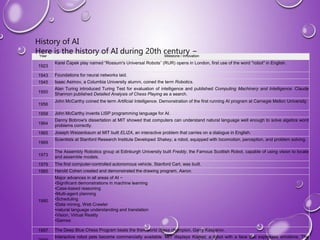
History of AI
Here is the history of AI during 20th century −
Applications of AI
AI has been dominant in various fields such as −
•Gaming − AI plays crucial role in strategic games such as chess, poker, tic-tac-toe, etc.,
where machine can think of large number of possible positions based on heuristic
knowledge.
•Natural Language Processing − It is possible to interact with the computer that
understands natural language spoken by humans.
•Expert Systems − There are some applications which integrate machine, software, and
special information to impart reasoning and advising. They provide explanation and
advice to the users.
•Vision Systems − These systems understand, interpret, and comprehend visual input
on the computer. For example,
• A spying aeroplane takes photographs, which are used to figure out spatial
information or map of the areas.
• Doctors use clinical expert system to diagnose the patient.
• Police use computer software that can recognize the face of criminal with the
stored portrait made by forensic artist.
•Speech Recognition − Some intelligent systems are capable of hearing and
comprehending the language in terms of sentences and their meanings while a human
talks to it. It can handle different accents, slang words, noise in the background, change
in human’s noise due to cold, etc.
•Handwriting Recognition − The handwriting recognition software reads the text
written on paper by a pen or on screen by a stylus. It can recognize the shapes of the
letters and convert it into editable text.
•Intelligent Robots − Robots are able to perform the tasks given by a human. They
have sensors to detect physical data from the real world such as light, heat,
temperature, movement, sound, bump, and pressure. They have efficient processors,
multiple sensors and huge memory, to exhibit intelligence. In addition, they are capable
of learning from their mistakes and they can adapt to the new environment.
EVERY DAY APPLICATION OF
AI
Difference between Human and Machine
Intelligence
•Humans perceive by patterns whereas the machines perceive
by set of rules and data.
•Humans store and recall information by patterns, machines do
it by searching algorithms. For example, the number 40404040
is easy to remember, store, and recall as its pattern is simple.
•Humans can figure out the complete object even if some part
of it is missing or distorted; whereas the machines cannot do it
correctly.
Philosophy of AI
While exploiting the power of the computer systems, the curiosity of
human, lead him to wonder, “Can a machine think and behave like
humans do?”
Thus, the development of AI started with the intention of creating
similar intelligence in machines that we find and regard high in humans.
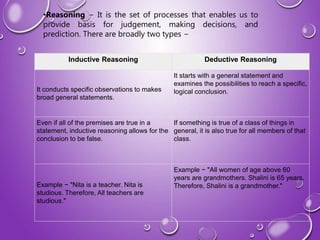
Inductive Reasoning Deductive Reasoning
It conducts specific observations to makes
broad general statements.
It starts with a general statement and
examines the possibilities to reach a specific,
logical conclusion.
Even if all of the premises are true in a
statement, inductive reasoning allows for the
conclusion to be false.
If something is true of a class of things in
general, it is also true for all members of that
class.
Example − "Nita is a teacher. Nita is
studious. Therefore, All teachers are
studious."
Example − "All women of age above 60
years are grandmothers. Shalini is 65 years.
Therefore, Shalini is a grandmother."
•Reasoning − It is the set of processes that enables us to
provide basis for judgement, making decisions, and
prediction. There are broadly two types −
•Learning − It is the activity of gaining knowledge or skill by studying, practising,
being taught, or experiencing something. Learning enhances the awareness of the
subjects of the study.
•The ability of learning is possessed by humans, some animals, and AI-enabled
systems. Learning is categorized as −
• Auditory Learning − It is learning by listening and hearing. For example,
students listening to recorded audio lectures.
• Episodic Learning − To learn by remembering sequences of events that
one has witnessed or experienced. This is linear and orderly.
• Motor Learning − It is learning by precise movement of muscles. For
example, picking objects, Writing, etc.
• Observational Learning − To learn by watching and imitating others. For
example, child tries to learn by mimicking her parent.
• Perceptual Learning − It is learning to recognize stimuli that one has seen
before. For example, identifying and classifying objects and situations.
• Relational Learning − It involves learning to differentiate among various
stimuli on the basis of relational properties, rather than absolute
properties. For Example, Adding ‘little less’ salt at the time of cooking
potatoes that came up salty last time, when cooked with adding say a
tablespoon of salt.
• Spatial Learning − It is learning through visual stimuli such as images,
colors, maps, etc. For Example, A person can create roadmap in mind
before actually following the road.
• Stimulus-Response Learning − It is learning to perform a particular
behavior when a certain stimulus is present. For example, a dog raises its
ear on hearing doorbell.
•Problem Solving − It is the process in which one
perceives and tries to arrive at a desired solution
from a present situation by taking some path,
which is blocked by known or unknown hurdles.
•Problem solving also includes decision making,
which is the process of selecting the best suitable
alternative out of multiple alternatives to reach the
desired goal are available.
•Perception − It is the process of acquiring,
interpreting, selecting, and organizing
sensory information.
•Perception presumes sensing. In humans,
perception is aided by sensory organs. In the
domain of AI, perception mechanism puts
the data acquired by the sensors together in
a meaningful manner.
•Linguistic Intelligence − It is one’s
ability to use, comprehend, speak, and
write the verbal and written language.
It is important in interpersonal
communication.
Goals of AI
•To Create Expert Systems − The systems which exhibit
intelligent behavior, learn, demonstrate, explain, and advice its
users.
•To Implement Human Intelligence in Machines − Creating
systems that understand, think, learn, and behave like humans.
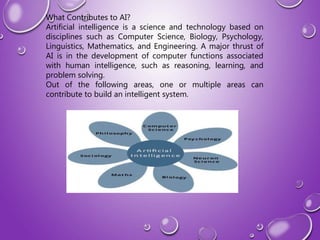
What Contributes to AI?
Artificial intelligence is a science and technology based on
disciplines such as Computer Science, Biology, Psychology,
Linguistics, Mathematics, and Engineering. A major thrust of
AI is in the development of computer functions associated
with human intelligence, such as reasoning, learning, and
problem solving.
Out of the following areas, one or multiple areas can
contribute to build an intelligent system.
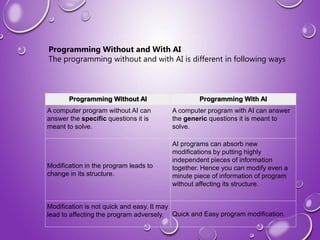
Programming Without AI Programming With AI
A computer program without AI can
answer the specific questions it is
meant to solve.
A computer program with AI can answer
the generic questions it is meant to
solve.
Modification in the program leads to
change in its structure.
AI programs can absorb new
modifications by putting highly
independent pieces of information
together. Hence you can modify even a
minute piece of information of program
without affecting its structure.
Modification is not quick and easy. It may
lead to affecting the program adversely. Quick and Easy program modification.
Programming Without and With AI
The programming without and with AI is different in following ways
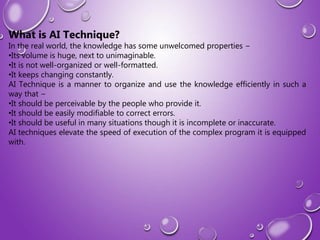
What is AI Technique?
In the real world, the knowledge has some unwelcomed properties −
•Its volume is huge, next to unimaginable.
•It is not well-organized or well-formatted.
•It keeps changing constantly.
AI Technique is a manner to organize and use the knowledge efficiently in such a
way that −
•It should be perceivable by the people who provide it.
•It should be easily modifiable to correct errors.
•It should be useful in many situations though it is incomplete or inaccurate.
AI techniques elevate the speed of execution of the complex program it is equipped
with.
The domain of artificial intelligence is huge in breadth
and width. While proceeding, we consider the broadly
common and prospering research areas in the domain
of AI −
Sr.No. Research Areas Real Life Application
1 Expert Systems
Examples − Flight-tracking
systems, Clinical systems.
2 Natural Language Processing
Examples: Google Now feature,
speech recognition, Automatic
voice output.
3 Neural Networks
Examples − Pattern recognition
systems such as face recognition,
character recognition, handwriting
recognition.
4 Robotics
Examples − Industrial robots for moving,
spraying, painting, precision checking,
drilling, cleaning, coating, carving, etc.
5 Fuzzy Logic Systems
Examples − Consumer electronics,
automobiles, etc.
Real Life Applications of Research Areas
There is a large array of applications where AI is serving common people in their day-to-day
lives −
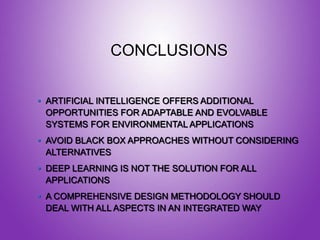
CONCLUSIONS
• ARTIFICIAL INTELLIGENCE OFFERS ADDITIONAL
OPPORTUNITIES FOR ADAPTABLE AND EVOLVABLE
SYSTEMS FOR ENVIRONMENTAL APPLICATIONS
• AVOID BLACK BOX APPROACHES WITHOUT CONSIDERING
ALTERNATIVES
• DEEP LEARNING IS NOT THE SOLUTION FOR ALL
APPLICATIONS
• A COMPREHENSIVE DESIGN METHODOLOGY SHOULD
DEAL WITH ALL ASPECTS IN AN INTEGRATED WAY
THANK YOU

AI.ppt

  • 1.
    TOPIC: ARTIFICIAL INTELLIGENCE RESOURCE PERSON:BIMAL KISHORE DIVINE PUBLIC SCHOOL AffiliatedtoCBSE,NewDelhi Gangpacho,Barkatha( Hazaribagh) I N H O U S E T R AI N I N G DATE: 24-JUNE-2023
  • 2.
    What is ArtificialIntelligence? According to the father of Artificial Intelligence, John McCarthy, it is “The science and engineering of making intelligent machines, especially intelligent computer programs”. Artificial Intelligence is a way of making a computer, a computer- controlled robot, or a software think intelligently, in the similar manner the intelligent humans think. AI is accomplished by studying how human brain thinks, and how humans learn, decide, and work while trying to solve a problem, and then using the outcomes of this study as a basis of developing intelligent software and systems.
  • 3.
    Year Milestone /Innovation 1923 Karel Čapek play named “Rossum's Universal Robots” (RUR) opens in London, first use of the word "robot" in English. 1943 Foundations for neural networks laid. 1945 Isaac Asimov, a Columbia University alumni, coined the term Robotics. 1950 Alan Turing introduced Turing Test for evaluation of intelligence and published Computing Machinery and Intelligence. Claude Shannon published Detailed Analysis of Chess Playing as a search. 1956 John McCarthy coined the term Artificial Intelligence. Demonstration of the first running AI program at Carnegie Mellon University. 1958 John McCarthy invents LISP programming language for AI. 1964 Danny Bobrow's dissertation at MIT showed that computers can understand natural language well enough to solve algebra word problems correctly. 1965 Joseph Weizenbaum at MIT built ELIZA, an interactive problem that carries on a dialogue in English. 1969 Scientists at Stanford Research Institute Developed Shakey, a robot, equipped with locomotion, perception, and problem solving. 1973 The Assembly Robotics group at Edinburgh University built Freddy, the Famous Scottish Robot, capable of using vision to locate and assemble models. 1979 The first computer-controlled autonomous vehicle, Stanford Cart, was built. 1985 Harold Cohen created and demonstrated the drawing program, Aaron. 1990 Major advances in all areas of AI − •Significant demonstrations in machine learning •Case-based reasoning •Multi-agent planning •Scheduling •Data mining, Web Crawler •natural language understanding and translation •Vision, Virtual Reality •Games 1997 The Deep Blue Chess Program beats the then world chess champion, Garry Kasparov. Interactive robot pets become commercially available. MIT displays Kismet, a robot with a face that expresses emotions. The History of AI Here is the history of AI during 20th century −
  • 4.
    Applications of AI AIhas been dominant in various fields such as − •Gaming − AI plays crucial role in strategic games such as chess, poker, tic-tac-toe, etc., where machine can think of large number of possible positions based on heuristic knowledge. •Natural Language Processing − It is possible to interact with the computer that understands natural language spoken by humans. •Expert Systems − There are some applications which integrate machine, software, and special information to impart reasoning and advising. They provide explanation and advice to the users. •Vision Systems − These systems understand, interpret, and comprehend visual input on the computer. For example, • A spying aeroplane takes photographs, which are used to figure out spatial information or map of the areas. • Doctors use clinical expert system to diagnose the patient. • Police use computer software that can recognize the face of criminal with the stored portrait made by forensic artist. •Speech Recognition − Some intelligent systems are capable of hearing and comprehending the language in terms of sentences and their meanings while a human talks to it. It can handle different accents, slang words, noise in the background, change in human’s noise due to cold, etc. •Handwriting Recognition − The handwriting recognition software reads the text written on paper by a pen or on screen by a stylus. It can recognize the shapes of the letters and convert it into editable text. •Intelligent Robots − Robots are able to perform the tasks given by a human. They have sensors to detect physical data from the real world such as light, heat, temperature, movement, sound, bump, and pressure. They have efficient processors, multiple sensors and huge memory, to exhibit intelligence. In addition, they are capable of learning from their mistakes and they can adapt to the new environment.
  • 5.
  • 6.
    Difference between Humanand Machine Intelligence •Humans perceive by patterns whereas the machines perceive by set of rules and data. •Humans store and recall information by patterns, machines do it by searching algorithms. For example, the number 40404040 is easy to remember, store, and recall as its pattern is simple. •Humans can figure out the complete object even if some part of it is missing or distorted; whereas the machines cannot do it correctly.
  • 7.
    Philosophy of AI Whileexploiting the power of the computer systems, the curiosity of human, lead him to wonder, “Can a machine think and behave like humans do?” Thus, the development of AI started with the intention of creating similar intelligence in machines that we find and regard high in humans.
  • 9.
    Inductive Reasoning DeductiveReasoning It conducts specific observations to makes broad general statements. It starts with a general statement and examines the possibilities to reach a specific, logical conclusion. Even if all of the premises are true in a statement, inductive reasoning allows for the conclusion to be false. If something is true of a class of things in general, it is also true for all members of that class. Example − "Nita is a teacher. Nita is studious. Therefore, All teachers are studious." Example − "All women of age above 60 years are grandmothers. Shalini is 65 years. Therefore, Shalini is a grandmother." •Reasoning − It is the set of processes that enables us to provide basis for judgement, making decisions, and prediction. There are broadly two types −
  • 10.
    •Learning − Itis the activity of gaining knowledge or skill by studying, practising, being taught, or experiencing something. Learning enhances the awareness of the subjects of the study. •The ability of learning is possessed by humans, some animals, and AI-enabled systems. Learning is categorized as − • Auditory Learning − It is learning by listening and hearing. For example, students listening to recorded audio lectures. • Episodic Learning − To learn by remembering sequences of events that one has witnessed or experienced. This is linear and orderly. • Motor Learning − It is learning by precise movement of muscles. For example, picking objects, Writing, etc. • Observational Learning − To learn by watching and imitating others. For example, child tries to learn by mimicking her parent. • Perceptual Learning − It is learning to recognize stimuli that one has seen before. For example, identifying and classifying objects and situations. • Relational Learning − It involves learning to differentiate among various stimuli on the basis of relational properties, rather than absolute properties. For Example, Adding ‘little less’ salt at the time of cooking potatoes that came up salty last time, when cooked with adding say a tablespoon of salt. • Spatial Learning − It is learning through visual stimuli such as images, colors, maps, etc. For Example, A person can create roadmap in mind before actually following the road. • Stimulus-Response Learning − It is learning to perform a particular behavior when a certain stimulus is present. For example, a dog raises its ear on hearing doorbell.
  • 11.
    •Problem Solving −It is the process in which one perceives and tries to arrive at a desired solution from a present situation by taking some path, which is blocked by known or unknown hurdles. •Problem solving also includes decision making, which is the process of selecting the best suitable alternative out of multiple alternatives to reach the desired goal are available.
  • 12.
    •Perception − Itis the process of acquiring, interpreting, selecting, and organizing sensory information. •Perception presumes sensing. In humans, perception is aided by sensory organs. In the domain of AI, perception mechanism puts the data acquired by the sensors together in a meaningful manner.
  • 13.
    •Linguistic Intelligence −It is one’s ability to use, comprehend, speak, and write the verbal and written language. It is important in interpersonal communication.
  • 14.
    Goals of AI •ToCreate Expert Systems − The systems which exhibit intelligent behavior, learn, demonstrate, explain, and advice its users. •To Implement Human Intelligence in Machines − Creating systems that understand, think, learn, and behave like humans.
  • 15.
    What Contributes toAI? Artificial intelligence is a science and technology based on disciplines such as Computer Science, Biology, Psychology, Linguistics, Mathematics, and Engineering. A major thrust of AI is in the development of computer functions associated with human intelligence, such as reasoning, learning, and problem solving. Out of the following areas, one or multiple areas can contribute to build an intelligent system.
  • 16.
    Programming Without AIProgramming With AI A computer program without AI can answer the specific questions it is meant to solve. A computer program with AI can answer the generic questions it is meant to solve. Modification in the program leads to change in its structure. AI programs can absorb new modifications by putting highly independent pieces of information together. Hence you can modify even a minute piece of information of program without affecting its structure. Modification is not quick and easy. It may lead to affecting the program adversely. Quick and Easy program modification. Programming Without and With AI The programming without and with AI is different in following ways
  • 17.
    What is AITechnique? In the real world, the knowledge has some unwelcomed properties − •Its volume is huge, next to unimaginable. •It is not well-organized or well-formatted. •It keeps changing constantly. AI Technique is a manner to organize and use the knowledge efficiently in such a way that − •It should be perceivable by the people who provide it. •It should be easily modifiable to correct errors. •It should be useful in many situations though it is incomplete or inaccurate. AI techniques elevate the speed of execution of the complex program it is equipped with.
  • 18.
    The domain ofartificial intelligence is huge in breadth and width. While proceeding, we consider the broadly common and prospering research areas in the domain of AI −
  • 19.
    Sr.No. Research AreasReal Life Application 1 Expert Systems Examples − Flight-tracking systems, Clinical systems. 2 Natural Language Processing Examples: Google Now feature, speech recognition, Automatic voice output. 3 Neural Networks Examples − Pattern recognition systems such as face recognition, character recognition, handwriting recognition. 4 Robotics Examples − Industrial robots for moving, spraying, painting, precision checking, drilling, cleaning, coating, carving, etc. 5 Fuzzy Logic Systems Examples − Consumer electronics, automobiles, etc. Real Life Applications of Research Areas There is a large array of applications where AI is serving common people in their day-to-day lives −
  • 21.
    CONCLUSIONS • ARTIFICIAL INTELLIGENCEOFFERS ADDITIONAL OPPORTUNITIES FOR ADAPTABLE AND EVOLVABLE SYSTEMS FOR ENVIRONMENTAL APPLICATIONS • AVOID BLACK BOX APPROACHES WITHOUT CONSIDERING ALTERNATIVES • DEEP LEARNING IS NOT THE SOLUTION FOR ALL APPLICATIONS • A COMPREHENSIVE DESIGN METHODOLOGY SHOULD DEAL WITH ALL ASPECTS IN AN INTEGRATED WAY
  • 22.