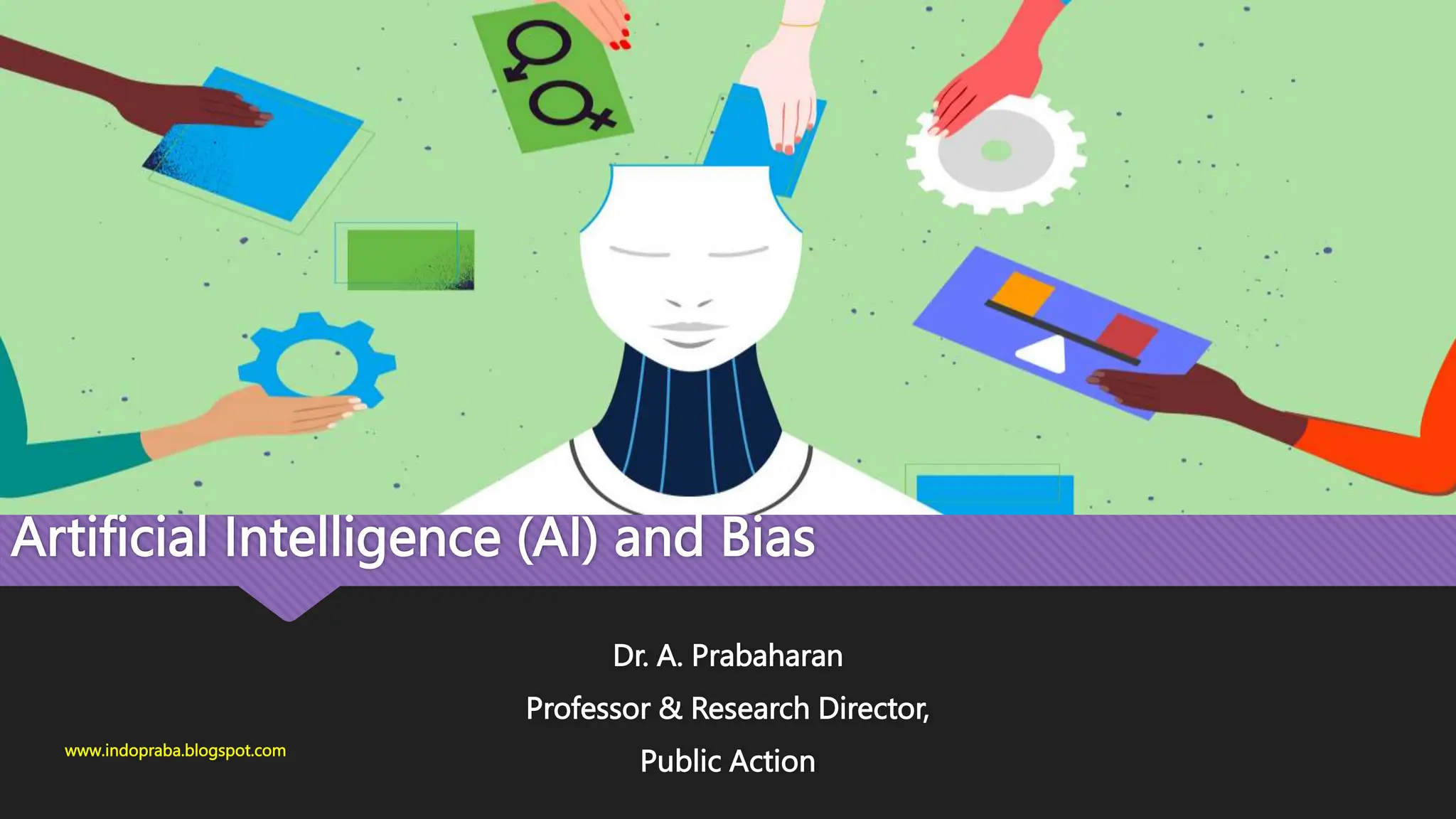
Artificial Intelligence (AI) and Bias
Dr. A. Prabaharan
Professor & Research Director,
Public Action
www.indopraba.blogspot.com
AI & Bias
AI and bias intersect in
several ways, raising
concerns about fairness,
equity, and
discrimination in AI
systems.
Here are some key
aspects of AI bias
www.indopraba.blogspot.com
Data Bias
AI systems learn from historical data,
which may reflect existing societal
biases and prejudices. If the training
data is biased, the AI model may
perpetuate or even amplify these
biases, leading to unfair or
discriminatory outcomes.
www.indopraba.blogspot.com
Algorithmic Bias
 AI algorithms can encode biases if they are
not properly designed, tested, and validated.
 Biases may arise from the algorithm's
structure, parameters, or optimization
objectives, resulting in biased predictions or
decisions.
www.indopraba.blogspot.com
Selection Bias
 Data used to train AI models may not be
representative of the population or
context in which the AI system will be
deployed, leading to selection bias.
 This can result in AI systems that are less
accurate or effective for certain
demographic groups or underrepresented
communities
www.indopraba.blogspot.com
Feedback Loop Bias
 Biased AI systems can perpetuate
feedback loops that reinforce existing
biases.
 For example, biased recommendations
made by AI systems may influence user
behavior, leading to further biased data
collection and model predictions.
www.indopraba.blogspot.com
Contextual Bias
AI systems may exhibit biases in specific
contexts or domains, such as healthcare,
criminal justice, or hiring.
 Biased AI decisions in these contexts can
have significant real-world consequences,
impacting individuals' lives and
perpetuating systemic inequalities.
www.indopraba.blogspot.com
Fairness and Equity
 Addressing bias in AI requires
considerations of fairness and equity,
ensuring that AI systems treat individuals
fairly and equitably across different
demographic groups and contexts.
 Fairness metrics, such as demographic
parity, equal opportunity, and disparate
impact, can be used to assess and mitigate
bias in AI systems.
www.indopraba.blogspot.com
Mitigation Strategies
 Various strategies can be employed to
mitigate bias in AI, including data
preprocessing techniques (e.g., data
augmentation, debiasing), algorithmic
fairness interventions (e.g., fairness-
aware algorithms, post-processing
techniques), and diversity and inclusion
efforts (e.g., diverse data collection,
stakeholder engagement).
www.indopraba.blogspot.com
Ethical Considerations
 Addressing bias in AI raises ethical
considerations related to fairness,
transparency, accountability, and social
responsibility.
 Ethical frameworks, such as the principle
of beneficence, non-maleficence,
autonomy, and justice, can guide the
development and deployment of AI
systems in a manner that aligns with
ethical principles and societal values.
www.indopraba.blogspot.com
End Note
 Overall, addressing bias in AI is crucial for
promoting fairness, equity, and social justice in AI-
driven decision-making processes.
 It requires interdisciplinary collaboration,
stakeholder engagement, and ongoing efforts to
identify, mitigate, and prevent biases in AI systems,
ensuring that AI technologies serve the common
good and contribute to positive societal outcomes.
www.indopraba.blogspot.com