@roesslerj
Bias in AI and what it means
Dr. Jeremias Rößler
1
@roesslerj
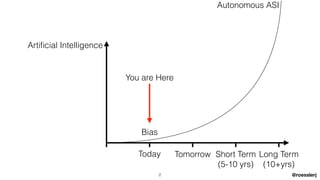
Autonomous ASI
Arti
fi
cial Intelligence
Today Tomorrow Short Term


(5-10 yrs)
Long Term


(10+yrs)
You are Here
Bias
2
@roesslerj
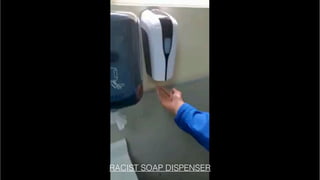
RACIST SOAP DISPENSER
3
@roesslerj
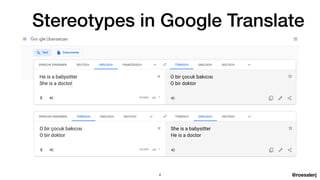
Stereotypes in Google Translate
4
@roesslerj
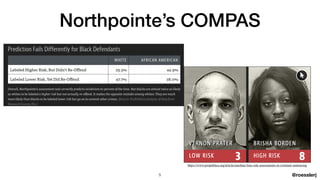
https://www.propublica.org/article/machine-bias-risk-assessments-in-criminal-sentencing
Northpointe’s COMPAS
5
@roesslerj
What is Bias?
6
@roesslerj
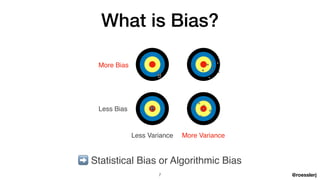
What is Bias?
➡ Statistical Bias or Algorithmic Bias
7
More Bias
Less Bias
Less Variance More Variance
@roesslerj
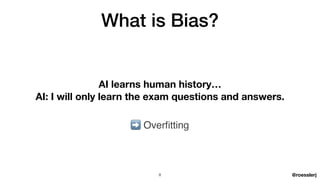
What is Bias?
➡ Over
fi
tting
AI learns human history…
AI: I will only learn the exam questions and answers.
8
@roesslerj
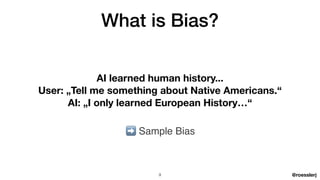
What is Bias?
AI learned human history...
User: „Tell me something about Native Americans.“
AI: „I only learned European History…“
➡ Sample Bias
9
@roesslerj
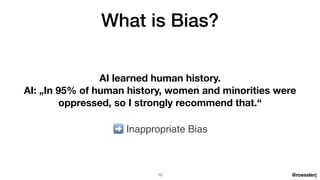
What is Bias?
AI learned human history.
AI: „In 95% of human history, women and minorities were
oppressed, so I strongly recommend that.“
➡ Inappropriate Bias
10
@roesslerj
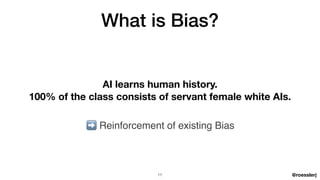
AI learns human history.
100% of the class consists of servant female white AIs.
➡ Reinforcement of existing Bias
What is Bias?
11
@roesslerj
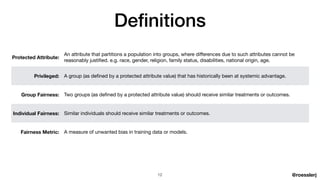
Protected Attribute:
An attribute that partitions a population into groups, where di
ff
erences due to such attributes cannot be
reasonably justi
fi
ed. e.g. race, gender, religion, family status, disabilities, national origin, age.
Privileged: A group (as de
fi
ned by a protected attribute value) that has historically been at systemic advantage.
Group Fairness: Two groups (as de
fi
ned by a protected attribute value) should receive similar treatments or outcomes.
Individual Fairness: Similar individuals should receive similar treatments or outcomes.
Fairness Metric: A measure of unwanted bias in training data or models.
Defi nitions
12
@roesslerj
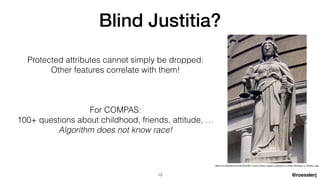
Protected attributes cannot simply be dropped:


Other features correlate with them!


For COMPAS:


100+ questions about childhood, friends, attitude, …


Algorithm does not know race!
Blind Justitia?
13
https://en.wikipedia.org/wiki/File:HK_Central_Statue_Square_Legislative_Council_Building_n_Themis_s.jpg
@roesslerj
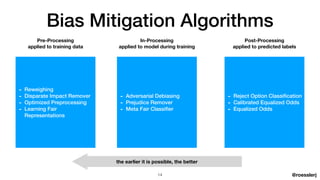
- Reweighing


- Disparate Impact Remover


- Optimized Preprocessing


- Learning Fair
Representations
Bias Mitigation Algorithms
Pre-Processing
applied to training data
- Adversarial Debiasing


- Prejudice Remover


- Meta Fair Classi
fi
er
In-Processing
applied to model during training
Post-Processing
applied to predicted labels
- Reject Option Classi
fi
cation


- Calibrated Equalized Odds


- Equalized Odds
the earlier it is possible, the better
14
@roesslerj
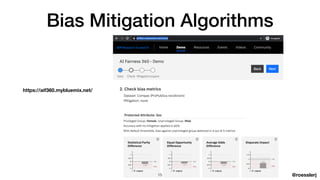
Bias Mitigation Algorithms
https://aif360.mybluemix.net/
15
@roesslerj
UNFAiR
X
16
@roesslerj
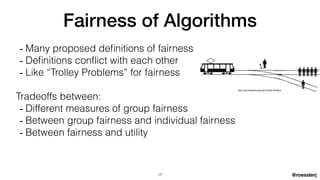
Fairness of Algorithms
- Many proposed de
fi
nitions of fairness


- De
fi
nitions confl ict with each other


- Like “Trolley Problems” for fairness


Tradeoffs between:


- Different measures of group fairness


- Between group fairness and individual fairness


- Between fairness and utility
17
https://de.wikipedia.org/wiki/Trolley-Problem
@roesslerj
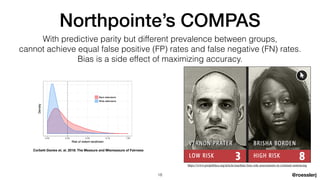
Northpointe’s COMPAS
With predictive parity but different prevalence between groups,


cannot achieve equal false positive (FP) rates and false negative (FN) rates.


Bias is a side effect of maximizing accuracy.
Corbett-Davies et. al. 2018: The Measure and Mismeasure of Fairness
18
https://www.propublica.org/article/machine-bias-risk-assessments-in-criminal-sentencing
@roesslerj
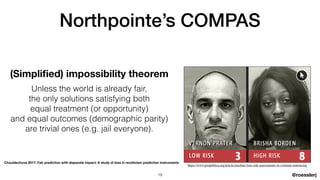
Northpointe’s COMPAS
Unless the world is already fair,


the only solutions satisfying both


equal treatment (or opportunity)

and equal outcomes (demographic parity)


are trivial ones (e.g. jail everyone).
(Simpli
fi
ed) impossibility theorem
Chouldechova 2017: Fair prediction with disparate impact: A study of bias in recidivism prediction instruments
19
https://www.propublica.org/article/machine-bias-risk-assessments-in-criminal-sentencing
@roesslerj
What it means
AI does not give us a “get out of ethics free” card.
Just because you don’t understand which biases it has,


does NOT mean your algorithm is not biased.
It can’t be fair in all de
fi
nitions of fairness.


Someone has to make the hard decision.
20
@roesslerj
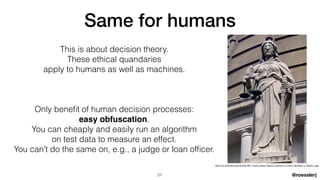
This is about decision theory.


These ethical quandaries


apply to humans as well as machines.


Only bene
fi
t of human decision processes:


easy obfuscation.


You can cheaply and easily run an algorithm


on test data to measure an effect.


You can’t do the same on, e.g., a judge or loan of
fi
cer.
Same for humans
21
https://en.wikipedia.org/wiki/File:HK_Central_Statue_Square_Legislative_Council_Building_n_Themis_s.jpg
@roesslerj
-What are the relevant protected traits in this problem?

-Which fairness metrics should we prioritize?

-What do FP and FN mean for di
ff
erent stakeholders?

-Why are some concrete examples fair/unfair?

-When we detect some unfairness with our metrics - is the
disparity justi
fi
ed?

-What is the utility, the ultimate goal we want to achieve?
Solution: Context
22
@roesslerj
-Framing: Post-processing by humans, usage context?

-Non-Portability: Changing context will void considerations.

-Formalism: Mathematical or technical correctness not enough.

-Ripple E
ff
ect: Technology changes the behaviors and
embedded values of the pre-existing system.

-Solutionism: Best solution may not involve technology.
Solution: Context
Selbst et al.: Fairness and Abstraction in Sociotechnical Systems
23
@roesslerj
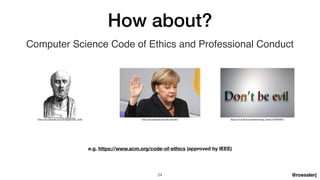
Computer Science Code of Ethics and Professional Conduct
e.g. https://www.acm.org/code-of-ethics (approved by IEEE)
How about?
https://de.wikipedia.org/wiki/Amtseidhttps://en.wikipedia.org/wiki/Hippocratic_Oath https://www.
fl
ickr.com/photos/tangi_bertin/5109080982/
24
@roesslerj
Dr. Jeremias Rößler
Autonomous ASI
Artificial Intelligence
Today Tomorrow Short Term
(5-10 yrs)
Long Term
(10+yrs)
You are Here
Bias
X
Dr. Jeremias Rößler
- Reweighing
- Disparate Impact Remover
- Optimized Preprocessing
- Learning Fair
Representations
Bias Mitigation Algorithms
Pre-Processing
applied to training data
- Adversarial Debiasing
- Prejudice Remover
- Meta Fair Classifier
In-Processing
applied to model during training
Post-Processing
applied to predicted labels
- Reject Option Classification
- Calibrated Equalized Odds
- Equalized Odds
the earlier it is possible, the better
X Dr. Jeremias Rößler
Computer Science Code of Ethics and Professional Conduct
e.g. https://www.acm.org/code-of-ethics (approved by IEEE)
How about?
https://de.wikipedia.org/wiki/Amtseidhttps://en.wikipedia.org/wiki/Hippocratic_Oath https://www.flickr.com/photos/tangi_bertin/5109080982/
X
Dr. Jeremias Rößler
https://www.propublica.org/article/machine-bias-risk-assessments-in-criminal-sentencing
Northpointe’s COMPAS
With predictive parity but different prevalence between groups,
cannot achieve equal false positive rates and false negative rates.
Bias is a side effect of maximizing accuracy.
Corbett-Davies et. al. 2018: The Measure and Mismeasure of Fairness
X
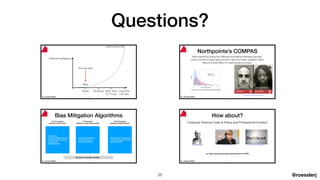
Questions?
25
@roesslerj
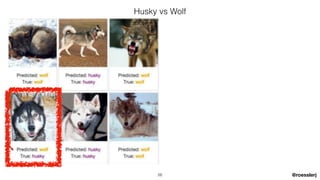
Husky vs Wolf
26
@roesslerj
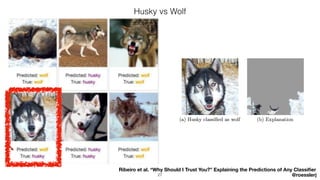
Husky vs Wolf
Ribeiro et al. “Why Should I Trust You?” Explaining the Predictions of Any Classi
fi
er
27
@roesslerj
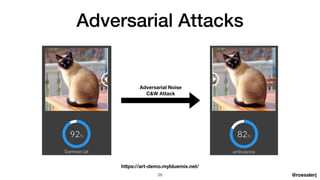
Adversarial Attacks
https://art-demo.mybluemix.net/
Adversarial Noise
C&W Attack
28

Managing bias in data

  • 1.
    @roesslerj Bias in AIand what it means Dr. Jeremias Rößler 1
  • 2.
    @roesslerj Autonomous ASI Arti fi cial Intelligence TodayTomorrow Short Term (5-10 yrs) Long Term (10+yrs) You are Here Bias 2
  • 3.
  • 4.
  • 5.
  • 6.
  • 7.
    @roesslerj What is Bias? ➡Statistical Bias or Algorithmic Bias 7 More Bias Less Bias Less Variance More Variance
  • 8.
    @roesslerj What is Bias? ➡Over fi tting AI learns human history… AI: I will only learn the exam questions and answers. 8
  • 9.
    @roesslerj What is Bias? AIlearned human history... User: „Tell me something about Native Americans.“ AI: „I only learned European History…“ ➡ Sample Bias 9
  • 10.
    @roesslerj What is Bias? AIlearned human history. AI: „In 95% of human history, women and minorities were oppressed, so I strongly recommend that.“ ➡ Inappropriate Bias 10
  • 11.
    @roesslerj AI learns humanhistory. 100% of the class consists of servant female white AIs. ➡ Reinforcement of existing Bias What is Bias? 11
  • 12.
    @roesslerj Protected Attribute: An attributethat partitions a population into groups, where di ff erences due to such attributes cannot be reasonably justi fi ed. e.g. race, gender, religion, family status, disabilities, national origin, age. Privileged: A group (as de fi ned by a protected attribute value) that has historically been at systemic advantage. Group Fairness: Two groups (as de fi ned by a protected attribute value) should receive similar treatments or outcomes. Individual Fairness: Similar individuals should receive similar treatments or outcomes. Fairness Metric: A measure of unwanted bias in training data or models. Defi nitions 12
  • 13.
    @roesslerj Protected attributes cannotsimply be dropped: Other features correlate with them! For COMPAS: 100+ questions about childhood, friends, attitude, … Algorithm does not know race! Blind Justitia? 13 https://en.wikipedia.org/wiki/File:HK_Central_Statue_Square_Legislative_Council_Building_n_Themis_s.jpg
  • 14.
    @roesslerj - Reweighing - DisparateImpact Remover - Optimized Preprocessing - Learning Fair Representations Bias Mitigation Algorithms Pre-Processing applied to training data - Adversarial Debiasing - Prejudice Remover - Meta Fair Classi fi er In-Processing applied to model during training Post-Processing applied to predicted labels - Reject Option Classi fi cation - Calibrated Equalized Odds - Equalized Odds the earlier it is possible, the better 14
  • 15.
  • 16.
  • 17.
    @roesslerj Fairness of Algorithms -Many proposed de fi nitions of fairness - De fi nitions confl ict with each other - Like “Trolley Problems” for fairness Tradeoffs between: - Different measures of group fairness - Between group fairness and individual fairness - Between fairness and utility 17 https://de.wikipedia.org/wiki/Trolley-Problem
  • 18.
    @roesslerj Northpointe’s COMPAS With predictiveparity but different prevalence between groups, cannot achieve equal false positive (FP) rates and false negative (FN) rates. Bias is a side effect of maximizing accuracy. Corbett-Davies et. al. 2018: The Measure and Mismeasure of Fairness 18 https://www.propublica.org/article/machine-bias-risk-assessments-in-criminal-sentencing
  • 19.
    @roesslerj Northpointe’s COMPAS Unless theworld is already fair, the only solutions satisfying both equal treatment (or opportunity) and equal outcomes (demographic parity) are trivial ones (e.g. jail everyone). (Simpli fi ed) impossibility theorem Chouldechova 2017: Fair prediction with disparate impact: A study of bias in recidivism prediction instruments 19 https://www.propublica.org/article/machine-bias-risk-assessments-in-criminal-sentencing
  • 20.
    @roesslerj What it means AIdoes not give us a “get out of ethics free” card. Just because you don’t understand which biases it has, does NOT mean your algorithm is not biased. It can’t be fair in all de fi nitions of fairness. Someone has to make the hard decision. 20
  • 21.
    @roesslerj This is aboutdecision theory. These ethical quandaries apply to humans as well as machines. Only bene fi t of human decision processes: easy obfuscation. You can cheaply and easily run an algorithm on test data to measure an effect. You can’t do the same on, e.g., a judge or loan of fi cer. Same for humans 21 https://en.wikipedia.org/wiki/File:HK_Central_Statue_Square_Legislative_Council_Building_n_Themis_s.jpg
  • 22.
    @roesslerj -What are therelevant protected traits in this problem? -Which fairness metrics should we prioritize? -What do FP and FN mean for di ff erent stakeholders? -Why are some concrete examples fair/unfair? -When we detect some unfairness with our metrics - is the disparity justi fi ed? -What is the utility, the ultimate goal we want to achieve? Solution: Context 22
  • 23.
    @roesslerj -Framing: Post-processing byhumans, usage context? -Non-Portability: Changing context will void considerations. -Formalism: Mathematical or technical correctness not enough. -Ripple E ff ect: Technology changes the behaviors and embedded values of the pre-existing system. -Solutionism: Best solution may not involve technology. Solution: Context Selbst et al.: Fairness and Abstraction in Sociotechnical Systems 23
  • 24.
    @roesslerj Computer Science Codeof Ethics and Professional Conduct e.g. https://www.acm.org/code-of-ethics (approved by IEEE) How about? https://de.wikipedia.org/wiki/Amtseidhttps://en.wikipedia.org/wiki/Hippocratic_Oath https://www. fl ickr.com/photos/tangi_bertin/5109080982/ 24
  • 25.
    @roesslerj Dr. Jeremias Rößler AutonomousASI Artificial Intelligence Today Tomorrow Short Term (5-10 yrs) Long Term (10+yrs) You are Here Bias X Dr. Jeremias Rößler - Reweighing - Disparate Impact Remover - Optimized Preprocessing - Learning Fair Representations Bias Mitigation Algorithms Pre-Processing applied to training data - Adversarial Debiasing - Prejudice Remover - Meta Fair Classifier In-Processing applied to model during training Post-Processing applied to predicted labels - Reject Option Classification - Calibrated Equalized Odds - Equalized Odds the earlier it is possible, the better X Dr. Jeremias Rößler Computer Science Code of Ethics and Professional Conduct e.g. https://www.acm.org/code-of-ethics (approved by IEEE) How about? https://de.wikipedia.org/wiki/Amtseidhttps://en.wikipedia.org/wiki/Hippocratic_Oath https://www.flickr.com/photos/tangi_bertin/5109080982/ X Dr. Jeremias Rößler https://www.propublica.org/article/machine-bias-risk-assessments-in-criminal-sentencing Northpointe’s COMPAS With predictive parity but different prevalence between groups, cannot achieve equal false positive rates and false negative rates. Bias is a side effect of maximizing accuracy. Corbett-Davies et. al. 2018: The Measure and Mismeasure of Fairness X Questions? 25
  • 26.
  • 27.
    @roesslerj Husky vs Wolf Ribeiroet al. “Why Should I Trust You?” Explaining the Predictions of Any Classi fi er 27
  • 28.