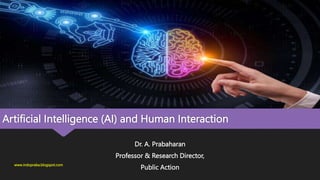
Artificial Intelligence (AI) and Human Interaction
Dr. A. Prabaharan
Professor & Research Director,
Public Action
www.indopraba.blogspot.com
AI & Future Technology
AI is profoundly influencing
human interactions in
various aspects of life, from
personal relationships to
professional environments.
Here's how AI is impacting
human interactions
www.indopraba.blogspot.com
Virtual Assistants and Chatbots
 AI-powered virtual assistants, such as Siri,
Alexa, and Google Assistant, have become
ubiquitous in daily life, providing personalized
assistance, information retrieval, and task
automation through natural language
interaction.
 These virtual assistants have transformed how
people interact with technology, making it
more intuitive, conversational, and accessible.
www.indopraba.blogspot.com
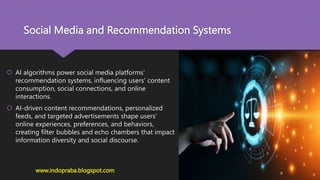
Social Media and Recommendation Systems
 AI algorithms power social media platforms'
recommendation systems, influencing users' content
consumption, social connections, and online
interactions.
 AI-driven content recommendations, personalized
feeds, and targeted advertisements shape users'
online experiences, preferences, and behaviors,
creating filter bubbles and echo chambers that impact
information diversity and social discourse.
www.indopraba.blogspot.com
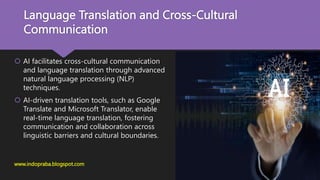
Language Translation and Cross-Cultural
Communication
 AI facilitates cross-cultural communication
and language translation through advanced
natural language processing (NLP)
techniques.
 AI-driven translation tools, such as Google
Translate and Microsoft Translator, enable
real-time language translation, fostering
communication and collaboration across
linguistic barriers and cultural boundaries.
www.indopraba.blogspot.com
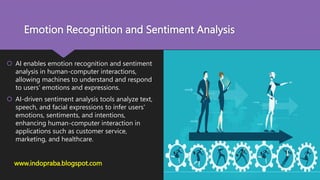
Emotion Recognition and Sentiment Analysis
 AI enables emotion recognition and sentiment
analysis in human-computer interactions,
allowing machines to understand and respond
to users' emotions and expressions.
 AI-driven sentiment analysis tools analyze text,
speech, and facial expressions to infer users'
emotions, sentiments, and intentions,
enhancing human-computer interaction in
applications such as customer service,
marketing, and healthcare.
www.indopraba.blogspot.com
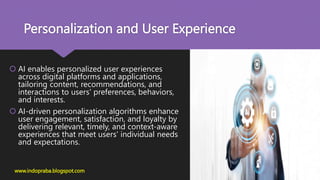
Personalization and User Experience
 AI enables personalized user experiences
across digital platforms and applications,
tailoring content, recommendations, and
interactions to users' preferences, behaviors,
and interests.
 AI-driven personalization algorithms enhance
user engagement, satisfaction, and loyalty by
delivering relevant, timely, and context-aware
experiences that meet users' individual needs
and expectations.
www.indopraba.blogspot.com
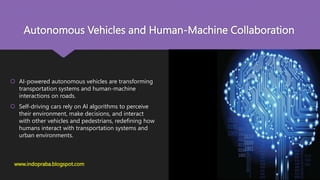
Autonomous Vehicles and Human-Machine Collaboration
www.indopraba.blogspot.com
 AI-powered autonomous vehicles are transforming
transportation systems and human-machine
interactions on roads.
 Self-driving cars rely on AI algorithms to perceive
their environment, make decisions, and interact
with other vehicles and pedestrians, redefining how
humans interact with transportation systems and
urban environments.
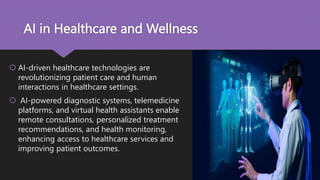
AI in Healthcare and Wellness
 AI-driven healthcare technologies are
revolutionizing patient care and human
interactions in healthcare settings.
 AI-powered diagnostic systems, telemedicine
platforms, and virtual health assistants enable
remote consultations, personalized treatment
recommendations, and health monitoring,
enhancing access to healthcare services and
improving patient outcomes.
Ethical and Social Implications
 AI raises ethical and social questions about the impact of
AI technologies on human relationships, privacy,
autonomy, and societal values.
 Addressing these implications requires responsible AI
development, ethical guidelines, and transparent
governance frameworks that prioritize human well-being,
equity, and dignity in AI-driven interactions and systems.
End Note
 Overall, AI is reshaping human interactions by
enabling new forms of communication,
personalization, and collaboration while raising
important questions about privacy, autonomy, and
social dynamics in the digital age.
 By fostering responsible AI deployment and
promoting human-centered design principles,
stakeholders can harness the transformative
potential of AI to enhance human interactions,
foster social connections, and empower individuals
and communities to thrive in a rapidly evolving
technological landscape.
www.indopraba.blogspot.com

Artificial Intelligence (AI) and Human Interaction.pptx

  • 1.
    Artificial Intelligence (AI)and Human Interaction Dr. A. Prabaharan Professor & Research Director, Public Action www.indopraba.blogspot.com
  • 2.
    AI & FutureTechnology AI is profoundly influencing human interactions in various aspects of life, from personal relationships to professional environments. Here's how AI is impacting human interactions www.indopraba.blogspot.com
  • 3.
    Virtual Assistants andChatbots  AI-powered virtual assistants, such as Siri, Alexa, and Google Assistant, have become ubiquitous in daily life, providing personalized assistance, information retrieval, and task automation through natural language interaction.  These virtual assistants have transformed how people interact with technology, making it more intuitive, conversational, and accessible. www.indopraba.blogspot.com
  • 4.
    Social Media andRecommendation Systems  AI algorithms power social media platforms' recommendation systems, influencing users' content consumption, social connections, and online interactions.  AI-driven content recommendations, personalized feeds, and targeted advertisements shape users' online experiences, preferences, and behaviors, creating filter bubbles and echo chambers that impact information diversity and social discourse. www.indopraba.blogspot.com
  • 5.
    Language Translation andCross-Cultural Communication  AI facilitates cross-cultural communication and language translation through advanced natural language processing (NLP) techniques.  AI-driven translation tools, such as Google Translate and Microsoft Translator, enable real-time language translation, fostering communication and collaboration across linguistic barriers and cultural boundaries. www.indopraba.blogspot.com
  • 6.
    Emotion Recognition andSentiment Analysis  AI enables emotion recognition and sentiment analysis in human-computer interactions, allowing machines to understand and respond to users' emotions and expressions.  AI-driven sentiment analysis tools analyze text, speech, and facial expressions to infer users' emotions, sentiments, and intentions, enhancing human-computer interaction in applications such as customer service, marketing, and healthcare. www.indopraba.blogspot.com
  • 7.
    Personalization and UserExperience  AI enables personalized user experiences across digital platforms and applications, tailoring content, recommendations, and interactions to users' preferences, behaviors, and interests.  AI-driven personalization algorithms enhance user engagement, satisfaction, and loyalty by delivering relevant, timely, and context-aware experiences that meet users' individual needs and expectations. www.indopraba.blogspot.com
  • 8.
    Autonomous Vehicles andHuman-Machine Collaboration www.indopraba.blogspot.com  AI-powered autonomous vehicles are transforming transportation systems and human-machine interactions on roads.  Self-driving cars rely on AI algorithms to perceive their environment, make decisions, and interact with other vehicles and pedestrians, redefining how humans interact with transportation systems and urban environments.
  • 9.
    AI in Healthcareand Wellness  AI-driven healthcare technologies are revolutionizing patient care and human interactions in healthcare settings.  AI-powered diagnostic systems, telemedicine platforms, and virtual health assistants enable remote consultations, personalized treatment recommendations, and health monitoring, enhancing access to healthcare services and improving patient outcomes.
  • 10.
    Ethical and SocialImplications  AI raises ethical and social questions about the impact of AI technologies on human relationships, privacy, autonomy, and societal values.  Addressing these implications requires responsible AI development, ethical guidelines, and transparent governance frameworks that prioritize human well-being, equity, and dignity in AI-driven interactions and systems.
  • 11.
    End Note  Overall,AI is reshaping human interactions by enabling new forms of communication, personalization, and collaboration while raising important questions about privacy, autonomy, and social dynamics in the digital age.  By fostering responsible AI deployment and promoting human-centered design principles, stakeholders can harness the transformative potential of AI to enhance human interactions, foster social connections, and empower individuals and communities to thrive in a rapidly evolving technological landscape.
  • 12.