Sociology of Machine Learning
Dr. A. Prabaharan
Professor & Research Director,
Public Action
www.indopraba.blogspot.com
Sociology of Machine Learning
The sociology of machine learning is an
interdisciplinary field that examines the
social, cultural, economic, and political
implications of the development,
deployment, and use of machine learning
algorithms and systems in society.
It encompasses a broad range of topics,
including ethics, bias and fairness, power
dynamics, accountability, and the social
shaping of technology
www.indopraba.blogspot.com
Ethics and Fairness
 One major area of study is the ethical
implications of machine learning algorithms,
particularly concerning issues of bias and
fairness.
 Researchers investigate how biases in training
data or algorithmic design can lead to
discriminatory outcomes, perpetuate social
inequalities, or reinforce existing power
dynamics.
www.indopraba.blogspot.com
Power Dynamics
Machine learning systems often have
significant implications for power
structures within society. Researchers
examine how these technologies can
shift power relations between
individuals, institutions, and groups,
and how they can be used to exert
control or influence over people's lives.
www.indopraba.blogspot.com
Accountability and Transparency
 There is growing interest in understanding how
to make machine learning systems more
transparent and accountable.
 This involves studying mechanisms for ensuring
that these systems are understandable,
interpretable, and subject to scrutiny, as well as
exploring frameworks for assigning
responsibility when they fail or produce harmful
outcomes.
www.indopraba.blogspot.com
Labor and Automation
 The introduction of machine learning
technologies into various sectors can
have profound effects on labor markets
and employment patterns.
 Sociologists study how automation and
the use of algorithms reshape job roles,
labor processes, and working
conditions, as well as the social and
economic implications for workers and
communities.
www.indopraba.blogspot.com
Surveillance and Privacy
Machine learning algorithms are
increasingly used for surveillance
purposes, raising concerns about privacy
and civil liberties.
Sociologists investigate how these
technologies are deployed in surveillance
systems, how they impact individuals'
privacy rights, and how they shape
broader dynamics of surveillance and
social control.
www.indopraba.blogspot.com
Cultural and Social Impacts
www.indopraba.blogspot.com
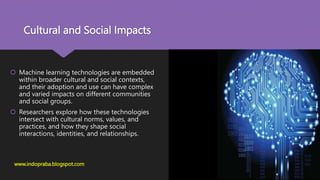
 Machine learning technologies are embedded
within broader cultural and social contexts,
and their adoption and use can have complex
and varied impacts on different communities
and social groups.
 Researchers explore how these technologies
intersect with cultural norms, values, and
practices, and how they shape social
interactions, identities, and relationships.
Policy and Governance
 Finally, the sociology of machine learning
engages with questions of policy and
governance, including how to regulate the
development and deployment of these
technologies in ways that promote social
welfare, protect human rights, and address
concerns about equity and justice.
End Note
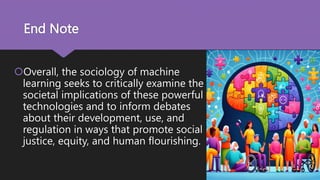
Overall, the sociology of machine
learning seeks to critically examine the
societal implications of these powerful
technologies and to inform debates
about their development, use, and
regulation in ways that promote social
justice, equity, and human flourishing.
www.indopraba.blogspot.com

Sociology of Machine Learning.pptx Explained

  • 1.
    Sociology of MachineLearning Dr. A. Prabaharan Professor & Research Director, Public Action www.indopraba.blogspot.com
  • 2.
    Sociology of MachineLearning The sociology of machine learning is an interdisciplinary field that examines the social, cultural, economic, and political implications of the development, deployment, and use of machine learning algorithms and systems in society. It encompasses a broad range of topics, including ethics, bias and fairness, power dynamics, accountability, and the social shaping of technology www.indopraba.blogspot.com
  • 3.
    Ethics and Fairness One major area of study is the ethical implications of machine learning algorithms, particularly concerning issues of bias and fairness.  Researchers investigate how biases in training data or algorithmic design can lead to discriminatory outcomes, perpetuate social inequalities, or reinforce existing power dynamics. www.indopraba.blogspot.com
  • 4.
    Power Dynamics Machine learningsystems often have significant implications for power structures within society. Researchers examine how these technologies can shift power relations between individuals, institutions, and groups, and how they can be used to exert control or influence over people's lives. www.indopraba.blogspot.com
  • 5.
    Accountability and Transparency There is growing interest in understanding how to make machine learning systems more transparent and accountable.  This involves studying mechanisms for ensuring that these systems are understandable, interpretable, and subject to scrutiny, as well as exploring frameworks for assigning responsibility when they fail or produce harmful outcomes. www.indopraba.blogspot.com
  • 6.
    Labor and Automation The introduction of machine learning technologies into various sectors can have profound effects on labor markets and employment patterns.  Sociologists study how automation and the use of algorithms reshape job roles, labor processes, and working conditions, as well as the social and economic implications for workers and communities. www.indopraba.blogspot.com
  • 7.
    Surveillance and Privacy Machinelearning algorithms are increasingly used for surveillance purposes, raising concerns about privacy and civil liberties. Sociologists investigate how these technologies are deployed in surveillance systems, how they impact individuals' privacy rights, and how they shape broader dynamics of surveillance and social control. www.indopraba.blogspot.com
  • 8.
    Cultural and SocialImpacts www.indopraba.blogspot.com  Machine learning technologies are embedded within broader cultural and social contexts, and their adoption and use can have complex and varied impacts on different communities and social groups.  Researchers explore how these technologies intersect with cultural norms, values, and practices, and how they shape social interactions, identities, and relationships.
  • 9.
    Policy and Governance Finally, the sociology of machine learning engages with questions of policy and governance, including how to regulate the development and deployment of these technologies in ways that promote social welfare, protect human rights, and address concerns about equity and justice.
  • 10.
    End Note Overall, thesociology of machine learning seeks to critically examine the societal implications of these powerful technologies and to inform debates about their development, use, and regulation in ways that promote social justice, equity, and human flourishing.
  • 11.