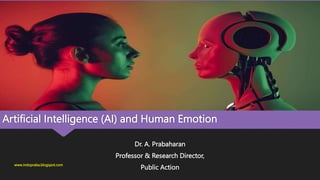
Artificial Intelligence (AI) and Human Emotion
Dr. A. Prabaharan
Professor & Research Director,
Public Action
www.indopraba.blogspot.com
AI & Human Emotion
AI's impact on human emotion
is a complex and evolving field,
with both potential benefits and
challenges.
Here's how AI intersects with
human emotion:
www.indopraba.blogspot.com
Emotion Recognition
 AI-powered algorithms can analyze facial expressions,
speech patterns, and text to recognize human
emotions.
 This capability is utilized in various applications,
including customer service, market research, and
mental health monitoring.
 Emotion recognition AI can provide valuable insights
into user sentiment and engagement, enabling
personalized interactions and content
recommendations.
www.indopraba.blogspot.com
Virtual Assistants and Chatbots
 AI-driven virtual assistants and chatbots are designed
to engage with users in a conversational manner,
often incorporating elements of emotional
intelligence.
 These systems can respond empathetically to user
queries, providing emotional support or reassurance
when needed.
 While they may not truly understand emotions, they
can simulate empathy through predefined responses
and interaction patterns.
www.indopraba.blogspot.com
Emotionally Intelligent Interfaces
 AI is being used to develop emotionally intelligent
interfaces that can adapt their behavior based on
user emotions.
 For example, AI-driven educational platforms can
adjust the difficulty of learning materials based on
student frustration levels, providing tailored support
to enhance learning outcomes.
 Similarly, AI-powered virtual therapists can adapt
their counseling approach based on user emotions,
offering personalized guidance and support.
www.indopraba.blogspot.com
Artificial Emotional Intelligence
 Some researchers are exploring the concept of
artificial emotional intelligence, which aims to
imbue AI systems with a deeper understanding
of human emotions and social cues.
 By integrating principles from psychology,
neuroscience, and computer science, these
efforts seek to create AI systems that can
empathize with human emotions, understand
social contexts, and respond appropriately in
interpersonal interactions.
www.indopraba.blogspot.com
Ethical Considerations
 The development and deployment of AI systems
that interact with human emotions raise ethical
considerations regarding privacy, consent, and
manipulation.
 For example, AI-powered emotion recognition
systems used in surveillance or marketing contexts
may infringe on individuals' privacy rights and
autonomy. Additionally, there is concern about the
potential for AI to manipulate or exploit human
emotions for commercial or political purposes.
www.indopraba.blogspot.com
Bias and Cultural Sensitivity
www.indopraba.blogspot.com
 AI algorithms for emotion recognition and analysis
may exhibit bias, leading to inaccurate or unfair
assessments of human emotions, particularly
across diverse cultural and demographic groups.
 Ensuring the fairness and cultural sensitivity of AI
systems requires careful consideration of dataset
biases, algorithmic transparency, and ongoing
monitoring and evaluation to mitigate potential
harms.
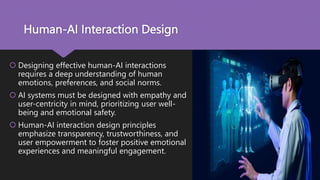
Human-AI Interaction Design
 Designing effective human-AI interactions
requires a deep understanding of human
emotions, preferences, and social norms.
 AI systems must be designed with empathy and
user-centricity in mind, prioritizing user well-
being and emotional safety.
 Human-AI interaction design principles
emphasize transparency, trustworthiness, and
user empowerment to foster positive emotional
experiences and meaningful engagement.
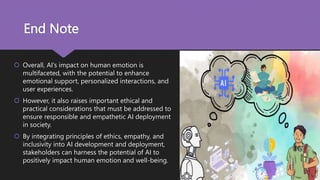
End Note
 Overall, AI's impact on human emotion is
multifaceted, with the potential to enhance
emotional support, personalized interactions, and
user experiences.
 However, it also raises important ethical and
practical considerations that must be addressed to
ensure responsible and empathetic AI deployment
in society.
 By integrating principles of ethics, empathy, and
inclusivity into AI development and deployment,
stakeholders can harness the potential of AI to
positively impact human emotion and well-being.
www.indopraba.blogspot.com

Artificial Intelligence (AI) and Human Emotion.pptx

  • 1.
    Artificial Intelligence (AI)and Human Emotion Dr. A. Prabaharan Professor & Research Director, Public Action www.indopraba.blogspot.com
  • 2.
    AI & HumanEmotion AI's impact on human emotion is a complex and evolving field, with both potential benefits and challenges. Here's how AI intersects with human emotion: www.indopraba.blogspot.com
  • 3.
    Emotion Recognition  AI-poweredalgorithms can analyze facial expressions, speech patterns, and text to recognize human emotions.  This capability is utilized in various applications, including customer service, market research, and mental health monitoring.  Emotion recognition AI can provide valuable insights into user sentiment and engagement, enabling personalized interactions and content recommendations. www.indopraba.blogspot.com
  • 4.
    Virtual Assistants andChatbots  AI-driven virtual assistants and chatbots are designed to engage with users in a conversational manner, often incorporating elements of emotional intelligence.  These systems can respond empathetically to user queries, providing emotional support or reassurance when needed.  While they may not truly understand emotions, they can simulate empathy through predefined responses and interaction patterns. www.indopraba.blogspot.com
  • 5.
    Emotionally Intelligent Interfaces AI is being used to develop emotionally intelligent interfaces that can adapt their behavior based on user emotions.  For example, AI-driven educational platforms can adjust the difficulty of learning materials based on student frustration levels, providing tailored support to enhance learning outcomes.  Similarly, AI-powered virtual therapists can adapt their counseling approach based on user emotions, offering personalized guidance and support. www.indopraba.blogspot.com
  • 6.
    Artificial Emotional Intelligence Some researchers are exploring the concept of artificial emotional intelligence, which aims to imbue AI systems with a deeper understanding of human emotions and social cues.  By integrating principles from psychology, neuroscience, and computer science, these efforts seek to create AI systems that can empathize with human emotions, understand social contexts, and respond appropriately in interpersonal interactions. www.indopraba.blogspot.com
  • 7.
    Ethical Considerations  Thedevelopment and deployment of AI systems that interact with human emotions raise ethical considerations regarding privacy, consent, and manipulation.  For example, AI-powered emotion recognition systems used in surveillance or marketing contexts may infringe on individuals' privacy rights and autonomy. Additionally, there is concern about the potential for AI to manipulate or exploit human emotions for commercial or political purposes. www.indopraba.blogspot.com
  • 8.
    Bias and CulturalSensitivity www.indopraba.blogspot.com  AI algorithms for emotion recognition and analysis may exhibit bias, leading to inaccurate or unfair assessments of human emotions, particularly across diverse cultural and demographic groups.  Ensuring the fairness and cultural sensitivity of AI systems requires careful consideration of dataset biases, algorithmic transparency, and ongoing monitoring and evaluation to mitigate potential harms.
  • 9.
    Human-AI Interaction Design Designing effective human-AI interactions requires a deep understanding of human emotions, preferences, and social norms.  AI systems must be designed with empathy and user-centricity in mind, prioritizing user well- being and emotional safety.  Human-AI interaction design principles emphasize transparency, trustworthiness, and user empowerment to foster positive emotional experiences and meaningful engagement.
  • 10.
    End Note  Overall,AI's impact on human emotion is multifaceted, with the potential to enhance emotional support, personalized interactions, and user experiences.  However, it also raises important ethical and practical considerations that must be addressed to ensure responsible and empathetic AI deployment in society.  By integrating principles of ethics, empathy, and inclusivity into AI development and deployment, stakeholders can harness the potential of AI to positively impact human emotion and well-being.
  • 11.