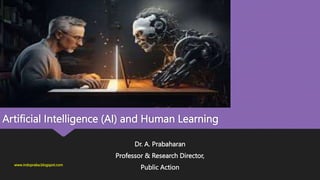
Artificial Intelligence (AI) and Human Learning
Dr. A. Prabaharan
Professor & Research Director,
Public Action
www.indopraba.blogspot.com
AI & Human Learning
AI's interaction with human
behavior and identity is a
complex and multifaceted topic,
raising questions about the
impact of AI on individual and
collective identity, agency, and
autonomy.
Here's how AI intersects with
human behavior and identity
www.indopraba.blogspot.com
Behavior Prediction and Influence
 AI algorithms can analyze vast amounts of data to
predict human behavior, preferences, and decisions.
 This capability is leveraged in various applications,
including personalized recommendations, targeted
advertising, and social media manipulation.
 AI-driven systems can influence human behavior by
shaping information consumption, decision-making
processes, and social interactions, raising concerns
about autonomy and agency.
www.indopraba.blogspot.com
Personalization and User Profiling
 AI-driven personalization algorithms create detailed
user profiles based on individuals' online activities,
preferences, and social connections.
 These profiles are used to tailor content, products, and
services to individual users, enhancing user
engagement and satisfaction.
 However, the use of personalized algorithms can also
lead to filter bubbles, echo chambers, and
reinforcement of existing biases, affecting individuals'
perceptions and behaviors.
www.indopraba.blogspot.com
Social Influence and Conformity
 AI-driven social media platforms and
recommendation systems can amplify social
influence dynamics, leading to conformity,
group polarization, and echo chamber effects.
 By promoting content that aligns with users'
existing beliefs and preferences, AI algorithms
can reinforce social norms, ideologies, and
behaviors, shaping collective identity and group
dynamics in online communities.
www.indopraba.blogspot.com
Identity Construction and Representation
 AI technologies play a role in identity
construction and representation, influencing
how individuals perceive themselves and are
perceived by others.
 Social media platforms use AI algorithms to
curate users' online personas, presenting a
curated version of their identity to the public.
 Additionally, AI-driven avatars and virtual
characters enable users to explore and express
different aspects of their identity in virtual
environments.
www.indopraba.blogspot.com
Cultural and Societal Norms
 AI systems reflect and reinforce cultural and societal
norms embedded in the data used for training and
development.
 As a result, AI algorithms may perpetuate biases,
stereotypes, and inequalities present in society,
impacting individuals' sense of identity and belonging.
 Addressing bias in AI requires diverse and
representative datasets, as well as algorithmic fairness
measures to mitigate unintended consequences on
human behavior and identity.
www.indopraba.blogspot.com
Ethical and Philosophical Implications
www.indopraba.blogspot.com
 AI's influence on human behavior and identity
raises ethical and philosophical questions about
autonomy, free will, and self-determination.
 As AI algorithms increasingly shape individuals'
choices and experiences, there is debate about the
extent to which humans retain control over their
actions and identities in AI-mediated environments.
 Exploring these implications requires
interdisciplinary dialogue and reflection on the
nature of human agency and identity in the digital
age.
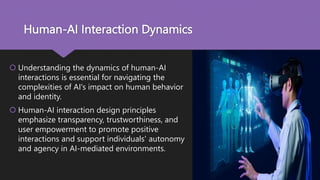
Human-AI Interaction Dynamics
 Understanding the dynamics of human-AI
interactions is essential for navigating the
complexities of AI's impact on human behavior
and identity.
 Human-AI interaction design principles
emphasize transparency, trustworthiness, and
user empowerment to promote positive
interactions and support individuals' autonomy
and agency in AI-mediated environments.
www.indopraba.blogspot.com

Artificial Intelligence (AI) and Human Learning.pptx

  • 1.
    Artificial Intelligence (AI)and Human Learning Dr. A. Prabaharan Professor & Research Director, Public Action www.indopraba.blogspot.com
  • 2.
    AI & HumanLearning AI's interaction with human behavior and identity is a complex and multifaceted topic, raising questions about the impact of AI on individual and collective identity, agency, and autonomy. Here's how AI intersects with human behavior and identity www.indopraba.blogspot.com
  • 3.
    Behavior Prediction andInfluence  AI algorithms can analyze vast amounts of data to predict human behavior, preferences, and decisions.  This capability is leveraged in various applications, including personalized recommendations, targeted advertising, and social media manipulation.  AI-driven systems can influence human behavior by shaping information consumption, decision-making processes, and social interactions, raising concerns about autonomy and agency. www.indopraba.blogspot.com
  • 4.
    Personalization and UserProfiling  AI-driven personalization algorithms create detailed user profiles based on individuals' online activities, preferences, and social connections.  These profiles are used to tailor content, products, and services to individual users, enhancing user engagement and satisfaction.  However, the use of personalized algorithms can also lead to filter bubbles, echo chambers, and reinforcement of existing biases, affecting individuals' perceptions and behaviors. www.indopraba.blogspot.com
  • 5.
    Social Influence andConformity  AI-driven social media platforms and recommendation systems can amplify social influence dynamics, leading to conformity, group polarization, and echo chamber effects.  By promoting content that aligns with users' existing beliefs and preferences, AI algorithms can reinforce social norms, ideologies, and behaviors, shaping collective identity and group dynamics in online communities. www.indopraba.blogspot.com
  • 6.
    Identity Construction andRepresentation  AI technologies play a role in identity construction and representation, influencing how individuals perceive themselves and are perceived by others.  Social media platforms use AI algorithms to curate users' online personas, presenting a curated version of their identity to the public.  Additionally, AI-driven avatars and virtual characters enable users to explore and express different aspects of their identity in virtual environments. www.indopraba.blogspot.com
  • 7.
    Cultural and SocietalNorms  AI systems reflect and reinforce cultural and societal norms embedded in the data used for training and development.  As a result, AI algorithms may perpetuate biases, stereotypes, and inequalities present in society, impacting individuals' sense of identity and belonging.  Addressing bias in AI requires diverse and representative datasets, as well as algorithmic fairness measures to mitigate unintended consequences on human behavior and identity. www.indopraba.blogspot.com
  • 8.
    Ethical and PhilosophicalImplications www.indopraba.blogspot.com  AI's influence on human behavior and identity raises ethical and philosophical questions about autonomy, free will, and self-determination.  As AI algorithms increasingly shape individuals' choices and experiences, there is debate about the extent to which humans retain control over their actions and identities in AI-mediated environments.  Exploring these implications requires interdisciplinary dialogue and reflection on the nature of human agency and identity in the digital age.
  • 9.
    Human-AI Interaction Dynamics Understanding the dynamics of human-AI interactions is essential for navigating the complexities of AI's impact on human behavior and identity.  Human-AI interaction design principles emphasize transparency, trustworthiness, and user empowerment to promote positive interactions and support individuals' autonomy and agency in AI-mediated environments.
  • 10.