ETHICAL ISSUES
AND SOLUTIONS
ARTIFICIAL
INTELLIGENCE
What is Artificial Intelligence?
1
Ethics in the field of AI
2
Ethical Issues in the field of AI
3
How can we help ?
4
How would you use AI?
5
Contents
Artificial Intelligence (AI) is the
use of computer systems to
simulate human mental
processes, such as interpreting
and generating language.
What is Artificial
Intelligence?
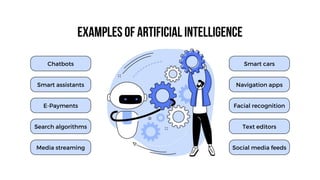
examples of Artificial Intelligence
Media streaming
Chatbots
Smart assistants
E-Payments
Search algorithms
Social media feeds
Smart cars
Navigation apps
Facial recognition
Text editors
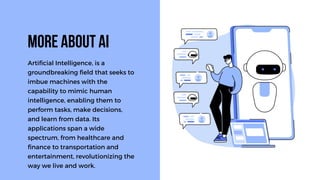
Artificial Intelligence, is a
groundbreaking field that seeks to
imbue machines with the
capability to mimic human
intelligence, enabling them to
perform tasks, make decisions,
and learn from data. Its
applications span a wide
spectrum, from healthcare and
finance to transportation and
entertainment, revolutionizing the
way we live and work.
MORE ABOUT AI
However, the rapid
proliferation of AI has
brought forth a host
of ethical concerns
that intersect with
professional ethics
across various
industries.
As AI continues to
reshape our world, it is
imperative that
individuals and
organizations adhere to a
set of guiding principles
that uphold ethical
standards, fostering a
harmonious relationship
between technological
advancement and
professional integrity.
In this discussion, we
delve into these
critical ethical issues
and their profound
connection with
professional ethics,
navigating the
intricate intersection
of AI and responsible,
principled practice in
the modern age.
ethics in the field of ai
From the potential for
biased algorithms to
the automation of
jobs and concerns
about privacy, the
ethical considerations
surrounding AI are
paramount for
professionals across
the board.
AI = ARTIFICIAL INTELLIGENCE
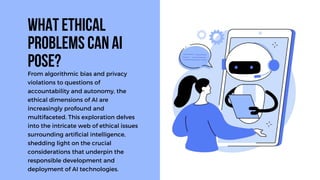
From algorithmic bias and privacy
violations to questions of
accountability and autonomy, the
ethical dimensions of AI are
increasingly profound and
multifaceted. This exploration delves
into the intricate web of ethical issues
surrounding artificial intelligence,
shedding light on the crucial
considerations that underpin the
responsible development and
deployment of AI technologies.
What ethical
problems can AI
pose?
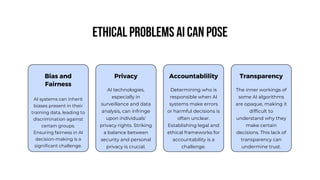
Bias and
Fairness
AI systems can inherit
biases present in their
training data, leading to
discrimination against
certain groups.
Ensuring fairness in AI
decision-making is a
significant challenge.
Accountablility
Determining who is
responsible when AI
systems make errors
or harmful decisions is
often unclear.
Establishing legal and
ethical frameworks for
accountability is a
challenge.
Transparency
The inner workings of
some AI algorithms
are opaque, making it
difficult to
understand why they
make certain
decisions. This lack of
transparency can
undermine trust.
ETHICAL problems AI can pose
Privacy
AI technologies,
especially in
surveillance and data
analysis, can infringe
upon individuals'
privacy rights. Striking
a balance between
security and personal
privacy is crucial.
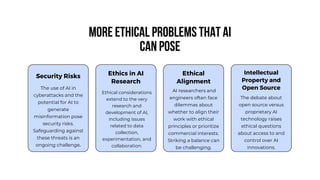
Security Risks
The use of AI in
cyberattacks and the
potential for AI to
generate
misinformation pose
security risks.
Safeguarding against
these threats is an
ongoing challenge.
Ethical
Alignment
AI researchers and
engineers often face
dilemmas about
whether to align their
work with ethical
principles or prioritize
commercial interests.
Striking a balance can
be challenging.
Intellectual
Property and
Open Source
The debate about
open source versus
proprietary AI
technology raises
ethical questions
about access to and
control over AI
innovations.
MORE ETHICAL problems THAT AI
can pose
Ethics in AI
Research
Ethical considerations
extend to the very
research and
development of AI,
including issues
related to data
collection,
experimentation, and
collaboration.
College students and faculty can
promote ethical AI by integrating
ethics into the curriculum,
organizing events, and fostering a
culture of responsible AI
development. This includes
hackathons, research,
interdisciplinary collaboration,
and dialogue with industry
experts, collectively contributing
to solving AI's ethical challenges.
How can we help?
Ethical AI use involves transparent
data handling, minimizing bias,
ensuring privacy, and making
decisions in the best interest of
society. It requires ongoing
vigilance, open communication,
and a commitment to responsible
AI development to maximize
benefits while mitigating harm.
How would you
use AI?
Khwaish Arora
RA2211026030085
Manvendra
Singh Solanki
RA2211026030066
Khushi Sharma
RA2211026030103
Krish Chopra
RA2211026030076
Krishna
Bharadwaj
RA2211026030120
Vaibhav Kumar
Rajput
RA2211026030081
OUR TEAM
THANK YOU FOR
LISTENING!