
Bias in AI
•
1 like•554 views

This document discusses bias in artificial intelligence and algorithms. It begins with an introduction to the topic and why it is important. It then explores how to detect bias through various fairness metrics and how to mitigate bias through preprocessing, inprocessing, and postprocessing techniques. The document provides examples of different sources of bias and strategies to address them. It also recommends resources like the AI Fairness 360 toolkit to help evaluate models for fairness and identify potential biases.

Recommended
More Related Content
What's hot
What's hot (20)
Similar to Bias in AI
Similar to Bias in AI (20)
More from Zeydy Ortiz, Ph. D.
Recently uploaded
Recently uploaded (20)
Bias in AI
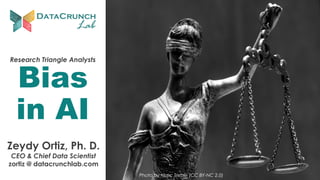
- 1. Research Triangle Analysts Bias in AI Zeydy Ortiz, Ph. D. CEO & Chief Data Scientist zortiz @ datacrunchlab.com Photo by Marc Treble (CC BY-NC 2.0)
- 3. Law EnforcementEmployment EducationCredit Algorithms used for high- stakes decisions affect us all
- 5. • •
- 8. @DataCrunch_Lab @RTPAnalystsFederal law prohibits discrimination against people based on… Sex Age Race Color Religion Disability Citizenship Pregnancy Familial Status Veteran Status National Origin Genetic Information in certain circumstances
- 9. @DataCrunch_Lab @RTPAnalysts US Anti-discrimination Laws • Housing – Fair Housing Act (FHA) 1968; FHA Amendments Act 1988 • Finance – Equal Credit Opportunity Act • Education - Civil Rights Act 1964; Education Amendments 1972 • Employment - Civil Rights Act 1964; Civil Rights Act 1991; Pregnancy Discrimination Act; Age Discrimination in Employment Act; Americans with Disability Act; Equal Pay Act; Immigration Reform and Control Act; Genetic Information Nondiscrimination Act • Public Accommodation - Civil Rights Act 1964
- 10. @DataCrunch_Lab @RTPAnalysts Discrimination Disparate treatment policies, practices or procedures that treat people differently because of their membership in a protected class Disparate impact policies, practices or procedures that has disadvantageous effect on some people of a protected class compared to others
- 11. @DataCrunch_Lab @RTPAnalysts “Scores like this — known as risk assessments — are increasingly common in courtrooms across the nation. They are used to inform decisions about who can be set free at every stage of the criminal justice system, from assigning bond amounts — as is the case in Fort Lauderdale — to even more fundamental decisions about defendants’ freedom. In Arizona, Colorado, Delaware, Kentucky, Louisiana, Oklahoma, Virginia, Washington and Wisconsin, the results of such assessments are given to judges during criminal sentencing.” – Julia Angwin, Jeff Larson, Surya Mattu, and Lauren Kirchner, ProPublica, May 23, 2016 (https://www.propublica.org/article/machine-bias-risk-assessments-in-criminal-sentencing)
- 12. @DataCrunch_Lab @RTPAnalysts Recidivism Northpointe “a finger-printable arrest involving a charge and a filing for any uniform crime reporting (UCR) code.” ProPublica “criminal offense that resulted in a jail booking”
- 13. @DataCrunch_Lab @RTPAnalysts Risk of Recidivism Score https://www.propublica.org/article/how-we-analyzed-the-compas-recidivism-algorithm
- 14. @DataCrunch_Lab @RTPAnalysts Analysis of COMPAS Recidivism Score ALL DEFENDANTS BLACK DEFENDANTS WHITE DEFENDANTS Low High Low High Low High Survived 2681 1282 Survived 990 805 Survived 1139 349 Recidivated 1216 2035 Recidivated 532 1369 Recidivated 461 505
- 15. @DataCrunch_Lab @RTPAnalysts Accurate for all groups ALL DEFENDANTS BLACK DEFENDANTS WHITE DEFENDANTS Low High Low High Low High Survived 2681 1282 Survived 990 805 Survived 1139 349 Recidivated 1216 2035 Recidivated 532 1369 Recidivated 461 505 65.4% 63.8% 67.0% Accuracy “ The company said it had devised the algorithm to achieve this goal. A test that is correct in equal proportions for all groups cannot be biased, the company said.”
- 16. @DataCrunch_Lab @RTPAnalysts Black defendants wrongly classified high risk more often ALL DEFENDANTS BLACK DEFENDANTS WHITE DEFENDANTS Low High Low High Low High Survived 2681 1282 Survived 990 805 Survived 1139 349 Recidivated 1216 2035 Recidivated 532 1369 Recidivated 461 505 32.3% 44.8% 23.5% Error rate “Black defendants who do not recidivate were nearly twice as likely to be classified by COMPAS as higher risk compared to their white counterparts.”
- 17. @DataCrunch_Lab @RTPAnalysts White defendants wrongly classified low risk more often ALL DEFENDANTS BLACK DEFENDANTS WHITE DEFENDANTS Low High Low High Low High Survived 2681 1282 Survived 990 805 Survived 1139 349 Recidivated 1216 2035 Recidivated 532 1369 Recidivated 461 505 37.4% 28.0% 47.7% Error rate “The test tended to make the opposite mistake with whites, meaning that it was more likely to wrongly predict that white people would not commit additional crimes if released compared to black defendants.”
- 18. @DataCrunch_Lab @RTPAnalysts Biased or Unbiased? Predictive Parity 65.4 63.8 67 0 10 20 30 40 50 60 70 80 ALL BLACK WHITE Accuracy Accuracy Disparate Impact 32.3 44.8 23.5 37.4 28 47.7 0 10 20 30 40 50 60 70 80 ALL BLACK WHITE Error rate Negative Positive
- 19. @DataCrunch_Lab @RTPAnalysts “Since blacks are re-arrested more often than whites, is it possible to create a formula that is equally predictive for all races without disparities in who suffers the harm of incorrect predictions?” NO
- 20. @DataCrunch_Lab @RTPAnalysts Key finding “If you have two populations that have unequal base rates then you can’t satisfy both definitions of fairness at the same time.” (CC BY 2.0) Photo by Ivan Radic
- 22. • •
- 23. @DataCrunch_Lab @RTPAnalysts Project Plan • Human-centered approach • Include multiple stakeholders • Set fairness goals & metrics • Audit the data for bias • Consider potential sources of bias • Consider primary, secondary, and tertiary layers of effect • Determine additional data collection needs • Plan mitigation strategies • Plan monitoring strategies Human
- 24. @DataCrunch_Lab @RTPAnalysts Bias sneaks in… “In 1952 the Boston Symphony Orchestra initiated blind auditions to help diversify its male- dominated roster, but trials still skewed heavily towards men.” - Edd Gent, “Beware of the gaps in Big Data,” Sept. 12, 2016
- 25. @DataCrunch_Lab @RTPAnalysts Sources of Bias Skewed sample Tainted examples Sample size disparity Limited features Proxies(CC BY-SA 2.0) Photo by Chris Bloom
- 26. @DataCrunch_Lab @RTPAnalysts Skewed sample Detect potholes to allocate repair crews “The system reported a disproportionate number of potholes in wealthier neighbourhoods. It turned out it was oversampling the younger, more affluent citizens who were digitally clued up enough to download and use the app in the first place. ” - David Wallace, “Big data has unconscious bias too”, Sept. 21, 2016
- 27. @DataCrunch_Lab @RTPAnalysts Tainted examples Identify job candidates “That is because Amazon’s computer models were trained to vet applicants by observing patterns in resumes submitted to the company over a 10-year period. Most came from men, a reflection of male dominance across the tech industry.” - Jeffrey Dastin, “Amazon scraps secret AI recruiting tool that showed bias against women”, Oct. 9, 2018
- 28. @DataCrunch_Lab @RTPAnalysts Sample size disparity “Assuming a fixed feature space, a classifier generally improves with the number of data points used to train it… The contrapositive is that less data leads to worse predictions. ” - Moritz Hardt, “How big data is unfair”, Sept. 26, 2014
- 29. @DataCrunch_Lab @RTPAnalysts Limited features Diagnose heart disease “recent research has shown that women who have heart disease experience different symptoms, causes and outcomes than men.” “Women are often told their stress tests are normal or that they have "false positives." Bairey Merz says doctors should pay attention to symptoms such as chest pain and shortness of breath rather than relying on a stress test score.”
- 30. @DataCrunch_Lab @RTPAnalysts Proxies Make college admissions decisions “…certain rules in the system that weighed applicants on the basis of seemingly non- relevant factors, like place of birth and name. […]simply having a non-European name could automatically take 15 points off an applicant’s score. The commission also found that female applicants were docked three points, on average.” - Oscar Schwartz, “Untold History of AI: Algorithmic Bias was Born in the 1980s”, April 15, 2019
- 31. • •
- 33. @DataCrunch_Lab @RTPAnalysts AI Fairness 360 Toolkit aif360.mybluemix.net Datasets Toolbox • Fairness metrics • Fairness metrics explanations • Bias mitigation algorithms Guidance Tutorials
- 34. @DataCrunch_Lab @RTPAnalysts AI Fairness 360 Structure
- 35. @DataCrunch_Lab @RTPAnalysts Detect bias Metrics: • Statistical Parity Difference • Equal Opportunity Difference • Average Odds Difference • Disparate Impact • Theil Index
- 36. @DataCrunch_Lab @RTPAnalysts Fairness Metrics ALL DEFENDANTS BLACK DEFENDANTS WHITE DEFENDANTS Low High Low High Low High Survived 2681 1282 Survived 990 805 Survived 1139 349 Recidivated 1216 2035 Recidivated 532 1369 Recidivated 461 505 Statistical Parity Difference 41.2% 65.2% 0% 20% 40% 60% 80% 100% BLACK WHITE Statistical Parity Difference = -24.0% LOW RISK HIGH RISK Difference of the rate of favorable outcomes between the unprivileged and privileged groups
- 37. @DataCrunch_Lab @RTPAnalysts Fairness Metrics ALL DEFENDANTS BLACK DEFENDANTS WHITE DEFENDANTS Low High Low High Low High Survived 2681 1282 Survived 990 805 Survived 1139 349 Recidivated 1216 2035 Recidivated 532 1369 Recidivated 461 505 Disparate Impact Ratio of the rate of favorable outcomes between the unprivileged and privileged groups 41.2% 65.2% 0% 20% 40% 60% 80% 100% BLACK WHITE Disparate Impact = 63.2% LOW RISK HIGH RISK
- 38. @DataCrunch_Lab @RTPAnalysts Fairness Metrics ALL DEFENDANTS BLACK DEFENDANTS WHITE DEFENDANTS Low High Low High Low High Survived 2681 1282 Survived 990 805 Survived 1139 349 Recidivated 1216 2035 Recidivated 532 1369 Recidivated 461 505 Equal Opportunity Difference Difference in true positive rates between the unprivileged and privileged groups 55.2% 76.5% 0% 20% 40% 60% 80% 100% BLACK WHITE Equal Opportunity Diff = -21.4% LOW RISK HIGH RISK
- 39. @DataCrunch_Lab @RTPAnalysts Fairness Metrics ALL DEFENDANTS BLACK DEFENDANTS WHITE DEFENDANTS Low High Low High Low High Survived 2681 1282 Survived 990 805 Survived 1139 349 Recidivated 1216 2035 Recidivated 532 1369 Recidivated 461 505 Average Odds Difference Average of difference in false positive rate and true positive rates of favorable outcomes between the unprivileged and privileged groups 65.0% 71.2% 35.0% 28.8% 0% 20% 40% 60% 80% 100% BLACK WHITE (Abs) Average Odds Diff = 6.1% SURVIVED RECIDIVATED
- 40. @DataCrunch_Lab @RTPAnalysts Mitigate Bias Pre-processing Mitigate bias in training data • Disparate Impact Remover • Learning Fair Representations • Optimized Preprocessing • Reweighing In-processing Mitigate bias in classifiers • Adversarial Debiasing • ART Classifier • Prejudice Remover Post-processing Mitigate bias in predictions • Calibrated Equality of Odds • Equality of Odds • Reject Option Classification https://aif360.readthedocs.io/en/latest/modules/algorithms.html
- 41. @DataCrunch_Lab @RTPAnalysts “there is no [machine learning] model that works best for every problem” Based on work by Wolpert (1996), “The Lack of A Priori Distinctions between Learning Algorithms” Photo by Hermes Rivera on Unsplash
- 42. @DataCrunch_Lab @RTPAnalysts Pre-processing Disparate impact remover is a preprocessing technique that edits feature values to increase group fairness while preserving rank-ordering within groups
- 43. @DataCrunch_Lab @RTPAnalysts In-processing Adversarial debiasing is an in-processing technique that learns a classifier to maximize prediction accuracy and simultaneously reduce an adversary’s ability to determine the protected attribute from the predictions.
- 44. @DataCrunch_Lab @RTPAnalysts Post-processing Equalized odds postprocessing is a post- processing technique that solves a linear program to find probabilities with which to change output labels to optimize equalized odds
- 45. @DataCrunch_Lab @RTPAnalystsBenefits of post- processing @ LinkedIn • Model agnostic • Robust to application- specific business logic • Easier integration • No significant modifications to existing components • Complementary to pre- processing and in- processing efforts https://engineering.linkedin.com/blog/2018/10/building-representative-talent-search-at-linkedin
- 46. • •
- 53. @DataCrunch_Lab @RTPAnalysts Learn more about the AI Fairness 360 toolkit •GitHub: https://github.com/IBM/AIF360 •Docs: https://aif360.readthedocs.io/en/latest/ •Demo: http://aif360.mybluemix.net/
- 54. @DataCrunch_Lab @RTPAnalysts Try IBM Watson OpenScale Videos and Tutorials: https://www.ibm.com/demos/collection/ IBM-Watson-OpenScale/
- 55. @DataCrunch_Lab @RTPAnalysts Other resources •What-if Tool Interactive visual interface designed to probe your models better including AI Fairness https://pair-code.github.io/what-if-tool/ •Ethics & Algorithms Toolkit A risk management frameworks for government (and other people too) http://ethicstoolkit.ai/
- 56. • •
- 57. Thank you! Zeydy Ortiz, Ph. D. CEO & Chief Data Scientist zortiz @ datacrunchlab.com www.linkedin.com/in/zortiz
- 58. Our Profile DataCrunch Lab, LLC is an IT professional services and technology development organization providing customized solutions that leverage data science, machine learning, and artificial intelligence. Our solutions transform data into value resulting in increased operational efficiency, reduced costs, and improved outcomes. Our Focus We create value by uncovering needs, co-developing the best solution, supporting customers through implementation, and ensuring the solution is successful. As an IBM Business Partner, we leverage the Data & AI portfolio of products in our solutions. We serve customers across many industries including IT, legal, retail, financial, and industrial/manufacturing sectors. Our Success We have 20+ years of professional experience with the ability to architect, design and develop highly complex IT solutions focused on business outcomes. Some of the issues we have addressed include: • Informed business strategy - what products to produce, what features to include, and for which markets - with predictive modeling and simulation • Increased visibility of real-time operations by integrating multiple technologies - messaging, natural language understanding, chatbots, data visualization, cloud computing • Increased operational efficiency by predicting customer churn • Reduced IT costs by predicting process duration to efficiently allocate resources
- 59. @DataCrunch_Lab @RTPAnalysts Trademarks and Notes © IBM Corporation 2019 • IBM, the IBM logo, ibm.com, and Watson OpenScale are trademarks or registered trademarks of International Business Machines Corporation in the United States, other countries, or both. If these and other IBM trademarked terms are marked on their first occurrence in this information with the appropriate symbol (® or ™), these symbols indicate U.S. registered or common law trademarks owned by IBM at the time this information was published. Such trademarks may also be registered or common law trademarks in other countries. A current list of IBM trademarks is available on the Web at “Copyright and trademark information” at www.ibm.com/legal/copytrade.shtml. • Other company, product, and service names may be trademarks or service marks of others. • References in this publication to IBM products or services do not imply that IBM intends to make them available in all countries in which IBM operates.
- 60. @DataCrunch_Lab @RTPAnalysts References ❖ “Machine Bias”, ProPublica, ❖ https://www.propublica.org/article/machine-bias-risk-assessments-in-criminal-sentencing ❖ https://www.propublica.org/article/how-we-analyzed-the-compas-recidivism-algorithm ❖ https://www.propublica.org/article/bias-in-criminal-risk-scores-is-mathematically-inevitable-researchers-say ❖ “Beware of the gaps in Big Data,” https://eandt.theiet.org/content/articles/2016/09/beware-of-the-gaps- in-big-data/ ❖ “Big data has unconscious bias too”: https://thesumisgreater.wordpress.com/2016/09/21/big-data-has- unconscious-bias-too/ ❖ “Amazon scraps secret AI recruiting tool that showed bias against women”: https://www.reuters.com/article/us-amazon-com-jobs-automation-insight/amazon-scraps-secret-ai- recruiting-tool-that-showed-bias-against-women-idUSKCN1MK08G ❖ “How big data is unfair,” https://medium.com/@mrtz/how-big-data-is-unfair-9aa544d739de ❖ “When it comes to heart disease, women and men are not equal” https://www.cedars-sinai.edu/About- Us/HH-Landing-Pages/When-it-comes-to-heart-disease-women-and-men-are-not-equal.aspx ❖ “Untold History of AI: Algorithmic Bias was Born in the 1980s,” https://spectrum.ieee.org/tech-talk/tech- history/dawn-of-electronics/untold-history-of-ai-the-birth-of-machine-bias ❖ AI Fairness 360 Toolkit: http://aif360.mybluemix.net ❖ “Certifying and removing disparate impact.” https://arxiv.org/abs/1412.3756 ❖ “Mitigating Unwanted Biases with Adversarial Learning”, https://arxiv.org/pdf/1801.07593 ❖ “On Fairness and Calibration,” https://arxiv.org/abs/1709.02012 ❖ “Building Representative Talent Search at LinkedIn,” https://engineering.linkedin.com/blog/2018/10/building-representative-talent-search-at-linkedin ❖ IBM Watson OpenScale, https://console.bluemix.net/catalog/services/ai-openscale