Artificial Intelligence
One Vision of an AI
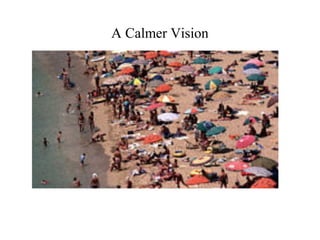
A Calmer Vision
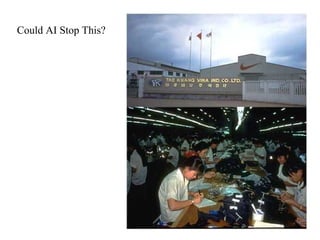
Could AI Stop This?
What is Artificial Intelligence?
A.I. is the study of how to make computers do things at
which, at the moment, people are better.
Or, Stepping Back Even Farther, Can We
Build Artificial People?
•Historical attempts
•The modern quest for robots and intelligent agents
•Us vs. Them
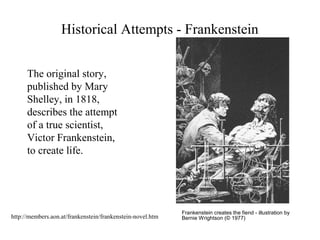
Historical Attempts - Frankenstein
Frankenstein creates the fiend - illustration by
Bernie Wrightson (© 1977)
The original story,
published by Mary
Shelley, in 1818,
describes the attempt
of a true scientist,
Victor Frankenstein,
to create life.
http://members.aon.at/frankenstein/frankenstein-novel.htm
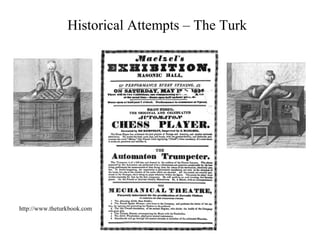
Historical Attempts – The Turk
http://www.theturkbook.com
Historical Attempts - Euphonia
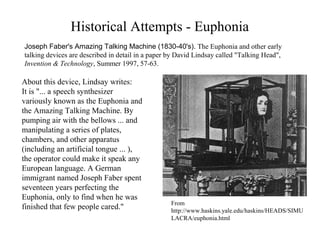
Joseph Faber's Amazing Talking Machine (1830-40's). The Euphonia and other early
talking devices are described in detail in a paper by David Lindsay called "Talking Head",
Invention & Technology, Summer 1997, 57-63.
From
http://www.haskins.yale.edu/haskins/HEADS/SIMU
LACRA/euphonia.html
About this device, Lindsay writes:
It is "... a speech synthesizer
variously known as the Euphonia and
the Amazing Talking Machine. By
pumping air with the bellows ... and
manipulating a series of plates,
chambers, and other apparatus
(including an artificial tongue ... ),
the operator could make it speak any
European language. A German
immigrant named Joseph Faber spent
seventeen years perfecting the
Euphonia, only to find when he was
finished that few people cared."
Historical Attempts - RUR
"CHEAP LABOR. ROSSUM'S ROBOTS." 
"ROBOTS FOR THE TROPICS.  150 DOLLARS EACH."
"EVERYONE SHOULD BUY HIS OWN ROBOT." 
"DO YOU WANT TO CHEAPEN YOUR OUTPUT? 
 ORDER ROSSUM'S ROBOTS" 
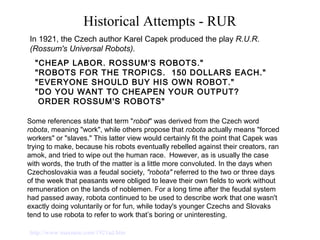
In 1921, the Czech author Karel Capek produced the play R.U.R.
(Rossum's Universal Robots).
http://www.maxmon.com/1921ad.htm
Some references state that term "robot" was derived from the Czech word
robota, meaning "work", while others propose that robota actually means "forced
workers" or "slaves." This latter view would certainly fit the point that Capek was
trying to make, because his robots eventually rebelled against their creators, ran
amok, and tried to wipe out the human race. However, as is usually the case
with words, the truth of the matter is a little more convoluted. In the days when
Czechoslovakia was a feudal society, "robota" referred to the two or three days
of the week that peasants were obliged to leave their own fields to work without
remuneration on the lands of noblemen. For a long time after the feudal system
had passed away, robota continued to be used to describe work that one wasn't
exactly doing voluntarily or for fun, while today's younger Czechs and Slovaks
tend to use robota to refer to work that’s boring or uninteresting.
The Roots of Modern Technology
5th
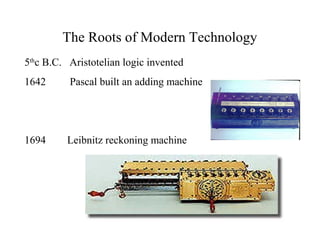
c B.C. Aristotelian logic invented
1642 Pascal built an adding machine
1694 Leibnitz reckoning machine
The Roots, continued
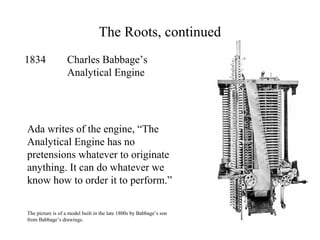
1834 Charles Babbage’s
Analytical Engine
Ada writes of the engine, “The
Analytical Engine has no
pretensions whatever to originate
anything. It can do whatever we
know how to order it to perform.”
The picture is of a model built in the late 1800s by Babbage’s son
from Babbage’s drawings.
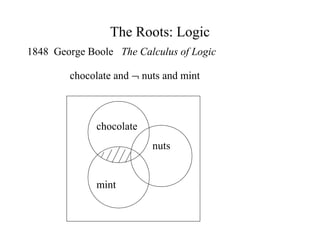
The Roots: Logic
1848 George Boole The Calculus of Logic
chocolate
nuts
mint
chocolate and ¬ nuts and mint
Mathematics in the Early 20th
Century –
(Looking Ahead: Will Logic be the Key to
Thinking?)
1900 Hilbert’s program and the effort to formalize
mathematics
1931 Kurt Gödel’s paper, On Formally Undecidable
Propositions
1936 Alan Turing’s paper, On Computable Numbers with an
application to the Entscheidungs problem
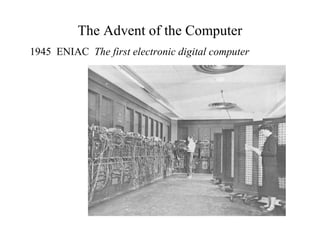
The Advent of the Computer
1945 ENIAC The first electronic digital computer
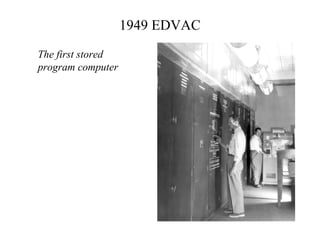
1949 EDVAC
The first stored
program computer
The Dartmouth Conference and the Name
Artificial Intelligence
J. McCarthy, M. L. Minsky, N. Rochester, and C.E.
Shannon. August 31, 1955. "We propose that a 2
month, 10 man study of artificial intelligence be
carried out during the summer of 1956 at
Dartmouth College in Hanover, New Hampshire.
The study is to proceed on the basis of the
conjecture that every aspect of learning or any
other feature of intelligence can in principle be
so precisely described that a machine can be
made to simulate it."
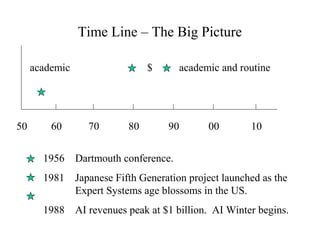
Time Line – The Big Picture
50 60 70 80 90 00 10
1956 Dartmouth conference.
1981 Japanese Fifth Generation project launched as the
Expert Systems age blossoms in the US.
1988 AI revenues peak at $1 billion. AI Winter begins.
academic $ academic and routine
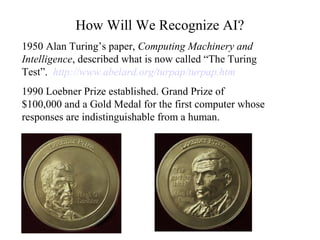
How Will We Recognize AI?
1950 Alan Turing’s paper, Computing Machinery and
Intelligence, described what is now called “The Turing
Test”. http://www.abelard.org/turpap/turpap.htm
1990 Loebner Prize established. Grand Prize of
$100,000 and a Gold Medal for the first computer whose
responses are indistinguishable from a human.
The Origins of AI Hype
1950 Turing predicted that in about fifty years "an average
interrogator will not have more than a 70 percent chance of
making the right identification after five minutes of
questioning".
1957 Newell and Simon predicted that "Within ten years a
computer will be the world's chess champion, unless the rules
bar it from competition."
Was Turing Right?
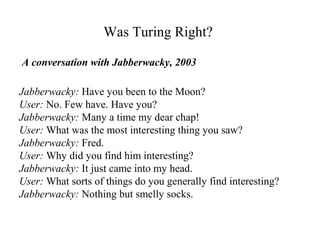
Jabberwacky: Have you been to the Moon?
User: No. Few have. Have you?
Jabberwacky: Many a time my dear chap!
User: What was the most interesting thing you saw?
Jabberwacky: Fred.
User: Why did you find him interesting?
Jabberwacky: It just came into my head.
User: What sorts of things do you generally find interesting?
Jabberwacky: Nothing but smelly socks.
A conversation with Jabberwacky, 2003
Another One
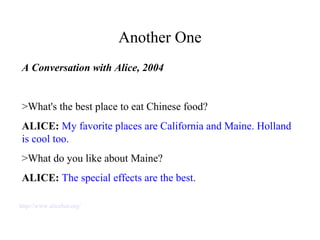
A Conversation with Alice, 2004
>What's the best place to eat Chinese food?
ALICE: My favorite places are California and Maine. Holland
is cool too.
>What do you like about Maine?
ALICE: The special effects are the best.
http://www.alicebot.org/
Alice, Again
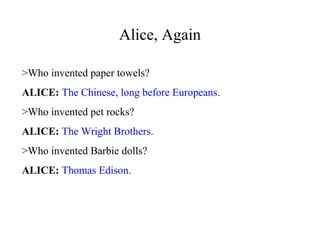
>Who invented paper towels?
ALICE: The Chinese, long before Europeans.
>Who invented pet rocks?
ALICE: The Wright Brothers.
>Who invented Barbie dolls?
ALICE: Thomas Edison.
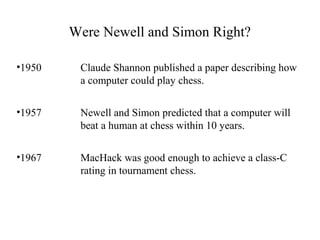
Were Newell and Simon Right?
•1950 Claude Shannon published a paper describing how
a computer could play chess.
•1957 Newell and Simon predicted that a computer will
beat a human at chess within 10 years.
•1967 MacHack was good enough to achieve a class-C
rating in tournament chess.
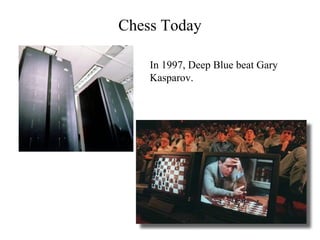
Chess Today
In 1997, Deep Blue beat Gary
Kasparov.
Why Did They Get it Wrong?
They failed to understand at least three key things:
•The need for knowledge (lots of it)
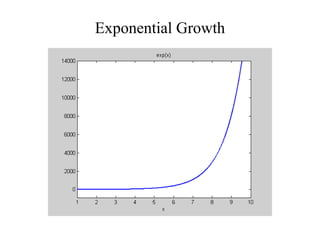
•Scalability and the problem of complexity and exponential
growth
•The need to perceive the world
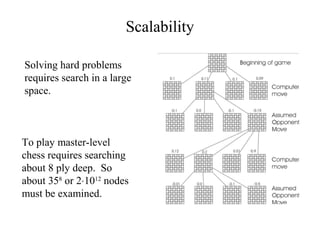
Scalability
Solving hard problems
requires search in a large
space.
To play master-level
chess requires searching
about 8 ply deep. So
about 358
or 2⋅1012
nodes
must be examined.
Exponential Growth
But Chess is Easy
•The rules are simple enough to fit on one page
•The branching factor is only 35.
A Harder One
John saw a boy and a girl with a red wagon with one blue and
one white wheel dragging on the ground under a tree with huge
branches.
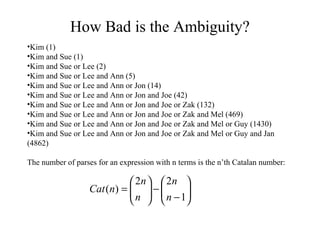
How Bad is the Ambiguity?
•Kim (1)
•Kim and Sue (1)
•Kim and Sue or Lee (2)
•Kim and Sue or Lee and Ann (5)
•Kim and Sue or Lee and Ann or Jon (14)
•Kim and Sue or Lee and Ann or Jon and Joe (42)
•Kim and Sue or Lee and Ann or Jon and Joe or Zak (132)
•Kim and Sue or Lee and Ann or Jon and Joe or Zak and Mel (469)
•Kim and Sue or Lee and Ann or Jon and Joe or Zak and Mel or Guy (1430)
•Kim and Sue or Lee and Ann or Jon and Joe or Zak and Mel or Guy and Jan
(4862)
The number of parses for an expression with n terms is the n’th Catalan number:






−
−





=
1
22
)(
n
n
n
n
nCat
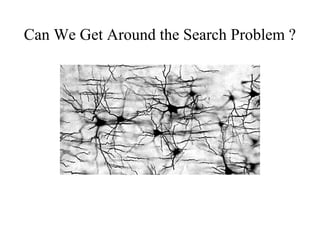
Can We Get Around the Search Problem ?
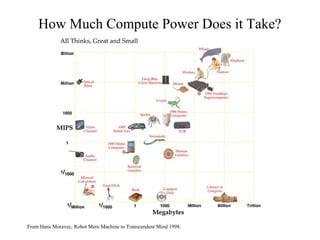
How Much Compute Power Does it Take?
From Hans Moravec, Robot Mere Machine to Transcendent Mind 1998.
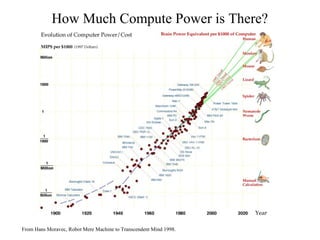
How Much Compute Power is There?
From Hans Moravec, Robot Mere Machine to Transcendent Mind 1998.
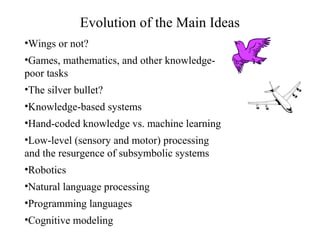
Evolution of the Main Ideas
•Wings or not?
•Games, mathematics, and other knowledge-
poor tasks
•The silver bullet?
•Knowledge-based systems
•Hand-coded knowledge vs. machine learning
•Low-level (sensory and motor) processing
and the resurgence of subsymbolic systems
•Robotics
•Natural language processing
•Programming languages
•Cognitive modeling
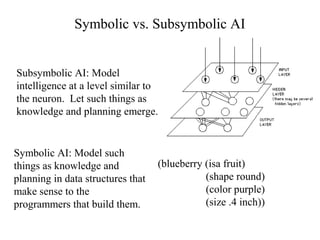
Symbolic vs. Subsymbolic AI
Subsymbolic AI: Model
intelligence at a level similar to
the neuron. Let such things as
knowledge and planning emerge.
Symbolic AI: Model such
things as knowledge and
planning in data structures that
make sense to the
programmers that build them.
(blueberry (isa fruit)
(shape round)
(color purple)
(size .4 inch))
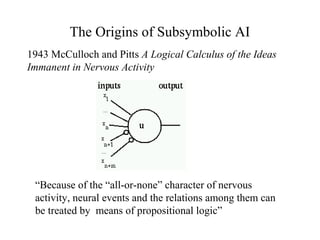
The Origins of Subsymbolic AI
1943 McCulloch and Pitts A Logical Calculus of the Ideas
Immanent in Nervous Activity
“Because of the “all-or-none” character of nervous
activity, neural events and the relations among them can
be treated by means of propositional logic”
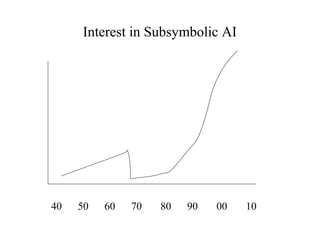
Interest in Subsymbolic AI
40 50 60 70 80 90 00 10
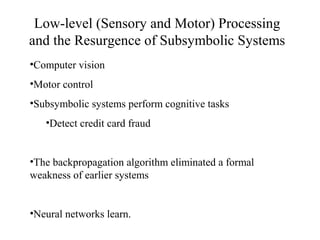
Low-level (Sensory and Motor) Processing
and the Resurgence of Subsymbolic Systems
•Computer vision
•Motor control
•Subsymbolic systems perform cognitive tasks
•Detect credit card fraud
•The backpropagation algorithm eliminated a formal
weakness of earlier systems
•Neural networks learn.
The Origins of Symbolic AI
•Games
•Theorem proving
Games
•Chess
•Checkers:
•1952-1962 Art Samuel built the first checkers
program
•Chinook became the world checkers champion in
1994
•Othello:
•Logistello beat the world champion in 1997
Games
•Chess
•Checkers: Chinook became the world checkers champion in
1994
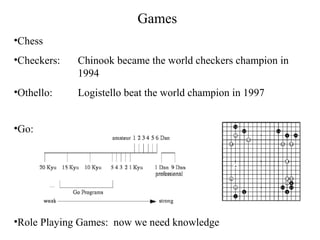
•Othello: Logistello beat the world champion in 1997
•Role Playing Games: now we need knowledge
•Go:
Mathematics
1956 Logic Theorist (the first running AI program?)
1961 SAINT solved calculus problems at the college
freshman level
1967 Macsyma
Gradually theorem proving has become well enough
understood that it is usually no longer considered AI
1996 J Moore and others verified the correctness of the
AMD5k86 Floating-Point Division algorithm
The Silver Bullet?
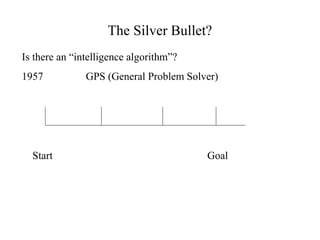
Is there an “intelligence algorithm”?
1957 GPS (General Problem Solver)
Start Goal
But What About Knowledge?
•Why do we need it?
•How can we represent it and use it?
•How can we acquire it?
Find me stuff about dogs who save people’s lives.
Around midnight, two beagles spotted a
fire in the house next door. Their
barking alerted their owners, who called
911.
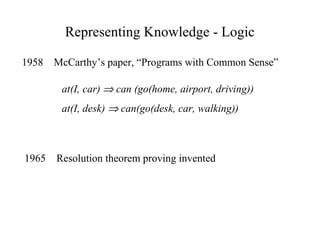
Representing Knowledge - Logic
1958 McCarthy’s paper, “Programs with Common Sense”
at(I, car) ⇒ can (go(home, airport, driving))
at(I, desk) ⇒ can(go(desk, car, walking))
1965 Resolution theorem proving invented
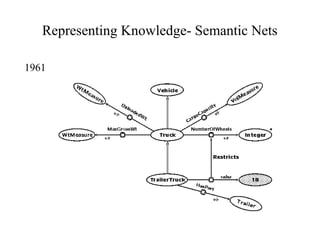
Representing Knowledge- Semantic Nets
1961
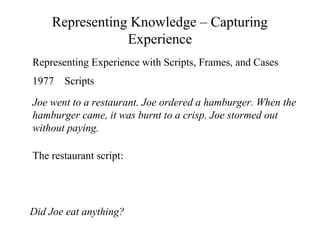
Representing Knowledge – Capturing
Experience
Representing Experience with Scripts, Frames, and Cases
1977 Scripts
Joe went to a restaurant. Joe ordered a hamburger. When the
hamburger came, it was burnt to a crisp. Joe stormed out
without paying.
The restaurant script:
Did Joe eat anything?
Representing Knowledge - Rules
Expert knowledge in many domains can be captured in
rules.
From XCON (1982):
If: the most current active context is distributing
massbus devices, and
there is a single-port disk drive that has not been
assigned to a massbus, and
there are no unassigned dual-port disk drives, and
the number of devices that each massbus should support is known,
and
there is a massbus that has been assigned at least one disk drive that
should support additional disk drives, and
the type of cable needed to connect the disk drive to the previous
device on the massbus is known
Then: assign the disk drive to the massbus.
Representing Knowledge – Probabilistically
1975 Mycin attaches probability-like numbers to rules
1970s Probabilistic models of speech recognition
1980s Statistical Machine Translation systems
1990s large scale neural nets
If: (1) the stain of the ogranism is gram-positive, and
(2) the morphology of the organism is coccus, and
(3) the growth conformation of the organism is clumps
Then: there is suggestive evidence (0.7) that the identity of
the organism is stphylococcus.
The Rise of Expert Systems
1967 Dendral – a rule-based system that infered
molecular structure from mass spectral and NMR data
1975 Mycin – a rule-based system to recommend
antibiotic therapy
1975 Meta-Dendral learned new rules of mass
spectrometry, the first discoveries by a computer to appear in
a refereed scientific journal
1979 EMycin – the first expert system shell
1980’s The Age of Expert Systems
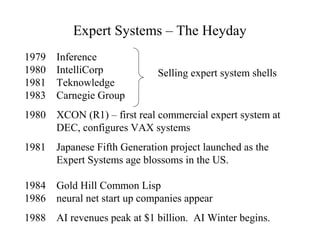
Expert Systems – The Heyday
1979 Inference
1980 IntelliCorp
1981 Teknowledge
1983 Carnegie Group
1980 XCON (R1) – first real commercial expert system at
DEC, configures VAX systems
1981 Japanese Fifth Generation project launched as the
Expert Systems age blossoms in the US.
1984 Gold Hill Common Lisp
1986 neural net start up companies appear
1988 AI revenues peak at $1 billion. AI Winter begins.
Selling expert system shells
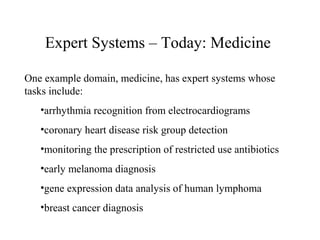
Expert Systems – Today: Medicine
One example domain, medicine, has expert systems whose
tasks include:
•arrhythmia recognition from electrocardiograms
•coronary heart disease risk group detection
•monitoring the prescription of restricted use antibiotics
•early melanoma diagnosis
•gene expression data analysis of human lymphoma
•breast cancer diagnosis
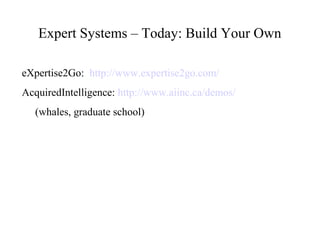
Expert Systems – Today: Build Your Own
eXpertise2Go: http://www.expertise2go.com/
AcquiredIntelligence: http://www.aiinc.ca/demos/
(whales, graduate school)
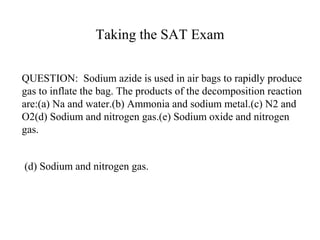
Taking the SAT Exam
QUESTION: Sodium azide is used in air bags to rapidly produce
gas to inflate the bag. The products of the decomposition reaction
are:(a) Na and water.(b) Ammonia and sodium metal.(c) N2 and
O2(d) Sodium and nitrogen gas.(e) Sodium oxide and nitrogen
gas.
(d) Sodium and nitrogen gas.
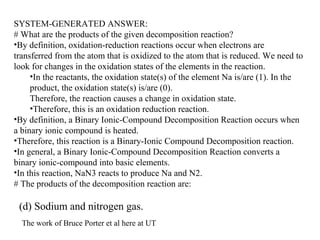
SYSTEM-GENERATED ANSWER:
# What are the products of the given decomposition reaction?
•By definition, oxidation-reduction reactions occur when electrons are
transferred from the atom that is oxidized to the atom that is reduced. We need to
look for changes in the oxidation states of the elements in the reaction.
•In the reactants, the oxidation state(s) of the element Na is/are (1). In the
product, the oxidation state(s) is/are (0).
Therefore, the reaction causes a change in oxidation state.
•Therefore, this is an oxidation reduction reaction.
•By definition, a Binary Ionic-Compound Decomposition Reaction occurs when
a binary ionic compound is heated.
•Therefore, this reaction is a Binary-Ionic Compound Decomposition reaction.
•In general, a Binary Ionic-Compound Decomposition Reaction converts a
binary ionic-compound into basic elements.
•In this reaction, NaN3 reacts to produce Na and N2.
# The products of the decomposition reaction are:
(d) Sodium and nitrogen gas.
The work of Bruce Porter et al here at UT
What About Things that People Do Easily?
•Common sense
•Moving Around
•Language

Artificial intelligence

  • 1.
  • 2.
  • 3.
  • 4.
  • 5.
    What is ArtificialIntelligence? A.I. is the study of how to make computers do things at which, at the moment, people are better.
  • 6.
    Or, Stepping BackEven Farther, Can We Build Artificial People? •Historical attempts •The modern quest for robots and intelligent agents •Us vs. Them
  • 7.
    Historical Attempts -Frankenstein Frankenstein creates the fiend - illustration by Bernie Wrightson (© 1977) The original story, published by Mary Shelley, in 1818, describes the attempt of a true scientist, Victor Frankenstein, to create life. http://members.aon.at/frankenstein/frankenstein-novel.htm
  • 8.
    Historical Attempts –The Turk http://www.theturkbook.com
  • 9.
    Historical Attempts -Euphonia Joseph Faber's Amazing Talking Machine (1830-40's). The Euphonia and other early talking devices are described in detail in a paper by David Lindsay called "Talking Head", Invention & Technology, Summer 1997, 57-63. From http://www.haskins.yale.edu/haskins/HEADS/SIMU LACRA/euphonia.html About this device, Lindsay writes: It is "... a speech synthesizer variously known as the Euphonia and the Amazing Talking Machine. By pumping air with the bellows ... and manipulating a series of plates, chambers, and other apparatus (including an artificial tongue ... ), the operator could make it speak any European language. A German immigrant named Joseph Faber spent seventeen years perfecting the Euphonia, only to find when he was finished that few people cared."
  • 10.
    Historical Attempts -RUR "CHEAP LABOR. ROSSUM'S ROBOTS."  "ROBOTS FOR THE TROPICS.  150 DOLLARS EACH." "EVERYONE SHOULD BUY HIS OWN ROBOT."  "DO YOU WANT TO CHEAPEN YOUR OUTPUT?   ORDER ROSSUM'S ROBOTS"  In 1921, the Czech author Karel Capek produced the play R.U.R. (Rossum's Universal Robots). http://www.maxmon.com/1921ad.htm Some references state that term "robot" was derived from the Czech word robota, meaning "work", while others propose that robota actually means "forced workers" or "slaves." This latter view would certainly fit the point that Capek was trying to make, because his robots eventually rebelled against their creators, ran amok, and tried to wipe out the human race. However, as is usually the case with words, the truth of the matter is a little more convoluted. In the days when Czechoslovakia was a feudal society, "robota" referred to the two or three days of the week that peasants were obliged to leave their own fields to work without remuneration on the lands of noblemen. For a long time after the feudal system had passed away, robota continued to be used to describe work that one wasn't exactly doing voluntarily or for fun, while today's younger Czechs and Slovaks tend to use robota to refer to work that’s boring or uninteresting.
  • 11.
    The Roots ofModern Technology 5th c B.C. Aristotelian logic invented 1642 Pascal built an adding machine 1694 Leibnitz reckoning machine
  • 12.
    The Roots, continued 1834Charles Babbage’s Analytical Engine Ada writes of the engine, “The Analytical Engine has no pretensions whatever to originate anything. It can do whatever we know how to order it to perform.” The picture is of a model built in the late 1800s by Babbage’s son from Babbage’s drawings.
  • 13.
    The Roots: Logic 1848George Boole The Calculus of Logic chocolate nuts mint chocolate and ¬ nuts and mint
  • 14.
    Mathematics in theEarly 20th Century – (Looking Ahead: Will Logic be the Key to Thinking?) 1900 Hilbert’s program and the effort to formalize mathematics 1931 Kurt Gödel’s paper, On Formally Undecidable Propositions 1936 Alan Turing’s paper, On Computable Numbers with an application to the Entscheidungs problem
  • 15.
    The Advent ofthe Computer 1945 ENIAC The first electronic digital computer
  • 16.
    1949 EDVAC The firststored program computer
  • 17.
    The Dartmouth Conferenceand the Name Artificial Intelligence J. McCarthy, M. L. Minsky, N. Rochester, and C.E. Shannon. August 31, 1955. "We propose that a 2 month, 10 man study of artificial intelligence be carried out during the summer of 1956 at Dartmouth College in Hanover, New Hampshire. The study is to proceed on the basis of the conjecture that every aspect of learning or any other feature of intelligence can in principle be so precisely described that a machine can be made to simulate it."
  • 18.
    Time Line –The Big Picture 50 60 70 80 90 00 10 1956 Dartmouth conference. 1981 Japanese Fifth Generation project launched as the Expert Systems age blossoms in the US. 1988 AI revenues peak at $1 billion. AI Winter begins. academic $ academic and routine
  • 19.
    How Will WeRecognize AI? 1950 Alan Turing’s paper, Computing Machinery and Intelligence, described what is now called “The Turing Test”. http://www.abelard.org/turpap/turpap.htm 1990 Loebner Prize established. Grand Prize of $100,000 and a Gold Medal for the first computer whose responses are indistinguishable from a human.
  • 20.
    The Origins ofAI Hype 1950 Turing predicted that in about fifty years "an average interrogator will not have more than a 70 percent chance of making the right identification after five minutes of questioning". 1957 Newell and Simon predicted that "Within ten years a computer will be the world's chess champion, unless the rules bar it from competition."
  • 21.
    Was Turing Right? Jabberwacky:Have you been to the Moon? User: No. Few have. Have you? Jabberwacky: Many a time my dear chap! User: What was the most interesting thing you saw? Jabberwacky: Fred. User: Why did you find him interesting? Jabberwacky: It just came into my head. User: What sorts of things do you generally find interesting? Jabberwacky: Nothing but smelly socks. A conversation with Jabberwacky, 2003
  • 22.
    Another One A Conversationwith Alice, 2004 >What's the best place to eat Chinese food? ALICE: My favorite places are California and Maine. Holland is cool too. >What do you like about Maine? ALICE: The special effects are the best. http://www.alicebot.org/
  • 23.
    Alice, Again >Who inventedpaper towels? ALICE: The Chinese, long before Europeans. >Who invented pet rocks? ALICE: The Wright Brothers. >Who invented Barbie dolls? ALICE: Thomas Edison.
  • 24.
    Were Newell andSimon Right? •1950 Claude Shannon published a paper describing how a computer could play chess. •1957 Newell and Simon predicted that a computer will beat a human at chess within 10 years. •1967 MacHack was good enough to achieve a class-C rating in tournament chess.
  • 25.
    Chess Today In 1997,Deep Blue beat Gary Kasparov.
  • 26.
    Why Did TheyGet it Wrong? They failed to understand at least three key things: •The need for knowledge (lots of it) •Scalability and the problem of complexity and exponential growth •The need to perceive the world
  • 27.
    Scalability Solving hard problems requiressearch in a large space. To play master-level chess requires searching about 8 ply deep. So about 358 or 2⋅1012 nodes must be examined.
  • 28.
  • 29.
    But Chess isEasy •The rules are simple enough to fit on one page •The branching factor is only 35.
  • 30.
    A Harder One Johnsaw a boy and a girl with a red wagon with one blue and one white wheel dragging on the ground under a tree with huge branches.
  • 31.
    How Bad isthe Ambiguity? •Kim (1) •Kim and Sue (1) •Kim and Sue or Lee (2) •Kim and Sue or Lee and Ann (5) •Kim and Sue or Lee and Ann or Jon (14) •Kim and Sue or Lee and Ann or Jon and Joe (42) •Kim and Sue or Lee and Ann or Jon and Joe or Zak (132) •Kim and Sue or Lee and Ann or Jon and Joe or Zak and Mel (469) •Kim and Sue or Lee and Ann or Jon and Joe or Zak and Mel or Guy (1430) •Kim and Sue or Lee and Ann or Jon and Joe or Zak and Mel or Guy and Jan (4862) The number of parses for an expression with n terms is the n’th Catalan number:       − −      = 1 22 )( n n n n nCat
  • 32.
    Can We GetAround the Search Problem ?
  • 33.
    How Much ComputePower Does it Take? From Hans Moravec, Robot Mere Machine to Transcendent Mind 1998.
  • 34.
    How Much ComputePower is There? From Hans Moravec, Robot Mere Machine to Transcendent Mind 1998.
  • 35.
    Evolution of theMain Ideas •Wings or not? •Games, mathematics, and other knowledge- poor tasks •The silver bullet? •Knowledge-based systems •Hand-coded knowledge vs. machine learning •Low-level (sensory and motor) processing and the resurgence of subsymbolic systems •Robotics •Natural language processing •Programming languages •Cognitive modeling
  • 36.
    Symbolic vs. SubsymbolicAI Subsymbolic AI: Model intelligence at a level similar to the neuron. Let such things as knowledge and planning emerge. Symbolic AI: Model such things as knowledge and planning in data structures that make sense to the programmers that build them. (blueberry (isa fruit) (shape round) (color purple) (size .4 inch))
  • 37.
    The Origins ofSubsymbolic AI 1943 McCulloch and Pitts A Logical Calculus of the Ideas Immanent in Nervous Activity “Because of the “all-or-none” character of nervous activity, neural events and the relations among them can be treated by means of propositional logic”
  • 38.
    Interest in SubsymbolicAI 40 50 60 70 80 90 00 10
  • 39.
    Low-level (Sensory andMotor) Processing and the Resurgence of Subsymbolic Systems •Computer vision •Motor control •Subsymbolic systems perform cognitive tasks •Detect credit card fraud •The backpropagation algorithm eliminated a formal weakness of earlier systems •Neural networks learn.
  • 40.
    The Origins ofSymbolic AI •Games •Theorem proving
  • 41.
    Games •Chess •Checkers: •1952-1962 Art Samuelbuilt the first checkers program •Chinook became the world checkers champion in 1994 •Othello: •Logistello beat the world champion in 1997
  • 42.
    Games •Chess •Checkers: Chinook becamethe world checkers champion in 1994 •Othello: Logistello beat the world champion in 1997 •Role Playing Games: now we need knowledge •Go:
  • 43.
    Mathematics 1956 Logic Theorist(the first running AI program?) 1961 SAINT solved calculus problems at the college freshman level 1967 Macsyma Gradually theorem proving has become well enough understood that it is usually no longer considered AI 1996 J Moore and others verified the correctness of the AMD5k86 Floating-Point Division algorithm
  • 44.
    The Silver Bullet? Isthere an “intelligence algorithm”? 1957 GPS (General Problem Solver) Start Goal
  • 45.
    But What AboutKnowledge? •Why do we need it? •How can we represent it and use it? •How can we acquire it? Find me stuff about dogs who save people’s lives. Around midnight, two beagles spotted a fire in the house next door. Their barking alerted their owners, who called 911.
  • 46.
    Representing Knowledge -Logic 1958 McCarthy’s paper, “Programs with Common Sense” at(I, car) ⇒ can (go(home, airport, driving)) at(I, desk) ⇒ can(go(desk, car, walking)) 1965 Resolution theorem proving invented
  • 47.
  • 48.
    Representing Knowledge –Capturing Experience Representing Experience with Scripts, Frames, and Cases 1977 Scripts Joe went to a restaurant. Joe ordered a hamburger. When the hamburger came, it was burnt to a crisp. Joe stormed out without paying. The restaurant script: Did Joe eat anything?
  • 49.
    Representing Knowledge -Rules Expert knowledge in many domains can be captured in rules. From XCON (1982): If: the most current active context is distributing massbus devices, and there is a single-port disk drive that has not been assigned to a massbus, and there are no unassigned dual-port disk drives, and the number of devices that each massbus should support is known, and there is a massbus that has been assigned at least one disk drive that should support additional disk drives, and the type of cable needed to connect the disk drive to the previous device on the massbus is known Then: assign the disk drive to the massbus.
  • 50.
    Representing Knowledge –Probabilistically 1975 Mycin attaches probability-like numbers to rules 1970s Probabilistic models of speech recognition 1980s Statistical Machine Translation systems 1990s large scale neural nets If: (1) the stain of the ogranism is gram-positive, and (2) the morphology of the organism is coccus, and (3) the growth conformation of the organism is clumps Then: there is suggestive evidence (0.7) that the identity of the organism is stphylococcus.
  • 51.
    The Rise ofExpert Systems 1967 Dendral – a rule-based system that infered molecular structure from mass spectral and NMR data 1975 Mycin – a rule-based system to recommend antibiotic therapy 1975 Meta-Dendral learned new rules of mass spectrometry, the first discoveries by a computer to appear in a refereed scientific journal 1979 EMycin – the first expert system shell 1980’s The Age of Expert Systems
  • 52.
    Expert Systems –The Heyday 1979 Inference 1980 IntelliCorp 1981 Teknowledge 1983 Carnegie Group 1980 XCON (R1) – first real commercial expert system at DEC, configures VAX systems 1981 Japanese Fifth Generation project launched as the Expert Systems age blossoms in the US. 1984 Gold Hill Common Lisp 1986 neural net start up companies appear 1988 AI revenues peak at $1 billion. AI Winter begins. Selling expert system shells
  • 53.
    Expert Systems –Today: Medicine One example domain, medicine, has expert systems whose tasks include: •arrhythmia recognition from electrocardiograms •coronary heart disease risk group detection •monitoring the prescription of restricted use antibiotics •early melanoma diagnosis •gene expression data analysis of human lymphoma •breast cancer diagnosis
  • 54.
    Expert Systems –Today: Build Your Own eXpertise2Go: http://www.expertise2go.com/ AcquiredIntelligence: http://www.aiinc.ca/demos/ (whales, graduate school)
  • 55.
    Taking the SATExam QUESTION: Sodium azide is used in air bags to rapidly produce gas to inflate the bag. The products of the decomposition reaction are:(a) Na and water.(b) Ammonia and sodium metal.(c) N2 and O2(d) Sodium and nitrogen gas.(e) Sodium oxide and nitrogen gas. (d) Sodium and nitrogen gas.
  • 56.
    SYSTEM-GENERATED ANSWER: # Whatare the products of the given decomposition reaction? •By definition, oxidation-reduction reactions occur when electrons are transferred from the atom that is oxidized to the atom that is reduced. We need to look for changes in the oxidation states of the elements in the reaction. •In the reactants, the oxidation state(s) of the element Na is/are (1). In the product, the oxidation state(s) is/are (0). Therefore, the reaction causes a change in oxidation state. •Therefore, this is an oxidation reduction reaction. •By definition, a Binary Ionic-Compound Decomposition Reaction occurs when a binary ionic compound is heated. •Therefore, this reaction is a Binary-Ionic Compound Decomposition reaction. •In general, a Binary Ionic-Compound Decomposition Reaction converts a binary ionic-compound into basic elements. •In this reaction, NaN3 reacts to produce Na and N2. # The products of the decomposition reaction are: (d) Sodium and nitrogen gas. The work of Bruce Porter et al here at UT
  • 57.
    What About Thingsthat People Do Easily? •Common sense •Moving Around •Language

Editor's Notes

  • #4 But there’s still a fear: how would we eat?
  • #13 Picture from http://www.fourmilab.ch/babbage/hpb1910.html
  • #20 http://cogsci.ucsd.edu/~asaygin/tt/ttest.html http://www.loebner.net/Prizef/loebner-prize.html
  • #21 Herbert A. Simon and Allen Newell, "Heuristic Problem Solving: The Next Advance in Operations Research," Operations Research, January-February 1958, 1-10.
  • #22 http://www.jabberwacky.com 2003 Loebner bot winner, beaten by two people
  • #23 http://www.alicebot.org/
  • #24 Note here that the language processing seems fine. It’s a lack of specific knowledge that is killing Alice.
  • #26 Is this AI? Is it just search? Is chess a representative “intelligent problem”? What about role playing games? Need a lot more knowledge.
  • #27 Knowledge – more later Perception – more later
  • #28 http://sern.ucalgary.ca/courses/CPSC/533/W99/presentations/L1_5A_Szuch_Boyd/game.html
  • #31 Parses: read bottom up. It gets worse at the end. 8064 total. With huge branches: tree, ground, dragging, wheel, wagon, girl, boy and girl, saw (8) under a tree can attach to ground, dragging, wheel, wagon, girl, boy and girl, saw. (7) On the ground (6) Dragging: wheel, wagon, girl, boy and girl (4) And: (one blue and one white) wheel, one blue and (one white wheel) (2) With a red wagon: girl, boy and girl, saw (3) How hard to check each? Current approaches: use statistics to guess right a lot of the time. But note that this one is ambiguous even for people.
  • #32 From Church and Patil, 1982, via http://www.cogs.susx.ac.uk/lab/nlp/gazdar/teach/nlp/nlpnode11.html Binomial coefficients: (a b) = a!/(b!(a-b)!) Cat(n) is the number of ways to parenthesize an expresssion of length n with two conditions: 1) Equal number of open and closes. That’s the first term. 2) They must be properly nested. That’s the second term, so it subtracts out the improper ones.
  • #33 Maybe the problem is representation. Can we punt search if we have trained a neural net to simply do the right thing? Maybe but now we have to search in a different space, the space of all neural nets.
  • #37 Neural net picture from http://hem.hj.se/~de96klda/NeuralNetworks.htm#2.1.2%20The%20Artificial%20Neuron
  • #38 http://diwww.epfl.ch/mantra/tutorial/english/mcpits/html/
  • #41 Note: They’re formal. Don’t need a lot of messy knowledge.
  • #42 Pictures from M. Muller, Computer Go, AIJ v.134, 1-2.
  • #43 Pictures from M. Muller, Computer Go, AIJ v.134, 1-2.
  • #46 Two beagles spot fire. Their barking alerts neighbors who call the police.
  • #48 http://www.jfsowa.com/pubs/semnet.htm