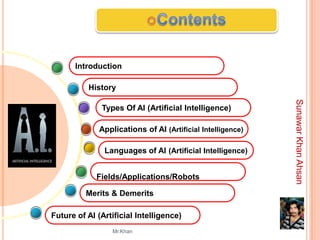
Introduction

          History


                                                            Sunawar Khan Ahsan
              Types Of AI (Artificial Intelligence)

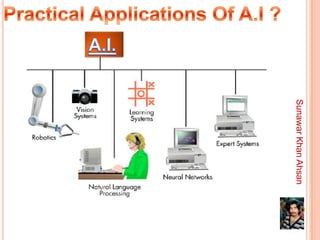
             Applications of AI (Artificial Intelligence)

               Languages of AI (Artificial Intelligence)


             Fields/Applications/Robots

          Merits & Demerits

Future of AI (Artificial Intelligence)
                 Mr.Khan
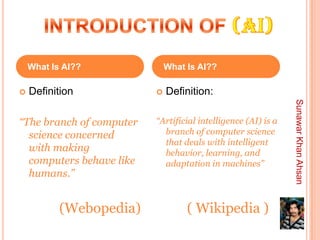
What    Is AI??          What    Is AI??

   Definition               Definition:


                                                               Sunawar Khan Ahsan
“The branch of computer   “Artificial intelligence (AI) is a
  science concerned         branch of computer science
                            that deals with intelligent
  with making               behavior, learning, and
  computers behave like     adaptation in machines”
  humans.”


          (Webopedia)             ( Wikipedia )
Sunawar Khan Ahsan
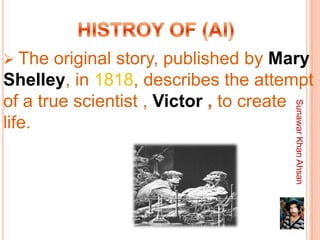
 The   original story, published by Mary
Shelley, in 1818, describes the attempt
of a true scientist , Victor , to create


                                      Sunawar Khan Ahsan
life.


                                      8
 Joseph Faber's Amazing Talking
  Machine (1830-40's).
 A speech synthesizer variously


                                             Sunawar Khan Ahsan
  known as the Euphonia and the
  Amazing Talking Machine. By
pumping       air with the bellows ... and
  manipulating a series of plates,
  chambers, and other apparatus
  (including an artificial tongue ... ),
 The operator could make it speak any
  European language
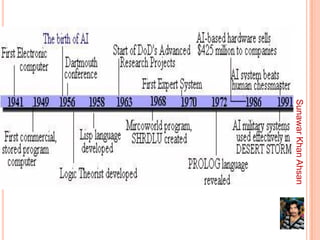
In the 1940s and 50s, a handful of
 scientists from a variety of fields
 began to discuss the possibility of


                                         Sunawar Khan Ahsan
 creating an artificial brain.
 The field of artificial intelligence
 research was founded as an
 academic discipline in 1956.
Sunawar Khan Ahsan
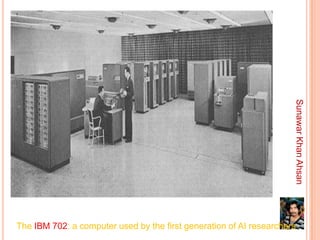
The IBM 702: a computer used by the first generation of AI researchers
Sunawar Khan Ahsan
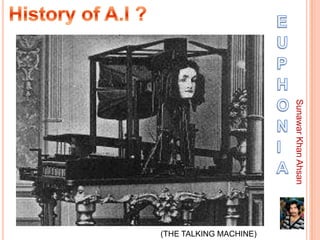
(THE TALKING MACHINE)
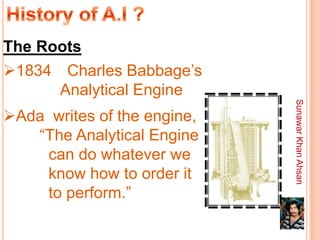
The Roots
1834 Charles Babbage’s
      Analytical Engine


                             Sunawar Khan Ahsan
Ada writes of the engine,
   “The Analytical Engine
    can do whatever we
    know how to order it
    to perform.”
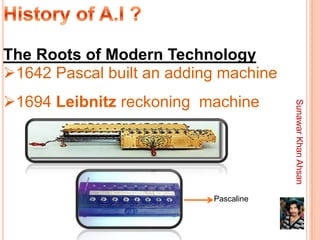
The Roots of Modern Technology
1642 Pascal built an adding machine
1694 Leibnitz reckoning machine


                                       Sunawar Khan Ahsan
                           Pascaline
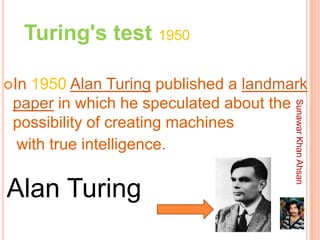
Turing's test 1950

In1950 Alan Turing published a landmark
 paper in which he speculated about the


                                      Sunawar Khan Ahsan
 possibility of creating machines
 with true intelligence.

Alan Turing
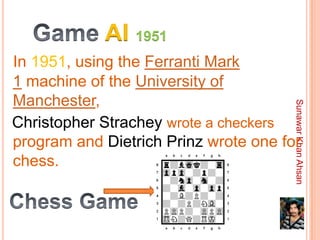
AI 1951
In 1951, using the Ferranti Mark
1 machine of the University of
Manchester,


                                       Sunawar Khan Ahsan
Christopher Strachey wrote a checkers
program and Dietrich Prinz wrote one for
chess.
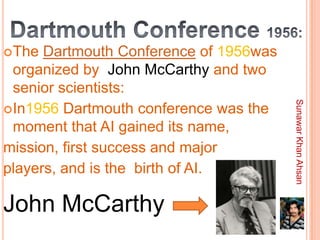
The  Dartmouth Conference of 1956was
 organized by John McCarthy and two
 senior scientists:


                                        Sunawar Khan Ahsan
In1956 Dartmouth conference was the
 moment that AI gained its name,
mission, first success and major
players, and is the birth of AI.

John McCarthy
The    years after the Dartmouth
 conference were an era of discovery,
 of sprinting across new ground.


                                         Sunawar Khan Ahsan
The programs that were developed
 during this time were solving algebra
 word problems, proving theorems in
 geometry and learning to speak
 English
In the 70s, AI was subject to
 financial setbacks.
AI researchers had failed to


                                    Sunawar Khan Ahsan
 appreciate the difficulty of the
 problems they faced.
Problem;
Limited computer power:
 There was not enough memory or
 processing speed.
BOOM 1980–1987
 Inthe 1980s a form of AI program called "expert
 systems" was adopted by corporations around
 the world and knowledge became the focus of


                                             Sunawar Khan Ahsan
 mainstream AI research.
 In those same years, the Japanese government
 aggressively funded AI with its fifth generation
 computer project.

   Once again, AI had achieved
    success.
 The  first indication of a change in weather
  was the sudden collapse of the market for
  specialized AI hardware in 1987.
 Desktop computers


                                                 Sunawar Khan Ahsan
  from Apple and IBM had been gaining
  speed and power.
 in 1987 they became more powerful than
  the more expensive Lisp machines made
  by Symbolics .
 The  field of AI, now more than a half a
 century old, finally achieved some of its
 oldest goals.


                                             Sunawar Khan Ahsan
 It began to be used successfully
 throughout the technology industry.
 For Ray Kurzweil, the issue is computer
 power and, using Moore's Law, he
 predicts that machines with human-level
 intelligence will appear by 2029
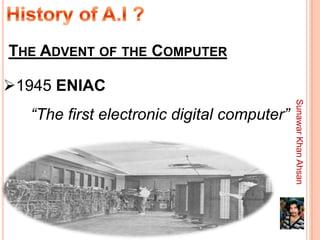
THE ADVENT OF THE COMPUTER

1945 ENIAC


                                            Sunawar Khan Ahsan
  “The first electronic digital computer”


                                     23
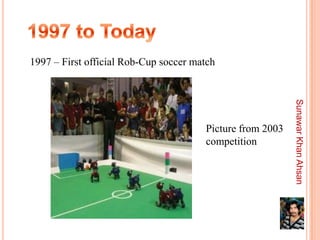
1997 – First official Rob-Cup soccer match


                                                           Sunawar Khan Ahsan
                                       Picture from 2003
                                       competition
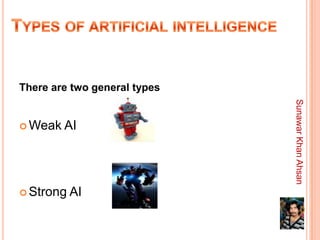
There are two general types


                              Sunawar Khan Ahsan
 Weak   AI


 Strong AI
 Weak
     AI refers to AI that only simulates
 human thoughts and actions


                                               Sunawar Khan Ahsan
 Actions,
        decisions and ideas are
 programmed into it

 All   the current forms of AI are weak AI.
 Strong
       AI refers to AI that matches or
 exceeds human intelligence


                                              Sunawar Khan Ahsan
 Also  called “True AI”, as they are truly
 intelligent

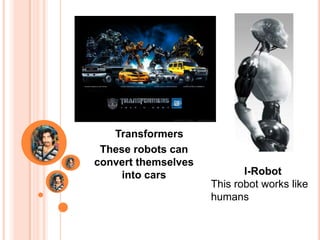
 Example:   The robots from the movies
 transformers, matrix, terminator, I-
 robot, etc.
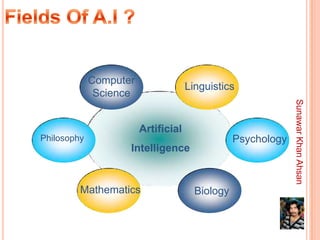
Computer
                                     Linguistics
              Science


                                                              Sunawar Khan Ahsan
                        Artificial
Philosophy                                       Psychology
                    Intelligence


         Mathematics                   Biology
Transformers
 These robots can
convert themselves
     into cars              I-Robot
                     This robot works like
                     humans
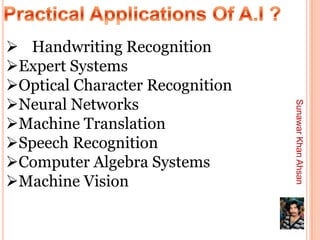
 Handwriting Recognition
Expert Systems
Optical Character Recognition
Neural Networks


                                 Sunawar Khan Ahsan
Machine Translation
Speech Recognition
Computer Algebra Systems
Machine Vision
 Handwriting   recognition is the ability of a
 computer to receive and interpret
 intelligible handwritten input from sources
 such as paper documents, photographs,


                                                  Sunawar Khan Ahsan
 touch-screens and other devices. The
 image of the written text may be sensed
 "off line" from a piece of paper by optical
 scanning Alternatively, the movements of
 the pen tip may be sensed "on line", for
 example by a pen-based computer
 screen surface
 An expert system is software that uses a
 knowledge base of human expertise
 for problem solving, or clarify
 uncertainties where normally one or


                                             Sunawar Khan Ahsan
 more human experts would need to be
 consulted
 Optical character recognition, usually
 abbreviated to OCR, is the mechanical or
 electronic translation of scanned images
 of handwritten, typewritten or printed text
 into machine-encoded text. It is widely


                                               Sunawar Khan Ahsan
 used to convert books and documents
 into electronic files, to computerize a
 record-keeping system in an office, or to
 publish the text on a website.
 Speech   recognition (also known as
 automatic speech recognition or
 computer speech recognition) converts


                                           Sunawar Khan Ahsan
 spoken words to text. The term "voice
 recognition" is sometimes used to refer
 to recognition systems that must be
 trained to a particular speaker—as is
 the case for most desktop recognition
 software. Recognizing the speaker can
 simplify the task of translating speech
 Robotics  is a branch of science and
 engineering dealing with the study of


                                               Sunawar Khan Ahsan
 robots. It is involved with a robot's
 design, manufacture, application, and
 structural disposition. Robotics is related
 to electronics, mechanics, and
 software
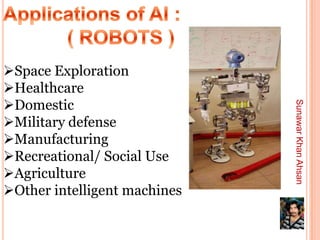
Space Exploration
Healthcare
Domestic


                              Sunawar Khan Ahsan
Military defense
Manufacturing
Recreational/ Social Use
Agriculture
Other intelligent machines
700,000 robots were in the industrial
world in 1995 and over 500,000 were used
in Japan. About 120,000 in Western


                                           Sunawar Khan Ahsan
Europe and 60,000 in the United States
and many were doing tasks too dangerous
or unpleasant for humans!!!!!
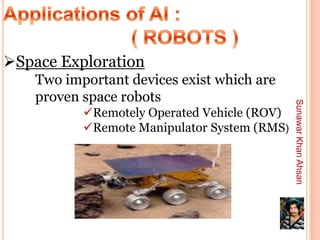
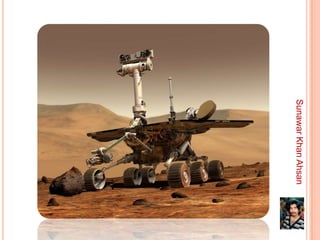
Space Exploration
    Two important devices exist which are
    proven space robots


                                              Sunawar Khan Ahsan
           Remotely Operated Vehicle (ROV)
           Remote Manipulator System (RMS)
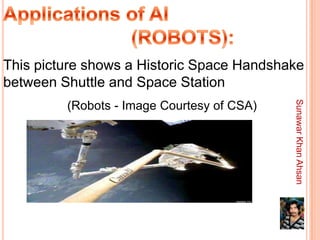
This picture shows a Historic Space Handshake
between Shuttle and Space Station


                                            Sunawar Khan Ahsan
         (Robots - Image Courtesy of CSA)
Sunawar Khan Ahsan
                     42
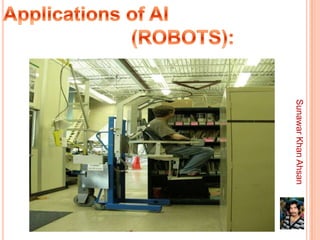
Healthcare
     Robots are used sometimes for
operations. A human could never drill a


                                           Sunawar Khan Ahsan
hole exactly one    100th of a inch wide
and long.
          e.g.
          Tug robot (delivery robot),
               RoboDoc
Robotic Wheelchair can facilitate
 patient locomotion
Sunawar Khan Ahsan
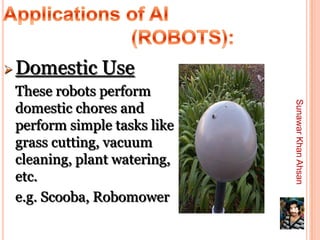
 Domestic    Use
 These robots perform


                             Sunawar Khan Ahsan
 domestic chores and
 perform simple tasks like
 grass cutting, vacuum
 cleaning, plant watering,
 etc.
 e.g. Scooba, Robomower
                             45
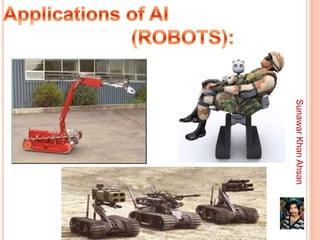
Military Defense
           The U.S. military is currently


                                              Sunawar Khan Ahsan
using robots to diffuse bombs and to
transport goods in danger zones. These
vehicles (AGVs) use sensors and
coordinates to guide themselves through
streets and rough terrain to supply
ammunition and food stuff to soldiers.        46

           e.g. iRobot Packbot, Transbotics
Sunawar Khan Ahsan
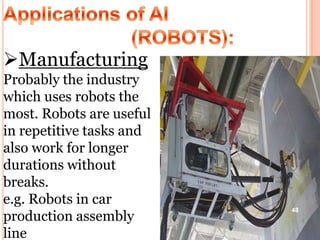
Manufacturing
Probably the industry
which uses robots the


                          Sunawar Khan Ahsan
most. Robots are useful
in repetitive tasks and
also work for longer
durations without
breaks.
e.g. Robots in car
                          48
production assembly
line
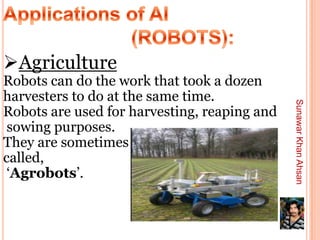
Agriculture
Robots can do the work that took a dozen
harvesters to do at the same time.


                                              Sunawar Khan Ahsan
Robots are used for harvesting, reaping and
 sowing purposes.
They are sometimes
called,
 ‘Agrobots’.
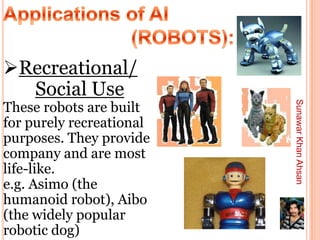
Recreational/
  Social Use
These robots are built


                          Sunawar Khan Ahsan
for purely recreational
purposes. They provide
company and are most
life-like.
e.g. Asimo (the
humanoid robot), Aibo
(the widely popular
robotic dog)
Sunawar Khan Ahsan
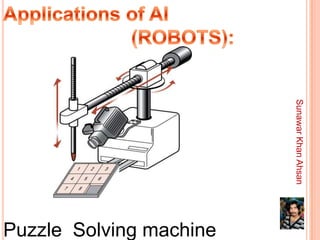
Puzzle Solving machine
Business Benefits:
Robots have the ability to consistently
produce high-quality products and to
precisely perform tasks


                                          Sunawar Khan Ahsan
Since they never tire and can work
nonstop without breaks, robots are
able to produce more quality goods or
execute commands quicker than their
human counterparts
Employee Benefits:
 Robots can do the work that no one else
wants to do—the mundane, dangerous, and


                                               Sunawar Khan Ahsan
repetitive jobs

Common Misconception about Robots:
Introducing robots into a work environment
does not necessarily mean the elimination of
jobs. With the addition of robots comes the
need for highly-skilled, human workers
Sunawar Khan Ahsan
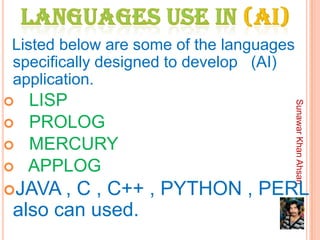
Listed below are some of the languages
specifically designed to develop (AI)
application.
   LISP


                                     Sunawar Khan Ahsan
   PROLOG
   MERCURY
   APPLOG
JAVA , C , C++ , PYTHON , PERL
also can used.
LISP-( LISPROGRAMMING        LANGUAGE   )
 LISPis second oldest high level Programming
 language .
 Invented   by John McCarthy in 1958 and


                                              Sunawar Khan Ahsan
  the first implemented by Steve Russell on
  IBM 704 computer.
 Number dialects have existed over LISP
  history.
    e.g : Common LISP
          Scheme
PROLOG-(PROGRAMMING IN LOGIC)


PROLOG     is a logic programming
 language which was invented in


                                     Sunawar Khan Ahsan
 1972 by Alain.
PROLOG was one of the first
 logic programming language, and
 remains among the most popular
 such languages today.
Sunawar Khan Ahsan
 Delegance: routine operations can be
  delegated to a computer, freeing up more time
  for humans (eg setup wizard)
 Confimation: having an ai check your work as


                                                   Sunawar Khan Ahsan
  you go along (eg spellcheck)
 Isolation: have a computer simulate a human
  interaction in order to test something(eg fire
  safety simulations)
 Emulation: provide a virtual second user for a
  system(eg game ai.)
 Proficiency: an ai has only the real world
  experience of the specialists who created it
 Predictability: an ai will only ever cerate new


                                                           Sunawar Khan Ahsan
  permutations of known states, completely new
  behavior will never arise (learn the ai's tactics, and
  it'll never pull anything new on you)
 Redundancy: if a system becomes too proficient,
  it may render humans obsolete (casino security).
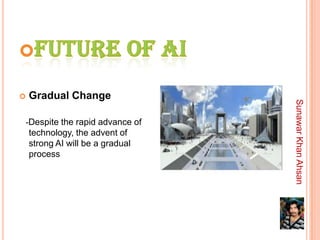
   Gradual Change


                                  Sunawar Khan Ahsan
-Despite the rapid advance of
    technology, the advent of
    strong AI will be a gradual
    process
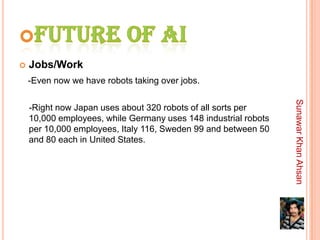
   Jobs/Work
    -Even now we have robots taking over jobs.


                                                                 Sunawar Khan Ahsan
    -Right now Japan uses about 320 robots of all sorts per
    10,000 employees, while Germany uses 148 industrial robots
    per 10,000 employees, Italy 116, Sweden 99 and between 50
    and 80 each in United States.
• Will AI rule the world ?
    if machines can replicate human
  intelligence , it might be able to rule the


                                                Sunawar Khan Ahsan
  world.
But.
The question remain ……………..........
    Can Artificial Intelligence match the
  human Intelligence.??
AI can have two purposes.
First is to use the power of computers to augment
human thinking. Robotics and expert systems are


                                                    Sunawar Khan Ahsan
major branches of that.
The other is to use a computer's artificial
intelligence to understand how humans think.
Sunawar Khan Ahsan

Artificial intelligence

  • 3.
    Introduction History Sunawar Khan Ahsan Types Of AI (Artificial Intelligence) Applications of AI (Artificial Intelligence) Languages of AI (Artificial Intelligence) Fields/Applications/Robots Merits & Demerits Future of AI (Artificial Intelligence) Mr.Khan
  • 5.
    What Is AI?? What Is AI??  Definition  Definition: Sunawar Khan Ahsan “The branch of computer “Artificial intelligence (AI) is a science concerned branch of computer science that deals with intelligent with making behavior, learning, and computers behave like adaptation in machines” humans.” (Webopedia) ( Wikipedia )
  • 7.
  • 8.
     The original story, published by Mary Shelley, in 1818, describes the attempt of a true scientist , Victor , to create Sunawar Khan Ahsan life. 8
  • 9.
     Joseph Faber'sAmazing Talking Machine (1830-40's).  A speech synthesizer variously Sunawar Khan Ahsan known as the Euphonia and the Amazing Talking Machine. By pumping air with the bellows ... and manipulating a series of plates, chambers, and other apparatus (including an artificial tongue ... ),  The operator could make it speak any European language
  • 10.
    In the 1940sand 50s, a handful of scientists from a variety of fields began to discuss the possibility of Sunawar Khan Ahsan creating an artificial brain.  The field of artificial intelligence research was founded as an academic discipline in 1956.
  • 11.
    Sunawar Khan Ahsan TheIBM 702: a computer used by the first generation of AI researchers
  • 12.
    Sunawar Khan Ahsan (THETALKING MACHINE)
  • 13.
    The Roots 1834 CharlesBabbage’s Analytical Engine Sunawar Khan Ahsan Ada writes of the engine, “The Analytical Engine can do whatever we know how to order it to perform.”
  • 14.
    The Roots ofModern Technology 1642 Pascal built an adding machine 1694 Leibnitz reckoning machine Sunawar Khan Ahsan Pascaline
  • 15.
    Turing's test 1950 In1950Alan Turing published a landmark paper in which he speculated about the Sunawar Khan Ahsan possibility of creating machines with true intelligence. Alan Turing
  • 16.
    AI 1951 In 1951,using the Ferranti Mark 1 machine of the University of Manchester, Sunawar Khan Ahsan Christopher Strachey wrote a checkers program and Dietrich Prinz wrote one for chess.
  • 17.
    The DartmouthConference of 1956was organized by John McCarthy and two senior scientists: Sunawar Khan Ahsan In1956 Dartmouth conference was the moment that AI gained its name, mission, first success and major players, and is the birth of AI. John McCarthy
  • 18.
    The years after the Dartmouth conference were an era of discovery, of sprinting across new ground. Sunawar Khan Ahsan The programs that were developed during this time were solving algebra word problems, proving theorems in geometry and learning to speak English
  • 19.
    In the 70s,AI was subject to financial setbacks. AI researchers had failed to Sunawar Khan Ahsan appreciate the difficulty of the problems they faced. Problem; Limited computer power:  There was not enough memory or processing speed.
  • 20.
    BOOM 1980–1987  Inthe1980s a form of AI program called "expert systems" was adopted by corporations around the world and knowledge became the focus of Sunawar Khan Ahsan mainstream AI research.  In those same years, the Japanese government aggressively funded AI with its fifth generation computer project.  Once again, AI had achieved success.
  • 21.
     The first indication of a change in weather was the sudden collapse of the market for specialized AI hardware in 1987.  Desktop computers Sunawar Khan Ahsan from Apple and IBM had been gaining speed and power.  in 1987 they became more powerful than the more expensive Lisp machines made by Symbolics .
  • 22.
     The field of AI, now more than a half a century old, finally achieved some of its oldest goals. Sunawar Khan Ahsan  It began to be used successfully throughout the technology industry.  For Ray Kurzweil, the issue is computer power and, using Moore's Law, he predicts that machines with human-level intelligence will appear by 2029
  • 23.
    THE ADVENT OFTHE COMPUTER 1945 ENIAC Sunawar Khan Ahsan “The first electronic digital computer” 23
  • 24.
    1997 – Firstofficial Rob-Cup soccer match Sunawar Khan Ahsan Picture from 2003 competition
  • 26.
    There are twogeneral types Sunawar Khan Ahsan  Weak AI  Strong AI
  • 27.
     Weak AI refers to AI that only simulates human thoughts and actions Sunawar Khan Ahsan  Actions, decisions and ideas are programmed into it  All the current forms of AI are weak AI.
  • 28.
     Strong AI refers to AI that matches or exceeds human intelligence Sunawar Khan Ahsan  Also called “True AI”, as they are truly intelligent  Example: The robots from the movies transformers, matrix, terminator, I- robot, etc.
  • 30.
    Computer Linguistics Science Sunawar Khan Ahsan Artificial Philosophy Psychology Intelligence Mathematics Biology
  • 31.
    Transformers These robotscan convert themselves into cars I-Robot This robot works like humans
  • 32.
     Handwriting Recognition ExpertSystems Optical Character Recognition Neural Networks Sunawar Khan Ahsan Machine Translation Speech Recognition Computer Algebra Systems Machine Vision
  • 33.
     Handwriting recognition is the ability of a computer to receive and interpret intelligible handwritten input from sources such as paper documents, photographs, Sunawar Khan Ahsan touch-screens and other devices. The image of the written text may be sensed "off line" from a piece of paper by optical scanning Alternatively, the movements of the pen tip may be sensed "on line", for example by a pen-based computer screen surface
  • 34.
     An expertsystem is software that uses a knowledge base of human expertise for problem solving, or clarify uncertainties where normally one or Sunawar Khan Ahsan more human experts would need to be consulted
  • 35.
     Optical characterrecognition, usually abbreviated to OCR, is the mechanical or electronic translation of scanned images of handwritten, typewritten or printed text into machine-encoded text. It is widely Sunawar Khan Ahsan used to convert books and documents into electronic files, to computerize a record-keeping system in an office, or to publish the text on a website.
  • 36.
     Speech recognition (also known as automatic speech recognition or computer speech recognition) converts Sunawar Khan Ahsan spoken words to text. The term "voice recognition" is sometimes used to refer to recognition systems that must be trained to a particular speaker—as is the case for most desktop recognition software. Recognizing the speaker can simplify the task of translating speech
  • 37.
     Robotics is a branch of science and engineering dealing with the study of Sunawar Khan Ahsan robots. It is involved with a robot's design, manufacture, application, and structural disposition. Robotics is related to electronics, mechanics, and software
  • 38.
    Space Exploration Healthcare Domestic Sunawar Khan Ahsan Military defense Manufacturing Recreational/ Social Use Agriculture Other intelligent machines
  • 39.
    700,000 robots werein the industrial world in 1995 and over 500,000 were used in Japan. About 120,000 in Western Sunawar Khan Ahsan Europe and 60,000 in the United States and many were doing tasks too dangerous or unpleasant for humans!!!!!
  • 40.
    Space Exploration Two important devices exist which are proven space robots Sunawar Khan Ahsan Remotely Operated Vehicle (ROV) Remote Manipulator System (RMS)
  • 41.
    This picture showsa Historic Space Handshake between Shuttle and Space Station Sunawar Khan Ahsan (Robots - Image Courtesy of CSA)
  • 42.
  • 43.
    Healthcare Robots are used sometimes for operations. A human could never drill a Sunawar Khan Ahsan hole exactly one 100th of a inch wide and long. e.g. Tug robot (delivery robot), RoboDoc Robotic Wheelchair can facilitate patient locomotion
  • 44.
  • 45.
     Domestic Use These robots perform Sunawar Khan Ahsan domestic chores and perform simple tasks like grass cutting, vacuum cleaning, plant watering, etc. e.g. Scooba, Robomower 45
  • 46.
    Military Defense The U.S. military is currently Sunawar Khan Ahsan using robots to diffuse bombs and to transport goods in danger zones. These vehicles (AGVs) use sensors and coordinates to guide themselves through streets and rough terrain to supply ammunition and food stuff to soldiers. 46 e.g. iRobot Packbot, Transbotics
  • 47.
  • 48.
    Manufacturing Probably the industry whichuses robots the Sunawar Khan Ahsan most. Robots are useful in repetitive tasks and also work for longer durations without breaks. e.g. Robots in car 48 production assembly line
  • 49.
    Agriculture Robots can dothe work that took a dozen harvesters to do at the same time. Sunawar Khan Ahsan Robots are used for harvesting, reaping and sowing purposes. They are sometimes called, ‘Agrobots’.
  • 50.
    Recreational/ SocialUse These robots are built Sunawar Khan Ahsan for purely recreational purposes. They provide company and are most life-like. e.g. Asimo (the humanoid robot), Aibo (the widely popular robotic dog)
  • 51.
  • 52.
    Business Benefits: Robots havethe ability to consistently produce high-quality products and to precisely perform tasks Sunawar Khan Ahsan Since they never tire and can work nonstop without breaks, robots are able to produce more quality goods or execute commands quicker than their human counterparts
  • 53.
    Employee Benefits: Robotscan do the work that no one else wants to do—the mundane, dangerous, and Sunawar Khan Ahsan repetitive jobs Common Misconception about Robots: Introducing robots into a work environment does not necessarily mean the elimination of jobs. With the addition of robots comes the need for highly-skilled, human workers
  • 54.
  • 56.
    Listed below aresome of the languages specifically designed to develop (AI) application.  LISP Sunawar Khan Ahsan  PROLOG  MERCURY  APPLOG JAVA , C , C++ , PYTHON , PERL also can used.
  • 57.
    LISP-( LISPROGRAMMING LANGUAGE )  LISPis second oldest high level Programming language .  Invented by John McCarthy in 1958 and Sunawar Khan Ahsan the first implemented by Steve Russell on IBM 704 computer.  Number dialects have existed over LISP history. e.g : Common LISP Scheme
  • 58.
    PROLOG-(PROGRAMMING IN LOGIC) PROLOG is a logic programming language which was invented in Sunawar Khan Ahsan 1972 by Alain. PROLOG was one of the first logic programming language, and remains among the most popular such languages today.
  • 60.
  • 61.
     Delegance: routineoperations can be delegated to a computer, freeing up more time for humans (eg setup wizard)  Confimation: having an ai check your work as Sunawar Khan Ahsan you go along (eg spellcheck)  Isolation: have a computer simulate a human interaction in order to test something(eg fire safety simulations)  Emulation: provide a virtual second user for a system(eg game ai.)
  • 62.
     Proficiency: anai has only the real world experience of the specialists who created it  Predictability: an ai will only ever cerate new Sunawar Khan Ahsan permutations of known states, completely new behavior will never arise (learn the ai's tactics, and it'll never pull anything new on you)  Redundancy: if a system becomes too proficient, it may render humans obsolete (casino security).
  • 64.
    Gradual Change Sunawar Khan Ahsan -Despite the rapid advance of technology, the advent of strong AI will be a gradual process
  • 65.
    Jobs/Work -Even now we have robots taking over jobs. Sunawar Khan Ahsan -Right now Japan uses about 320 robots of all sorts per 10,000 employees, while Germany uses 148 industrial robots per 10,000 employees, Italy 116, Sweden 99 and between 50 and 80 each in United States.
  • 66.
    • Will AIrule the world ? if machines can replicate human intelligence , it might be able to rule the Sunawar Khan Ahsan world. But. The question remain …………….......... Can Artificial Intelligence match the human Intelligence.??
  • 68.
    AI can havetwo purposes. First is to use the power of computers to augment human thinking. Robotics and expert systems are Sunawar Khan Ahsan major branches of that. The other is to use a computer's artificial intelligence to understand how humans think.
  • 69.