Rise of
Rise of
Contents
 History
 Definition
 Applications
 Advantages
 Disadvantages
 Robotics
 Limitations
 Future
 Conclusion
 References
History
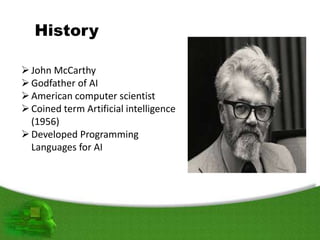
John McCarthy
Godfather of AI
American computer scientist
Coined term Artificial intelligence
(1956)
Developed Programming
Languages for AI
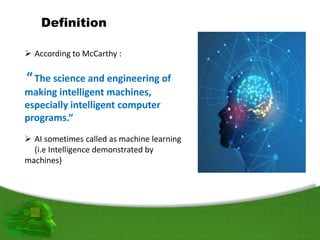
Definition
 According to McCarthy :
“The science and engineering of
making intelligent machines,
especially intelligent computer
programs.“
 AI sometimes called as machine learning
(i.e Intelligence demonstrated by
machines)
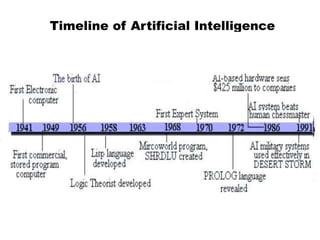
Timeline of Artificial Intelligence
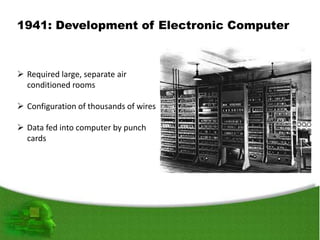
1941: Development of Electronic Computer
 Required large, separate air
conditioned rooms
 Configuration of thousands of wires
 Data fed into computer by punch
cards
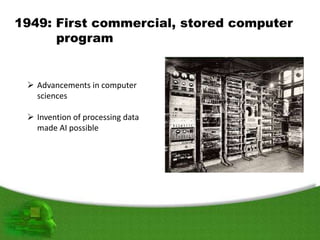
1949: First commercial, stored computer
program
 Advancements in computer
sciences
 Invention of processing data
made AI possible
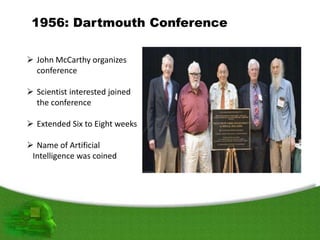
1956: Dartmouth Conference
 John McCarthy organizes
conference
 Scientist interested joined
the conference
 Extended Six to Eight weeks
 Name of Artificial
Intelligence was coined
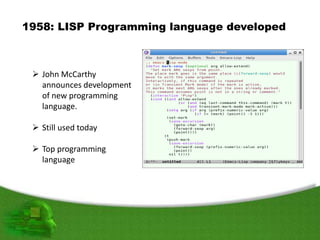
1958: LISP Programming language developed
 John McCarthy
announces development
of new programming
language.

 Still used today
 Top programming
language
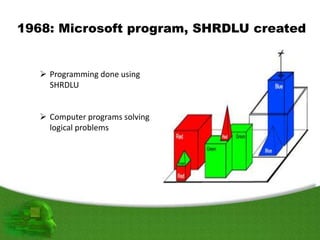
1968: Microsoft program, SHRDLU created
 Programming done using
SHRDLU
 Computer programs solving
logical problems
1986: AI-Based Hardware sells at $425
to Companies
Expert systems in particular demand
General motors, Boeing rely heavily on expert systems
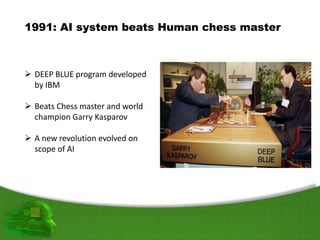
1991: AI system beats Human chess master
 DEEP BLUE program developed
by IBM
 Beats Chess master and world
champion Garry Kasparov
 A new revolution evolved on
scope of AI
Types of AI
Weak AI
 Only perform predetermined tasks
 Actions, ideas and decisions are programmed into it
 Weak AI are all current form of AI
Types of AI
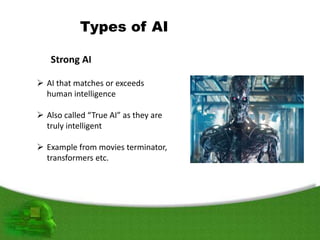
 AI that matches or exceeds
human intelligence
 Also called “True AI” as they are
truly intelligent
 Example from movies terminator,
transformers etc.
Applications
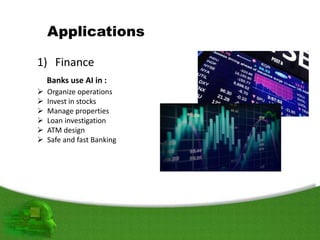
1) Finance
Banks use AI in :
 Organize operations
 Invest in stocks
 Manage properties
 Loan investigation
 ATM design
 Safe and fast Banking
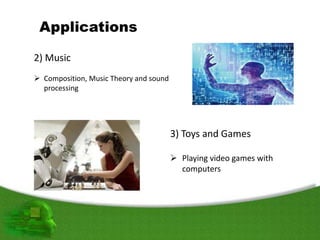
2) Music
 Composition, Music Theory and sound
processing
3) Toys and Games
 Playing video games with
computers
Applications
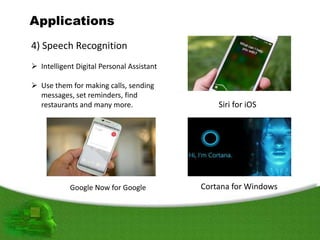
4) Speech Recognition
 Intelligent Digital Personal Assistant
 Use them for making calls, sending
messages, set reminders, find
restaurants and many more. Siri for iOS
Cortana for WindowsGoogle Now for Google
Applications
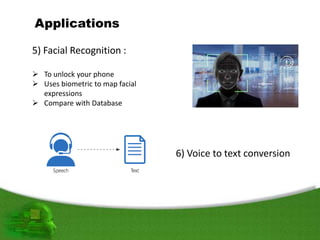
5) Facial Recognition :
 To unlock your phone
 Uses biometric to map facial
expressions
 Compare with Database
6) Voice to text conversion
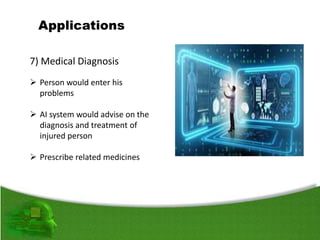
7) Medical Diagnosis
 Person would enter his
problems
 AI system would advise on the
diagnosis and treatment of
injured person
 Prescribe related medicines
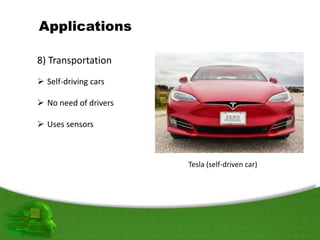
8) Transportation
 Self-driving cars
 No need of drivers
 Uses sensors
Tesla (self-driven car)
Robotics
 A Robot is a electro-mechanical device that can be programmed to
perform manual tasks
 Study composed of Electrical, Mechanical and Computer
Engineering.
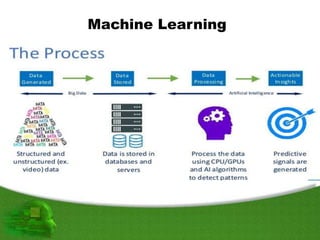
 Machine learning
 Uses Algorithms to perform better
Application of AI in Robotics
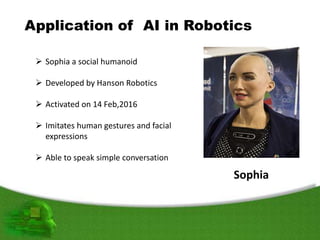
 Sophia a social humanoid
 Developed by Hanson Robotics
 Activated on 14 Feb,2016
 Imitates human gestures and facial
expressions
 Able to speak simple conversation
Sophia
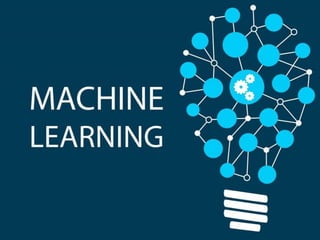
Machine Learning
 Saves time
 Don’t need sleep
 Chances of error are zero
 Used to explore space and depths of oceans
 Laborious and repetitive task
 24/7/365
Advantages of AI
 Higher cost to setup
 Cost incurred on Repair and Maintenance
 Unemployment
 Lacks common sense
 Becomes dependent on machines
Disadvantages of AI
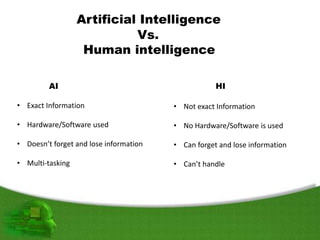
Artificial Intelligence
Vs.
Human intelligence
AI HI
• Exact Information
• Hardware/Software used
• Doesn’t forget and lose information
• Multi-tasking
• Not exact Information
• No Hardware/Software is used
• Can forget and lose information
• Can’t handle
Programming
Languages
 LISP
 Python
 Java
 Prolog
 C++
Machine Learning
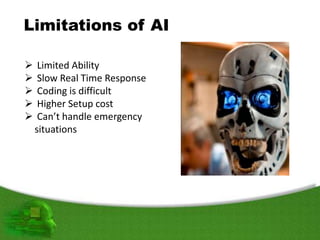
Limitations of AI
 Limited Ability
 Slow Real Time Response
 Coding is difficult
 Higher Setup cost
 Can’t handle emergency
situations
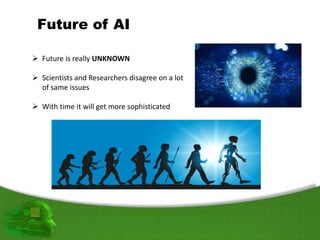
Future of AI
 Future is really UNKNOWN
 Scientists and Researchers disagree on a lot
of same issues
 With time it will get more sophisticated
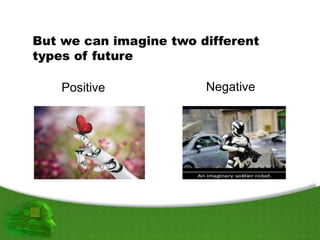
But we can imagine two different
types of future
NegativePositive
Conclusion
 AI is like two edged sword, At one end they can solve problems
intelligently , At another end they pose a problem themselves……so
we have to handle it properly
 Renowned scientist Stephen Hawking thinks :
“……success in creating artificial intelligence
could be the biggest event in human history, but could
also be the last. “
Conclusion
In a nutshell :
 AI has so many applications and can benefit the world in so many
ways. It is a gift to mankind.
 Science fictions and futuristic films have often projected scary
scenarios of robots acquiring to challenge its creators.
 The crux of this matter is that in search of AI, Humans shouldn’t lose
their intelligence.
But these machines still require much more
precision to take over the roles of human.
References
 https://www.google.com/search?q=artificial+intelligence&safe=a
ctive&source=lnms&tbm=isch&sa=X&ved=0ahUKEwiJtZ7uttThAh
UpT98KHdvBCf8Q_AUIDigB
 https://www.tutorialspoint.com/artificial_intelligence/artificial_i
ntelligence_robotics.htm
 https://consc.net/mindpapers/6/all
 https://en.wikipedia.org/wiki/Machine_learning
 https://www.coursera.org/learn/machine-learning
 https://en.wikipedia.org/wiki/Artificial_intelligence
 www.google.com
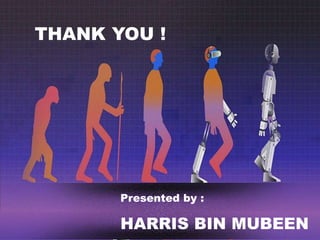
THANK YOU !
Presented by :
HARRIS BIN MUBEEN
Any Questions ?

Rise of Artificial Intelligence (AI)

  • 1.
  • 2.
    Contents  History  Definition Applications  Advantages  Disadvantages  Robotics  Limitations  Future  Conclusion  References
  • 3.
    History John McCarthy Godfather ofAI American computer scientist Coined term Artificial intelligence (1956) Developed Programming Languages for AI
  • 4.
    Definition  According toMcCarthy : “The science and engineering of making intelligent machines, especially intelligent computer programs.“  AI sometimes called as machine learning (i.e Intelligence demonstrated by machines)
  • 5.
  • 6.
    1941: Development ofElectronic Computer  Required large, separate air conditioned rooms  Configuration of thousands of wires  Data fed into computer by punch cards
  • 7.
    1949: First commercial,stored computer program  Advancements in computer sciences  Invention of processing data made AI possible
  • 8.
    1956: Dartmouth Conference John McCarthy organizes conference  Scientist interested joined the conference  Extended Six to Eight weeks  Name of Artificial Intelligence was coined
  • 9.
    1958: LISP Programminglanguage developed  John McCarthy announces development of new programming language.  Still used today  Top programming language
  • 10.
    1968: Microsoft program,SHRDLU created  Programming done using SHRDLU  Computer programs solving logical problems
  • 11.
    1986: AI-Based Hardwaresells at $425 to Companies Expert systems in particular demand General motors, Boeing rely heavily on expert systems
  • 12.
    1991: AI systembeats Human chess master  DEEP BLUE program developed by IBM  Beats Chess master and world champion Garry Kasparov  A new revolution evolved on scope of AI
  • 13.
    Types of AI WeakAI  Only perform predetermined tasks  Actions, ideas and decisions are programmed into it  Weak AI are all current form of AI
  • 14.
    Types of AI AI that matches or exceeds human intelligence  Also called “True AI” as they are truly intelligent  Example from movies terminator, transformers etc.
  • 15.
    Applications 1) Finance Banks useAI in :  Organize operations  Invest in stocks  Manage properties  Loan investigation  ATM design  Safe and fast Banking
  • 16.
    2) Music  Composition,Music Theory and sound processing 3) Toys and Games  Playing video games with computers
  • 17.
    Applications 4) Speech Recognition Intelligent Digital Personal Assistant  Use them for making calls, sending messages, set reminders, find restaurants and many more. Siri for iOS Cortana for WindowsGoogle Now for Google
  • 18.
    Applications 5) Facial Recognition:  To unlock your phone  Uses biometric to map facial expressions  Compare with Database 6) Voice to text conversion
  • 19.
    7) Medical Diagnosis Person would enter his problems  AI system would advise on the diagnosis and treatment of injured person  Prescribe related medicines
  • 20.
    8) Transportation  Self-drivingcars  No need of drivers  Uses sensors Tesla (self-driven car)
  • 21.
    Robotics  A Robotis a electro-mechanical device that can be programmed to perform manual tasks  Study composed of Electrical, Mechanical and Computer Engineering.  Machine learning  Uses Algorithms to perform better
  • 22.
    Application of AIin Robotics  Sophia a social humanoid  Developed by Hanson Robotics  Activated on 14 Feb,2016  Imitates human gestures and facial expressions  Able to speak simple conversation Sophia
  • 23.
  • 24.
     Saves time Don’t need sleep  Chances of error are zero  Used to explore space and depths of oceans  Laborious and repetitive task  24/7/365 Advantages of AI
  • 25.
     Higher costto setup  Cost incurred on Repair and Maintenance  Unemployment  Lacks common sense  Becomes dependent on machines Disadvantages of AI
  • 26.
    Artificial Intelligence Vs. Human intelligence AIHI • Exact Information • Hardware/Software used • Doesn’t forget and lose information • Multi-tasking • Not exact Information • No Hardware/Software is used • Can forget and lose information • Can’t handle
  • 27.
  • 29.
  • 30.
    Limitations of AI Limited Ability  Slow Real Time Response  Coding is difficult  Higher Setup cost  Can’t handle emergency situations
  • 31.
    Future of AI Future is really UNKNOWN  Scientists and Researchers disagree on a lot of same issues  With time it will get more sophisticated
  • 32.
    But we canimagine two different types of future NegativePositive
  • 33.
    Conclusion  AI islike two edged sword, At one end they can solve problems intelligently , At another end they pose a problem themselves……so we have to handle it properly  Renowned scientist Stephen Hawking thinks : “……success in creating artificial intelligence could be the biggest event in human history, but could also be the last. “
  • 34.
    Conclusion In a nutshell:  AI has so many applications and can benefit the world in so many ways. It is a gift to mankind.  Science fictions and futuristic films have often projected scary scenarios of robots acquiring to challenge its creators.  The crux of this matter is that in search of AI, Humans shouldn’t lose their intelligence. But these machines still require much more precision to take over the roles of human.
  • 36.
    References  https://www.google.com/search?q=artificial+intelligence&safe=a ctive&source=lnms&tbm=isch&sa=X&ved=0ahUKEwiJtZ7uttThAh UpT98KHdvBCf8Q_AUIDigB  https://www.tutorialspoint.com/artificial_intelligence/artificial_i ntelligence_robotics.htm https://consc.net/mindpapers/6/all  https://en.wikipedia.org/wiki/Machine_learning  https://www.coursera.org/learn/machine-learning  https://en.wikipedia.org/wiki/Artificial_intelligence  www.google.com
  • 37.
    THANK YOU ! Presentedby : HARRIS BIN MUBEEN
  • 38.