ABHISHEK
SWEWTA
AKSHAY
VERMA
KAPOOR
JINDAL
CONTENTS
What is AI?
Programs that behave externally like humans?
Programs that operate internally as humans do?
Computational systems that behave intelligently?
Rational behavior?
ARTIFICIAL INTELIGENCE
INTELIGENCE
Intelligence: “The capacity to learn and solve problems”
Artificial Intelligence: Artificial intelligence (AI) is the simulation of human
intelligence by machines.
• The ability to solve problems
• The ability to act rationally
• The ability to act like humans
• Human beings are
intelligent
• To be called
intelligent, a
machine must
produce responses
that are
indistinguishable
from those of a
human
8
Program has common sense
if it automatically deduces for
itself
our ultimate objective is to
make programs that learn
from their experience as
effectively as humans do.
HISTORY
The overall research goal of artificial intelligence is to
create technology that allows computers and machines
to function in an intelligent manner
The overall research goal of artificial intelligence is to create technology that allows computers and
machines to function in an intelligent manner. The general problem of simulating (or creating)
intelligence has been broken down into sub-problems.
Reasoning, problem solving :
Researchers developed algorithms that imitated step-
by-step reasoning that humans use when they solve
puzzles or make logical deductions.
Knowledge representation :
Knowledge representation and knowledge
engineering are central to AI research. Many of the
problems machines are expected to solve will require
extensive knowledge about the world.
Planning :
Intelligent agents must be able to set goals and achieve them. This calls for an
agent that can not only assess its environment and make predictions, but also
evaluate its predictions and adapt based on its assessment.
Learning :
Machine learning, a fundamental concept of AI research since the field’s
inception, is the study of computer algorithms that improve automatically through
experience. Unsupervised learning is the ability to find patterns in a stream of input.
Social intelligence :
Affective computing is the study and development of systems that can recognize,
interpret, process, and simulate human affects.
Creativity :
A sub-field of AI addresses creativity both theoretically and practically .
General intelligence :
Many researchers think that their work will eventually be incorporated into a
machine with artificial general intelligence, combining all the skills mentioned above
and even exceeding human ability in most or all these areas.
Applications of artificial intelligence
17
Artificial intelligence as
become a crucial part of
daily human lives today and
it assists in almost every
scenario whether you realize
it or not
Automated customer support
18
The online shopping platform you use collects and
stores lots of information about your usage — whether
you like it or not.
Healthcare Intelligence
healthcare, artificial intelligence has already
proved to be a game-changer, improving every
part of the industry virtually.
19
Collaboration of finance industry and artificial
intelligence is a perfect match.
Smart cars and drones
When it comes to AI applications, you can hardly get a
more prominent and better demonstration of the
technology than what smart cars, as well as drone
manufacturers, are accomplishing with it.
20
Security and surveillance
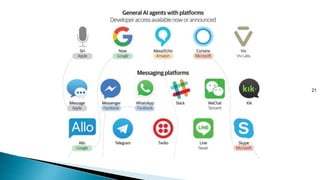
Social media Travel and navigation
Smart home devices
21
23
• The positive impact AI research can
have on humanity will start to be
across many walks of life -much of
it behind the scenes
• Improved speech, voice, image
video recognition will change the
way interact with our
• AI has demonstrated
unprecedented growth. Sophia
the AI Robot, is the
quintessential
• Improved speech, voice, image
video recognition will change
the way interact with
ourdevices
• Personal assistants will
become more personal and
context aware
• More and more systems will
run autonomously to a point
• Definition of robotics
• Robotics’ relevance to AI
• Current developments in the
field
• Current implementations
• Past successes in robotics
• Roadblocks to robotics research
• Future of robotics
Presentation Overview
Definition of Robotics
A robot is…
“An active artificial agent whose environment is the
physical world”
--Russell and Norvig
“A programmable, multifunction manipulator designed
to move material, parts, tools or specific devices
through variable programmed motions for the
performance of a variety of tasks”
--Robot Institute of America
 Effectors
 Sensors
 Architecture
 Integration of various inputs
◦ Hierarchy of information representation
 Emotions
Effector vs. Actuator
Degrees of freedom (d.f.)
6 d.f. for free body in space
Locomotion
Statically stable vs.
Dynamically stable
Manipulation
Rotary vs. Prismatic motion
End Effector
Effectors
Four-finger Utah/MIT hand
 Force-sensing
 Tactile-sensing
 Sonar
 Visual (camera)
 Proprioceptive Robot with camera
attached
 Classical architecture
◦ shortcomings
 Behavior-based architecture
Sensors
Reason about behavior of objects
Identify objects
Build maps
Avoid objects
Actuators
Design for a behavior-based mobile robot
(adapted from Fig 25.10 in AIMA)
 Emotions
 Energy-efficiency
 Integration
◦ Hierarchy of information representation
 Control structures
◦ Synthesis of neural nets and fuzzy logic
 Robotic surgery
◦ Telepresence
 Robot perception
◦ Face and object recognition
 Emotions help prevent people from repeating
their mistakes (decisions that resulted in
negative feelings)
 Recognizing emotions would allow robots to
become more responsive to users’ needs
 Exhibiting emotions would help robots
interact with humans
 Decides proper emotional
response to stimuli and
exhibits corresponding
facial expression, body
posture, and vocal quality
 Behavioral response
serves either social or
self-maintenance
functions
Kismet smiling
 Small electric pump
transfers 100cm3 of
oil from an external
bladder to its
reservoir, making
Seaglider dense
enough to sink
 To dive, small motor
pushes battery pack
into nose
 Process is reversed to
ascend
Seaglider’s diving process
 Industrial robots
◦ used in factories to
manufacture boxes and
pack and wrap merchandise
 Car manufacturers own
50% of today’s robots
 Robots used in hazardous
situations
◦ Nuclear power plants
◦ Response to bomb threat
◦ Outer space exploration Robotic arm arranging
chocolates
Honda’s Asimo (Advanced
Step in Innovative Mobility)
 Able to walk freely (can
change stride speed)
 Able to balance on one foot
 Able to climb stairs
 Able to manipulate objects
 Space- & cost-efficient
Honda’s Asimo
 Based on visual cues
such as the angle and
distance at which it
perceives an object
 Can map an object's
contour and compare it
to a database of
prototypes for different
expressions and actions
 Is currently limited to
pre-registered people ASIMO making measurements
 Sensing
 Vision
 Mobility
 Design
 Control
 Reasoning
 Sensing
◦ Cost of tactile sensors
very high
◦ Range Limits
 Light – 2 meters
 Required(factory) – 10
meters
 Vision
◦ Two methods
 Corner recognition
 Edge recognition
◦ Overlap of objects
◦ Visibility of local
features
 Control
◦ Simulation is not
accurate to real world
interaction
◦ Based on
mathematical and
numerical
computations
 Reasoning
◦ AI (an essential
component of
robotics) has slowly
been introduced into
industrial world
◦ Further refinement in
this field before faster
progress of robotics
 Downsizing
◦ Reduction in power
needs and size
 Synergism
◦ Greater integration of
technologies
 Greater intelligence
◦ More user-friendly
interface
 More environmentally
friendly
◦ Robots easy to
disassemble and
destroy
◦ Easily reusable or
degradable parts
 Design robots to
recognize presence,
posture, and gaze
 Develop viable social
exchange between
robots and humans
 Design systems that
can learn via
reinforcement
44
Any questions?
You can find me at:
abhisheksingh_66@yahoo.in

ARTIFICIAL INTELLIGENCE AND ROBOTICS

  • 2.
  • 3.
  • 5.
    What is AI? Programsthat behave externally like humans? Programs that operate internally as humans do? Computational systems that behave intelligently? Rational behavior?
  • 6.
    ARTIFICIAL INTELIGENCE INTELIGENCE Intelligence: “Thecapacity to learn and solve problems” Artificial Intelligence: Artificial intelligence (AI) is the simulation of human intelligence by machines. • The ability to solve problems • The ability to act rationally • The ability to act like humans
  • 7.
    • Human beingsare intelligent • To be called intelligent, a machine must produce responses that are indistinguishable from those of a human
  • 8.
    8 Program has commonsense if it automatically deduces for itself our ultimate objective is to make programs that learn from their experience as effectively as humans do. HISTORY
  • 10.
    The overall researchgoal of artificial intelligence is to create technology that allows computers and machines to function in an intelligent manner
  • 12.
    The overall researchgoal of artificial intelligence is to create technology that allows computers and machines to function in an intelligent manner. The general problem of simulating (or creating) intelligence has been broken down into sub-problems.
  • 13.
    Reasoning, problem solving: Researchers developed algorithms that imitated step- by-step reasoning that humans use when they solve puzzles or make logical deductions. Knowledge representation : Knowledge representation and knowledge engineering are central to AI research. Many of the problems machines are expected to solve will require extensive knowledge about the world.
  • 14.
    Planning : Intelligent agentsmust be able to set goals and achieve them. This calls for an agent that can not only assess its environment and make predictions, but also evaluate its predictions and adapt based on its assessment. Learning : Machine learning, a fundamental concept of AI research since the field’s inception, is the study of computer algorithms that improve automatically through experience. Unsupervised learning is the ability to find patterns in a stream of input. Social intelligence : Affective computing is the study and development of systems that can recognize, interpret, process, and simulate human affects. Creativity : A sub-field of AI addresses creativity both theoretically and practically . General intelligence : Many researchers think that their work will eventually be incorporated into a machine with artificial general intelligence, combining all the skills mentioned above and even exceeding human ability in most or all these areas.
  • 16.
  • 17.
    17 Artificial intelligence as becomea crucial part of daily human lives today and it assists in almost every scenario whether you realize it or not Automated customer support
  • 18.
    18 The online shoppingplatform you use collects and stores lots of information about your usage — whether you like it or not. Healthcare Intelligence healthcare, artificial intelligence has already proved to be a game-changer, improving every part of the industry virtually.
  • 19.
    19 Collaboration of financeindustry and artificial intelligence is a perfect match. Smart cars and drones When it comes to AI applications, you can hardly get a more prominent and better demonstration of the technology than what smart cars, as well as drone manufacturers, are accomplishing with it.
  • 20.
    20 Security and surveillance Socialmedia Travel and navigation Smart home devices
  • 21.
  • 23.
    23 • The positiveimpact AI research can have on humanity will start to be across many walks of life -much of it behind the scenes • Improved speech, voice, image video recognition will change the way interact with our
  • 24.
    • AI hasdemonstrated unprecedented growth. Sophia the AI Robot, is the quintessential • Improved speech, voice, image video recognition will change the way interact with ourdevices • Personal assistants will become more personal and context aware • More and more systems will run autonomously to a point
  • 26.
    • Definition ofrobotics • Robotics’ relevance to AI • Current developments in the field • Current implementations • Past successes in robotics • Roadblocks to robotics research • Future of robotics Presentation Overview
  • 27.
    Definition of Robotics Arobot is… “An active artificial agent whose environment is the physical world” --Russell and Norvig “A programmable, multifunction manipulator designed to move material, parts, tools or specific devices through variable programmed motions for the performance of a variety of tasks” --Robot Institute of America
  • 28.
     Effectors  Sensors Architecture  Integration of various inputs ◦ Hierarchy of information representation  Emotions
  • 29.
    Effector vs. Actuator Degreesof freedom (d.f.) 6 d.f. for free body in space Locomotion Statically stable vs. Dynamically stable Manipulation Rotary vs. Prismatic motion End Effector Effectors Four-finger Utah/MIT hand
  • 30.
     Force-sensing  Tactile-sensing Sonar  Visual (camera)  Proprioceptive Robot with camera attached
  • 31.
     Classical architecture ◦shortcomings  Behavior-based architecture Sensors Reason about behavior of objects Identify objects Build maps Avoid objects Actuators Design for a behavior-based mobile robot (adapted from Fig 25.10 in AIMA)
  • 32.
     Emotions  Energy-efficiency Integration ◦ Hierarchy of information representation  Control structures ◦ Synthesis of neural nets and fuzzy logic  Robotic surgery ◦ Telepresence  Robot perception ◦ Face and object recognition
  • 33.
     Emotions helpprevent people from repeating their mistakes (decisions that resulted in negative feelings)  Recognizing emotions would allow robots to become more responsive to users’ needs  Exhibiting emotions would help robots interact with humans
  • 34.
     Decides properemotional response to stimuli and exhibits corresponding facial expression, body posture, and vocal quality  Behavioral response serves either social or self-maintenance functions Kismet smiling
  • 35.
     Small electricpump transfers 100cm3 of oil from an external bladder to its reservoir, making Seaglider dense enough to sink  To dive, small motor pushes battery pack into nose  Process is reversed to ascend Seaglider’s diving process
  • 36.
     Industrial robots ◦used in factories to manufacture boxes and pack and wrap merchandise  Car manufacturers own 50% of today’s robots  Robots used in hazardous situations ◦ Nuclear power plants ◦ Response to bomb threat ◦ Outer space exploration Robotic arm arranging chocolates
  • 37.
    Honda’s Asimo (Advanced Stepin Innovative Mobility)  Able to walk freely (can change stride speed)  Able to balance on one foot  Able to climb stairs  Able to manipulate objects  Space- & cost-efficient Honda’s Asimo
  • 38.
     Based onvisual cues such as the angle and distance at which it perceives an object  Can map an object's contour and compare it to a database of prototypes for different expressions and actions  Is currently limited to pre-registered people ASIMO making measurements
  • 39.
     Sensing  Vision Mobility  Design  Control  Reasoning
  • 40.
     Sensing ◦ Costof tactile sensors very high ◦ Range Limits  Light – 2 meters  Required(factory) – 10 meters  Vision ◦ Two methods  Corner recognition  Edge recognition ◦ Overlap of objects ◦ Visibility of local features
  • 41.
     Control ◦ Simulationis not accurate to real world interaction ◦ Based on mathematical and numerical computations  Reasoning ◦ AI (an essential component of robotics) has slowly been introduced into industrial world ◦ Further refinement in this field before faster progress of robotics
  • 42.
     Downsizing ◦ Reductionin power needs and size  Synergism ◦ Greater integration of technologies  Greater intelligence ◦ More user-friendly interface  More environmentally friendly ◦ Robots easy to disassemble and destroy ◦ Easily reusable or degradable parts
  • 43.
     Design robotsto recognize presence, posture, and gaze  Develop viable social exchange between robots and humans  Design systems that can learn via reinforcement
  • 44.
    44 Any questions? You canfind me at: abhisheksingh_66@yahoo.in