Q magazine: Feature article-
Ed Sheeran
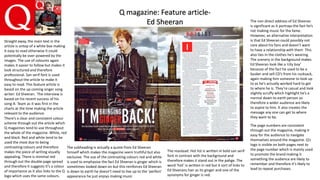
Straight away, the main text in the
article is ontop of a white box making
it easy to read otherwise it could
potentially be over powered by the
images. The use of coloums again
makes it easier to follow but makes it
look structured and therefore
professional. San serif font is used
throughout the article to make it
easy to read. This feature article is
based on the up coming singer song
writer: Ed Sheeran. The interview is
based on his recent success of his
song A- Team as it was first in the
charts at the time making the article
relevant to the audience.
The non direct address of Ed Sheeran
is significant as it portrays the fact he’s
not making music for the fame.
However, an alternative interpretation
is that Ed Sheeran could possibly not
care about his fans and doesn’t want
to have a relationship with them This
also ties in the clothes he’s wearing.
The scenery in the background makes
Ed Sheeran look like a ‘city boy’
because of the fact he used to be a
busker and sell CD’s from his rucksack,
again making him someone to look up
to as he’s actually worked hard to get
to where he is. They’re casual and look
slightly scruffy which highlight he’s a
normal down to earth person so
therefore a wider audience are likely
to aspire to him. It also creates the
message any one can get to where
they want to be.
The page numbers are consistent
through out the magazine, making it
easy for the audience to navigate
themselves around the magazine. Q’s
logo is visible on both pages next to
the page number which is mainly used
to promote the brand making it
something the audience are likely to
remember and therefore it’s likely to
lead to repeat purchases.
There’s a clear and consistent colour
scheme through out the article which
Q magazines tend to use throughout
the whole of the magazine. White, red
and black. Red and white tend to be
used the most due to being
contrasting colours and therefore
makes the piece of writing visually
appealing. There is minimal red
through out the double page spread
and therefore it suggests it’s a colour
of importance as it also links to the Q
logo which uses the same colours.
The subheading is actually a quote from Ed Sheeran
himself which makes the magazine seem truthful but also
exclusive. The use of the contrasting colours red and white
is used to emphasise the fact Ed Sheeran is ginger which is
sometimes looked down on but this reinforces Ed Sheeran
is down to earth he doesn’t need to live up to the ‘perfect’
appearance he just enjoys making music
The mastead: Hot list is written in bold san serif
font in contrast with the background and
therefore makes it stand out in the pahge. The
word ‘hot’ is written in red but it sort of links to
Ed Sheerans hair as its ginger and one of the
synonyms for ginger is red.
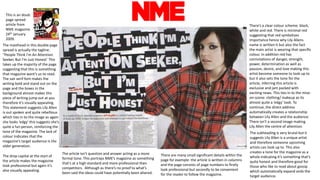
There’s a clear colour scheme: black,
white and red. There is minimal red
suggesting that red symbolizes
importance hence why Lily Allens
name is written it but also the fact
the main artist is wearing that specific
colour. In addition red has
connotations of danger, strength,
power, determination as well as
passion, desire, and love making this
artist become someone to look up to
but it also sets the tone for the
article, inferring this article is
exclusive and jam packed with
exciting news. This ties in to the mise-
on-scene: clothing/ makeup as its
almost quite a ‘edgy’ look. To
continue, the direct address
automatically creates a relationship
between Lily Allen and the audience.
There isn’t a second image making
Lily Allen the centre of attention.
The masthead in this double page
spread is actually the tagline:
“People Think I’m An Attention
Seeker, But I’m Just Honest’ This
takes up the majority of the page
suggesting that this is something
that magazine want’s us to read.
The san serif font makes the
writing bold and stand out on the
page and the boxes in the
background almost makes this
piece of writing jump out at you
therefore it’s visually appealing.
This statement suggests Lily Allen
is out spoken and quite rebellious
which ties in to the image as again
she looks ‘edgy’ this suggests she’s
quite a fun person, reinforcing the
tone of the magazine. The lack of
colour indicates that the
magazine’s target audience Is the
older generation.
This is an double
page spread
article from
NME magazine.
24th January
2009.
The drop capital at the start of
the article makes the magazine
look professional but again it’s
also visually appealing.
The subheading is very brutal but it
suggests Lily Allen is a unique artist
and therefore someone upcoming
artists can look up to. This also
creates a tone for the magazine as a
whole indicating it’s something that’s
quite honest and therefore good for
those who like to read about gossip
which automatically expand ands the
target audience.
The article isn’t question and answer acting as a more
formal tone. This portrays NME’s magazine as something
that’s at a high standard and more professional then
competitors. Although as there’s no proof to what’s
been said the ideas could have potentially been altered.
There are many small significant details within the
page for example: the article is written in columns
and the page consists of page numbers to firstly
look professional but secondly to be convenient
for the reader to follow the magazine.
This is an double
page spread
article from the
magazine:
Rolling Stone
featuring Adele
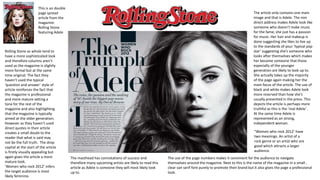
The article only contains one main
image and that is Adele. The non
direct address makes Adele look like
someone who doesn’t make music
for the fame, she just has a passion
for music. Her hair and makeup is
done suggesting she likes to live up
to the standards of your ‘typical pop
star’ suggesting she’s someone who
looks after themselves which makes
her become someone that those
especially of the younger
generation are likely to look up to.
She actually takes up the majority
of the page again making her the
main focus of the article. The use of
black and white makes Adele look
more reserved than how she’s
usually presented in the press. This
depicts the article is perhaps more
truthful as this is the ‘real Adele’ .
At the same time Adele is
represented as an strong,
independent woman.
Rolling Stone as whole tend to
have a more sophisticated look
and therefore columns aren’t
used as the magazine is slightly
more formal but at the same
time original. The fact they
haven’t used the typical
‘question and answer’ style of
article reinforces the fact that
the magazine is professional
and more mature setting a
tone for the rest of the
magazine and also highlighting
that the magazine is typically
aimed at the older generation.
However as they haven’t used
direct quotes in their article
creates a small doubt to the
reader that what is said may
not be the full truth. The drop
capital at the start of the article
is firstly visually appealing but
again gives the article a more
mature look.
‘Women who rock 2012’ infers
the target audience is most
likely feminine.
The use of the page numbers makes it convinient for the audience to navigate
themselves around the magazine. Next to this is the name of the magazine in a small ,
clear san serif font purely to promote their brand but it also gives the page a professional
look.
“Women who rock 2012’ have
two meanings. An artist of a
rock genre or an artist who are
good which attracts a larger
audience.
The masthead has connotations of success and
therefore many upcoming artists are likely to read this
article as Adele is someone they will most likely look
up to.

Article analysis

  • 1.
    Q magazine: Featurearticle- Ed Sheeran Straight away, the main text in the article is ontop of a white box making it easy to read otherwise it could potentially be over powered by the images. The use of coloums again makes it easier to follow but makes it look structured and therefore professional. San serif font is used throughout the article to make it easy to read. This feature article is based on the up coming singer song writer: Ed Sheeran. The interview is based on his recent success of his song A- Team as it was first in the charts at the time making the article relevant to the audience. The non direct address of Ed Sheeran is significant as it portrays the fact he’s not making music for the fame. However, an alternative interpretation is that Ed Sheeran could possibly not care about his fans and doesn’t want to have a relationship with them This also ties in the clothes he’s wearing. The scenery in the background makes Ed Sheeran look like a ‘city boy’ because of the fact he used to be a busker and sell CD’s from his rucksack, again making him someone to look up to as he’s actually worked hard to get to where he is. They’re casual and look slightly scruffy which highlight he’s a normal down to earth person so therefore a wider audience are likely to aspire to him. It also creates the message any one can get to where they want to be. The page numbers are consistent through out the magazine, making it easy for the audience to navigate themselves around the magazine. Q’s logo is visible on both pages next to the page number which is mainly used to promote the brand making it something the audience are likely to remember and therefore it’s likely to lead to repeat purchases. There’s a clear and consistent colour scheme through out the article which Q magazines tend to use throughout the whole of the magazine. White, red and black. Red and white tend to be used the most due to being contrasting colours and therefore makes the piece of writing visually appealing. There is minimal red through out the double page spread and therefore it suggests it’s a colour of importance as it also links to the Q logo which uses the same colours. The subheading is actually a quote from Ed Sheeran himself which makes the magazine seem truthful but also exclusive. The use of the contrasting colours red and white is used to emphasise the fact Ed Sheeran is ginger which is sometimes looked down on but this reinforces Ed Sheeran is down to earth he doesn’t need to live up to the ‘perfect’ appearance he just enjoys making music The mastead: Hot list is written in bold san serif font in contrast with the background and therefore makes it stand out in the pahge. The word ‘hot’ is written in red but it sort of links to Ed Sheerans hair as its ginger and one of the synonyms for ginger is red.
  • 2.
    There’s a clearcolour scheme: black, white and red. There is minimal red suggesting that red symbolizes importance hence why Lily Allens name is written it but also the fact the main artist is wearing that specific colour. In addition red has connotations of danger, strength, power, determination as well as passion, desire, and love making this artist become someone to look up to but it also sets the tone for the article, inferring this article is exclusive and jam packed with exciting news. This ties in to the mise- on-scene: clothing/ makeup as its almost quite a ‘edgy’ look. To continue, the direct address automatically creates a relationship between Lily Allen and the audience. There isn’t a second image making Lily Allen the centre of attention. The masthead in this double page spread is actually the tagline: “People Think I’m An Attention Seeker, But I’m Just Honest’ This takes up the majority of the page suggesting that this is something that magazine want’s us to read. The san serif font makes the writing bold and stand out on the page and the boxes in the background almost makes this piece of writing jump out at you therefore it’s visually appealing. This statement suggests Lily Allen is out spoken and quite rebellious which ties in to the image as again she looks ‘edgy’ this suggests she’s quite a fun person, reinforcing the tone of the magazine. The lack of colour indicates that the magazine’s target audience Is the older generation. This is an double page spread article from NME magazine. 24th January 2009. The drop capital at the start of the article makes the magazine look professional but again it’s also visually appealing. The subheading is very brutal but it suggests Lily Allen is a unique artist and therefore someone upcoming artists can look up to. This also creates a tone for the magazine as a whole indicating it’s something that’s quite honest and therefore good for those who like to read about gossip which automatically expand ands the target audience. The article isn’t question and answer acting as a more formal tone. This portrays NME’s magazine as something that’s at a high standard and more professional then competitors. Although as there’s no proof to what’s been said the ideas could have potentially been altered. There are many small significant details within the page for example: the article is written in columns and the page consists of page numbers to firstly look professional but secondly to be convenient for the reader to follow the magazine.
  • 3.
    This is andouble page spread article from the magazine: Rolling Stone featuring Adele The article only contains one main image and that is Adele. The non direct address makes Adele look like someone who doesn’t make music for the fame, she just has a passion for music. Her hair and makeup is done suggesting she likes to live up to the standards of your ‘typical pop star’ suggesting she’s someone who looks after themselves which makes her become someone that those especially of the younger generation are likely to look up to. She actually takes up the majority of the page again making her the main focus of the article. The use of black and white makes Adele look more reserved than how she’s usually presented in the press. This depicts the article is perhaps more truthful as this is the ‘real Adele’ . At the same time Adele is represented as an strong, independent woman. Rolling Stone as whole tend to have a more sophisticated look and therefore columns aren’t used as the magazine is slightly more formal but at the same time original. The fact they haven’t used the typical ‘question and answer’ style of article reinforces the fact that the magazine is professional and more mature setting a tone for the rest of the magazine and also highlighting that the magazine is typically aimed at the older generation. However as they haven’t used direct quotes in their article creates a small doubt to the reader that what is said may not be the full truth. The drop capital at the start of the article is firstly visually appealing but again gives the article a more mature look. ‘Women who rock 2012’ infers the target audience is most likely feminine. The use of the page numbers makes it convinient for the audience to navigate themselves around the magazine. Next to this is the name of the magazine in a small , clear san serif font purely to promote their brand but it also gives the page a professional look. “Women who rock 2012’ have two meanings. An artist of a rock genre or an artist who are good which attracts a larger audience. The masthead has connotations of success and therefore many upcoming artists are likely to read this article as Adele is someone they will most likely look up to.