Chapter 27
Contemporary Art
and Globalization
Art and the Expression of Culture
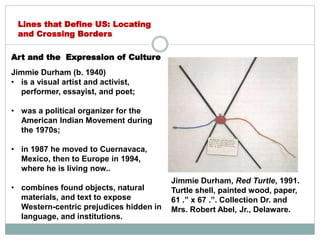
Jimmie Durham (b. 1940)
• is a visual artist and activist,
performer, essayist, and poet;
• was a political organizer for the
American Indian Movement during
the 1970s;
• in 1987 he moved to Cuernavaca,
Mexico, then to Europe in 1994,
where he is living now..
• combines found objects, natural
materials, and text to expose
Western-centric prejudices hidden in
language, and institutions.
Lines that Define US: Locating
and Crossing Borders
Jimmie Durham, Red Turtle, 1991.
Turtle shell, painted wood, paper,
61 .” x 67 .”. Collection Dr. and
Mrs. Robert Abel, Jr., Delaware.
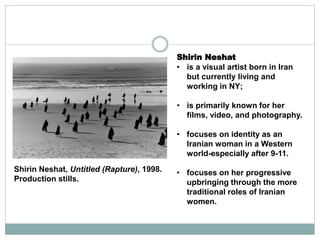
Shirin Neshat
• is a visual artist born in Iran
but currently living and
working in NY;
• is primarily known for her
films, video, and photography.
• focuses on identity as an
Iranian woman in a Western
world-especially after 9-11.
• focuses on her progressive
upbringing through the more
traditional roles of Iranian
women.
Shirin Neshat, Untitled (Rapture), 1998.
Production stills.
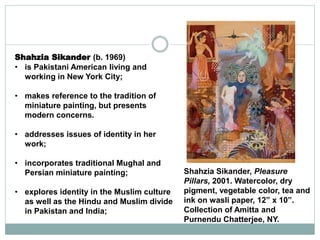
Shahzia Sikander (b. 1969)
• is Pakistani American living and
working in New York City;
• makes reference to the tradition of
miniature painting, but presents
modern concerns.
• addresses issues of identity in her
work;
• incorporates traditional Mughal and
Persian miniature painting;
• explores identity in the Muslim culture
as well as the Hindu and Muslim divide
in Pakistan and India;
Shahzia Sikander, Pleasure
Pillars, 2001. Watercolor, dry
pigment, vegetable color, tea and
ink on wasli paper, 12” x 10”.
Collection of Amitta and
Purnendu Chatterjee, NY.
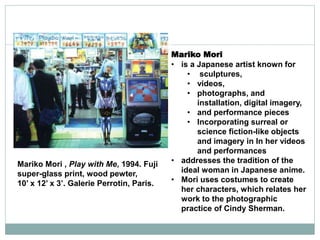
Mariko Mori
• is a Japanese artist known for
• sculptures,
• videos,
• photographs, and
installation, digital imagery,
• and performance pieces
• Incorporating surreal or
science fiction-like objects
and imagery in In her videos
and performances
• addresses the tradition of the
ideal woman in Japanese anime.
• Mori uses costumes to create
her characters, which relates her
work to the photographic
practice of Cindy Sherman.
Mariko Mori , Play with Me, 1994. Fuji
super-glass print, wood pewter,
10’ x 12’ x 3’. Galerie Perrotin, Paris.
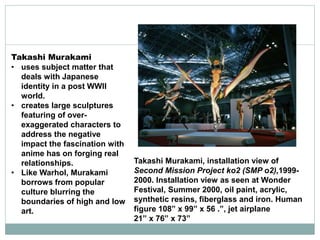
Takashi Murakami
• uses subject matter that
deals with Japanese
identity in a post WWII
world.
• creates large sculptures
featuring of over-
exaggerated characters to
address the negative
impact the fascination with
anime has on forging real
relationships.
• Like Warhol, Murakami
borrows from popular
culture blurring the
boundaries of high and low
art.
Takashi Murakami, installation view of
Second Mission Project ko2 (SMP o2),1999-
2000. Installation view as seen at Wonder
Festival, Summer 2000, oil paint, acrylic,
synthetic resins, fiberglass and iron. Human
figure 108” x 99” x 56 .”, jet airplane
21” x 76” x 73”
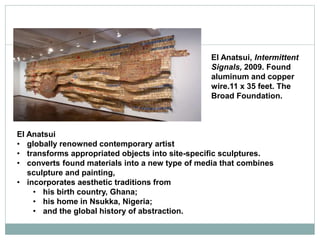
El Anatsui
• globally renowned contemporary artist
• transforms appropriated objects into site-specific sculptures.
• converts found materials into a new type of media that combines
sculpture and painting,
• incorporates aesthetic traditions from
• his birth country, Ghana;
• his home in Nsukka, Nigeria;
• and the global history of abstraction.
El Anatsui, Intermittent
Signals, 2009. Found
aluminum and copper
wire.11 x 35 feet. The
Broad Foundation.
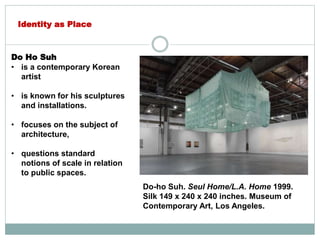
Do Ho Suh
• is a contemporary Korean
artist
• is known for his sculptures
and installations.
• focuses on the subject of
architecture,
• questions standard
notions of scale in relation
to public spaces.
Identity as Place
Do-ho Suh. Seul Home/L.A. Home 1999.
Silk 149 x 240 x 240 inches. Museum of
Contemporary Art, Los Angeles.
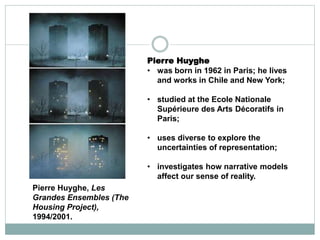
Pierre Huyghe
• was born in 1962 in Paris; he lives
and works in Chile and New York;
• studied at the Ecole Nationale
Supérieure des Arts Décoratifs in
Paris;
• uses diverse to explore the
uncertainties of representation;
• investigates how narrative models
affect our sense of reality.
Pierre Huyghe, Les
Grandes Ensembles (The
Housing Project),
1994/2001.
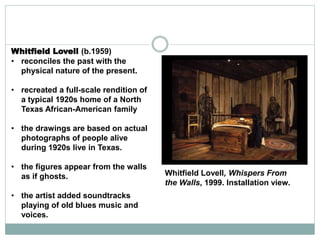
Whitfield Lovell (b.1959)
• reconciles the past with the
physical nature of the present.
• recreated a full-scale rendition of
a typical 1920s home of a North
Texas African-American family
• the drawings are based on actual
photographs of people alive
during 1920s live in Texas.
• the figures appear from the walls
as if ghosts.
• the artist added soundtracks
playing of old blues music and
voices.
Whitfield Lovell, Whispers From
the Walls, 1999. Installation view.
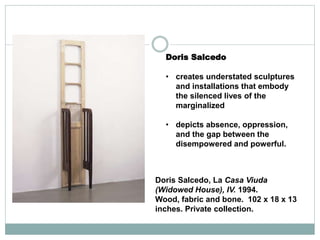
Doris Salcedo
• creates understated sculptures
and installations that embody
the silenced lives of the
marginalized
• depicts absence, oppression,
and the gap between the
disempowered and powerful.
Doris Salcedo, La Casa Viuda
(Widowed House), IV. 1994.
Wood, fabric and bone. 102 x 18 x 13
inches. Private collection.
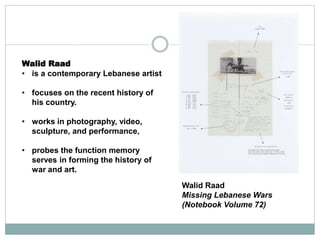
Walid Raad
Missing Lebanese Wars
(Notebook Volume 72)
Walid Raad
• is a contemporary Lebanese artist
• focuses on the recent history of
his country.
• works in photography, video,
sculpture, and performance,
• probes the function memory
serves in forming the history of
war and art.
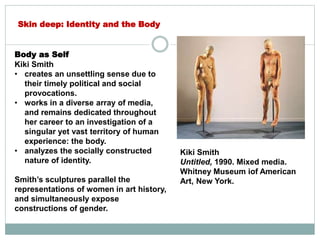
Kiki Smith
Untitled, 1990. Mixed media.
Whitney Museum iof American
Art, New York.
Skin deep: Identity and the Body
Body as Self
Kiki Smith
• creates an unsettling sense due to
their timely political and social
provocations.
• works in a diverse array of media,
and remains dedicated throughout
her career to an investigation of a
singular yet vast territory of human
experience: the body.
• analyzes the socially constructed
nature of identity.
Smith’s sculptures parallel the
representations of women in art history,
and simultaneously expose
constructions of gender.
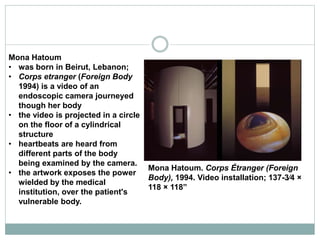
Mona Hatoum
• was born in Beirut, Lebanon;
• Corps etranger (Foreign Body
1994) is a video of an
endoscopic camera journeyed
though her body
• the video is projected in a circle
on the floor of a cylindrical
structure
• heartbeats are heard from
different parts of the body
being examined by the camera.
• the artwork exposes the power
wielded by the medical
institution, over the patient's
vulnerable body.
Mona Hatoum. Corps Étranger (Foreign
Body), 1994. Video installation; 137-3⁄4 ×
118 × 118”
The Sensual Body
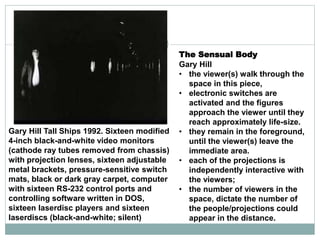
Gary Hill
• the viewer(s) walk through the
space in this piece,
• electronic switches are
activated and the figures
approach the viewer until they
reach approximately life-size.
• they remain in the foreground,
until the viewer(s) leave the
immediate area.
• each of the projections is
independently interactive with
the viewers;
• the number of viewers in the
space, dictate the number of
the people/projections could
appear in the distance.
Gary Hill Tall Ships 1992. Sixteen modified
4-inch black-and-white video monitors
(cathode ray tubes removed from chassis)
with projection lenses, sixteen adjustable
metal brackets, pressure-sensitive switch
mats, black or dark gray carpet, computer
with sixteen RS-232 control ports and
controlling software written in DOS,
sixteen laserdisc players and sixteen
laserdiscs (black-and-white; silent)
The Absent Body
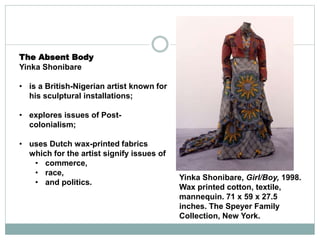
Yinka Shonibare
• is a British-Nigerian artist known for
his sculptural installations;
• explores issues of Post-
colonialism;
• uses Dutch wax-printed fabrics
which for the artist signify issues of
• commerce,
• race,
• and politics.
Yinka Shonibare, Girl/Boy, 1998.
Wax printed cotton, textile,
mannequin. 71 x 59 x 27.5
inches. The Speyer Family
Collection, New York.
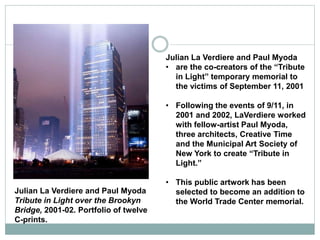
Julian La Verdiere and Paul Myoda
• are the co-creators of the “Tribute
in Light” temporary memorial to
the victims of September 11, 2001
• Following the events of 9/11, in
2001 and 2002, LaVerdiere worked
with fellow-artist Paul Myoda,
three architects, Creative Time
and the Municipal Art Society of
New York to create “Tribute in
Light.”
• This public artwork has been
selected to become an addition to
the World Trade Center memorial.
Julian La Verdiere and Paul Myoda
Tribute in Light over the Brookyn
Bridge, 2001-02. Portfolio of twelve
C-prints.
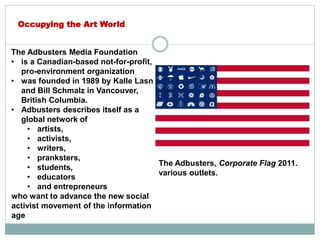
The Adbusters Media Foundation
• is a Canadian-based not-for-profit,
pro-environment organization
• was founded in 1989 by Kalle Lasn
and Bill Schmalz in Vancouver,
British Columbia.
• Adbusters describes itself as a
global network of
• artists,
• activists,
• writers,
• pranksters,
• students,
• educators
• and entrepreneurs
who want to advance the new social
activist movement of the information
age
Occupying the Art World
The Adbusters, Corporate Flag 2011.
various outlets.
Intervention in the Global
Museum
• Globalization is a mechanism
that tries to connect the planet;
• Globalism is an attempt to make
sense of globalization or even
counteract it;
• Lothar Baumgarten
• German conceptual artist,
• was based in New York and
Düsseldorf.
• was one of the most politically
engaged artists during the
1970s
• was part of an activist-oriented
conceptualist movement,
Globalization and Arts
Institutions
Lothar Baumgarten, AMERICA,
Invention I, detail 1988-93.
Installation at the Guggenheim
Museum, New York.
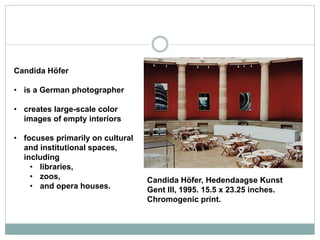
Candida Höfer
• is a German photographer
• creates large-scale color
images of empty interiors
• focuses primarily on cultural
and institutional spaces,
including
• libraries,
• zoos,
• and opera houses.
Candida Höfer, Hedendaagse Kunst
Gent III, 1995. 15.5 x 23.25 inches.
Chromogenic print.
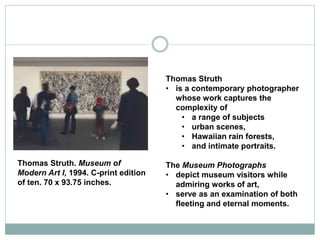
Thomas Struth
• is a contemporary photographer
whose work captures the
complexity of
• a range of subjects
• urban scenes,
• Hawaiian rain forests,
• and intimate portraits.
The Museum Photographs
• depict museum visitors while
admiring works of art,
• serve as an examination of both
fleeting and eternal moments.
Thomas Struth. Museum of
Modern Art I, 1994. C-print edition
of ten. 70 x 93.75 inches.
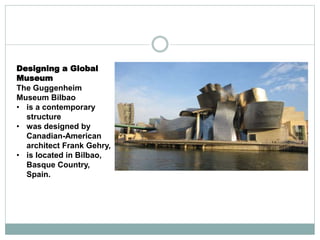
Designing a Global
Museum
The Guggenheim
Museum Bilbao
• is a contemporary
structure
• was designed by
Canadian-American
architect Frank Gehry,
• is located in Bilbao,
Basque Country,
Spain.

Chapter 27 - Contemporary Art and Globalization

  • 1.
  • 2.
    Art and theExpression of Culture Jimmie Durham (b. 1940) • is a visual artist and activist, performer, essayist, and poet; • was a political organizer for the American Indian Movement during the 1970s; • in 1987 he moved to Cuernavaca, Mexico, then to Europe in 1994, where he is living now.. • combines found objects, natural materials, and text to expose Western-centric prejudices hidden in language, and institutions. Lines that Define US: Locating and Crossing Borders Jimmie Durham, Red Turtle, 1991. Turtle shell, painted wood, paper, 61 .” x 67 .”. Collection Dr. and Mrs. Robert Abel, Jr., Delaware.
  • 3.
    Shirin Neshat • isa visual artist born in Iran but currently living and working in NY; • is primarily known for her films, video, and photography. • focuses on identity as an Iranian woman in a Western world-especially after 9-11. • focuses on her progressive upbringing through the more traditional roles of Iranian women. Shirin Neshat, Untitled (Rapture), 1998. Production stills.
  • 4.
    Shahzia Sikander (b.1969) • is Pakistani American living and working in New York City; • makes reference to the tradition of miniature painting, but presents modern concerns. • addresses issues of identity in her work; • incorporates traditional Mughal and Persian miniature painting; • explores identity in the Muslim culture as well as the Hindu and Muslim divide in Pakistan and India; Shahzia Sikander, Pleasure Pillars, 2001. Watercolor, dry pigment, vegetable color, tea and ink on wasli paper, 12” x 10”. Collection of Amitta and Purnendu Chatterjee, NY.
  • 5.
    Mariko Mori • isa Japanese artist known for • sculptures, • videos, • photographs, and installation, digital imagery, • and performance pieces • Incorporating surreal or science fiction-like objects and imagery in In her videos and performances • addresses the tradition of the ideal woman in Japanese anime. • Mori uses costumes to create her characters, which relates her work to the photographic practice of Cindy Sherman. Mariko Mori , Play with Me, 1994. Fuji super-glass print, wood pewter, 10’ x 12’ x 3’. Galerie Perrotin, Paris.
  • 6.
    Takashi Murakami • usessubject matter that deals with Japanese identity in a post WWII world. • creates large sculptures featuring of over- exaggerated characters to address the negative impact the fascination with anime has on forging real relationships. • Like Warhol, Murakami borrows from popular culture blurring the boundaries of high and low art. Takashi Murakami, installation view of Second Mission Project ko2 (SMP o2),1999- 2000. Installation view as seen at Wonder Festival, Summer 2000, oil paint, acrylic, synthetic resins, fiberglass and iron. Human figure 108” x 99” x 56 .”, jet airplane 21” x 76” x 73”
  • 7.
    El Anatsui • globallyrenowned contemporary artist • transforms appropriated objects into site-specific sculptures. • converts found materials into a new type of media that combines sculpture and painting, • incorporates aesthetic traditions from • his birth country, Ghana; • his home in Nsukka, Nigeria; • and the global history of abstraction. El Anatsui, Intermittent Signals, 2009. Found aluminum and copper wire.11 x 35 feet. The Broad Foundation.
  • 8.
    Do Ho Suh •is a contemporary Korean artist • is known for his sculptures and installations. • focuses on the subject of architecture, • questions standard notions of scale in relation to public spaces. Identity as Place Do-ho Suh. Seul Home/L.A. Home 1999. Silk 149 x 240 x 240 inches. Museum of Contemporary Art, Los Angeles.
  • 9.
    Pierre Huyghe • wasborn in 1962 in Paris; he lives and works in Chile and New York; • studied at the Ecole Nationale Supérieure des Arts Décoratifs in Paris; • uses diverse to explore the uncertainties of representation; • investigates how narrative models affect our sense of reality. Pierre Huyghe, Les Grandes Ensembles (The Housing Project), 1994/2001.
  • 10.
    Whitfield Lovell (b.1959) •reconciles the past with the physical nature of the present. • recreated a full-scale rendition of a typical 1920s home of a North Texas African-American family • the drawings are based on actual photographs of people alive during 1920s live in Texas. • the figures appear from the walls as if ghosts. • the artist added soundtracks playing of old blues music and voices. Whitfield Lovell, Whispers From the Walls, 1999. Installation view.
  • 11.
    Doris Salcedo • createsunderstated sculptures and installations that embody the silenced lives of the marginalized • depicts absence, oppression, and the gap between the disempowered and powerful. Doris Salcedo, La Casa Viuda (Widowed House), IV. 1994. Wood, fabric and bone. 102 x 18 x 13 inches. Private collection.
  • 12.
    Walid Raad Missing LebaneseWars (Notebook Volume 72) Walid Raad • is a contemporary Lebanese artist • focuses on the recent history of his country. • works in photography, video, sculpture, and performance, • probes the function memory serves in forming the history of war and art.
  • 13.
    Kiki Smith Untitled, 1990.Mixed media. Whitney Museum iof American Art, New York. Skin deep: Identity and the Body Body as Self Kiki Smith • creates an unsettling sense due to their timely political and social provocations. • works in a diverse array of media, and remains dedicated throughout her career to an investigation of a singular yet vast territory of human experience: the body. • analyzes the socially constructed nature of identity. Smith’s sculptures parallel the representations of women in art history, and simultaneously expose constructions of gender.
  • 14.
    Mona Hatoum • wasborn in Beirut, Lebanon; • Corps etranger (Foreign Body 1994) is a video of an endoscopic camera journeyed though her body • the video is projected in a circle on the floor of a cylindrical structure • heartbeats are heard from different parts of the body being examined by the camera. • the artwork exposes the power wielded by the medical institution, over the patient's vulnerable body. Mona Hatoum. Corps Étranger (Foreign Body), 1994. Video installation; 137-3⁄4 × 118 × 118”
  • 15.
    The Sensual Body GaryHill • the viewer(s) walk through the space in this piece, • electronic switches are activated and the figures approach the viewer until they reach approximately life-size. • they remain in the foreground, until the viewer(s) leave the immediate area. • each of the projections is independently interactive with the viewers; • the number of viewers in the space, dictate the number of the people/projections could appear in the distance. Gary Hill Tall Ships 1992. Sixteen modified 4-inch black-and-white video monitors (cathode ray tubes removed from chassis) with projection lenses, sixteen adjustable metal brackets, pressure-sensitive switch mats, black or dark gray carpet, computer with sixteen RS-232 control ports and controlling software written in DOS, sixteen laserdisc players and sixteen laserdiscs (black-and-white; silent)
  • 16.
    The Absent Body YinkaShonibare • is a British-Nigerian artist known for his sculptural installations; • explores issues of Post- colonialism; • uses Dutch wax-printed fabrics which for the artist signify issues of • commerce, • race, • and politics. Yinka Shonibare, Girl/Boy, 1998. Wax printed cotton, textile, mannequin. 71 x 59 x 27.5 inches. The Speyer Family Collection, New York.
  • 17.
    Julian La Verdiereand Paul Myoda • are the co-creators of the “Tribute in Light” temporary memorial to the victims of September 11, 2001 • Following the events of 9/11, in 2001 and 2002, LaVerdiere worked with fellow-artist Paul Myoda, three architects, Creative Time and the Municipal Art Society of New York to create “Tribute in Light.” • This public artwork has been selected to become an addition to the World Trade Center memorial. Julian La Verdiere and Paul Myoda Tribute in Light over the Brookyn Bridge, 2001-02. Portfolio of twelve C-prints.
  • 18.
    The Adbusters MediaFoundation • is a Canadian-based not-for-profit, pro-environment organization • was founded in 1989 by Kalle Lasn and Bill Schmalz in Vancouver, British Columbia. • Adbusters describes itself as a global network of • artists, • activists, • writers, • pranksters, • students, • educators • and entrepreneurs who want to advance the new social activist movement of the information age Occupying the Art World The Adbusters, Corporate Flag 2011. various outlets.
  • 19.
    Intervention in theGlobal Museum • Globalization is a mechanism that tries to connect the planet; • Globalism is an attempt to make sense of globalization or even counteract it; • Lothar Baumgarten • German conceptual artist, • was based in New York and Düsseldorf. • was one of the most politically engaged artists during the 1970s • was part of an activist-oriented conceptualist movement, Globalization and Arts Institutions Lothar Baumgarten, AMERICA, Invention I, detail 1988-93. Installation at the Guggenheim Museum, New York.
  • 20.
    Candida Höfer • isa German photographer • creates large-scale color images of empty interiors • focuses primarily on cultural and institutional spaces, including • libraries, • zoos, • and opera houses. Candida Höfer, Hedendaagse Kunst Gent III, 1995. 15.5 x 23.25 inches. Chromogenic print.
  • 21.
    Thomas Struth • isa contemporary photographer whose work captures the complexity of • a range of subjects • urban scenes, • Hawaiian rain forests, • and intimate portraits. The Museum Photographs • depict museum visitors while admiring works of art, • serve as an examination of both fleeting and eternal moments. Thomas Struth. Museum of Modern Art I, 1994. C-print edition of ten. 70 x 93.75 inches.
  • 22.
    Designing a Global Museum TheGuggenheim Museum Bilbao • is a contemporary structure • was designed by Canadian-American architect Frank Gehry, • is located in Bilbao, Basque Country, Spain.