Objectives:
At the end of the lesson, the student
must be able to:
• define and identify arithmetic
sequence;
• determine the nth term of an
arithmetic sequence.
• Given the first few terms of an
arithmetic sequence, find the
common difference and the nth for
a specified n.
Arithmetic Sequence
– Consider the situation below.
• A school sets a fine of Php 30 for
the first littering offense. The fine
increases by Php 5 for each
subsequent offense.
• How much will a student be fined
for the second offense? Third
offense? Sixth offense?
What is it?
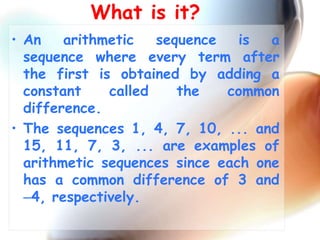
• An arithmetic sequence is a
sequence where every term after
the first is obtained by adding a
constant called the common
difference.
• The sequences 1, 4, 7, 10, ... and
15, 11, 7, 3, ... are examples of
arithmetic sequences since each one
has a common difference of 3 and
4, respectively.
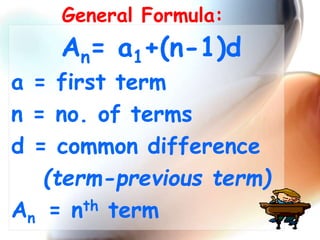
General Formula:
An= a1+(n-1)d
a = first term
n = no. of terms
d = common difference
(term-previous term)
An = nth term
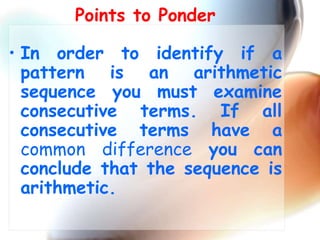
Points to Ponder
• In order to identify if a
pattern is an arithmetic
sequence you must examine
consecutive terms. If all
consecutive terms have a
common difference you can
conclude that the sequence is
arithmetic.
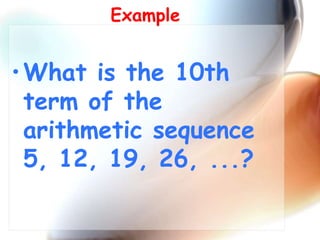
Example
•What is the 10th
term of the
arithmetic sequence
5, 12, 19, 26, ...?
Example
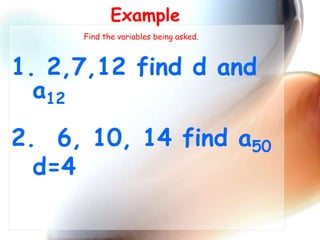
1. 2,7,12 find d and
a12
2. 6, 10, 14 find a50
d=4
Find the variables being asked.
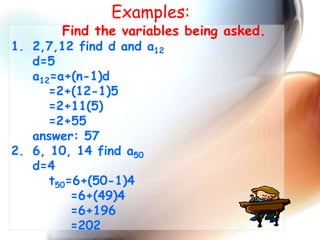
1. 2,7,12 find d and a12
d=5
a12=a+(n-1)d
=2+(12-1)5
=2+11(5)
=2+55
answer: 57
2. 6, 10, 14 find a50
d=4
t50=6+(50-1)4
=6+(49)4
=6+196
=202
Examples:
Oral Activity
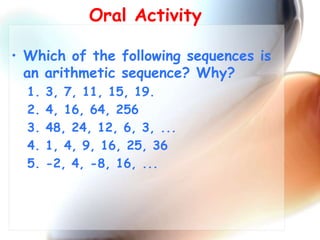
• Which of the following sequences is
an arithmetic sequence? Why?
1. 3, 7, 11, 15, 19.
2. 4, 16, 64, 256
3. 48, 24, 12, 6, 3, ...
4. 1, 4, 9, 16, 25, 36
5. -2, 4, -8, 16, ...
Oral Activity
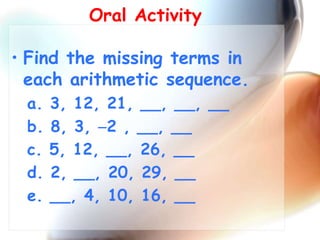
• Find the missing terms in
each arithmetic sequence.
a. 3, 12, 21, __, __, __
b. 8, 3, 2 , __, __
c. 5, 12, __, 26, __
d. 2, __, 20, 29, __
e. __, 4, 10, 16, __
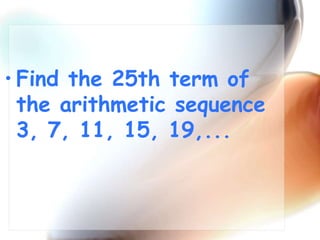
• Find the 25th term of
the arithmetic sequence
3, 7, 11, 15, 19,...
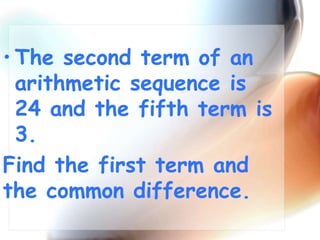
• The second term of an
arithmetic sequence is
24 and the fifth term is
3.
Find the first term and
the common difference.
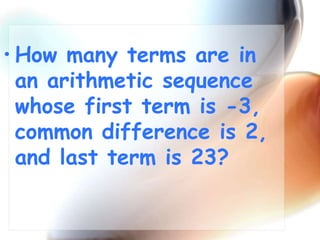
• How many terms are in
an arithmetic sequence
whose first term is -3,
common difference is 2,
and last term is 23?
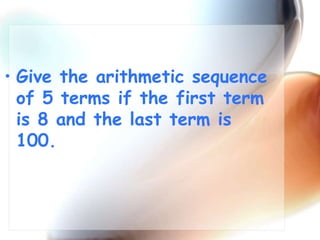
• Give the arithmetic sequence
of 5 terms if the first term
is 8 and the last term is
100.
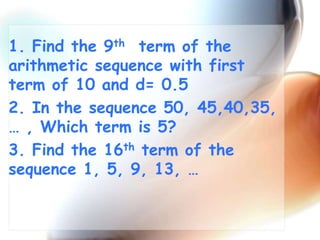
1. Find the 9th term of the
arithmetic sequence with first
term of 10 and d= 0.5
2. In the sequence 50, 45,40,35,
… , Which term is 5?
3. Find the 16th term of the
sequence 1, 5, 9, 13, …
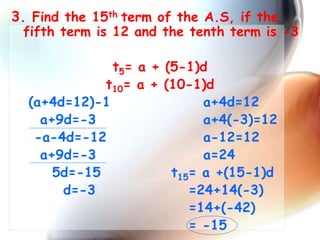
3. Find the 15th term of the A.S, if the
fifth term is 12 and the tenth term is -3
t5= a + (5-1)d
t10= a + (10-1)d
(a+4d=12)-1 a+4d=12
a+9d=-3 a+4(-3)=12
-a-4d=-12 a-12=12
a+9d=-3 a=24
5d=-15 t15= a +(15-1)d
d=-3 =24+14(-3)
=14+(-42)
= -15
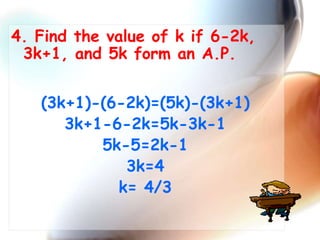
4. Find the value of k if 6-2k,
3k+1, and 5k form an A.P.
(3k+1)-(6-2k)=(5k)-(3k+1)
3k+1-6-2k=5k-3k-1
5k-5=2k-1
3k=4
k= 4/3
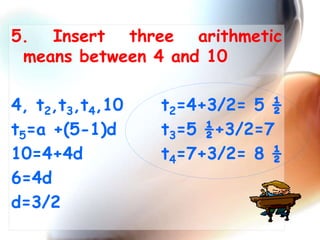
5. Insert three arithmetic
means between 4 and 10
4, t2,t3,t4,10 t2=4+3/2= 5 ½
t5=a +(5-1)d t3=5 ½+3/2=7
10=4+4d t4=7+3/2= 8 ½
6=4d
d=3/2
ACTIVITIES
Good Luck!!!
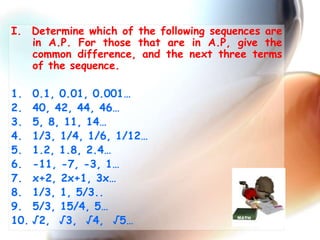
I. Determine which of the following sequences are
in A.P. For those that are in A.P, give the
common difference, and the next three terms
of the sequence.
1. 0.1, 0.01, 0.001…
2. 40, 42, 44, 46…
3. 5, 8, 11, 14…
4. 1/3, 1/4, 1/6, 1/12…
5. 1.2, 1.8, 2.4…
6. -11, -7, -3, 1…
7. x+2, 2x+1, 3x…
8. 1/3, 1, 5/3..
9. 5/3, 15/4, 5…
10. √2, √3, √4, √5…
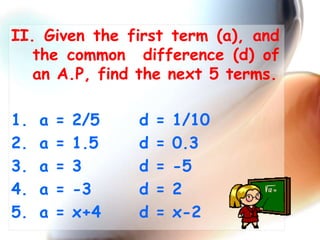
II. Given the first term (a), and
the common difference (d) of
an A.P, find the next 5 terms.
1. a = 2/5 d = 1/10
2. a = 1.5 d = 0.3
3. a = 3 d = -5
4. a = -3 d = 2
5. a = x+4 d = x-2
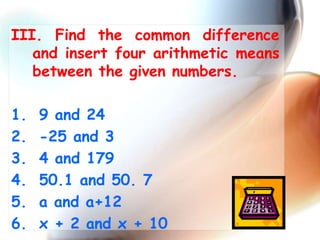
III. Find the common difference
and insert four arithmetic means
between the given numbers.
1. 9 and 24
2. -25 and 3
3. 4 and 179
4. 50.1 and 50. 7
5. a and a+12
6. x + 2 and x + 10
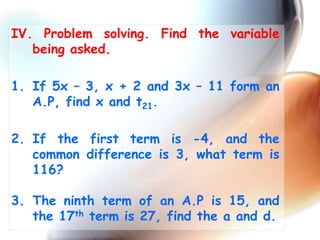
IV. Problem solving. Find the variable
being asked.
1. If 5x – 3, x + 2 and 3x – 11 form an
A.P, find x and t21.
2. If the first term is -4, and the
common difference is 3, what term is
116?
3. The ninth term of an A.P is 15, and
the 17th term is 27, find the a and d.
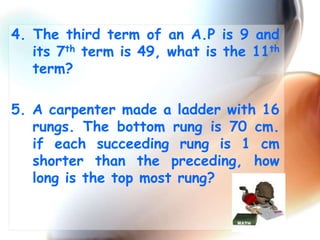
4. The third term of an A.P is 9 and
its 7th term is 49, what is the 11th
term?
5. A carpenter made a ladder with 16
rungs. The bottom rung is 70 cm.
if each succeeding rung is 1 cm
shorter than the preceding, how
long is the top most rung?
Answers
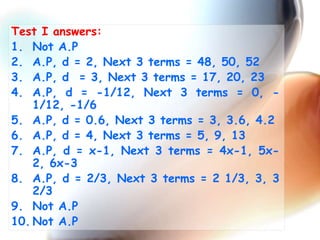
Test I answers:
1. Not A.P
2. A.P, d = 2, Next 3 terms = 48, 50, 52
3. A.P, d = 3, Next 3 terms = 17, 20, 23
4. A.P, d = -1/12, Next 3 terms = 0, -
1/12, -1/6
5. A.P, d = 0.6, Next 3 terms = 3, 3.6, 4.2
6. A.P, d = 4, Next 3 terms = 5, 9, 13
7. A.P, d = x-1, Next 3 terms = 4x-1, 5x-
2, 6x-3
8. A.P, d = 2/3, Next 3 terms = 2 1/3, 3, 3
2/3
9. Not A.P
10. Not A.P
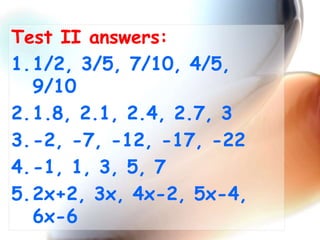
Test II answers:
1.1/2, 3/5, 7/10, 4/5,
9/10
2.1.8, 2.1, 2.4, 2.7, 3
3.-2, -7, -12, -17, -22
4.-1, 1, 3, 5, 7
5.2x+2, 3x, 4x-2, 5x-4,
6x-6
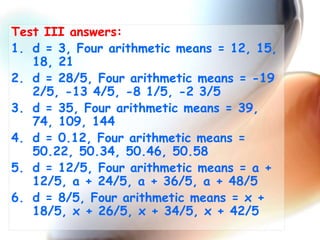
Test III answers:
1. d = 3, Four arithmetic means = 12, 15,
18, 21
2. d = 28/5, Four arithmetic means = -19
2/5, -13 4/5, -8 1/5, -2 3/5
3. d = 35, Four arithmetic means = 39,
74, 109, 144
4. d = 0.12, Four arithmetic means =
50.22, 50.34, 50.46, 50.58
5. d = 12/5, Four arithmetic means = a +
12/5, a + 24/5, a + 36/5, a + 48/5
6. d = 8/5, Four arithmetic means = x +
18/5, x + 26/5, x + 34/5, x + 42/5
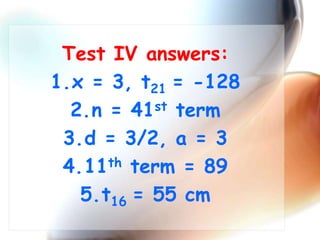
Test IV answers:
1.x = 3, t21 = -128
2.n = 41st term
3.d = 3/2, a = 3
4.11th term = 89
5.t16 = 55 cm
Prepared by:
• Marx Lennin Cabaltican
• Bernadette Aubrey Cabrera
• Precious Fernandez

Arithmetic sequence.ppt

  • 1.
    Objectives: At the endof the lesson, the student must be able to: • define and identify arithmetic sequence; • determine the nth term of an arithmetic sequence. • Given the first few terms of an arithmetic sequence, find the common difference and the nth for a specified n.
  • 2.
  • 3.
    – Consider thesituation below. • A school sets a fine of Php 30 for the first littering offense. The fine increases by Php 5 for each subsequent offense. • How much will a student be fined for the second offense? Third offense? Sixth offense?
  • 4.
    What is it? •An arithmetic sequence is a sequence where every term after the first is obtained by adding a constant called the common difference. • The sequences 1, 4, 7, 10, ... and 15, 11, 7, 3, ... are examples of arithmetic sequences since each one has a common difference of 3 and 4, respectively.
  • 5.
    General Formula: An= a1+(n-1)d a= first term n = no. of terms d = common difference (term-previous term) An = nth term
  • 6.
    Points to Ponder •In order to identify if a pattern is an arithmetic sequence you must examine consecutive terms. If all consecutive terms have a common difference you can conclude that the sequence is arithmetic.
  • 7.
    Example •What is the10th term of the arithmetic sequence 5, 12, 19, 26, ...?
  • 8.
    Example 1. 2,7,12 findd and a12 2. 6, 10, 14 find a50 d=4 Find the variables being asked.
  • 9.
    Find the variablesbeing asked. 1. 2,7,12 find d and a12 d=5 a12=a+(n-1)d =2+(12-1)5 =2+11(5) =2+55 answer: 57 2. 6, 10, 14 find a50 d=4 t50=6+(50-1)4 =6+(49)4 =6+196 =202 Examples:
  • 10.
    Oral Activity • Whichof the following sequences is an arithmetic sequence? Why? 1. 3, 7, 11, 15, 19. 2. 4, 16, 64, 256 3. 48, 24, 12, 6, 3, ... 4. 1, 4, 9, 16, 25, 36 5. -2, 4, -8, 16, ...
  • 11.
    Oral Activity • Findthe missing terms in each arithmetic sequence. a. 3, 12, 21, __, __, __ b. 8, 3, 2 , __, __ c. 5, 12, __, 26, __ d. 2, __, 20, 29, __ e. __, 4, 10, 16, __
  • 12.
    • Find the25th term of the arithmetic sequence 3, 7, 11, 15, 19,...
  • 13.
    • The secondterm of an arithmetic sequence is 24 and the fifth term is 3. Find the first term and the common difference.
  • 14.
    • How manyterms are in an arithmetic sequence whose first term is -3, common difference is 2, and last term is 23?
  • 15.
    • Give thearithmetic sequence of 5 terms if the first term is 8 and the last term is 100.
  • 16.
    1. Find the9th term of the arithmetic sequence with first term of 10 and d= 0.5 2. In the sequence 50, 45,40,35, … , Which term is 5? 3. Find the 16th term of the sequence 1, 5, 9, 13, …
  • 17.
    3. Find the15th term of the A.S, if the fifth term is 12 and the tenth term is -3 t5= a + (5-1)d t10= a + (10-1)d (a+4d=12)-1 a+4d=12 a+9d=-3 a+4(-3)=12 -a-4d=-12 a-12=12 a+9d=-3 a=24 5d=-15 t15= a +(15-1)d d=-3 =24+14(-3) =14+(-42) = -15
  • 18.
    4. Find thevalue of k if 6-2k, 3k+1, and 5k form an A.P. (3k+1)-(6-2k)=(5k)-(3k+1) 3k+1-6-2k=5k-3k-1 5k-5=2k-1 3k=4 k= 4/3
  • 19.
    5. Insert threearithmetic means between 4 and 10 4, t2,t3,t4,10 t2=4+3/2= 5 ½ t5=a +(5-1)d t3=5 ½+3/2=7 10=4+4d t4=7+3/2= 8 ½ 6=4d d=3/2
  • 20.
  • 21.
  • 22.
    I. Determine whichof the following sequences are in A.P. For those that are in A.P, give the common difference, and the next three terms of the sequence. 1. 0.1, 0.01, 0.001… 2. 40, 42, 44, 46… 3. 5, 8, 11, 14… 4. 1/3, 1/4, 1/6, 1/12… 5. 1.2, 1.8, 2.4… 6. -11, -7, -3, 1… 7. x+2, 2x+1, 3x… 8. 1/3, 1, 5/3.. 9. 5/3, 15/4, 5… 10. √2, √3, √4, √5…
  • 23.
    II. Given thefirst term (a), and the common difference (d) of an A.P, find the next 5 terms. 1. a = 2/5 d = 1/10 2. a = 1.5 d = 0.3 3. a = 3 d = -5 4. a = -3 d = 2 5. a = x+4 d = x-2
  • 24.
    III. Find thecommon difference and insert four arithmetic means between the given numbers. 1. 9 and 24 2. -25 and 3 3. 4 and 179 4. 50.1 and 50. 7 5. a and a+12 6. x + 2 and x + 10
  • 25.
    IV. Problem solving.Find the variable being asked. 1. If 5x – 3, x + 2 and 3x – 11 form an A.P, find x and t21. 2. If the first term is -4, and the common difference is 3, what term is 116? 3. The ninth term of an A.P is 15, and the 17th term is 27, find the a and d.
  • 26.
    4. The thirdterm of an A.P is 9 and its 7th term is 49, what is the 11th term? 5. A carpenter made a ladder with 16 rungs. The bottom rung is 70 cm. if each succeeding rung is 1 cm shorter than the preceding, how long is the top most rung?
  • 27.
  • 28.
    Test I answers: 1.Not A.P 2. A.P, d = 2, Next 3 terms = 48, 50, 52 3. A.P, d = 3, Next 3 terms = 17, 20, 23 4. A.P, d = -1/12, Next 3 terms = 0, - 1/12, -1/6 5. A.P, d = 0.6, Next 3 terms = 3, 3.6, 4.2 6. A.P, d = 4, Next 3 terms = 5, 9, 13 7. A.P, d = x-1, Next 3 terms = 4x-1, 5x- 2, 6x-3 8. A.P, d = 2/3, Next 3 terms = 2 1/3, 3, 3 2/3 9. Not A.P 10. Not A.P
  • 29.
    Test II answers: 1.1/2,3/5, 7/10, 4/5, 9/10 2.1.8, 2.1, 2.4, 2.7, 3 3.-2, -7, -12, -17, -22 4.-1, 1, 3, 5, 7 5.2x+2, 3x, 4x-2, 5x-4, 6x-6
  • 30.
    Test III answers: 1.d = 3, Four arithmetic means = 12, 15, 18, 21 2. d = 28/5, Four arithmetic means = -19 2/5, -13 4/5, -8 1/5, -2 3/5 3. d = 35, Four arithmetic means = 39, 74, 109, 144 4. d = 0.12, Four arithmetic means = 50.22, 50.34, 50.46, 50.58 5. d = 12/5, Four arithmetic means = a + 12/5, a + 24/5, a + 36/5, a + 48/5 6. d = 8/5, Four arithmetic means = x + 18/5, x + 26/5, x + 34/5, x + 42/5
  • 31.
    Test IV answers: 1.x= 3, t21 = -128 2.n = 41st term 3.d = 3/2, a = 3 4.11th term = 89 5.t16 = 55 cm
  • 33.
    Prepared by: • MarxLennin Cabaltican • Bernadette Aubrey Cabrera • Precious Fernandez