




ARITHMETIC
SEQUENCE
Solomon Hippocrates S. Flores
E. Rodriguez Vocational High School
How many wheels do you see?
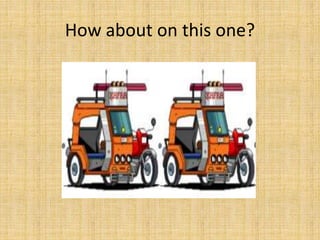
How about on this one?
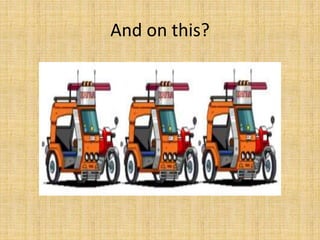
And on this?
What if 10 tricycles pass by, how
many wheels would you see? How
about 15 tricycles?
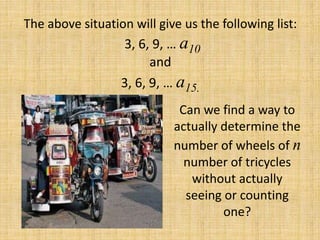
The above situation will give us the following list:
3, 6, 9, … a10
and
3, 6, 9, … a15.
Can we find a way to
actually determine the
number of wheels of n
number of tricycles
without actually
seeing or counting
one?
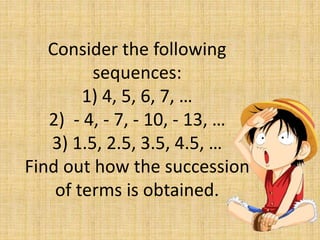
Consider the following
sequences:
1) 4, 5, 6, 7, …
2) - 4, - 7, - 10, - 13, …
3) 1.5, 2.5, 3.5, 4.5, …
Find out how the succession
of terms is obtained.
The sequences above show that a
constant, either positive or
negative, is added to the preceding
term to get the next term.
Such situation is
called an
Arithmetic
Sequence.
An arithmetic sequence is a
sequence in which any term is
obtained by adding a constant to the
preceding term. The number added to
any term to get the next term is the
difference between two successive
terms, hence, the common difference,
denoted by d, which can either be
positive or negative.
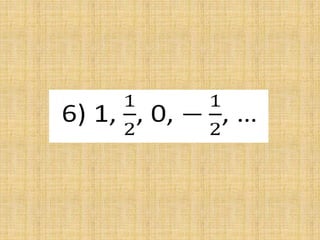
Determine if the following sequence is
arithmetic or not. If yes, find the common
difference d and identify the next term.
1) 5, 12, 19, 26, …
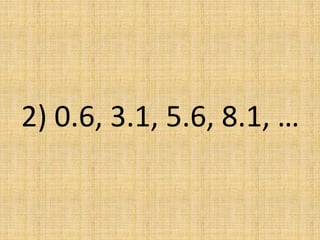
2) 0.6, 3.1, 5.6, 8.1, …
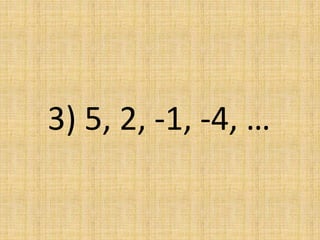
3) 5, 2, -1, -4, …
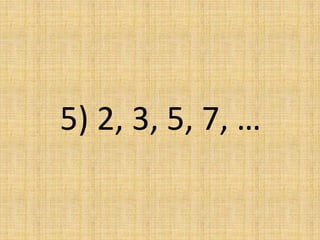
5) 2, 3, 5, 7, …
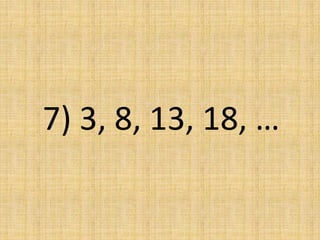
7) 3, 8, 13, 18, …
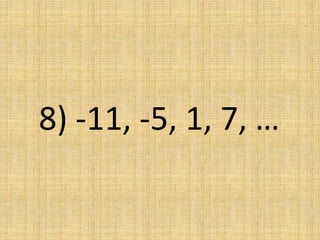
8) -11, -5, 1, 7, …
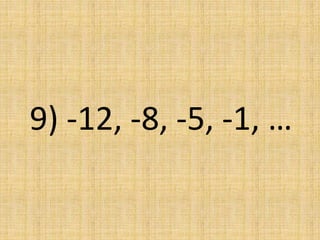
9) -12, -8, -5, -1, …
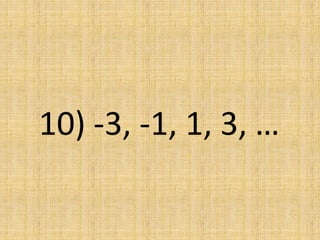
10) -3, -1, 1, 3, …
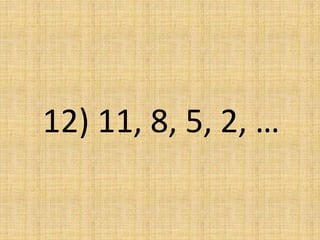
12) 11, 8, 5, 2, …
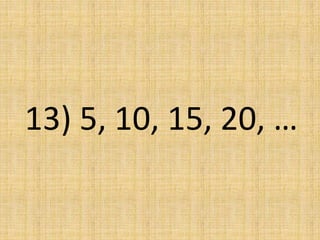
13) 5, 10, 15, 20, …
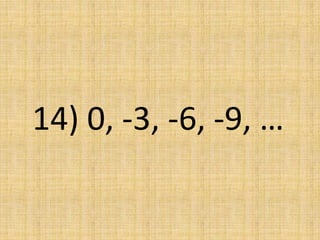
14) 0, -3, -6, -9, …
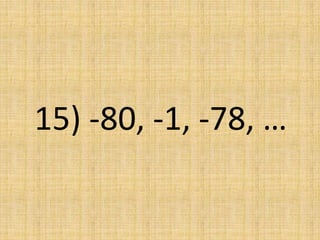
15) -80, -1, -78, …
VALUES INTEGRATIONDiligence can
help bring
you to a
targeted
end.Name a sequence
of steps that you
can set for yourself
when aiming for a
target.
Complete the
following
statements:
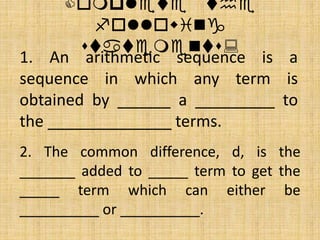
1. An arithmetic sequence is a
sequence in which any term is
obtained by ______ a _________ to
the ______________ terms.
2. The common difference, d, is the
_______ added to _____ term to get the
_____ term which can either be
__________ or __________.
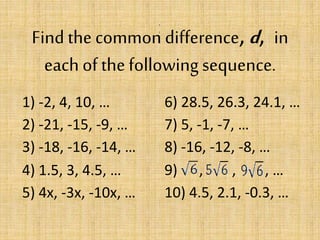
Find the common difference, d, in
each of thefollowing sequence.
,
,
1) -2, 4, 10, … 6) 28.5, 26.3, 24.1, …
2) -21, -15, -9, … 7) 5, -1, -7, …
3) -18, -16, -14, … 8) -16, -12, -8, …
4) 1.5, 3, 4.5, … 9) , , , …
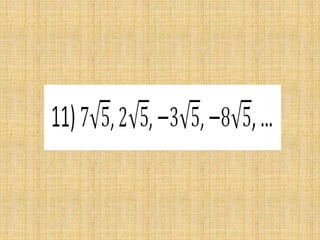
5) 4x, -3x, -10x, … 10) 4.5, 2.1, -0.3, …
Assignment
Determine if the following sequence is arithmetic
or not. If yes, find the common difference and identify
the next term.
1) -2, 4, 10, …
2) 2, -2, 2, -2, …
3) 4.5, 2.1, -0.3, …
4) 6, 12, 19, 26, …
5) 5, -1, -7, …
Thank you!

Definition of Arithmetic Sequence

  • 1.
    ARITHMETIC SEQUENCE Solomon Hippocrates S.Flores E. Rodriguez Vocational High School
  • 2.
    How many wheelsdo you see?
  • 3.
    How about onthis one?
  • 4.
  • 5.
    What if 10tricycles pass by, how many wheels would you see? How about 15 tricycles?
  • 6.
    The above situationwill give us the following list: 3, 6, 9, … a10 and 3, 6, 9, … a15. Can we find a way to actually determine the number of wheels of n number of tricycles without actually seeing or counting one?
  • 7.
    Consider the following sequences: 1)4, 5, 6, 7, … 2) - 4, - 7, - 10, - 13, … 3) 1.5, 2.5, 3.5, 4.5, … Find out how the succession of terms is obtained.
  • 8.
    The sequences aboveshow that a constant, either positive or negative, is added to the preceding term to get the next term. Such situation is called an Arithmetic Sequence.
  • 9.
    An arithmetic sequenceis a sequence in which any term is obtained by adding a constant to the preceding term. The number added to any term to get the next term is the difference between two successive terms, hence, the common difference, denoted by d, which can either be positive or negative.
  • 10.
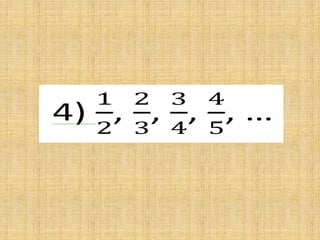
    Determine if thefollowing sequence is arithmetic or not. If yes, find the common difference d and identify the next term. 1) 5, 12, 19, 26, …
  • 11.
    2) 0.6, 3.1,5.6, 8.1, …
  • 12.
    3) 5, 2,-1, -4, …
  • 14.
    5) 2, 3,5, 7, …
  • 16.
    7) 3, 8,13, 18, …
  • 17.
    8) -11, -5,1, 7, …
  • 18.
    9) -12, -8,-5, -1, …
  • 19.
    10) -3, -1,1, 3, …
  • 21.
    12) 11, 8,5, 2, …
  • 22.
    13) 5, 10,15, 20, …
  • 23.
    14) 0, -3,-6, -9, …
  • 24.
    15) -80, -1,-78, …
  • 25.
    VALUES INTEGRATIONDiligence can helpbring you to a targeted end.Name a sequence of steps that you can set for yourself when aiming for a target.
  • 26.
    Complete the following statements: 1. Anarithmetic sequence is a sequence in which any term is obtained by ______ a _________ to the ______________ terms. 2. The common difference, d, is the _______ added to _____ term to get the _____ term which can either be __________ or __________.
  • 27.
    Find the commondifference, d, in each of thefollowing sequence. , , 1) -2, 4, 10, … 6) 28.5, 26.3, 24.1, … 2) -21, -15, -9, … 7) 5, -1, -7, … 3) -18, -16, -14, … 8) -16, -12, -8, … 4) 1.5, 3, 4.5, … 9) , , , … 5) 4x, -3x, -10x, … 10) 4.5, 2.1, -0.3, …
  • 28.
    Assignment Determine if thefollowing sequence is arithmetic or not. If yes, find the common difference and identify the next term. 1) -2, 4, 10, … 2) 2, -2, 2, -2, … 3) 4.5, 2.1, -0.3, … 4) 6, 12, 19, 26, … 5) 5, -1, -7, …
  • 29.