WELLCOME TO
MY
PRESENTATION
TOPIC :
A pen picture of the
Victorian society that is
found in the Novels of
Victorian writers.
Presented for:
Monir Hossen
Lecturer
Department of English
Uttara University
Email: monir.eng.cou@gmail.com
Presented by:
Mst. Sharmin Akter
Department of English
Id: F21433111030
Batch :35th
Semester: Fall 2017
Email: Srabonishimu95@gmail.com
METHODOLOGY
Primary data:
• Personal observation
• Books / Sheet.
Secondary data:
• Internet.
Victorian Era
The Victorian era of
the British history was
the period of queen
Victoria’s reign from
1837 until her death in
1901.
Cont....
It was a long period of peace, prosperity, refined
culture, great advancements in technology, and national
self-confidence for Britain.
The Victorian era was the greatest age of English
novel. The novel as a genre rose to entertain the rising
middle class and to depict the contemporary life of
changing society.
The Victorian period of English history witnessed a
set of complex, political, social, scientific and
philosophical developments.
The Victorian period of English history witnessed a
set of complex, political, social, scientific and
philosophical developments.
Cont....
Charles Dickens (1812-1870), William Thackeray
(1811-1863), Thomas Hardy (1840-1928), William
Morris (1834-1896),Elizabeth Gaskell (1810-
1865),George Eliot (1819-1880),Anne Bronte
(1820-1849), Charlotte Bronte (1816-1865), Emily
Bronte (1818-1848).
Some of the Victorian period novelist
name in the below—
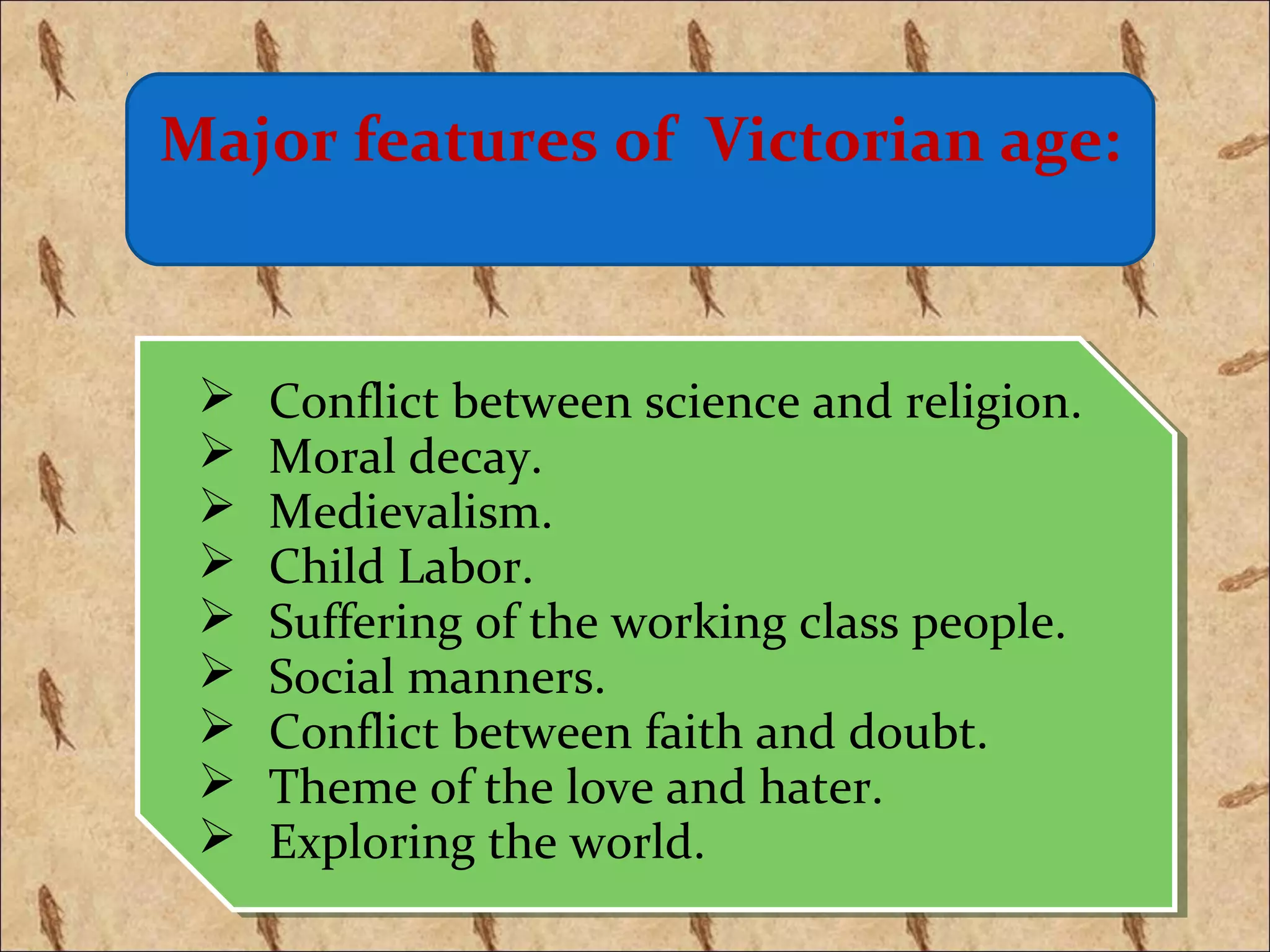
Major features of Victorian age:
 Conflict between science and religion.
 Moral decay.
 Medievalism.
 Child Labor.
 Suffering of the working class people.
 Social manners.
 Conflict between faith and doubt.
 Theme of the love and hater.
 Exploring the world.
 Conflict between science and religion.
 Moral decay.
 Medievalism.
 Child Labor.
 Suffering of the working class people.
 Social manners.
 Conflict between faith and doubt.
 Theme of the love and hater.
 Exploring the world.
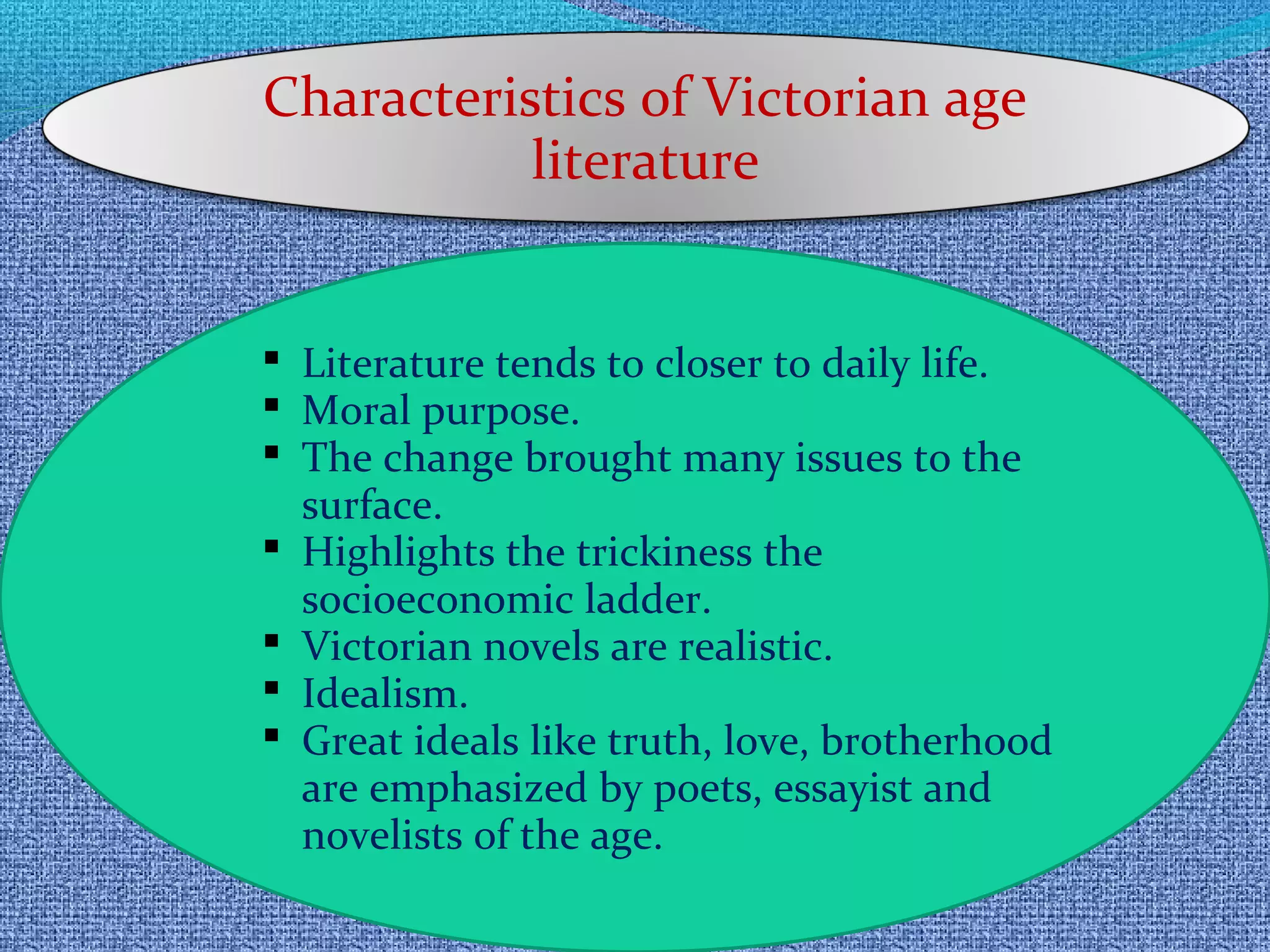
Characteristics of Victorian age
literature
 Literature tends to closer to daily life.
 Moral purpose.
 The change brought many issues to the
surface.
 Highlights the trickiness the
socioeconomic ladder.
 Victorian novels are realistic.
 Idealism.
 Great ideals like truth, love, brotherhood
are emphasized by poets, essayist and
novelists of the age.
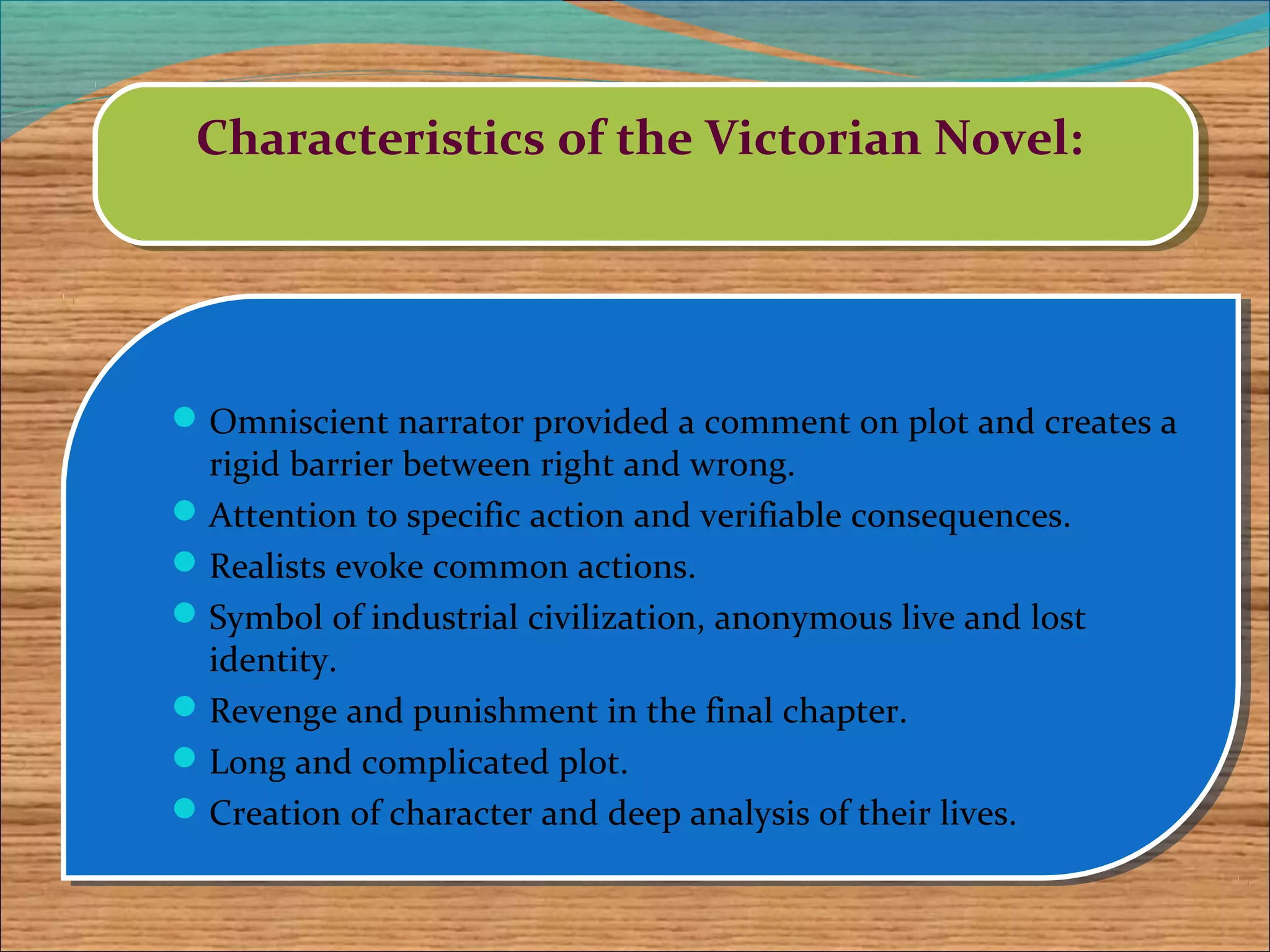
Characteristics of the Victorian Novel:Characteristics of the Victorian Novel:
Omniscient narrator provided a comment on plot and creates a
rigid barrier between right and wrong.
Attention to specific action and verifiable consequences.
Realists evoke common actions.
Symbol of industrial civilization, anonymous live and lost
identity.
Revenge and punishment in the final chapter.
Long and complicated plot.
Creation of character and deep analysis of their lives.
Now I am going to discuss
a pen picture of the
Victorian society that I
find in the novels of
Victorian writers.
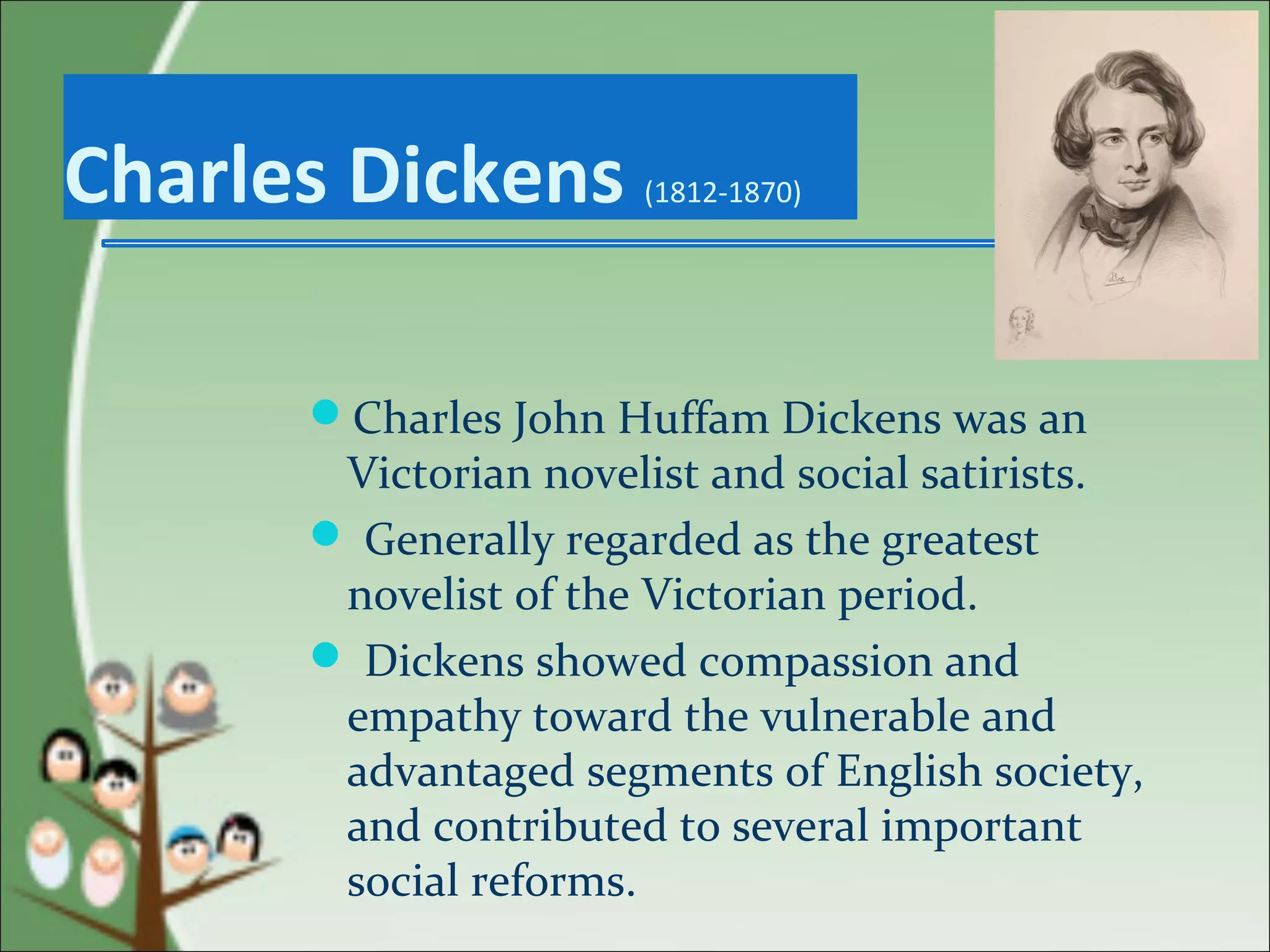
Charles Dickens (1812-1870)
Charles John Huffam Dickens was an
Victorian novelist and social satirists.
 Generally regarded as the greatest
novelist of the Victorian period.
 Dickens showed compassion and
empathy toward the vulnerable and
advantaged segments of English society,
and contributed to several important
social reforms.
Characteristics of Charles Dickens’
novels:
The title of novel was extremely important to
Dickens.
Dickens’s criticized Victorians for considering
low class as inadequate.
Dickens used suspense and mystery.
Dickens used comedy as relief from the serious
and unhappy sections of his novel
Thomas Hardy(1840-1928)
Thomas Hardy must be regarded as a key
forerunner of the Victorian novelist in
literature.
His Tess of the D'Urbervilles is a famous
novel, is a simple girl who is preyed upon by
an aristocratic menace. He showed here to
escape his ideals on the morals and Victorian
society.
Characteristics of Thomas Hardys’ novels:
Hardy used several literary devices and
themes to express his ideas stylistically, by
foreshadow, symbolism, marriage and different
philosopher.
Hardy tragic vision manifested in major
novels.
Hardy’s conviction that there is a fundamental
conflict between humanity and the ruthless
fate.
William Thackeray(1811-1863)
William Thackeray was born in Calcutta, India and
was also an important writer but one who expressed
his age very differently from Dickens and other
writers.
He is most noted for his satirical work Vanity Fair
that portrays the many myriads of English society.
 His work is seen almost as a reactionary voice.
Characteristics of Thackerays’ novels:
Thackeray showed the latter is a harsh critique of the
material greed of the age and a critique of the
contemporary culture of the age.
Thackeray stands in isolation as an outsider to this
circle due his skepticism of the changing Victorian
society.
Women Novelists of the Victorian Era:
The era saw a proliferation of women
writers. The novel as a genre was initially
seen as feminine literature and as the literacy
rate among women increased, a new need for
women writers catering to this segment was
answered by these writers.
Elizabeth Gaskell(1810-1865)
• Elizabeth Gaskell, popularly called Mrs. Gaskell
wrote short stories and novels that dealt with
presenting a social picture of her society in the
1850s.
• While it was a time when doubts about
material progress reaching the actual lives of
the ordinary man were starting to be raised,
Gaskell mostly gave an optimistic view of the
time.
Characteristics of Gaskels’ novels:
She was accomplished in writing
novels, novellas, short stories, and
poems also – so it’s fair to say she
made good use for her talent.
She was most famous for writing
ghost stories.
George Eliot (1819-1880)
• George Eliot was really a woman who
chose a male pen name for herself.
• Her stories reflected the reality of life
in rural England, depicting the effects
urbanization have on small towns, or
of the difficulties of local political
disputes.
Characteristics of Eliots’ novels:
She showed her novels of many different
characters who lived in the same small
town.
She showed critical appreciation for its
psychological descriptions of the
characters and a realistic description of
rural life.
Anne Bronte, Charlotte Bronte and
Emily Bronte
• Charlotte, Emily and Anne Bronte are the most original
novelist of this period.
• The Bronte sisters wrote fiction rather different from that
common at the time.
• Anne, Charlotte and Emily Bronte produced notable
works of the period, although these were not immediately
appreciated by Victorian critics.
Some of their work
Characteristic of their novels:
They published their work under the
male pseudonyms Curer as it was
common practice for female that wanted
to be taken more seriously.
Their novels include some
unconventional themes for this era, such
as violence, a deep desire for freedom,
feminism and even the supernatural.
Conclusion:
In conclusion it can be said that the
age hence was important for the rise of
the novel as a genre and form which
itself saw transformation within the
period. The novel could successfully deal
with the changing mood of the society.
And it is true that Victorian era can be
considered as the golden age of novel.
Thanks
All

Victorian Novel Presented by Sharmin Akter

  • 1.
  • 2.
    TOPIC : A penpicture of the Victorian society that is found in the Novels of Victorian writers.
  • 3.
    Presented for: Monir Hossen Lecturer Departmentof English Uttara University Email: monir.eng.cou@gmail.com Presented by: Mst. Sharmin Akter Department of English Id: F21433111030 Batch :35th Semester: Fall 2017 Email: Srabonishimu95@gmail.com
  • 4.
    METHODOLOGY Primary data: • Personalobservation • Books / Sheet. Secondary data: • Internet.
  • 5.
    Victorian Era The Victorianera of the British history was the period of queen Victoria’s reign from 1837 until her death in 1901.
  • 6.
    Cont.... It was along period of peace, prosperity, refined culture, great advancements in technology, and national self-confidence for Britain. The Victorian era was the greatest age of English novel. The novel as a genre rose to entertain the rising middle class and to depict the contemporary life of changing society.
  • 7.
    The Victorian periodof English history witnessed a set of complex, political, social, scientific and philosophical developments. The Victorian period of English history witnessed a set of complex, political, social, scientific and philosophical developments. Cont....
  • 8.
    Charles Dickens (1812-1870),William Thackeray (1811-1863), Thomas Hardy (1840-1928), William Morris (1834-1896),Elizabeth Gaskell (1810- 1865),George Eliot (1819-1880),Anne Bronte (1820-1849), Charlotte Bronte (1816-1865), Emily Bronte (1818-1848). Some of the Victorian period novelist name in the below—
  • 10.
    Major features ofVictorian age:  Conflict between science and religion.  Moral decay.  Medievalism.  Child Labor.  Suffering of the working class people.  Social manners.  Conflict between faith and doubt.  Theme of the love and hater.  Exploring the world.  Conflict between science and religion.  Moral decay.  Medievalism.  Child Labor.  Suffering of the working class people.  Social manners.  Conflict between faith and doubt.  Theme of the love and hater.  Exploring the world.
  • 11.
    Characteristics of Victorianage literature  Literature tends to closer to daily life.  Moral purpose.  The change brought many issues to the surface.  Highlights the trickiness the socioeconomic ladder.  Victorian novels are realistic.  Idealism.  Great ideals like truth, love, brotherhood are emphasized by poets, essayist and novelists of the age.
  • 12.
    Characteristics of theVictorian Novel:Characteristics of the Victorian Novel: Omniscient narrator provided a comment on plot and creates a rigid barrier between right and wrong. Attention to specific action and verifiable consequences. Realists evoke common actions. Symbol of industrial civilization, anonymous live and lost identity. Revenge and punishment in the final chapter. Long and complicated plot. Creation of character and deep analysis of their lives.
  • 13.
    Now I amgoing to discuss a pen picture of the Victorian society that I find in the novels of Victorian writers.
  • 14.
    Charles Dickens (1812-1870) CharlesJohn Huffam Dickens was an Victorian novelist and social satirists.  Generally regarded as the greatest novelist of the Victorian period.  Dickens showed compassion and empathy toward the vulnerable and advantaged segments of English society, and contributed to several important social reforms.
  • 16.
    Characteristics of CharlesDickens’ novels: The title of novel was extremely important to Dickens. Dickens’s criticized Victorians for considering low class as inadequate. Dickens used suspense and mystery. Dickens used comedy as relief from the serious and unhappy sections of his novel
  • 17.
    Thomas Hardy(1840-1928) Thomas Hardymust be regarded as a key forerunner of the Victorian novelist in literature. His Tess of the D'Urbervilles is a famous novel, is a simple girl who is preyed upon by an aristocratic menace. He showed here to escape his ideals on the morals and Victorian society.
  • 19.
    Characteristics of ThomasHardys’ novels: Hardy used several literary devices and themes to express his ideas stylistically, by foreshadow, symbolism, marriage and different philosopher. Hardy tragic vision manifested in major novels. Hardy’s conviction that there is a fundamental conflict between humanity and the ruthless fate.
  • 20.
    William Thackeray(1811-1863) William Thackeraywas born in Calcutta, India and was also an important writer but one who expressed his age very differently from Dickens and other writers. He is most noted for his satirical work Vanity Fair that portrays the many myriads of English society.  His work is seen almost as a reactionary voice.
  • 22.
    Characteristics of Thackerays’novels: Thackeray showed the latter is a harsh critique of the material greed of the age and a critique of the contemporary culture of the age. Thackeray stands in isolation as an outsider to this circle due his skepticism of the changing Victorian society.
  • 23.
    Women Novelists ofthe Victorian Era: The era saw a proliferation of women writers. The novel as a genre was initially seen as feminine literature and as the literacy rate among women increased, a new need for women writers catering to this segment was answered by these writers.
  • 24.
    Elizabeth Gaskell(1810-1865) • ElizabethGaskell, popularly called Mrs. Gaskell wrote short stories and novels that dealt with presenting a social picture of her society in the 1850s. • While it was a time when doubts about material progress reaching the actual lives of the ordinary man were starting to be raised, Gaskell mostly gave an optimistic view of the time.
  • 26.
    Characteristics of Gaskels’novels: She was accomplished in writing novels, novellas, short stories, and poems also – so it’s fair to say she made good use for her talent. She was most famous for writing ghost stories.
  • 27.
    George Eliot (1819-1880) •George Eliot was really a woman who chose a male pen name for herself. • Her stories reflected the reality of life in rural England, depicting the effects urbanization have on small towns, or of the difficulties of local political disputes.
  • 29.
    Characteristics of Eliots’novels: She showed her novels of many different characters who lived in the same small town. She showed critical appreciation for its psychological descriptions of the characters and a realistic description of rural life.
  • 30.
    Anne Bronte, CharlotteBronte and Emily Bronte • Charlotte, Emily and Anne Bronte are the most original novelist of this period. • The Bronte sisters wrote fiction rather different from that common at the time. • Anne, Charlotte and Emily Bronte produced notable works of the period, although these were not immediately appreciated by Victorian critics.
  • 31.
  • 32.
    Characteristic of theirnovels: They published their work under the male pseudonyms Curer as it was common practice for female that wanted to be taken more seriously. Their novels include some unconventional themes for this era, such as violence, a deep desire for freedom, feminism and even the supernatural.
  • 33.
    Conclusion: In conclusion itcan be said that the age hence was important for the rise of the novel as a genre and form which itself saw transformation within the period. The novel could successfully deal with the changing mood of the society. And it is true that Victorian era can be considered as the golden age of novel.
  • 34.