Constructing an argument in
MA assignments

    Gillian Lazar
    Academic Writing and Language (AWL)
    Learner Development Unit
    G.Lazar@mdx.ac.uk
Introduction:

http://www.24-7.mdx.ac.uk/ldu/index.htm
(The Learner Development Unit) at Middlesex
  University.

G.Lazar@mdx.ac.uk
Aims of this talk

   To explain briefly what is meant by
    ‘argument’ in academic writing
   To provide an example of a typical academic
    argument
   To pose some further questions about
    argument
What is an argument in academic writing?

                         Statement/
                         Proposition/
                            Claim


Supporting evidence   Supporting evidence   Supporting evidence
Building an argument 1

Considering the learning styles of students can
 be useful for assessment and teaching of
 dyslexic students, as it can give them the
 opportunity to focus on their own
 understanding of text and utilise their
 strengths in learning to access text across
 the curriculum (Wearmouth and Reid 2002).
Building an argument 2
Considering the learning styles of students can be useful for
  assessment and teaching of dyslexic students, as it can give
  them the opportunity to focus on their own understanding of text
  and utilise their strengths in learning to access text across the
  curriculum (Wearmouth and Reid 2002). A study undertaken by
  Exley (2003; cited in Elliot et al 2007) examined the performance
  and attainment in both literacy and numeracy of dyslexic children
  when their preferred learning styles are taken into account. From
  the results it could be noted that when the students’ preferred
  learning styles are used during teaching, they increase their
  academic attainment and also improve their attitudes to learning
  and behaviour.
Analysing the proposition and the supporting
evidence
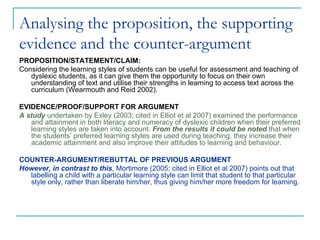
PROPOSITION/STATEMENT/CLAIM:

Considering the learning styles of students can be useful for assessment
  and teaching of dyslexic students, as it can give them the opportunity to
  focus on their own understanding of text and utilise their strengths in
  learning to access text across the curriculum (Wearmouth and Reid
  2002).

EVIDENCE/PROOF/SUPPORT FOR ARGUMENT

A study undertaken by Exley (2003; cited in Elliot et al 2007) examined the
   performance and attainment in both literacy and numeracy of dyslexic
   children when their preferred learning styles are taken into account.
   From the results it could be noted that when the students’ preferred
   learning styles are used during teaching, they increase their academic
   attainment and also improve their attitudes to learning and behaviour.
Building an argument 3
Considering the learning styles of students can be useful for
  assessment and teaching of dyslexic students, as it can give
  them the opportunity to focus on their own understanding of text
  and utilise their strengths in learning to access text across the
  curriculum (Wearmouth and Reid 2002). A study undertaken by
  Exley (2003; cited in Elliot et al 2007) examined the performance
  and attainment in both literacy and numeracy of dyslexic children
  when their preferred learning styles are taken into account. From
  the results it could be noted that when the students’ preferred
  learning styles are used during teaching, they increase their
  academic attainment and also improve their attitudes to learning
  and behaviour. However, in contrast to this, Mortimore (2005;
  cited in Elliot et al 2007) points out that labelling a child with a
  particular learning style can limit that student to that particular
  style only, rather than liberate him/her, thus giving him/her more
  freedom for learning.
Analysing the proposition, the supporting
evidence and the counter-argument
PROPOSITION/STATEMENT/CLAIM:
Considering the learning styles of students can be useful for assessment and teaching of
   dyslexic students, as it can give them the opportunity to focus on their own
   understanding of text and utilise their strengths in learning to access text across the
   curriculum (Wearmouth and Reid 2002).

EVIDENCE/PROOF/SUPPORT FOR ARGUMENT
A study undertaken by Exley (2003; cited in Elliot et al 2007) examined the performance
   and attainment in both literacy and numeracy of dyslexic children when their preferred
   learning styles are taken into account. From the results it could be noted that when
   the students’ preferred learning styles are used during teaching, they increase their
   academic attainment and also improve their attitudes to learning and behaviour.

COUNTER-ARGUMENT/REBUTTAL OF PREVIOUS ARGUMENT
However, in contrast to this, Mortimore (2005; cited in Elliot et al 2007) points out that
  labelling a child with a particular learning style can limit that student to that particular
  style only, rather than liberate him/her, thus giving him/her more freedom for learning.
What counts as evidence?

   Studies by published researchers
   Logical reasoning providing plausible
    explanations
   Statistics
   Practitioner-based observation or experiential
    ‘data’
   Results/data from your own research
   ????
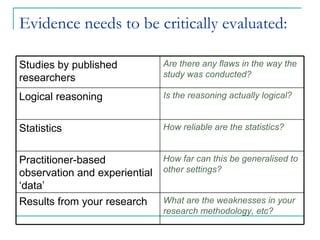
Evidence needs to be critically evaluated:

Studies by published           Are there any flaws in the way the
researchers                    study was conducted?

Logical reasoning              Is the reasoning actually logical?


Statistics                     How reliable are the statistics?


Practitioner-based             How far can this be generalised to
observation and experiential   other settings?
‘data’
Results from your research     What are the weaknesses in your
                               research methodology, etc?
Some further questions regarding
argument?
   What else counts as ‘evidence’ in an argument in education?

   ‘However’ is a connecting word which can be used to introduce a
    counter-argument as it means ‘but’. What other connecting words
    can be used to show the logical relationships between different
    parts of an argument?

   How can one build an argument throughout an entire essay or
    dissertation?


   ?????????????????
Self-assessment:
I have you been aware of the need to include
argument in my academic assignments up to now?
   A) Yes
   B) No


   Well done. Consider now how you
  can refine your arguments to include
    more convincing evidence. Also,                    Do you want to review the
  how you can link the different parts
                     Your answer:                         presentation again?
     of an argument more logically
                together?You answered thisthis question
                      You did not answer
                                            correctly!
                     The correct answer is:
                                  completely                        Submit         Clear
Quiz

       Your Score {score}


       Max Score {max-score}


 Number of Quiz {total-attempts}
     Attempts


          Question Feedback/Review Information Will
                        Appear Here


                                                      Continue   Review Quiz

Argument in MA Assignments

  • 1.
    Constructing an argumentin MA assignments Gillian Lazar Academic Writing and Language (AWL) Learner Development Unit G.Lazar@mdx.ac.uk
  • 2.
  • 3.
    Aims of thistalk  To explain briefly what is meant by ‘argument’ in academic writing  To provide an example of a typical academic argument  To pose some further questions about argument
  • 4.
    What is anargument in academic writing? Statement/ Proposition/ Claim Supporting evidence Supporting evidence Supporting evidence
  • 5.
    Building an argument1 Considering the learning styles of students can be useful for assessment and teaching of dyslexic students, as it can give them the opportunity to focus on their own understanding of text and utilise their strengths in learning to access text across the curriculum (Wearmouth and Reid 2002).
  • 6.
    Building an argument2 Considering the learning styles of students can be useful for assessment and teaching of dyslexic students, as it can give them the opportunity to focus on their own understanding of text and utilise their strengths in learning to access text across the curriculum (Wearmouth and Reid 2002). A study undertaken by Exley (2003; cited in Elliot et al 2007) examined the performance and attainment in both literacy and numeracy of dyslexic children when their preferred learning styles are taken into account. From the results it could be noted that when the students’ preferred learning styles are used during teaching, they increase their academic attainment and also improve their attitudes to learning and behaviour.
  • 7.
    Analysing the propositionand the supporting evidence PROPOSITION/STATEMENT/CLAIM: Considering the learning styles of students can be useful for assessment and teaching of dyslexic students, as it can give them the opportunity to focus on their own understanding of text and utilise their strengths in learning to access text across the curriculum (Wearmouth and Reid 2002). EVIDENCE/PROOF/SUPPORT FOR ARGUMENT A study undertaken by Exley (2003; cited in Elliot et al 2007) examined the performance and attainment in both literacy and numeracy of dyslexic children when their preferred learning styles are taken into account. From the results it could be noted that when the students’ preferred learning styles are used during teaching, they increase their academic attainment and also improve their attitudes to learning and behaviour.
  • 8.
    Building an argument3 Considering the learning styles of students can be useful for assessment and teaching of dyslexic students, as it can give them the opportunity to focus on their own understanding of text and utilise their strengths in learning to access text across the curriculum (Wearmouth and Reid 2002). A study undertaken by Exley (2003; cited in Elliot et al 2007) examined the performance and attainment in both literacy and numeracy of dyslexic children when their preferred learning styles are taken into account. From the results it could be noted that when the students’ preferred learning styles are used during teaching, they increase their academic attainment and also improve their attitudes to learning and behaviour. However, in contrast to this, Mortimore (2005; cited in Elliot et al 2007) points out that labelling a child with a particular learning style can limit that student to that particular style only, rather than liberate him/her, thus giving him/her more freedom for learning.
  • 9.
    Analysing the proposition,the supporting evidence and the counter-argument PROPOSITION/STATEMENT/CLAIM: Considering the learning styles of students can be useful for assessment and teaching of dyslexic students, as it can give them the opportunity to focus on their own understanding of text and utilise their strengths in learning to access text across the curriculum (Wearmouth and Reid 2002). EVIDENCE/PROOF/SUPPORT FOR ARGUMENT A study undertaken by Exley (2003; cited in Elliot et al 2007) examined the performance and attainment in both literacy and numeracy of dyslexic children when their preferred learning styles are taken into account. From the results it could be noted that when the students’ preferred learning styles are used during teaching, they increase their academic attainment and also improve their attitudes to learning and behaviour. COUNTER-ARGUMENT/REBUTTAL OF PREVIOUS ARGUMENT However, in contrast to this, Mortimore (2005; cited in Elliot et al 2007) points out that labelling a child with a particular learning style can limit that student to that particular style only, rather than liberate him/her, thus giving him/her more freedom for learning.
  • 10.
    What counts asevidence?  Studies by published researchers  Logical reasoning providing plausible explanations  Statistics  Practitioner-based observation or experiential ‘data’  Results/data from your own research  ????
  • 11.
    Evidence needs tobe critically evaluated: Studies by published Are there any flaws in the way the researchers study was conducted? Logical reasoning Is the reasoning actually logical? Statistics How reliable are the statistics? Practitioner-based How far can this be generalised to observation and experiential other settings? ‘data’ Results from your research What are the weaknesses in your research methodology, etc?
  • 12.
    Some further questionsregarding argument?  What else counts as ‘evidence’ in an argument in education?  ‘However’ is a connecting word which can be used to introduce a counter-argument as it means ‘but’. What other connecting words can be used to show the logical relationships between different parts of an argument?  How can one build an argument throughout an entire essay or dissertation?  ?????????????????
  • 13.
    Self-assessment: I have youbeen aware of the need to include argument in my academic assignments up to now? A) Yes B) No Well done. Consider now how you can refine your arguments to include more convincing evidence. Also, Do you want to review the how you can link the different parts Your answer: presentation again? of an argument more logically together?You answered thisthis question You did not answer correctly! The correct answer is: completely Submit Clear
  • 14.
    Quiz Your Score {score} Max Score {max-score} Number of Quiz {total-attempts} Attempts Question Feedback/Review Information Will Appear Here Continue Review Quiz

Editor's Notes

  • #2 Constructing an argument in MA assignments Hello, my name is Gillian Lazar and I am from the Learner Development Unit at Middlesex University. For those of you who haven’t met me before I am from the Academic Writing and English Language (ALD) team. My job is to support and help students in their academic writing development and English Language skills.
  • #3 Here is the web address for the LDU where you can find out what we do. You can also see my email address if you would like to contact me directly.
  • #4 This brief PowerPoint presentation aims to begin exploring the notion of argument, or argumentation, in academic writing. The concept of argument is key in all aspects of study at university, whether you are writing an assignment, participating in a seminar, reading the views of different theorists or conducting your own research. This presentation has three main aims, which can be seen on the slide. The presentation is intended only as a very brief introduction to the idea of argument, and we will be following this up with a much more in-depth discussion when I take the hot seat in a discussion board and you all have the chance to discuss your ideas.
  • #5 We begin by considering what exactly an argument in academic writing is. To put it very briefly, an argument can be thought of as a statement, a proposition or claim that you make in your writing, which you then back up or support with proof or evidence. In this diagram, there are three different pieces of supporting evidence, but in fact, there can be as many as you wish. One may even be sufficient, provided that this evidence or proof provides convincing and persuasive support for the claim that you are making. In the next few slides, we will see how this diagram translates into an actual piece of text from a student assignment.
  • #6 In this slide, we have a proposition or claim. The writer is putting forward an idea that has actually been advanced by two researchers Wearmouth and Reid. Note that the writer acknowledges that this statement or proposition is not necessarily his or her own idea, but had been advanced by others. Of course, you could be putting forward a claim, proposition or opinion that was yours only and therefore would not need to be supported with a reference. This proposition is the first part of argument, but it needs some supporting evidence to strengthen it in some way. Take a minute or two to consider what this evidence might be, before you move onto the next slide.
  • #7 In the next slide we have the proposition (in black), but this is followed by two sentences in blue. As you can see, these sentences describe a study which seems to lend support to the claim being made in the first sentence. Thus, an academic study is described which provides proof or support for the statement made at the beginning.
  • #8 We can break down the argument in the previous slide into two main parts. First, we have a proposition, statement or claim. Secondly, we have the evidence, proof or support for this argument. Notice how there are certain words in the second and third sentences which show a clear logical relationship between the proof and the statement. In particular, the phrase ‘from the results it could be noted that’ suggests a strong causal relationship between the evidence provided and the original proposition made at the beginning of the argument.  
  • #9 Interestingly, the writer of the argument we have just examined is not content with a proposition and its evidence. Have a look at the complete text on this slide, in particular the last sentence highlighted in navy blue. What is the purpose of this sentence and how does it relate to what has come before? Think about this before moving on to the next slide.
  • #10 The last sentence adds a counter-argument (what some people call a rebuttal) to what has already gone before. Thus, the word ‘however’ signals that the writer is introducing an idea which contradicts what has gone before. This idea of counter-argument is very important in academic writing and research as it suggests that different points of view have been considered, and that for every proposition that is advanced there may be a counter-proposition which contradicts it, or provided contrary evidence or proof. If possible, you should try to incorporate counter-arguments into your writing as they demonstrate that you have considered a topic from many different points of view.
  • #11 One issue which frequently comes up when considering argument is the nature of evidence. What counts as evidence varies widely from one subject or discipline to another. As you are studying for an MA in the field of education, you need to draw on proof or evidence which is regarded as valid in this field. This might include some of the different types of evidence mentioned on this slide. Of course, there may be other kinds of evidence, and I hope we will have a chance to consider these in our discussion board.
  • #12 Remember, of course, that all evidence needs to be critically evaluated so that we can assess how plausible, persuasive or convincing it is. On this slide, you can see some of the types of questions that you can ask yourself when assessing the validity of a particular piece of evidence
  • #13 As I said at the beginning of this presentation, this is just a brief introduction to the idea of argument. Argument should be present in all your academic assignments, whether they are essays, work for a portfolio or a full-length dissertation. On this slide, you can see some further questions to consider in this area. I look forward to discussing these with you in the hot seat, and hope to see you then.