




PREPARED BY: Mr. Ronald Macanip Quileste, M.Ed
Problem-
solving items
*
Problem-solvingitems
This kind of test item
is classified as a
subjective type of
item due to the
procedures used to
score item responses.
Problem-solvingitems
Instructors can assign full
or partial credit to either
correct or incorrect
solutions depending on
the quality and kind of
work procedures
presented.
Problem-solvingitems
Advantages:
• minimize guessing by requiring the
students to provide an original
response rather than to select
from several alternatives.
• are easier to construct than are
multiple-choice or matching
items.
Problem-solvingitems
Advantages:
• can most appropriately measure
learning objectives which focus on
the ability to apply skills or knowledge
in the solution of problems.
• can measure an extensive amount of
content or a large number of
learning objectives.
Problem-solvingitems
Limitations:
• generally provide low test and low scorer
reliability.
• require an extensive amount of instructor time
to read and grade.
• generally do not provide an objective measure
of student achievement or ability (subject to
bias on the part of the grader when partial
credit is given).
1
Clearly identify and
explain the problem
1 Clearly identify and explain the problem
Undesirable: During a car crash, the car slows down at
the rate of 490 m/sec2. What is the magnitude and
direction of the force acting on a 100-kg driver?
Desirable: During a car crash, the car slows down at the
rate of 490 m/sec2. Using the car as a frame of
reference, what is the magnitude and direction of the
gram force acting on a 100-kg driver?
2
Provide directions which
clearly inform the student
of the type of response
called for
2 Provide directions which clearly inform the
student of the type of response called for
Undesirable: An American tourist in Paris finds
that he weighs 70 kilograms. When he left the
United States he weighed 144 pounds. What was
his net change in weight?
Desirable: An American tourist in Paris finds that
he weighs 70 kilograms. When he left the United
States he weighed 144 pounds. What was his net
weight change in pounds?
3
State in the directions whether
or not the student must show
his/her work procedures for
full or partial credit
3
State in the directions whether or not the student must
show his/her work procedures for full or partial credit
Undesirable: A double concave lens is made of glass
with n = 1.50. If the radii of curvature of the two lens
surfaces are both 30.0 cm, what is the focal length of
the lens?
Desirable: A double concave lens is made of glass with
n = 1.50. If the radii of curvature of the two lens
surfaces are both 30.0 cm, what is the focal length of
the lens? Show your work to receive full or partial
credit.
4
Clearly separate item parts and
indicate their point values. Decide
in advance how incorrect answers
in earlier steps of a problem will
affect the score on later steps
4
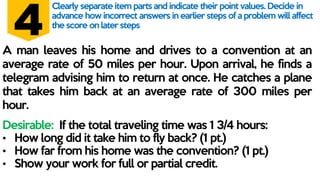
Clearly separate item parts and indicate their point values. Decide in
advance how incorrect answers in earlier steps of a problem will affect
the score on later steps
A man leaves his home and drives to a convention at an
average rate of 50 miles per hour. Upon arrival, he finds a
telegram advising him to return at once. He catches a plane
that takes him back at an average rate of 300 miles per
hour.
4
Clearly separate item parts and indicate their point values. Decide in
advance how incorrect answers in earlier steps of a problem will affect
the score on later steps
A man leaves his home and drives to a convention at an
average rate of 50 miles per hour. Upon arrival, he finds a
telegram advising him to return at once. He catches a plane
that takes him back at an average rate of 300 miles per
hour.
Undesirable: If the total traveling time was 1 3/4 hours, how
long did it take him to fly back? How far from his home was
the convention?
4
Clearly separate item parts and indicate their point values. Decide in
advance how incorrect answers in earlier steps of a problem will affect
the score on later steps
A man leaves his home and drives to a convention at an
average rate of 50 miles per hour. Upon arrival, he finds a
telegram advising him to return at once. He catches a plane
that takes him back at an average rate of 300 miles per
hour.
Desirable: If the total traveling time was 1 3/4 hours:
• How long did it take him to fly back? (1 pt.)
• How far from his home was the convention? (1 pt.)
• Show your work for full or partial credit.
5
Use figures, conditions
and situations which
create a realistic problem
5
Use figures, conditions and situations which create a realistic
problem
Undesirable: An automobile weighing 2,840 N (about
640 pounds) is traveling at a speed of 300 miles per
hour. What is the car's kinetic energy? Show your
work. (2 pts.)
Desirable: An automobile weighing 14,200 N (about
3200 pounds) is traveling at a speed of 12m/sec. What
is the car's kinetic energy? Show your work. (2 pts.)
6
Ask questions that elicit responses
on which experts could agree that
one solution and one or more
work procedures are better than
others
7
Work through each problem
before classroom
administration to double-check
accuracy
Egypt
Increase
objectivity
IN PROBLEM – SOLVING SCORING
5 Ways to
Score
blind
Read one
question
at a time
Avoid
Halo
effects
Provide a
scoring
plan or
attribute
Have a policy
on irrelevant
answers,
errors
WRITE-SHOP
Write a 2-item Problem-Solving Test
1. Construct a sample/model answer.
2. Specify the attributes to be scored and the
number of points for each attribute.
3. Identify the level of thinking required in each
item based on Bloom’s taxonomy.
WRITE-SHOP
Present your work
Namaste!
references
Raagas, Ester L . (2010). Assessment and Evaluation of Student
Learning: Concepts and Applications (3rd edition) by Ester L.
Raagas, ELR DATStat Analysis Center, Cagayan de Oro
City.
http://www.utexas.edu/academic/mec/research/pdf/oldhtmlfiles/m
ultichoiceexamhandout.html
http://web.utk.edu/~mccay/apdm/plan/plan_b.htm

How to Create Problem Solving Test Items

  • 1.
    PREPARED BY: Mr.Ronald Macanip Quileste, M.Ed
  • 2.
  • 4.
    Problem-solvingitems This kind oftest item is classified as a subjective type of item due to the procedures used to score item responses.
  • 5.
    Problem-solvingitems Instructors can assignfull or partial credit to either correct or incorrect solutions depending on the quality and kind of work procedures presented.
  • 6.
    Problem-solvingitems Advantages: • minimize guessingby requiring the students to provide an original response rather than to select from several alternatives. • are easier to construct than are multiple-choice or matching items.
  • 7.
    Problem-solvingitems Advantages: • can mostappropriately measure learning objectives which focus on the ability to apply skills or knowledge in the solution of problems. • can measure an extensive amount of content or a large number of learning objectives.
  • 8.
    Problem-solvingitems Limitations: • generally providelow test and low scorer reliability. • require an extensive amount of instructor time to read and grade. • generally do not provide an objective measure of student achievement or ability (subject to bias on the part of the grader when partial credit is given).
  • 10.
  • 11.
    1 Clearly identifyand explain the problem Undesirable: During a car crash, the car slows down at the rate of 490 m/sec2. What is the magnitude and direction of the force acting on a 100-kg driver? Desirable: During a car crash, the car slows down at the rate of 490 m/sec2. Using the car as a frame of reference, what is the magnitude and direction of the gram force acting on a 100-kg driver?
  • 12.
    2 Provide directions which clearlyinform the student of the type of response called for
  • 14.
    2 Provide directionswhich clearly inform the student of the type of response called for Undesirable: An American tourist in Paris finds that he weighs 70 kilograms. When he left the United States he weighed 144 pounds. What was his net change in weight? Desirable: An American tourist in Paris finds that he weighs 70 kilograms. When he left the United States he weighed 144 pounds. What was his net weight change in pounds?
  • 15.
    3 State in thedirections whether or not the student must show his/her work procedures for full or partial credit
  • 16.
    3 State in thedirections whether or not the student must show his/her work procedures for full or partial credit Undesirable: A double concave lens is made of glass with n = 1.50. If the radii of curvature of the two lens surfaces are both 30.0 cm, what is the focal length of the lens? Desirable: A double concave lens is made of glass with n = 1.50. If the radii of curvature of the two lens surfaces are both 30.0 cm, what is the focal length of the lens? Show your work to receive full or partial credit.
  • 17.
    4 Clearly separate itemparts and indicate their point values. Decide in advance how incorrect answers in earlier steps of a problem will affect the score on later steps
  • 18.
    4 Clearly separate itemparts and indicate their point values. Decide in advance how incorrect answers in earlier steps of a problem will affect the score on later steps A man leaves his home and drives to a convention at an average rate of 50 miles per hour. Upon arrival, he finds a telegram advising him to return at once. He catches a plane that takes him back at an average rate of 300 miles per hour.
  • 19.
    4 Clearly separate itemparts and indicate their point values. Decide in advance how incorrect answers in earlier steps of a problem will affect the score on later steps A man leaves his home and drives to a convention at an average rate of 50 miles per hour. Upon arrival, he finds a telegram advising him to return at once. He catches a plane that takes him back at an average rate of 300 miles per hour. Undesirable: If the total traveling time was 1 3/4 hours, how long did it take him to fly back? How far from his home was the convention?
  • 20.
    4 Clearly separate itemparts and indicate their point values. Decide in advance how incorrect answers in earlier steps of a problem will affect the score on later steps A man leaves his home and drives to a convention at an average rate of 50 miles per hour. Upon arrival, he finds a telegram advising him to return at once. He catches a plane that takes him back at an average rate of 300 miles per hour. Desirable: If the total traveling time was 1 3/4 hours: • How long did it take him to fly back? (1 pt.) • How far from his home was the convention? (1 pt.) • Show your work for full or partial credit.
  • 21.
    5 Use figures, conditions andsituations which create a realistic problem
  • 22.
    5 Use figures, conditionsand situations which create a realistic problem Undesirable: An automobile weighing 2,840 N (about 640 pounds) is traveling at a speed of 300 miles per hour. What is the car's kinetic energy? Show your work. (2 pts.) Desirable: An automobile weighing 14,200 N (about 3200 pounds) is traveling at a speed of 12m/sec. What is the car's kinetic energy? Show your work. (2 pts.)
  • 23.
    6 Ask questions thatelicit responses on which experts could agree that one solution and one or more work procedures are better than others
  • 25.
    7 Work through eachproblem before classroom administration to double-check accuracy
  • 26.
  • 27.
    Increase objectivity IN PROBLEM –SOLVING SCORING 5 Ways to
  • 28.
  • 29.
  • 30.
  • 31.
  • 32.
    Have a policy onirrelevant answers, errors
  • 33.
  • 34.
    Write a 2-itemProblem-Solving Test 1. Construct a sample/model answer. 2. Specify the attributes to be scored and the number of points for each attribute. 3. Identify the level of thinking required in each item based on Bloom’s taxonomy. WRITE-SHOP
  • 35.
  • 37.
  • 38.
    references Raagas, Ester L. (2010). Assessment and Evaluation of Student Learning: Concepts and Applications (3rd edition) by Ester L. Raagas, ELR DATStat Analysis Center, Cagayan de Oro City. http://www.utexas.edu/academic/mec/research/pdf/oldhtmlfiles/m ultichoiceexamhandout.html http://web.utk.edu/~mccay/apdm/plan/plan_b.htm