CIRCLES
Made by :- Amit choube
Class :- 10th ‘ B ’
Introduction
In this power point presentation we will discuss about
• Circle and its related terms .
• Concepts of perimeter and area of a circle .
• Finding the areas of two special parts of a circular region known as sector and segment .
• Finding the areas of some combinations of plane figures involving circles or their parts .
Contents
 Circle and its related terms .
 Area of a circle .
Areas related to circle .
 Perimeter of a circle .
 Sector of a circle and its area .
 Segment of a circle and its area
 Areas of combinations of plane figures .
Circle – Definition
The collection of all the points in a plane which
are at a fixed distance from in the plane is
called a circle .
or
A circle is a locus of a point which moves in a
plane in such a way that its distance from a
fixed point always remains same.
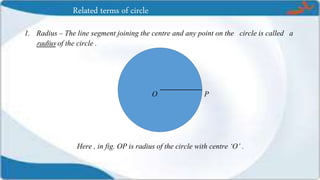
1. Radius – The line segment joining the centre and any point on the circle is called a
radius of the circle .
O P
Here , in fig. OP is radius of the circle with centre ‘O’ .
Related terms of circle
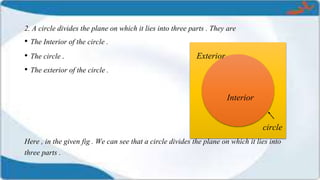
2. A circle divides the plane on which it lies into three parts . They are
• The Interior of the circle .
• The circle . Exterior
• The exterior of the circle .
Interior
circle
Here , in the given fig . We can see that a circle divides the plane on which it lies into
three parts .
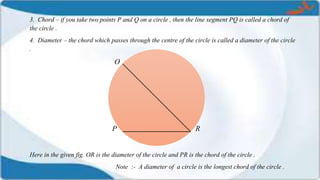
3. Chord – if you take two points P and Q on a circle , then the line segment PQ is called a chord of
the circle .
4. Diameter – the chord which passes through the centre of the circle is called a diameter of the circle
.
O
P R
Here in the given fig. OR is the diameter of the circle and PR is the chord of the circle .
Note :- A diameter of a circle is the longest chord of the circle .
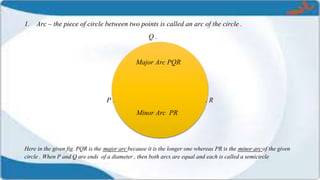
1. Arc – the piece of circle between two points is called an arc of the circle .
Q .
Major Arc PQR
P . . R
Minor Arc PR
Here in the given fig. PQR is the major arc because it is the longer one whereas PR is the minor arc of the given
circle . When P and Q are ends of a diameter , then both arcs are equal and each is called a semicircle
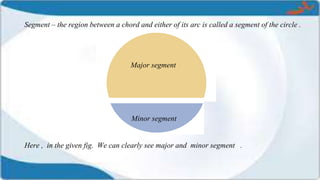
Segment – the region between a chord and either of its arc is called a segment of the circle .
Major segment
Minor segment
Here , in the given fig. We can clearly see major and minor segment .
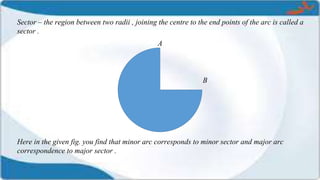
Sector – the region between two radii , joining the centre to the end points of the arc is called a
sector .
A
B
Here in the given fig. you find that minor arc corresponds to minor sector and major arc
correspondence to major sector .
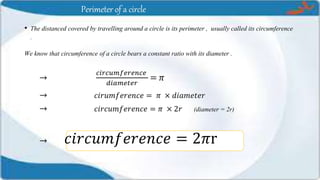
Perimeter of a circle
• The distanced covered by travelling around a circle is its perimeter , usually called its circumference
.
We know that circumference of a circle bears a constant ratio with its diameter .
→
𝑐𝑖𝑟𝑐𝑢𝑚𝑓𝑒𝑟𝑒𝑛𝑐𝑒
𝑑𝑖𝑎𝑚𝑒𝑡𝑒𝑟
= 𝜋
→ 𝑐𝑖𝑟𝑢𝑚𝑓𝑒𝑟𝑒𝑛𝑐𝑒 = 𝜋 × 𝑑𝑖𝑎𝑚𝑒𝑡𝑒𝑟
→ 𝑐𝑖𝑟𝑐𝑢𝑚𝑓𝑒𝑟𝑒𝑛𝑐𝑒 = 𝜋 × 2𝑟 (diameter = 2r)
→ 𝑐𝑖𝑟𝑐𝑢𝑚𝑓𝑒𝑟𝑒𝑛𝑐𝑒 = 2𝜋r
Area of a circle
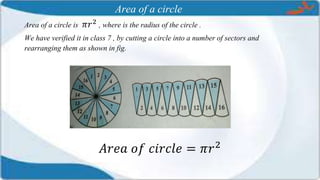
Area of a circle is 𝜋𝑟2 , where is the radius of the circle .
We have verified it in class 7 , by cutting a circle into a number of sectors and
rearranging them as shown in fig.
𝐴𝑟𝑒𝑎 𝑜𝑓 𝑐𝑖𝑟𝑐𝑙𝑒 = 𝜋𝑟2
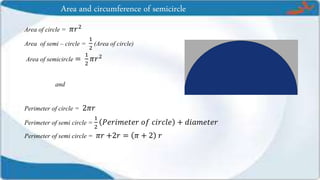
Area and circumference of semicircle
Area of circle = 𝜋𝑟2
Area of semi – circle =
1
2
(Area of circle)
Area of semicircle =
1
2
𝜋𝑟2
and
Perimeter of circle = 2𝜋𝑟
Perimeter of semi circle =
1
2
𝑃𝑒𝑟𝑖𝑚𝑒𝑡𝑒𝑟 𝑜𝑓 𝑐𝑖𝑟𝑐𝑙𝑒 + 𝑑𝑖𝑎𝑚𝑒𝑡𝑒𝑟
Perimeter of semi circle = 𝜋𝑟 +2𝑟 = 𝜋 + 2 𝑟
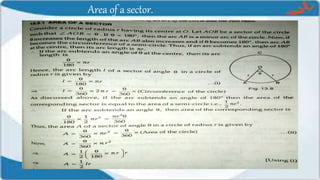
Area of a sector .
Following are some important points to remember
1. A minor sector has an angle 𝜃 , (say) , subtended at the centre of the circle ,
whereas a major sector has no angle .
2. The sum of arcs of major and minor sectors of a circle is equal to the circumference
of the circle .
3. The sum of the areas of major and minor sectors of a circle is equal to the areas of
the circle .
4. The boundary of a sector consists of an arc of the circle and the two radii .
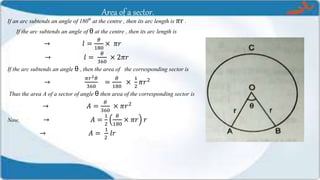
If an arc subtends an angle of 180° at the centre , then its arc length is 𝜋r .
If the arc subtends an angle of θ at the centre , then its arc length is
→ 𝑙 =
𝜃
180
× 𝜋𝑟
→ 𝑙 =
𝜃
360
× 2𝜋𝑟
If the arc subtends an angle θ , then the area of the corresponding sector is
→
𝜋𝑟2 𝜃
360
=
𝜃
180
×
1
2
𝜋𝑟2
Thus the area A of a sector of angle θ then area of the corresponding sector is
→ 𝐴 =
𝜃
360
× 𝜋𝑟2
Now, → 𝐴 =
1
2
𝜃
180
× 𝜋𝑟 𝑟
→ 𝐴 =
1
2
𝑙𝑟
Area of a sector.
Area of a sector.
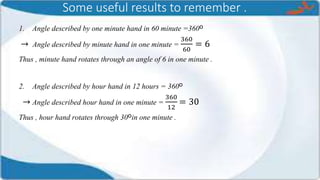
Some useful results to remember .
1. Angle described by one minute hand in 60 minute =360 ͦ
→ Angle described by minute hand in one minute =
360
60
= 6
Thus , minute hand rotates through an angle of 6 in one minute .
2. Angle described by hour hand in 12 hours = 360 ͦ
→ Angle described hour hand in one minute =
360
12
= 30
Thus , hour hand rotates through 30 ͦ in one minute .
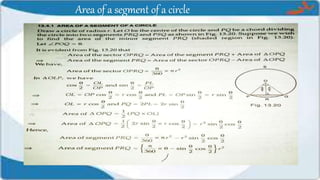
Area of a segment of a circle
Thank you

Areas related to Circles - class 10 maths

  • 1.
    CIRCLES Made by :-Amit choube Class :- 10th ‘ B ’
  • 2.
    Introduction In this powerpoint presentation we will discuss about • Circle and its related terms . • Concepts of perimeter and area of a circle . • Finding the areas of two special parts of a circular region known as sector and segment . • Finding the areas of some combinations of plane figures involving circles or their parts .
  • 3.
    Contents  Circle andits related terms .  Area of a circle . Areas related to circle .  Perimeter of a circle .  Sector of a circle and its area .  Segment of a circle and its area  Areas of combinations of plane figures .
  • 4.
    Circle – Definition Thecollection of all the points in a plane which are at a fixed distance from in the plane is called a circle . or A circle is a locus of a point which moves in a plane in such a way that its distance from a fixed point always remains same.
  • 5.
    1. Radius –The line segment joining the centre and any point on the circle is called a radius of the circle . O P Here , in fig. OP is radius of the circle with centre ‘O’ . Related terms of circle
  • 6.
    2. A circledivides the plane on which it lies into three parts . They are • The Interior of the circle . • The circle . Exterior • The exterior of the circle . Interior circle Here , in the given fig . We can see that a circle divides the plane on which it lies into three parts .
  • 7.
    3. Chord –if you take two points P and Q on a circle , then the line segment PQ is called a chord of the circle . 4. Diameter – the chord which passes through the centre of the circle is called a diameter of the circle . O P R Here in the given fig. OR is the diameter of the circle and PR is the chord of the circle . Note :- A diameter of a circle is the longest chord of the circle .
  • 8.
    1. Arc –the piece of circle between two points is called an arc of the circle . Q . Major Arc PQR P . . R Minor Arc PR Here in the given fig. PQR is the major arc because it is the longer one whereas PR is the minor arc of the given circle . When P and Q are ends of a diameter , then both arcs are equal and each is called a semicircle
  • 9.
    Segment – theregion between a chord and either of its arc is called a segment of the circle . Major segment Minor segment Here , in the given fig. We can clearly see major and minor segment .
  • 10.
    Sector – theregion between two radii , joining the centre to the end points of the arc is called a sector . A B Here in the given fig. you find that minor arc corresponds to minor sector and major arc correspondence to major sector .
  • 11.
    Perimeter of acircle • The distanced covered by travelling around a circle is its perimeter , usually called its circumference . We know that circumference of a circle bears a constant ratio with its diameter . → 𝑐𝑖𝑟𝑐𝑢𝑚𝑓𝑒𝑟𝑒𝑛𝑐𝑒 𝑑𝑖𝑎𝑚𝑒𝑡𝑒𝑟 = 𝜋 → 𝑐𝑖𝑟𝑢𝑚𝑓𝑒𝑟𝑒𝑛𝑐𝑒 = 𝜋 × 𝑑𝑖𝑎𝑚𝑒𝑡𝑒𝑟 → 𝑐𝑖𝑟𝑐𝑢𝑚𝑓𝑒𝑟𝑒𝑛𝑐𝑒 = 𝜋 × 2𝑟 (diameter = 2r) → 𝑐𝑖𝑟𝑐𝑢𝑚𝑓𝑒𝑟𝑒𝑛𝑐𝑒 = 2𝜋r
  • 12.
    Area of acircle Area of a circle is 𝜋𝑟2 , where is the radius of the circle . We have verified it in class 7 , by cutting a circle into a number of sectors and rearranging them as shown in fig. 𝐴𝑟𝑒𝑎 𝑜𝑓 𝑐𝑖𝑟𝑐𝑙𝑒 = 𝜋𝑟2
  • 13.
    Area and circumferenceof semicircle Area of circle = 𝜋𝑟2 Area of semi – circle = 1 2 (Area of circle) Area of semicircle = 1 2 𝜋𝑟2 and Perimeter of circle = 2𝜋𝑟 Perimeter of semi circle = 1 2 𝑃𝑒𝑟𝑖𝑚𝑒𝑡𝑒𝑟 𝑜𝑓 𝑐𝑖𝑟𝑐𝑙𝑒 + 𝑑𝑖𝑎𝑚𝑒𝑡𝑒𝑟 Perimeter of semi circle = 𝜋𝑟 +2𝑟 = 𝜋 + 2 𝑟
  • 14.
    Area of asector . Following are some important points to remember 1. A minor sector has an angle 𝜃 , (say) , subtended at the centre of the circle , whereas a major sector has no angle . 2. The sum of arcs of major and minor sectors of a circle is equal to the circumference of the circle . 3. The sum of the areas of major and minor sectors of a circle is equal to the areas of the circle . 4. The boundary of a sector consists of an arc of the circle and the two radii .
  • 15.
    If an arcsubtends an angle of 180° at the centre , then its arc length is 𝜋r . If the arc subtends an angle of θ at the centre , then its arc length is → 𝑙 = 𝜃 180 × 𝜋𝑟 → 𝑙 = 𝜃 360 × 2𝜋𝑟 If the arc subtends an angle θ , then the area of the corresponding sector is → 𝜋𝑟2 𝜃 360 = 𝜃 180 × 1 2 𝜋𝑟2 Thus the area A of a sector of angle θ then area of the corresponding sector is → 𝐴 = 𝜃 360 × 𝜋𝑟2 Now, → 𝐴 = 1 2 𝜃 180 × 𝜋𝑟 𝑟 → 𝐴 = 1 2 𝑙𝑟 Area of a sector.
  • 16.
    Area of asector.
  • 17.
    Some useful resultsto remember . 1. Angle described by one minute hand in 60 minute =360 ͦ → Angle described by minute hand in one minute = 360 60 = 6 Thus , minute hand rotates through an angle of 6 in one minute . 2. Angle described by hour hand in 12 hours = 360 ͦ → Angle described hour hand in one minute = 360 12 = 30 Thus , hour hand rotates through 30 ͦ in one minute .
  • 18.
    Area of asegment of a circle
  • 19.