MATHS PROJECT
TOPIC
CIRCLES
M
.RAMKI
INTRODUCTION
You may have come across many object in daily life,
which are round in shape, such as wheels of a
vehicle, clocks, coins, buttons of a shirt, etc. In a
clock, the second’s hand goes round the dial of the
clock rapidly and its tip moves in a round path. This
path traced by the tip of the second’s hand is called
a CIRCLE.
Circles and Its Related Terms
Definition :
The collection of all the points in a plane, which are at a fixed
distance froma fixed point in the plain, is calleda circle.
The fixed point is called the centre of the
circle and the fixed distance is called the
radius of the circle.
A circle divides the plain on which it lies into
three parts . They are :
(i) Inside the circle, which is also called the
interior of the circle.
(ii) The circle.
(iii)Outside the circle, which is also called the
exterior of the circle.
The circle and its interior make up the circular
region.
The upcoming activities will make you
know more about the TERMS and
DEFINITIONS related to CIRCLES.
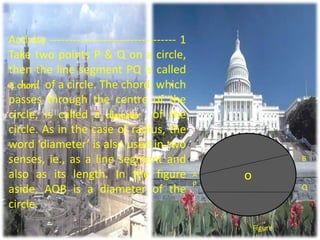
Activity --------------------------------- 1
Take two points P & Q on a circle,
then the line segment PQ is called
a chord of a circle. The chord, which
passes through the centre of the
circle, is called a diameter of the
circle. As in the case of radius, the
word ‘diameter’ is also used in two
senses, ie., as a line segment and
also as its length. In the figure
aside, AOB is a diameter of the
circle.
o
Figure
A
P
B
Q
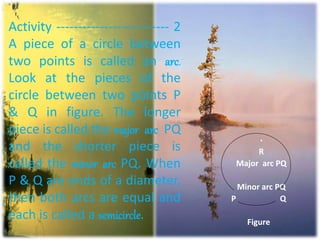
Activity -------------------------- 2
A piece of a circle between
two points is called an arc.
Look at the pieces of the
circle between two points P
& Q in figure. The longer
piece is called the major arc PQ
and the shorter piece is
called the minor arc PQ. When
P & Q are ends of a diameter,
then both arcs are equal and
each is called a semicircle.
.
R
Major arc PQ
Minor arc PQ
P Q
Figure
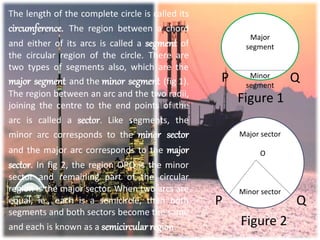
The length of the complete circle is called its
circumference. The region between a chord
and either of its arcs is called a segment of
the circular region of the circle. There are
two types of segments also, which are the
major segment and the minor segment (fig 1).
The region between an arc and the two radii,
joining the centre to the end points of the
arc is called a sector. Like segments, the
minor arc corresponds to the minor sector
and the major arc corresponds to the major
sector. In fig 2, the region OPQ is the minor
sector and remaining part of the circular
region is the major sector. When two arcs are
equal, ie., each is a semicircle, then both
segments and both sectors become the same
and each is known as a semicircularregion.
P Q
Figure 1
P Q
Figure 2
Major
segment
Minor
segment
Major sector
O
Minor sector
Angle Subtended by a Chord at a
Point
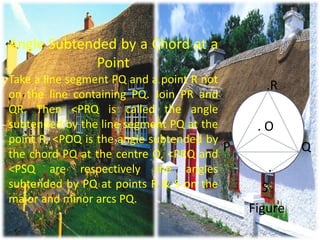
Take a line segment PQ and a point R not
on the line containing PQ. Join PR and
QR. Then <PRQ is called the angle
subtended by the line segment PQ at the
point R. <POQ is the angle subtended by
the chord PQ at the centre O, <PRQ and
<PSQ are respectively the angles
subtended by PQ at points R & S on the
major and minor arcs PQ.
.R
. O
P Q
.
S
Figure
THEOREMS OF CIRCLES
SOME OF THE THEOREMS WHICH YOU
WILL BE SEEING IN THE FOLLOWING
SLIDES WILL MAKE YOU UNDERSTAND
MORE ABOUT CIRCLES.
Theorem - 1
Equal chords of a circle
subtend equal angles at the
centre.
Theorem - 2
If the angle subtended by
the chords of a circle at
the centre are equal, then
the chords are equal.
Theorem - 3
The perpendicular from the
centre of a circle to a
chord bisects the chord.
Theorem - 4
The line drawn through
the centre of a circle
to bisect a chord is
perpendicular to the chord.
Theorem - 5
There is one and only one
circle passing through three
given non-collinear points.
Theorem - 6
Equal chords of a circle
(or of congruent circles ) are
equidistant from the centre.
Theorem - 7
Chords equidistant from
the centre of a circle
are equal in length.
Theorem - 8
The angle subtended by
an arc at the centre is
double the angle subtended
by it at any point on the
remaining part of the
circle.
Theorem - 9
Angles in the same
segment of a circle are
equal.
Theorem - 10
If a line segment joining two
points subtends equal angles at
two other points lying on the
same side of the line
containing the line segment,
the four points lie on a
circle, ie., they are concyclic.
Theorem - 11
The sum of either pair
of opposite angles of a
cyclic quadrilateral is 180°.
Theorem - 12
If the sum of a pair of
opposite angles of a
quadrilateral is 180°, the
quadrilateral is cyclic.
A JOKE ON CIRCLES
THERE IS A JOKE ON CIRCLES WHICH IS
VERY INTERESTING.
I THINK YOU ALL WILL
LIKE IT
AND
ENJOY IT.
HAVE YOU ALL SEEN A BILLIARDS GAME, THE BALL USED
IN IT IS CIRCLE IN SHAPE. I THINK YOU ALL KNOW THIS,
BUT HAVE YOU SEEN A HEN PLAYING IT WITHOUT A STICK.
DO YOU WANT TO SEE IT ?
COME LET’S TAKE A LOOK AT IT.
Circles - Maths project

Circles - Maths project

  • 1.
  • 2.
    INTRODUCTION You may havecome across many object in daily life, which are round in shape, such as wheels of a vehicle, clocks, coins, buttons of a shirt, etc. In a clock, the second’s hand goes round the dial of the clock rapidly and its tip moves in a round path. This path traced by the tip of the second’s hand is called a CIRCLE.
  • 3.
    Circles and ItsRelated Terms Definition : The collection of all the points in a plane, which are at a fixed distance froma fixed point in the plain, is calleda circle. The fixed point is called the centre of the circle and the fixed distance is called the radius of the circle.
  • 4.
    A circle dividesthe plain on which it lies into three parts . They are : (i) Inside the circle, which is also called the interior of the circle. (ii) The circle. (iii)Outside the circle, which is also called the exterior of the circle. The circle and its interior make up the circular region.
  • 5.
    The upcoming activitieswill make you know more about the TERMS and DEFINITIONS related to CIRCLES.
  • 6.
    Activity --------------------------------- 1 Taketwo points P & Q on a circle, then the line segment PQ is called a chord of a circle. The chord, which passes through the centre of the circle, is called a diameter of the circle. As in the case of radius, the word ‘diameter’ is also used in two senses, ie., as a line segment and also as its length. In the figure aside, AOB is a diameter of the circle. o Figure A P B Q
  • 7.
    Activity -------------------------- 2 Apiece of a circle between two points is called an arc. Look at the pieces of the circle between two points P & Q in figure. The longer piece is called the major arc PQ and the shorter piece is called the minor arc PQ. When P & Q are ends of a diameter, then both arcs are equal and each is called a semicircle. . R Major arc PQ Minor arc PQ P Q Figure
  • 8.
    The length ofthe complete circle is called its circumference. The region between a chord and either of its arcs is called a segment of the circular region of the circle. There are two types of segments also, which are the major segment and the minor segment (fig 1). The region between an arc and the two radii, joining the centre to the end points of the arc is called a sector. Like segments, the minor arc corresponds to the minor sector and the major arc corresponds to the major sector. In fig 2, the region OPQ is the minor sector and remaining part of the circular region is the major sector. When two arcs are equal, ie., each is a semicircle, then both segments and both sectors become the same and each is known as a semicircularregion. P Q Figure 1 P Q Figure 2 Major segment Minor segment Major sector O Minor sector
  • 9.
    Angle Subtended bya Chord at a Point Take a line segment PQ and a point R not on the line containing PQ. Join PR and QR. Then <PRQ is called the angle subtended by the line segment PQ at the point R. <POQ is the angle subtended by the chord PQ at the centre O, <PRQ and <PSQ are respectively the angles subtended by PQ at points R & S on the major and minor arcs PQ. .R . O P Q . S Figure
  • 10.
    THEOREMS OF CIRCLES SOMEOF THE THEOREMS WHICH YOU WILL BE SEEING IN THE FOLLOWING SLIDES WILL MAKE YOU UNDERSTAND MORE ABOUT CIRCLES.
  • 11.
    Theorem - 1 Equalchords of a circle subtend equal angles at the centre.
  • 12.
    Theorem - 2 Ifthe angle subtended by the chords of a circle at the centre are equal, then the chords are equal.
  • 13.
    Theorem - 3 Theperpendicular from the centre of a circle to a chord bisects the chord.
  • 14.
    Theorem - 4 Theline drawn through the centre of a circle to bisect a chord is perpendicular to the chord.
  • 15.
    Theorem - 5 Thereis one and only one circle passing through three given non-collinear points.
  • 16.
    Theorem - 6 Equalchords of a circle (or of congruent circles ) are equidistant from the centre.
  • 17.
    Theorem - 7 Chordsequidistant from the centre of a circle are equal in length.
  • 18.
    Theorem - 8 Theangle subtended by an arc at the centre is double the angle subtended by it at any point on the remaining part of the circle.
  • 19.
    Theorem - 9 Anglesin the same segment of a circle are equal.
  • 20.
    Theorem - 10 Ifa line segment joining two points subtends equal angles at two other points lying on the same side of the line containing the line segment, the four points lie on a circle, ie., they are concyclic.
  • 21.
    Theorem - 11 Thesum of either pair of opposite angles of a cyclic quadrilateral is 180°.
  • 22.
    Theorem - 12 Ifthe sum of a pair of opposite angles of a quadrilateral is 180°, the quadrilateral is cyclic.
  • 23.
    A JOKE ONCIRCLES THERE IS A JOKE ON CIRCLES WHICH IS VERY INTERESTING. I THINK YOU ALL WILL LIKE IT AND ENJOY IT.
  • 24.
    HAVE YOU ALLSEEN A BILLIARDS GAME, THE BALL USED IN IT IS CIRCLE IN SHAPE. I THINK YOU ALL KNOW THIS, BUT HAVE YOU SEEN A HEN PLAYING IT WITHOUT A STICK. DO YOU WANT TO SEE IT ? COME LET’S TAKE A LOOK AT IT.