NEWLY AVAILABLE
COPD
MEDICATIONS
Ryan Lally,YuryViknevich
Overview
2
• Background on Chronic Obstructive Pulmonary Disorder (COPD)
• Long Acting Muscarinic Antagonists (LAMA)
• Drug Monographs
• Clinical Evidence
• Cost
• Recommendation
• Long Acting Muscarinic Antagonists / LongActing Beta 2 Agonists
(LAMA/LABA) combinations
• Drug Monographs
• Clinical Review/evidence
• Cost
• Recommendation
• Summary
• References
• Questions/Comments
Chronic Obstructive Pulmonary Disorder
(COPD)
• Symptoms / Presentation:
• Dyspnea, chronic cough, and chronic sputum production
• Onset in mid-life
• Progressive
• History of tobacco smoking or exposure to other types of smoke
• Diagnosis
• Spirometry reading of FEV1/FVC < 0.7  confirms presence of airflow
limitation and thus COPD
• COPD costs healthcare systems 50 billion dollars per year in the United
States
3
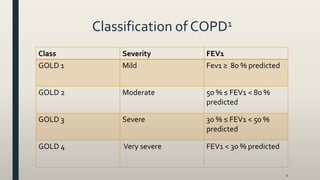
Classification of COPD1
Class Severity FEV1
GOLD 1 Mild Fev1 ≥ 80 % predicted
GOLD 2 Moderate 50 % ≤ FEV1 < 80 %
predicted
GOLD 3 Severe 30 % ≤ FEV1 < 50 %
predicted
GOLD 4 Very severe FEV1 < 30 % predicted
4
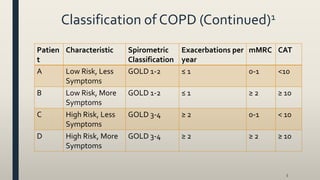
Classification of COPD (Continued)1
Patien
t
Characteristic Spirometric
Classification
Exacerbations per
year
mMRC CAT
A Low Risk, Less
Symptoms
GOLD 1-2 ≤ 1 0-1 <10
B Low Risk, More
Symptoms
GOLD 1-2 ≤ 1 ≥ 2 ≥ 10
C High Risk, Less
Symptoms
GOLD 3-4 ≥ 2 0-1 < 10
D High Risk, More
Symptoms
GOLD 3-4 ≥ 2 ≥ 2 ≥ 10
5
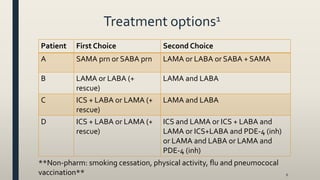
Treatment options1
Patient First Choice Second Choice
A SAMA prn or SABA prn LAMA or LABA or SABA + SAMA
B LAMA or LABA (+
rescue)
LAMA and LABA
C ICS + LABA or LAMA (+
rescue)
LAMA and LABA
D ICS + LABA or LAMA (+
rescue)
ICS and LAMA or ICS + LABA and
LAMA or ICS+LABA and PDE-4 (inh)
or LAMA and LABA or LAMA and
PDE-4 (inh)
6
**Non-pharm: smoking cessation, physical activity, flu and pneumococal
vaccination**
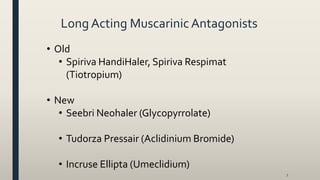
Long Acting Muscarinic Antagonists
• Old
• Spiriva HandiHaler, Spiriva Respimat
(Tiotropium)
• New
• Seebri Neohaler (Glycopyrrolate)
• Tudorza Pressair (Aclidinium Bromide)
• Incruse Ellipta (Umeclidium)
7
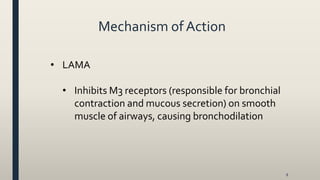
Mechanism of Action
• LAMA
• Inhibits M3 receptors (responsible for bronchial
contraction and mucous secretion) on smooth
muscle of airways, causing bronchodilation
8
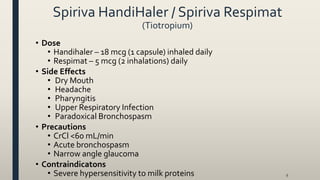
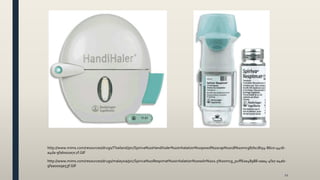
Spiriva HandiHaler / Spiriva Respimat
(Tiotropium)
• Dose
• Handihaler – 18 mcg (1 capsule) inhaled daily
• Respimat – 5 mcg (2 inhalations) daily
• Side Effects
• Dry Mouth
• Headache
• Pharyngitis
• Upper Respiratory Infection
• Paradoxical Bronchospasm
• Precautions
• CrCl <60 mL/min
• Acute bronchospasm
• Narrow angle glaucoma
• Contraindicatons
• Severe hypersensitivity to milk proteins 9
Spiriva Handihaler, Spiriva Respimat
(Tiotropium)
10
• Pregnancy/Lactation
• Category C
• Risk Cannot be ruled out
• Pharmacokinetics
• Tmax: 5-7 minutes
• Oxidation followed by glutathione conjugation (25% CYP2D6 and
CYP3A4)
• Half Life: 5-6 days (powder); 25 hours (Spray)
• Drug-Drug Interactions
• Oxymorphone (Paralytic Ileus)
• Bupropion / Donepezil (Seizure threshold)
• Anticholinergics (Side effects)
11
http://www.mims.com/resources/drugs/Thailand/pic/Spiriva%20Handihaler%20inhalation%20powd%20cap%2018%20mcg87bcdb54-86c0-4416-
a4da-9fab001e7c2f.GIF
http://www.mims.com/resources/drugs/malaysia/pic/Spiriva%20Respimat%20inhalation%20soln%202.5%20mcg_puff61e48988-0aa4-4fa7-a4ab-
9faa0009e53f.GIF
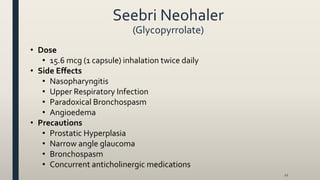
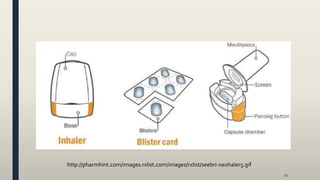
Seebri Neohaler
(Glycopyrrolate)
• Dose
• 15.6 mcg (1 capsule) inhalation twice daily
• Side Effects
• Nasopharyngitis
• Upper Respiratory Infection
• Paradoxical Bronchospasm
• Angioedema
• Precautions
• Prostatic Hyperplasia
• Narrow angle glaucoma
• Bronchospasm
• Concurrent anticholinergic medications
12
Seebri Neohaler
(Glycopyrrolate)
13
• Pregnancy/Lactation
• Category C
• Infant risk Cannot be ruled out
• Pharmacokinetics
• Tmax: 5 minutes
• Oxidation and Hydrolysis in Liver
• Half Life: 33-53 hours
• Drug – Drug Interactions
• Potassium (GI lesions)
• Oxymorphone (Paralytic Ileus)
• Bupropion / Donepezil (Seizure threshold)
• Anticholinergics (Side effects)
14
http://pharmhint.com/images.rxlist.com/images/rxlist/seebri-neohaler5.gif
Efficacy and Safety ofTwice-Daily
GlycopyrrolateVersus Placebo in Patients
with COPD:The GEM2 Study2
15
Edward Kerwin,Thomas M. Siler, Phillip Korenblat, et al.
COPD Foundation
9 December 2015
Methods
16
• 12-week multicenter, randomized, double-blind, parallel-group, placebo
controlled study of 432 patients
• Wash out period of 1-7 days
• Run-in period of 2 weeks
• 12 week randomization
• 30 day safety follow-up
• Primary objective: demonstrate the superiority of glycopyrrolate 15.6 mcg
bid compared with placebo for FEV1 AUC0-12 h at 12 weeks
• Exclusion: history of asthma and COPD exacerbation needing ABX, PO/IV
corticosteroids, and/or hospitalization within 6 weeks before/during
screening
Results
17
• Seebri Neohaler showed statistically significant improvement
in FEV1 and St. George Respiratory Questionnaire (SGRQ) at 12
weeks vs placebo
• Seebri Neohaler showed statistically significant decrease in
rescue haler usage vs placebo
• No statistical decrease inTotal Dyspnea Index (TDI) between
Seebri Neohaler vs placebo
• No difference in serious adverse events between Seebri
Neohaler and placebo
• Most common were COPD exacerbation, atrial fibrilation,
QTC elongation
• Increased mild/moderate adverse events with Seebri Neohaler
Tudorza Pressair
(Aclidinium Bromide)
• Dose
• 400 mcg (1 puff/inhalation) twice daily
• Side Effects
• Nasopharyngitis/ Headache/Cough
• Upper Respiratory Infection
• Paradoxical Bronchospasm
• Precautions
• Urinary Retention
• Narrow angle glaucoma
• Bronchospasm
• Contraindicatons
• Severe hypersensitivity to milk proteins 18
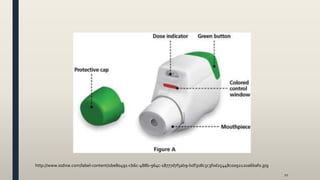
Tudorza Pressair
(Aclidinium Bromide)
19
• Pregnancy/Lactation
• Category C
• Infant risk Cannot be ruled out
• Pharmacokinetics
• Tmax: 10 minutes
• Hydralysis via esterases
• Half Life: 5-8 hours
• Drug-Drug Interactions
• Bupropion/Donepezil (Seizure threshold)
• Anticholinergics (side effects)
20
http://www.iodine.com/label-content/0be80491-cb6c-488b-964c-18777d7f5ab9-bdf308c5c3f0d25448c0092120a6baf0.jpg
Efficacy and Safety of Aclidinium Bromide
compared with Placebo andTiotropium in
Patients with Moderate-to-Severe Chronic
Obstructive Pulmonary Disease: Results
from a 6 week, Randomized, Controlled
Phase IIIb Study3
21
Jutta Beir,Anne-Marie Kirste, et al.
COPD: Journal of Chronic Obstructive Pulmonary Disease
July/02/2013
Methods
22
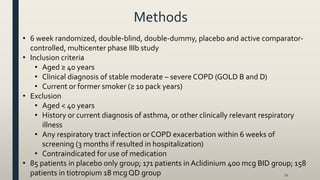
• 6 week randomized, double-blind, double-dummy, placebo and active comparator-
controlled, multicenter phase IIIb study
• Inclusion criteria
• Aged ≥ 40 years
• Clinical diagnosis of stable moderate – severe COPD (GOLD B and D)
• Current or former smoker (≥ 10 pack years)
• Exclusion
• Aged < 40 years
• History or current diagnosis of asthma, or other clinically relevant respiratory
illness
• Any respiratory tract infection orCOPD exacerbation within 6 weeks of
screening (3 months if resulted in hospitalization)
• Contraindicated for use of medication
• 85 patients in placebo only group; 171 patients in Aclidinium 400 mcg BID group; 158
patients in tiotropium 18 mcg QD group
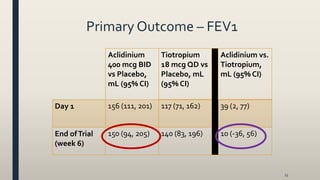
Primary Outcome – FEV1
23
Aclidinium
400 mcg BID
vs Placebo,
mL (95% CI)
Tiotropium
18 mcg QD vs
Placebo, mL
(95% CI)
Aclidinium vs.
Tiotropium,
mL (95% CI)
Day 1 156 (111, 201) 117 (71, 162) 39 (2, 77)
End ofTrial
(week 6)
150 (94, 205) 140 (83, 196) 10 (-36, 56)
Results
24
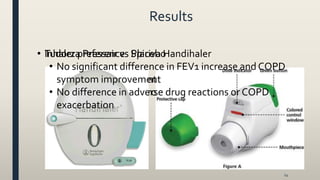
• Tudorza Pressair vs Placebo
• There was a significant difference in FEV1 increase and
COPD symptom improvement
• Tudorza Pressair vs Spiriva Handihaler
• No significant difference in FEV1 increase and COPD
symptom improvement
• No difference in adverse drug reactions or COPD
exacerbation
• Inhaler preference
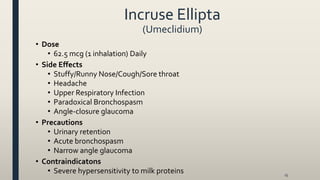
Incruse Ellipta
(Umeclidium)
• Dose
• 62.5 mcg (1 inhalation) Daily
• Side Effects
• Stuffy/Runny Nose/Cough/Sore throat
• Headache
• Upper Respiratory Infection
• Paradoxical Bronchospasm
• Angle-closure glaucoma
• Precautions
• Urinary retention
• Acute bronchospasm
• Narrow angle glaucoma
• Contraindicatons
• Severe hypersensitivity to milk proteins 25
Incruse Ellipta
(Umeclidium)
26
• Pregnancy/Lactation
• Category C
• Risk Cannot be ruled out
• Pharmacokinetics
• Tmax: 5-15 minutes
• Oxidation followed by conjugation (substrate of CYP2D6)
• Half Life: 11 hours
• Drug-Drug Interactions
• Oxymorphone (Paralytic Ileus)
• Bupropion / Donepezil (Seizure threshold)
• Anticholinergics (Side effects)
27
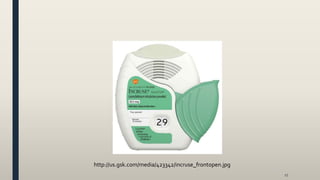
http://us.gsk.com/media/423342/incruse_frontopen.jpg
A randomized, blinded study to evaluate the
efficacy and safety of Umeclidinium 62.5
mcg compared withTiotropium 18 mcg in
patients with COPD4
28
Gregory Feldman, François Maltais, et al.
International Journal of COPD
April/7/2016
Methods
29
• 12 week, multicenter, randomized, blinded, double dummy, parallel-group study
• Inclusion
• ≥ 40 years old with diagnosis of COPD
• Current or former smoker (10+ pack year history)
• Patient B or D
• Exclusion
• Pregnancy
• Asthma/other significant respiratory disorder/condition effecting respiratory
function
• Lung volume reduction surgery
• Hospitalization forCOPD/pneumonia within 12 weeks prior to visit 1
• 509 patients in experimental group; 508 patients in control group
Primary Outcome –Trough FEV1Value
30
Day 2 28 56 84 85
Drug Umec Tio Umec Tio Umec Tio Umec Tio Umec Tio
n 469 471 453 454 425 432 402 420 392 416
Mean Change from
baseline (mL) [SE]
103
[±8]
91 [±8] 144
[±10]
102
[±10]
136
[±11]
89
[±11]
142
[±11]
86
[±11]
154
[±11]
95 [±11]
Difference vsTio
(mL)
[95% CI]
13 [-9,35] N/A 42
[14,69]
N/A 46
[17,76]
N/A 56
[26,85]
N/A 59
[29,88]
N/A
P -Value 0.254 0.003 0.002 <0.001 <0.001
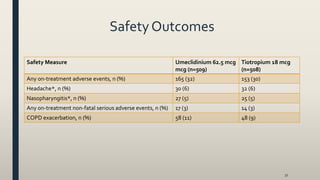
Safety Outcomes
31
Safety Measure Umeclidinium 62.5 mcg
mcg (n=509)
Tiotropium 18 mcg
(n=508)
Any on-treatment adverse events, n (%) 165 (32) 153 (30)
Headache*, n (%) 30 (6) 32 (6)
Nasopharyngitis*, n (%) 27 (5) 25 (5)
Any on-treatment non-fatal serious adverse events, n (%) 17 (3) 14 (3)
COPD exacerbation, n (%) 58 (11) 48 (9)
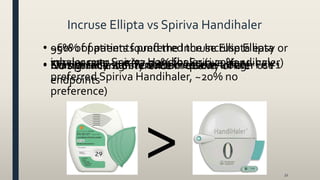
Incruse Ellipta vs Spiriva Handihaler
32
• Statistically significant increase in trough FEV1• No significant difference in quality of life
endpoints
• No significant difference in rescue inhaler use
• ~60% of patients preferred the Incruse Ellipta
inhaler over Spiriva Handihaler (~20%
preferred Spiriva Handihaler, ~20% no
preference)
• Comparable safety outcomes
>
• 95% of patients found the Incruse Ellipta easy or
very easy to use (77-79% for Spiriva Handihaler)
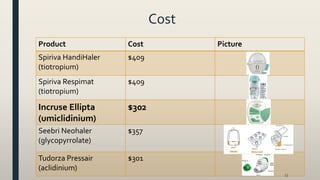
Cost
33
Product Cost Picture
Spiriva HandiHaler
(tiotropium)
$409
Spiriva Respimat
(tiotropium)
$409
Incruse Ellipta
(umiclidinium)
$302
Seebri Neohaler
(glycopyrrolate)
$357
Tudorza Pressair
(aclidinium)
$301
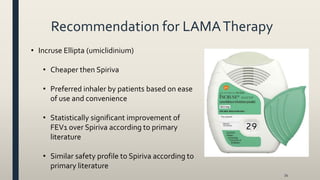
Recommendation for LAMATherapy
34
• Incruse Ellipta (umiclidinium)
• Cheaper then Spiriva
• Preferred inhaler by patients based on ease
of use and convenience
• Statistically significant improvement of
FEV1 over Spiriva according to primary
literature
• Similar safety profile to Spiriva according to
primary literature
New LAMA/LABA Combination Medications
■ Umeclidinium Bromide/VilanterolTrifenatate -- (Anoro Ellipta)
■ Glycopyrrolate/Indacaterol -- (Utibron Neohaler)
■ Tiotropium Bromide/Olodaterol -- (Stiolto Respimat)
35
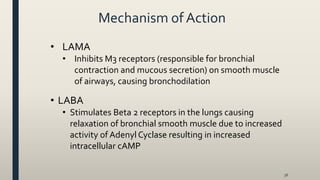
Mechanism of Action
• LAMA
• Inhibits M3 receptors (responsible for bronchial
contraction and mucous secretion) on smooth muscle
of airways, causing bronchodilation
• LABA
• Stimulates Beta 2 receptors in the lungs causing
relaxation of bronchial smooth muscle due to increased
activity of Adenyl Cyclase resulting in increased
intracellular cAMP
36
Anoro (Ellipta Umeclidinium
Bromide/VilanterolTrifenatate)
■ Dose
– 62.5 mcg / 25 mcg (1 inhalation) daily
■ Side Effects
– Pharyngitis
– Chest Pain
– Spasm
– Lower Respiratory Infection
■ Precautions
– Arrhythmias
– Urinary Retention
– Bronchospasm
■ Contraindicatons
– Severe hypersensitivity to milk proteins 37
Anoro Ellipta
■ Pharmacokinetics
– Umeclidium
■ TMAX = 5-15 minutes
■ Extensive metabolism by liver (CYP2D6)
■ Half Life: 11 hours
– Vilanterol
■ Tmax: 5-15 minutes
■ Extensive metabolism by liver (CYP3A4)
■ Half Life: 11 hours
■ Drug – Drug Interactions
– QTC elongating drugs
– CYP3A4 inhibitors
38
39
http://us.gsk.com/media/154065/anoro_frontdevice_closed_mr20final.jpg
Utibron Neohaler
(Glycopyrrolate/Indacaterol)
• Dose
• 15.6 mcg/27.5 mcg (1 capsule) inhaled twice daily
• Side Effects
• Nasopharyngitis/Pneumonia
• Hypertension
• Back Pain
• Diarrhea,GERD
• Headache
• Precautions
• Arrhythmias
• Uncontrolled hypertension
• Urinary retention/CrCl < 30 mL/min
40
Utibron Neohaler
■ Pregnancy/Lactation
– Category C
■ Pharmacokinetics
– Glycopyrrolate:
■ Tmax: 5 minutes
■ Metabolized via multiple CYP enzymes
■ Half Life: 33-53 hours
– Indacterol:
■ Tmax: 15 minutes
■ Metabolized by CYP3A4 and UGT1A1
■ Half Life: 40-56 hours
41
42
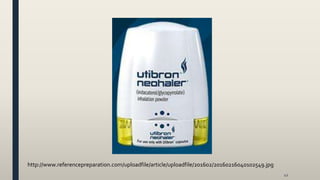
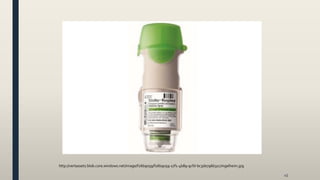
http://www.referencepreparation.com/uploadfile/article/uploadfile/201602/20160216040102549.jpg
Stiolto Respimat(Tiotropium
Bromide/Olodaterol)
• Dose
• 5 mcg / 5 mcg (2 inhalation) daily
• Side Effects
• Nasopharyngitis
• Back Pain
• Angle-closure glaucoma (worsening)
• Pneumonia
• Urinary Retention
• Precautions
• Angle-closure glaucoma
• Urinary Retention
• Bronchospasm
• CrCl <60 mL/min (increased anticholinergic)
43
Stiolto Respimat
■ Contraindicatons
– Severe hypersensitivity to milk proteins
■ Pharmacokinetics
– Tiotropium:
■ Tmax: 5-7 minutes
■ Metablized CYP2D6, 3A4
■ Half life – 25 hours
– Olodaterol:
■ Tmax: 10-20 minutes
■ Metabolized by CYP2C9, 2C8, UGT2B7, 1A1, 1A7, 1A9
■ Half life 45 hours
44
45
http://vertassets.blob.core.windows.net/image/f26b9059/f26b9059-17f1-4b89-9cfd-bc3de796b31c/ingelheim.jpg
Black BoxWarning – LABA class
• “Use of long-acting beta 2-adrenergic agonists
(LABAs) increases the risk of asthma-related
death.”
• None of these medications have been approved
for use in asthma
46
Efficacy and safety of LABA/LAMA fixed-
dose combinations approved in the US for
the management of COPD5
47
Donald Banerji, Donald A. Mahler, and Nicola A. Hanania
Taylor & Francis Group
30 May 2016
Methods
48
• FLIGHT1/2 were replicate, 12 week, multicenter, randomized, double-blind, parallel-group,
placebo-controlled, and active-controlled studies of 2038 patients with moderate to severe COPD
• Compared indacterol (IND)/glycopyrrolate (GLY)27.5/15.6 mcg bid with it mono-components
and placebo
• DB2113373 was a 12- or 24- week, randomized, double-blind, placebo-controlled, and/or active
controlled trials of 1532 patients with moderate to very severe COPD
• Compared umeclidinium (UMEC)/vilanterol (VI) 62.5/25 mcg qd with it mono-components
and placebo
• TOnado 1/2 52-week, multicenter, randomized, active-controlled studies of 5162 patients with
moderate to very severe COPD
• Compared tiotropium (Tio)/olodaterol (Olo) 5/5 mcg qd andTio/Olo 2.5/5 mcg qd vs mono-
components in patients
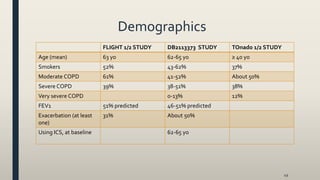
Demographics
49
FLIGHT 1/2 STUDY DB2113373 STUDY TOnado 1/2 STUDY
Age (mean) 63 yo 62-65 yo ≥ 40 yo
Smokers 52% 43-62% 37%
Moderate COPD 61% 41-52% About 50%
Severe COPD 39% 38-51% 38%
Very severe COPD 0-13% 12%
FEV1 51% predicted 46-51% predicted
Exacerbation (at least
one)
31% About 50%
Using ICS, at baseline 62-65 yo
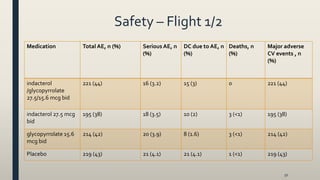
Safety – Flight 1/2
50
Medication Total AE, n (%) Serious AE, n
(%)
DC due to AE, n
(%)
Deaths, n
(%)
Major adverse
CV events , n
(%)
indacterol
/glycopyrrolate
27.5/15.6 mcg bid
221 (44) 16 (3.2) 15 (3) 0 221 (44)
indacterol 27.5 mcg
bid
195 (38) 18 (3.5) 10 (2) 3 (<1) 195 (38)
glycopyrrolate 15.6
mcg bid
214 (42) 20 (3.9) 8 (1.6) 3 (<1) 214 (42)
Placebo 219 (43) 21 (4.1) 21 (4.1) 1 (<1) 219 (43)
Results Flight 1/2
51
• indacterol /glycopyrrolate 27.5/15.6 mcg bid significantly
improved FEV1 AUC0-12 h at week 12 vs mono-components
[103 mL (indacterol 24.8 mcg bid) and 88 mL
(glycopyrrolate 15.6 mcg bid), respectively; all p<0.001]
• indacterol /glycopyrrolate 27.5/15.6 mcg bid significantly improved breathlessness at week 12
• Improvement exceeded the minimal clinically important difference (MCID) of 1.64 according to transition dyspnea
index (TDI) unit vs placebo [p<0.001]
• indacterol /glycopyrrolate mcg bid provided a statistically significant and clinically meaningful improvement in health-
related quality of life vs indacterol 24.8 mcg bid and glycopyrrolate 15.6 mcg bid (1.7 [p=0.019] and 1.5 [p=0.033]unit
improvement according to St. George's respiratory questionnaire (SGRQ), respectively)
• indacterol /glycopyrrolate mcg bid significantly reduced rescue medication use over 12 weeks vs indacterol 24.8 mcg
bid and glycopyrrolate 15.6 mcg bid by 0.33 and 0.5 puffs/day [p<0.05], respectively
Results
• indacterol /glycopyrrolate 27.5/15.6 mcg bid significantly improved FEV1AUC0-12 h at week 12 vs mono-components [103 mL (indacterol 24.8 mcg
bid) and 88 mL (glycopyrrolate 15.6 mcg bid), respectively; all p<0.001]
• indacterol /glycopyrrolate 27.5/15.6 mcg bid significantly
improved breathlessness at week 12
• Improvement exceeded the minimal clinically important
difference (MCID) of 1.64 according to transition dyspnea index
(TDI) unit vs placebo [p<0.001]
• indacterol /glycopyrrolate mcg bid provided a statistically significant and clinically meaningful improvement in health-related
quality of life vs indacterol 24.8 mcg bid and glycopyrrolate 15.6 mcg bid (1.7 [p=0.019] and 1.5 [p=0.033]unit improvement
according to St. George's respiratory questionnaire (SGRQ), respectively)
• indacterol /glycopyrrolate mcg bid significantly reduced rescue medication use over 12 weeks vs indacterol 24.8 mcg bid and
glycopyrrolate 15.6 mcg bid by 0.33 and 0.5 puffs/day [p<0.05], respectively
52
Results
• indacterol /glycopyrrolate 27.5/15.6 mcg bid significantly improved FEV1 AUC0-12 h at week 12 vs mono-components [103 mL (indacterol 24.8 mcg bid) and 88
mL (glycopyrrolate 15.6 mcg bid), respectively; all p<0.001]
• indacterol /glycopyrrolate 27.5/15.6 mcg bid significantly improved breathlessness at week 12
• Improvement exceeded the minimal clinically important difference (MCID) of 1.64 according to transition dyspnea index (TDI) unit vs placebo [p<0.001]
• indacterol /glycopyrrolate mcg bid provided a statistically
significant and clinically meaningful improvement in health-
related quality of life vs indacterol 24.8 mcg bid and
glycopyrrolate 15.6 mcg bid (1.7 [p=0.019] and 1.5 [p=0.033]unit
improvement according to St. George's respiratory questionnaire
(SGRQ), respectively)
• indacterol /glycopyrrolate mcg bid significantly reduced rescue medication use over 12 weeks vs indacterol 24.8 mcg bid and glycopyrrolate
15.6 mcg bid by 0.33 and 0.5 puffs/day [p<0.05], respectively
53
Results
• indacterol /glycopyrrolate 27.5/15.6 mcg bid significantly improved FEV1AUC0-12 h at week 12 vs mono-components [103 mL (indacterol 24.8 mcg
bid) and 88 mL (glycopyrrolate 15.6 mcg bid), respectively; all p<0.001]
• indacterol /glycopyrrolate 27.5/15.6 mcg bid significantly improved breathlessness at week 12
• Improvement exceeded the minimal clinically important difference (MCID) of 1.64 according to transition dyspnea index (TDI) unit vs placebo
[p<0.001]
• indacterol /glycopyrrolate mcg bid provided a statistically significant and clinically meaningful improvement in health-related quality of life vs
indacterol 24.8 mcg bid and glycopyrrolate 15.6 mcg bid (1.7 [p=0.019] and 1.5 [p=0.033]unit improvement according to St. George's respiratory
questionnaire (SGRQ), respectively)
• indacterol /glycopyrrolate mcg bid significantly reduced rescue
medication use over 12 weeks vs indacterol 24.8 mcg bid and
glycopyrrolate 15.6 mcg bid by 0.33 and 0.5 puffs/day [p<0.05],
respectively
54
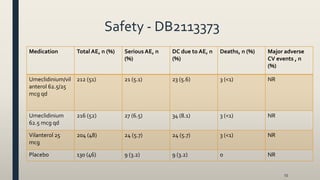
Safety - DB2113373
55
Medication Total AE, n (%) Serious AE, n
(%)
DC due to AE, n
(%)
Deaths, n (%) Major adverse
CV events , n
(%)
Umeclidinium/vil
anterol 62.5/25
mcg qd
212 (51) 21 (5.1) 23 (5.6) 3 (<1) NR
Umeclidinium
62.5 mcg qd
216 (52) 27 (6.5) 34 (8.1) 3 (<1) NR
Vilanterol 25
mcg
204 (48) 24 (5.7) 24 (5.7) 3 (<1) NR
Placebo 130 (46) 9 (3.2) 9 (3.2) 0 NR
Results - DB2113373
56
• Umeclidinium/vilanterol 62.5/25 mcg qd significantly improved
trough FEV1 = 52 and 95 mL at week 24 compared with mono-
components (p=0.004 and p<0.001), respectively
• Umeclidinium/vilanterol 62.5/25 mcg qd improvedTDI total score at 24 weeks compared with mono-components (0.03 and 0.4 units, respectively
• Umeclidinium/vilanterol 62.5/25 mcg qd improved SGRQ total score compared with mono-components at 24 weeks (0.82 and 0.32 units, respectively)
• Umeclidinium/vilanterol 62.5/25 mcg qd reduced rescue medication use over 24 weeks compared with Umeclidinium 62.5 mcg qd (0.6 puffs/day
[p≤0.001]); however, increased use with vilanterol 25 mcg qd (0.1 puffs/day [p<0.05]
Result
• Umeclidinium/vilanterol 62.5/25 mcg qd significantly improved trough FEV1 = 52 and 95 mL at week 24
compared with mono-components (p=0.004 and p<0.001), respectively
• Umeclidinium/vilanterol 62.5/25 mcg qd
improvedTDI total score at 24 weeks compared
with mono-components (0.03 and 0.4 units,
respectively
• Umeclidinium/vilanterol 62.5/25 mcg qd improved SGRQ total score compared with mono-
components at 24 weeks (0.82 and 0.32 units, respectively)
• Umeclidinium/vilanterol 62.5/25 mcg qd reduced rescue medication use over 24 weeks
compared with Umeclidinium 62.5 mcg qd (0.6 puffs/day [p≤0.001]); however, increased use
with vilanterol 25 mcg qd (0.1 puffs/day [p<0.05]
57
Result
• Umeclidinium/vilanterol 62.5/25 mcg qd significantly improved trough FEV1 = 52 and 95 mL at week 24
compared with mono-components (p=0.004 and p<0.001), respectively
• Umeclidinium/vilanterol 62.5/25 mcg qd improvedTDI total score at 24 weeks compared with
mono-components (0.03 and 0.4 units, respectively
• Umeclidinium/vilanterol 62.5/25 mcg qd improved SGRQ
total score compared with mono-components at 24 weeks
(0.82 and 0.32 units, respectively)
• Umeclidinium/vilanterol 62.5/25 mcg qd reduced rescue medication use over 24 weeks
compared with Umeclidinium 62.5 mcg qd (0.6 puffs/day [p≤0.001]); however, increased use
with vilanterol 25 mcg qd (0.1 puffs/day [p<0.05]
58
Result
• Umeclidinium/vilanterol 62.5/25 mcg qd significantly improved trough FEV1 = 52 and
95 mL at week 24 compared with mono-components (p=0.004 and p<0.001),
respectively
• Umeclidinium/vilanterol 62.5/25 mcg qd improvedTDI total score at 24 weeks compared with
mono-components (0.03 and 0.4 units, respectively
• Umeclidinium/vilanterol 62.5/25 mcg qd improved SGRQ total score compared with mono-
components at 24 weeks (0.82 and 0.32 units, respectively)
• Umeclidinium/vilanterol 62.5/25 mcg qd reduced rescue
medication use over 24 weeks compared with
Umeclidinium 62.5 mcg qd (0.6 puffs/day [p≤0.001]);
however, increased with vilanterol 25 mcg qd (0.1
puffs/day [p<0.05] 59
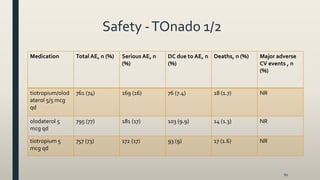
Safety -TOnado 1/2
60
Medication Total AE, n (%) Serious AE, n
(%)
DC due to AE, n
(%)
Deaths, n (%) Major adverse
CV events , n
(%)
tiotropium/olod
aterol 5/5 mcg
qd
761 (74) 169 (16) 76 (7.4) 18 (1.7) NR
olodaterol 5
mcg qd
795 (77) 181 (17) 103 (9.9) 14 (1.3) NR
tiotropium 5
mcg qd
757 (73) 172 (17) 93 (9) 17 (1.6) NR
Results -TOnado 1/2
• tiotropium/olodaterol 5/5 mcg qd significantly improved
both primary end points at 24 weeks compared with mono-
components (FEV1= 85 and 60 mL for olodaterol 5 mcg qd
and tiotropium 5 mcg qd, respectively [all p<0.001]
• tiotropium/olodaterol 5/5 mcg qd significantly improvedTDI score at week 24 compared with mono-components (0.42
units [p<0.005] and 0.36 units [p<0.05] vs olodaterol 5 mcg qd and tiotropium 5 mcg qd, respectively
• tiotropium/olodaterol 5/5 mcg qd significantly improved SGRQ total score compared with olodaterol 5 mcg qd and
tiotropium 5 mcg qd (1.7 units [p<0.01] and 1.2 [p<0.05], respectively)
• tiotropium/olodaterol 5/5 mcg qd reduced the weekly mean daily (24 h) rescue medication use vs the mono-
components throughout the 52 week treatment, but no values or statistical analysis has been reported
61
Results
• tiotropium/olodaterol 5/5 mcg qd significantly improved both primary end points and 24 weeks compared with mono-components
(FEV1= 85 and 60 mL for olodaterol 5 mcg qd and tiotropium 5 mcg qd, respectively [all p<0.001]
• tiotropium/olodaterol 5/5 mcg qd significantly improvedTDI
score at week 24 compared with mono-components (0.42 units
[p<0.005] and 0.36 units [p<0.05] vs olodaterol 5 mcg qd and
tiotropium 5 mcg qd, respectively
• tiotropium/olodaterol 5/5 mcg qd significantly improved SGRQ total score compared with olodaterol 5 mcg qd and
tiotropium 5 mcg qd (1.7 units [p<0.01] and 1.2 [p<0.05], respectively)
• tiotropium/olodaterol 5/5 mcg qd reduced the weekly mean daily (24 h) rescue medication use vs the mono-
components throughout the 52 week treatment, but no values or statistical analysis has been reported
62
Results
• tiotropium/olodaterol 5/5 mcg qd significantly improved both primary end points and 24 weeks compared with mono-components (FEV1= 85 and 60
mL for olodaterol 5 mcg qd and tiotropium 5 mcg qd, respectively [all p<0.001]
• tiotropium/olodaterol 5/5 mcg qd significantly improvedTDI score at week 24 compared with mono-components (0.42 units [p<0.005] and 0.36 units
[p<0.05] vs olodaterol 5 mcg qd and tiotropium 5 mcg qd, respectively
• tiotropium/olodaterol 5/5 mcg qd significantly improved SGRQ
total score compared with olodaterol 5 mcg qd and tiotropium 5
mcg qd (1.7 units [p<0.01] and 1.2 units [p<0.05], respectively)
• tiotropium/olodaterol 5/5 mcg qd reduced the weekly mean daily (24 h) rescue medication use vs the mono-components throughout the 52 week
treatment, but no values or statistical analysis has been reported
63
Results
• tiotropium/olodaterol 5/5 mcg qd significantly improved both primary end points and 24 weeks compared with mono-components
(FEV1= 85 and 60 mL for olodaterol 5 mcg qd and tiotropium 5 mcg qd, respectively [all p<0.001]
• tiotropium/olodaterol 5/5 mcg qd significantly improvedTDI score at week 24 compared with mono-components (0.42 units
[p<0.005] and 0.36 units [p<0.05] vs olodaterol 5 mcg qd and tiotropium 5 mcg qd, respectively
• tiotropium/olodaterol 5/5 mcg qd significantly improved SGRQ total score compared with olodaterol 5 mcg qd and tiotropium 5
mcg qd (1.7 units [p<0.01] and 1.2 [p<0.05], respectively)
• tiotropium/olodaterol 5/5 mcg qd reduced the weekly mean daily
(24 h) rescue medication use vs the mono-components
throughout the 52 week treatment, but no values or statistical
analysis has been reported
64
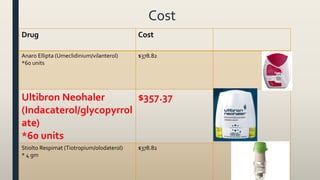
Cost
65
Drug Cost
Anaro Ellipta (Umeclidinium/vilanterol)
*60 units
$378.82
Ultibron Neohaler
(Indacaterol/glycopyrrol
ate)
*60 units
$357.37
Stiolto Respimat (Tiotropium/olodaterol)
* 4 gm
$378.82
Recommendations
66
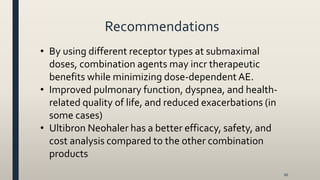
• By using different receptor types at submaximal
doses, combination agents may incr therapeutic
benefits while minimizing dose-dependentAE.
• Improved pulmonary function, dyspnea, and health-
related quality of life, and reduced exacerbations (in
some cases)
• Ultibron Neohaler has a better efficacy, safety, and
cost analysis compared to the other combination
products
Summary
67
• Incruse Ellipta has shown similar efficacy and
safety to Spiriva Handihaler for less cost and
increased favorability/convenience
• Ultibron Neohaler has a better efficacy,
safety, and cost analysis compared to the
other combination products
References
68
1) Global Initiative for Chronic Obstructive Lung Disease (GOLD). Pocket Guide to COPD Diagnosis, Management,
and Prevention. Updated 2007 available at www.goldcopd.com
2) Edward Kerwin,Thomas M. Siler, Phillip Korenblat, et al. Efficacy and Safety ofTwice-Daily Glycopyrrolate
Versus Placebo in Patients with COPD:The GEM2 Study. COPD foundation. 9 December 2015; (3) 2; 549-559
3) Beier J, KirstenA, et al. Efficacy and Safety of Aclidinium Bromide Compared to Placebo andTiotropium in
Patients with Moderate-Severe Chronic Obstructive Pulmonary Disease: Results from a 6-Week, Randomized,
Controlled Phase liib Study. COPD: Journal of Chronic Obstructive Pulmonary Dusease. 02 Jul 2013. Available from
pubmed.
4) Feldman G, Maltais F, et al. A randomized, blinded study to evaluate the efficacy and safety of umeclidinium
62.5 mcg compared with tiotropium 18 mcg in patients with COPD. International Journal of COPD. 2016. Available
from pubmed
5) Donald Banerji, Donald A. Mahler, Nicola A. Hanania. Efficacy and safety of LABA/LAMA fixed-dose
combinations approved in the US for the management of COPD.Taylor and Francis Group. 2016 May 30
6) All drug information from Micromedex
Case 1 - DM
■ DM is a 49 year old male with a 33 year ppd smoking history.The patient was
diagnosed with COPD 4 years ago, and his current medications includeTudorza
Pressair and ProAir HFA.
■ He presents to the clinic today for a refill on his ProAir, and he explains that he is using
hisTudorza Pressair every morning and that he “never forgets”.
■ What more do you want to know?
■ What do you think is the best course of action?
69
Case 2 - CB
■ CB is a 61 year old male patient who presents to the the clinic for a follow up with his
PCP. CB explains that he went to the emergency room last week because he was
unable to breath and had a productive cough. He was diagnosed with a COPD
exacerbation and discharged the next day on prednisone therapy.
■ CB’s current COPD regimen includes Spiriva Handihaler, and ProAir HFA. He used to
use a Combivent Respimat inhaler but “could never figure the darn thing out”
■ CB explains that he travels frequently for work as a sports analyst, and explains that he
often forgets to pack his Spiriva capsules. He would like to know if there is a different
inhaler you could prescribe him that he would still only need to use once per day, and
has the medication built in.
70
What is the Best Option for CB
1) Incruse Ellipta
2) SeeBri Neohaler
3)Tudorza Pressair
4) Spiriva Respimat
71
Case 3 - CD
■ CD is a 47 yo Caucasian established patient at the clinic. Patient is a 10 pack smoker
whom had their last Influenza vaccination last year. Patient is classified as a D category
according to the GOLD guidelines. Current medications:ASA 81 mg Qdaily,
amlodipine besylate 10 mg PO Qdaily, HCTZ 25 mg PO Qdaily, lisinopril 40 mg PO
Qdaily, albuterol 90 mcg 2 puffs q4-6hr prn, and spiriva 2 PO inhalationsQdaily.
Patient is compliant with their medication; however, they are using the albuterol
frequently,
– Is there any other information that you would like to have?
– What non-pharmacological options would you recommend?
– According to the new information presented, what medication(s) would you recommend?
72
73
Questions?

lecture (new COPD meds)

  • 1.
  • 2.
    Overview 2 • Background onChronic Obstructive Pulmonary Disorder (COPD) • Long Acting Muscarinic Antagonists (LAMA) • Drug Monographs • Clinical Evidence • Cost • Recommendation • Long Acting Muscarinic Antagonists / LongActing Beta 2 Agonists (LAMA/LABA) combinations • Drug Monographs • Clinical Review/evidence • Cost • Recommendation • Summary • References • Questions/Comments
  • 3.
    Chronic Obstructive PulmonaryDisorder (COPD) • Symptoms / Presentation: • Dyspnea, chronic cough, and chronic sputum production • Onset in mid-life • Progressive • History of tobacco smoking or exposure to other types of smoke • Diagnosis • Spirometry reading of FEV1/FVC < 0.7  confirms presence of airflow limitation and thus COPD • COPD costs healthcare systems 50 billion dollars per year in the United States 3
  • 4.
    Classification of COPD1 ClassSeverity FEV1 GOLD 1 Mild Fev1 ≥ 80 % predicted GOLD 2 Moderate 50 % ≤ FEV1 < 80 % predicted GOLD 3 Severe 30 % ≤ FEV1 < 50 % predicted GOLD 4 Very severe FEV1 < 30 % predicted 4
  • 5.
    Classification of COPD(Continued)1 Patien t Characteristic Spirometric Classification Exacerbations per year mMRC CAT A Low Risk, Less Symptoms GOLD 1-2 ≤ 1 0-1 <10 B Low Risk, More Symptoms GOLD 1-2 ≤ 1 ≥ 2 ≥ 10 C High Risk, Less Symptoms GOLD 3-4 ≥ 2 0-1 < 10 D High Risk, More Symptoms GOLD 3-4 ≥ 2 ≥ 2 ≥ 10 5
  • 6.
    Treatment options1 Patient FirstChoice Second Choice A SAMA prn or SABA prn LAMA or LABA or SABA + SAMA B LAMA or LABA (+ rescue) LAMA and LABA C ICS + LABA or LAMA (+ rescue) LAMA and LABA D ICS + LABA or LAMA (+ rescue) ICS and LAMA or ICS + LABA and LAMA or ICS+LABA and PDE-4 (inh) or LAMA and LABA or LAMA and PDE-4 (inh) 6 **Non-pharm: smoking cessation, physical activity, flu and pneumococal vaccination**
  • 7.
    Long Acting MuscarinicAntagonists • Old • Spiriva HandiHaler, Spiriva Respimat (Tiotropium) • New • Seebri Neohaler (Glycopyrrolate) • Tudorza Pressair (Aclidinium Bromide) • Incruse Ellipta (Umeclidium) 7
  • 8.
    Mechanism of Action •LAMA • Inhibits M3 receptors (responsible for bronchial contraction and mucous secretion) on smooth muscle of airways, causing bronchodilation 8
  • 9.
    Spiriva HandiHaler /Spiriva Respimat (Tiotropium) • Dose • Handihaler – 18 mcg (1 capsule) inhaled daily • Respimat – 5 mcg (2 inhalations) daily • Side Effects • Dry Mouth • Headache • Pharyngitis • Upper Respiratory Infection • Paradoxical Bronchospasm • Precautions • CrCl <60 mL/min • Acute bronchospasm • Narrow angle glaucoma • Contraindicatons • Severe hypersensitivity to milk proteins 9
  • 10.
    Spiriva Handihaler, SpirivaRespimat (Tiotropium) 10 • Pregnancy/Lactation • Category C • Risk Cannot be ruled out • Pharmacokinetics • Tmax: 5-7 minutes • Oxidation followed by glutathione conjugation (25% CYP2D6 and CYP3A4) • Half Life: 5-6 days (powder); 25 hours (Spray) • Drug-Drug Interactions • Oxymorphone (Paralytic Ileus) • Bupropion / Donepezil (Seizure threshold) • Anticholinergics (Side effects)
  • 11.
  • 12.
    Seebri Neohaler (Glycopyrrolate) • Dose •15.6 mcg (1 capsule) inhalation twice daily • Side Effects • Nasopharyngitis • Upper Respiratory Infection • Paradoxical Bronchospasm • Angioedema • Precautions • Prostatic Hyperplasia • Narrow angle glaucoma • Bronchospasm • Concurrent anticholinergic medications 12
  • 13.
    Seebri Neohaler (Glycopyrrolate) 13 • Pregnancy/Lactation •Category C • Infant risk Cannot be ruled out • Pharmacokinetics • Tmax: 5 minutes • Oxidation and Hydrolysis in Liver • Half Life: 33-53 hours • Drug – Drug Interactions • Potassium (GI lesions) • Oxymorphone (Paralytic Ileus) • Bupropion / Donepezil (Seizure threshold) • Anticholinergics (Side effects)
  • 14.
  • 15.
    Efficacy and SafetyofTwice-Daily GlycopyrrolateVersus Placebo in Patients with COPD:The GEM2 Study2 15 Edward Kerwin,Thomas M. Siler, Phillip Korenblat, et al. COPD Foundation 9 December 2015
  • 16.
    Methods 16 • 12-week multicenter,randomized, double-blind, parallel-group, placebo controlled study of 432 patients • Wash out period of 1-7 days • Run-in period of 2 weeks • 12 week randomization • 30 day safety follow-up • Primary objective: demonstrate the superiority of glycopyrrolate 15.6 mcg bid compared with placebo for FEV1 AUC0-12 h at 12 weeks • Exclusion: history of asthma and COPD exacerbation needing ABX, PO/IV corticosteroids, and/or hospitalization within 6 weeks before/during screening
  • 17.
    Results 17 • Seebri Neohalershowed statistically significant improvement in FEV1 and St. George Respiratory Questionnaire (SGRQ) at 12 weeks vs placebo • Seebri Neohaler showed statistically significant decrease in rescue haler usage vs placebo • No statistical decrease inTotal Dyspnea Index (TDI) between Seebri Neohaler vs placebo • No difference in serious adverse events between Seebri Neohaler and placebo • Most common were COPD exacerbation, atrial fibrilation, QTC elongation • Increased mild/moderate adverse events with Seebri Neohaler
  • 18.
    Tudorza Pressair (Aclidinium Bromide) •Dose • 400 mcg (1 puff/inhalation) twice daily • Side Effects • Nasopharyngitis/ Headache/Cough • Upper Respiratory Infection • Paradoxical Bronchospasm • Precautions • Urinary Retention • Narrow angle glaucoma • Bronchospasm • Contraindicatons • Severe hypersensitivity to milk proteins 18
  • 19.
    Tudorza Pressair (Aclidinium Bromide) 19 •Pregnancy/Lactation • Category C • Infant risk Cannot be ruled out • Pharmacokinetics • Tmax: 10 minutes • Hydralysis via esterases • Half Life: 5-8 hours • Drug-Drug Interactions • Bupropion/Donepezil (Seizure threshold) • Anticholinergics (side effects)
  • 20.
  • 21.
    Efficacy and Safetyof Aclidinium Bromide compared with Placebo andTiotropium in Patients with Moderate-to-Severe Chronic Obstructive Pulmonary Disease: Results from a 6 week, Randomized, Controlled Phase IIIb Study3 21 Jutta Beir,Anne-Marie Kirste, et al. COPD: Journal of Chronic Obstructive Pulmonary Disease July/02/2013
  • 22.
    Methods 22 • 6 weekrandomized, double-blind, double-dummy, placebo and active comparator- controlled, multicenter phase IIIb study • Inclusion criteria • Aged ≥ 40 years • Clinical diagnosis of stable moderate – severe COPD (GOLD B and D) • Current or former smoker (≥ 10 pack years) • Exclusion • Aged < 40 years • History or current diagnosis of asthma, or other clinically relevant respiratory illness • Any respiratory tract infection orCOPD exacerbation within 6 weeks of screening (3 months if resulted in hospitalization) • Contraindicated for use of medication • 85 patients in placebo only group; 171 patients in Aclidinium 400 mcg BID group; 158 patients in tiotropium 18 mcg QD group
  • 23.
    Primary Outcome –FEV1 23 Aclidinium 400 mcg BID vs Placebo, mL (95% CI) Tiotropium 18 mcg QD vs Placebo, mL (95% CI) Aclidinium vs. Tiotropium, mL (95% CI) Day 1 156 (111, 201) 117 (71, 162) 39 (2, 77) End ofTrial (week 6) 150 (94, 205) 140 (83, 196) 10 (-36, 56)
  • 24.
    Results 24 • Tudorza Pressairvs Placebo • There was a significant difference in FEV1 increase and COPD symptom improvement • Tudorza Pressair vs Spiriva Handihaler • No significant difference in FEV1 increase and COPD symptom improvement • No difference in adverse drug reactions or COPD exacerbation • Inhaler preference
  • 25.
    Incruse Ellipta (Umeclidium) • Dose •62.5 mcg (1 inhalation) Daily • Side Effects • Stuffy/Runny Nose/Cough/Sore throat • Headache • Upper Respiratory Infection • Paradoxical Bronchospasm • Angle-closure glaucoma • Precautions • Urinary retention • Acute bronchospasm • Narrow angle glaucoma • Contraindicatons • Severe hypersensitivity to milk proteins 25
  • 26.
    Incruse Ellipta (Umeclidium) 26 • Pregnancy/Lactation •Category C • Risk Cannot be ruled out • Pharmacokinetics • Tmax: 5-15 minutes • Oxidation followed by conjugation (substrate of CYP2D6) • Half Life: 11 hours • Drug-Drug Interactions • Oxymorphone (Paralytic Ileus) • Bupropion / Donepezil (Seizure threshold) • Anticholinergics (Side effects)
  • 27.
  • 28.
    A randomized, blindedstudy to evaluate the efficacy and safety of Umeclidinium 62.5 mcg compared withTiotropium 18 mcg in patients with COPD4 28 Gregory Feldman, François Maltais, et al. International Journal of COPD April/7/2016
  • 29.
    Methods 29 • 12 week,multicenter, randomized, blinded, double dummy, parallel-group study • Inclusion • ≥ 40 years old with diagnosis of COPD • Current or former smoker (10+ pack year history) • Patient B or D • Exclusion • Pregnancy • Asthma/other significant respiratory disorder/condition effecting respiratory function • Lung volume reduction surgery • Hospitalization forCOPD/pneumonia within 12 weeks prior to visit 1 • 509 patients in experimental group; 508 patients in control group
  • 30.
    Primary Outcome –TroughFEV1Value 30 Day 2 28 56 84 85 Drug Umec Tio Umec Tio Umec Tio Umec Tio Umec Tio n 469 471 453 454 425 432 402 420 392 416 Mean Change from baseline (mL) [SE] 103 [±8] 91 [±8] 144 [±10] 102 [±10] 136 [±11] 89 [±11] 142 [±11] 86 [±11] 154 [±11] 95 [±11] Difference vsTio (mL) [95% CI] 13 [-9,35] N/A 42 [14,69] N/A 46 [17,76] N/A 56 [26,85] N/A 59 [29,88] N/A P -Value 0.254 0.003 0.002 <0.001 <0.001
  • 31.
    Safety Outcomes 31 Safety MeasureUmeclidinium 62.5 mcg mcg (n=509) Tiotropium 18 mcg (n=508) Any on-treatment adverse events, n (%) 165 (32) 153 (30) Headache*, n (%) 30 (6) 32 (6) Nasopharyngitis*, n (%) 27 (5) 25 (5) Any on-treatment non-fatal serious adverse events, n (%) 17 (3) 14 (3) COPD exacerbation, n (%) 58 (11) 48 (9)
  • 32.
    Incruse Ellipta vsSpiriva Handihaler 32 • Statistically significant increase in trough FEV1• No significant difference in quality of life endpoints • No significant difference in rescue inhaler use • ~60% of patients preferred the Incruse Ellipta inhaler over Spiriva Handihaler (~20% preferred Spiriva Handihaler, ~20% no preference) • Comparable safety outcomes > • 95% of patients found the Incruse Ellipta easy or very easy to use (77-79% for Spiriva Handihaler)
  • 33.
    Cost 33 Product Cost Picture SpirivaHandiHaler (tiotropium) $409 Spiriva Respimat (tiotropium) $409 Incruse Ellipta (umiclidinium) $302 Seebri Neohaler (glycopyrrolate) $357 Tudorza Pressair (aclidinium) $301
  • 34.
    Recommendation for LAMATherapy 34 •Incruse Ellipta (umiclidinium) • Cheaper then Spiriva • Preferred inhaler by patients based on ease of use and convenience • Statistically significant improvement of FEV1 over Spiriva according to primary literature • Similar safety profile to Spiriva according to primary literature
  • 35.
    New LAMA/LABA CombinationMedications ■ Umeclidinium Bromide/VilanterolTrifenatate -- (Anoro Ellipta) ■ Glycopyrrolate/Indacaterol -- (Utibron Neohaler) ■ Tiotropium Bromide/Olodaterol -- (Stiolto Respimat) 35
  • 36.
    Mechanism of Action •LAMA • Inhibits M3 receptors (responsible for bronchial contraction and mucous secretion) on smooth muscle of airways, causing bronchodilation • LABA • Stimulates Beta 2 receptors in the lungs causing relaxation of bronchial smooth muscle due to increased activity of Adenyl Cyclase resulting in increased intracellular cAMP 36
  • 37.
    Anoro (Ellipta Umeclidinium Bromide/VilanterolTrifenatate) ■Dose – 62.5 mcg / 25 mcg (1 inhalation) daily ■ Side Effects – Pharyngitis – Chest Pain – Spasm – Lower Respiratory Infection ■ Precautions – Arrhythmias – Urinary Retention – Bronchospasm ■ Contraindicatons – Severe hypersensitivity to milk proteins 37
  • 38.
    Anoro Ellipta ■ Pharmacokinetics –Umeclidium ■ TMAX = 5-15 minutes ■ Extensive metabolism by liver (CYP2D6) ■ Half Life: 11 hours – Vilanterol ■ Tmax: 5-15 minutes ■ Extensive metabolism by liver (CYP3A4) ■ Half Life: 11 hours ■ Drug – Drug Interactions – QTC elongating drugs – CYP3A4 inhibitors 38
  • 39.
  • 40.
    Utibron Neohaler (Glycopyrrolate/Indacaterol) • Dose •15.6 mcg/27.5 mcg (1 capsule) inhaled twice daily • Side Effects • Nasopharyngitis/Pneumonia • Hypertension • Back Pain • Diarrhea,GERD • Headache • Precautions • Arrhythmias • Uncontrolled hypertension • Urinary retention/CrCl < 30 mL/min 40
  • 41.
    Utibron Neohaler ■ Pregnancy/Lactation –Category C ■ Pharmacokinetics – Glycopyrrolate: ■ Tmax: 5 minutes ■ Metabolized via multiple CYP enzymes ■ Half Life: 33-53 hours – Indacterol: ■ Tmax: 15 minutes ■ Metabolized by CYP3A4 and UGT1A1 ■ Half Life: 40-56 hours 41
  • 42.
  • 43.
    Stiolto Respimat(Tiotropium Bromide/Olodaterol) • Dose •5 mcg / 5 mcg (2 inhalation) daily • Side Effects • Nasopharyngitis • Back Pain • Angle-closure glaucoma (worsening) • Pneumonia • Urinary Retention • Precautions • Angle-closure glaucoma • Urinary Retention • Bronchospasm • CrCl <60 mL/min (increased anticholinergic) 43
  • 44.
    Stiolto Respimat ■ Contraindicatons –Severe hypersensitivity to milk proteins ■ Pharmacokinetics – Tiotropium: ■ Tmax: 5-7 minutes ■ Metablized CYP2D6, 3A4 ■ Half life – 25 hours – Olodaterol: ■ Tmax: 10-20 minutes ■ Metabolized by CYP2C9, 2C8, UGT2B7, 1A1, 1A7, 1A9 ■ Half life 45 hours 44
  • 45.
  • 46.
    Black BoxWarning –LABA class • “Use of long-acting beta 2-adrenergic agonists (LABAs) increases the risk of asthma-related death.” • None of these medications have been approved for use in asthma 46
  • 47.
    Efficacy and safetyof LABA/LAMA fixed- dose combinations approved in the US for the management of COPD5 47 Donald Banerji, Donald A. Mahler, and Nicola A. Hanania Taylor & Francis Group 30 May 2016
  • 48.
    Methods 48 • FLIGHT1/2 werereplicate, 12 week, multicenter, randomized, double-blind, parallel-group, placebo-controlled, and active-controlled studies of 2038 patients with moderate to severe COPD • Compared indacterol (IND)/glycopyrrolate (GLY)27.5/15.6 mcg bid with it mono-components and placebo • DB2113373 was a 12- or 24- week, randomized, double-blind, placebo-controlled, and/or active controlled trials of 1532 patients with moderate to very severe COPD • Compared umeclidinium (UMEC)/vilanterol (VI) 62.5/25 mcg qd with it mono-components and placebo • TOnado 1/2 52-week, multicenter, randomized, active-controlled studies of 5162 patients with moderate to very severe COPD • Compared tiotropium (Tio)/olodaterol (Olo) 5/5 mcg qd andTio/Olo 2.5/5 mcg qd vs mono- components in patients
  • 49.
    Demographics 49 FLIGHT 1/2 STUDYDB2113373 STUDY TOnado 1/2 STUDY Age (mean) 63 yo 62-65 yo ≥ 40 yo Smokers 52% 43-62% 37% Moderate COPD 61% 41-52% About 50% Severe COPD 39% 38-51% 38% Very severe COPD 0-13% 12% FEV1 51% predicted 46-51% predicted Exacerbation (at least one) 31% About 50% Using ICS, at baseline 62-65 yo
  • 50.
    Safety – Flight1/2 50 Medication Total AE, n (%) Serious AE, n (%) DC due to AE, n (%) Deaths, n (%) Major adverse CV events , n (%) indacterol /glycopyrrolate 27.5/15.6 mcg bid 221 (44) 16 (3.2) 15 (3) 0 221 (44) indacterol 27.5 mcg bid 195 (38) 18 (3.5) 10 (2) 3 (<1) 195 (38) glycopyrrolate 15.6 mcg bid 214 (42) 20 (3.9) 8 (1.6) 3 (<1) 214 (42) Placebo 219 (43) 21 (4.1) 21 (4.1) 1 (<1) 219 (43)
  • 51.
    Results Flight 1/2 51 •indacterol /glycopyrrolate 27.5/15.6 mcg bid significantly improved FEV1 AUC0-12 h at week 12 vs mono-components [103 mL (indacterol 24.8 mcg bid) and 88 mL (glycopyrrolate 15.6 mcg bid), respectively; all p<0.001] • indacterol /glycopyrrolate 27.5/15.6 mcg bid significantly improved breathlessness at week 12 • Improvement exceeded the minimal clinically important difference (MCID) of 1.64 according to transition dyspnea index (TDI) unit vs placebo [p<0.001] • indacterol /glycopyrrolate mcg bid provided a statistically significant and clinically meaningful improvement in health- related quality of life vs indacterol 24.8 mcg bid and glycopyrrolate 15.6 mcg bid (1.7 [p=0.019] and 1.5 [p=0.033]unit improvement according to St. George's respiratory questionnaire (SGRQ), respectively) • indacterol /glycopyrrolate mcg bid significantly reduced rescue medication use over 12 weeks vs indacterol 24.8 mcg bid and glycopyrrolate 15.6 mcg bid by 0.33 and 0.5 puffs/day [p<0.05], respectively
  • 52.
    Results • indacterol /glycopyrrolate27.5/15.6 mcg bid significantly improved FEV1AUC0-12 h at week 12 vs mono-components [103 mL (indacterol 24.8 mcg bid) and 88 mL (glycopyrrolate 15.6 mcg bid), respectively; all p<0.001] • indacterol /glycopyrrolate 27.5/15.6 mcg bid significantly improved breathlessness at week 12 • Improvement exceeded the minimal clinically important difference (MCID) of 1.64 according to transition dyspnea index (TDI) unit vs placebo [p<0.001] • indacterol /glycopyrrolate mcg bid provided a statistically significant and clinically meaningful improvement in health-related quality of life vs indacterol 24.8 mcg bid and glycopyrrolate 15.6 mcg bid (1.7 [p=0.019] and 1.5 [p=0.033]unit improvement according to St. George's respiratory questionnaire (SGRQ), respectively) • indacterol /glycopyrrolate mcg bid significantly reduced rescue medication use over 12 weeks vs indacterol 24.8 mcg bid and glycopyrrolate 15.6 mcg bid by 0.33 and 0.5 puffs/day [p<0.05], respectively 52
  • 53.
    Results • indacterol /glycopyrrolate27.5/15.6 mcg bid significantly improved FEV1 AUC0-12 h at week 12 vs mono-components [103 mL (indacterol 24.8 mcg bid) and 88 mL (glycopyrrolate 15.6 mcg bid), respectively; all p<0.001] • indacterol /glycopyrrolate 27.5/15.6 mcg bid significantly improved breathlessness at week 12 • Improvement exceeded the minimal clinically important difference (MCID) of 1.64 according to transition dyspnea index (TDI) unit vs placebo [p<0.001] • indacterol /glycopyrrolate mcg bid provided a statistically significant and clinically meaningful improvement in health- related quality of life vs indacterol 24.8 mcg bid and glycopyrrolate 15.6 mcg bid (1.7 [p=0.019] and 1.5 [p=0.033]unit improvement according to St. George's respiratory questionnaire (SGRQ), respectively) • indacterol /glycopyrrolate mcg bid significantly reduced rescue medication use over 12 weeks vs indacterol 24.8 mcg bid and glycopyrrolate 15.6 mcg bid by 0.33 and 0.5 puffs/day [p<0.05], respectively 53
  • 54.
    Results • indacterol /glycopyrrolate27.5/15.6 mcg bid significantly improved FEV1AUC0-12 h at week 12 vs mono-components [103 mL (indacterol 24.8 mcg bid) and 88 mL (glycopyrrolate 15.6 mcg bid), respectively; all p<0.001] • indacterol /glycopyrrolate 27.5/15.6 mcg bid significantly improved breathlessness at week 12 • Improvement exceeded the minimal clinically important difference (MCID) of 1.64 according to transition dyspnea index (TDI) unit vs placebo [p<0.001] • indacterol /glycopyrrolate mcg bid provided a statistically significant and clinically meaningful improvement in health-related quality of life vs indacterol 24.8 mcg bid and glycopyrrolate 15.6 mcg bid (1.7 [p=0.019] and 1.5 [p=0.033]unit improvement according to St. George's respiratory questionnaire (SGRQ), respectively) • indacterol /glycopyrrolate mcg bid significantly reduced rescue medication use over 12 weeks vs indacterol 24.8 mcg bid and glycopyrrolate 15.6 mcg bid by 0.33 and 0.5 puffs/day [p<0.05], respectively 54
  • 55.
    Safety - DB2113373 55 MedicationTotal AE, n (%) Serious AE, n (%) DC due to AE, n (%) Deaths, n (%) Major adverse CV events , n (%) Umeclidinium/vil anterol 62.5/25 mcg qd 212 (51) 21 (5.1) 23 (5.6) 3 (<1) NR Umeclidinium 62.5 mcg qd 216 (52) 27 (6.5) 34 (8.1) 3 (<1) NR Vilanterol 25 mcg 204 (48) 24 (5.7) 24 (5.7) 3 (<1) NR Placebo 130 (46) 9 (3.2) 9 (3.2) 0 NR
  • 56.
    Results - DB2113373 56 •Umeclidinium/vilanterol 62.5/25 mcg qd significantly improved trough FEV1 = 52 and 95 mL at week 24 compared with mono- components (p=0.004 and p<0.001), respectively • Umeclidinium/vilanterol 62.5/25 mcg qd improvedTDI total score at 24 weeks compared with mono-components (0.03 and 0.4 units, respectively • Umeclidinium/vilanterol 62.5/25 mcg qd improved SGRQ total score compared with mono-components at 24 weeks (0.82 and 0.32 units, respectively) • Umeclidinium/vilanterol 62.5/25 mcg qd reduced rescue medication use over 24 weeks compared with Umeclidinium 62.5 mcg qd (0.6 puffs/day [p≤0.001]); however, increased use with vilanterol 25 mcg qd (0.1 puffs/day [p<0.05]
  • 57.
    Result • Umeclidinium/vilanterol 62.5/25mcg qd significantly improved trough FEV1 = 52 and 95 mL at week 24 compared with mono-components (p=0.004 and p<0.001), respectively • Umeclidinium/vilanterol 62.5/25 mcg qd improvedTDI total score at 24 weeks compared with mono-components (0.03 and 0.4 units, respectively • Umeclidinium/vilanterol 62.5/25 mcg qd improved SGRQ total score compared with mono- components at 24 weeks (0.82 and 0.32 units, respectively) • Umeclidinium/vilanterol 62.5/25 mcg qd reduced rescue medication use over 24 weeks compared with Umeclidinium 62.5 mcg qd (0.6 puffs/day [p≤0.001]); however, increased use with vilanterol 25 mcg qd (0.1 puffs/day [p<0.05] 57
  • 58.
    Result • Umeclidinium/vilanterol 62.5/25mcg qd significantly improved trough FEV1 = 52 and 95 mL at week 24 compared with mono-components (p=0.004 and p<0.001), respectively • Umeclidinium/vilanterol 62.5/25 mcg qd improvedTDI total score at 24 weeks compared with mono-components (0.03 and 0.4 units, respectively • Umeclidinium/vilanterol 62.5/25 mcg qd improved SGRQ total score compared with mono-components at 24 weeks (0.82 and 0.32 units, respectively) • Umeclidinium/vilanterol 62.5/25 mcg qd reduced rescue medication use over 24 weeks compared with Umeclidinium 62.5 mcg qd (0.6 puffs/day [p≤0.001]); however, increased use with vilanterol 25 mcg qd (0.1 puffs/day [p<0.05] 58
  • 59.
    Result • Umeclidinium/vilanterol 62.5/25mcg qd significantly improved trough FEV1 = 52 and 95 mL at week 24 compared with mono-components (p=0.004 and p<0.001), respectively • Umeclidinium/vilanterol 62.5/25 mcg qd improvedTDI total score at 24 weeks compared with mono-components (0.03 and 0.4 units, respectively • Umeclidinium/vilanterol 62.5/25 mcg qd improved SGRQ total score compared with mono- components at 24 weeks (0.82 and 0.32 units, respectively) • Umeclidinium/vilanterol 62.5/25 mcg qd reduced rescue medication use over 24 weeks compared with Umeclidinium 62.5 mcg qd (0.6 puffs/day [p≤0.001]); however, increased with vilanterol 25 mcg qd (0.1 puffs/day [p<0.05] 59
  • 60.
    Safety -TOnado 1/2 60 MedicationTotal AE, n (%) Serious AE, n (%) DC due to AE, n (%) Deaths, n (%) Major adverse CV events , n (%) tiotropium/olod aterol 5/5 mcg qd 761 (74) 169 (16) 76 (7.4) 18 (1.7) NR olodaterol 5 mcg qd 795 (77) 181 (17) 103 (9.9) 14 (1.3) NR tiotropium 5 mcg qd 757 (73) 172 (17) 93 (9) 17 (1.6) NR
  • 61.
    Results -TOnado 1/2 •tiotropium/olodaterol 5/5 mcg qd significantly improved both primary end points at 24 weeks compared with mono- components (FEV1= 85 and 60 mL for olodaterol 5 mcg qd and tiotropium 5 mcg qd, respectively [all p<0.001] • tiotropium/olodaterol 5/5 mcg qd significantly improvedTDI score at week 24 compared with mono-components (0.42 units [p<0.005] and 0.36 units [p<0.05] vs olodaterol 5 mcg qd and tiotropium 5 mcg qd, respectively • tiotropium/olodaterol 5/5 mcg qd significantly improved SGRQ total score compared with olodaterol 5 mcg qd and tiotropium 5 mcg qd (1.7 units [p<0.01] and 1.2 [p<0.05], respectively) • tiotropium/olodaterol 5/5 mcg qd reduced the weekly mean daily (24 h) rescue medication use vs the mono- components throughout the 52 week treatment, but no values or statistical analysis has been reported 61
  • 62.
    Results • tiotropium/olodaterol 5/5mcg qd significantly improved both primary end points and 24 weeks compared with mono-components (FEV1= 85 and 60 mL for olodaterol 5 mcg qd and tiotropium 5 mcg qd, respectively [all p<0.001] • tiotropium/olodaterol 5/5 mcg qd significantly improvedTDI score at week 24 compared with mono-components (0.42 units [p<0.005] and 0.36 units [p<0.05] vs olodaterol 5 mcg qd and tiotropium 5 mcg qd, respectively • tiotropium/olodaterol 5/5 mcg qd significantly improved SGRQ total score compared with olodaterol 5 mcg qd and tiotropium 5 mcg qd (1.7 units [p<0.01] and 1.2 [p<0.05], respectively) • tiotropium/olodaterol 5/5 mcg qd reduced the weekly mean daily (24 h) rescue medication use vs the mono- components throughout the 52 week treatment, but no values or statistical analysis has been reported 62
  • 63.
    Results • tiotropium/olodaterol 5/5mcg qd significantly improved both primary end points and 24 weeks compared with mono-components (FEV1= 85 and 60 mL for olodaterol 5 mcg qd and tiotropium 5 mcg qd, respectively [all p<0.001] • tiotropium/olodaterol 5/5 mcg qd significantly improvedTDI score at week 24 compared with mono-components (0.42 units [p<0.005] and 0.36 units [p<0.05] vs olodaterol 5 mcg qd and tiotropium 5 mcg qd, respectively • tiotropium/olodaterol 5/5 mcg qd significantly improved SGRQ total score compared with olodaterol 5 mcg qd and tiotropium 5 mcg qd (1.7 units [p<0.01] and 1.2 units [p<0.05], respectively) • tiotropium/olodaterol 5/5 mcg qd reduced the weekly mean daily (24 h) rescue medication use vs the mono-components throughout the 52 week treatment, but no values or statistical analysis has been reported 63
  • 64.
    Results • tiotropium/olodaterol 5/5mcg qd significantly improved both primary end points and 24 weeks compared with mono-components (FEV1= 85 and 60 mL for olodaterol 5 mcg qd and tiotropium 5 mcg qd, respectively [all p<0.001] • tiotropium/olodaterol 5/5 mcg qd significantly improvedTDI score at week 24 compared with mono-components (0.42 units [p<0.005] and 0.36 units [p<0.05] vs olodaterol 5 mcg qd and tiotropium 5 mcg qd, respectively • tiotropium/olodaterol 5/5 mcg qd significantly improved SGRQ total score compared with olodaterol 5 mcg qd and tiotropium 5 mcg qd (1.7 units [p<0.01] and 1.2 [p<0.05], respectively) • tiotropium/olodaterol 5/5 mcg qd reduced the weekly mean daily (24 h) rescue medication use vs the mono-components throughout the 52 week treatment, but no values or statistical analysis has been reported 64
  • 65.
    Cost 65 Drug Cost Anaro Ellipta(Umeclidinium/vilanterol) *60 units $378.82 Ultibron Neohaler (Indacaterol/glycopyrrol ate) *60 units $357.37 Stiolto Respimat (Tiotropium/olodaterol) * 4 gm $378.82
  • 66.
    Recommendations 66 • By usingdifferent receptor types at submaximal doses, combination agents may incr therapeutic benefits while minimizing dose-dependentAE. • Improved pulmonary function, dyspnea, and health- related quality of life, and reduced exacerbations (in some cases) • Ultibron Neohaler has a better efficacy, safety, and cost analysis compared to the other combination products
  • 67.
    Summary 67 • Incruse Elliptahas shown similar efficacy and safety to Spiriva Handihaler for less cost and increased favorability/convenience • Ultibron Neohaler has a better efficacy, safety, and cost analysis compared to the other combination products
  • 68.
    References 68 1) Global Initiativefor Chronic Obstructive Lung Disease (GOLD). Pocket Guide to COPD Diagnosis, Management, and Prevention. Updated 2007 available at www.goldcopd.com 2) Edward Kerwin,Thomas M. Siler, Phillip Korenblat, et al. Efficacy and Safety ofTwice-Daily Glycopyrrolate Versus Placebo in Patients with COPD:The GEM2 Study. COPD foundation. 9 December 2015; (3) 2; 549-559 3) Beier J, KirstenA, et al. Efficacy and Safety of Aclidinium Bromide Compared to Placebo andTiotropium in Patients with Moderate-Severe Chronic Obstructive Pulmonary Disease: Results from a 6-Week, Randomized, Controlled Phase liib Study. COPD: Journal of Chronic Obstructive Pulmonary Dusease. 02 Jul 2013. Available from pubmed. 4) Feldman G, Maltais F, et al. A randomized, blinded study to evaluate the efficacy and safety of umeclidinium 62.5 mcg compared with tiotropium 18 mcg in patients with COPD. International Journal of COPD. 2016. Available from pubmed 5) Donald Banerji, Donald A. Mahler, Nicola A. Hanania. Efficacy and safety of LABA/LAMA fixed-dose combinations approved in the US for the management of COPD.Taylor and Francis Group. 2016 May 30 6) All drug information from Micromedex
  • 69.
    Case 1 -DM ■ DM is a 49 year old male with a 33 year ppd smoking history.The patient was diagnosed with COPD 4 years ago, and his current medications includeTudorza Pressair and ProAir HFA. ■ He presents to the clinic today for a refill on his ProAir, and he explains that he is using hisTudorza Pressair every morning and that he “never forgets”. ■ What more do you want to know? ■ What do you think is the best course of action? 69
  • 70.
    Case 2 -CB ■ CB is a 61 year old male patient who presents to the the clinic for a follow up with his PCP. CB explains that he went to the emergency room last week because he was unable to breath and had a productive cough. He was diagnosed with a COPD exacerbation and discharged the next day on prednisone therapy. ■ CB’s current COPD regimen includes Spiriva Handihaler, and ProAir HFA. He used to use a Combivent Respimat inhaler but “could never figure the darn thing out” ■ CB explains that he travels frequently for work as a sports analyst, and explains that he often forgets to pack his Spiriva capsules. He would like to know if there is a different inhaler you could prescribe him that he would still only need to use once per day, and has the medication built in. 70
  • 71.
    What is theBest Option for CB 1) Incruse Ellipta 2) SeeBri Neohaler 3)Tudorza Pressair 4) Spiriva Respimat 71
  • 72.
    Case 3 -CD ■ CD is a 47 yo Caucasian established patient at the clinic. Patient is a 10 pack smoker whom had their last Influenza vaccination last year. Patient is classified as a D category according to the GOLD guidelines. Current medications:ASA 81 mg Qdaily, amlodipine besylate 10 mg PO Qdaily, HCTZ 25 mg PO Qdaily, lisinopril 40 mg PO Qdaily, albuterol 90 mcg 2 puffs q4-6hr prn, and spiriva 2 PO inhalationsQdaily. Patient is compliant with their medication; however, they are using the albuterol frequently, – Is there any other information that you would like to have? – What non-pharmacological options would you recommend? – According to the new information presented, what medication(s) would you recommend? 72
  • 73.

Editor's Notes

  • #18 96.8% of the treatment group vs 94.9% of the placebo group completed the study. At day 1 and week 12, FEV1 AUC0-12 h was higher with glycopyrrolate (p<0.001) vs placebo (95% CI and treatment difference 119 mL (93, 145 mL) and 123 mL (81, 165 mL), respectively) Glycopyrrolate improved St. George respiratory questionnaire (SGRQ) vs placebo (∆=-5.2, 95% CI (-7.7,-2.7); p<0.001 and OR=1.78) Total dyspnea index (TDI) with treatment group showed numerical reduction vs placebo, but was not statistically significant Rescue medication use was lower in the treatment arm (daily = treatment difference = -0.53 puff/day, p<0.05; daytime = treatment difference = -0.3 puff/day, p<0.05; nighttime = treatment difference = -0.25 puff/night, p<0.05)
  • #19 Click green button, release Ensure bar is green (not red) Exhale completely, away from inhaler Inhale quickly and deeply, should hear a click, keep going Hold breath for 10 seconds, ensure bar is now red (not green)
  • #24 Mean increase vs placebo group Significant difference between aclidinium and placebo; no significant difference between aclidinium vs tiotropium week 6
  • #25 ~80% of patients preferred the Tudorza Pressair (right) to the Spiriva Handihaler due to ease of use, convenience, and ability to ensure correct dose
  • #30 Intention to treat
  • #31 No difference in QOL endpoints
  • #32 No deaths related to medications or COPD exacerbation (2 deaths in Tio group from alcohol and seizure)
  • #44 Pregnancy/Lactation Category C Infant risk Cannot be ruled out
  • #49 Meta-analysis that reviewed pooled data for 3 different combination medications and tested them against mono-components and/or placebo. Objective of studies: efficacy, safety, and tolerability. TOnado 1/2 didn’t use a placebo controlled study
  • #52 Primary end point: FEV1 AUC0-12h
  • #57 Primary end point: trough FEV1 No p values for dyspnea and GOL (cannot compare statistical significance)
  • #70 Uses ProAir 2-4 puffs daily Get really short of breath, especially in the evening after using the stairs, need the ProAir to breath FEV1 40% predicted I use the Tudorza every morning, I never forget ANSWER: The patient is underdosing his tudorza (twice daily inhaler) – Consider changing to a 1 time daily LAMA (Incruse or Spiriva)
  • #72 Answer: Incruse Ellipta