Sumi Varghese
2nd year, M.Sc. Respiratory Therapy(ARC)
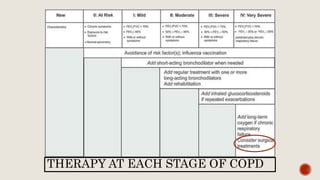
THERAPY AT EACH STAGE OF COPD
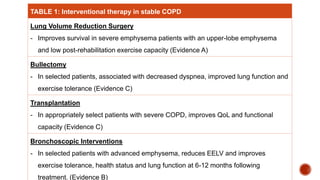
TABLE 1: Interventional therapy in stable COPD
Lung Volume Reduction Surgery
- Improves survival in severe emphysema patients with an upper-lobe emphysema
and low post-rehabilitation exercise capacity (Evidence A)
Bullectomy
- In selected patients, associated with decreased dyspnea, improved lung function and
exercise tolerance (Evidence C)
Transplantation
- In appropriately select patients with severe COPD, improves QoL and functional
capacity (Evidence C)
Bronchoscopic Interventions
- In selected patients with advanced emphysema, reduces EELV and improves
exercise tolerance, health status and lung function at 6-12 months following
treatment. (Evidence B)
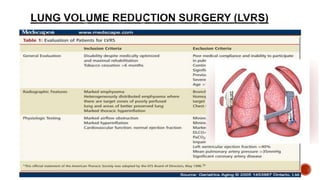
 Surgical reduction of lung volume by multiple wedge excisions of emphysematous tissue
 Rationale for LVRS
- Increased elastic recoil of the lung
- Improved expiratory flow
- Improvement in the mechanical function of diaphragm
- Improved LV filling
- Reduced dynamic hyperinflation
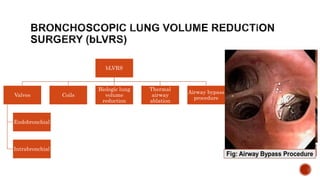
bLVRS
Valves
Endobronchial
Intrabronchial
Coils
Biologic lung
volume
reduction
Thermal
airway
ablation
Airway bypass
procedure
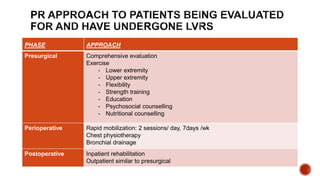
PHASE APPROACH
Presurgical Comprehensive evaluation
Exercise
- Lower extremity
- Upper extremity
- Flexibility
- Strength training
- Education
- Psychosocial counselling
- Nutritional counselling
Perioperative Rapid mobilization: 2 sessions/ day, 7days /wk
Chest physiotherapy
Bronchial drainage
Postoperative Inpatient rehabilitation
Outpatient similar to presurgical
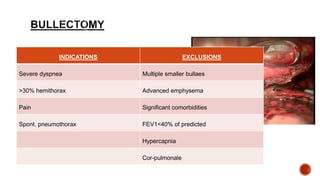
 Bullae > ball-valve-mechanism
 Effects of excision of bullae:
- Expansion of the underlying compressed lung.
- Raw, FRC, PVR and physiologic dead space.
- Increase in the elastic recoil pressure of the lung.
- Improvement in dynamic compliance.
- Restoration of the mechanical linkage between the chest wall and normal lung.
- Upward movement of the diaphragm to a more efficient position.
INDICATIONS EXCLUSIONS
Severe dyspnea Multiple smaller bullaes
>30% hemithorax Advanced emphysema
Pain Significant comorbidities
Spont. pneumothorax FEV1<40% of predicted
Hypercapnia
Cor-pulmonale
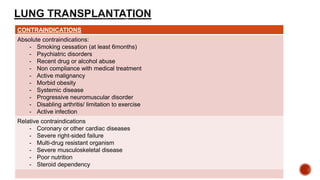
INDICATIONS
Age :
<65-70 years – single lung transplant
<60 years – bilateral lung transplant
<55 years – heart-lung transplants
Failure to respond to conventional treatment
Limited life expectancy (<2-3 years)
At least be ambulatory with O2
CONTRAINDICATIONS
Absolute contraindications:
- Smoking cessation (at least 6months)
- Psychiatric disorders
- Recent drug or alcohol abuse
- Non compliance with medical treatment
- Active malignancy
- Morbid obesity
- Systemic disease
- Progressive neuromuscular disorder
- Disabling arthritis/ limitation to exercise
- Active infection
Relative contraindications
- Coronary or other cardiac diseases
- Severe right-sided failure
- Multi-drug resistant organism
- Severe musculoskeletal disease
- Poor nutrition
- Steroid dependency
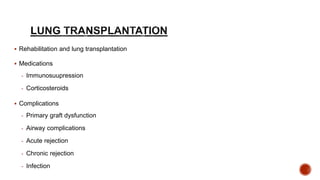
 Rehabilitation and lung transplantation
 Medications
- Immunosuupression
- Corticosteroids
 Complications
- Primary graft dysfunction
- Airway complications
- Acute rejection
- Chronic rejection
- Infection
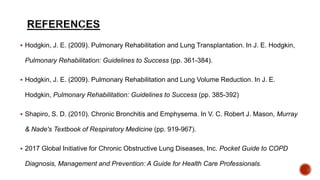
 Hodgkin, J. E. (2009). Pulmonary Rehabilitation and Lung Transplantation. In J. E. Hodgkin,
Pulmonary Rehabilitation: Guidelines to Success (pp. 361-384).
 Hodgkin, J. E. (2009). Pulmonary Rehabilitation and Lung Volume Reduction. In J. E.
Hodgkin, Pulmonary Rehabilitation: Guidelines to Success (pp. 385-392)
 Shapiro, S. D. (2010). Chronic Bronchitis and Emphysema. In V. C. Robert J. Mason, Murray
& Nade's Textbook of Respiratory Medicine (pp. 919-967).
 2017 Global Initiative for Chronic Obstructive Lung Diseases, Inc. Pocket Guide to COPD
Diagnosis, Management and Prevention: A Guide for Health Care Professionals.

Surgical therapy in copd

  • 1.
    Sumi Varghese 2nd year,M.Sc. Respiratory Therapy(ARC)
  • 3.
    THERAPY AT EACHSTAGE OF COPD
  • 4.
    TABLE 1: Interventionaltherapy in stable COPD Lung Volume Reduction Surgery - Improves survival in severe emphysema patients with an upper-lobe emphysema and low post-rehabilitation exercise capacity (Evidence A) Bullectomy - In selected patients, associated with decreased dyspnea, improved lung function and exercise tolerance (Evidence C) Transplantation - In appropriately select patients with severe COPD, improves QoL and functional capacity (Evidence C) Bronchoscopic Interventions - In selected patients with advanced emphysema, reduces EELV and improves exercise tolerance, health status and lung function at 6-12 months following treatment. (Evidence B)
  • 5.
     Surgical reductionof lung volume by multiple wedge excisions of emphysematous tissue  Rationale for LVRS - Increased elastic recoil of the lung - Improved expiratory flow - Improvement in the mechanical function of diaphragm - Improved LV filling - Reduced dynamic hyperinflation
  • 6.
  • 7.
    PHASE APPROACH Presurgical Comprehensiveevaluation Exercise - Lower extremity - Upper extremity - Flexibility - Strength training - Education - Psychosocial counselling - Nutritional counselling Perioperative Rapid mobilization: 2 sessions/ day, 7days /wk Chest physiotherapy Bronchial drainage Postoperative Inpatient rehabilitation Outpatient similar to presurgical
  • 8.
     Bullae >ball-valve-mechanism  Effects of excision of bullae: - Expansion of the underlying compressed lung. - Raw, FRC, PVR and physiologic dead space. - Increase in the elastic recoil pressure of the lung. - Improvement in dynamic compliance. - Restoration of the mechanical linkage between the chest wall and normal lung. - Upward movement of the diaphragm to a more efficient position. INDICATIONS EXCLUSIONS Severe dyspnea Multiple smaller bullaes >30% hemithorax Advanced emphysema Pain Significant comorbidities Spont. pneumothorax FEV1<40% of predicted Hypercapnia Cor-pulmonale
  • 9.
    INDICATIONS Age : <65-70 years– single lung transplant <60 years – bilateral lung transplant <55 years – heart-lung transplants Failure to respond to conventional treatment Limited life expectancy (<2-3 years) At least be ambulatory with O2 CONTRAINDICATIONS Absolute contraindications: - Smoking cessation (at least 6months) - Psychiatric disorders - Recent drug or alcohol abuse - Non compliance with medical treatment - Active malignancy - Morbid obesity - Systemic disease - Progressive neuromuscular disorder - Disabling arthritis/ limitation to exercise - Active infection Relative contraindications - Coronary or other cardiac diseases - Severe right-sided failure - Multi-drug resistant organism - Severe musculoskeletal disease - Poor nutrition - Steroid dependency
  • 10.
     Rehabilitation andlung transplantation  Medications - Immunosuupression - Corticosteroids  Complications - Primary graft dysfunction - Airway complications - Acute rejection - Chronic rejection - Infection
  • 11.
     Hodgkin, J.E. (2009). Pulmonary Rehabilitation and Lung Transplantation. In J. E. Hodgkin, Pulmonary Rehabilitation: Guidelines to Success (pp. 361-384).  Hodgkin, J. E. (2009). Pulmonary Rehabilitation and Lung Volume Reduction. In J. E. Hodgkin, Pulmonary Rehabilitation: Guidelines to Success (pp. 385-392)  Shapiro, S. D. (2010). Chronic Bronchitis and Emphysema. In V. C. Robert J. Mason, Murray & Nade's Textbook of Respiratory Medicine (pp. 919-967).  2017 Global Initiative for Chronic Obstructive Lung Diseases, Inc. Pocket Guide to COPD Diagnosis, Management and Prevention: A Guide for Health Care Professionals.