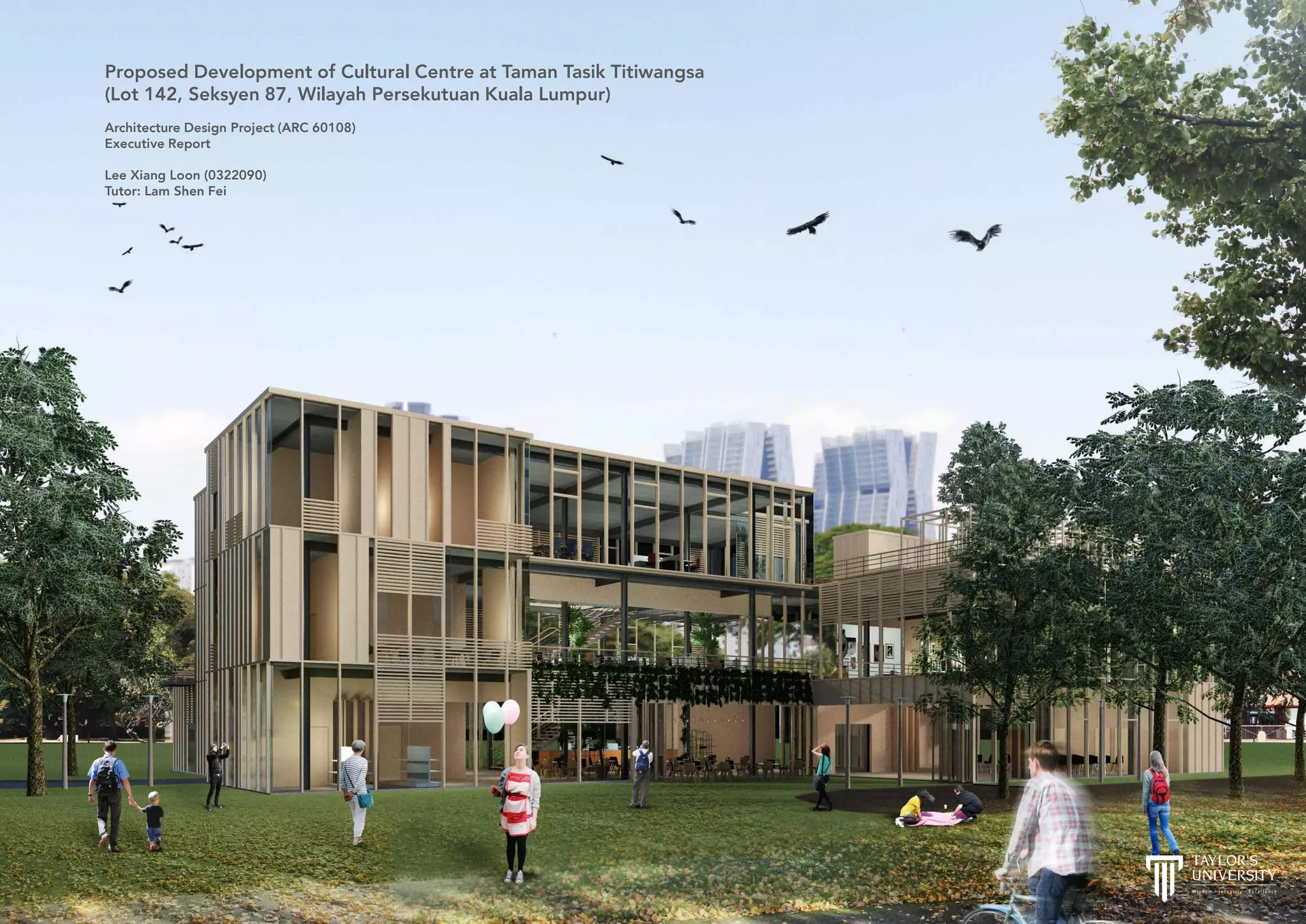
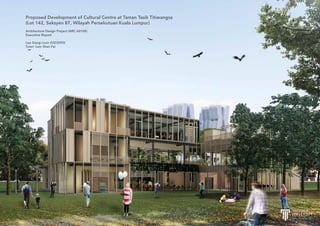
The proposed cultural centre at Taman Tasik Titiwangsa in Kuala Lumpur aims to foster community engagement, promote cultural activities, and enhance urban sustainability. Designed with the theme of 'sustaining humanities,' the centre will provide flexible spaces for public use, encouraging interaction and cultural preservation. The project addresses site-specific issues and aims to become a new landmark that supports the economic growth and cultural heritage of the daerah.
Proposed Development ofCultural Centre at Taman Tasik Titiwangsa
(Lot 142, Seksyen 87, Wilayah Persekutuan Kuala Lumpur)
Architecture Design Project (ARC 60108)
Executive Report
Lee Xiang Loon (0322090)
Tutor: Lam Shen Fei
2.
table of
contents
Proposed Developmentof Cultural Centre at
Taman Tasik Titiwangsa, Kuala Lumpur Table of Contents
Table of Contents 2
1.0 Introduction
1.1 Abstract 3
1.2 Introduction 4
1.2 Aims & Objectives 4
2.0 Site Investigation & Contextual Studies
2.1 Site Introduction 5
2.2 Historical Background 6
2.3 Site Significant Issues 7
2.4 Urban Studies 8
2.5 Macro Site Analysis 9
3.0 Project Background & Design Intention Strategies
3.1 Micro Site Analysis 10
3.2 Precedent Studies 11
3.3 Design Intention 12
3.4 Programme and Project Brief 13
3.5 Site Response 14
3.6 Spatial Programming 15–17
3.7 Morphological & Form Studies 18
4.0 Environmental & Technological Strategies
4.1 Site Planning Strategies 19–20
4.2 Sustainability Concepts, Green Features
and Innovations 21
4.3 Material and Resources, and
Acoustical Considerations 22
4.4 Structural Concept 23–26
2
3.
Proposed Development ofCultural Centre at
Taman Tasik Titiwangsa, Kuala Lumpur
Introduction
Abstract
3
Architecture creates better places, affects society and it can even have a
role in making a place civilized by making a community more liveable as
a social catalyst. Designs are encouraged to be more sensitive to issues
on given site and context.
This Architecture Design Project is based on the theme of “sustaining
humanities”, an architecture for people, place and time, with a social
impact and the resolution and integration of technology, environment
and cultural context in architectural design. Sustainability design is a
fundamental issue in our time within global and regional contexts.
This design studio progresses from the urban issues of urban street
environment by proposing strategies to resolving social issues
pertaining to the conditions of an urban landscape.
The proposed site is situated in Kuala Lumpur and faces the Titiwangsa
Lake and some architectural landmarks including Istana Budaya,
Titiwangsa Stadium and Balai Seni Lukis Negara. The Titiwangsa Lake
Gardens is part of a cleaning up and beautification in line with the
“River of Life” project plan for the convenience and comfort of visitors
in the future. The design proposal will address the social needs of a
particularly urban place and provide interaction and connection of
people in the urban spaces.
abstract
4.
Proposed Development ofCultural Centre at
Taman Tasik Titiwangsa, Kuala Lumpur
Introduction
Introduction & Objectives
4
Located in the outskirts of Kuala Lumpur city centre, the Titiwangsa
Cultural Centre emphasizes on the theme of humanity and sustainability.
The keyword ‘Resonance’ is used as the core of the design, which is to
strengthen and prolong the cultural liveliness and collective lifestyle of
the locals and tourists of Titiwangsa Lake Gardens.
The ground area is designed as a public realm mainly for community
use, a space for gathering and meetings and as a pit stop for activities
for the existing Titiwangsa Lake users. The extra permeability of the
Centre allows the building to blend in with the surrounding greenery.
The transparency of the Centre also sparks curiosity and enables the
users from the outside to have direct views to the activities and events
being held indoors. The building is designed to orientate towards the
views of the lake and neighbouring cultural landmarks.
In line with the River of Life project of the lake, the building is intended
to maximize public interactions by taking advantage of its strategic
location at the entrance of the Titiwangsa Lake. The building will
potentially form a new node at the site and as a catalyst for a
sustainable socioeconomic growth, as well as to strengthen, conserve
and preserve national arts, culture and heritage.
introduction
The design of the cultural centre aims to create a promote culture and
assist in the upcoming River of Life project of Titiwangsa Lake. In
respond to the lack of many cultural centres available in Malaysia, the
proposed building is designed in hopes to educate younger generation
about the significance and the history of this well-known lake in Kuala
Lumpur.
In order to tackle the issue of underutilized vacant space of the existing
site where the building is proposed to be built, the Centre allows public
engagement and attracts the local community and tourists alike to allow
the users to utilize the building according to the different activities or
events needed to be held at any time. The Centre is designed to
capture the existing on-site cultural lifestyles and activities at Titiwangsa
Lake Gardens to create a new landmark and node for the existing users.
Ultimately, the building signifies the importance of sustaining
humanities as well as the living environment a better quality of life.
aims &
objectives
5.
Proposed Development ofCultural Centre at
Taman Tasik Titiwangsa, Kuala Lumpur
Site Investigation & Contextual Studies
Site Introduction
5
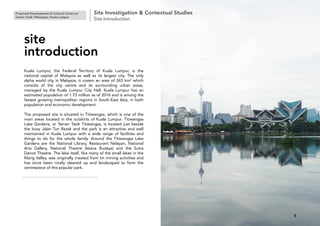
Kuala Lumpur, the Federal Territory of Kuala Lumpur, is the
national capital of Malaysia as well as its largest city. The only
alpha world city in Malaysia, it covers an area of 243 km2 which
consists of the city centre and its surrounding urban areas,
managed by the Kuala Lumpur City Hall. Kuala Lumpur has an
estimated population of 1.73 million as of 2016 and is among the
fastest growing metropolitan regions in South-East Asia, in both
population and economic development.
The proposed site is situated in Titiwangsa, which is one of the
main areas located in the outskirts of Kuala Lumpur. Titiwangsa
Lake Gardens, or Taman Tasik Titiwangsa, is located just beside
the busy Jalan Tun Razak and the park is an attractive and well
maintained in Kuala Lumpur with a wide range of facilities and
things to do for the whole family. Around the Titiwangsa Lake
Gardens are the National Library, Restaurant Nelayan, National
Arts Gallery, National Theatre (Istana Budaya) and the Sutra
Dance Theatre. The lake itself, like many of the small lakes in the
Klang Valley, was originally created from tin mining activities and
has since been nicely cleaned up and landscaped to form the
centrepiece of this popular park.
site
introduction
6.
Proposed Development ofCultural Centre at
Taman Tasik Titiwangsa, Kuala Lumpur
Site Investigation & Contextual Studies
Historical Background
6
historical
background
1970s
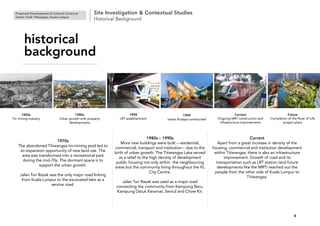
The abandoned Titiwangsa tin-mining pool led to
an expansion opportunity of new land use. The
area was transformed into a recreational park
during the mid-70s. The dormant space is to
support the urban growth.
Jalan Tun Razak was the only major road linking
from Kuala Lumpur to the excavated lake as a
service road.
1980s – 1990s
More new buildings were built – residential,
commercial, transport and institution – due to the
birth of urban growth. The Titiwangsa Lake served
as a relief to the high density of development
public housing not only within the neighbouring
areas but the community living throughout the KL
City Centre.
Jalan Tun Razak was used as a major road
connecting the community from Kampung Baru,
Kampung Datuk Keramat, Sentul and Chow Kit.
Current
Apart from a great increase in density of the
housing, commercial and institution development
within Titiwangsa, there is also an infrastructure
improvement. Growth of road and its
transportation such as LRT station (and future
developments like the MRT) reached out the
people from the other side of Kuala Lumpur to
Titiwangsa.
1850s
Tin mining industry
1980s
Urban growth with property
developments
1998
LRT establishment
1999
Istana Budaya constructed
Current
Ongoing MRT construction and
infrastructure improvements
Future
Completion of the River of Life
project plans
7.
Proposed Development ofCultural Centre at
Taman Tasik Titiwangsa, Kuala Lumpur
Site Investigation & Contextual Studies
Site Significant Issues
7
site issues
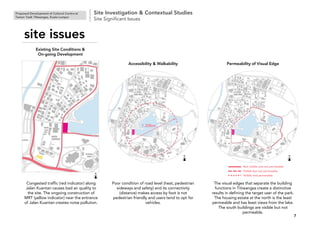
Existing Site Conditions &
On-going Development
Accessibility & Walkability Permeability of Visual Edge
Poor condition of road level (heat, pedestrian
sideways and safety) and its connectivity
(distance) makes access by foot is not
pedestrian friendly and users tend to opt for
vehicles.
The visual edges that separate the building
functions in Titiwangsa create a distinctive
results in defining the target user of the park.
The housing estate at the north is the least
permeable and has least views from the lake.
The south buildings are visible but not
permeable.
Congested traffic (red indicator) along
Jalan Kuantan causes bad air quality to
the site. The ongoing construction of
MRT (yellow indicator) near the entrance
of Jalan Kuantan creates noise pollution.
1.20km
Not visible and not permeable
Visible but not permeable
Visible and permeable
8.
Proposed Development ofCultural Centre at
Taman Tasik Titiwangsa, Kuala Lumpur
Site Investigation & Contextual Studies
Urban Studies: Node
8
urban
studies
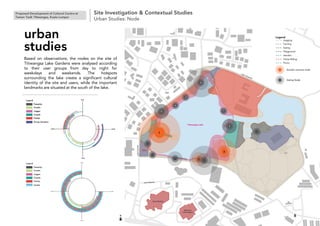
Based on observations, the nodes on the site of
Titiwangsa Lake Gardens were analysed according
to their user groups from day to night for
weekdays and weekends. The hotspots
surrounding the lake create a significant cultural
identity of the site and users, while the important
landmarks are situated at the south of the lake.
9.
Proposed Development ofCultural Centre at
Taman Tasik Titiwangsa, Kuala Lumpur
Site Investigation & Contextual Studies
Macro Site Analysis
9
Main Access Active Traffic Hours Permeability:
From Public Transports and Car Parks
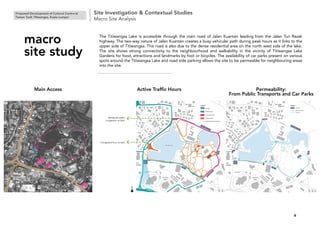
The Titiwangsa Lake is accessible through the main road of Jalan Kuantan leading from the Jalan Tun Razak
highway. The two-way nature of Jalan Kuantan creates a busy vehicular path during peak hours as it links to the
upper side of Titiwangsa. This road is also due to the dense residential area on the north west side of the lake.
The site shows strong connectivity to the neighbourhood and walkability in the vicinity of Titiwangsa Lake
Gardens for food, attractions and landmarks by foot or bicycles. The availability of car parks present on various
spots around the Titiwangsa Lake and road side parking allows the site to be permeable for neighbouring areas
into the site.
macro
site study
10.
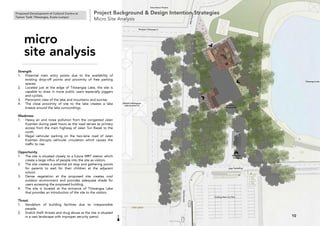
Strength
1. Potential mainentry points due to the availability of
existing drop-off points and proximity of free parking
spaces.
2. Located just at the edge of Titiwangsa Lake, the site is
capable to draw in more public users especially joggers
and cyclists.
3. Panoramic view of the lake and mountains and sunrise.
4. The close proximity of site to the lake creates a lake
breeze around the lake surroundings.
Weakness
1. Heavy air and noise pollution from the congested Jalan
Kuantan during peak hours as the road serves as primary
access from the main highway of Jalan Tun Razak to the
north.
2. Illegal vehicular parking on the two-lane road of Jalan
Kuantan disrupts vehicular circulation which causes the
traffic to rise.
Opportunity
1. The site is situated closely to a future MRT station which
create a large influx of people into the site as visitors.
2. The site creates a potential pit stop and gathering points
for parents to wait for their children at the adjacent
school.
3. Dense vegetation at the proposed site creates cool
outdoor environment and provides adequate shade for
users accessing the proposed building.
4. The site is located at the entrance of Titiwangsa Lake
that provides an introduction of the site to the visitors.
Threat
1. Vandalism of building facilities due to irresponsible
people.
2. Snatch theft threats and drug abuse as the site is situated
in a vast landscape with improper security patrol.
Proposed Development of Cultural Centre at
Taman Tasik Titiwangsa, Kuala Lumpur
Project Background & Design Intention Strategies
Micro Site Analysis
10
micro
site analysis
11.
Proposed Development ofCultural Centre at
Taman Tasik Titiwangsa, Kuala Lumpur
Project Background & Design Intention Strategies
Precedent Studies
11
precedent
studies
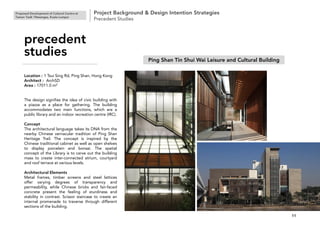
Location : 1 Tsui Sing Rd, Ping Shan, Hong Kong
Architect : ArchSD
Area : 17011.0 m2
The design signifies the idea of civic building with
a piazza as a place for gathering. The building
accommodates two main functions, which are a
public library and an indoor recreation centre (IRC).
Concept
The architectural language takes its DNA from the
nearby Chinese vernacular tradition of Ping Shan
Heritage Trail. The concept is inspired by the
Chinese traditional cabinet as well as open shelves
to display porcelain and bonsai. The spatial
concept of the Library is to carve out the building
mass to create inter-connected atrium, courtyard
and roof terrace at various levels.
Architectural Elements
Metal frames, timber screens and steel lattices
offer varying degrees of transparency and
permeability, while Chinese bricks and fair-faced
concrete present the feeling of sturdiness and
stability in contrast. Scissor staircase to create an
internal promenade to traverse through different
sections of the building.
Ping Shan Tin Shui Wai Leisure and Cultural Building
12.
Proposed Development ofCultural Centre at
Taman Tasik Titiwangsa, Kuala Lumpur
Project Background & Design Intention Strategies
Design Intention
12
A cultural centre is a building space to participate in cultural activities.
These centres aim to promote culture among the people of a
community. It serves as a meeting point in the community where people
come together to strengthen various existing traditions and cultural
activities.
The Titiwangsa Cultural Centre aims to promote culture among the
people as an extension of cultural activities into the site through the
existing lifestyles of users at Titiwangsa Lake through flexible spaces
and facilities that can adopt and adapt to the different activities. Being
able to view the Kuala Lumpur city skyline and the mountains, this
Centre offers visitors a pleasant place to pause during their day and
after work hours and temporarily slow down their minds in an
accelerating urban condition.
The disperse situation of people seen at different locations around the
current Titiwangsa Lake will be congregated at this new form of park,
allowing visitors to enjoy the park and at the same time can learn and
gain the cultural importance.
cultural
centre
1. Cultural Preservation of Titiwangsa Lake Gardens
To strengthen and promote cultural preservation through the
promotion of cultural awareness and an understanding of the
tradition and history of Titiwangsa and its people at both individual
and collective levels.
2. Promotion of Events and Activities
To promote programming events and activities which provide
opportunities for cultural enrichment of all students, residences,
workers and tourists through active participation.
3. Platform for Artists
To provide a venue and support to associations of artists and to
individuals involved in artistic and cultural activities including
performance art, concerts and exhibitions.
4. Volunteerism
To provide a supportive and welcoming environment for people
who will assist in the organisation of events and activities in hope to
build a partnership with neighbouring schools, civic buildings and
governmental bodies.
project
objectives
13.
Proposed Development ofCultural Centre at
Taman Tasik Titiwangsa, Kuala Lumpur
Project Background & Design Intention Strategies
Programme & Design Brief
13
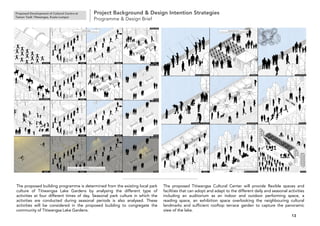
The proposed building programme is determined from the existing local park
culture of Titiwangsa Lake Gardens by analysing the different type of
activities at four different times of day. Seasonal park culture in which the
activities are conducted during seasonal periods is also analysed. These
activities will be considered in the proposed building to congregate the
community of Titiwangsa Lake Gardens.
The proposed Titiwangsa Cultural Center will provide flexible spaces and
facilities that can adopt and adapt to the different daily and seasonal activities
including an auditorium as an indoor and outdoor performing space, a
reading space, an exhibition space overlooking the neighbouring cultural
landmarks and sufficient rooftop terrace garden to capture the panoramic
view of the lake.
14.
Proposed Development ofCultural Centre at
Taman Tasik Titiwangsa, Kuala Lumpur
Project Background & Design Intention Strategies
Site Response
14
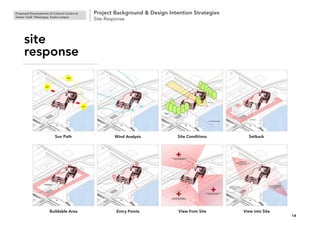
Sun Path Wind Analysis Site Conditions Setback
Buildable Area Entry Points View from Site View into Site
site
response
15.
Proposed Development ofCultural Centre at
Taman Tasik Titiwangsa, Kuala Lumpur
Project Background & Design Intention Strategies
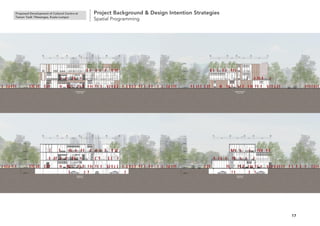
Spatial Programming
15
Lobby
Performing /
Communal
Space
Central
Stage
Courtyard
Lobby
Lobby
Cafeteria
Retail
Store
Reading
Space
Terrace
Visitor’s
Gallery
Office
Terrace
GardenAccomm
–odation
spatial
programming
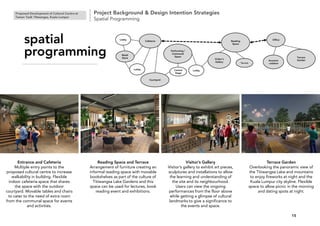
Entrance and Cafeteria
Multiple entry points to the
proposed cultural centre to increase
walkability in building. Flexible
indoor cafeteria space that shares
the space with the outdoor
courtyard. Movable tables and chairs
to cater to the need of extra room
from the communal space for events
and activities.
Reading Space and Terrace
Arrangement of furniture creating an
informal reading space with movable
bookshelves as part of the culture of
Titiwangsa Lake Gardens and this
space can be used for lectures, book
reading event and exhibitions.
Visitor’s Gallery
Visitor’s gallery to exhibit art pieces,
sculptures and installations to allow
the learning and understanding of
the site and its neighbourhood.
Users can view the ongoing
performances from the floor above
while getting a glimpse of cultural
landmarks to give a significance to
the events and space.
Terrace Garden
Overlooking the panoramic view of
the Titiwangsa Lake and mountains
to enjoy fireworks at night and the
Kuala Lumpur city skyline. Flexible
space to allow picnic in the morning
and dating spots at night.
16.
Proposed Development ofCultural Centre at
Taman Tasik Titiwangsa, Kuala Lumpur
Project Background & Design Intention Strategies
Spatial Programming
16
Basement Parking
Communal Space
Retail Store
Cafeteria
Visitor’s Gallery
Reading Space
Terrace Garden
Terrace Garden
Staff Residences
Staff Area
Structural Column
Fire Escape Stairs
Featured Stairs
Glass Facade
spatial
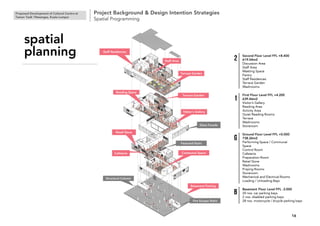
planning Second Floor Level FFL +8.400
619.04m2
Discussion Area
Staff Area
Meeting Space
Pantry
Staff Residences
Terrace Garden
Washrooms
First Floor Level FFL +4.200
639.46m2
Visitor’s Gallery
Reading Area
Activity Area
Quiet Reading Rooms
Terrace
Washrooms
Storeroom
Ground Floor Level FFL +0.000
738.26m2
Performing Space / Communal
Space
Control Room
Cafeteria
Preparation Room
Retail Store
Washrooms
Praying Rooms
Storeroom
Mechanical and Electrical Rooms
Loading / Unloading Bays
Basement Floor Level FFL -3.000
20 nos. car parking bays
2 nos. disabled parking bays
28 nos. motorcycle / bicycle parking bays
17.
Proposed Development ofCultural Centre at
Taman Tasik Titiwangsa, Kuala Lumpur
Project Background & Design Intention Strategies
Spatial Programming
17
18.
Proposed Development ofCultural Centre at
Taman Tasik Titiwangsa, Kuala Lumpur
Project Background & Design Intention Strategies
Morphological & Form Studies
18
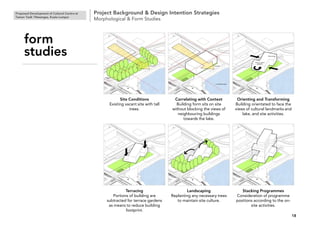
Site Conditions
Existing vacant site with tall
trees.
Correlating with Context
Building form sits on site
without blocking the views of
neighbouring buildings
towards the lake.
Orienting and Transforming
Building orientated to face the
views of cultural landmarks and
lake, and site activities.
Terracing
Portions of building are
subtracted for terrace gardens
as means to reduce building
footprint.
Landscaping
Replanting any necessary trees
to maintain site culture.
Stacking Programmes
Consideration of programme
positions according to the on-
site activities.
form
studies
19.
Proposed Development ofCultural Centre at
Taman Tasik Titiwangsa, Kuala Lumpur
Environmental & Technological Strategies
Site Planning Strategies
19
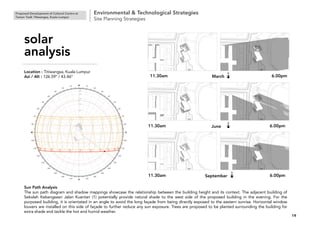
solar
analysis
March11.30am 6.00pm
June11.30am 6.00pm
September11.30am 6.00pm
Location : Titiwangsa, Kuala Lumpur
Azi / Alt : 126.59° / 43.46°
Sun Path Analysis
The sun path diagram and shadow mappings showcase the relationship between the building height and its context. The adjacent building of
Sekolah Kebangsaan Jalan Kuantan (1) potentially provide natural shade to the west side of the proposed building in the evening. For the
purposed building, it is orientated in an angle to avoid the long façade from being directly exposed to the eastern sunrise. Horizontal window
louvers are installed on this side of façade to further reduce any sun exposure. Trees are proposed to be planted surrounding the building for
extra shade and tackle the hot and humid weather.
20.
Proposed Development ofCultural Centre at
Taman Tasik Titiwangsa, Kuala Lumpur
Environmental & Technological Strategies
Site Planning Strategies
20
wind
analysis
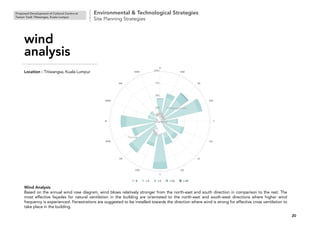
Location : Titiwangsa, Kuala Lumpur
Wind Analysis
Based on the annual wind rose diagram, wind blows relatively stronger from the north-east and south direction in comparison to the rest. The
most effective façades for natural ventilation in the building are orientated to the north-east and south-west directions where higher wind
frequency is experienced. Fenestrations are suggested to be installed towards the direction where wind is strong for effective cross ventilation to
take place in the building.
Titiwangsa Lake
Courtyard
Terrace
21.
Proposed Development ofCultural Centre at
Taman Tasik Titiwangsa, Kuala Lumpur
Environmental & Technological Strategies
Sustainability Concepts, Green Features and Innovations
21
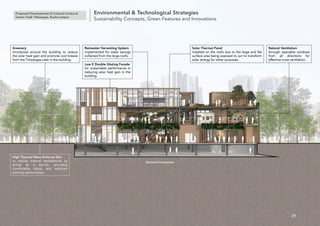
Greenery
introduced around the building to reduce
the solar heat gain and promote cool breeze
from the Titiwangsa Lake in the building.
Rainwater Harvesting System
implemented for water savings
collected from the large roofs.
Natural Ventilation
through openable windows
from all directions for
effective cross ventilation.
Solar Thermal Panel
installed on the roofs due to the large and flat
surface area being exposed to sun to transform
solar energy for other purposes.
Low E Double Glazing Facade
for sustainable performance in
reducing solar heat gain in the
building.
High Thermal Mass External Skin
to reduce internal temperature by
acting as a barrier, providing
comfortable indoor and optimum
working performance.
22.
Proposed Development ofCultural Centre at
Taman Tasik Titiwangsa, Kuala Lumpur
Environmental & Technological Strategies
Material and Resources, and Acoustical Considerations
22
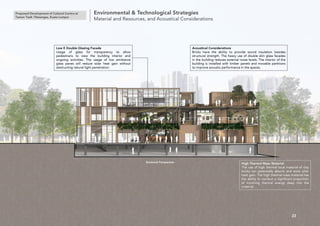
Low E Double Glazing Facade
Usage of glass for transparency to allow
pedestrians to view the building interior and
ongoing activities. The usage of low emittance
glass panes will reduce solar heat gain without
obstructing natural light penetration.
Acoustical Considerations
Bricks have the ability to provide sound insulation besides
structural strength. The heavy use of double skin glass facades
in the building reduces external noise levels. The interior of the
building is installed with timber panels and movable partitions
to improve acoustic performance in the spaces.
High Thermal Mass Material
The use of high thermal local material of clay
bricks can potentially absorb and store solar
heat gain. The high thermal mass material has
the ability to conduct a significant proportion
of incoming thermal energy deep into the
material.
23.
Proposed Development ofCultural Centre at
Taman Tasik Titiwangsa, Kuala Lumpur
Environmental & Technological Strategies
Structural Concept