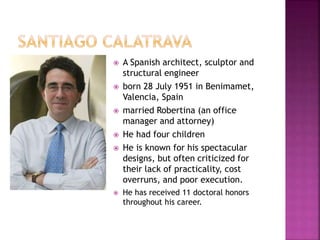

 A Spanish architect, sculptor and
structural engineer
 born 28 July 1951 in Benimamet,
Valencia, Spain
 married Robertina (an office
manager and attorney)
 He had four children
 He is known for his spectacular
designs, but often criticized for
their lack of practicality, cost
overruns, and poor execution.
 He has received 11 doctoral honors
throughout his career.
 Calatrava attended primary and secondary
school in Valencia.
 From the age of eight, he attended the Arts
and Crafts School, where he began his formal
instruction in drawing and painting.
 When he was thirteen, his family took
advantage of the recent opening of the borders
and sent him to Paris as an exchange student.
 In 1969, he studied architecture in Escuela Tecnica
Superior de Arquitectura in Valencia where he
earned a degree in architecture and took a post-
graduate course in urbanism
 In 1975, Attracted by the mathematical rigor of
certain great works of historic architecture, and
feeling that his training in Valencia had given him no
clear direction, Calatrava decided to pursue post-
graduate studies in civil engineering and enrolled at
the ETH (Federal Institute of Technology) in Zurich.
 In 1979, he earned doctorate in Technical Science
from the Department of Architecture, ETH Zurich
 In 1981, he opened architectural firm in Zürich,
Switzerland, Calatrava Valls S.A.,
 Calatrava began working with small
engineering commissions.
 He also began to enter competitions, feeling
that this was his most likely way to obtain
commissions.
 In 1983, he won his first competition for
Stadelhofen Railway Station in Zurich.
 In 1984, Calatrava won another competition
to design and build the Bach de Roda Bridge
 This was the beginning of the bridge projects
that created his international reputation.
 1992: London Institution of Structural
Engineers Gold Medal
 1993: Toronto Municipality Urban Design
Award
 1996: Gold Medal for Excellence in the Fine
Arts from the Granada Ministry of Culture
 1999: Prince of Asturias Award in Arts
 2005: American Institute of Architects Gold
Medal
2007: Spanish National Architecture Award
 1979 Auguste Perret Award
 1992 London Institution of Structural Engineers Gold Medal
 1993 Toronto Municipality Urban Design Award
 1996 Gold Medal for Excellence in the Fine Arts from
the Granada Ministry of Culture
 1997 Honoris Causa degree awarded by Delft University of Technology
 1999 Prince of Asturias Award in Arts
 2000 Algur H. Meadows Award for Excellence in the Arts from
the Meadows School of the Arts,Southern Methodist University
 2004 James Parks Morton Interfaith Award from the Interfaith Center of
New York
 2005 American Institute of Architects Gold Medal
 2006 Eugene McDermott Award in the Arts from the Council for the Arts
at MIT (Massachusetts Institute of Technology)
 2006 Honorary Engineering Degree from Rensselaer Polytechnic Institute
 Designation as a Global Leader for Tomorrow by the World Economic
Forum in Davos
 2007 Honorary Engineering Degree from Columbia University
 2007 Awarded with the Spanish National Architecture Award
 Design Futures Council Senior Fellow
 2013 Honorary Doctoral degree from Georgia institute of technology
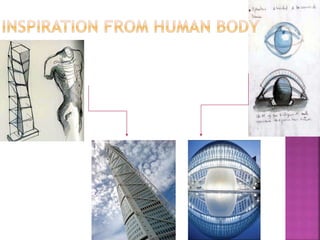
-Calatrava is inspired by natural forms in
movement- waves undulating, trees bending to
the wind, flower petals opening. Especially, he
focuses on the human body.
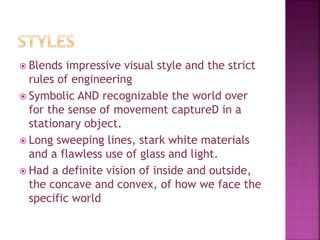
 Blends impressive visual style and the strict
rules of engineering
 Symbolic AND recognizable the world over
for the sense of movement captureD in a
stationary object.
 Long sweeping lines, stark white materials
and a flawless use of glass and light.
 Had a definite vision of inside and outside,
the concave and convex, of how we face the
specific world
“One draws the human body to understand the
movement, the gesture. The space, the
landscape, the human landscape, and
topology are important for me. These will
inspire or bring the essence to a project. So,
for myself I venerate the human body.”
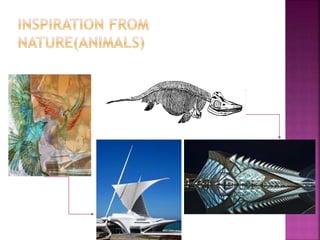
“To me, there are two overriding principles to
be found in nature which are most
appropriate for building; one is the optimal
use of material, the other the capacity of
organisms to change shape, to grow, and to
move.”
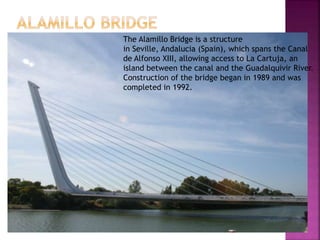
The Alamillo Bridge is a structure
in Seville, Andalucia (Spain), which spans the Canal
de Alfonso XIII, allowing access to La Cartuja, an
island between the canal and the Guadalquivir River.
Construction of the bridge began in 1989 and was
completed in 1992.
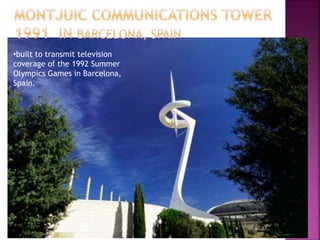
•built to transmit television
coverage of the 1992 Summer
Olympics Games in Barcelona,
Spain.
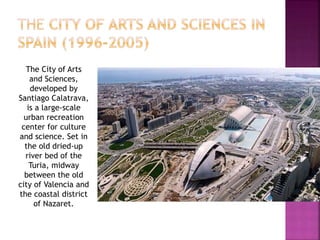
The City of Arts
and Sciences,
developed by
Santiago Calatrava,
is a large-scale
urban recreation
center for culture
and science. Set in
the old dried-up
river bed of the
Turia, midway
between the old
city of Valencia and
the coastal district
of Nazaret.
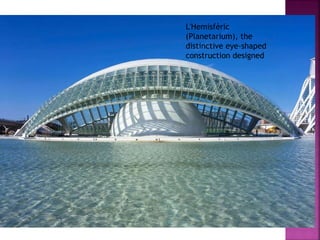
L'Hemisfèric
(Planetarium), the
distinctive eye-shaped
construction designed
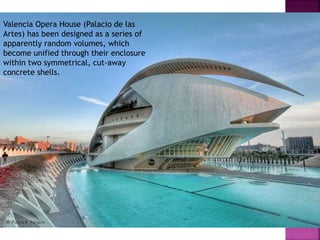
Valencia Opera House (Palacio de las
Artes) has been designed as a series of
apparently random volumes, which
become unified through their enclosure
within two symmetrical, cut-away
concrete shells.
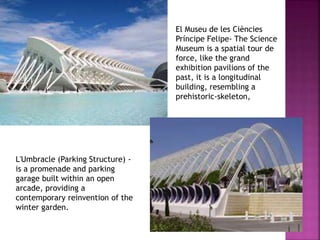
El Museu de les Ciències
Príncipe Felipe- The Science
Museum is a spatial tour de
force, like the grand
exhibition pavilions of the
past, it is a longitudinal
building, resembling a
prehistoric-skeleton,
L'Umbracle (Parking Structure) -
is a promenade and parking
garage built within an open
arcade, providing a
contemporary reinvention of the
winter garden.
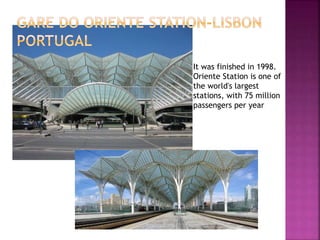
It was finished in 1998.
Oriente Station is one of
the world's largest
stations, with 75 million
passengers per year
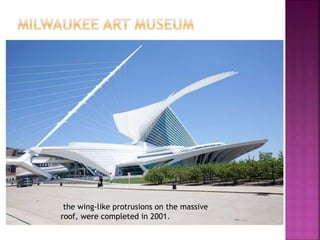
the wing-like protrusions on the massive
roof, were completed in 2001.
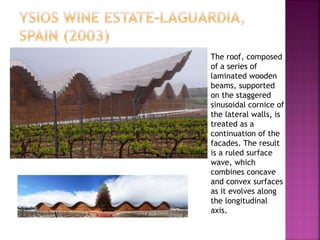
The roof, composed
of a series of
laminated wooden
beams, supported
on the staggered
sinusoidal cornice of
the lateral walls, is
treated as a
continuation of the
facades. The result
is a ruled surface
wave, which
combines concave
and convex surfaces
as it evolves along
the longitudinal
axis.
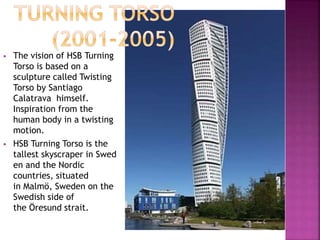
 The vision of HSB Turning
Torso is based on a
sculpture called Twisting
Torso by Santiago
Calatrava himself.
Inspiration from the
human body in a twisting
motion.
 HSB Turning Torso is the
tallest skyscraper in Swed
en and the Nordic
countries, situated
in Malmö, Sweden on the
Swedish side of
the Öresund strait.
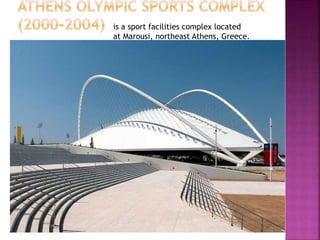
is a sport facilities complex located
at Marousi, northeast Athens, Greece.
Prepared by:

Santiago Calatrava.ppt

  • 2.
     A Spanisharchitect, sculptor and structural engineer  born 28 July 1951 in Benimamet, Valencia, Spain  married Robertina (an office manager and attorney)  He had four children  He is known for his spectacular designs, but often criticized for their lack of practicality, cost overruns, and poor execution.  He has received 11 doctoral honors throughout his career.
  • 3.
     Calatrava attendedprimary and secondary school in Valencia.  From the age of eight, he attended the Arts and Crafts School, where he began his formal instruction in drawing and painting.  When he was thirteen, his family took advantage of the recent opening of the borders and sent him to Paris as an exchange student.
  • 4.
     In 1969,he studied architecture in Escuela Tecnica Superior de Arquitectura in Valencia where he earned a degree in architecture and took a post- graduate course in urbanism  In 1975, Attracted by the mathematical rigor of certain great works of historic architecture, and feeling that his training in Valencia had given him no clear direction, Calatrava decided to pursue post- graduate studies in civil engineering and enrolled at the ETH (Federal Institute of Technology) in Zurich.  In 1979, he earned doctorate in Technical Science from the Department of Architecture, ETH Zurich  In 1981, he opened architectural firm in Zürich, Switzerland, Calatrava Valls S.A.,
  • 5.
     Calatrava beganworking with small engineering commissions.  He also began to enter competitions, feeling that this was his most likely way to obtain commissions.  In 1983, he won his first competition for Stadelhofen Railway Station in Zurich.  In 1984, Calatrava won another competition to design and build the Bach de Roda Bridge  This was the beginning of the bridge projects that created his international reputation.
  • 6.
     1992: LondonInstitution of Structural Engineers Gold Medal  1993: Toronto Municipality Urban Design Award  1996: Gold Medal for Excellence in the Fine Arts from the Granada Ministry of Culture  1999: Prince of Asturias Award in Arts  2005: American Institute of Architects Gold Medal 2007: Spanish National Architecture Award
  • 7.
     1979 AugustePerret Award  1992 London Institution of Structural Engineers Gold Medal  1993 Toronto Municipality Urban Design Award  1996 Gold Medal for Excellence in the Fine Arts from the Granada Ministry of Culture  1997 Honoris Causa degree awarded by Delft University of Technology  1999 Prince of Asturias Award in Arts  2000 Algur H. Meadows Award for Excellence in the Arts from the Meadows School of the Arts,Southern Methodist University  2004 James Parks Morton Interfaith Award from the Interfaith Center of New York  2005 American Institute of Architects Gold Medal  2006 Eugene McDermott Award in the Arts from the Council for the Arts at MIT (Massachusetts Institute of Technology)  2006 Honorary Engineering Degree from Rensselaer Polytechnic Institute  Designation as a Global Leader for Tomorrow by the World Economic Forum in Davos  2007 Honorary Engineering Degree from Columbia University  2007 Awarded with the Spanish National Architecture Award  Design Futures Council Senior Fellow  2013 Honorary Doctoral degree from Georgia institute of technology
  • 8.
    -Calatrava is inspiredby natural forms in movement- waves undulating, trees bending to the wind, flower petals opening. Especially, he focuses on the human body.
  • 11.
     Blends impressivevisual style and the strict rules of engineering  Symbolic AND recognizable the world over for the sense of movement captureD in a stationary object.  Long sweeping lines, stark white materials and a flawless use of glass and light.  Had a definite vision of inside and outside, the concave and convex, of how we face the specific world
  • 12.
    “One draws thehuman body to understand the movement, the gesture. The space, the landscape, the human landscape, and topology are important for me. These will inspire or bring the essence to a project. So, for myself I venerate the human body.” “To me, there are two overriding principles to be found in nature which are most appropriate for building; one is the optimal use of material, the other the capacity of organisms to change shape, to grow, and to move.”
  • 14.
    The Alamillo Bridgeis a structure in Seville, Andalucia (Spain), which spans the Canal de Alfonso XIII, allowing access to La Cartuja, an island between the canal and the Guadalquivir River. Construction of the bridge began in 1989 and was completed in 1992.
  • 15.
    •built to transmittelevision coverage of the 1992 Summer Olympics Games in Barcelona, Spain.
  • 17.
    The City ofArts and Sciences, developed by Santiago Calatrava, is a large-scale urban recreation center for culture and science. Set in the old dried-up river bed of the Turia, midway between the old city of Valencia and the coastal district of Nazaret.
  • 18.
  • 19.
    Valencia Opera House(Palacio de las Artes) has been designed as a series of apparently random volumes, which become unified through their enclosure within two symmetrical, cut-away concrete shells.
  • 20.
    El Museu deles Ciències Príncipe Felipe- The Science Museum is a spatial tour de force, like the grand exhibition pavilions of the past, it is a longitudinal building, resembling a prehistoric-skeleton, L'Umbracle (Parking Structure) - is a promenade and parking garage built within an open arcade, providing a contemporary reinvention of the winter garden.
  • 21.
    It was finishedin 1998. Oriente Station is one of the world's largest stations, with 75 million passengers per year
  • 22.
    the wing-like protrusionson the massive roof, were completed in 2001.
  • 23.
    The roof, composed ofa series of laminated wooden beams, supported on the staggered sinusoidal cornice of the lateral walls, is treated as a continuation of the facades. The result is a ruled surface wave, which combines concave and convex surfaces as it evolves along the longitudinal axis.
  • 24.
     The visionof HSB Turning Torso is based on a sculpture called Twisting Torso by Santiago Calatrava himself. Inspiration from the human body in a twisting motion.  HSB Turning Torso is the tallest skyscraper in Swed en and the Nordic countries, situated in Malmö, Sweden on the Swedish side of the Öresund strait.
  • 25.
    is a sportfacilities complex located at Marousi, northeast Athens, Greece.
  • 29.