Arcadia Alive
Operational Decision Making
Richard Madders
Arcadia Alive - Philosophy
www.arcadiaalive.com
Ultimately it is people that make the difference
People and Performance in Parallel
Everyone deserves an inspirational teacher and can grow
We achieve more through collaboration
In the modern economy most work is about mental effort
It is our conscious and subconscious thoughts that drive behaviour
Most “training” is a waste of time because it does not change behaviour
We blend two disciplines; Psychology and Management to support people in delivering sustainable and
measurable behavioural change
“If you always do what you have always done
you will always get what you have always got”
The right support at the right time to the right people enabling them
to optimise their performance
Arcadia Alive is a Behavioural Change & Human Factor
Consultancy
Leadership & Management Challenge
www.arcadiaalive.com
Why do Managers Make Bad Decisions?
www.arcadiaalive.com
Initial Impressions
Justifying past decisions
Seeing what you want to see
Being Influenced by Problem Framing
Overconfidence
Perpetuating the Status Quo
…………………………….
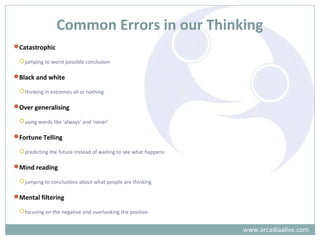
Common Errors in our Thinking
Catastrophic
jumping to worst possible conclusion
Black and white
thinking in extremes all or nothing
Over generalising
using words like ‘always’ and ‘never’
Fortune Telling
predicting the future instead of waiting to see what happens
Mind reading
jumping to conclusions about what people are thinking
Mental filtering
focusing on the negative and overlooking the positive
www.arcadiaalive.com
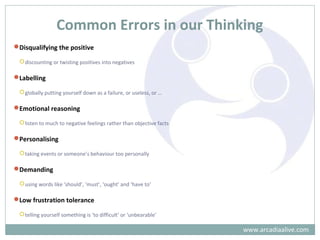
Common Errors in our Thinking
Disqualifying the positive
discounting or twisting positives into negatives
Labelling
globally putting yourself down as a failure, or useless, or …
Emotional reasoning
listen to much to negative feelings rather than objective facts
Personalising
taking events or someone’s behaviour too personally
Demanding
using words like ‘should’, ‘must’, ‘ought’ and ‘have to’
Low frustration tolerance
telling yourself something is ‘to difficult’ or ‘unbearable’
www.arcadiaalive.com
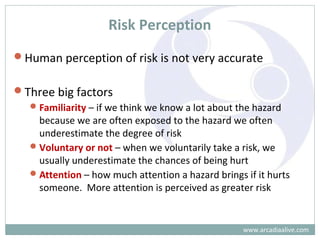
Risk Perception
Human perception of risk is not very accurate
Three big factors
Familiarity – if we think we know a lot about the hazard
because we are often exposed to the hazard we often
underestimate the degree of risk
Voluntary or not – when we voluntarily take a risk, we
usually underestimate the chances of being hurt
Attention – how much attention a hazard brings if it hurts
someone. More attention is perceived as greater risk
www.arcadiaalive.com
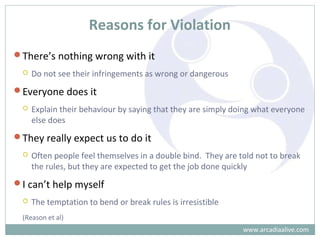
Reasons for Violation
www.arcadiaalive.com
There’s nothing wrong with it
 Do not see their infringements as wrong or dangerous
Everyone does it
 Explain their behaviour by saying that they are simply doing what everyone
else does
They really expect us to do it
 Often people feel themselves in a double bind. They are told not to break
the rules, but they are expected to get the job done quickly
I can’t help myself
 The temptation to bend or break rules is irresistible
(Reason et al)
Reasons for Violation
www.arcadiaalive.com
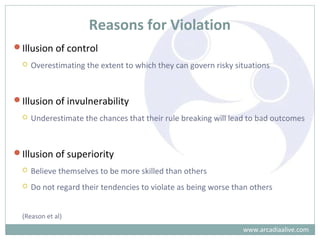
Illusion of control
 Overestimating the extent to which they can govern risky situations
Illusion of invulnerability
 Underestimate the chances that their rule breaking will lead to bad outcomes
Illusion of superiority
 Believe themselves to be more skilled than others
 Do not regard their tendencies to violate as being worse than others
(Reason et al)
www.arcadiaalive.com
Dan A Video
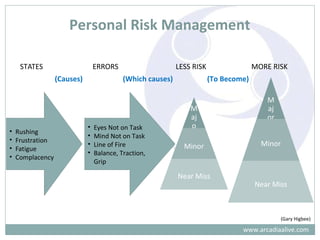
M
aj
o
r
Minor
Near Miss
M
aj
or
Minor
Near Miss
Personal Risk Management
• Rushing
• Frustration
• Fatigue
• Complacency
• Eyes Not on Task
• Mind Not on Task
• Line of Fire
• Balance, Traction,
Grip
STATES ERRORS LESS RISK MORE RISK
(Causes) (Which causes) (To Become)
www.arcadiaalive.com
(Gary Higbee)
Risk Management - Business Objective
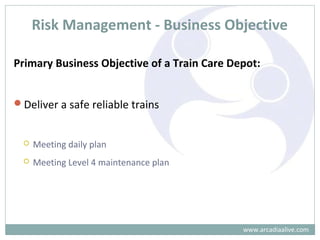
Primary Business Objective of a Train Care Depot:
Deliver a safe reliable trains
 Meeting daily plan
 Meeting Level 4 maintenance plan
www.arcadiaalive.com
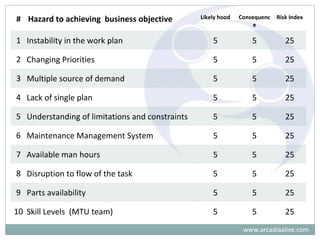
# Hazard to achieving business objective Likely hood Consequenc
e
Risk Index
1 Instability in the work plan 5 5 25
2 Changing Priorities 5 5 25
3 Multiple source of demand 5 5 25
4 Lack of single plan 5 5 25
5 Understanding of limitations and constraints 5 5 25
6 Maintenance Management System 5 5 25
7 Available man hours 5 5 25
8 Disruption to flow of the task 5 5 25
9 Parts availability 5 5 25
10 Skill Levels (MTU team) 5 5 25
www.arcadiaalive.com
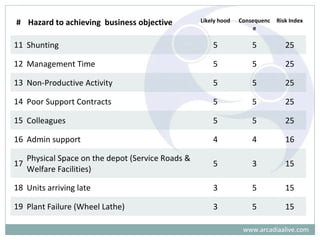
# Hazard to achieving business objective Likely hood Consequenc
e
Risk Index
11 Shunting 5 5 25
12 Management Time 5 5 25
13 Non-Productive Activity 5 5 25
14 Poor Support Contracts 5 5 25
15 Colleagues 5 5 25
16 Admin support 4 4 16
17
Physical Space on the depot (Service Roads &
Welfare Facilities)
5 3 15
18 Units arriving late 3 5 15
19 Plant Failure (Wheel Lathe) 3 5 15
www.arcadiaalive.com
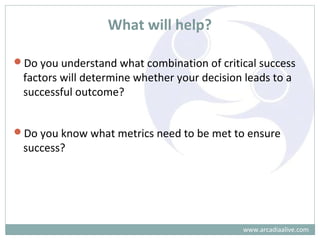
What will help?
Do you understand what combination of critical success
factors will determine whether your decision leads to a
successful outcome?
Do you know what metrics need to be met to ensure
success?
www.arcadiaalive.com
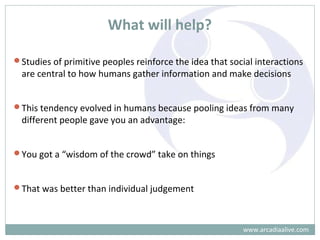
What will help?
Studies of primitive peoples reinforce the idea that social interactions
are central to how humans gather information and make decisions
This tendency evolved in humans because pooling ideas from many
different people gave you an advantage:
You got a “wisdom of the crowd” take on things
That was better than individual judgement
www.arcadiaalive.com
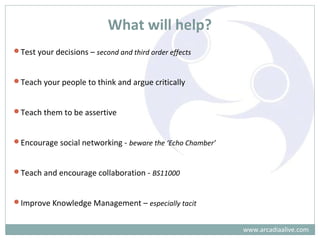
What will help?
Test your decisions – second and third order effects
Teach your people to think and argue critically
Teach them to be assertive
Encourage social networking - beware the ‘Echo Chamber’
Teach and encourage collaboration - BS11000
Improve Knowledge Management – especially tacit
www.arcadiaalive.com
Summary
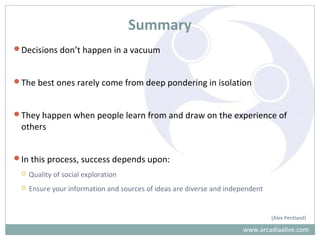
Decisions don’t happen in a vacuum
The best ones rarely come from deep pondering in isolation
They happen when people learn from and draw on the experience of
others
In this process, success depends upon:
 Quality of social exploration
 Ensure your information and sources of ideas are diverse and independent
(Alex Pentland)
www.arcadiaalive.com
Captain Video
Thank You

Arcadia alive operational decision making may 2014 video

  • 1.
    Arcadia Alive Operational DecisionMaking Richard Madders
  • 2.
    Arcadia Alive -Philosophy www.arcadiaalive.com Ultimately it is people that make the difference People and Performance in Parallel Everyone deserves an inspirational teacher and can grow We achieve more through collaboration In the modern economy most work is about mental effort It is our conscious and subconscious thoughts that drive behaviour Most “training” is a waste of time because it does not change behaviour We blend two disciplines; Psychology and Management to support people in delivering sustainable and measurable behavioural change “If you always do what you have always done you will always get what you have always got” The right support at the right time to the right people enabling them to optimise their performance Arcadia Alive is a Behavioural Change & Human Factor Consultancy
  • 3.
    Leadership & ManagementChallenge www.arcadiaalive.com
  • 4.
    Why do ManagersMake Bad Decisions? www.arcadiaalive.com Initial Impressions Justifying past decisions Seeing what you want to see Being Influenced by Problem Framing Overconfidence Perpetuating the Status Quo …………………………….
  • 5.
    Common Errors inour Thinking Catastrophic jumping to worst possible conclusion Black and white thinking in extremes all or nothing Over generalising using words like ‘always’ and ‘never’ Fortune Telling predicting the future instead of waiting to see what happens Mind reading jumping to conclusions about what people are thinking Mental filtering focusing on the negative and overlooking the positive www.arcadiaalive.com
  • 6.
    Common Errors inour Thinking Disqualifying the positive discounting or twisting positives into negatives Labelling globally putting yourself down as a failure, or useless, or … Emotional reasoning listen to much to negative feelings rather than objective facts Personalising taking events or someone’s behaviour too personally Demanding using words like ‘should’, ‘must’, ‘ought’ and ‘have to’ Low frustration tolerance telling yourself something is ‘to difficult’ or ‘unbearable’ www.arcadiaalive.com
  • 7.
    Risk Perception Human perceptionof risk is not very accurate Three big factors Familiarity – if we think we know a lot about the hazard because we are often exposed to the hazard we often underestimate the degree of risk Voluntary or not – when we voluntarily take a risk, we usually underestimate the chances of being hurt Attention – how much attention a hazard brings if it hurts someone. More attention is perceived as greater risk www.arcadiaalive.com
  • 8.
    Reasons for Violation www.arcadiaalive.com There’snothing wrong with it  Do not see their infringements as wrong or dangerous Everyone does it  Explain their behaviour by saying that they are simply doing what everyone else does They really expect us to do it  Often people feel themselves in a double bind. They are told not to break the rules, but they are expected to get the job done quickly I can’t help myself  The temptation to bend or break rules is irresistible (Reason et al)
  • 9.
    Reasons for Violation www.arcadiaalive.com Illusionof control  Overestimating the extent to which they can govern risky situations Illusion of invulnerability  Underestimate the chances that their rule breaking will lead to bad outcomes Illusion of superiority  Believe themselves to be more skilled than others  Do not regard their tendencies to violate as being worse than others (Reason et al)
  • 10.
  • 11.
    M aj o r Minor Near Miss M aj or Minor Near Miss PersonalRisk Management • Rushing • Frustration • Fatigue • Complacency • Eyes Not on Task • Mind Not on Task • Line of Fire • Balance, Traction, Grip STATES ERRORS LESS RISK MORE RISK (Causes) (Which causes) (To Become) www.arcadiaalive.com (Gary Higbee)
  • 12.
    Risk Management -Business Objective Primary Business Objective of a Train Care Depot: Deliver a safe reliable trains  Meeting daily plan  Meeting Level 4 maintenance plan www.arcadiaalive.com
  • 13.
    # Hazard toachieving business objective Likely hood Consequenc e Risk Index 1 Instability in the work plan 5 5 25 2 Changing Priorities 5 5 25 3 Multiple source of demand 5 5 25 4 Lack of single plan 5 5 25 5 Understanding of limitations and constraints 5 5 25 6 Maintenance Management System 5 5 25 7 Available man hours 5 5 25 8 Disruption to flow of the task 5 5 25 9 Parts availability 5 5 25 10 Skill Levels (MTU team) 5 5 25 www.arcadiaalive.com
  • 14.
    # Hazard toachieving business objective Likely hood Consequenc e Risk Index 11 Shunting 5 5 25 12 Management Time 5 5 25 13 Non-Productive Activity 5 5 25 14 Poor Support Contracts 5 5 25 15 Colleagues 5 5 25 16 Admin support 4 4 16 17 Physical Space on the depot (Service Roads & Welfare Facilities) 5 3 15 18 Units arriving late 3 5 15 19 Plant Failure (Wheel Lathe) 3 5 15 www.arcadiaalive.com
  • 15.
    What will help? Doyou understand what combination of critical success factors will determine whether your decision leads to a successful outcome? Do you know what metrics need to be met to ensure success? www.arcadiaalive.com
  • 16.
    What will help? Studiesof primitive peoples reinforce the idea that social interactions are central to how humans gather information and make decisions This tendency evolved in humans because pooling ideas from many different people gave you an advantage: You got a “wisdom of the crowd” take on things That was better than individual judgement www.arcadiaalive.com
  • 17.
    What will help? Testyour decisions – second and third order effects Teach your people to think and argue critically Teach them to be assertive Encourage social networking - beware the ‘Echo Chamber’ Teach and encourage collaboration - BS11000 Improve Knowledge Management – especially tacit www.arcadiaalive.com
  • 18.
    Summary Decisions don’t happenin a vacuum The best ones rarely come from deep pondering in isolation They happen when people learn from and draw on the experience of others In this process, success depends upon:  Quality of social exploration  Ensure your information and sources of ideas are diverse and independent (Alex Pentland) www.arcadiaalive.com
  • 19.
  • 20.

Editor's Notes

  • #2 <number>
  • #4 <number>
  • #5 <number>
  • #8 <number>