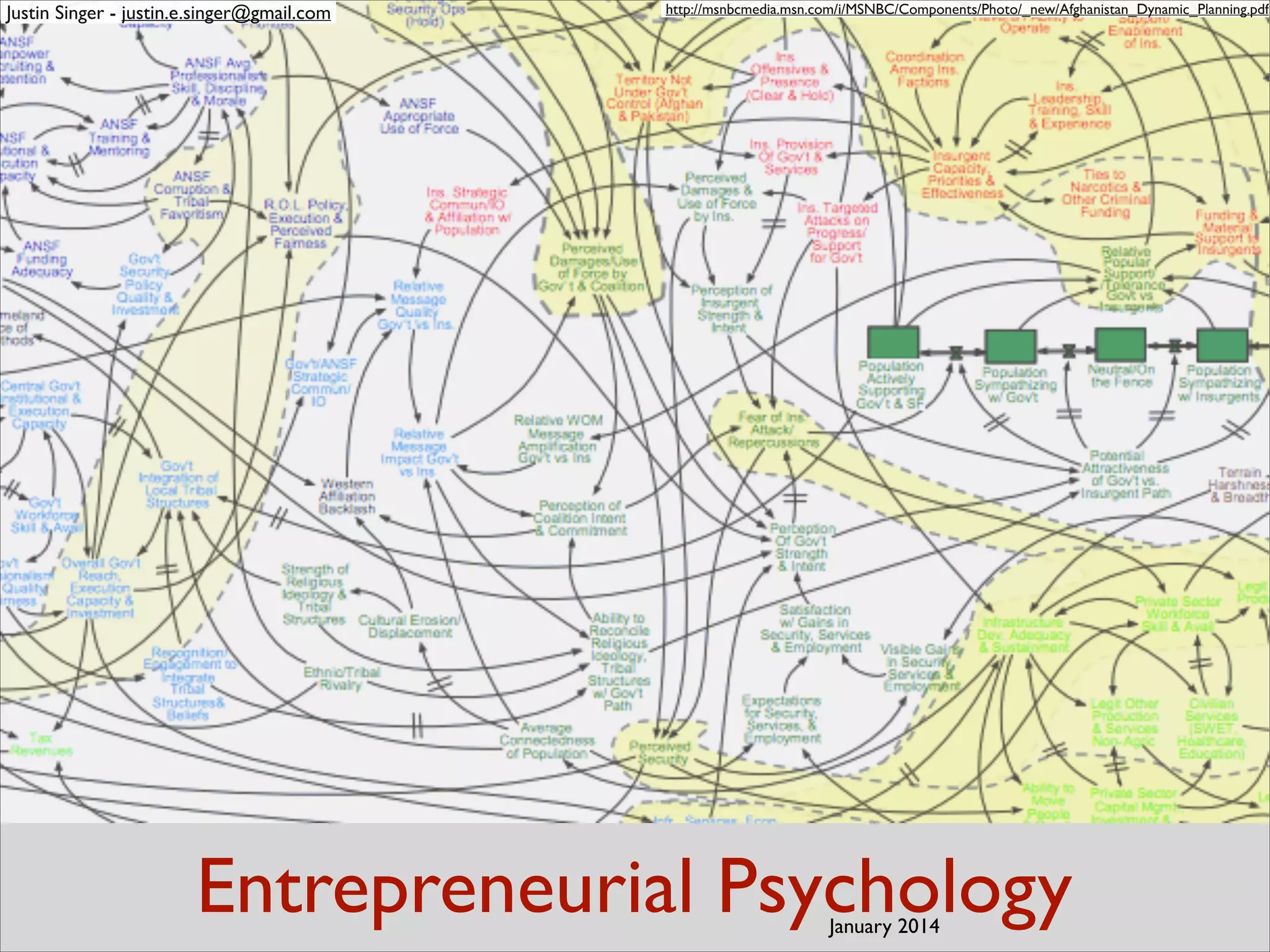
Entrepreneurial Psychology
http://msnbcmedia.msn.com/i/MSNBC/Components/Photo/_new/Afghanistan_Dynamic_Planning.pdfJustin Singer - justin.e.singer@gmail.com
January 2014
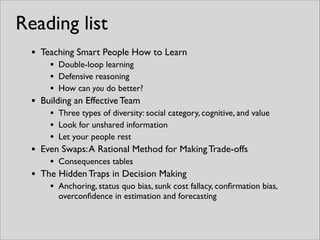
• Teaching Smart People How to Learn	

• Double-loop learning	

• Defensive reasoning	

• How can you do better?	

• Building an Effective Team	

• Three types of diversity: social category, cognitive, and value	

• Look for unshared information	

• Let your people rest	

• Even Swaps:A Rational Method for Making Trade-offs	

• Consequences tables	

• The Hidden Traps in Decision Making	

• Anchoring, status quo bias, sunk cost fallacy, confirmation bias,
overconfidence in estimation and forecasting
Reading list
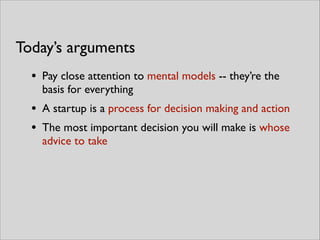
• Pay close attention to mental models -- they’re the
basis for everything	

• A startup is a process for decision making and action	

• The most important decision you will make is whose
advice to take
Today’s arguments
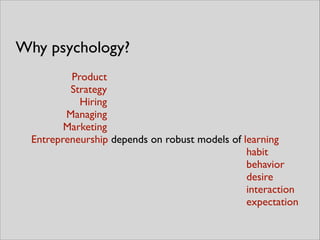
Product	

Strategy	

Hiring	

Managing	

Marketing	

Entrepreneurship depends on robust models of learning	

habit	

behavior	

desire	

interaction	

expectation
Why psychology?
Mental Models
http://friqt.com/worldchil.html
“[M]odels people have of themselves, others, the
environment, and the things with which they interact."	

- Donald A. Norman.The Design of Everyday Things (1988)
What are mental models?
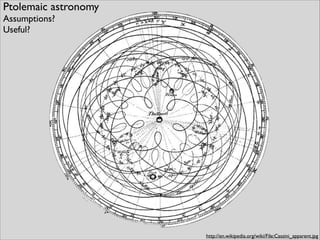
http://en.wikipedia.org/wiki/File:Cassini_apparent.jpg
Ptolemaic astronomy	

Assumptions?	

Useful?
http://www.fi.edu/wright/again/wings.avkids.com/wings.avkids.com/Book/History/instructor/jumpers-01.html
Winged flight	

Assumptions?	

Useful?
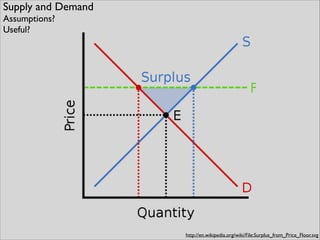
http://en.wikipedia.org/wiki/File:Surplus_from_Price_Floor.svg
Supply and Demand	

Assumptions?	

Useful?
Mental models define how we think the world works,
but not necessarily how it actually works	

- Me, just now
Mental models are necessarily personal	

If a model doesn’t work for you, build a better one	

When judging a model’s quality, focus on process, not outcome

What are mental models?
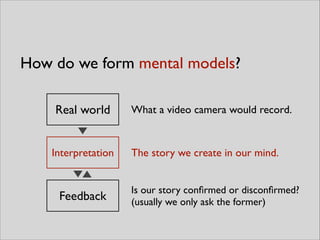
How do we form mental models?
Real world
Interpretation
Feedback
What a video camera would record.
The story we create in our mind.
Is our story confirmed or disconfirmed?
(usually we only ask the former)
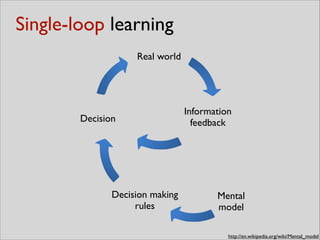
Single-loop learning
http://en.wikipedia.org/wiki/Mental_model
Real world
Decision
Information	

feedback
Mental	

model
Decision making	

rules
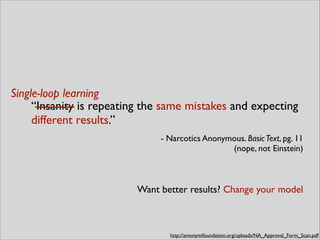
“Insanity is repeating the same mistakes and expecting
different results.”	

- Narcotics Anonymous. BasicText, pg. 11

(nope, not Einstein)
Single-loop learning
http://amonymifoundation.org/uploads/NA_Approval_Form_Scan.pdf
Want better results? Change your model
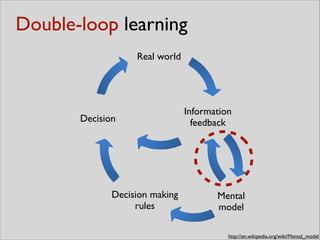
Double-loop learning
http://en.wikipedia.org/wiki/Mental_model
Real world
Decision
Information	

feedback
Mental	

model
Decision making	

rules
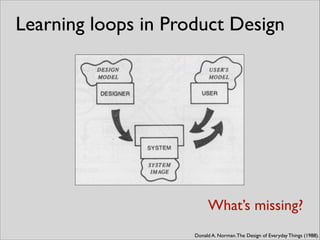
Learning loops in Product Design
Donald A. Norman.The Design of Everyday Things (1988).
What’s missing?
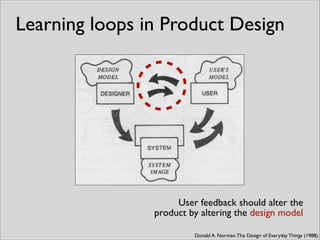
Donald A. Norman.The Design of Everyday Things (1988).
User feedback should alter the 	

product by altering the design model
Learning loops in Product Design
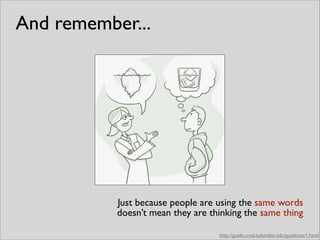
http://guide.cred.columbia.edu/guide/sec1.html
Just because people are using the same words 	

doesn’t mean they are thinking the same thing
And remember...
Strong sources of mental models
• Bayesian updating	

• Physical laws (especially movement mechanics)	

- Elasticity (springs)	

- Friction	

• Large and representative data sets (empirical
observation)	

• Careful experimentation (seeking to disconfirm)	

• Relevant analogy
• Abstract theory	

• Personal experience	

• Irrelevant analogy	

• Repeated observations (small data sets)	

• Single observation (single data point)	

• Anecdote/inductive reasoning (Malcolm Gladwell)	

• Opinion
Unfortunately, the less data we have,	

the more heavily we weight it
Weak sources of mental models
Treat your models as hypotheses
Make sure they’re testable	

Models that can’t be disproven aren’t models -- they’re beliefs	

!
Actively seek to disprove them	

Welcome disproof -- a model disproved is a lesson learned	

!
Look for hidden assumptions	

Treat secondhand data as assumptions until proven otherwise	

!
Question their predictability	

The same event may be evidence of many different hypotheses
Models don’t care about your loyalty	

If a model doesn’t work, change it
Decision
making
What does rational decision making look like?
Herbert A. Simon, Administrative Behavior
1. Complete knowledge and anticipation of the
consequences of every choice	

2. A valuation for each consequence	

3. Awareness of all possible alternatives
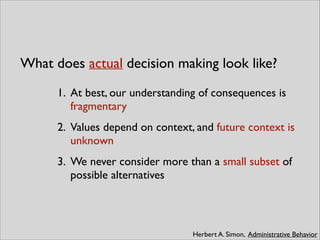
What does actual decision making look like?
Herbert A. Simon, Administrative Behavior
1. At best, our understanding of consequences is
fragmentary	

2. Values depend on context, and future context is
unknown	

3. We never consider more than a small subset of
possible alternatives
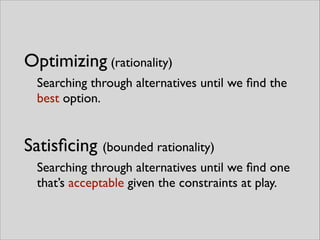
Optimizing (rationality)
Searching through alternatives until we find the
best option.
Satisficing (bounded rationality)
Searching through alternatives until we find one
that’s acceptable given the constraints at play.
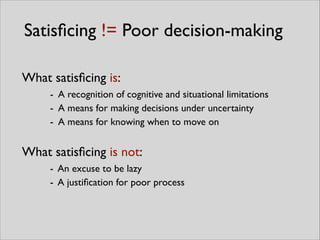
Satisficing != Poor decision-making
What satisficing is:	

- A recognition of cognitive and situational limitations	

- A means for making decisions under uncertainty	

- A means for knowing when to move on
What satisficing is not:	

- An excuse to be lazy	

- A justification for poor process
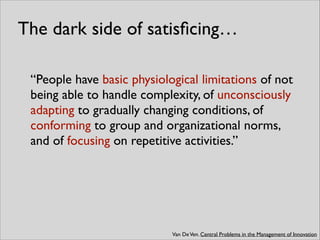
The dark side of satisficing…
“People have basic physiological limitations of not
being able to handle complexity, of unconsciously
adapting to gradually changing conditions, of
conforming to group and organizational norms,
and of focusing on repetitive activities.”
Van DeVen. Central Problems in the Management of Innovation
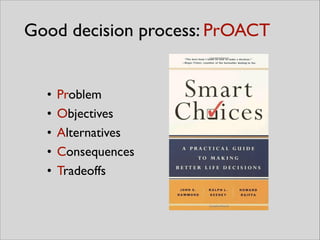
Good decision process: PrOACT
• Problem	

• Objectives	

• Alternatives	

• Consequences	

• Tradeoffs
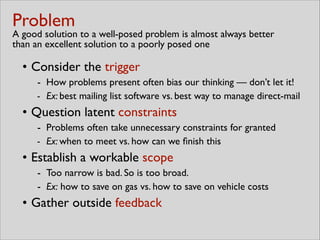
Problem

A good solution to a well-posed problem is almost always better
than an excellent solution to a poorly posed one
• Consider the trigger	

- How problems present often bias our thinking — don’t let it!	

- Ex: best mailing list software vs. best way to manage direct-mail	

• Question latent constraints 	

- Problems often take unnecessary constraints for granted	

- Ex: when to meet vs. how can we finish this	

• Establish a workable scope	

- Too narrow is bad. So is too broad.	

- Ex: how to save on gas vs. how to save on vehicle costs	

• Gather outside feedback
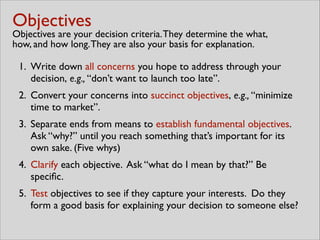
Objectives

Objectives are your decision criteria.They determine the what,
how, and how long.They are also your basis for explanation.
1. Write down all concerns you hope to address through your
decision, e.g., “don’t want to launch too late”.	

2. Convert your concerns into succinct objectives, e.g., “minimize
time to market”.	

3. Separate ends from means to establish fundamental objectives.
Ask “why?” until you reach something that’s important for its
own sake. (Five whys)	

4. Clarify each objective. Ask “what do I mean by that?” Be
specific.	

5. Test objectives to see if they capture your interests. Do they
form a good basis for explaining your decision to someone else?
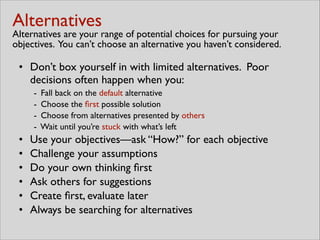
Alternatives

Alternatives are your range of potential choices for pursuing your
objectives. You can’t choose an alternative you haven’t considered.
• Don’t box yourself in with limited alternatives. Poor
decisions often happen when you:	

- Fall back on the default alternative	

- Choose the first possible solution	

- Choose from alternatives presented by others	

- Wait until you’re stuck with what’s left	

• Use your objectives—ask “How?” for each objective	

• Challenge your assumptions	

• Do your own thinking first	

• Ask others for suggestions	

• Create first, evaluate later	

• Always be searching for alternatives
Alternatives

Tailor your alternatives to your problem.
• Process alternatives. Sometimes the best choice is a
process, e.g., voting, auctions, arbitration.	

• Win-wins. Sometimes the key is to analyze someone
else’s decision problem and make sure yours gibes with it.	

• Information-gathering. Reduce uncertainties by
identifying and collecting needed information.	

• Time-buying. Deferring a decision is a decision.
Consequences & Tradeoffs

Be sure you understand the consequences of each choice. Once
you do, the decision may well be obvious. If not, make even swaps.
• Describe consequences with appropriate accuracy,
completeness, and precision.	

• Build a consequences table.	

• Make even swaps. (READINGS!!!)
“The fox knows many things;
the hedgehog one great thing.”	

- Archilochus
http://www.etsy.com/listing/60007735/woodland-animal-pair-hedgehog-and-fox
Expert Prediction
Every feature	

suggestion	

opinion	

piece of advice is a prediction
What does this have to do with startups?
Who should you listen to?	

How much credence should you give?
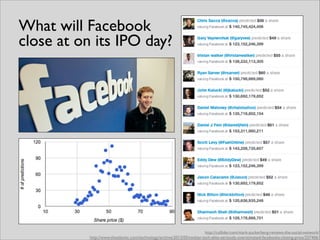
http://www.theatlantic.com/technology/archive/2012/05/twitter-tech-elite-seriously-overstimated-facebooks-closing-price/257406/
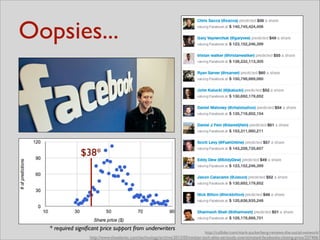
What will Facebook
close at on its IPO day?
http://collider.com/mark-zuckerberg-reviews-the-social-network/
http://www.theatlantic.com/technology/archive/2012/05/twitter-tech-elite-seriously-overstimated-facebooks-closing-price/257406/
Oopsies...
http://collider.com/mark-zuckerberg-reviews-the-social-network/
* required significant price support from underwriters
$38*
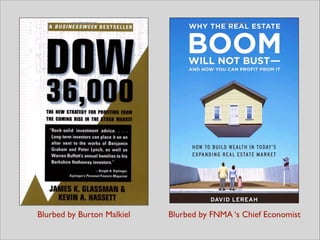
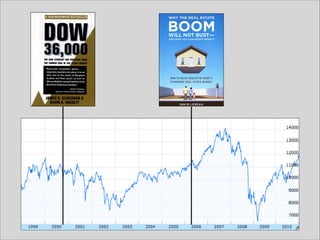
Blurbed by Burton Malkiel Blurbed by FNMA ‘s Chief Economist
"Freddie Mac and Fannie Mae are fundamentally sound.They're not in
danger of going under…I think they are in good shape going
forward." 	

- Barney Frank (D-Mass.) House Fin. Svcs. Comm. chairman, July 14, 2008
Placed into conservatorship in September
"I think you'll see [oil prices at] $150 a barrel by the end of the year" 	

- T. Boone Pickens, May 20, 2008
$100/bbl in May - $135/bbl in July - $38/bbl in November
“The subscription model of buying music is bankrupt. I think you
could make available the Second Coming in a subscription model and
it might not be successful.”	

- Steve Jobs, Rolling Stone, Dec. 3, 2003
Spotify and Rdio would beg to differ
Why?
These are very, very smart people who
were very, very wrong.
http://www.stratabridge.com/2011/08/putting-the-t-into-leadership/t-shaped/
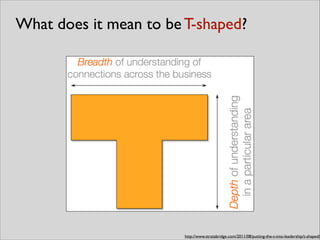
What does it mean to be T-shaped?
Fox-Experts Hedgehog-Experts
Fox-Dilettantes Hedgehog-Dilettantes
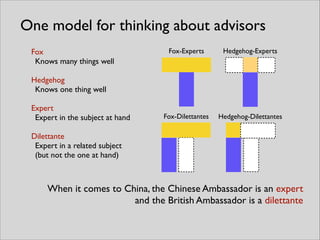
One model for thinking about advisors
Fox	

Knows many things well	

!
Hedgehog	

Knows one thing well	

!
Expert	

Expert in the subject at hand	

!
Dilettante	

Expert in a related subject
(but not the one at hand)
When it comes to China, the Chinese Ambassador is an expert	

and the British Ambassador is a dilettante
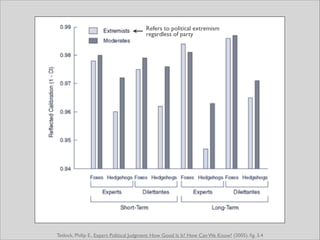
Tetlock, Philip E., Expert Political Judgment: How Good Is It? How Can We Know? (2005), fig. 3.4
Refers to political extremism
regardless of party
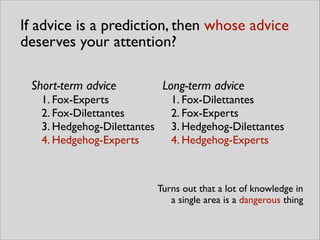
If advice is a prediction, then whose advice
deserves your attention?
Turns out that a lot of knowledge in 	

a single area is a dangerous thing
Short-term advice	

1. Fox-Experts	

2. Fox-Dilettantes	

3. Hedgehog-Dilettantes	

4. Hedgehog-Experts
Long-term advice	

1. Fox-Dilettantes	

2. Fox-Experts	

3. Hedgehog-Dilettantes	

4. Hedgehog-Experts
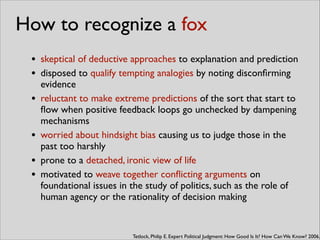
How to recognize a fox
• skeptical of deductive approaches to explanation and prediction 	

• disposed to qualify tempting analogies by noting disconfirming
evidence	

• reluctant to make extreme predictions of the sort that start to
flow when positive feedback loops go unchecked by dampening
mechanisms 	

• worried about hindsight bias causing us to judge those in the
past too harshly	

• prone to a detached, ironic view of life	

• motivated to weave together conflicting arguments on
foundational issues in the study of politics, such as the role of
human agency or the rationality of decision making
Tetlock, Philip E. Expert Political Judgment: How Good Is It? How Can We Know? 2006.
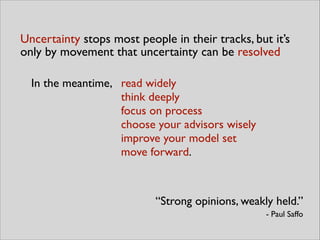
Uncertainty stops most people in their tracks, but it’s
only by movement that uncertainty can be resolved
“Strong opinions, weakly held.”	

- Paul Saffo
In the meantime, read widely	

think deeply	

focus on process	

choose your advisors wisely	

improve your model set	

move forward.
Osterwalder, pgs. 1-119	

Case study (will be posted on CW soon)
Readings for next week

Entrepreneurial Psychology

  • 1.
  • 2.
    • Teaching SmartPeople How to Learn • Double-loop learning • Defensive reasoning • How can you do better? • Building an Effective Team • Three types of diversity: social category, cognitive, and value • Look for unshared information • Let your people rest • Even Swaps:A Rational Method for Making Trade-offs • Consequences tables • The Hidden Traps in Decision Making • Anchoring, status quo bias, sunk cost fallacy, confirmation bias, overconfidence in estimation and forecasting Reading list
  • 3.
    • Pay closeattention to mental models -- they’re the basis for everything • A startup is a process for decision making and action • The most important decision you will make is whose advice to take Today’s arguments
  • 4.
    Product Strategy Hiring Managing Marketing Entrepreneurship depends onrobust models of learning habit behavior desire interaction expectation Why psychology?
  • 5.
  • 6.
    “[M]odels people haveof themselves, others, the environment, and the things with which they interact." - Donald A. Norman.The Design of Everyday Things (1988) What are mental models?
  • 7.
  • 8.
  • 9.
  • 10.
    Mental models definehow we think the world works, but not necessarily how it actually works - Me, just now Mental models are necessarily personal If a model doesn’t work for you, build a better one When judging a model’s quality, focus on process, not outcome
 What are mental models?
  • 11.
    How do weform mental models? Real world Interpretation Feedback What a video camera would record. The story we create in our mind. Is our story confirmed or disconfirmed? (usually we only ask the former)
  • 12.
  • 13.
    “Insanity is repeatingthe same mistakes and expecting different results.” - Narcotics Anonymous. BasicText, pg. 11
 (nope, not Einstein) Single-loop learning http://amonymifoundation.org/uploads/NA_Approval_Form_Scan.pdf Want better results? Change your model
  • 14.
  • 15.
    Learning loops inProduct Design Donald A. Norman.The Design of Everyday Things (1988). What’s missing?
  • 16.
    Donald A. Norman.TheDesign of Everyday Things (1988). User feedback should alter the product by altering the design model Learning loops in Product Design
  • 17.
    http://guide.cred.columbia.edu/guide/sec1.html Just because peopleare using the same words doesn’t mean they are thinking the same thing And remember...
  • 18.
    Strong sources ofmental models • Bayesian updating • Physical laws (especially movement mechanics) - Elasticity (springs) - Friction • Large and representative data sets (empirical observation) • Careful experimentation (seeking to disconfirm) • Relevant analogy
  • 19.
    • Abstract theory •Personal experience • Irrelevant analogy • Repeated observations (small data sets) • Single observation (single data point) • Anecdote/inductive reasoning (Malcolm Gladwell) • Opinion Unfortunately, the less data we have, the more heavily we weight it Weak sources of mental models
  • 20.
    Treat your modelsas hypotheses Make sure they’re testable Models that can’t be disproven aren’t models -- they’re beliefs ! Actively seek to disprove them Welcome disproof -- a model disproved is a lesson learned ! Look for hidden assumptions Treat secondhand data as assumptions until proven otherwise ! Question their predictability The same event may be evidence of many different hypotheses Models don’t care about your loyalty If a model doesn’t work, change it
  • 21.
  • 22.
    What does rationaldecision making look like? Herbert A. Simon, Administrative Behavior 1. Complete knowledge and anticipation of the consequences of every choice 2. A valuation for each consequence 3. Awareness of all possible alternatives
  • 23.
    What does actualdecision making look like? Herbert A. Simon, Administrative Behavior 1. At best, our understanding of consequences is fragmentary 2. Values depend on context, and future context is unknown 3. We never consider more than a small subset of possible alternatives
  • 24.
    Optimizing (rationality) Searching throughalternatives until we find the best option. Satisficing (bounded rationality) Searching through alternatives until we find one that’s acceptable given the constraints at play.
  • 25.
    Satisficing != Poordecision-making What satisficing is: - A recognition of cognitive and situational limitations - A means for making decisions under uncertainty - A means for knowing when to move on What satisficing is not: - An excuse to be lazy - A justification for poor process
  • 26.
    The dark sideof satisficing… “People have basic physiological limitations of not being able to handle complexity, of unconsciously adapting to gradually changing conditions, of conforming to group and organizational norms, and of focusing on repetitive activities.” Van DeVen. Central Problems in the Management of Innovation
  • 27.
    Good decision process:PrOACT • Problem • Objectives • Alternatives • Consequences • Tradeoffs
  • 28.
    Problem
 A good solutionto a well-posed problem is almost always better than an excellent solution to a poorly posed one • Consider the trigger - How problems present often bias our thinking — don’t let it! - Ex: best mailing list software vs. best way to manage direct-mail • Question latent constraints - Problems often take unnecessary constraints for granted - Ex: when to meet vs. how can we finish this • Establish a workable scope - Too narrow is bad. So is too broad. - Ex: how to save on gas vs. how to save on vehicle costs • Gather outside feedback
  • 29.
    Objectives
 Objectives are yourdecision criteria.They determine the what, how, and how long.They are also your basis for explanation. 1. Write down all concerns you hope to address through your decision, e.g., “don’t want to launch too late”. 2. Convert your concerns into succinct objectives, e.g., “minimize time to market”. 3. Separate ends from means to establish fundamental objectives. Ask “why?” until you reach something that’s important for its own sake. (Five whys) 4. Clarify each objective. Ask “what do I mean by that?” Be specific. 5. Test objectives to see if they capture your interests. Do they form a good basis for explaining your decision to someone else?
  • 30.
    Alternatives
 Alternatives are yourrange of potential choices for pursuing your objectives. You can’t choose an alternative you haven’t considered. • Don’t box yourself in with limited alternatives. Poor decisions often happen when you: - Fall back on the default alternative - Choose the first possible solution - Choose from alternatives presented by others - Wait until you’re stuck with what’s left • Use your objectives—ask “How?” for each objective • Challenge your assumptions • Do your own thinking first • Ask others for suggestions • Create first, evaluate later • Always be searching for alternatives
  • 31.
    Alternatives
 Tailor your alternativesto your problem. • Process alternatives. Sometimes the best choice is a process, e.g., voting, auctions, arbitration. • Win-wins. Sometimes the key is to analyze someone else’s decision problem and make sure yours gibes with it. • Information-gathering. Reduce uncertainties by identifying and collecting needed information. • Time-buying. Deferring a decision is a decision.
  • 32.
    Consequences & Tradeoffs
 Besure you understand the consequences of each choice. Once you do, the decision may well be obvious. If not, make even swaps. • Describe consequences with appropriate accuracy, completeness, and precision. • Build a consequences table. • Make even swaps. (READINGS!!!)
  • 33.
    “The fox knowsmany things; the hedgehog one great thing.” - Archilochus http://www.etsy.com/listing/60007735/woodland-animal-pair-hedgehog-and-fox Expert Prediction
  • 34.
    Every feature suggestion opinion piece ofadvice is a prediction What does this have to do with startups? Who should you listen to? How much credence should you give?
  • 35.
  • 36.
  • 37.
    Blurbed by BurtonMalkiel Blurbed by FNMA ‘s Chief Economist
  • 39.
    "Freddie Mac andFannie Mae are fundamentally sound.They're not in danger of going under…I think they are in good shape going forward." - Barney Frank (D-Mass.) House Fin. Svcs. Comm. chairman, July 14, 2008 Placed into conservatorship in September "I think you'll see [oil prices at] $150 a barrel by the end of the year" - T. Boone Pickens, May 20, 2008 $100/bbl in May - $135/bbl in July - $38/bbl in November “The subscription model of buying music is bankrupt. I think you could make available the Second Coming in a subscription model and it might not be successful.” - Steve Jobs, Rolling Stone, Dec. 3, 2003 Spotify and Rdio would beg to differ
  • 40.
    Why? These are very,very smart people who were very, very wrong.
  • 41.
  • 42.
    Fox-Experts Hedgehog-Experts Fox-Dilettantes Hedgehog-Dilettantes Onemodel for thinking about advisors Fox Knows many things well ! Hedgehog Knows one thing well ! Expert Expert in the subject at hand ! Dilettante Expert in a related subject (but not the one at hand) When it comes to China, the Chinese Ambassador is an expert and the British Ambassador is a dilettante
  • 43.
    Tetlock, Philip E.,Expert Political Judgment: How Good Is It? How Can We Know? (2005), fig. 3.4 Refers to political extremism regardless of party
  • 44.
    If advice isa prediction, then whose advice deserves your attention? Turns out that a lot of knowledge in a single area is a dangerous thing Short-term advice 1. Fox-Experts 2. Fox-Dilettantes 3. Hedgehog-Dilettantes 4. Hedgehog-Experts Long-term advice 1. Fox-Dilettantes 2. Fox-Experts 3. Hedgehog-Dilettantes 4. Hedgehog-Experts
  • 45.
    How to recognizea fox • skeptical of deductive approaches to explanation and prediction • disposed to qualify tempting analogies by noting disconfirming evidence • reluctant to make extreme predictions of the sort that start to flow when positive feedback loops go unchecked by dampening mechanisms • worried about hindsight bias causing us to judge those in the past too harshly • prone to a detached, ironic view of life • motivated to weave together conflicting arguments on foundational issues in the study of politics, such as the role of human agency or the rationality of decision making Tetlock, Philip E. Expert Political Judgment: How Good Is It? How Can We Know? 2006.
  • 46.
    Uncertainty stops mostpeople in their tracks, but it’s only by movement that uncertainty can be resolved “Strong opinions, weakly held.” - Paul Saffo In the meantime, read widely think deeply focus on process choose your advisors wisely improve your model set move forward.
  • 47.
    Osterwalder, pgs. 1-119 Casestudy (will be posted on CW soon) Readings for next week